Have you ever wondered why some web pages always appear at the top of Google while others never make it past page two? The secret behind this is something called authority.
Authority is one of the most important ideas in SEO. It tells search engines how strong and trustworthy a webpage is. The stronger the authority of a page, the higher it can rank in Google search results.
For a long time, Google had its own system called PageRank that helped SEOs measure how powerful a page was. It was reliable, widely used, and trusted by everyone in the industry. Then in 2016, Google stopped showing PageRank scores to the public. SEOs suddenly had no clear way to measure the strength of an individual page.
Moz stepped in and created Page Authority to solve this problem. If you are new to SEO, understanding what is page authority and how it works can completely change the way you approach your website. It is a simple score that shows how competitive a single webpage is based on the backlinks pointing to it.
We know you want to learn how page authority works, what the score means, and how to improve it to reach better positions in Google. This guide covers all of that in plain and simple language.
Let’s get started.
What Is Page Authority in SEO?

Page Authority is a score that predicts how well a single page on your website can rank in Google search results. It was created by a company called Moz. The score goes from 1 to 100. A higher number means the page is stronger and more likely to rank well.
This score exists for a simple reason. Google used to share a public score called PageRank. It showed how much trust and authority a page had earned. Google stopped sharing that score publicly in 2016. After that, SEOs had no easy way to measure how strong a page was. Moz created Page Authority to fill that gap.
Moz was the first to build this kind of score. But other SEO tools followed.Ahrefs has its own version called URL Rating (UR). The names are different but the idea is the same. All of them try to measure the strength of one single page. Many SEOs use these scores side by side, even though each tool measures them in a slightly different way.
Think of your website like a house. Every room in that house is one page on your site. Page Authority measures how strong and valuable one specific room is. Not the whole house. Just that one room. A bright bedroom with good furniture and a great view scores high. A dusty storage room with nothing useful in it scores low.
One important thing to know. Google does not use Page Authority as a direct ranking factor. But pages with high PA tend to rank well because strong pages usually have strong backlinks. That is why PA is useful. It helps you compare pages, spot weak ones, and decide where to focus your efforts.
How Is Page Authority Scored?

Page Authority is measured on a scale from 1 to 100. The scoring system is logarithmic, which simply means the higher your score gets, the harder it becomes to improve it. For example, going from 20 to 30 is far easier than going from 60 to 70. Most pages on the web fall below 40. A score above 60 is strong. Moz regularly updates how PA is calculated, so your score may shift slightly over time even without any changes on your end.
To calculate this score, Moz collects data from the Mozscape web index. Think of this as Moz’s own version of Google’s web crawler. It visits pages across the internet, collects information about links and content, and builds a map of what appears in search results.
That data is then fed into a machine learning model trained on thousands of real Google search results. The model studied which pages ranked well and identified the patterns behind their success. PA is the output of that process. It is not a perfect copy of Google’s algorithm, but it is Moz’s best attempt to predict which pages Google will reward in search.
To make the score even more reliable, Moz released an update called PA 2.0. This added Spam Score signals to catch low quality links and link pattern analysis to spot unnatural linking behaviour. Both changes made PA harder to manipulate and more useful in practice.
What Goes Into a Page Authority Score?
Moz does not share the exact formula. But the key signals behind the score are well known. Here is what drives the number:
- Backlinks. The more high quality pages that link to your page, the stronger your PA becomes. One link from a trusted and well known site is worth far more than fifty links from weak or unrelated sites.
- Unique referring domains. Getting links from 30 different websites is much stronger than getting 30 links from the same one site. The more varied your link sources, the better.
- MozRank. This measures how popular your page is based on the number of pages linking to it and how strong those pages are.
- MozTrust. This measures how closely your page is connected to highly trusted sites such as government or university websites. A closer connection means a stronger trust signal.
- Machine learning model. Moz trained this system using thousands of real search results. It identifies the link patterns behind pages that rank well and uses those patterns to score other pages.
What Is a Good Page Authority Score?
A good Page Authority score is one that is higher than the pages already ranking for your target keyword. That is the only definition that matters. PA is a relative metric, which means a score of 30 can be strong in one niche and weak in another.
To give you a starting point, here is a rough guide to what each score range means in practice:
- 1 to 20. New or very weak pages with little to no backlinks. Every single page on the internet starts at this level. This is completely normal and nothing to worry about.
- 20 to 40. Pages that are starting to pick up links and build some strength. Still in the early stages but moving in the right direction.
- 40 to 60. Established pages with a solid link profile. These pages can compete in many niches and rank for moderately difficult keywords.
- 60 and above. Strong and well linked pages. These usually belong to sites that have been earning backlinks consistently for years.
These ranges give you a general idea of where pages stand. But they do not tell you whether your specific page is strong enough to rank. Only your competition can tell you that.
Why is my Page Authority so low? This is one of the most common questions from people who are new to SEO. The honest answer is simple. A low PA is completely normal for any new page. PA does not improve overnight. It grows slowly as you earn more quality backlinks over time. If your site is new, a score between 1 and 20 is exactly where you should be. Do not let it discourage you from moving forward.
The right way to find your target score is straightforward. Go to Moz Link Explorer and look up the PA scores of the top 5 pages already ranking for your keyword. Those numbers are your real benchmark. For example, if you want to rank for “best email marketing tools” and the top 5 pages have PA scores between 35 and 50, then reaching that range is your actual goal. You do not need a PA of 80 to compete with pages that sit at 40.
The biggest mistake people make is chasing a high PA number without checking their competition first. Your only goal is to close the gap between your score and the pages already ranking above you. That is the target that actually moves the needle.
Page Authority vs Domain Authority: Key Differences

Domain Authority (DA) and Page Authority (PA) are both Moz metrics that predict how well a page or site can rank in search results. They both use a scale from 1 to 100. The key difference is simple. DA measures the strength of your entire website. PA measures the strength of just one page on that website.
Key Differences Between PA and DA
- Scope. DA looks at your entire website as a whole. PA looks at one single page on your site. Think of DA as the overall health of your body and PA as the health of one specific organ.
- Purpose. DA tells you how likely your whole site is to rank well across many different searches. PA tells you how likely one specific page is to rank well for its own target keyword.
- Fluctuation. DA is slow to change because it reflects years of link building across your whole domain. PA can improve faster because you only need to earn links pointing to one specific page.
- Relationship. A site with a high DA can still have pages with very low PA if those pages have no backlinks. And a site with a low DA can have one strong page if that page has earned good quality links directly to it.
At a Glance Comparison
| Feature | Domain Authority (DA) | Page Authority (PA) |
| Scope | Entire website | Single page |
| Focus | Overall site credibility | Specific page performance |
| Growth Speed | Slow, long term | Faster, short term |
| Improvement | High quality backlinks, branding | On page SEO, internal links |
When to Use PA and When to Use DA
Knowing the difference is useful. Knowing when to use each one is even more useful.
Use Page Authority when you are making decisions about a specific page. For example, if you are deciding which page on another site to get a backlink from, always check the PA of that exact page first. A link from a page with PA 45 is worth far more than a link from a page with PA 10, even if both pages sit on the same domain.
Use Domain Authority when you are evaluating an entire website. If you want to know whether a site is worth targeting for link building, guest posting, or any kind of partnership, DA gives you a fast and reliable read on how strong and trustworthy that domain is as a whole.
In most cases, the smartest move is to check both. A link from a high DA site on a high PA page is the strongest combination you can get. A link from a low DA site on a low PA page adds very little value to your SEO efforts.
Is Page Authority a Google Ranking Factor?

No. Page Authority is not a Google ranking factor. PA is a metric that Moz created on its own. Google had no involvement in building it and does not use it when deciding which pages to show in search results.
This is not an assumption. Both John Mueller and Gary Illyes from Google’s Search team have said publicly that Google does not use Domain Authority or Page Authority in its ranking system. These are third party metrics that exist completely outside of how Google works.
Correlation vs Causation
Many people see that high PA pages rank well in Google and assume PA is the reason. It is not. Here is what is actually happening.
Both PA and Google rankings respond to the same thing. Quality backlinks. When a page earns strong backlinks, its PA score goes up. Those same backlinks also help the page rank better in Google. So PA and rankings improve at the same time, but the backlinks are doing the real work. PA is just measuring the same signal in a different way.
PA goes up with rankings. But PA is not what causes the rankings.
What Google Actually Uses
Google has its own internal link based system called PageRank. This is the original system Google was built on. Google stopped making PageRank scores public in 2016 but still uses it privately as a ranking signal today.
Moz created Page Authority to replace the public PageRank score that disappeared. PA is not an exact copy of PageRank but it measures similar things. That is why PA scores and Google rankings often move in the same direction even though Google plays no part in calculating PA.
Why PA Is Still Worth Tracking
Google does not use PA but that does not mean PA is useless. It is still a practical tool for making everyday SEO decisions.
- It helps you quickly compare the strength of different pages when choosing where to get backlinks from.
- It shows you which pages on your own site are weak and need more links or better internal linking.
- It helps you track whether your link building efforts are working by showing score changes over time.
- It helps you avoid spending time on low quality sites that would bring little to no SEO value.
How Links Pass Authority From Page to Page

Links pass authority, often called link equity or link juice, by acting as votes of confidence from one page to another. When a high authority page links to another page, it shares some of its own strength with that page. This process works through both external backlinks and internal links, and it is the core mechanism behind how Page Authority in SEO is built and grown over time.
Authority moves between pages in two ways:
- External backlinks bring authority into your site from other websites.
- Internal links move that authority between pages within your own site.
How External Backlinks Pass Authority to Your Page
When another website links to your page, it sends some of its own authority your way. Think of it like a vote of confidence. The more trusted and powerful the page giving you that vote, the more your Page Authority benefits from it.
One strong link from a high PA page on a well known site will do more for your score than ten links from pages that nobody trusts. Always focus on getting links from pages that are already strong and relevant to your topic.
How Internal Links Spread Authority Across Your Site
Once authority enters your site through backlinks, internal links decide where it goes next. When a strong page on your site links to a weaker page, it passes some of its authority to that page.
Your homepage and your most popular articles usually carry the most authority. Linking from those pages to the pages you want to rank is one of the simplest and most overlooked ways to improve Page Authority without building a single new backlink.
What About Nofollow Links?
Not every link passes authority. A nofollow link has a small tag attached to it that tells search engines to ignore it when passing link equity. These links do not help build Page Authority.
Nofollow links are common on social media pages, blog comment sections, and many news websites. They can still bring visitors to your page but they do not move your PA score. When your goal is to grow Page Authority, always focus on earning followed links from pages that are trusted and relevant to your niche.
How to Check Your Page Authority Score

Checking your Page Authority is simple and takes just a few seconds with the right tool. The most direct way is to use Moz Link Explorer. Just enter any URL into the search bar and it will show you the PA score for that page along with linking domains, inbound links, and Spam Score. Moz gives you a limited number of free searches every month, which is more than enough if you are checking occasionally.
You can also install the MozBar Chrome extension for a faster way to check. It shows PA and DA scores directly on the search results page as you browse. This means you can check your own pages and competitor pages at the same time without opening any separate tool. It is completely free to install.
One thing many beginners get wrong. Google Search Console does not show Page Authority. Search Console is a Google tool that tracks clicks, impressions, and keyword rankings. PA is a Moz metric and it only appears in Moz tools or other third party SEO platforms. If you have been looking for PA inside Search Console, that is why you cannot find it.
You do not need to check PA every day. Once a month is enough. PA moves slowly and checking it too often will not show you anything useful.
Ahrefs, Semrush, and Other Tools You Can Use Instead
If you do not use Moz, other SEO tools have their own versions of page level authority.Ahrefs calls it URL Rating (UR) and measures page strength based purely on backlinks.Semrush calls it Authority Score and combines backlinks, organic traffic, and spam signals to give a broader picture of page strength.
If you need to check multiple pages at once,Moz Link Explorer has a bulk analysis feature. You can upload a list of URLs and get PA scores for all of them in one go. This saves a lot of time when you are auditing a large site or comparing multiple link building prospects.
One rule that applies to all of these tools. Never compare scores across different platforms. A PA of 40 in Moz does not mean the same thing as a UR of 40 in Ahrefs or an Authority Score of 40 in Semrush. Every tool uses its own data and its own way of calculating the score. Pick one tool, stick with it, and track your progress consistently inside that platform.
Why Does Your Page Authority Score Change?

If your Page Authority score dropped and you have not done anything wrong, you are not alone. This is one of the most common frustrations for site owners. The reason it happens is simpler than most people think.
PA is not measured in isolation. It is calculated relative to the entire web. This means your score can go down even if nothing changed on your site. If other websites around you are gaining strong new backlinks, the overall scale shifts and your relative position drops. A lower score does not always mean something went wrong. It sometimes just means others moved ahead of you.
The Most Common Reasons PA Changes
Moz index updates. Moz regularly recrawls the web and updates the data it uses to calculate scores. When this happens, PA scores shift across the board for millions of pages at the same time. This is not targeted at your site. It affects everyone.
PA 2.0 model updates. When Moz makes changes to its scoring model, scores can drop or rise suddenly across the web. If your score changed sharply around the time of a known Moz update, the model is the most likely cause and not anything you did.
Link rot. Backlinks do not last forever. Pages that link to you can get deleted, taken offline, or redesigned without the link. When those links disappear, your PA drops gradually over time. This is completely natural and happens to every site.
Competitor link gains. Because PA is a relative metric, your score can fall simply because a competitor earned strong new backlinks and moved ahead of you on the scale. Your link profile did not get weaker. Theirs just got stronger.
Site migrations. Moving to a new domain or changing your URL structure can cause PA drops if 301 redirects are not set up correctly. Every old URL needs a direct redirect to the new one. Missing or chained redirects leak authority and push your score down.
What to Do If Your PA Dropped Unexpectedly
Do not panic over one score drop. Work through these three checks first:
- Check for lost backlinks. Use Moz Link Explorer or Ahrefs to see if any referring domains have recently stopped linking to your page.
- Check for Moz updates. Look for recent Moz announcements to see if a system wide index or model update happened around the time your score changed.
- Compare with your competitors. If their scores dropped at the same time as yours, a Moz update is almost certainly the cause rather than a problem with your site specifically.
A single PA drop is rarely a crisis. Keep earning quality backlinks, fix any broken redirects, and maintain a clean link profile. Your score will recover and grow as that work adds up over time.
How to Improve Page Authority
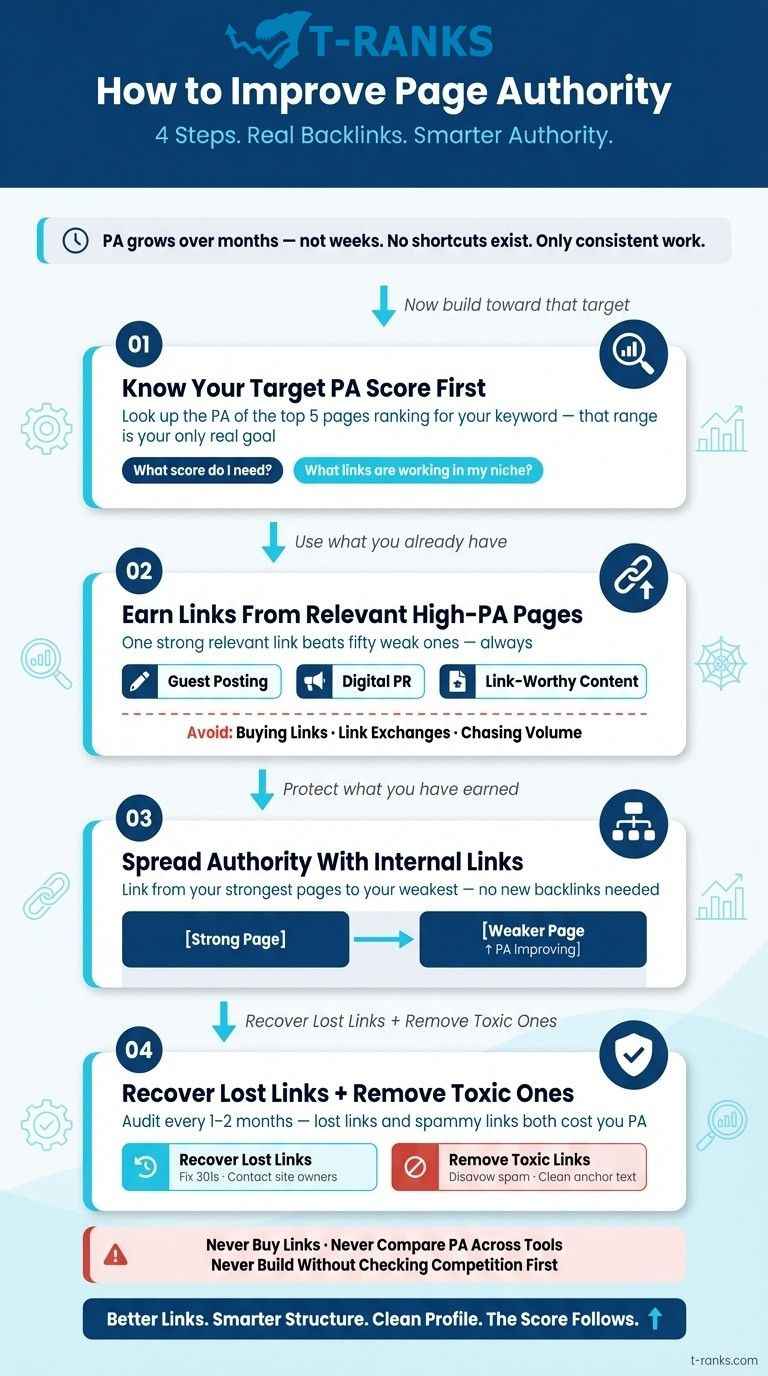
Improving Page Authority takes time. There are no shortcuts and no quick fixes. PA is built on real backlinks from real pages, and earning those links takes consistent work over several months. The sooner you accept that, the better your strategy will be.
Improving PA comes down to four things. Knowing what score you actually need to compete. Earning new links from strong and relevant pages. Moving the authority you already have to the right pages on your site. And protecting your link profile from links that do more harm than good.
Know Your Target Score Before You Start
Before you do anything else, find out what PA score you actually need. Open Moz Link Explorer and look up the top 5 pages already ranking for your target keyword. Check their PA scores, how many referring domains they have, and what types of sites are linking to them.
This research answers two important questions. What score do you need to be competitive? And what link building approach is already working in your niche? Without this step you are building links without a real target to aim for.
Build Quality Backlinks From Relevant Pages
Once you know your target score, the next step is earning the right links. The most effective way to improve PA is to get backlinks from pages that are strong and relevant to your topic. One link from a high PA page in your niche will do more for your score than fifty links from weak or unrelated sites.
Relevance matters just as much as PA score. A link from a page covering a closely related topic sends a stronger signal than a link from a high PA page on a completely different subject. Here are the tactics that work best:
- Guest posting. Write useful and original content for trusted sites in your niche. In return you earn a followed link back to your page.
- Digital PR. Publish original research, data, or unique insights that journalists and bloggers in your industry want to reference and link to.
- Content that earns links on its own. In depth guides, original studies, and practical tools attract links naturally. If your content covers a topic better than anything else out there, other pages will link to it without you having to ask.
What to avoid: buying links from low quality directories, link exchanges with unrelated sites, and any approach that chases more links rather than better ones.
Use Internal Links to Spread Authority Across Your Site
While you are building new links from outside your site, do not overlook the authority that is already sitting inside it. Your strongest pages are holding link equity that could be helping your weaker pages right now.
Start by finding your highest PA pages using Moz Link Explorer. Add internal links from those pages to the pages you want to improve. This moves existing authority to where it is needed without requiring a single new backlink from outside. Go back through your existing pages regularly and look for opportunities to connect strong pages to weaker ones that need more support.
Find and Recover Backlinks You Have Lost
As you build new links and distribute authority internally, it is equally important to protect what you have already earned. Backlinks disappear over time. Pages get deleted, sites get redesigned, and links quietly vanish. Every lost backlink is a small drop in PA that could have been recovered.
Use Moz Link Explorer or Ahrefs to find backlinks that have disappeared from your pages. Once you find them here is what to do:
- Contact the site owner. Let them know the link is broken and ask them to restore or update it.
- Set up 301 redirects. If any of your URLs have changed, make sure every old URL redirects directly to the new one. A missing redirect means that backlink’s authority is completely lost.
- Check for lost backlinks every one to two months. Make this a regular part of your SEO routine so small losses do not build up into a bigger problem.
Remove or Disavow Toxic Backlinks
The final step is cleaning up the links that are working against you. Not every backlink helps your Page Authority. Links from spammy, low quality, or completely unrelated sites can raise your Spam Score and cancel out the benefit of your good links.
Use Moz Link Explorer or Ahrefs to audit your full backlink profile. Look for links with strange anchor text, links from completely unrelated industries, or links from sites with unusually high Spam Scores. If you cannot get a bad link removed by contacting the site owner, use Google’s Disavow Tool to tell Google to ignore it.
Cleaning your link profile protects your overall SEO health and makes sure your good links are doing the work they should be doing.
How to Use Page Authority in Your SEO Strategy
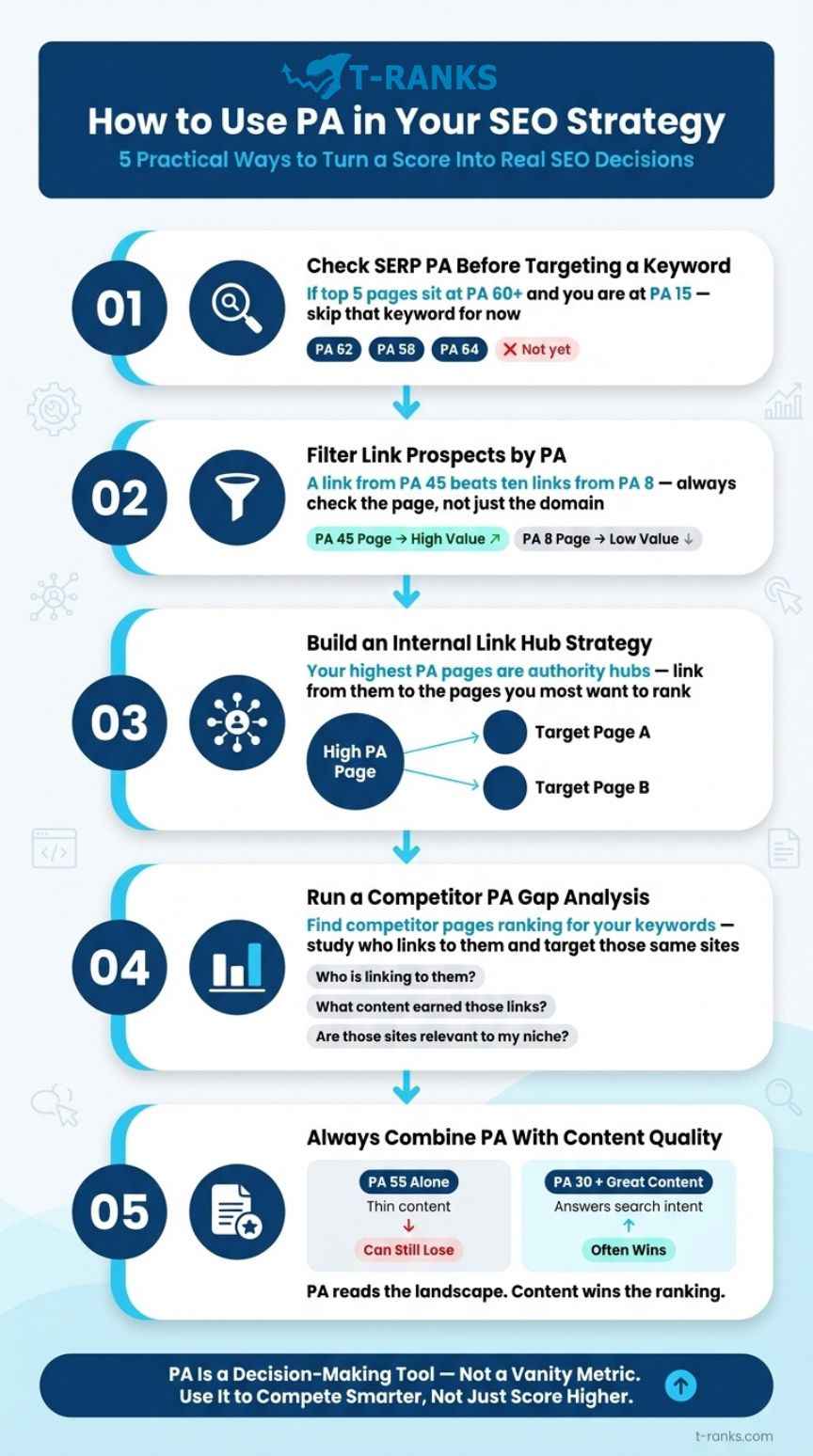
Most people check their PA score and stop there. But PA becomes a genuinely powerful tool when you use it to make real decisions in your day to day SEO work. Here is exactly how to put it to use.
Evaluate SERP Competition Before Targeting a Keyword
Before you decide to go after a keyword, check the PA of the pages already ranking for it. Open Moz Link Explorer and look up the top 5 results for your target keyword. If those pages have PA scores of 60 and above and your page sits at 15, that keyword is going to be very difficult to compete for right now.
This simple check saves you from spending months creating content for keywords you are not yet strong enough to rank for. Start with keywords where the ranking pages have PA scores closer to your own. Win those first. Then go after harder terms as your own PA grows.
Use PA to Filter and Prioritise Link Prospects
Not every backlink opportunity is worth your time. PA helps you decide quickly which ones are. When building a list of sites to approach for guest posts, digital PR, or link outreach, always check the PA of the specific page where your link would appear.
A link from a page with PA 45 is worth far more than a link from a page with PA 8, even if both sites look similar from the outside. Use PA as a quick filter to rank your outreach list by value. Spend your time and energy on the opportunities that will actually make a difference to your score.
Build an Internal Link Strategy Around Your Authority Hubs
Your highest PA pages are the most powerful assets on your site. Most site owners publish them and never think about them again. Instead treat them as authority hubs.
Use Moz Link Explorer to find your top PA pages and make a list. Then identify the pages you most want to rank. Add internal links from your authority hub pages directly to those target pages. This sends existing link equity exactly where it is needed without requiring a single new backlink from outside your site.
Come back to this every few months. As newer pages earn links and grow stronger, they can become authority hubs themselves and support other pages that need a boost.
Run a Competitor Gap Analysis Using PA
Find competitor pages with high PA scores that are already ranking for keywords you want. These pages are worth studying closely. Look up their backlink profiles in Moz Link Explorer or Ahrefs and answer three questions. Who is linking to them? What type of content earned those links? Are any of those linking sites relevant to your niche too?
The answers give you a ready made list of sites that are already willing to link to content on your topic. That is your starting point for outreach.
Always Combine PA With Content Quality and Relevance
PA is a helpful guide but it does not tell the whole story on its own. A page with PA 55 and thin content will often lose to a page with PA 30 that genuinely answers what the searcher is looking for. Google measures relevance, search intent, and content quality in ways that PA simply cannot capture.
Think of it this way. PA helps you understand the competitive landscape. Content quality and relevance are what actually win the ranking. You need both working together to get the best results.
Common Page Authority Mistakes to Avoid
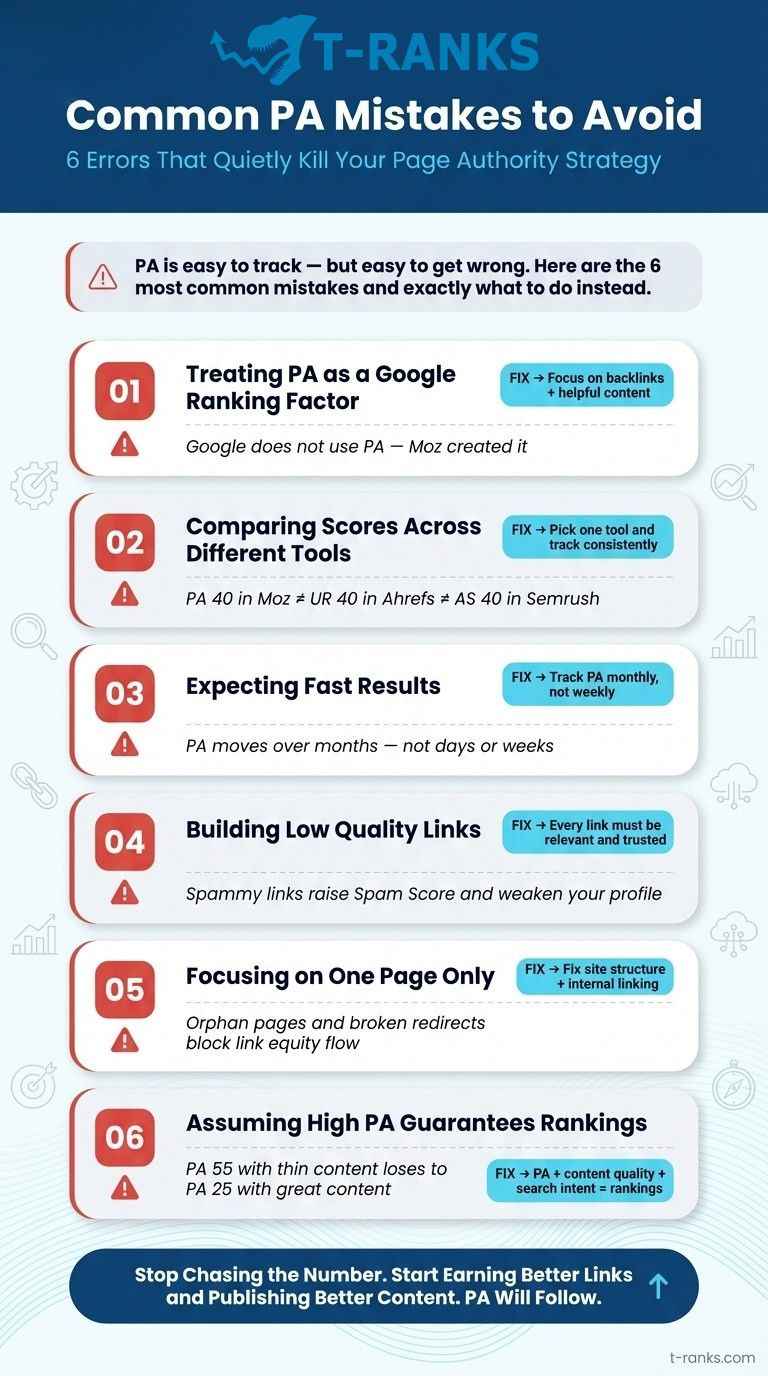
PA is easy to track but easy to get wrong. Most site owners either chase the score without understanding what it means, or make decisions based on assumptions that are not true. Here are the six most common mistakes and what to do instead.
Treating PA as a Google ranking factor. PA is a Moz metric. Google does not use it. Stop optimising for the PA number and start focusing on earning quality backlinks and publishing helpful content. Your PA will improve as a natural result of that work.
Comparing scores across different tools. A PA of 40 in Moz is not the same as a URL Rating of 40 in Ahrefs or an Authority Score of 40 in Semrush. Each tool uses different data and a different calculation method. Comparing scores across platforms gives you a misleading picture. Pick one tool and stick with it.
Expecting fast results. PA moves slowly because backlinks take time to earn and be recognised by Moz’s crawler. If your score has not moved after a few weeks, that is normal. Track PA over months not weeks.
Building low quality links to push the number up. Links from spammy or irrelevant sites do not improve PA in any meaningful way. They raise your Spam Score and weaken your link profile. Every link you build should come from a relevant and trusted page.
Focusing on one page and ignoring the rest of your site. PA is a page level metric but your whole site affects how authority flows. Weak site structure, orphan pages, and broken redirects all stop link equity from reaching the pages that need it most. Internal linking and site structure matter just as much as external links.
Assuming a high PA score means you will rank. PA measures backlink strength. It does not measure content quality or search intent match. A page with PA 55 and thin content will often lose to a page with PA 25 that directly answers what the searcher wants. PA is one piece of the picture. Content quality and relevance complete it.
Is Page Authority Still Relevant in 2026?

Yes. Page Authority is still a useful metric in 2026. But the way you should think about it has changed.
PA still lines up with real rankings because it is built on backlink signals and backlinks still matter. Pages that earn strong links from trusted and relevant sources tend to rank well. That has not changed. What has changed is that backlinks alone are no longer enough to tell the full story of how a page will perform.
How AI Search Is Changing the Way Authority Works
Google AI Overviews and tools like Perplexity are changing how content gets found and cited online. These systems do not just look at how many backlinks a page has. They look at how deeply a page covers a topic, how clearly it is structured, and how well it answers the full question behind a search.
This means a page with a strong PA score but thin or shallow content is less likely to show up in an AI generated answer. A page that covers its topic thoroughly and clearly has a better chance, even if its PA score is lower. Topical depth and content quality are gaining real weight alongside traditional link based signals. Building PA still matters. But building genuine expertise across a topic now matters more than it used to.
Why Some SEOs Are Moving Away From Moz PA
A growing number of SEO professionals now prefe rAhrefs URL Rating or Semrush Authority Score over Moz PA. The main reason is how quickly each tool picks up changes. Ahrefs crawls the web more often and its URL Rating tends to reflect recent link changes faster than Moz does. Semrush goes a step further by adding organic traffic data and spam signals into its score, which gives a broader picture of page strength beyond just backlinks.
None of these tools is better than the others in every situation. But if you do a lot of link prospecting or competitive research, you may find that Ahrefs or Semrush gives you more up to date information to work with.
The Right Way to Think About PA in 2026
PA is one useful tool in your SEO toolkit. It tells you about the backlink strength of a page. It does not tell you about content quality, search intent, topical depth, or how well a page is likely to be picked up by AI search tools.
Use PA alongside those other signals. Check it when you are evaluating link opportunities. Track it over time to see whether your link building is working. But do not treat it as the only measure of whether a page will rank or get cited in AI search results.
FAQs About What Is Page Authority in SEO and How Is It Scored?
What is Page Authority in SEO?
Page Authority is a score created by Moz that predicts how well a single page will rank in search engine results. It runs on a scale from 1 to 100, with higher scores indicating a stronger ability to rank.
What is a good Page Authority score?
A good Page Authority score is one that is higher than the pages already ranking for your target keyword. PA is a relative metric, so a score of 30 can be competitive in one niche and weak in another.
Is Page Authority a Google ranking factor?
No. Page Authority is a third party metric created by Moz. Google does not use PA in its ranking algorithm and has never done so. It correlates with rankings because both PA and Google rankings respond to the same signal — quality backlinks.
What is the difference between Page Authority and Domain Authority?
Page Authority measures the strength of a single page. Domain Authority measures the strength of an entire website. Both are Moz metrics that use the same 1 to 100 scale but operate at different levels.
Why did my Page Authority drop?
PA can drop for several reasons including Moz index updates, lost backlinks, competitor link gains, or a site migration without proper 301 redirects. A score drop does not always mean something went wrong on your site.
How long does it take to build Page Authority?
Building Page Authority takes several months of consistent link building. PA moves slowly because it depends on real backlinks being earned, crawled, and indexed by Moz. There are no shortcuts to improving it quickly.
How do I check my Page Authority score?
The easiest way is to use Moz Link Explorer at moz.com/link-explorer. Enter any URL and it will show the PA score along with linking domains and inbound links. The free MozBar Chrome extension also shows PA scores directly in your browser.
Can a high PA page still rank poorly?
Yes. PA measures backlink strength but not content quality or search intent match. A page with PA 55 and thin content can easily lose to a page with PA 25 that directly answers what the searcher is looking for.
Is Moz Page Authority still reliable in 2026?
Yes, but with limitations. PA still correlates with real rankings because backlinks still matter. However some SEOs now prefer Ahrefs URL Rating or Semrush Authority Score for more frequent data updates and broader scoring signals.
Does internal linking affect Page Authority?
Internal linking does not directly change your PA score but it distributes link equity between pages on your site. Linking from a high PA page to a weaker page passes authority to that page and can help it rank better over time.
What is PA 2.0?
PA 2.0 is an updated version of Moz’s Page Authority scoring model. It added Spam Score signals and link pattern analysis to make the score more accurate and harder to manipulate through low quality link building.
How is Page Authority different from Google PageRank?
PageRank is Google’s internal link based scoring system that it has used since 1998. Google stopped sharing PageRank scores publicly in 2016. Moz built Page Authority to fill that gap using a similar methodology but with its own data and algorithm.
Should I focus on Page Authority or Domain Authority?
Use Page Authority when making decisions about specific pages such as evaluating link building targets. Use Domain Authority when assessing the overall strength of an entire website. For the best results use both together rather than relying on just one.