Did you know that around 55% of Google searches now show AI-generated answers at the top of the page?
Google Search is changing fast. Instead of showing only blue links, Google now displays AI Overviews, short summaries that answer questions by pulling information from multiple websites. These AI answers often appear before normal search results, which means many users see the summary before they ever scroll down.
This shift has confused many website owners. Some believe they now need completely new strategies like AEO or AI SEO to stay visible. But the reality is simpler. Google AI Overviews still rely heavily on strong SEO foundations. Most websites that appear in AI Overviews are already performing well in organic search results. AI has not replaced SEO. It is built on top of it.
In this guide, you will learn what Google AI Overviews are, how they work, why they matter, and how to appear in them using practical, easy-to-follow strategies. The focus is on what actually works today, clear content structure, strong SEO basics, and smart optimization that helps both users and AI understand your site.
Now, let’s break it down step by step.

What Are Google AI Overviews?
Google AI Overviews are AI-generated summaries that appear at the top of Google search results.
They aim to answer a user’s question quickly by combining information from multiple trusted websites.
Earlier, when someone searched on Google, the top-ranking websites were the first thing users saw. They clicked those links to get answers. Now, with AI Overviews, Google often shows a complete answer at the top of the page. Because of this, click-through rates have dropped for many informational queries, since users may get what they need without scrolling down.
This does not mean organic search is gone. What has changed is how users interact with search results.
Some queries are simple. For these searches, users are satisfied with a short AI answer and do not scroll further.
Other queries need deeper explanations, tools, or services. In these cases, users still scroll and visit websites.
AI Overviews also highlight top cited sources, often shown on the right side or inside the summary itself. These sources receive the most attention and trust. When your website appears there, users are more likely to trust your brand and click through for more details.
So while some traffic may decrease for basic informational searches, AI Overviews create a new opportunity for visibility. Website owners can now focus on:
- Ranking in traditional organic results
- Appearing as a trusted source inside AI Overviews
The focus has shifted from only ranking on the page to being selected and trusted by Google’s AI.
Google AI Overviews Explained at a Glance
Google AI Overviews are not a single feature working in isolation. They are the result of multiple systems working together, from query understanding to content selection and presentation.
The infographic below shows the full structure of how Google AI Overviews operate. It breaks the topic into clear parts, including what AI Overviews are, how they work, what triggers them, common mistakes to avoid, optimization strategies, and how website owners can measure impact.
Use this visual as a quick reference to understand the complete AI Overview ecosystem before diving deeper into each section of this guide.

How Google AI Overviews Work
Google AI Overviews work by understanding a search query, collecting information from the web, and presenting a summarized answer directly in search results.

The process begins the moment a user enters a query into Google.
Step 1: Understanding the Search Query
Google first tries to understand what the user is really asking.
Some searches are simple and need only a short answer. Other searches are more complex, involve multiple ideas, or require explanation. These are the types of queries where AI Overviews usually appear.
At this stage, Google analyzes:
- The intent behind the query
- The context and meaning of the words
- Whether the query needs a detailed explanation or summary
Step 2: Expanding the Query (Query Breakdown)
Once Google understands the main question, it often breaks it into related sub-questions.
This helps Google cover the topic more completely.
For example, a single query may involve:
- Definitions
- Comparisons
- Steps
- Risks or benefits
This expansion allows Google to gather information from multiple angles instead of relying on one narrow answer.
Step 3: Collecting Information From the Web
After expanding the query, Google searches its existing index of web pages, just like it does for normal search results.
At this stage, Google looks for:
- Pages that are relevant to the topic
- Content that explains things clearly
- Pages with structured headings and readable text
- Websites that show reliability and trust
Google does not scrape random websites.
It selects content from pages that already meet its quality and relevance standards.
Step 4: Generating the AI Summary
Next, Google’s AI model combines key points from different sources and creates a short, conversational summary.
Important things to understand here:
- The AI does not copy text word for word
- It extracts useful ideas and explanations
- It rewrites them into a single response
The goal is to help users understand the topic quickly without visiting many pages.
Step 5: Presenting Sources to the User
Along with the AI summary, Google shows links to original sources.
These sources may appear:
- Inside the AI-generated text
- On the side as cited websites
This gives users the option to:
- Verify information
- Explore deeper details
- Visit trusted sites directly
Step 6: Learning From User Interaction
Google also observes how users interact with AI Overviews.
For example:
- Do users expand the overview?
- Do they click source links?
- Do they ask follow-up questions?
These signals help Google improve how future AI Overviews are generated and presented.
A Practical Observation (Not the Core Rule)
From large-scale studies and real-world analysis, one pattern appears consistently.
More than 70% of websites cited in Google AI Overviews already rank in the Top 10 organic search results.
This insight comes from an analysis of over 56 million AI Overviews.

This does not mean organic ranking is the only factor.
It simply shows that strong SEO foundations make it easier for Google to trust and select content when generating AI summaries.
10 Practical Strategies to Rank in Google AI Overviews
Before jumping into tactics, let me be clear about one thing.
Most of what you hear today about AEO, GEO, LLM ranking, or AI SEO is presented as something completely new. Many people make it sound like traditional SEO no longer matters.
From my personal experience, and from what almost all top SEO professionals agree on, that is not true.
Now let me share the practical strategies you actually need to adopt to rank in Google AI Overviews.
All of these strategies are based on real research and hands-on experience working on client sites that are already appearing in AI Overviews.

1. Build Strong SEO Foundations Before Chasing AI Overviews
From what I’ve observed lately, many people are selling AI SEO, GEO, or LLM ranking as if it requires a completely different SEO strategy.
In reality, you do not need a new or separate SEO system to rank in AI Overviews.
Based on my experience, the most important requirement is still the same:
you must have a strong grip on traditional SEO fundamentals.

Before thinking about AI Overviews, you need to make sure your website already does the basics well.
This includes:
- Clean and simple UI and UX
- High-quality, helpful content
- Logical internal linking
- Good site speed and mobile performance
- A healthy backlink profile
When these basics are weak, AI-focused strategies rarely work.
Once you have strong SEO foundations, two things happen naturally:
- Your site becomes eligible to rank in organic search
- Google starts trusting your content more
At this stage, many sites begin appearing in AI Overviews automatically, without doing anything special.
Only after this point do the extra AI-focused strategies start making a real difference.
And those are the strategies I’ll explain next.
2.Understand Search Intent and Target Informational Queries Naturally
Google AI Overviews are triggered mainly by informational, problem-solving, and long-tail queries.
This does not mean you should focus only on informational content or create separate pages just for AI Overviews.

The better approach is to understand your topic deeply and cover it naturally from all angles.
No matter what type of content you are writing, whether it is service-based, informational, affiliate, or a listicle, strong keyword research is essential. You should clearly know:
- Which keywords are commercial or transactional
- Which are navigational
- Which are informational or problem-based
Once this is clear, the next step is to blend these intents naturally into your content, instead of forcing them into separate sections or pages.
regular trackinToday, users rarely search using short keywords. They ask full questions, explain their problems, and search in the same way they speak to tools like ChatGPT, Gemini, or Perplexity. Because of this, content should reflect natural language and real questions.
A practical way to find these queries is by:
- Brainstorming common problems related to your topic
- Thinking about questions users may search for now or in the future
- Using Google’s “People also ask” section
- Exploring question-based keywords in tools like Ahrefs or Answer the Public
The more research you do on your topic and the better you understand it, the easier it becomes to write content in a natural, helpful tone. When content is written this way, it naturally aligns with both organic search ranking and Google AI Overview visibility.
3. Answer the Main Question Clearly in the First Few Lines
When it comes to ranking in Google AI Overviews and LLMs, we need to provide the direct answer to the query we are writing for.
This is one of the most important patterns I have observed in content that appears inside AI Overviews.
Google’s AI systems want to understand content quickly. If the main answer is delayed or buried under long introductions, it becomes difficult for AI to extract a clean summary.
The approach we follow is simple:
- First, give a clear and direct answer to the main question
- Keep it short and easy to understand
- Then expand the topic in depth based on the intent of that query
This is not about writing less content. It is about leading with clarity and expanding later.

A good example of this approach is shown in the screenshot above.
In that example, the main query is “What is Semantic SEO?”
The page starts by answering the question directly in the first few lines. After that, it explains the concept in more detail, connects related ideas, and covers the topic from multiple angles.
This structure helps in two ways:
- Users immediately understand what the page is about
- Google’s AI can easily extract the core explanation
The same principle applies when writing content for Google AI Overviews or LLM visibility.
First, answer the main question clearly.
Then explain the topic according to search intent.
Many pages struggle here because they:
- Start with long background sections
- Delay the actual answer
- Focus on context before clarity
When we lead with the answer and then expand, the content becomes easier for:
- Users to understand
- AI systems to summarize
- Google to trust
This simple structure works well for traditional organic rankings and AI Overviews at the same time.
4. Use Clear Headings and Logical Content Structure
After answering the main question clearly, the next thing we need to focus on is how the rest of the content is structured.
From what I’ve seen, Google AI Overviews and LLMs prefer content that is easy to scan and easy to understand, not just for users but also for machines.

This is where clear headings and logical structure matter.
Each page should follow a simple flow:
- One clear main topic
- Headings that explain what comes next
- Content that stays focused under each heading
We should avoid mixing multiple ideas under one heading or jumping between topics randomly. When the structure is clean, Google can understand what each section is about without confusion.
A practical way to do this is:
- Use H2s to break the topic into major sections
- Use H3s to explain sub-points clearly
- Make sure each heading actually matches the content below it
This helps AI systems extract information section by section, instead of trying to understand the entire page at once.
Another important point is content spacing.
Short paragraphs, bullet points where needed, and clear separation between ideas make it easier for AI to:
- Identify key explanations
- Pull summaries
- Combine information correctly
When headings are clear and content flows logically, the page becomes more readable for users and more usable for AI Overviews.
In simple terms, good structure tells Google what matters on the page, and that increases the chances of your content being selected and summarized correctly.
5. Cover the Topic Deeply Instead of Writing Thin Content
When it comes to Google AI Overviews, depth does not mean writing more words.
What matters is semantic depth.
From experience, AI systems do not care whether a page is 2,000 words or 10,000 words. What they care about is whether the content fully covers the topic from all relevant angles and satisfies the intent behind the query.
Covering a topic deeply means:
- Explaining the main concept clearly
- Addressing related subtopics naturally
- Answering follow-up questions users are likely to have
This is about semantic completeness, not length.
A common mistake many writers make is thinking that depth means adding more sections or stretching the content. In reality, content becomes stronger when it stays focused.
Another major mistake I often see is that writers go too broad inside a single section. For example, under one H2, they start discussing multiple loosely related topics. This breaks clarity for both users and AI systems.
Each section should:
- Stick closely to the heading topic
- Answer only what that heading promises
- Avoid drifting into other areas
When content stays focused and semantically complete within each section, it becomes much easier for Google to:
- Understand the topic
- Extract key explanations
- Summarize the content accurately
A good way to check depth is to ask:
- Does this section fully explain its topic?
- Does it answer likely follow-up questions without drifting?
When the answer is yes, the content is deep enough.
Semantic depth combined with clear focus makes your content far more useful for users and far easier for AI Overviews to trust and summarize.
6. Use Natural Language and Question-Based Phrasing
One important shift we need to accept is how people search today.
Users no longer search only with short keywords. They ask full questions, describe their problems, and search the same way they talk to AI tools like ChatGPT, Gemini, or Perplexity.
Because of this change, content should be written in natural, conversational language.
This does not mean casual or informal writing.
It means writing in a way that feels clear, human, and easy to understand.
Content that performs well in Google AI Overviews usually:
- Uses complete, natural sentences
- Matches how users phrase questions
- Answers those questions directly
Question-based phrasing helps both users and AI systems. Users immediately recognize that their problem is being addressed, and AI systems can easily match queries to answers.
Now, this is where many writers struggle.
Most of us use AI tools like ChatGPT or Claude to help with writing. That is fine. But simply asking these tools to “write in a human tone” does not automatically make the content human.
From experience, what actually makes content conversational is how we refine it after generation.
Using pronouns like I, we, and you adds a sense of personal experience. It makes the content feel like it is coming from a real person, not a machine.
Another effective step is adding personal observations. After generating a section, review it and ask:
- What is missing?
- What have I personally observed?
- How would I explain this if I were talking to a friend?
Then add those thoughts directly into the content.
A simple and effective approach is to treat the AI tool like a conversation partner, not just a content generator. Ask follow-up questions, clarify ideas, and adjust the wording until it sounds natural to you.
When content combines:
- Natural questions
- Clear answers
- Conversational language
- Personal insight
It becomes easier for both users and AI systems to understand and trust.
That clarity is exactly what Google AI Overviews and LLMs look for when selecting content to summarize and cite.
7. Strengthen Authority and Trust Signals
Google AI Overviews rely heavily on trust. Before citing any page, Google evaluates whether the website behind the content is reliable enough to be used as a reference.
Backlinks are still one of the strongest authority signals. They show Google that other websites trust your content and consider it worth referencing. Sites that consistently appear in AI Overviews usually have relevant, high-quality backlinks, not just a high number of links.
We’ve seen this firsthand. In a recent case study, T-RANKS appeared in Google AI Overviews and multiple LLM systems after building strong, topic-relevant backlinks.
You can read the full breakdown here:
How backlinks helped T-RANKS rank in AI Overviews and LLMs
However, backlinks alone are not enough.
Google also looks closely at topical authority. From our own testing at T-RANKS, we’ve seen that selecting one clear pillar page and then supporting it with multiple subtopic articles makes a measurable difference.
Each supporting article covers a specific angle of the main topic, and all pages are internally linked in a logical structure. This creates strong topical relevance and helps Google clearly understand what the site is an authority on.
When pillar pages and subtopics work together, trust builds naturally. As a result, we started ranking not only in organic results, but also in Google AI Overviews and LLM-based systems without forcing any AI-specific tactics.
Another important factor is brand and entity signals. Clear branding, consistent naming, and mentions across the web help Google understand who you are and what you are known for. This matters even when those mentions are not always linked.
Google also favors content that shows real experience. Pages that include practical explanations, observations, or real-world examples feel safer to cite than content that only repeats generic definitions.
When backlinks, topical consistency, brand signals, and real experience work together, Google becomes confident in:
- Trusting the site
- Using its content in AI Overviews
- Citing it across AI-driven search systems and LLMs
In simple terms, AI Overviews still depend on trust, and trust is built through multiple signals working together, not a single factor.
8. Optimize Content for Easy AI Extraction
Google AI Overviews do not read content the way humans do.
They look for clear, extractable information that can be summarized safely and accurately.
Because of this, content structure matters as much as content quality.
From what we’ve tested, pages that appear more often in AI Overviews usually follow a few clear patterns.
First, each section should start with a direct answer.
AI systems prefer content where the main point is clearly stated before details or explanations.
Second, keep sections tight and focused.
Each heading should cover one idea only. Avoid mixing definitions, examples, and side topics under the same H2 or H3.
Best practices that consistently help:
- Start sections with a clear summary sentence
- Use short paragraphs and simple sentences
- Keep one topic per heading
- Use bullet points or steps where possible
- Avoid unnecessary filler or storytelling
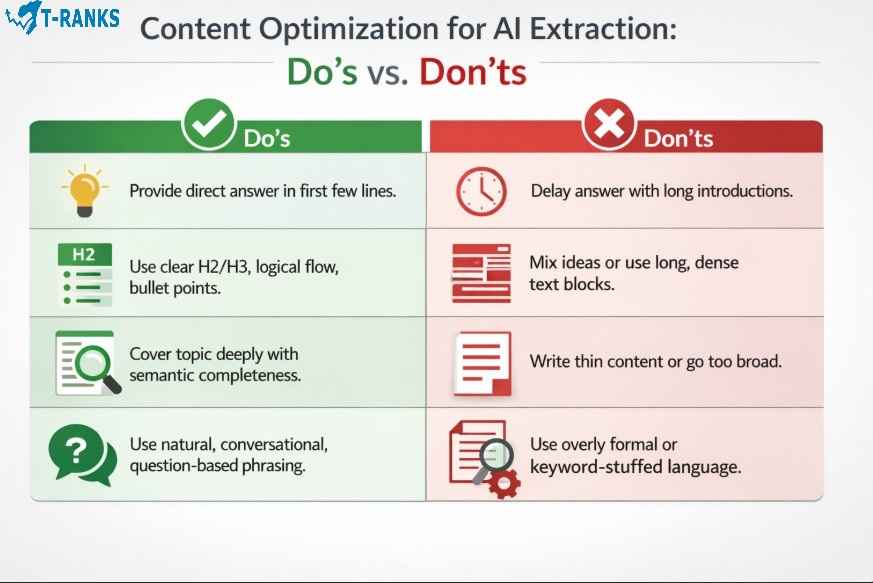
Another important point is heading clarity.
Headings should clearly describe what the section answers. When headings closely match search intent, AI systems can map queries to content more easily.
A common mistake is trying to cover too much under one heading. Even well-written content becomes hard for AI to extract when sections drift too broadly.
When content is structured cleanly, Google can:
- Scan it faster
- Understand the purpose of each section
- Extract answers with more confidence
In simple terms, content that is easy to read is also easy for AI to use.
9. Improve Page Experience and Technical Signals
Even strong content can struggle to appear in Google AI Overviews if the page experience is weak.
Google still relies on technical and usability signals to decide which pages are reliable enough to reference. AI systems do not ignore these signals. In fact, they depend on them to reduce risk and ensure quality.
From what we’ve observed, pages that perform well in both organic search and AI Overviews usually share a few core technical strengths.
First, page speed matters.
Slow-loading pages are harder for Google to crawl, process, and trust. Fast pages improve user experience and make it easier for Google systems to evaluate content efficiently.
Second, mobile usability is critical.
Most AI Overview impressions happen on mobile devices. Pages that are difficult to read, poorly spaced, or cluttered on small screens tend to lose trust signals.
Third, clean page structure supports AI understanding.
This includes:
- Proper HTML structure
- Clear and logical heading hierarchy
- No hidden, broken, or blocked content
Practical best practices that help:
- Optimize Core Web Vitals
- Avoid intrusive popups and excessive ads
- Ensure text is readable without zooming
- Keep layouts simple and focused
Another often overlooked factor is crawlability.
If Google struggles to access, render, or interpret a page, it is far less likely to rely on that page for AI-generated summaries.
In simple terms, strong page experience and technical health:
- Support organic rankings
- Strengthen trust signals
- Make content easier for AI systems to use
Technical SEO is not optional for AI Overviews. It remains a core part of visibility.
10.Measure and Track AI Overview and LLM Visibility
Ranking in Google AI Overviews is not something you set once and forget.
It needs regular tracking and review.
We should constantly monitor how our brand and pages appear in AI Overviews and LLM answers. This helps us understand what Google trusts and why.
Start by identifying:
- Which pages from your site appear in AI Overviews
- Which queries trigger those appearances
- Whether your site is shown as a cited source or only mentioned
Tools like Ahrefs and Semrush can help here.
They now show AI Overview visibility data for many queries, which makes it easier to spot:
- Pages getting AI exposure
- Topics where Google already trusts your content
- Gaps where competitors appear but you do not
Alongside tools, manual verification is still important.
Search important queries directly on Google and:
- Check if AI Overviews appear
- See which sources are cited
- Look for your brand name or pages
This manual step often reveals patterns tools may miss.
Once you know which pages are ranking, focus on why they are ranking.
Review:
- How clearly the page answers the query
- How well the content is structured
- What authority signals are present
- How strong the topical relevance is
At the same time, analyze competitors that appear in the same AI Overviews and LLM responses.
This shows you:
- What type of content Google prefers
- How competitors structure their answers
- Where your content needs improvement
After this analysis, updates become much clearer.
You can then:
- Improve pages that are close to being cited
- Strengthen authority and clarity
- Adjust structure and depth based on real AI behavior
The main idea is simple.
AI visibility must be tracked, compared, and improved continuously.
When you treat AI Overviews like an evolving system instead of a fixed ranking, improving visibility becomes a repeatable and practical SEO process.
Why Google AI Overviews Matter for Website Owners
Google AI Overviews matter because they change how users see and interact with search results.
Earlier, ranking on the first page of Google usually meant more clicks. Today, many users see an AI-generated answer before they see any website links. This shift affects visibility, traffic, and trust.
AI Overviews also take up a large portion of the search results page. In many cases, users see the AI summary before any organic listings appear. This means that even well-ranking pages can receive less attention if they are pushed lower on the screen.
For basic informational queries, users often get their answer directly from the AI Overview. In these cases, fewer users scroll down to traditional results. This has led to lower click-through rates for some types of content, especially short and simple informational pages.
However, this does not mean visibility is lost.
This change has created a new situation where visibility and clicks do not always move together. A website may appear more often in search results through AI citations, but receive fewer clicks at the same time. Because of this, trust and brand visibility are becoming just as important as traffic numbers.
AI Overviews also highlight trusted source websites. These sources are shown inside the summary or listed as citations. When your site appears there, users see your brand at the decision-making point, not buried below the fold.
This creates three important impacts for website owners.
First, visibility now matters more than position.
Even a page ranking lower than first place can gain strong exposure if it is cited in an AI Overview.
Second, trust is built faster.
When Google’s AI selects your website as a source, users see it as verified and reliable. This increases brand credibility, especially for competitive topics.
Third, traffic quality improves, even if total clicks change.
Users who click from AI Overviews are often looking for deeper explanations, tools, or services. These visitors tend to be more engaged and more likely to convert.
Because of this shift, website owners now need to look beyond rankings and pay attention to:
- Whether their site is cited in AI Overviews
- How often their brand appears in search results
- The quality of traffic coming from AI-driven clicks
This means AI Overviews are not just a challenge. They are a new opportunity.
Website owners who adapt can:
- Appear in both organic results and AI summaries
- Build authority earlier in the user journey
- Stay visible as search behavior continues to change
In simple terms, Google AI Overviews influence who gets seen first and who gets trusted first. Ignoring them means missing a growing part of modern search visibility.
When Do Google AI Overviews Appear in Search Results?
Google AI Overviews appear when Google believes a short, summarized answer is more helpful than showing a list of links.
They do not appear for every search. Instead, Google decides to show them based on search intent, query complexity, and expected user value.
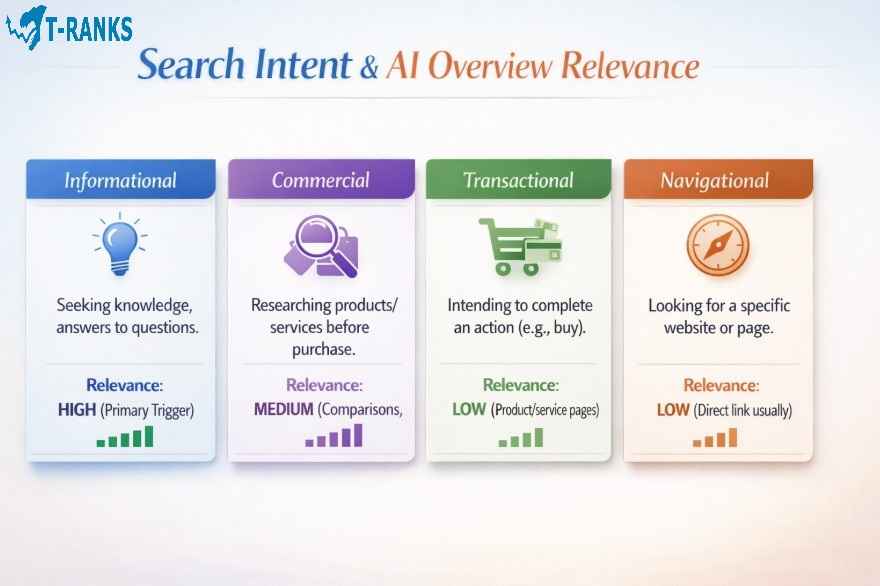
AI Overviews mostly appear for informational searches
The strongest and most consistent finding across studies is this:
AI Overviews are primarily triggered by informational queries.
According to Ahrefs,nearly 90% of AI Overviews appear for informational searches, such as:
- Definitions
- Explanations
- How-to guides
- Learning-focused questions
These are searches where users want to understand a topic, not immediately visit a specific website or make a purchase.
Complex and long-tail queries trigger AI Overviews more often
Google is more likely to show an AI Overview when a query:
- Has multiple parts
- Requires explanation from different angles
- Uses natural, conversational language
Examples include:
- “How does X work and why does it matter?”
- “X vs Y for beginners”
- “Best way to combine X with Y”
Long-tail queries written like real questions trigger AI Overviews far more often than short keyword searches.
Problem-solving and instructional searches are heavily affected
Research from WordStream shows that AI Overviews appear far more frequently for:
- Problem-solving queries
- Step-by-step instructional searches
These include searches where users are trying to:
- Fix a problem
- Learn a process
- Follow a method or guide
This explains why many educational blog posts now see AI Overviews above them.
AI Overviews are expanding beyond informational queries
While informational intent still dominates, AI Overviews are no longer limited to it.
Recent Ahrefs data confirms that AI Overview keyword coverage has more than doubled since March 2025, showing rapid expansion across search results.
Google has also begun testing AI Overviews for:
- Commercial research queries
- Early-stage transactional searches
- Some local searches
This trend is expected to continue into 2026.
When AI Overviews usually do NOT appear
AI Overviews are much less common for:
- Navigational searches, like “Facebook login”
- Breaking or fast-changing news
- Very short factual lookups
- Sensitive topics where accuracy is critical
In these cases, Google prefers traditional results or knowledge panels.
What this means for website owners
AI Overviews are not replacing organic search, but they are changing how visibility works.
For many informational queries:
- Users get answers immediately
- Click-through rates can drop
- Attention shifts to cited sources
At the same time, appearing inside AI Overviews:
- Builds strong brand trust
- Positions your site as an authority
- Sends high-quality traffic when users want deeper information
This makes AI Overviews a visibility opportunity, not just a traffic threat.
Simple takeaway
AI Overviews appear when:
- A question needs explanation
- Multiple sources add value
- A summary helps users decide what to explore next
Understanding when they appear helps you:
- Choose the right keywords
- Create the right content types
- Balance AI visibility with traditional SEO
How Google Chooses Sources for AI Overviews
Google selects AI Overview sources based on clarity, trust, and usefulness, not randomly.
Before citing a page, Google checks whether:
- The content clearly answers the question
- The explanation is easy to understand
- The page shows topic relevance and credibility
- The structure allows AI to extract information easily
Only pages that already meet Google’s quality standards are considered.
Large-scale studies also show that many cited pages already perform well in organic search, which suggests that strong SEO foundations make content easier for Google to trust when generating AI summaries.
This does not mean rankings alone guarantee AI visibility.
It simply means clear, trusted content is easier for AI to use.
Now let’s focus on what actually helps your content get selected.
Common Mistakes That Prevent Sites From Appearing in Google AI Overviews
Many websites fail to appear in Google AI Overviews not because their content is weak, but because of basic structural and intent-related mistakes.

Mistake 1: Chasing AI Hacks Instead of Fixing SEO Fundamentals
Many site owners jump straight into AEO, GEO, or LLM tactics without fixing core SEO issues. Weak site structure, slow pages, thin content, and poor internal linking make it difficult for Google to trust a site when generating AI summaries.
Mistake 2: Publishing Generic or Fully AI-Generated Content
Content that feels automated, repetitive, or lacks original insight is often ignored. Google prefers pages that show real understanding, clear explanations, and a human point of view, even if the language is simple.
Mistake 3: Not Answering the Main Query Directly
When the primary answer is buried deep inside long paragraphs, AI systems struggle to extract value. Pages that fail to provide a clear, direct answer at the start are commonly skipped for AI Overviews.
Mistake 4: Mixing Multiple Search Intents in One Section
Many pages drift too far inside a single H2 or H3. When a section becomes broad or unfocused, clarity drops. AI systems prefer sections that stay aligned with one clear intent instead of covering unrelated ideas.
Mistake 5: Ignoring Topical Authority and Internal Linking
Publishing isolated pages without supporting content weakens trust. Pages that are part of a topic cluster, supported by related articles and clear internal links, are easier for Google to understand and select.
Mistake 6: Content Does Not Match Search Intent
Writing sales-heavy content for informational queries, or generic blog-style content for problem-solving searches, often prevents AI inclusion. AI Overviews rely heavily on intent alignment.
Mistake 7: Tracking Rankings but Ignoring AI Visibility
Some pages appear in AI Overviews without ranking in the top positions, while others rank well but are never cited. Ignoring AI visibility hides important signals about how Google actually presents your content.
Most AI Overview failures happen because of clarity, intent, and trust gaps, not because advanced techniques are missing.
When content is focused, intent-aligned, and structurally clear, Google finds it much easier to select it for AI summaries.
Google AI Overview Stats That Matter (Based on Real Data)
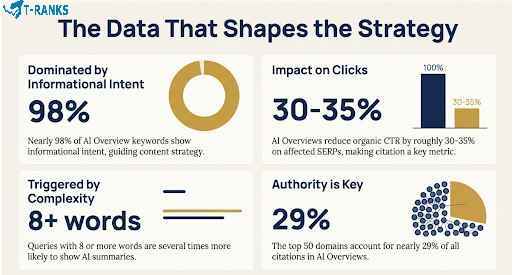
- AI Overviews now appear across a significant portion of Google searches, based on analysis of over 55.8 million AI Overviews across 590 million keywords.
This confirms that AI Overviews are no longer limited to edge cases and continue to expand. - AI Overviews are triggered primarily by informational queries, with nearly 98% of AI Overview keywords showing informational intent.
This explains why educational, explanatory, and problem-solving content dominates AI summaries. - Longer and more detailed search queries are far more likely to trigger AI Overviews.
Queries with eight or more words are several times more likely to show AI-generated summaries. - AI Overviews reduce organic click-through rates by roughly 30–35% on affected SERPs.
This shift explains why visibility alone is no longer enough and citation placement matters. - High-authority domains dominate AI Overview citations, with the top 50 domains accounting for nearly 29% of all mentions.
Trust, authority, and topical depth strongly influence which sites get cited. - AI Overviews appear less frequently for local, branded, and highly transactional queries.
This confirms that traditional SEO remains critical for commercial visibility.
Why these stats matter
Together, these findings support a clear conclusion:
Google AI Overviews are built on top of strong SEO fundamentals, not in place of them.
Websites that already rank well, cover topics deeply, and satisfy informational intent are far more likely to be selected as AI citation sources.
Conclusion

Google AI Overviews have changed how information is presented in search, but they have not changed the core principles of SEO.
From real-world testing and ongoing analysis, one pattern is clear. Websites that appear in AI Overviews are not using shortcuts or secret systems. They rely on strong SEO foundations, clear answers, topical authority, and trust built over time.
The biggest shift is not technical, it is strategic.
Ranking in AI Overviews is not about chasing new labels like AEO or GEO. It is about improving how clearly you explain topics, how completely you cover them, and how confidently your site demonstrates expertise.
When you:
- Understand search intent
- Answer questions directly
- Cover topics semantically
- Build authority through content and backlinks
- Track and refine AI visibility
Appearing in Google AI Overviews becomes a natural result, not a guessing game.
AI Overviews reward clarity, consistency, and real experience.
If you focus on those fundamentals, your visibility will grow across organic search, AI results, and future search systems.
FAQs About Google AI Overviews
What are Google AI Overviews?
Google AI Overviews are AI-generated summaries shown at the top of search results that answer a query using information from trusted websites.
They help users understand a topic quickly while still showing source links for verification and deeper reading.
How can a website rank in Google AI Overviews?
A website can rank in AI Overviews by providing clear answers, strong SEO foundations, topical authority, and trust signals.
Google selects content that best matches intent, explains the topic clearly, and comes from reliable sources.
Do you need to rank #1 to appear in AI Overviews?
No, ranking #1 is not required to appear in AI Overviews.
Pages outside the top positions can still be cited if they explain the topic better and align closely with search intent.
What type of queries trigger Google AI Overviews?
AI Overviews mainly appear for informational, problem-solving, and long-tail queries.
These include how-to questions, explanations, comparisons, and multi-step topics.
Can service pages appear in Google AI Overviews?
Yes, service pages can appear in AI Overviews if they answer informational and problem-based queries clearly.
Pages that explain processes, address concerns, and answer common questions have a higher chance of being cited.
Are Google AI Overviews replacing organic search results?
No, AI Overviews do not replace organic search results.
They change how information is displayed, but organic rankings still help Google decide which content to trust and cite.
Do backlinks matter for AI Overview rankings?
Yes, backlinks are still an important trust signal for AI Overviews.
Sites with relevant, high-quality backlinks are more likely to be trusted and selected as sources.
How important is topical authority for AI Overviews?
Topical authority is very important for AI Overviews.
Websites that cover a topic consistently and in depth are easier for Google to trust than sites with scattered content.
Can Google detect low-quality AI-generated content?
Yes, Google can detect generic or low-quality AI-generated content.
Content without originality, clarity, or human input is less likely to be selected for AI Overviews.
Do AI Overviews reduce website traffic?
AI Overviews can reduce clicks for simple informational queries.
However, they often increase brand visibility and send higher-quality traffic for complex or decision-based searches.
How can I check if my site appears in AI Overviews?
You can check AI Overview visibility using tools like Ahrefs or Semrush and by manually searching important queries on Google.
This helps confirm whether your pages or brand are being cited.
Is optimizing for AI Overviews different from traditional SEO?
Optimizing for AI Overviews builds on traditional SEO, not replaces it.
Strong SEO foundations combined with clear answers, structure, and trust signals produce the best results.