Choosing a PBN hosting package can feel confusing at first. One plan looks cheap, another promises better safety, and most pages are filled with terms that are hard to compare. It’s not always clear what you are really paying for or which option makes sense.
PBN hosting packages are not just about price. They differ in how websites are separated, how IP addresses are used, and how safely a network can grow over time. Two packages can cost almost the same but behave very differently once you add more sites.
This guide explains PBN hosting packages in a simple way. You will learn how pricing works, what different package types mean, and how to compare them without relying on marketing claims. The goal is to help you choose a setup that fits your network size and plans, even if you are just getting started.
What PBN Hosting Packages Are and What They Are Not
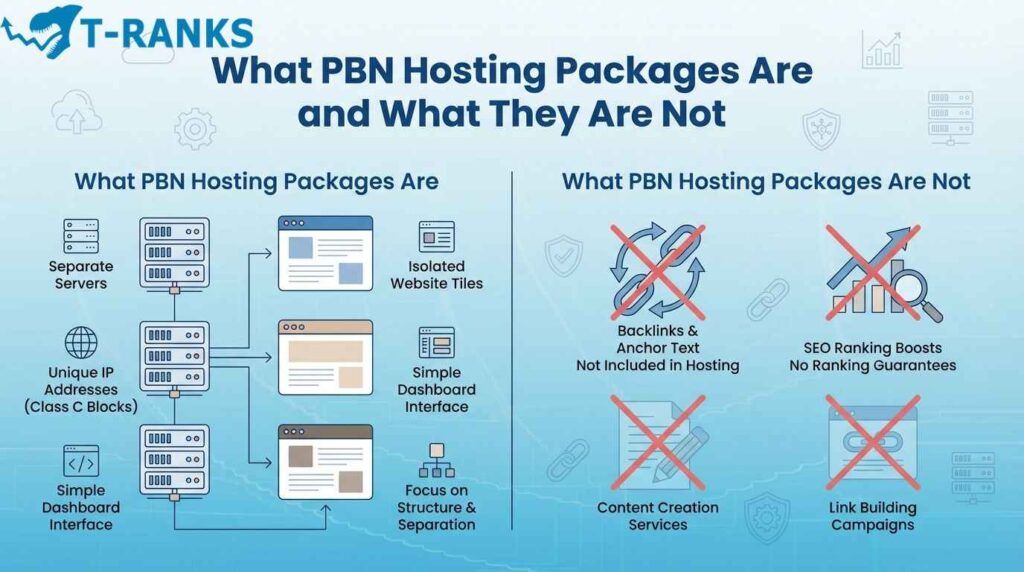
PBN hosting packages are hosting plans built to host multiple websites separately.
They are designed to reduce obvious hosting patterns by spreading sites across different IPs and servers.
The main purpose of these packages is structure and isolation, not speed or SEO results.
What PBN Hosting Packages Usually Include
Most PBN hosting packages include:
- Hosting space for multiple domains
- Different IP addresses for each site
- Separation across servers or systems
- A dashboard to manage sites
- Support for WordPress or static sites
Some higher-tier packages also include backups and basic monitoring.
What PBN Hosting Packages Do Not Include
PBN hosting packages do not include:
- Backlinks
- Link placement
- Anchor text
- SEO rankings
Hosting only provides infrastructure.
Links and rankings depend on how the sites are built and used.
PBN Hosting vs Regular Shared Hosting
PBN hosting and shared hosting are not the same.
Shared hosting:
- Hosts many sites on one server
- Often uses the same IP address
- Creates clear hosting patterns
PBN hosting packages:
- Spread sites across different IPs
- Reduce shared infrastructure
- Lower the risk of visible footprints
Understanding these differences helps avoid confusion.
It also prevents choosing a hosting package based on price alone instead of structure.
How PBN Hosting Packages Are Structured
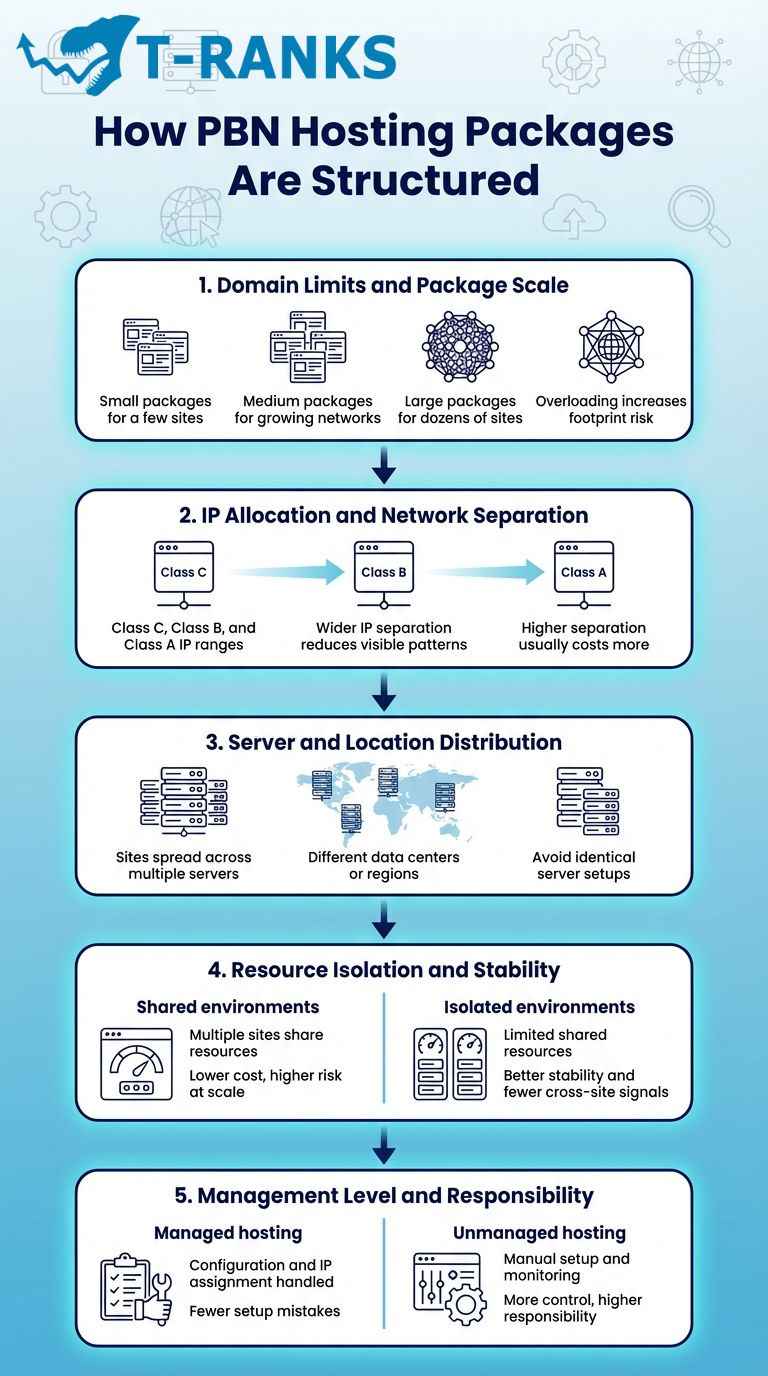
PBN hosting packages are structured around scale, separation, and management.
Understanding these layers explains why pricing and risk can differ even between similar plans.
Domain Limits and Package Scale
Every PBN hosting package limits how many websites you can host.
Most providers offer:
- Small packages for a few sites
- Medium packages for growing networks
- Large packages for dozens or more sites
As more sites are added to one package, footprint risk increases.
Overloading a package is one of the most common mistakes.
IP Allocation and Network Separation
IP structure plays a major role in how visible hosting patterns become.
Common IP allocation models include:
- Class C IPs with limited separation
- Class B IPs with wider network variation
- Class A IPs with the highest level of separation
Packages with broader IP separation reduce obvious network patterns and are usually priced higher.
Server and Location Distribution
Good PBN hosting packages do not place all sites on one server or in one location.
Most structured packages:
- Spread sites across multiple servers
- Use different data centers or regions
- Avoid repeating identical server setups
This distribution helps reduce detectable hosting similarities across sites.
Resource Isolation and Stability
Not all hosting packages isolate resources the same way.
Shared environments:
- Multiple sites share system resources
- Lower cost but higher risk at scale
Isolated environments:
- Limit shared resources between sites
- Improve stability and reduce cross-site signals
- Are more suitable for larger networks
Isolation becomes more important as a network grows.
Management Level and Responsibility
PBN hosting packages also differ by how much setup and maintenance they handle.
Managed packages:
- Handle configuration and IP assignment
- Reduce setup mistakes
- Require less technical effort
Unmanaged packages:
- Provide raw hosting access
- Require manual setup and monitoring
- Offer more control but higher responsibility
The right choice depends on experience, time, and network size.
This structure explains why two packages with similar prices can behave very differently.
Next, pricing will make more sense once you understand how these components work together.
PBN Hosting Pricing Explained

Pricing is often the first thing people compare, but it is also the easiest place to get misled. PBN hosting prices only make sense when you understand how packages are built.
Why PBN Hosting Prices Vary Widely
PBN hosting prices vary because packages differ in structure, not just capacity.
The biggest pricing factors are:
- How many sites are included in one package
- How IP addresses are separated across networks
- Whether sites share servers or are isolated
- How much setup and management is handled for you
Two packages with similar prices can carry very different levels of footprint risk.
Entry-Level, Mid-Tier, and Large-Scale Pricing Ranges
Most PBN hosting packages fall into three pricing tiers.
Entry-level packages:
- Usually cost around $2.50 to $4.00 per site per month
- Designed for small networks
- Limited IP separation
- Higher risk if scaled too quickly
Mid-tier packages:
- Usually cost around $2.00 to $3.00 per site per month
- Better IP and server distribution
- Suitable for steady network growth
- More balanced between cost and safety
Large-scale or premium packages:
- Often cost around $1.80 to $2.50 per site per month at volume
- Wider IP diversity across networks
- Better isolation and stability
- Designed for larger, long-term networks
As structure and separation improve, pricing increases even when performance stays similar.
Per-Site Pricing vs Bundled Package Pricing
Providers use two common pricing models.
Per-site pricing:
- A fixed monthly cost for each site
- Simple to calculate
- Can become expensive as networks grow
Bundled package pricing:
- One price for multiple sites
- Lower cost per site at scale
- Requires careful planning to avoid overloading
Neither model is automatically better. The right choice depends on network size and growth speed.
What Cheap PBN Hosting Usually Removes
Lower-priced PBN hosting packages reduce cost by cutting structure.
Common trade-offs include:
- Fewer unique IP ranges
- More shared servers
- Less resource isolation
- Limited management or automation
Cheap hosting can work for very small setups, but it leaves less room for mistakes. As networks grow, these compromises become easier to detect.
Understanding pricing this way helps you compare PBN hosting packages based on structure and risk, not just monthly cost.
What Is Typically Included in PBN Hosting Packages
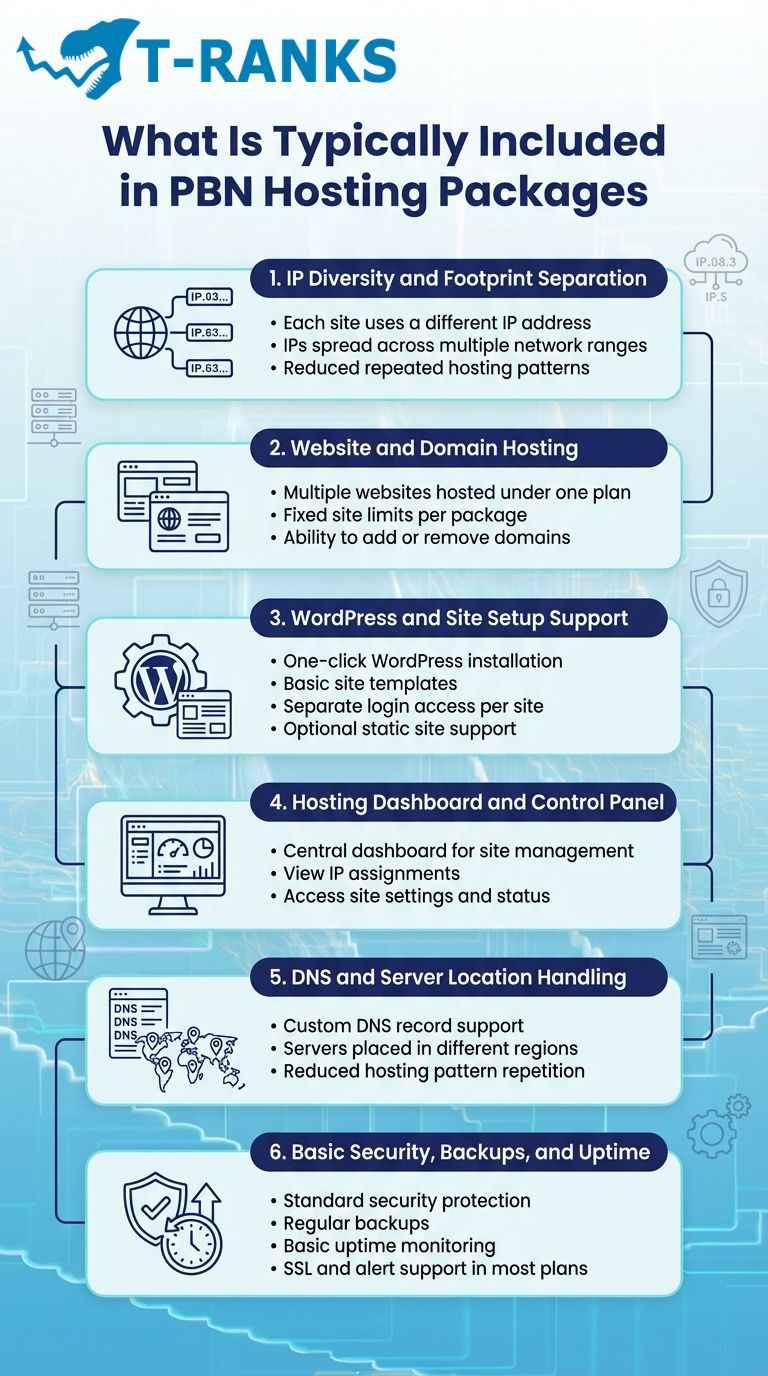
PBN hosting packages usually include a set of core features focused on separation, control, and basic management. Knowing what is standard helps you compare plans clearly.
IP Diversity and Footprint Separation
Most PBN hosting packages include some level of IP separation.
This usually means:
- Each site gets a different IP address
- IPs are spread across different ranges
- Repeated network patterns are reduced
IP separation can involve Class C, Class B, or wider network ranges, depending on the package level. Higher-tier packages usually offer broader separation.
Website and Domain Hosting
PBN hosting packages are built to host multiple websites under one plan.
They usually include:
- Support for multiple domains
- A fixed limit based on the package size
- The ability to add or remove sites
Hosting too many sites in one package increases footprint risk.
WordPress and Site Setup Support
Many PBN hosting packages support WordPress by default.
Common features include:
- One-click WordPress installation
- Basic site templates
- Separate login access for each site
Some packages also allow static websites instead of WordPress.
Hosting Dashboard and Control Panel
Most providers include a dashboard to manage all hosted sites.
This usually allows you to:
- Add or remove websites
- View IP assignments
- Access site settings
- Check basic site status
Dashboard quality and flexibility vary between providers.
DNS and Server Location Handling
PBN hosting packages often include basic DNS management.
This may involve:
- Custom DNS records
- Servers placed in different regions
- Tools to avoid repeated hosting patterns
Better packages spread sites across more locations.
Basic Security, Backups, and Uptime
Most PBN hosting packages include basic security features.
These usually cover:
- Standard security settings
- Regular backups
- Basic uptime monitoring
Many packages also include basic SSL certificates and uptime alerts, while advanced protection is usually part of higher-priced plans.
Cheap vs Premium PBN Hosting Packages
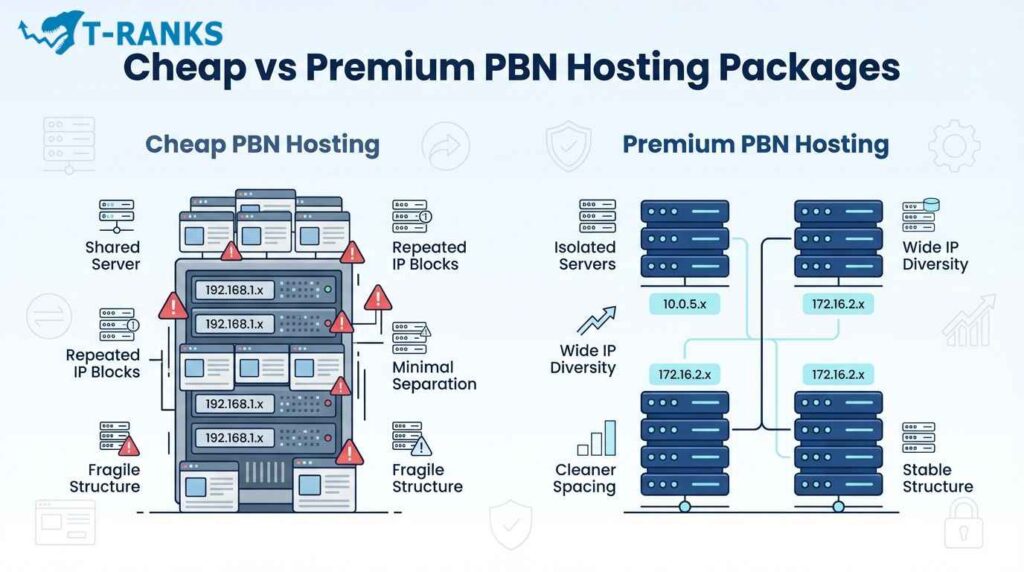
Cheap PBN hosting packages are built for low-cost, small setups with limited separation, while premium PBN hosting packages are designed for wider IP diversity, stronger isolation, and safer long-term scaling.
The key difference is not speed or rankings.
It is how much separation, flexibility, and margin for error the hosting structure provides as your network grows.
How Cheap PBN Hosting Packages Are Built
Cheap PBN hosting packages focus on keeping costs low.
They usually do this by:
- Using fewer IP ranges
- Hosting more sites on the same servers
- Sharing more system resources
- Offering limited setup or automation
These packages can work for testing or very small networks, but they leave little room for mistakes.
Where Cheap Packages Become Risky
Cheap hosting becomes risky when:
- Too many sites are added to one package
- IP patterns repeat across sites
- Server and location diversity is limited
- The network grows without restructuring
The risk is not immediate.
It increases gradually as the network expands.
How Premium PBN Hosting Packages Differ
Premium PBN hosting packages focus on structure first, not just capacity.
They usually offer:
- Wider IP separation across networks
- Better server and location distribution
- Stronger resource isolation
- Built-in support for scaling
Many premium packages also include management features that reduce setup errors.
When Paying More Actually Makes Sense
Premium hosting makes sense when:
- You plan to grow beyond a few sites
- You want cleaner separation between websites
- You prefer stability over short-term savings
- You want to avoid rebuilding hosting later
Paying more does not guarantee safety.
It simply reduces structural risk.
Cheap vs Premium PBN Hosting Packages at a Glance
| Aspect | Cheap PBN Hosting | Premium PBN Hosting |
| Infrastructure | More shared | More isolated |
| IP separation | Limited | Wider |
| Margin for error | Low | Higher |
| Scaling support | Weak | Stronger |
| Best suited for | Testing, small setups | Growing or long-term networks |
Choosing Between Cheap and Premium Packages
Cheap and premium hosting are not good or bad by default.
A simple rule:
- Cheap packages fit small, controlled setups
- Premium packages fit growing or long-term networks
The right choice depends on network size, growth plans, and risk tolerance, not on price alone.
How to Compare PBN Hosting Packages Properly
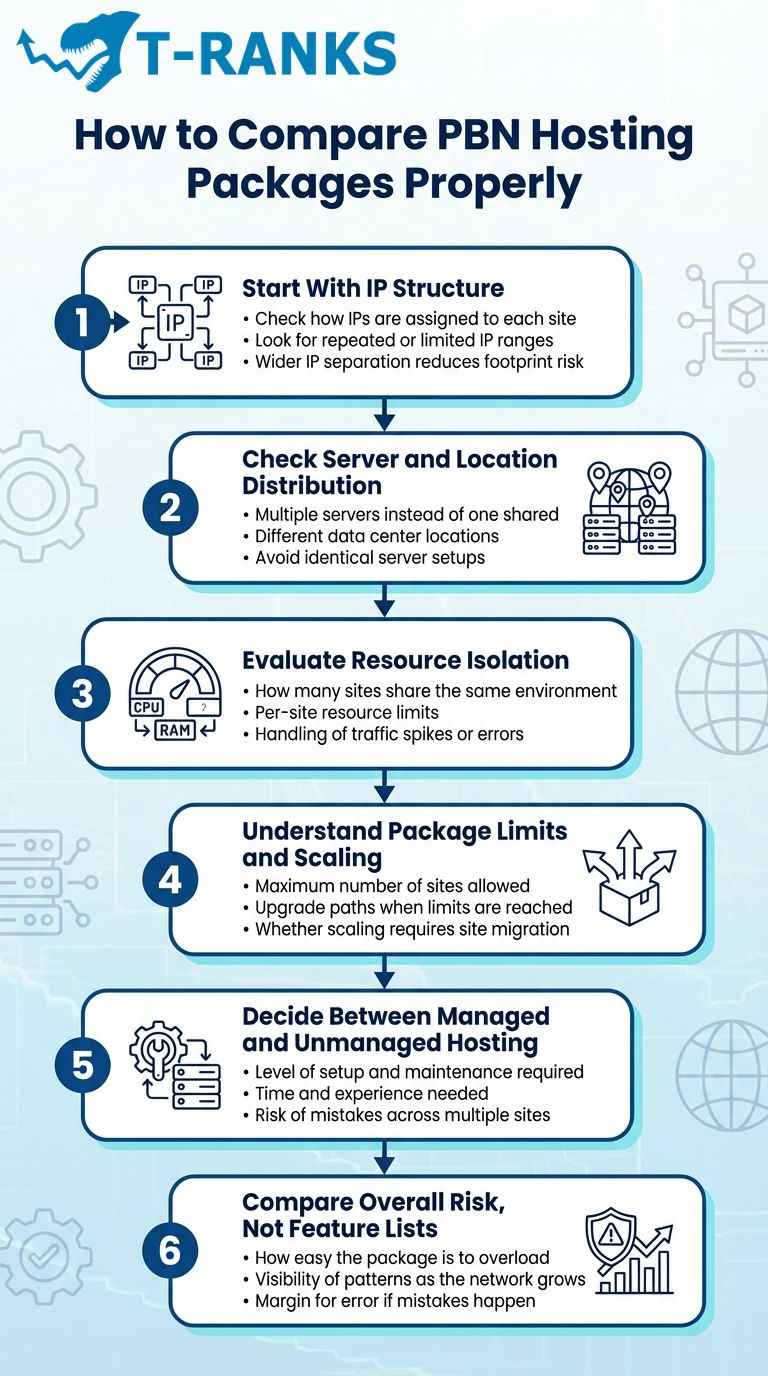
The safest way to compare PBN hosting packages is to evaluate structure first and cost second.
Packages with similar prices can behave very differently once sites are added.
When comparing PBN hosting packages, footprint structure matters more than features, performance, or advertised guarantees.
Start With IP Structure, Not Price
IP separation has the biggest impact on footprint risk.
Check:
- How IPs are assigned to each site
- Whether IPs repeat across the package
- If separation is limited or spread across wider network ranges
Wider and cleaner IP separation is usually more important than saving a small monthly amount.
Check Server and Location Distribution
Good packages distribute sites across infrastructure.
Look for:
- Multiple servers instead of one shared machine
- Different data center locations
- Avoidance of identical server setups
If many sites sit on the same server or location, patterns become easier to detect.
Evaluate Resource Isolation
Resource sharing affects both stability and visibility.
Compare:
- How many sites share the same environment
- Whether resource limits are applied per site
- How the package handles traffic spikes or errors
More isolation means fewer cross-site signals and fewer unexpected issues.
Understand Package Limits and Scaling
Every package has limits that affect growth.
Confirm:
- The maximum number of sites allowed
- How upgrades work when limits are reached
- Whether scaling requires moving sites
Packages that scale cleanly reduce future risk and rebuild work.
Decide Between Managed and Unmanaged Hosting
Management level affects effort and error rate.
Consider:
- Your experience with setup and maintenance
- Time available to manage hosting manually
- The impact of mistakes across multiple sites
Managed packages reduce setup errors. Unmanaged packages offer more control but require discipline.
Compare Overall Risk, Not Feature Lists
Do not compare packages based only on feature checklists.
Instead, compare:
- How easy it is to overload the package
- How visible patterns become as the network grows
- How forgiving the structure is if mistakes happen
The best package is the one that fits your current size and next stage, not the one with the longest feature list.
Common Mistakes When Choosing PBN Hosting Packages

Most PBN hosting problems come from choosing packages based on price or assumptions instead of structure.
These mistakes usually do not cause issues immediately, but they increase risk as the network grows.
Confusing Hosting Packages With Link Packages
A common mistake is assuming hosting packages include backlinks or SEO value.
PBN hosting packages:
- Only provide infrastructure
- Do not include links, anchor text, or rankings
Judging hosting quality by SEO results leads to poor decisions.
Overloading One Package With Too Many Sites
Many users try to fit as many sites as possible into one package.
This creates:
- Repeated IP patterns
- Shared servers becoming obvious
- Higher footprint risk over time
Even well-structured packages become risky when overloaded.
Choosing Price Before Structure
Low pricing often looks attractive at the start.
Problems appear when:
- IP separation is limited
- Server and location diversity are weak
- Scaling requires rebuilding everything later
Saving a small amount early often increases long-term risk.
Ignoring IP and Server Patterns
Some users check IP counts but ignore patterns.
Common issues include:
- IPs coming from the same network range
- Too many sites on the same server
- Repeated hosting environments
Patterns matter more than raw numbers.
Scaling Too Fast Without a Plan
Adding sites quickly without reviewing structure increases risk.
This often happens when:
- Packages are expanded without reassessment
- IP distribution is not adjusted
- Migrations are delayed too long
Growth should be gradual and planned.
Assuming Managed Hosting Removes All Risk
Managed hosting reduces setup mistakes, but it does not remove responsibility.
Even managed packages:
- Can be overloaded
- Still rely on how sites are used
- Do not guarantee safety
Understanding limits is still necessar
Ignoring Basic Reliability and Security
Reliability and security are minimum requirements, not advantages.
Issues arise when:
- Hosting is unstable or frequently offline
- Basic SSL or backups are missing
These problems do not cause penalties directly, but they weaken the network over time.
Avoiding these mistakes makes package comparison easier and reduces long-term risk.
How PBN Hosting Packages Scale as Networks Grow

PBN hosting packages must scale in a way that preserves separation, not just capacity.
Most hosting problems appear during growth, not at the start.
What Scaling Really Means for PBN Hosting
Scaling is not only about adding more sites.
It also means:
- Keeping IP separation consistent
- Avoiding server overload
- Maintaining the same structure as the network expands
If structure changes too much during growth, patterns become easier to spot.
When Small Packages Stop Working
Small hosting packages work only up to a certain point.
They begin to fail when:
- Site limits are reached
- IP ranges start repeating
- Too many sites share the same servers
At this stage, adding more sites increases risk instead of value.
Choosing How to Scale: New Packages or Bigger Packages
There are two main ways to scale a PBN hosting setup.
Adding new packages:
- Keeps site groups smaller
- Maintains cleaner separation
- Reduces visible patterns
Expanding one large package:
- Lowers cost per site
- Increases shared infrastructure
- Requires stricter limits and monitoring
For most networks, adding new packages is safer than over-expanding a single package.
Managing IP and Server Distribution During Growth
Once a scaling path is chosen, execution becomes critical.
Good practices include:
- Spreading new sites across different IP ranges
- Avoiding repeated server setups
- Not placing related sites in the same environment
Growth should preserve diversity, not reduce it.
When Migration Becomes Necessary
Sometimes scaling requires moving sites.
This usually happens when:
- A package becomes overloaded
- IP patterns grow too concentrated
- Better separation is needed
Migrations should be planned carefully to avoid sudden structural changes.
Planning for Long-Term Stability
Stable PBN hosting setups are built with future growth in mind.
This means:
- Choosing packages with clear upgrade paths
- Avoiding setups that only work at very small scale
- Accepting slightly higher costs for cleaner structure
A simple rule of thumb is to keep site groups small and repeat the same structure as the network grows.
Are PBN Hosting Packages Enough for SEO Safety?

No, PBN hosting packages alone are not enough to ensure SEO safety. They reduce technical footprints such as shared IPs, repeated servers, and clustered hosting locations, but they do not control how a network behaves once it is live.
Hosting only addresses the infrastructure layer. It helps create separation between sites and lowers the risk of obvious hosting patterns, which is important, especially in small to mid-sized networks.
However, hosting does not influence content quality, publishing behavior, or how links are placed. These factors carry equal or greater weight over time.
SEO risk usually appears when hosting is treated as protection instead of support. Even well-structured hosting can fail if sites follow the same content patterns, publish on similar schedules, or link aggressively in predictable ways. When those signals align, infrastructure alone cannot offset them.
Hosting also loses value when it is stretched beyond its limits. As networks grow, packages can become overloaded, IP ranges can repeat, and server patterns can tighten. If structure is not reviewed and adjusted during growth, the original safety benefits weaken.
The right way to think about PBN hosting packages is as supporting infrastructure, not a safety guarantee. They should reduce basic technical signals, support gradual scaling, and make mistakes easier to correct.
Long-term safety comes from combining clean hosting with disciplined site management and realistic expectations.
PBN Hosting Packages Comparison by Pricing and Use Case

PBN hosting packages are priced and structured around network size, separation level, and management depth, not rankings or performance promises. This section compares packages at a market level to help you choose the right type based on scale and risk tolerance. The examples are descriptive, not ranked, and are meant to show how pricing aligns with real use cases.
Most providers fall into a small number of package types, each designed for a different stage of growth. Understanding these segments first makes the pricing table easier to interpret and prevents mismatched decisions.
Small network packages are built for limited setups and testing. They keep monthly costs low but offer less separation and fewer safeguards, which is acceptable when the network is small. Examples commonly seen in this category include SeekaHost and HapHost.
CDN based packages prioritize wide distribution over traditional server models. These plans reduce visible server patterns and are often chosen when flexibility matters more than classic hosting layouts. A typical example is LaunchCDN.
Large scale volume packages focus on cost efficiency as site count grows. They use tiered pricing where features remain similar but per site cost drops significantly at higher volumes. A clear example of this approach is PBN LTD.
Managed PBN packages are designed for long term networks where automation, stability, and consistency matter more than raw price. These plans usually include dynamic IPs, restores, and centralized control. Common examples include PBN.hosting and Easy Blog Networks.
Market Level Pricing Comparison
| Package type | Typical pricing range | IP structure | Management level | Best fit scenario | Example providers |
| Small network packages | $20–$90 per month | Limited to moderate separation | Mostly unmanaged | Testing or small networks | SeekaHost, HapHost |
| CDN based packages | $49–$100 per month | Distributed or masked | Semi managed | Flexible or distributed setups | LaunchCDN |
| Volume scale packages | $6–$2000 per month | Consistent separation at scale | Low to moderate | Large budget focused networks | PBN LTD |
| Managed PBN packages | $29–$399 per month | Wide separation with dynamic IPs | Fully managed | Long term or agency networks | PBN.hosting, Easy Blog Networks |
The right choice depends on how many sites you run, how fast you plan to grow, and how much structural margin you need. Small packages are usually enough for testing. Growing networks benefit from better separation or CDN based setups. Large or long term networks are easier to maintain with managed or high volume packages, even if the monthly cost is higher.
Now that pricing and package types are clear, the next step is understanding where PBN hosting packages actually help and where they do not, so expectations stay realistic.
When PBN Hosting Packages Make Sense and When They Do Not

PBN hosting packages make sense when you want structure and control without managing everything manually. They work best for small to mid-sized networks, testing setups, or long-term projects where sites are added gradually and managed carefully.
They are also a good fit when consistency matters. Centralized dashboards, stable uptime, and predictable IP separation make it easier to maintain a network over time. For users or agencies running multiple sites, this reduces day-to-day workload and mistakes.
PBN hosting packages make less sense when networks grow too fast or are built using repeated patterns. Hosting alone cannot protect a network if content, linking behavior, or site layouts look the same across many sites. In these cases, packaged hosting can actually concentrate risk instead of reducing it.
Alternative hosting approaches are often safer when maximum separation is the goal. Spreading sites across different hosting providers and infrastructure types increases diversity, but it also increases management effort. This approach suits advanced setups that require extra flexibility.
The key is matching the hosting structure to your goal. If you want simplicity and steady growth, PBN hosting packages are usually enough. If you need maximum separation or are experimenting at higher risk, a more distributed setup is often a better choice.
Conclusion: Choosing the Right PBN Hosting Package for Your Network
PBN hosting packages differ by structure, pricing, and risk level. Some are built for small test networks, others for large-scale volume, and some for long-term managed setups. These differences are about separation and control, not rankings.
There is no single package that works for everyone. The right choice depends on network size, growth plans, and risk tolerance. Small networks need simplicity. Growing networks need better separation. Large or long-term networks benefit from stable, well-structured packages.
Hosting is only one part of safe PBN management. Clean infrastructure helps, but it cannot replace disciplined content and linking practices. Use the comparison framework to choose based on structure and use case, not marketing claims.
FAQs About PBN Hosting Packages
What are PBN hosting packages?
PBN hosting packages are bundled hosting plans designed to host multiple sites with separated IPs and reduced infrastructure overlap.
They focus on lowering detectable hosting patterns rather than improving rankings.
Do PBN hosting packages include backlinks?
No, PBN hosting packages only provide hosting infrastructure.
Backlinks must be created separately through content publishing and site management.
How much do PBN hosting packages usually cost?
PBN hosting packages typically range from $20 per month for small setups to several hundred dollars for large or managed networks.
Pricing depends on site count, IP separation, and management level.
Why do PBN hosting prices vary so much?
Prices vary based on IP diversity, server isolation, automation, and scalability.
Cheaper plans share more resources, while higher-priced plans invest in separation and management.
Are cheap PBN hosting packages safe to use?
Cheap PBN hosting packages can work for very small networks when site count is tightly controlled.
Risk increases quickly as more sites are added to shared infrastructure.
What is usually included in a PBN hosting package?
Most packages include hosting for multiple domains, IP separation, and basic management tools.
Higher-tier plans may add automation, backups, and monitoring.
How should PBN hosting packages be compared properly?
PBN hosting packages should be compared by IP structure, isolation, scalability, and management level.
Price alone does not reflect safety or long-term suitability.
What is the difference between managed and unmanaged PBN hosting packages?
Managed packages handle setup, IP allocation, and maintenance.
Unmanaged packages require manual configuration and ongoing oversight.
Can PBN hosting packages prevent Google penalties?
No, PBN hosting packages cannot prevent penalties.
They only reduce technical footprints, while content and linking behavior still determine risk.
Is PBN hosting the same as shared hosting?
No, PBN hosting focuses on separating sites across IPs and servers.
Shared hosting places many sites on the same infrastructure, increasing footprint risk.
How many sites should be hosted in one PBN hosting package?
The safe number depends on IP allocation and separation quality.
As site count increases within one package, footprint risk also increases.
Do PBN hosting packages improve SEO rankings directly?
No, PBN hosting packages do not improve rankings on their own.
They only support infrastructure used in broader SEO strategies.
Are CDN-based PBN hosting packages safer than traditional hosting?
CDN-based packages can reduce visible IP patterns but do not remove all risk.
They still require careful configuration and disciplined network management.
What is the safest way to choose a PBN hosting package?
The safest approach is to match the package to your network size and growth plans.
Avoid choosing based only on price or marketing claims.