Where do you actually start with keyword research?
Most beginners open an SEO tool, type a word, see thousands of keywords, and then feel stuck. Nothing feels clear, and content ideas start to feel random. This usually leads to wasted effort instead of real SEO progress.
Keyword research works better when it starts with one simple idea called a seed keyword.
A seed keyword is the main word or phrase that describes your website or the topic you are working on. It helps search engines understand your focus and helps you generate better keyword ideas without feeling lost.
In this guide, you will learn what a seed keyword is, why it matters for SEO, and how to use it to build strong keyword ideas using simple examples and step by step methods.
What Is a Seed Keyword ?

A seed keyword is a broad word or phrase that represents the main idea of what you are working on. It is the starting point for keyword research.
A seed keyword can be used at two levels. It can represent an entire website, or it can represent a specific topic inside that website.
For example, if your website is about SEO, your main seed keyword can be SEO. This seed keyword helps you plan the overall structure of the site and the main topics you will cover.
When you work on a specific topic, you choose a new seed keyword for that topic. If the topic is off page SEO, then off page SEO becomes the seed keyword for that section or article.
From one seed keyword, you generate many related keyword ideas. These include more detailed phrases, questions, and subtopics that people search for. This is how one topic grows into multiple content ideas.
Seed keywords are usually:
- Short and simple
- Broad, not very specific
- Closely tied to the main topic
In simple terms, a seed keyword answers one key question:
What is this website or topic really about?
Once this is clear, keyword research becomes easier, more organized, and more effective.
Why Seed Keywords Matter for SEO
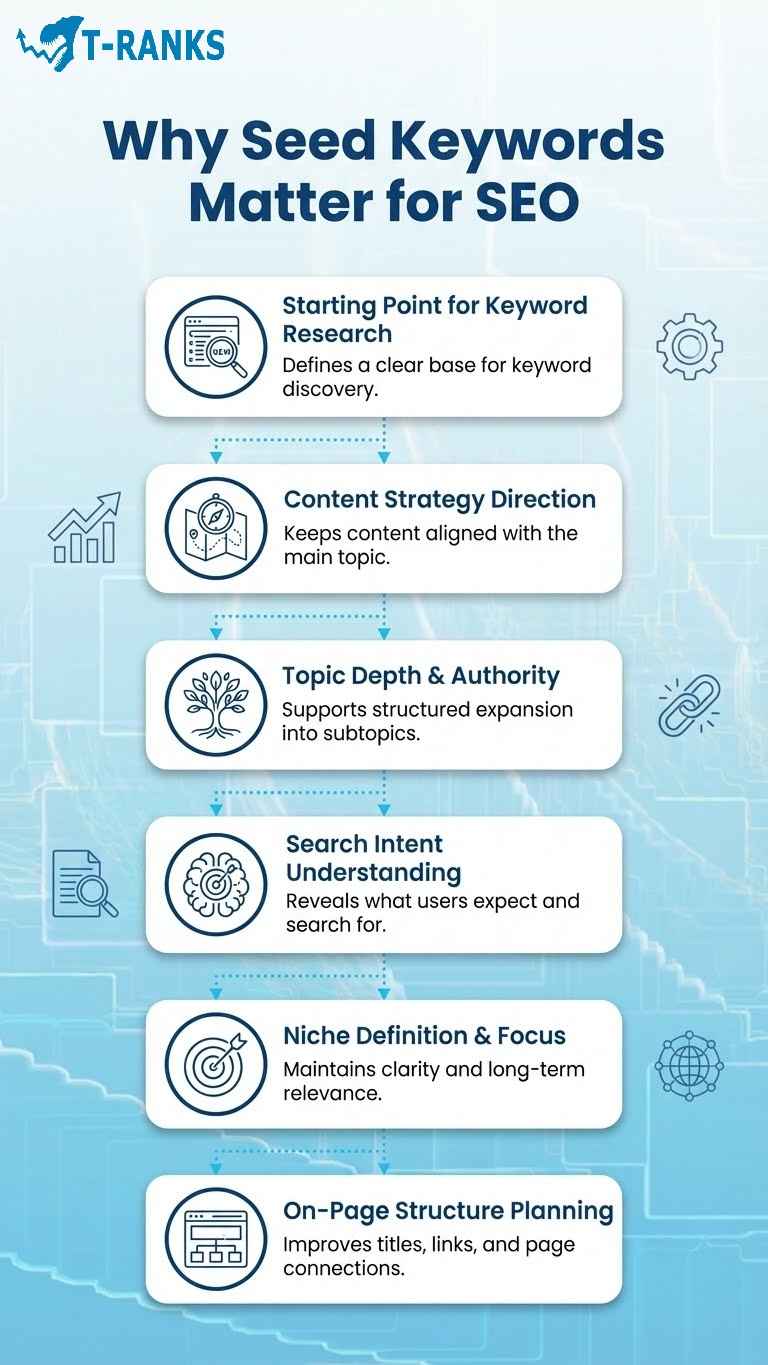
Seed keywords matter because they create structure in SEO from the very beginning. They help define what to research, what content to create, and how pages should connect under a clear topic focus.
Let’s look at why seed keywords matter for SEO and how they shape keyword research and content planning.
Starting Point for Keyword Research
Keyword research needs a clear starting point. A broad base term gives direction to the research process and helps tools generate relevant keyword ideas instead of unrelated suggestions. When this starting point is clear, keyword research becomes easier to manage and more purposeful.
Content Strategy Direction
A clear base topic guides content planning. It helps decide which topics belong on a website and which do not. This prevents random content creation and ensures every page supports the main theme of the site.
Over time, this direction leads to consistent content growth instead of scattered articles that struggle to rank.
Topic Depth and Authority Building
Search engines reward websites that cover topics in depth. A broad base topic makes it easier to expand into related subtopics and supporting pages. This creates organized content groups that signal expertise, relevance, and trust.
As topic coverage grows, search engines gain more confidence in the site’s authority.
Search Intent Understanding
Broad topic terms reflect how users begin searching. Expanding these terms reveals common questions, needs, and expectations. This insight helps create content that matches user intent instead of guessing what might work.
Niche Definition and Focus
A clear base topic defines the niche of a website or content section. It sets boundaries and keeps messaging aligned with what the audience is actually searching for. This focus improves relevance and long term consistency.
On Page Structure Planning
A strong base topic supports better planning of titles, headings, URLs, and internal links content planning
. Pages feel connected instead of isolated. This structure helps search engines understand content relationships and improves overall site clarity.
Practical Example
For a bakery business, base topics may include bakery, cakes, or pastries. Researching these topics can uncover specific searches like vegan cupcakes, wedding cake delivery, or best pastries near me. One broad idea turns into multiple targeted content opportunities.
Characteristics of a Seed Keyword
A seed keyword has specific traits that make it suitable as a starting point for keyword research. These characteristics help distinguish seed keywords from detailed or long-tail keywords.
Broad Topic Scope
A seed keyword represents a wide topic rather than a specific question or solution. It covers an entire subject area, which allows many related keyword ideas to grow from it.
For example, SEO covers a broad topic, while how to get backlinks for SEO is already too specific to act as a starting point.
Short Length
Most seed keywords are one or two words long. This short length helps them represent concepts instead of detailed searches.
Long phrases usually contain intent signals and are better suited for later stages of keyword research, not the starting stage.
High Search Demand
Seed keywords often have high search volume because they describe popular topics. Many people search these terms when they begin exploring a subject.
High search demand shows interest, not ranking opportunity. Seed keywords are not chosen for easy traffic but for topic discovery.
High Competition
Because seed keywords are broad and popular, they are usually competitive. This is expected and should not be avoided.
Competition at this stage does not indicate difficulty. It indicates that the topic has value and relevance.
Lack of Modifiers
Seed keywords do not include qualifiers such as “best,” “cheap,” “near me,” or dates. These modifiers appear later when users refine their searches.
For example, marketing is a seed keyword, while best digital marketing strategy is not.
Unclear Search Intent
Seed keywords often have mixed or unclear intent. A search for SEO could mean learning, hiring services, or researching tools.
This lack of clear intent is normal at the seed stage and becomes clearer when the keyword is expanded into more specific searches.
Expandable Into Multiple Keyword Paths
A good seed keyword can branch into many directions. It can generate informational keywords, commercial keywords, comparisons, and problem-focused searches.
If a keyword cannot expand into many related ideas, it is usually too narrow to act as a seed.
Seed Keyword Examples (Explained)
Seed keywords are easiest to understand when you see how they work in real situations. The examples below show how a broad idea becomes the starting point for many related topics and keyword ideas.
Example 1: SEO Website
If a website is about search optimization, the main seed keyword can be SEO. This keyword represents the overall focus of the website.
From this seed keyword, major topics can be planned, such as:
- on page SEO
- off page SEO
- technical SEO
- keyword research
Each of these topics can later act as a new seed keyword for deeper content planning.
Example 2: Topic-Level Seed Keyword
If you are writing content specifically about off page SEO, this phrase becomes the seed keyword for that topic.
From off page SEO, you can expand into more detailed keyword ideas, such as:
- off page SEO techniques
- off page SEO backlinks
- off page SEO examples
- off page SEO checklist
Here, off page SEO is not chosen to rank directly. It is used to guide topic expansion.
Example 3: Ecommerce Business
For an online store selling shoes, a clear seed keyword can be shoes.
This broad keyword helps organize product categories and content, such as:
- running shoes
- formal shoes
- men’s shoes
- women’s shoes
Each category can then expand into detailed product pages and supporting content.
Example 4: Local Service Business
For a local plumbing business, the seed keyword can be plumber.
From this starting point, keyword ideas may include:
- emergency plumber
- residential plumber
- commercial plumber
- plumber near me
The seed keyword defines the service, while expanded keywords target specific needs and locations.
Example 5: Blog or Educational Website
For a fitness blog, a suitable seed keyword can be fitness.
This seed keyword can grow into content topics like:
- fitness workouts
- fitness diet plans
- fitness for beginners
- home fitness exercises
The seed keyword keeps the blog focused on one clear theme.
Industry-Based Seed Keyword Examples
To make this even clearer, here are simple industry examples:
- Bakery: bakery, cakes, pastries
- Fitness: fitness, workouts, yoga
- Marketing: marketing, digital marketing, SEO
- Technology: laptops, headphones, smartphones
- Fashion: dresses, shoes, clothing
Each of these is broad enough to support many related keyword ideas.
Key Point to Remember
A seed keyword:
- Is broad, not specific
- Represents a topic, not a question
- Helps plan structure before content is written
- Can expand into many related keywords
If a keyword can support multiple topics and pages, it works well as a seed keyword
How to Brainstorm Seed Keywords (Key Differentiator)
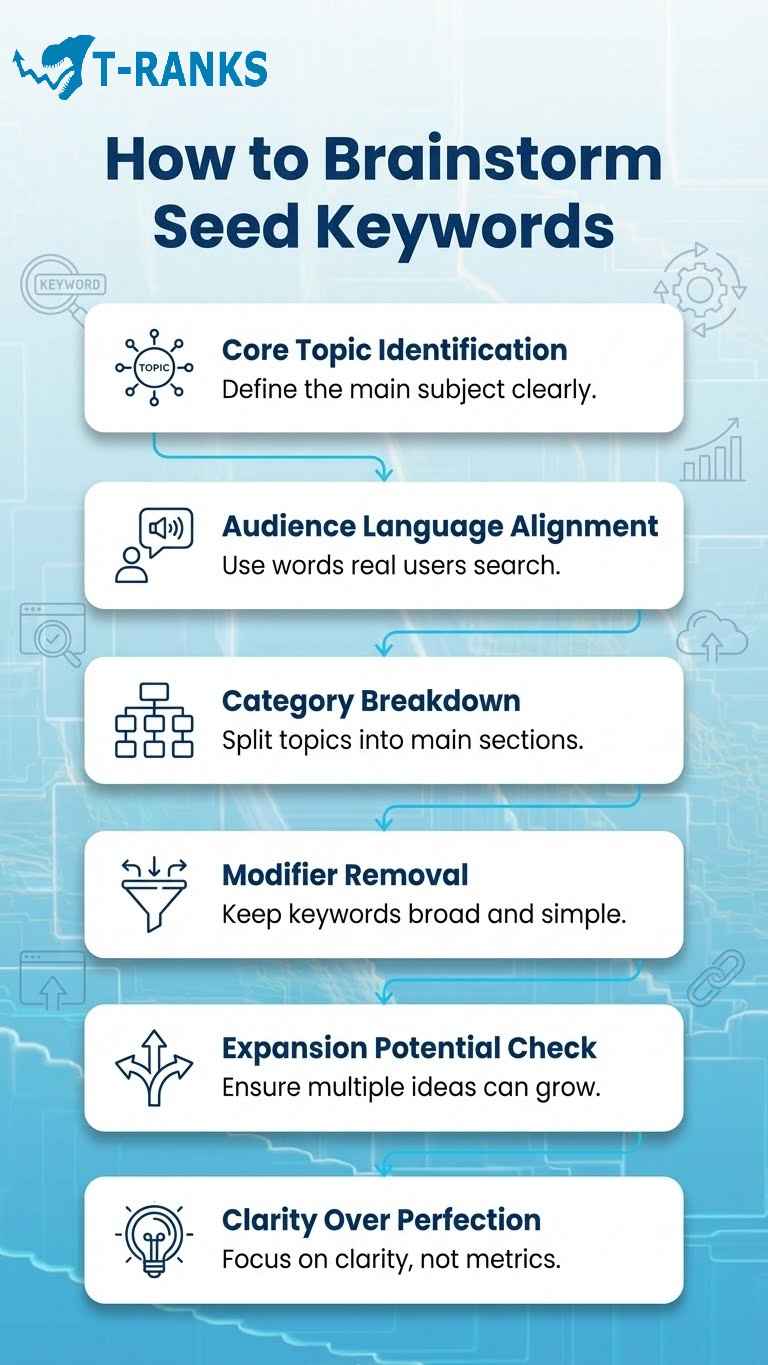
Brainstorming seed keywords is a thinking process, not a tool-based task. The goal is to identify clear starting points before expanding into detailed keyword research.
Core Topic Identification
Start by defining the main topic you want to focus on. This can represent the entire website or a specific section within it.
Ask one simple question:
What is the main subject this website or topic is about?
Examples:
- A search optimization website starts with SEO
- A fitness blog starts with fitness
- An online shoe store starts with shoes
This main subject usually becomes the first seed keyword.
Audience Language Alignment
Next, focus on how real users describe this topic when searching online. Avoid internal business terms, technical wording, or marketing phrases.
Seed keywords should match natural search behavior.
For example:
- Users search for SEO, not “search engine visibility”
- Users search for shoes, not “footwear products”
Clear and common language works best at this stage.
Category and Service Breakdown
If a topic feels too broad, break it into its main categories or services. Each category can act as a topic-level seed keyword.
Examples:
- SEO → on page SEO, off page SEO, technical SEO
- Fitness → workouts, diet, yoga
- Bakery → cakes, pastries, bread
These category-level terms help structure content more effectively.
Modifier Removal
Seed keywords should stay broad. Remove words that narrow intent or signal decision-making stages.
Avoid:
- best
- cheap
- near me
- for beginners
- dates or years
For example:
- Use digital marketing, not best digital marketing strategy
- Use cakes, not birthday cakes near me
Modifiers belong to later stages of keyword expansion.
Expansion Potential Check
A quick check helps confirm whether a keyword works as a seed.
Ask:
- Can this keyword support multiple subtopics?
- Can it expand into guides, questions, and comparisons?
If a keyword only supports one narrow idea, it is likely too specific to act as a seed.
Practical Walkthrough Example
For a bakery business, brainstorming may start with:
- bakery
- cakes
- pastries
From cakes, future expansion may include:
- wedding cakes
- chocolate cakes
- custom cakes
The brainstorming stage focuses on identifying broad starting points, not final keywords.
Clarity Over Perfection
At this stage, accuracy and search volume are not required. The goal is clarity.
A strong seed keyword:
- Clearly describes the topic
- Feels natural to say
- Matches how users search
Validation comes later with tools.
Key Takeaway
Seed keyword brainstorming is about defining the right starting point. When this step is clear, keyword research becomes easier, faster, and more structured. Tools support the process, but clarity drives it.
How Seed Keywords Turn Into Keyword Ideas

Once you choose a seed keyword, it becomes the base for finding many keyword ideas. This is the stage where one broad topic starts turning into real content ideas.
The goal here is not to choose final keywords. The goal is to see how a topic naturally grows.
One Topic, Many Directions
A seed keyword covers a broad subject. People search for this subject in different ways.
For example, if the seed keyword is SEO, people may look for:
- basic explanations
- step by step guides
- tools and software
- common problems
All of these searches come from the same topic.
Keyword Ideas From Question
People often start learning a topic by asking questions.
From off page SEO, common searches may include:
- what is off page SEO
- how off page SEO works
- why off page SEO is important
These questions later become blog posts or guide topics.
Keyword Ideas From Subtopics
A seed keyword also breaks into smaller parts of the same topic.
Examples:
- SEO → backlinks, site audits, rankings
- Fitness → workouts, nutrition, recovery
- Bakery → cakes, pastries, bread
Each subtopic can later become its own content area.
Different Search Intent Types
People search with different goals in mind.
From digital marketing, keyword ideas may include:
- learning and research
- comparisons
- services and solutions
This helps you plan different types of content instead of repeating the same type again and again.
Clear Content Planning
When keyword ideas grow from one seed keyword, content planning becomes easier.
This helps you:
- avoid repeating topics
- organize content better
- connect related pages naturally
Everything stays connected to the same main topic.
Simple Example
If the seed keyword is cakes, keyword ideas may grow like this:
- types of cakes
- wedding cakes
- chocolate cake recipes
- custom cake designs
All of these ideas come from one starting topic.
Key Takeaway
A seed keyword does not stay alone. It grows into questions, subtopics, and different content ideas. When this growth is clear, planning content becomes simple and organized.
How to Find Seed Keywords Using Tools
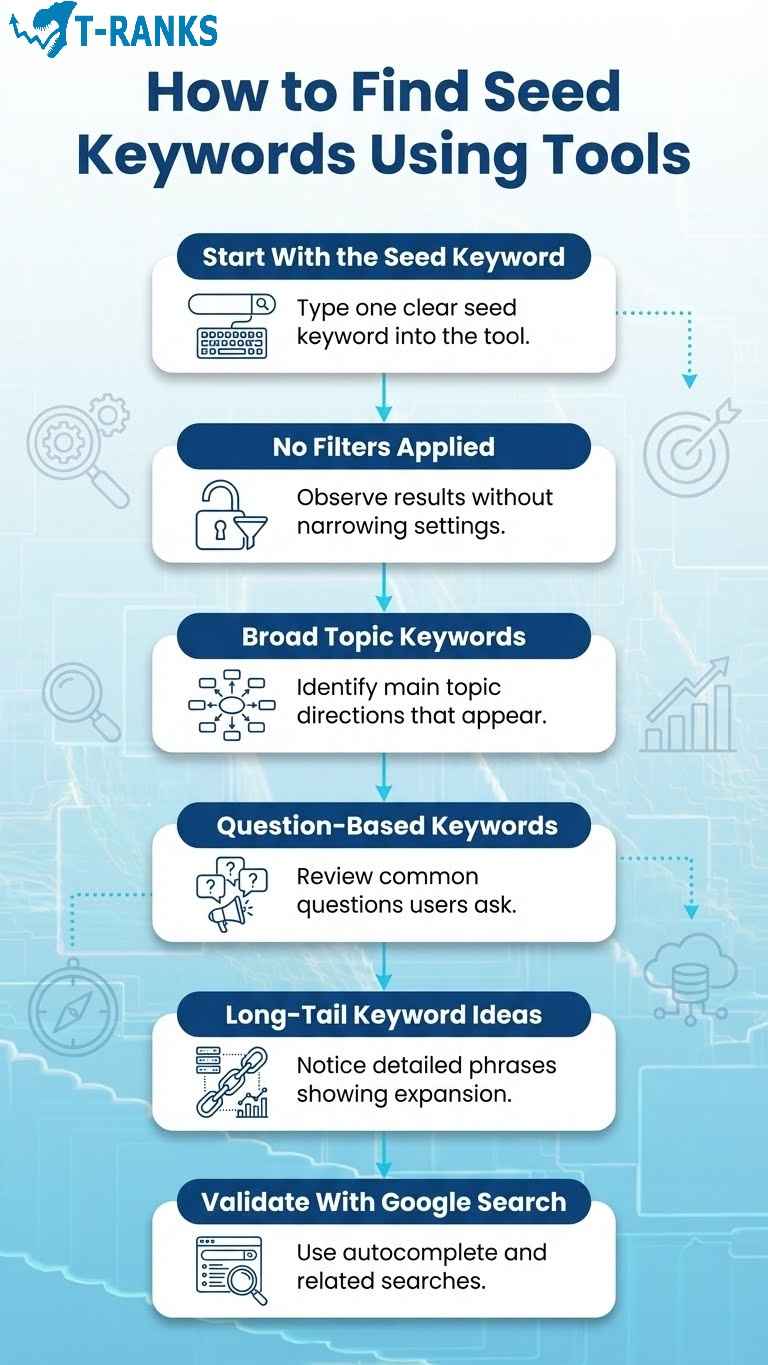
Once you have a clear seed keyword in mind, tools help confirm and expand it. Tools do not replace thinking. They simply show how people search around your topic.
This step is very simple. You type your seed keyword and observe what appears.
Entering the Seed Keyword
In tools like Semrush or Ahrefs, you start by typing your seed keyword into the search bar and pressing enter.
For example:
- SEO
- off page SEO
- fitness
- cakes
At this stage, you do not apply filters or settings. You only want to see how the topic expands.
Broad Topic Keywords
The first thing these tools usually show is a list of broad keyword ideas related to your seed keyword.
For example, from off page SEO, you may see:
- backlinks
- link building
- domain authority
These are not final keywords. They are topic directions that come from your seed keyword.
Question-Based Keywords
Most tools also show questions people ask around the seed keyword.
For example:
- what is off page SEO
- how off page SEO works
- why off page SEO is important
These questions help you understand learning intent and content opportunities.
Long-Tail Keyword Ideas
Next, tools display longer keyword phrases. These are more specific searches that come from the same topic.
For example:
- off page SEO techniques for beginners
- off page SEO checklist
- off page SEO strategies
These keywords are useful later, but for now they confirm that your seed keyword can grow.
Using Google Search as a Tool
Google is also a powerful tool for this step.
You can:
- type the seed keyword into Google
- look at autocomplete suggestions
- review “People also search for”
- scroll to related searches at the bottom
These results show how real users think about the topic.
What to Look For at This Stage
When using tools, focus on:
- whether many related ideas appear
- whether topics stay relevant
- whether questions and subtopics make sense
Do not worry about difficulty or competition yet.
Simple Example
If you type fitness into a tool, you may see:
- fitness workouts
- fitness training
- fitness tips
- fitness for beginners
This confirms that fitness works well as a seed keyword.
Key Takeaway
Tools help you see how a seed keyword expands. You type one word, press enter, and observe topics, questions, and longer phrases. This confirms whether your seed keyword is strong before moving to detailed keyword selection.
Common Mistakes Beginners Make With Seed Keywords

Seed keywords are simple, but small misunderstandings can cause big problems later. These are the most common mistakes beginners make when working with seed keywords and why they should be avoided.
Starting With Keywords That Are Too Specific
A common mistake is choosing very detailed phrases as seed keywords. These phrases already describe a specific problem or solution, which limits expansion.
For example, how to build backlinks for local SEO is already an article idea. A broader term like off page SEO works better as a starting point because it can grow into many topics.
Using Tools Before Clarifying the Topic
Many beginners open SEO tools before deciding what they actually want to focus on. This usually leads to thousands of keyword ideas without direction.
Seed keywords should be chosen through thinking first. Tools are meant to support that choice, not replace it.
Avoiding Competitive Topics Too Early
High competition often scares beginners into choosing weak or unclear topics. This creates confusion and poor content structure.
Seed keywords are naturally competitive because they represent popular topics. Competition at this stage is normal and expected.
Adding Modifiers Too Early
Words like best, cheap, near me, or specific years narrow the topic too soon. These words belong to later keyword selection stages.
For example, best SEO tools is too narrow for a seed keyword. SEO tools works better as a base topic.
Confusing Website Topics With Article Keywords
Another mistake is using article-level phrases as seed keywords for planning.
For example, off page SEO checklist is a good article idea, not a good seed keyword. Using it too early limits topic expansion.
Expecting Seed Keywords to Rank Directly
Some beginners expect seed keywords to bring traffic or rankings on their own. This leads to frustration.
Seed keywords are used for planning and structure. They help generate better keywords, not act as ranking targets.
Changing Direction Too Often
Switching seed keywords repeatedly breaks focus. This leads to scattered content and weak topical coverage.
Once a seed keyword is chosen, it should guide research and planning consistently before moving on.
Key Takeaway
Seed keywords work best when they are broad, clear, and stable. Avoiding these mistakes helps create a strong foundation for keyword research, content planning, and long-term SEO growth.
Simple Seed Keyword Workflow for Beginners

Seed keyword research works best when it follows a clear process. This simple workflow helps beginners move step by step without confusion.
Step 1: Define the Main Topic
Start by deciding what your website or content section is about. Focus on one main subject only.
Examples:
- SEO
- fitness
- shoes
- bakery
This step sets direction. Do not think about keywords yet.
Step 2: Choose the Seed Keyword
Turn the topic into a short and simple keyword. This keyword should describe the topic clearly without extra words.
Good examples:
- SEO
- off page SEO
- fitness
- cakes
Avoid long phrases like:
- best SEO strategies
- fitness tips for beginners
- cheap cakes near me
Broad keywords work better at this stage.
Step 3: List Related Topics
Think about how the seed keyword breaks into smaller parts. Write down categories, services, or main ideas related to it.
Examples:
- SEO → on page SEO, off page SEO, technical SEO
- fitness → workouts, diet, yoga
- cakes → wedding cakes, chocolate cakes, custom cakes
This step helps shape your site or content structure.
Step 4: Confirm With Tools
Now use tools to confirm your ideas. Type the seed keyword into keyword research tools or Google search.
Look for:
- related topics
- common questions
- longer keyword phrases
This step confirms that your seed keyword can expand. Tools support your choice. They do not replace it.
Step 5: Group Keywords by Topic
Organize keyword ideas into clear groups. Each group should focus on one topic only.
This helps:
- plan articles
- avoid overlapping content
- build clear topic sections
Each group can later become a page or article.
Step 6: Create Content in Order
Start content creation with broad topic pages. Then move toward more detailed articles.
Seed keywords guide planning. Detailed keywords guide writing.
Key Takeaway
Seed keyword research does not need to be complicated. Define the topic, choose a clear seed keyword, expand logically, and confirm with tools. This workflow gives beginners a clear and repeatable path for SEO planning.
Seed Keywords vs Seed Topics

Seed keywords and seed topics are closely related, but they are not the same. Understanding the difference helps you plan content more clearly and avoid mixing ideas.
What Is a Seed Topic
A seed topic is a broad subject area. It describes what your website or content section is about at a high level.
Examples of seed topics:
- SEO
- fitness
- digital marketing
- bakery
Seed topics are ideas. They are not written exactly as keywords. They help you define direction.
What Is a Seed Keyword
A seed keyword is the searchable form of a seed topic. It is the word or phrase people actually type into Google.
Examples:
- Seed topic: SEO → Seed keyword: SEO
- Seed topic: fitness → Seed keyword: fitness
- Seed topic: bakery → Seed keyword: bakery
Seed keywords turn topics into something you can research and expand.
How Seed Topics and Seed Keywords Work Together
Seed topics come first in thinking. Seed keywords come next in research.
The process usually looks like this:
- Decide the topic you want to cover
- Convert that topic into a seed keyword
- Use the seed keyword to find related keyword ideas
For example:
- Seed topic: off page SEO
- Seed keyword: off page SEO
- Expanded ideas: backlinks, link building, authority
Why This Difference Matters
Mixing topics and keywords can cause confusion.
If you only think in keywords, content can feel scattered.
If you only think in topics, keyword research stays incomplete.
Using both together helps you:
- Plan content clearly
- Keep site structure organized
- Expand topics naturally
- Avoid random keyword targeting
Simple Way to Remember
You can remember it like this:
- Seed topic = what you want to talk about
- Seed keyword = how people search for it
Both are needed for effective SEO planning.
Key Takeaway
Seed topics define direction. Seed keywords make that direction searchable. When you understand how they work together, keyword research becomes clearer, more structured, and easier to manage.
Conclusion
SEO keyword research becomes easier when you start in the right place. That starting point is the seed keyword.
Seed keywords help you define your topic, organize content, and expand ideas in a clear and structured way. Instead of jumping into tools or chasing random keywords, you begin with one focused idea and build from there.
By understanding how seed keywords work, how they grow into keyword ideas, and how tools support the process, beginners can plan SEO with confidence. The goal is not to find perfect keywords on day one. The goal is to create clarity and direction.
When the foundation is clear, everything else becomes simpler. Content planning feels natural, keyword research becomes manageable, and SEO no longer feels confusing.
Start with one clear seed keyword. Build around it step by step. That is how strong SEO begins.
FAQs About Seed Keywords
What is a seed keyword in SEO?
A seed keyword is a broad word or phrase that represents the main topic of a website or content section.
It is used as the starting point for keyword research to generate related topics, questions, and long-tail keywords.
Are seed keywords used for ranking directly?
No, seed keywords are not chosen to rank directly.
They are used for planning and expansion, while more specific keywords are used for ranking content.
What is the difference between a seed keyword and a long-tail keyword?
A seed keyword is broad and general, while a long-tail keyword is specific and detailed.
Seed keywords help discover long-tail keywords, not replace them.
Can a website have more than one seed keyword?
Yes, a website can have multiple seed keywords for different main sections.
Each seed keyword should represent a clear and distinct topic area.
How many seed keywords should I start with?
You should start with one seed keyword per topic or content section.
Starting with too many seed keywords at once creates confusion and weakens focus.
Do seed keywords always have high search volume?
Yes, seed keywords usually have high search volume and competition.
This is normal because they represent popular topics, not easy ranking opportunities.
Can seed keywords be used for individual blog posts?
Yes, seed keywords can be used at the topic level for blog posts.
In this case, the seed keyword defines the post’s main subject and guides subtopics.
How do I know if a keyword works as a seed keyword?
A keyword works as a seed if it can expand into many related topics and questions.
If it only supports one narrow idea, it is too specific.
Should I use SEO tools to find seed keywords?
Yes, but only after brainstorming.
Tools help confirm and expand seed keywords, not decide them from scratch.
What happens if I choose the wrong seed keyword?
Choosing the wrong seed keyword leads to scattered content and poor topic structure.
This makes keyword research harder and weakens long-term SEO performance.
Are seed keywords important for topical authority?
Yes, seed keywords are essential for building topical authority.
They help organize content around clear themes that search engines understand and trust.
What is the biggest mistake beginners make with seed keywords?
The biggest mistake is treating seed keywords as ranking targets.
Seed keywords are planning tools, not keywords meant to bring traffic directly.