You did everything right. You optimized your Google Business Profile. You built citations. You collected reviews. But you still cannot outrank Yelp or the big franchise in your city.
That situation is frustrating. Many small business owners experience it. The problem is not your effort. The problem is authority.
Local link building for small businesses helps you build the trust signals Google looks for when deciding who deserves to rank at the top. Bigger competitors often have hundreds of backlinks built over many years. That gives them stronger domain authority and makes it difficult for newer or smaller businesses to compete.
This difference is called the authority gap. It is the hidden reason why directories and franchises keep winning.
In this guide, you will learn what local link building really means, why citations and Google Business Profile are not enough in competitive markets, and how to close the authority gap step by step.
Why Local Businesses Struggle to Rank Even After Doing Everything Right
Local businesses struggle to rank not because they fail at optimization, but because they lack authority compared to their competitors.
Many business owners complete every visible task. They optimize their Google Business Profile, correct their name, address, and phone number across directories, collect reviews, and improve their website content.
Yet rankings do not improve.
Let’s look at a real example.

In the screenshot above, someone searches for “tea shop” in Dera Ismail Khan. Google shows a list of businesses in the local results.
Some shops have strong ratings. Some have fewer reviews. Yet certain businesses consistently appear higher than others.
That ranking is not random. It is influenced by deeper signals.
When Google evaluates businesses in the same city offering the same service, it considers three primary factors:
• Relevance, how well the business matches the search
• Distance, how close the business is to the searcher
• Prominence, how trusted and established the business appears online
Most small businesses improve relevance and distance. They select proper categories, add service descriptions, and maintain accurate information.
But prominence works differently.
Prominence is strongly influenced by backlinks. Backlinks are links from other websites pointing to your website. Each quality backlink acts as external validation. It signals that other trusted websites recognize your business.
If one tea shop has been mentioned on local blogs, linked from community websites, or featured in online news, Google sees it as more established.
Another tea shop may have similar reviews and similar optimization, but fewer backlinks. That business has weaker authority signals.
This difference is called the authority gap.
The authority gap is the difference between your website’s backlink strength and the backlink strength of the competitors ranking above you.
Until that authority gap is addressed, even well optimized local businesses can remain outranked by directories, franchise chains, and competitors with stronger backlink profiles.
When that gap is large, even well optimized local businesses can be consistently outranked by directories, franchise chains, and competitors with stronger backlink profiles.
What Is Local Link Building

Local link building for small businesses is the process of earning clickable links to your website from other websites that are connected to your city or your industry.
A backlink is a clickable link from one website to another. When another trusted website links to your business, it acts like a recommendation. Google reads that recommendation as a signal of trust.
Local link building is different from general link building.
General link building focuses on increasing overall domain authority by earning links from strong websites anywhere on the internet. The goal is broad visibility across national or global search results.
Local link building focuses on earning links that strengthen your authority within a specific geographic area. The goal is to rank higher for location based searches such as “plumber in Chicago” or “dentist in Dera Ismail Khan.”
For local rankings, relevance matters in two important ways:
• Geographic relevance, meaning the linking website is tied to your city, region, or community
• Topical relevance, meaning the linking website is tied to your industry or services
For example, a backlink from your city’s Chamber of Commerce sends a strong geographic signal. A backlink from an industry association sends a strong topical expertise signal. When both are present, Google gains stronger confidence that your business is established in that local market.
This is where many beginners get confused.
Citations and backlinks are not the same.
A citation is a mention of your business name, address, and phone number on a directory or listing website. It may not include a clickable link. Citations help Google verify consistency and confirm that your business exists in a specific location.
A backlink is a clickable link that passes authority from one website to yours. Backlinks transfer trust and directly influence prominence and ranking strength.
Citations confirm your presence.
Backlinks build your authority.
In competitive local niches, citations help you get recognized. Local link building for small businesses helps you close the authority gap and compete with stronger domains.
Why Citations and Google Business Profile Are Not Enough

Citations and Google Business Profile help your business show up in local search, but they do not give you the power to rank at the top.
Citations make sure your business information is the same everywhere online. When your name, address, and phone number are consistent across directories, Google feels confident that your business is real and located where you say it is.
Google Business Profile helps Google understand what you do. Your categories, services, photos, and reviews help your business appear for searches like “dentist near me” or “HVAC repair in Houston.”
These steps improve two things:
• Relevance, how well your business matches a search
• Proximity, how close your business is to the searcher
But they do not strongly improve authority.
In competitive markets, most businesses already have complete profiles, correct citations, and good reviews. When many businesses look similar, Google needs another way to decide who ranks first.
That deciding factor is authority.
Authority mainly comes from backlinks. When trusted websites link to your business, Google sees that as proof that your business is important and credible.
For example, if one company is linked by local news sites, industry groups, and community organizations, it appears more established than a competitor with no strong backlinks.
Even with perfect NAP consistency and a fully optimized profile, a business can still lose if it has weak link authority.
Citations confirm your business details.
Google Business Profile helps you get found.
Backlinks help you outrank competitors.
In competitive local niches, backlinks are not optional. They are necessary to move beyond basic visibility and reach the top positions.
How Backlinks Influence Local Rankings

Backlinks influence local rankings by increasing your website’s authority. More authority helps your business rank higher in both organic search results and Google Maps.
Google does not rank local businesses based only on reviews or profile optimization. When several businesses offer the same service in the same city, Google compares their authority. Backlinks are one of the strongest signals used to measure that authority.
In simple terms, backlinks are votes of trust. When other trusted websites link to your business, Google sees that as proof that your business is credible.
Stronger backlinks build stronger domain trust.
Stronger trust improves rankings.
To understand this fully, it helps to separate organic rankings and Google Maps rankings.
How Backlinks Affect Your Website’s Organic Rankings
Backlinks improve organic rankings by passing authority from one website to another.
When a reputable website links to you, part of its trust flows to your site. This is often called link equity. You can think of it as reputation being shared.
If PBNLinks.agency earns links from respected SEO blogs and marketing websites, Google sees that site as trusted in the SEO industry. That trust makes it easier to rank for competitive keywords related to link building.
The process is simple:
More relevant backlinks → More authority → More trust → Higher organic rankings
Businesses with stronger backlink profiles usually rank above competitors that have similar content but weaker authority.
How Backlinks Affect Your Google Maps Rankings
Backlinks also affect Google Maps rankings.
Google uses something called prominence when deciding which businesses appear in the local pack. Prominence means how well known and trusted a business appears online.
Your website and your Google Business Profile are connected. If your website has strong authority, your overall prominence improves.
If two businesses have similar reviews and are located close to the searcher, the one with stronger backlinks often ranks higher in the map results.
The process works like this:
Stronger backlinks → Higher website authority → Better prominence → Higher map visibility
This is why local link building for small businesses improves both website rankings and Google Maps rankings at the same time. Backlinks strengthen the overall trust of your business in Google’s eyes.
The Authority Gap — Why Directories and Franchises Always Outrank You

The authority gap is the difference between your website’s link strength and the link strength of the competitors ranking above you.
This gap is the main reason directories and franchises dominate local search results.
Websites like Yelp and Angi have been online for many years. During that time, they have earned thousands of backlinks. News sites link to them. Bloggers mention them. Businesses create profiles on them. Industry websites reference them. Each of these links increases their authority.
Franchise brands also benefit from strong national websites. Even if you compete with a local branch, that branch is supported by the authority of a larger domain. That authority helps it rank more easily.
Now compare that to a typical local HVAC company or dental clinic.
Most small business websites have far fewer referring domains. Many of their links come from basic directories. Even with good reviews and accurate business information, their overall authority is much lower.
Citations confirm your business details.
Google Business Profile helps customers find you.
But neither builds strong domain authority.
When Google compares your site to a directory with thousands of backlinks, it sees a big difference in trust and strength. That difference is the authority gap.
You cannot close this gap by submitting to more directories. You cannot fix it by adding more reviews. Those actions help, but they do not increase authority enough to compete.
The only way to close the authority gap is through strategic link building.
This means earning real backlinks from trusted local organizations, local news websites, industry associations, and relevant partners. It means steadily increasing the number and quality of websites linking to you.
As your authority grows, the gap becomes smaller. When the gap becomes small enough, your business can compete.
Local ranking is not only about optimization. It is about authority. If you want to outrank directories and franchises, you must build enough authority to challenge them.
Types of Backlinks That Work for Local Businesses
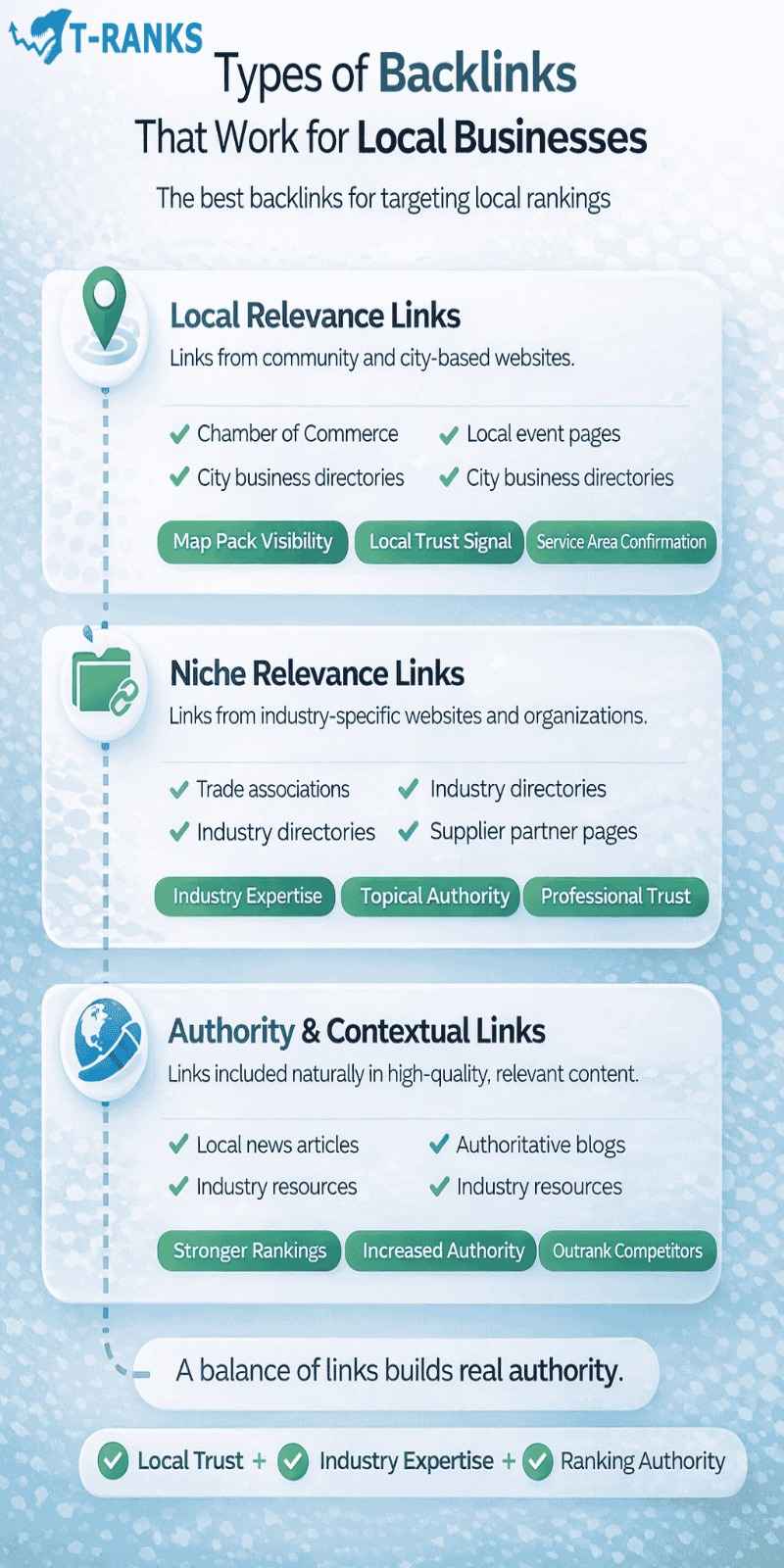
Not every backlink helps your rankings in the same way. For effective local link building for small businesses, you need links that are relevant, trustworthy, and connected to your city or your industry.
A strong backlink profile is built with a mix of link types. It is not about getting the highest number of links. It is about getting links that send clear trust signals to Google.
Below are the three backlink types that matter most for local businesses.
Local Relevance Links
Local relevance links come from websites in your city or region.
These links show Google that your business is truly part of the local community. They strengthen your geographic trust signal.
Common examples include:
• Chamber of Commerce websites
• Local event pages
• Community sponsorship pages
• City business directories
• Local newspapers
• Neighborhood blogs
For example, if your HVAC company sponsors a local sports team and gets listed on the team’s website, Google sees that as proof of real local involvement.
Local relevance links mainly help with:
• Building local trust
• Improving map pack visibility
• Confirming your service area
If you serve one city or region, these links are essential.
Niche Relevance Links
Niche relevance links come from websites related to your industry.
These links show Google that your business is recognized within its professional field. They strengthen your expertise signal.
Common examples include:
• Industry directories
• Trade associations
• Supplier or manufacturer partner pages
• Professional membership sites
• Industry resource websites
For example, if a dentist is listed on a dental association website, that builds topical authority. If a contractor appears on a manufacturer’s certified installer page, that strengthens industry trust.
Niche relevance links mainly help with:
• Proving industry expertise
• Increasing topical authority
• Building professional credibility
Local trust helps you compete in your city. Industry trust helps you compete in your niche. Both are important.
Authority and Contextual Links
Authority and contextual links are the most powerful type of backlinks.
These links appear naturally inside articles on trusted websites. They are not just directory listings. They are part of meaningful content.
Common examples include:
• A local news article mentioning your business
• A blog post linking to your service guide
• An industry article referencing your case study
• A feature story about your company
When your link appears inside relevant content, Google better understands why your business is being mentioned. This increases the value of the link.
Authority and contextual links mainly help with:
• Increasing domain strength
• Improving overall rankings
• Competing with stronger websites
These links often have more impact than dozens of low-quality links.
A smart local link building strategy for small businesses includes all three:
• Local relevance links for geographic trust
• Niche relevance links for industry expertise
• Authority and contextual links for strong ranking power
When combined, these links build real authority and help close the authority gap against larger competitors.
What a Healthy Local Backlink Profile Looks Like
A healthy local backlink profile looks natural and realistic. It shows Google that your business is trusted, active, and recognized in your city and your industry.
For local link building for small businesses, the goal is not to collect as many links as possible. The goal is to build a profile that looks like it grew over time as your business earned real mentions.
Here is what a balanced backlink profile looks like in simple terms.
1. Links From Local and Industry Websites
Your backlinks should come from websites related to:
• Your city or region
• Your industry or service
Examples include:
• Local news websites
• Chamber of Commerce pages
• Community event listings
• Industry associations
• Supplier or partner websites
Local links tell Google where you operate.
Industry links tell Google what you are good at.
When both types are present, your authority becomes stronger.
2. Links From Quality Websites
Quality matters more than quantity.
A few links from trusted websites are more powerful than many links from weak directories.
Good sources usually include:
• Established local media
• Professional organizations
• Recognized industry websites
• Real business partners
These links pass more authority and help improve rankings.
3. Diverse Anchor Text
Anchor text is the clickable text in a backlink.
A healthy profile includes a mix of:
• Branded anchors, such as your business name
• Naked URLs, such as https://t-ranks.com/
• Generic words, such as “learn more”
• Partial match phrases, such as “affordable roofing services in Multan”
What you should avoid is using the same exact keyword again and again.
If most of your backlinks say “best electrician Dallas,” it looks unnatural. Google may see that as manipulation. Real businesses get mentioned in different ways, so anchor text should vary.
4. Steady Link Growth
Backlinks should grow slowly and consistently.
If a small business suddenly gets hundreds of new links in a short time, it can look suspicious. Natural growth happens through ongoing activity such as partnerships, sponsorships, and content sharing.
Slow and steady growth builds trust.
5. Links to Different Pages
A healthy backlink profile does not send every link to your homepage.
Strong profiles include links to:
• The homepage
• Service pages
• Location pages
• Helpful blog content
This shows that different parts of your website provide value.
What You Are Building Toward
As a beginner, your goal is clear.
You want a backlink profile that looks:
• Natural
• Balanced
• Relevant
• Gradually expanding
When your links show local presence, industry expertise, varied anchor text, and steady growth, Google sees your business as established.
That is what a healthy local backlink profile looks like. And that is what helps local link building for small businesses close the authority gap and compete with stronger competitors.
How to Get Local Backlinks — Strategies That Work in 2026
You get local backlinks by earning links from trusted websites connected to your city or your industry.
For local link building for small businesses, the focus in 2026 is relevance and credibility, not mass submissions. The goal is to build authority that helps close the authority gap against stronger competitors.
Strong local backlinks usually come from:
• Local organizations
• Industry associations
• Community involvement
• Business partnerships
• Useful local content
Now let’s break down the most practical and effective ways to earn these types of links step by step.
Get Listed in Quality Local and Industry Directories
Start with strong, relevant directories.
Not all directories are equal.
Quality directories:
• Are connected to your city or industry
• Are moderated and maintained
• Have real businesses listed
• Provide actual visibility
Examples include:
• Chamber of Commerce websites
• Professional trade associations
• Trusted local business directories
• Manufacturer or supplier partner pages
Spam directories are different. They:
• Accept anyone instantly
• Contain thousands of unrelated listings
• Provide no real traffic
• Exist only to sell links
For local link building for small businesses, directory links build foundational trust. Focus on authoritative and relevant placements instead of submitting your website to hundreds of low-quality sites.
Sponsor Local Events and Community Organizations
Sponsoring local activities creates strong geographic relevance.
You can sponsor:
• Youth sports teams
• Charity events
• Community festivals
• School programs
• Local workshops
Most organizations list sponsors on their websites and include backlinks.
These links matter because they confirm real community involvement. Google sees that your business is active locally, not just listed online.
Sponsorship links improve:
• Geographic trust
• Local relevance
• Map pack competitiveness
They are genuine signals of local presence.
Get Featured in Local News and Press
Local press links are some of the strongest backlinks you can earn.
News websites are trusted domains. When they link to your business, they pass significant authority.
Ways to earn press coverage include:
• Offering expert commentary
• Sharing seasonal tips
• Launching community initiatives
• Announcing business milestones
• Providing local industry insights
You can reach out to journalists with helpful, newsworthy information instead of promotional content.
Press links carry strong trust signals because they are editorial. They are not purchased or self-submitted. They are earned.
Build Links Through Local Business Partnerships
Partnership links are natural and sustainable.
Look for complementary businesses such as:
• Realtors and home inspectors
• Dentists and orthodontists
• Plumbers and renovation contractors
• HVAC companies and equipment suppliers
You can:
• List trusted partners on your website
• Provide testimonials
• Collaborate on guides
• Reference each other’s services
These links are contextual and relevant. They reflect real business relationships.
Because they are natural, they strengthen both local and niche authority.
Create Content That Local Websites Want to Link To
Content can earn backlinks without direct outreach.
The key is local usefulness.
Examples include:
• City-specific service guides
• Seasonal maintenance checklists
• Neighborhood-focused pages
• Local resource directories
• Data or research related to your area
When your content genuinely helps local residents, bloggers and community websites are more likely to reference it.
Over time, this builds passive authority growth.
Reclaim Unlinked Brand Mentions and Broken Links
This is one of the easiest strategies beginners can implement.
Unlinked mentions happen when a website mentions your business name but does not link to your website.
You can:
• Search your business name in Google
• Identify mentions without links
• Contact the site owner and request a link
Broken link reclamation works when:
• Another website links to a page on your site that no longer exists
• You find broken competitor links and offer your page as a replacement
These methods are:
• Free
• Low effort
• High return
They help recover or capture authority that is already available.
Local link building for small businesses works best when these strategies operate together. Directory links build structure. Sponsorships build local trust. Press builds authority. Partnerships build relevance. Content earns natural links. Reclamation recovers lost value.
Consistency, not shortcuts, is what closes the authority gap and improves long-term local rankings.
What Is Tiered Link Building and Why Competitive Niches Need It
Tiered link building is a strategy where you build links to your backlinks, not just to your website.
Instead of pointing every link directly to your site, you create layers that strengthen your best links first. This helps increase authority in a safer and more structured way.
It usually works in two levels:
• Tier one links point directly to your website.
• Tier two links point to your tier one links.
This structure reinforces your strongest backlinks so they pass more authority to your site.
For local link building for small businesses, this approach becomes important in competitive niches where basic outreach alone is too slow to close the authority gap.
Let’s simplify each level.
Tier One Links
Tier one links are your most important backlinks. They connect directly to your website.
These should always be:
• High quality
• Relevant to your industry or location
• Placed on real, trusted websites
Examples include:
• Guest posts on industry blogs
• Niche edits inside relevant articles
• Local press placements
• Chamber of Commerce links
• Professional association listings
These are the links that directly influence your rankings.
Tier Two Links
Tier two links do not point to your website.
They point to your tier one links.
For example:
• A blog post linking to your guest article
• A content mention linking to a press article about your business
• Social or forum discussions referencing an industry article where you were featured
These links strengthen the page that links to you. When your tier one link becomes stronger, it transfers more authority to your website.
Think of it as reinforcing the strongest beams of your building instead of adding random weight to the structure.
Why Competitive Niches Need Tiered Link Building
In competitive local niches such as legal services, HVAC, dental clinics, and contracting, direct link building is often not enough.
If your competitors already have:
• Years of consistent link building
• Hundreds of referring domains
• Strong media coverage
• Established partnerships
Then adding a few new backlinks may not move rankings significantly.
Tiered link building offers important advantages in these markets:
• Amplifies link authority, by increasing the strength of your best backlinks
• Accelerates authority growth, helping you close the authority gap faster
• Creates a natural link structure, which mirrors how authority builds organically
• Minimizes risk, because reinforcement links do not point directly to your main domain
• Improves competitive positioning, especially for high-value local keywords
For example:
• You earn a strong local news backlink.
• You promote that article and attract additional links to it.
• That original backlink becomes stronger and passes more value to your site.
This layered structure makes each high-quality placement work harder for you.
For local link building for small businesses in competitive markets, tiered link building is not about manipulation. It is about structured reinforcement. It allows smaller businesses to compete with firms that already have large, established backlink profiles.
When used carefully, it becomes a strategic method to close the authority gap more efficiently than outreach alone.
How PBN Links Fit Into a Tiered Local Link Building Strategy
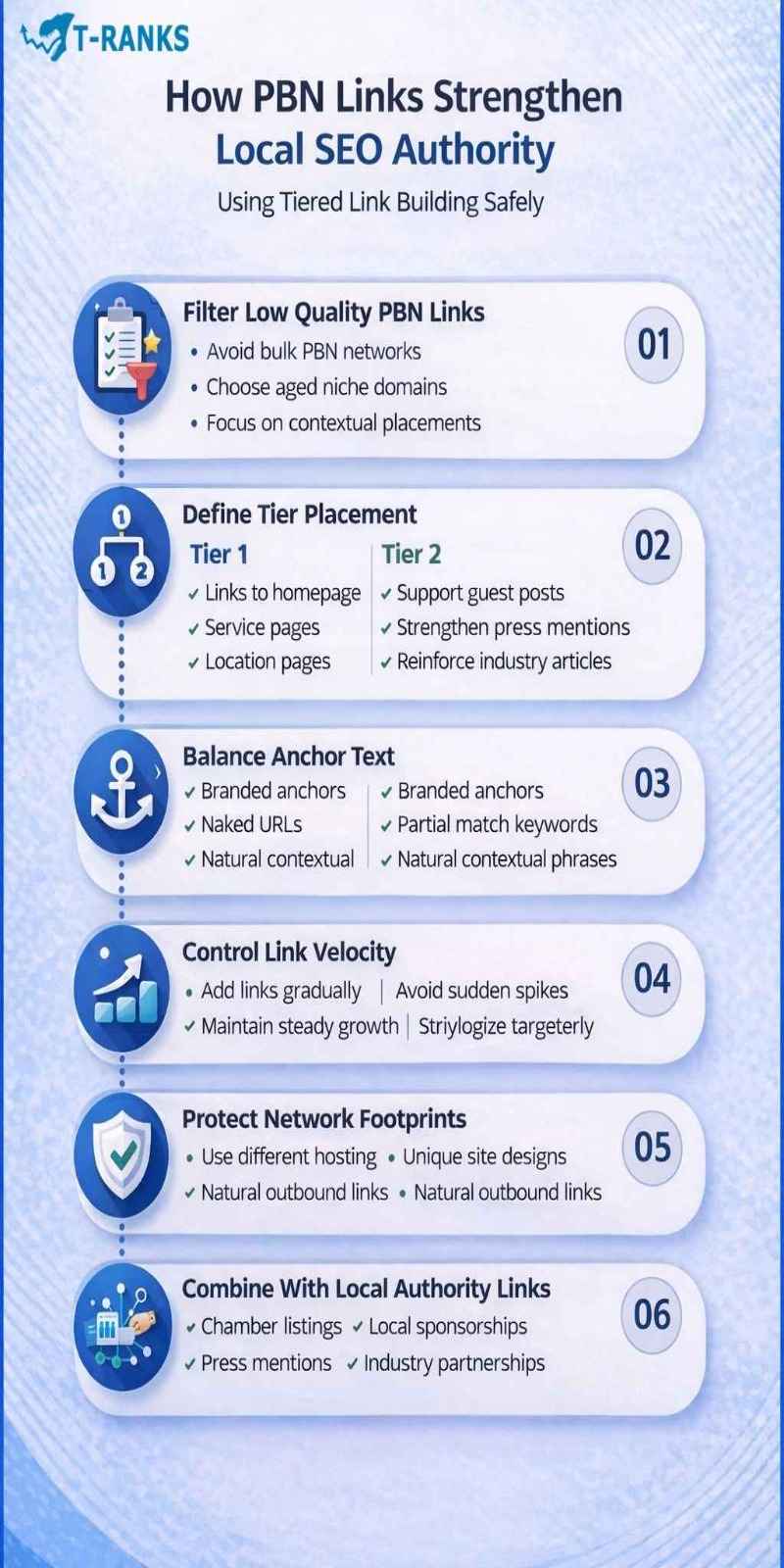
PBN Links Fit Into a Tiered Local Link Building Strategy as controlled authority reinforcements that strengthen key backlinks in competitive local niches. When outreach alone is too slow to close the authority gap, structured PBN placements can support primary assets without disrupting profile balance. When managed correctly, they enhance service pages or tier one links while maintaining risk control and strategic alignment.
To understand how this works in practice, the integration process can be broken down into clear, structured steps that build on each other.
Step 1: Separate Bulk PBN Links From Structured Placements
Not all PBN links carry the same weight or risk. The first step is distinguishing low-quality bulk links from professionally managed placements, because everything that follows depends on this decision.
Bulk PBN links are risky because they focus on volume instead of relevance. They often use repetitive anchors, share obvious hosting patterns, and create unnatural spikes in link growth.
Professionally managed placements operate differently. They use aged, niche-aligned domains, publish contextual content, and introduce links gradually. This structural difference determines whether PBN integration strengthens authority or increases exposure to penalties.
Once link quality is clearly defined, the next step is deciding how each placement fits into the tiered structure.
Step 2: Define the Tier Placement
After filtering for quality, PBN links must be assigned a clear role inside the tiered system.
Tier One Placement
These links point directly to:
• Homepage
• Service pages
• Location pages
This approach requires high-quality domains and natural contextual integration because the link connects straight to the primary site.
Tier Two Reinforcement
Instead of linking to the main site, the PBN link strengthens an existing tier one asset such as:
• A guest post
• A local press article
• An industry feature
Reinforcing strong tier one links increases their authority, which then transfers more value to the primary domain. In competitive local markets, tier two reinforcement often provides safer scaling.
With placement defined, the next layer of control focuses on anchor distribution.
Step 3: Control Anchor Text Distribution
Once tier placement is decided, anchor diversity becomes essential for maintaining a natural profile.
A healthy structure includes:
• Branded anchors
• Naked URLs
• Partial match phrases
• Contextual anchors
Overuse of exact match keywords creates over-optimization signals. Balanced anchor distribution protects ranking stability while supporting semantic relevance.
After anchor balance is secured, growth pace must be controlled.
Step 4: Maintain Gradual Link Velocity
Link velocity must reflect organic growth patterns.
Sudden spikes in link acquisition increase scrutiny. Gradual placements over time signal natural authority development.
Consistency strengthens trust. Acceleration without structure increases risk.
With velocity managed, structural protection becomes the next priority.
Step 5: Prioritize Content Quality and Footprint Control
Each PBN placement must exist within readable, niche-aligned content that provides contextual value. Thin or unrelated content weakens the entire structure.
Additionally:
• Hosting environments should vary
• Site designs should not follow identical patterns
• Outbound linking behavior must appear natural
Footprint management is critical in preventing network detection and protecting the primary site.
After structural safeguards are in place, the final step is strategic integration.
Step 6: Integrate PBN Links Within a Broader Authority Framework
PBN links should function as reinforcement, not as the foundation of the strategy.
A balanced local authority profile includes:
• Chamber and directory listings
• Community sponsorship links
• Local press mentions
• Industry partnerships
• Content-driven backlinks
Within this broader structure, high-quality PBN link building service placements act as controlled authority accelerators.
When integrated carefully, they reinforce primary assets, strengthen tiered structures, and help competitive local businesses close the authority gap without relying on shortcuts.
How to Build Links Safely — What to Avoid and What to Control

Safe link building is not about avoiding backlinks. It is about controlling how they are built. When local link building for small businesses is done with structure and moderation, it strengthens authority. When it is rushed or manipulated, it creates risk.
Most penalties do not happen because a business builds links. They happen because of over-optimization, unnatural growth patterns, or poor-quality sources. Understanding what to avoid and what to control makes the difference between steady growth and ranking loss.
To keep link building safe and sustainable, focus on the three core risk factors below.
Risk Factor 1: Over-Optimized Anchor Text
Anchor text is one of the most sensitive parts of a backlink profile.
Problems occur when too many backlinks use the exact same keyword phrase, especially commercial terms like “best plumber Chicago” or “cheap HVAC repair Dallas.” When repetition becomes obvious, it signals manipulation rather than organic growth.
A safe anchor structure includes:
• Branded anchors
• Naked URLs
• Partial match phrases
• Natural contextual wording
Exact match anchors can be used carefully, but they should represent a small portion of the profile. Diversity protects rankings. Repetition creates patterns that algorithms can detect.
Once anchor balance is controlled, growth speed must also be monitored.
Risk Factor 2: Unnatural Link Velocity
Link velocity refers to the speed at which new backlinks appear.
If a small local business suddenly gains hundreds of links within days, it raises suspicion. Real businesses grow gradually through partnerships, press, sponsorships, and content.
Healthy link velocity looks like:
• Steady monthly growth
• Consistent acquisition over time
• No extreme spikes without reason
Rapid growth without visibility signals often leads to ranking instability. Gradual expansion builds trust.
After anchor and velocity control, the final major risk factor is source quality.
Risk Factor 3: Low-Quality Source Domains
Not all backlinks improve authority. Some weaken it.
Low-quality sources often include:
• Thin content websites
• Irrelevant directories
• Sites built only for link placement
• Domains with obvious spam patterns
Search engines evaluate the credibility of linking domains. Links from trusted, relevant websites strengthen rankings. Links from low-trust sources dilute authority and may trigger filters.
Quality always outweighs quantity. A few strong links are more powerful than dozens of weak ones.
With these risk factors understood, it is important to clarify how penalties actually occur.
Manual Penalty vs Algorithmic Filter
A Google manual penalty happens when a human reviewer identifies manipulative link behavior. In this case, a notification appears inside Google Search Console. Rankings may drop significantly until the issue is resolved and a reconsideration request is submitted.
An algorithmic filter is different. It happens automatically when ranking systems detect patterns that reduce trust. There is no message or warning. Rankings simply decline because the algorithm adjusts visibility based on risk signals.
Manual penalties are less common. Algorithmic filtering is more frequent and usually results from poor execution rather than one single link.
The key takeaway is simple.
Link building itself is not dangerous. Poorly executed link building is.
When anchor diversity is balanced, growth is gradual, and sources are relevant and trusted, local link building for small businesses becomes a stable authority-building process.
Risk comes from shortcuts, not from strategy. Control the variables, follow natural growth patterns, and link building becomes a long-term asset instead of a liability.
Should You Build Links Yourself or Hire a Specialist

Deciding whether to build links yourself or hire a specialist depends on your budget, time, SEO knowledge, and how competitive your niche is. DIY link building costs less money but requires more time and skill. Hiring a specialist costs more but usually delivers faster, more structured results with lower risk.
Here is how to evaluate the decision step by step.
When to Build Links Yourself (DIY)
You Have a Limited Budget
If investing $1,000 or more per month in professional services is not realistic, building links yourself keeps direct costs low. Your main investment will be time.
You Have Time Available
Link building requires research, outreach emails, follow-ups, and tracking. If you can dedicate consistent hours each week, DIY becomes possible.
You Understand Basic SEO
You should understand:
• What makes a link high-quality
• How anchor text works
• Why relevance matters
• How to avoid spam tactics
Without this knowledge, mistakes can slow growth.
You Want Full Control
DIY allows you to decide:
• Which websites to approach
• What anchor text to use
• Which pages to promote
This level of control appeals to business owners who prefer hands-on involvement.
DIY works best when competition is moderate and the authority gap is small.
When to Hire a Link Building Specialist
You Do Not Have Time
Link building is one of the most time-consuming parts of SEO. If your priority is running daily operations, a specialist can manage outreach and strategy for you.
You Want Faster, Higher-Quality Results
Specialists use established systems, tools, and relationships. This often leads to stronger links and quicker authority growth compared to learning from scratch.
You Want to Reduce Risk
Experienced professionals manage:
• Anchor diversity
• Link velocity
• Domain quality screening
• Strategic tier placement
This reduces the risk of algorithmic suppression caused by poor execution.
Your Niche Is Competitive
If competitors have:
• Hundreds of referring domains
• Strong press mentions
• Long-standing authority
Then structured professional strategy is often required to close the authority gap.
In competitive industries, precision matters more than cost savings.
Comparison: DIY vs. Hiring a Specialist
| Feature | DIY Link Building | Hiring a Specialist / Agency |
| Cost | Low, mostly time and basic tools | High, often $1,000+ per month |
| Time Investment | Very high, requires ongoing effort | Low, fully managed |
| Speed of Results | Slow, depends on learning and outreach | Fast, structured execution |
| Risk of Penalties | High if inexperienced | Low when using white-hat strategies |
| Quality of Links | Varies based on skill and research | High, authoritative placements |
Final Perspective
If competition is low and time is available, DIY can work.
If the niche is competitive and authority gaps are large, hiring a specialist is usually the smarter long-term decision. The goal is not just building links. The goal is closing the authority gap safely and consistently.
Final Thoughts — Authority Is the Real Game in Local SEO
In conclusion, local SEO success depends on authority, not just activity. Setting up citations and optimizing a Google Business Profile are necessary first steps, but they are not enough to outrank directories, franchises, and established competitors. The real difference comes from the strength and depth of your backlink profile. Businesses fall behind when they ignore the authority gap and rely only on basic listings.
Closing that gap requires structured, consistent link building. That includes earning locally relevant links, building niche authority, managing anchor diversity, controlling link velocity, and reinforcing strong placements through tiered strategies when competition demands it. Safe execution matters. Risk does not come from link building itself, but from poor planning, over-optimization, and low-quality sources. When done correctly, link building becomes a stable growth engine.
Competitive local markets reward businesses that treat authority as a long-term asset. Rankings improve when trust compounds over time. The path forward is clear: move beyond citations, build relevant backlinks consistently, and strengthen your domain strategically.
If you are serious about outranking stronger local competitors, begin building real authority today. Develop a structured link strategy, close the authority gap step by step, and position your business for sustainable local growth.
FAQs About Local Link Building for Small Businesses
What is local link building for small businesses?
Local link building is the process of earning backlinks from websites connected to your city or industry. These links increase your website’s authority and help close the authority gap against directories, franchises, and established competitors.
What is the authority gap in local SEO?
The authority gap is the difference in backlink strength between your website and higher-ranking competitors. It forms when competitors accumulate more referring domains and stronger links over time.
What is the difference between a citation and a backlink?
A citation is a mention of your business name, address, and phone number, while a backlink is a clickable link to your website. Citations improve local consistency, but backlinks pass authority and directly impact rankings.
Do backlinks improve Google Maps rankings?
Yes, backlinks improve Google Maps rankings by strengthening your prominence signal. Google evaluates website authority as part of its local ranking system, which affects both organic and map results.
How many backlinks does a small business need to rank locally?
There is no fixed number of backlinks required. Rankings depend on closing the authority gap in your market, not hitting a specific link count.
Are citations and Google Business Profile optimization enough to rank?
Are citations and Google Business Profile optimization enough to rank?
No, citations and Google Business Profile optimization alone are not enough in competitive markets. They support relevance but do not build the authority needed to outrank strong domains.
What type of backlinks are most valuable for local SEO?
Backlinks that combine geographic relevance, topical alignment, and domain authority are most valuable. Contextual links inside relevant content pass more ranking equity than footer or sidebar links.
What is tiered link building in local SEO?
Tiered link building strengthens primary backlinks by building secondary links to them. This increases authority flow without directly overloading your main domain.
Is local link building safe in 2026?
Yes, local link building is safe when anchor diversity, link velocity, and domain quality are properly managed. Risk comes from poor execution, not from the strategy itself.
How long does local link building take to show results?
Early signals often appear within 6 to 8 weeks. Meaningful ranking improvements typically occur between 3 and 6 months, depending on competition.
Can a small local business outrank national franchises?
Yes, a small local business can outrank franchises by building stronger geographic and niche authority signals. Focused local link acquisition can outperform national domains in city-specific searches.
What happens if I stop building backlinks?
Rankings may decline if competitors continue acquiring links while you stop. Authority growth slows, and link decay reduces the strength of older placements.
Can Google detect manipulative link building?
Yes, Google can detect unnatural patterns such as repetitive anchors, sudden link spikes, and low-quality domains. Structured, gradual strategies reduce detection risk.
How do I measure whether my link building is working?
Link building effectiveness can be measured through ranking improvements, referring domain growth, impression increases in Google Search Console, and organic traffic gains.
Is it better to build links yourself or hire a specialist?
It depends on competition and expertise. DIY works in low-competition markets, but competitive niches often require structured professional strategy to close the authority gap efficiently.