Search engines no longer rank pages just because they contain the right keywords. Many websites publish content consistently but still struggle to appear in Google AI Overviews or maintain stable rankings. The issue isn’t effort. It’s structure.
Modern search systems don’t think in keywords. They understand topics through entities, attributes, and relationships. When content lacks a clear topical structure, search engines and AI models struggle to understand what a website truly represents. This results in weak authority signals and missed visibility in AEO and generative search results.
Semantic SEO solves this by organizing content around meaning instead of isolated phrases. It uses topical maps to structure a subject into related concepts, subtopics, and questions, helping search engines clearly understand context and trust your site.
In this guide, you’ll see how Semantic SEO works in practice and explore the advanced strategies we use at T-RANKS. You’ll also get a practical blueprint for building topical maps using Koray Tuğberk Gübür’s framework to strengthen your site’s topical authority and overall semantic SEO.
What Is Semantic SEO? (My Simple Explanation)
Semantic SEO is the process or strategy of creating content around a topic and covering that topic from every important angle.
In simple terms, “semantic” means meaning. In Semantic SEO, this means connecting the dots of a topic by explaining it in a proper sequence and covering every important angle in a clear, structured way. Modern search engines no longer look at keywords in isolation. They evaluate what a keyword represents, how it connects to related concepts, and what users expect to learn when they search for it.
This is why Semantic SEO is not about writing one page for one keyword. It’s about organizing content so it fully explains a topic. Instead of creating pages that target individual phrases, the focus is on covering every important part of the subject in a clear and structured way.
From our experience, this is one of the biggest challenges websites face. We see it repeatedly when conducting Semantic SEO audits at T-RANKS. Tools can help with research, but the real work comes from understanding the topic, mapping its attributes, and answering the questions users naturally have. When content is built this way, it becomes easier for search engines and AI models to trust, rank, and reuse it.
What Is a Semantic SEO Example?
A semantic SEO example is when content ranks because it explains a topic completely, not because it repeats a keyword multiple times.
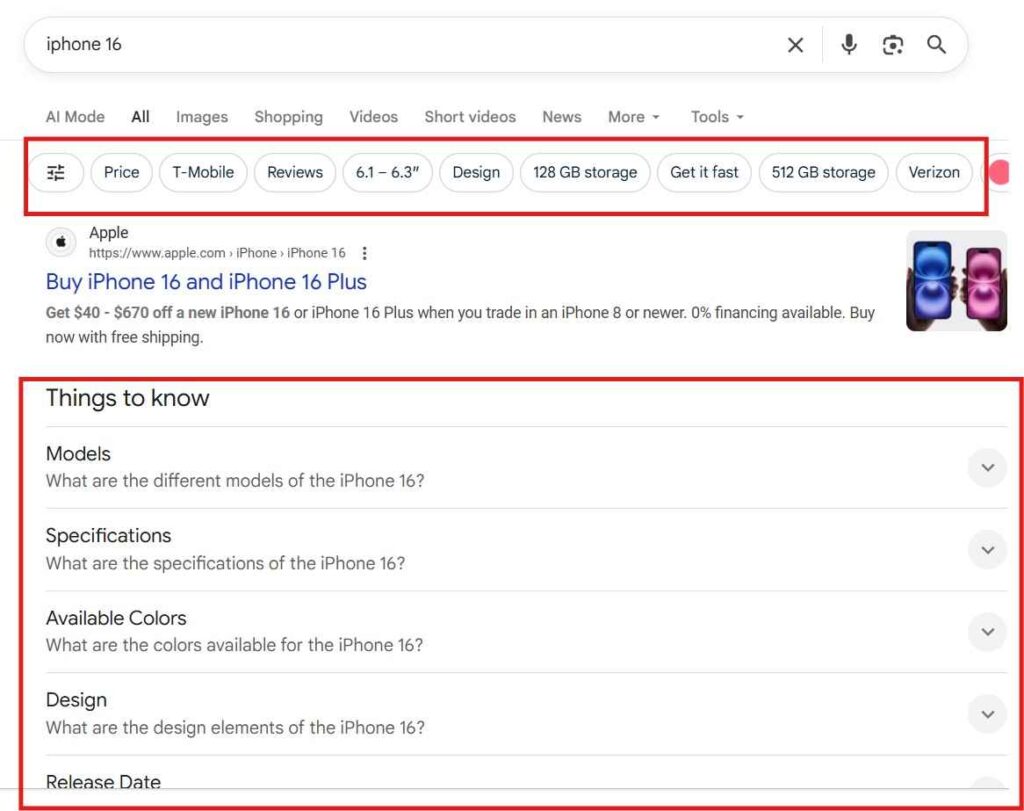
For example, as you can see in the above screen shot someone searches for “iPhone 16,” Google doesn’t rank pages just because they mention “iPhone 16” repeatedly. Instead, it surfaces content that explains everything related to the iPhone 16 as a topic, such as models, specifications, price, storage options, design, colors, and release date.
This is semantic SEO in action. Google understands “iPhone 16” as an entity and expects content to cover all the important information connected to it. Pages that match this expectation are more likely to rank and appear in AI Overviews.
The same logic applies to any topic. Instead of creating a page for one keyword, semantic SEO focuses on answering all the questions a user might have about that topic in a clear and structured way. When content connects these ideas naturally, search engines and AI systems can understand it better and trust it more.
Why Keywords Alone No Longer Work for SEO in 2026
Keywords alone no longer work because modern search engines rank content based on meaning, usefulness, and topical understanding, not on how often a phrase appears on a page.

Search engines understand meaning, not just words
Search engines now use advanced language models to understand what a query actually means. Instead of matching exact phrases, they interpret intent and context. A page does not need to repeat a keyword to rank if it clearly explains the topic and satisfies what the user is trying to learn.
SEO has shifted from keywords to entities
Modern SEO treats keywords as entry points, not ranking targets. Search engines organize information around entities such as people, products, brands, and concepts, along with their attributes and relationships. Content that explains these entities clearly and completely performs better than pages written for isolated keywords.
Helpful content is now a core ranking factor
Google’s ranking systems now evaluate whether content is genuinely helpful across an entire site. Pages created mainly to target keywords often lack depth and originality, which can weaken not only that page but the overall site’s performance.
User intent and topic depth matter more than search volume
Winning pages are those that answer the full task behind a search, including related questions and follow-up intent. Content built around a single keyword usually misses these expectations, while topic-focused content builds stronger relevance and authority.
Keywords still matter, but in a different way
Keywords are still useful for understanding demand and discovering what people search for. However, they now guide topic planning rather than on-page repetition. The real ranking advantage comes from explaining the topic clearly, completely, and in context.
This shift explains why keyword-first strategies no longer work in modern SEO. Semantic SEO replaces them by focusing on intent, entities, and full topic coverage so search engines and AI systems can confidently understand and surface the right content.
Core Components of Semantic SEO
The core components of Semantic SEO are user intent, topical completeness, entity optimization, structured data, keyword clustering, and strong internal linking. Semantic SEO is not about tricks or keyword hacks. It’s about organizing information in a way that helps search engines and AI systems clearly understand meaning, context, and relationships.
Together, these components form the foundation of topical authority. They help search engines understand what your content is about, how different pages relate to each other, and which pages should be trusted and surfaced in search results and AI Overviews. Below are the six core components of Semantic SEO, starting with the basics and moving toward more advanced elements.

1) Understand User Intent
User intent is the starting point of every semantic SEO strategy. Search engines evaluate what the user is actually trying to achieve, whether they want to learn, compare options, solve a problem, or take action. Content that aligns directly with that intent becomes more relevant and more useful.
This alignment is especially important for AI Overviews, where clarity and directness help answer engines generate accurate responses.
2) Create Topically Complete Content
Semantic SEO rewards complete explanations. Instead of publishing a single page for a single keyword, the goal is to cover every important aspect of a topic. When content answers all major questions, attributes, and subtopics, it becomes more trustworthy.
For example, when you search for a product like the iPhone 16, Google surfaces information about models, storage, colors, design, reviews, and specifications. Content that mirrors this level of completeness performs better in both traditional search results and AI Overviews.
3) Optimize Around Entities and Attributes
An entity is something search engines can clearly identify, such as a product, person, place, or concept. Attributes are the details that describe and define that entity.
For example, “iPhone 16” is an entity, while price, storage, camera, battery, and design are attributes. When content naturally includes these attributes, it becomes easier for search engines to classify the topic and connect it to their Knowledge Graph.
4) Use Structured Data (Schema Markup)
Structured data helps search engines understand the purpose and meaning of content without ambiguity. Schema markup provides explicit signals about entities, attributes, and relationships.
Schemas such as FAQ, HowTo, Product, and Article help reinforce relevance and increase eligibility for rich results and AI Overview mentions. Schema does not replace good content, but it strengthens how search engines interpret it.
5) Build Keyword Clusters and Natural Language Content
Semantic SEO organizes keywords into clusters rather than treating them as isolated targets. A keyword cluster includes the primary term, related phrases, variations, and the common questions users ask around a topic.
Writing in clear, natural language helps search engines understand context and intent. This is especially important for AEO, as AI systems extract concise, conversational answers rather than keyword-stuffed text.
6) Strengthen Internal Linking and Semantic Content Networks
Internal linking helps search engines understand how pages relate to each other. A strong internal structure creates a semantic content network that shows which pages support a topic, which answer specific questions, and which serve as central resources.
Effective internal linking improves crawlability, reinforces topical authority, and helps search engines and AI systems identify the most relevant content quickly. When pages support each other meaningfully, the entire topic becomes clearer and stronger.
How Topical Maps Fuel AEO Rankings

A strong topical map fuels AEO by giving search engines and AI systems a complete and structured understanding of a topic and how every subtopic relates to the main entity. As Google rolled out AI Overviews across most queries in 2025, this structure became critical. AEO, or Answer Engine Optimization, simply means optimizing content so AI systems can confidently extract, summarize, and cite answers from it.
Today’s SERP layout clearly shows this shift. Instead of ranking pages purely by keywords, Google presents AI Overviews that summarize answers, followed by supporting sources. To be selected as one of those sources, content must be easy for machines to understand, verify, and reuse. This is exactly where topical maps play a central role.
You can see in the screenshot below how today’s SERP is structured, with AI Overviews, AI Mode, and traditional organic search results appearing together.

Earlier, we discussed topical maps as a core component of Semantic SEO. This section explains why they matter so much for AEO.
A topical map ensures content is not published randomly. Instead, it creates a complete information system where the main entity connects to related entities, attributes, questions, comparisons, and intent-based pages. When this structure is clear, search engines trust the site more and reuse its content inside AI Overviews.
How Topical Maps Help AI Understand Your Content
Topical maps help AI systems by showing how all pieces of content relate to each other. Rather than seeing isolated articles, search engines see a connected knowledge structure.
A well-built topical map typically includes:
- A clearly defined main entity
- Supporting entities and attributes
- Informational, commercial, and comparative content
- Internal links that reinforce relationships
This makes it easier for AI models to identify which page answers which question and which source is authoritative enough to cite.
Semantic SEO vs AEO (How They Actually Work Together)

This is where the confusion between Semantic SEO and AEO usually starts.
Semantic SEO focuses on meaning. It organizes content around entities, attributes, relationships, and full topic coverage.
AEO focuses on extraction. It delivers fast, accurate answers pulled from trusted and well-structured content.
Put simply:
- Semantic SEO is the strategy
- AEO is the outcome
When a topical map is strong, AEO happens naturally. There is no separate checklist or shortcut required.
This is also why many people claim that “SEO is dead.” In reality, SEO has evolved. Ranking a single keyword is no longer enough. Search engines now expect complete context around a topic.
Why Topical Maps Outperform Keyword-Based SEO for AEO
Keyword-focused content creates gaps. Topical maps remove them.
When content covers:
- All key attributes of an entity
- Common user questions
- Supporting and comparison topics
- Clear intent stages
AI systems can confidently reuse that content. This is why pages built with topical maps appear more often in AI Overviews than isolated keyword pages.
Across real-world projects, the pattern is consistent. Websites that rank well in traditional SERPs usually perform well in AI Overviews and LLM answers too. The common factor is strong Semantic SEO backed by complete topical coverage.
AEO, GEO, and the Reality Behind the Hype
With the rise of Gemini, Perplexity, and ChatGPT browsing, many marketers now talk about GEO, or Generative Engine Optimization.
In practice, no separate GEO or AEO rules are needed.
Based on optimizing hundreds of sites, the conclusion is simple:
- Strong Semantic SEO
- Clear topical maps
- Complete topic coverage
These fundamentals work across Google Search, AI Overviews, and large language models. AEO and GEO are not replacements for SEO. They are the natural results of Semantic SEO done correctly.
How Topical Maps Work in Practice
Topical maps help you build and structure your content in a way that perfectly matches Google’s understanding of the topic. They remove confusion, prevent keyword cannibalization, and ensure every entity and attribute is properly covered.
Here’s an example of how we build topical maps internally and for our clients at T-RANKS using Koray Tuğberk Gübür’s methodology.

Step-by-Step: Building a Topical Map (Inspired by Koray’s Framework)
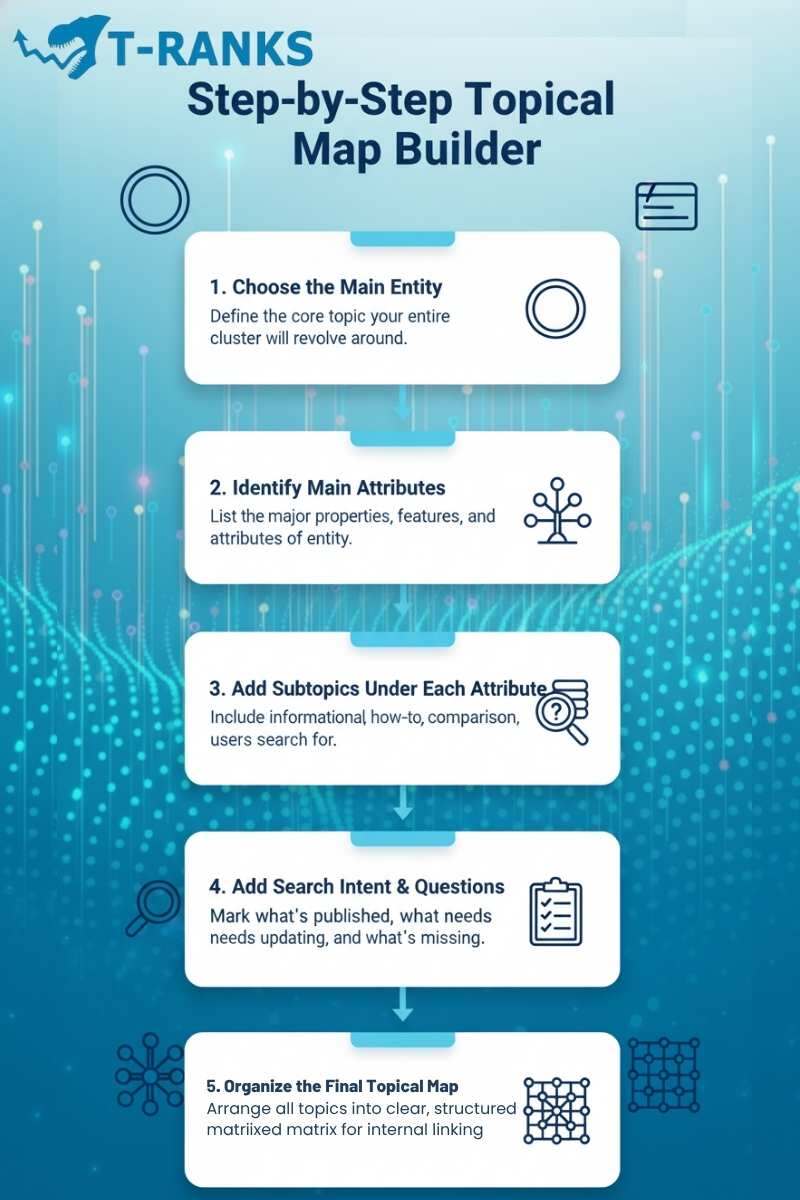
Before we move into the steps, I want to make one thing clear:
This is the exact topical map method we follow for our clients, and it’s heavily inspired by Koray’s entity-based SEO framework but simplified so anyone can use it.
Koray’s approach is built on three fundamentals:
- Every topic = an entity
- Every entity has attributes (features, parts, properties)
- Every attribute connects to subtopics, questions, and intent types
In simple words:
You don’t build a topical map around keywords — you build it around meaning, relationships, and coverage.
Now let me show you the easiest step-by-step method to build a topical map using this logic.
Step 1: Choose the Main Topic (Your Central Entity)

Start with one main entity — the “root” of your entire map.
Examples of central entities:
- PBN Links
- Semantic SEO
- Backlinks
- Guest Posting
- Local SEO
This entity becomes the center point that everything else connects to.
How Koray’s Framework Sees This
Every central topic is treated as a defined entity with characteristics and attributes.
This helps Google understand what your site is about instead of guessing.
Screenshot Example
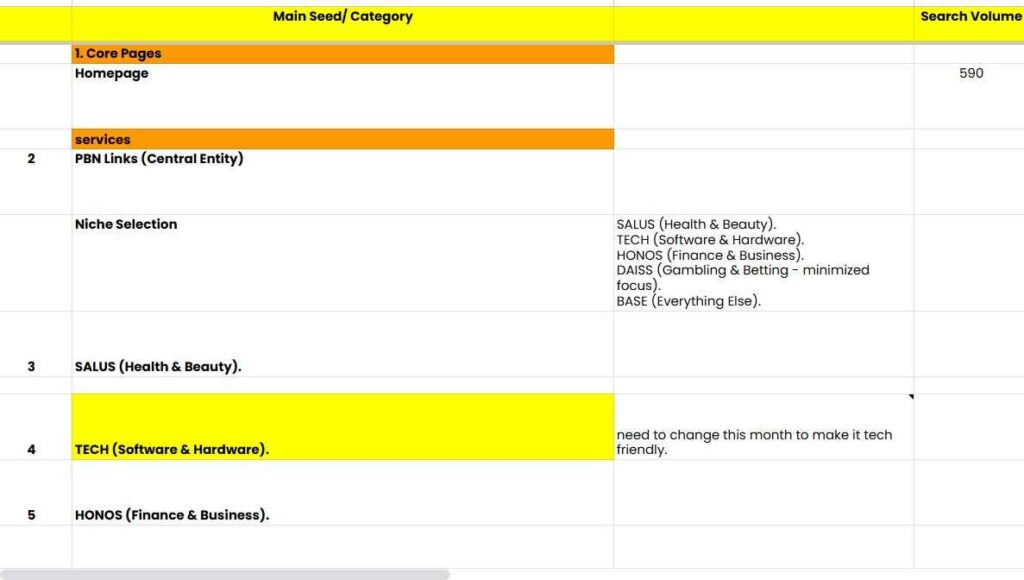
Step 2: Identify the Main Categories (Entity Attributes)

Now list the main attributes of your central entity.
Attributes = the core parts that define the topic.
Examples:
If Entity = PBN Links
Attributes might be:
- Niche selection
- Safety
- Platforms
- Hosting
- Metrics
- Management
- Pricing
If Entity = Semantic SEO
Attributes might be:
- Entities
- Intent
- Schema
- Topical coverage
- Internal linking
- NLP optimization
- AI Overviews
How Koray’s Framework Applies
Attributes = “entity properties.”
These represent the major branches that show Google you understand the full subject, not just pieces of it.
Step 3: Add Subtopics for Each Category

Under each category, add the subtopics that people search for.
Example (Category: Niche Selection):
- Health niche
- Tech niche
- Finance niche
- General niche
Example (Category: Safety):
- Footprints
- Hosting mistakes
- Deindexing causes
- IP diversity
Why This Matters
Google evaluates topical authority based on:
- completeness
- depth
- clarity
- interconnectedness
Subtopics show Google you aren’t “surface-level.”
Step 4: Add Search Intent and Real User Questions

Now add:
- informational questions
- how-to queries
- comparisons
- troubleshooting
- buying questions
This is where People Also Ask, AI Overviews, forums, and keyword tools help.
Example (for PBN Links):
- “Are PBN links safe?”
- “How many PBNs do I need?”
- “Why did my PBN get deindexed?”
- “What is a PBN footprint?”
Koray’s Logic Here
Questions = “entity attributes + user behaviors.”
These help answer engines like Gemini, Perplexity, and ChatGPT choose your page for summaries.
Step 5: Mark Existing Content and Find Missing Topics
Now check:
- What content already exists
- What’s missing
- What needs updating
- What needs merging
This instantly shows you where the gaps are.
Step 6: Organize the Final Topical Map
Your final map should look clean and structured:
- Column A → Category
- Column B → Subtopic
- Column C → Keywords
- Column D → Search volume
- Column E → Title ideas
- Column F → Existing link / To be written
- Color-code for clarity (green = done, yellow = needs update, red = missing)
This structure helps you:
- avoid keyword cannibalization
- plan content for 3–6 months
- create perfect internal linking
- match entities correctly
- build semantic authority automatically
Why This Framework Works for AEO & LLMS
We’ve tested this across hundreds of pages, and the result is always the same:
If you follow semantic structure + topical completeness, you will rank in SERPs, AEO Overviews, and LLM recommendations — even without chasing AEO “hacks.”
Why?
Because AI Overviews, LLMs, and Google’s ranking systems value:
- clarity
- coverage
- meaning
- relevance
- factual relationships
Topical maps solve all of these.
This is why we tell clients:
If you build a proper topical map, AEO and LLM rankings come naturally.
Advanced Semantic SEO Strategies for 2026
The most effective Semantic SEO strategies for 2026 focus on clarity, meaning, and complete topic coverage. This helps search engines and AI systems clearly understand what your content is about. Modern search engines no longer rely on keywords alone. They analyze entities, context, and how well content answers real user questions.
Below are advanced strategies that are simple to apply and work consistently in 2026.
1. Use Multimodal Content (Text, Images, and Screenshots)
Search engines now understand images, diagrams, and screenshots almost as well as text. Visual elements help explain complex ideas and add more context to your content.
To improve semantic understanding:
- Add helpful screenshots or diagrams
- Use clear, descriptive alt text
- Add short captions below images
- Include comparison tables or simple flowcharts
This additional context increases clarity and improves the chances of your content being selected for AI Overviews.
2. Strengthen Entity Clarity Across Your Pages
Every topic is an entity, and every entity has attributes such as features, types, or components. Clear entity definition helps search engines classify and trust your content.
To improve entity clarity:
- Clearly define your main topic
- Mention related entities naturally
- Explain key attributes and variations
- Use related terms without forcing keywords
This helps Google and AI models connect your content to real-world concepts and understand its relevance.
3. Build Complete Topic Coverage (Zero Gaps)
Search engines reward websites that fully cover a topic instead of touching it partially. Gaps in coverage weaken topical authority.
To achieve full coverage:
- Create a topical map
- List all subtopics and common questions
- Identify missing pages
- Fill those gaps with new content
- Update older pages when needed
When a topic is covered completely, your site becomes a more trusted and reusable source.
4. Improve Internal Linking With Meaningful Connections
Internal links help search engines understand how pages relate to one another. They also guide users through your content logically.
Use internal linking to:
- Connect related topics
- Guide readers from basic to advanced content
- Group similar pages together
- Strengthen pillar pages
- Improve crawlability
Keep anchor text natural and descriptive, not keyword-heavy.
5. Use Schema Markup to Add More Clarity

Schema markup helps search engines better understand your content and its structure.
Schema can clarify:
- What the page is about
- Who created it
- Which entities it references
- How it should appear in search results
You don’t need complex implementations. Start with:
- FAQPage
- Article
- ItemList
- HowTo
- Organization
Schema does not replace good content, but it reinforces meaning and increases confidence for search engines.
6. Optimize for AI Answer Engines (AEO and GEO)
Search is no longer limited to traditional Google results. AI systems like ChatGPT Browse, Gemini, and Perplexity now read pages and surface answers directly.
To optimize content for AI engines:
- Place the main answer at the top of sections
- Use short paragraphs
- Keep sentences simple
- Include examples
- Use bullet points where helpful
- Provide clear definitions
These adjustments make it easier for AI systems to extract and cite your content.
7. Add Personal Experience to Strengthen E-E-A-T
In 2026, experience-based content stands out more than generic explanations. Search engines favor content that feels real and practical.
You can show experience by including:
- Screenshots from real work
- Practical explanations
- Observations from audits or testing
- Mistakes and lessons learned
- Simple real-world examples
This builds trust and increases the likelihood of appearing in AI-driven results.
Your Semantic SEO Roadmap (Next Steps)
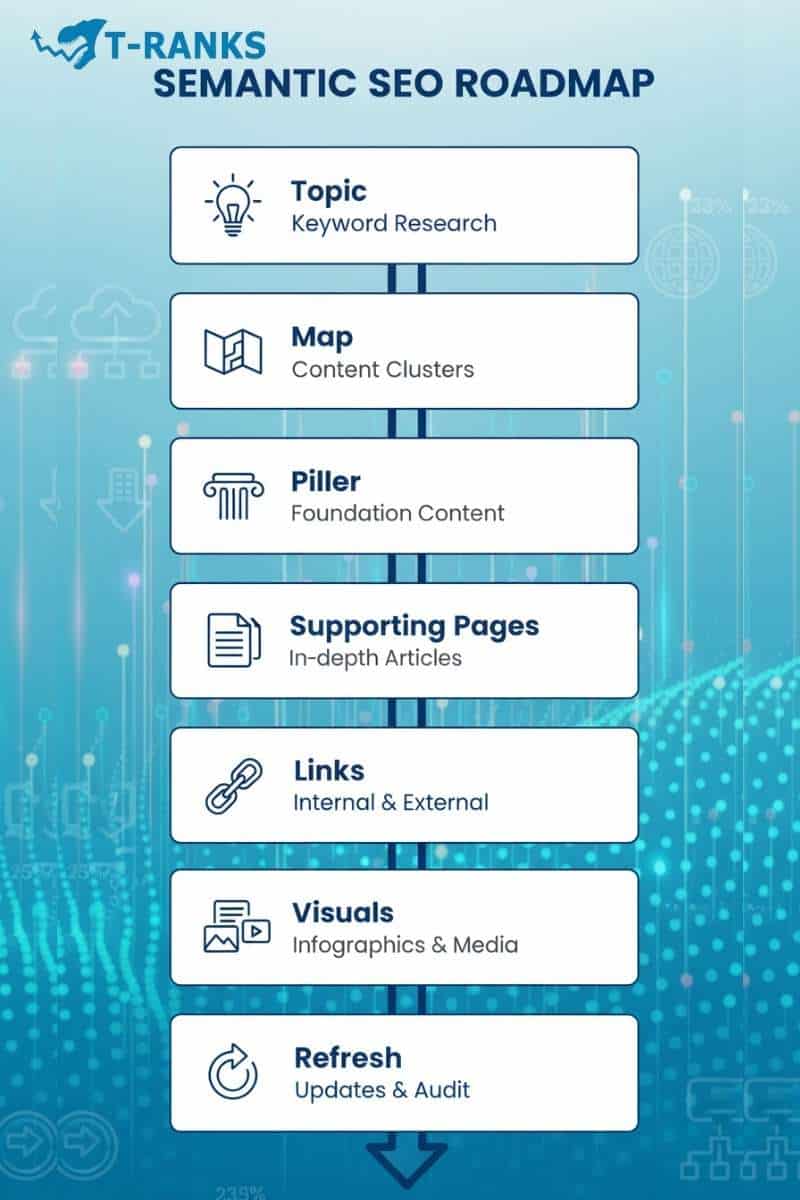
Your Semantic SEO roadmap is simple: choose one topic, structure it clearly, create helpful content around it, and connect everything with internal links.
This approach keeps your content focused and makes it easier for search engines and AI systems to understand.
Below is a practical plan you can follow step by step.
1. Focus on one main topic first
Start by choosing one main topic you want to build authority around. Working on a single cluster helps you build depth much faster and avoids confusion in your strategy.
Examples include:
- Semantic SEO
- Backlinks
- Local SEO
- Technical SEO
- AI content writing
Choose the topic that matters most to your audience or business goals.
This becomes the foundation for everything you create next.
2. Build a simple topical map
A topical map organizes your main topic into categories, subtopics, and user questions. Even a simple Google Sheet works perfectly for this stage.
Include sections like:
- Main categories
- Subtopics
- People Also Ask questions
- AI Overview questions
- Comparison angles
- Troubleshooting angles
- Commercial intent pages
A clear topical map removes guesswork and guides your entire content plan.
3. Create or improve your pillar page
Your pillar page should introduce the topic and act as a starting point for readers. Think of it as the “central hub” for everything inside your cluster.
A good pillar page includes:
- A clear introduction
- Definitions of key concepts
- Links to supporting subtopics
- Answers to basic questions
- Simple examples or visuals
This page signals to search engines that you cover the topic in full.
4. Write supporting articles for each subtopic
Supporting articles give depth to your topical map. Each subtopic deserves its own page so users and search engines can explore details easily.
For each supporting page:
- Explain one specific concept
- Answer related user questions
- Add examples, screenshots, or visuals
- Link back to the pillar page
- Suggest related articles at the end
These pages help build your topical authority and fill any content gaps.
5. Interlink everything naturally
Internal linking connects your ideas and helps search engines understand relationships between your pages. This is one of the strongest ranking signals in Semantic SEO.
Good internal linking includes:
- Linking supporting pages to the pillar page
- Linking between related subtopics
- Adding contextual anchors inside sentences
- Avoiding keyword-stuffed anchor text
- Keeping links relevant and helpful
A connected content network is easier for both users and AI systems to navigate.
6. Add screenshots and real examples
Search engines now value authentic, experience-based content. Adding screenshots and real examples makes your content more trustworthy and easier to understand.
Use visuals like:
- Step-by-step screenshots
- Diagrams
- Flowcharts
- Tool dashboards
- Before/after examples
Real examples strengthen EEAT and increase your chances of appearing in AI Overviews.
7. Refresh your content every 90 days
Search trends, SERPs, and AI Overviews change quickly. Updating your content regularly helps keep your pages active, accurate, and relevant.
When refreshing:
- Update outdated sections
- Add new insights or screenshots
- Improve clarity or structure
- Fill missing subtopics
- Strengthen internal links
Small refreshes help maintain strong rankings across SERPs and generative engines.
Semantic SEO Roadmap By T-RANKS
Follow these steps to build topical authority with clear structure, helpful content, and natural internal linking. This roadmap works for Google Search and AI answer engines because it improves meaning, coverage, and consistency.
Choose one main topic
Pick one topic you want to build authority around, then commit to it as your focus.
- Semantic SEO
- Backlinks
- Local SEO
- Technical SEO
- AI content writing
Build a simple topical map
Organize the topic into categories, subtopics, and real user questions. A simple sheet is enough.
- Main categories and subtopics
- People Also Ask and AI Overview questions
- Comparisons, troubleshooting, and commercial pages
Create or improve your pillar page
Build one central hub page that introduces the topic and links out to every key subtopic.
- Clear definitions and basic answers
- Simple examples or visuals
- Internal links to supporting pages
Publish supporting subtopic pages
Write one page per subtopic so each concept is explained clearly and completely.
- Explain one concept per page
- Add examples, screenshots, or visuals
- Link back to the pillar page
Interlink everything naturally
Connect pages with contextual internal links so relationships are obvious to users and search engines.
- Supporting pages to pillar page
- Related subtopics linked together
- Contextual anchors inside sentences
Add real examples and screenshots
Use experience based proof to increase trust, clarity, and reuse potential in AI summaries.
- Tool dashboards and step by step screenshots
- Diagrams, flowcharts, before and after examples
Refresh content every 90 days
Update content to match changing SERPs, new questions, and evolving AI Overview behavior.
- Update outdated sections and add new insights
- Improve clarity, structure, and internal links
- Fill missing subtopics and examples
Roadmap summary
Pick one topic, map it, build a pillar, publish subtopics, link naturally, add visuals, refresh regularly.
- Clear meaning and complete coverage wins
- Works across search and AI answer engines
Simple roadmap summary
To build strong Semantic SEO in 2026:
- Pick one topic
- Build your topical map
- Create your pillar page
- Publish supporting articles
- Link everything correctly
- Add helpful visuals
- Refresh regularly
This simple plan works for Google Search, AI Overviews, Gemini, ChatGPT Browse, Perplexity, and every generative search engine — because all of them rely on clear meaning and complete coverage.
Conclusion
In conclusion, semantic SEO is about organizing content around meaning, context, and relationships so search engines and AI systems can clearly understand what your site covers. By focusing on user intent, building complete topical maps, optimizing entities and their attributes, strengthening internal linking, and adding real examples, you create content that performs well across traditional search results, AI Overviews, and generative engines. SEO has not disappeared; it has evolved, and semantic structure is now the foundation that drives long-term visibility and authority.
Need help with safe, high-quality directory backlinks?
If you want a clear, practical roadmap to build topical authority and improve AI visibility, start with a T-RANKS Semantic SEO Audit and build your topical map the right way today.
FAQS On Semantic SEO
What is semantic SEO in simple terms?
Semantic SEO is the process of organizing content around meaning, context, and relationships so search engines and AI systems understand what your content represents, not just which keywords it contains.
How is semantic SEO different from traditional SEO?
Semantic SEO focuses on topics, entities, and content relationships, while traditional SEO focuses mainly on keywords and individual pages. Semantic SEO builds long-term authority instead of short-term keyword wins.
What is a topical map in semantic SEO?
A topical map is a structured plan that breaks a main topic into categories, subtopics, and real user questions to ensure complete topic coverage and clear content organization.
Does semantic SEO help with AI Overviews and AEO?
Yes, semantic SEO directly improves AI Overview and AEO visibility because answer engines rely on clear topic structure, entity clarity, and comprehensive coverage when selecting sources.
Is AEO different from semantic SEO?
AEO focuses on how answers appear in AI-driven results, while semantic SEO focuses on building the underlying structure that makes those answers possible. Strong semantic SEO naturally leads to better AEO results.
Do I need special tools to build a topical map?
No, you can build an effective topical map using a simple Google Sheet. Tools can assist with research, but understanding the topic and organizing it logically matters more than software.
How often should a topical map be updated?
A topical map should be reviewed every three to six months to add new subtopics, update outdated content, and stay aligned with changes in search behavior and AI results.
Can small websites benefit from semantic SEO?
Yes, semantic SEO works especially well for small websites because focused topic coverage often outperforms larger sites with scattered or shallow content.
Does schema markup improve semantic SEO?
Schema markup helps search engines better understand entities and page intent, which strengthens semantic signals and improves eligibility for rich results and AI citations.
What is the biggest mistake people make with semantic SEO?
The biggest mistake is publishing content without a topical structure. Without a topical map, content lacks context, depth, and clear relationships, which limits rankings and AI visibility.