Backlinks often confuse beginners. You open a tool, see numbers changing, and assume something is wrong without knowing why. This confusion is one of the most common reasons backlink audits feel stressful and unproductive.
The Ahrefs Backlink Checker is not designed to predict rankings or judge links as good or bad. Its purpose is much simpler. It shows backlink data so you can clearly see who is linking to your site and how those links are arranged.
When you understand this data, backlink audits become easier. You can see where links come from, how evenly they are spread, and whether your backlink profile looks natural or unbalanced. This clarity helps you avoid panic and focus only on what actually matters.
In this guide, you will learn how to use Ahrefs Backlink Checker step by step. The goal is to help you read backlink data with confidence and make calm SEO decisions that support steady, long-term growth.
What Is the Ahrefs Backlink Checker and Why It Matters for SEO

The Ahrefs Backlink Checker is a tool designed to show which websites link to your site and how those links are distributed. Instead of guessing where backlinks come from, it gives a clear view of how your website is referenced across the web through external links.
The tool gathers backlink data from a large web index and presents it in an organized, readable format. This makes it easier to review links pointing to a domain or a specific page in one place. You can see who is linking, where those links appear, and how they are spread across different websites.
Most importantly, the Ahrefs Backlink Checker focuses on visibility, not judgment. It shows backlink structure, link distribution, and reference patterns, but it does not decide rankings or label links as good or bad. Its value lies in helping you understand backlink context so better SEO decisions can be made later.
Why the Ahrefs Backlink Checker Matters for SEO
Backlinks remain an important part of how search engines interpret authority and trust. Understanding how backlinks appear and accumulate helps explain why some pages gain visibility while others struggle.
The Ahrefs Backlink Checker matters for SEO because it helps with the following:
- Backlink visibility
It shows which websites link to your content and how often those references appear, making external signals easier to understand. - Link profile structure
It reveals how backlinks are distributed across pages and domains, which helps identify whether link growth looks consistent or uneven. - Monitoring and tracking
It allows ongoing observation of backlink changes over time, helping you stay aware of new or lost references without relying on assumptions. - Context for SEO decisions
By making backlink patterns visible, it supports analysis alongside content quality, relevance, and intent, rather than treating links as isolated signals.
A common misunderstanding is assuming backlink data directly reflects Google’s ranking signals. This is incorrect. Tools like Ahrefs show discovered links and comparative metrics, not how search engines internally value or ignore those links. Some links may have no impact at all, while others quietly support authority without standing out in metrics.
Understanding this difference is essential. When backlink data is treated as contextual information rather than a verdict, it becomes far more useful. It supports clear analysis and long-term SEO thinking instead of confusion or overreaction.
Ahrefs Backlink Checker, Free vs Paid Access Explained
Ahrefs offers two ways to access backlink data. One is a free backlink checker that provides a limited snapshot of links. The other is the full version of the Ahrefs Backlink Checker, which gives complete access to backlink data for deeper analysis.
Both versions use the same backlink index. The difference is not accuracy, but how much data you can see and how deeply you can analyze it. Understanding this difference helps you choose the right level of access based on your needs, instead of assuming one version is always better.
The free version of the Ahrefs Backlink Checker is designed for quick visibility rather than deep analysis. It provides a limited snapshot of a site’s backlink profile so you can confirm whether backlinks exist and see where some of them come from. Look at the screen shot below
I provided the preview of How Ahref Free Backlink checker looks.
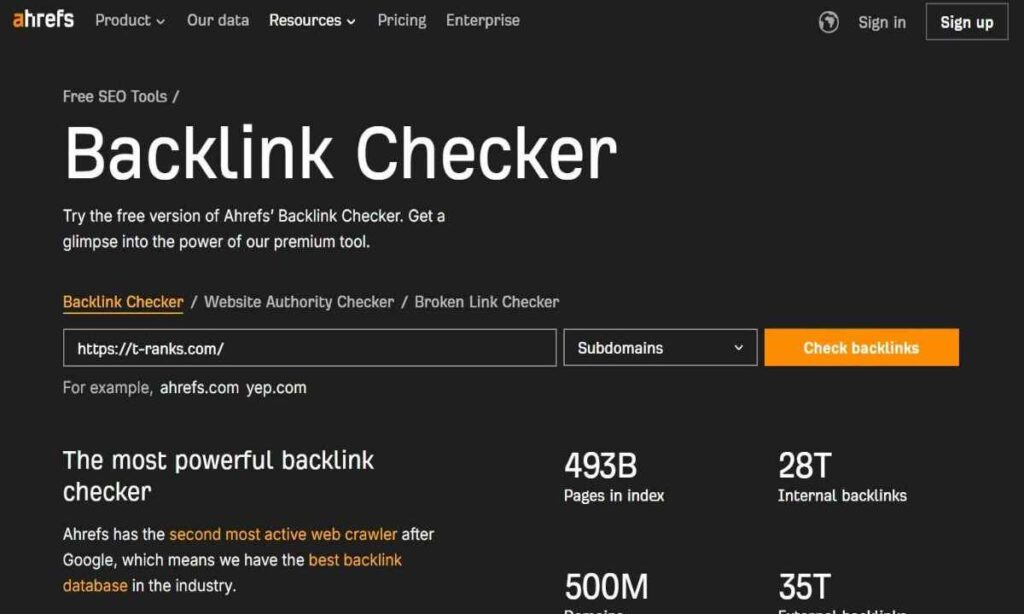
With the free backlink checker, you can typically see:
- A limited number of backlinks pointing to a domain or page
- A small sample of referring domains
- Basic anchor text information
- High-level authority indicators such as Domain Rating and URL Rating

From the screenshots above, you can see that the free tool provides basic backlink data for T-RANKS, but it does not allow deeper analysis or access to complete backlink details.
This data is intentionally capped. You do not get full backlink lists, advanced filters, or historical link tracking. The goal is to provide awareness, not a complete audit.
Because of these limits, the free version works best for simple checks. It helps answer basic questions such as whether a site has backlinks, whether links appear broadly relevant, and whether there are any obvious red flags at first glance.
The free backlink checker is usually enough when:
- You are doing a quick review of a small or new website
- You want a surface-level look at backlink sources
- You are validating backlink presence rather than analyzing patterns
- You do not need historical data or competitor comparisons
Used in this context, the free tool acts as an entry point. It shows that backlinks exist, while deeper analysis requires more complete data.
What the Paid Ahrefs Backlink Checker Unlocks
The paid version removes visibility limits and shows the complete backlink profile. This is where backlink data becomes useful for structured audits and ongoing analysis.
With paid access, you can see:
- All backlinks pointing to a site or page
- Full referring domain lists
- Anchor text distribution across the entire profile
- Backlink growth and loss over time
- Historical link data for trend analysis
- Side-by-side competitor backlink comparisons


From the screenshots above, you can see that the complete backlink details are available only in the paid version and are not accessible through the free backlink checker.
This deeper visibility makes it possible to understand patterns instead of isolated examples. You can see whether backlinks are growing steadily, how anchors are distributed, and how your profile compares to competitors.
Paid access matters when the goal is depth and control, not convenience. It is useful for detailed audits, competitive analysis, and long-term monitoring. It is not required for casual checks, but it becomes important when decisions depend on complete context.
The key difference is purpose. The free version helps with awareness. The paid version supports analysis. Neither version makes SEO decisions for you. They simply provide different levels of backlink visibility.
How to Use Ahrefs Backlink Checker for a Backlink Audit (Step by Step)
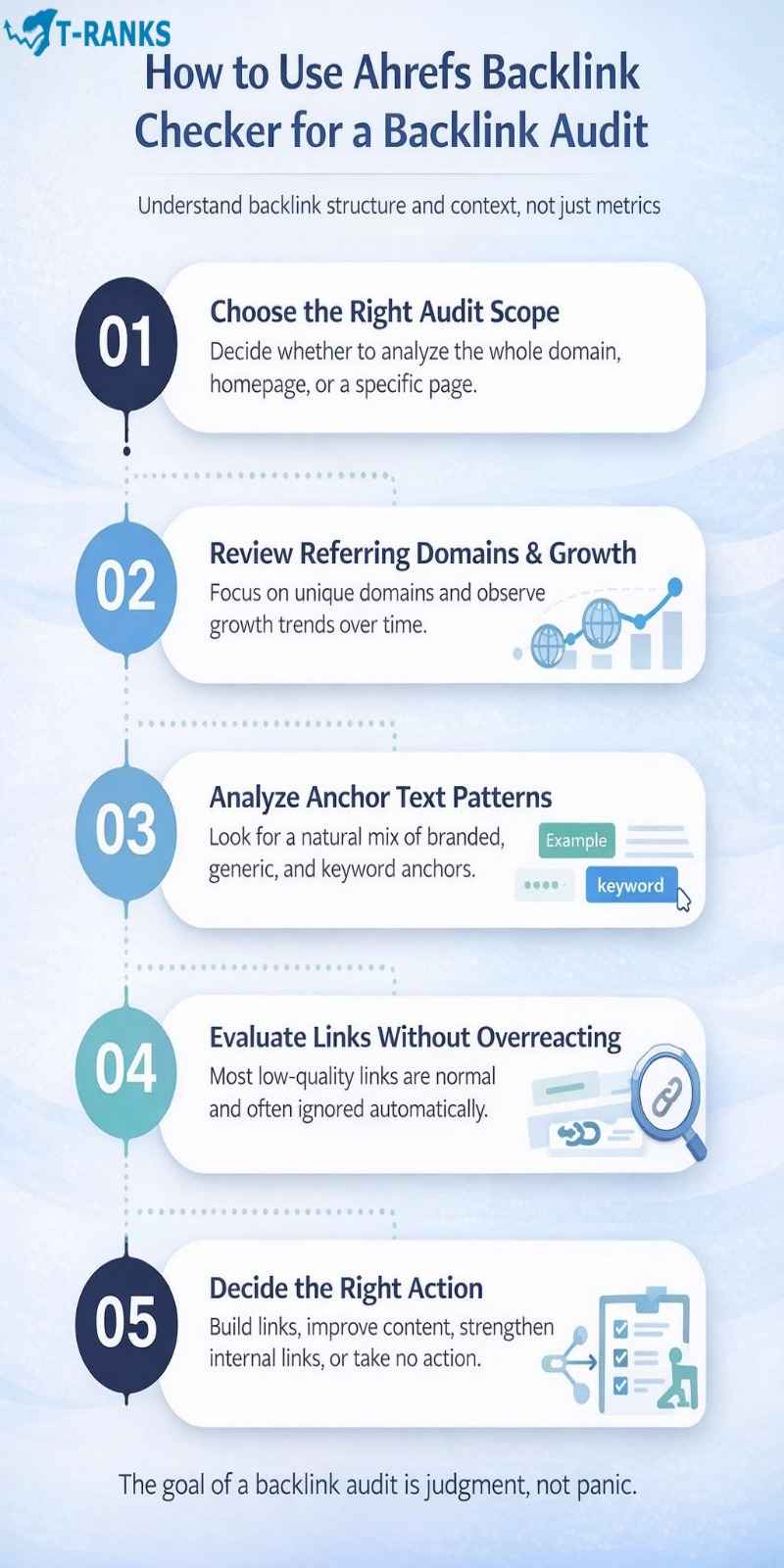
This section explains how to use the Ahrefs Backlink Checker in a clear and repeatable way. We will walk through each step together, focusing on what to review, why it matters, and how to interpret the data correctly. The goal is to understand backlink structure and context, not to chase metrics or react to raw numbers.
Step 1: Enter Your Domain and Choose the Right Scope
The first step sets the foundation for the entire audit. Choosing the correct scope determines what data you analyze and how accurate your conclusions will be.
When you enter a domain into Ahrefs, you can review backlinks at different levels. A domain-level analysis shows backlinks pointing to the entire website. This is useful when you want to understand overall authority, brand-level link coverage, and how links are distributed across the site.
A URL-level analysis focuses on backlinks pointing to a single page. This approach works better when you are evaluating a specific blog post, landing page, or commercial page.
Auditing the homepage makes sense when:
- Most backlinks point to the homepage
- You want to assess overall site authority
- You need a high-level view of brand mentions and citations
Inner pages should be reviewed when:
- A specific page is underperforming
- Rankings dropped for one URL but not the entire site
- Backlinks were intentionally built to content or product pages
Choosing the wrong scope leads to misleading conclusions. Mixing homepage-level data with page-specific performance often causes incorrect assumptions, which affects every step that follows.
Step 2: Review Referring Domains and Link Growth Trends
Once the scope is set, the next step is to understand the shape of the backlink profile. This starts with referring domains.
Referring domains matter more than total backlink counts because links from many unique websites signal broader recognition than repeated links from the same source. Multiple links from one site usually add diminishing value, while links from different domains indicate wider visibility.
After reviewing referring domains, we look at backlink growth trends over time. At this stage, the goal is not to judge quality but to observe behavior.
Pay attention to:
- Sudden spikes, which may indicate artificial link bursts or short-term campaigns
- Sharp drops, which can point to lost links or site changes
- Long flat growth periods, which may suggest limited discovery or outreach
This step establishes a baseline. We are learning how the backlink profile behaves before making any decisions.
Step 3: Analyze Anchor Text Distribution Carefully
With a baseline established, the next step is to understand how other websites describe your pages when they link to you. This is where anchor text becomes important.
Anchor text provides insight into backlink intent and external perception. Common anchor text types include:
- Branded
- URL or generic
- Partial-match
- Exact-match
A natural anchor mix usually contains a strong share of branded and generic anchors, with smaller portions of keyword-based anchors.
Anchor patterns may signal risk when:
- Exact-match anchors dominate the profile
- The same anchors repeat across many domains
- Irrelevant or spam-related terms appear
Here, we focus on patterns, not individual examples. One anchor rarely tells the full story. Consistent signals across many links are what matter.
Step 4: Identify Low-Value or Suspicious Links Without Overreacting
At this point, many people are tempted to start cleaning up links. This is where restraint matters.
Most backlink profiles contain low-quality or irrelevant links. This is normal. Search engines often ignore weak links automatically without any action required.
Judging links by appearance alone is unreliable. A link that looks poor may have no impact, while a link that looks strong may add little value. Instead, focus on signals that provide context:
- Relevance between the linking site and your content
- Unnatural repetition of similar links across domains
- Sitewide placement with identical anchors
- Links placed in clearly manipulative contexts
Unnecessary removal or disavowal often causes more harm than good. Calm, experience-based evaluation leads to safer decisions.
Step 5: Decide What Actions to Take After the Audit
Only after reviewing structure, patterns, and context should we decide whether action is needed. Not every backlink audit requires changes.
Building more backlinks makes sense when:
- The profile is clean but thin compared to competitors
- Referring domain coverage is limited
Improving content is the better option when:
- Pages have backlinks but fail to satisfy search intent
- Links point to outdated or weak content
Internal linking can solve authority issues when:
- Authority exists but is poorly distributed
- Important pages lack internal support
Leaving the backlink profile untouched is the right choice when:
- Growth appears natural
- No clear risk patterns are present
- Rankings and traffic are stable
The most important outcome of a backlink audit is judgment. Tools provide data, but effective SEO decisions come from understanding patterns, context, and intent, not from blindly following metrics.
Common Mistakes People Make When Using Ahrefs Backlink Checker
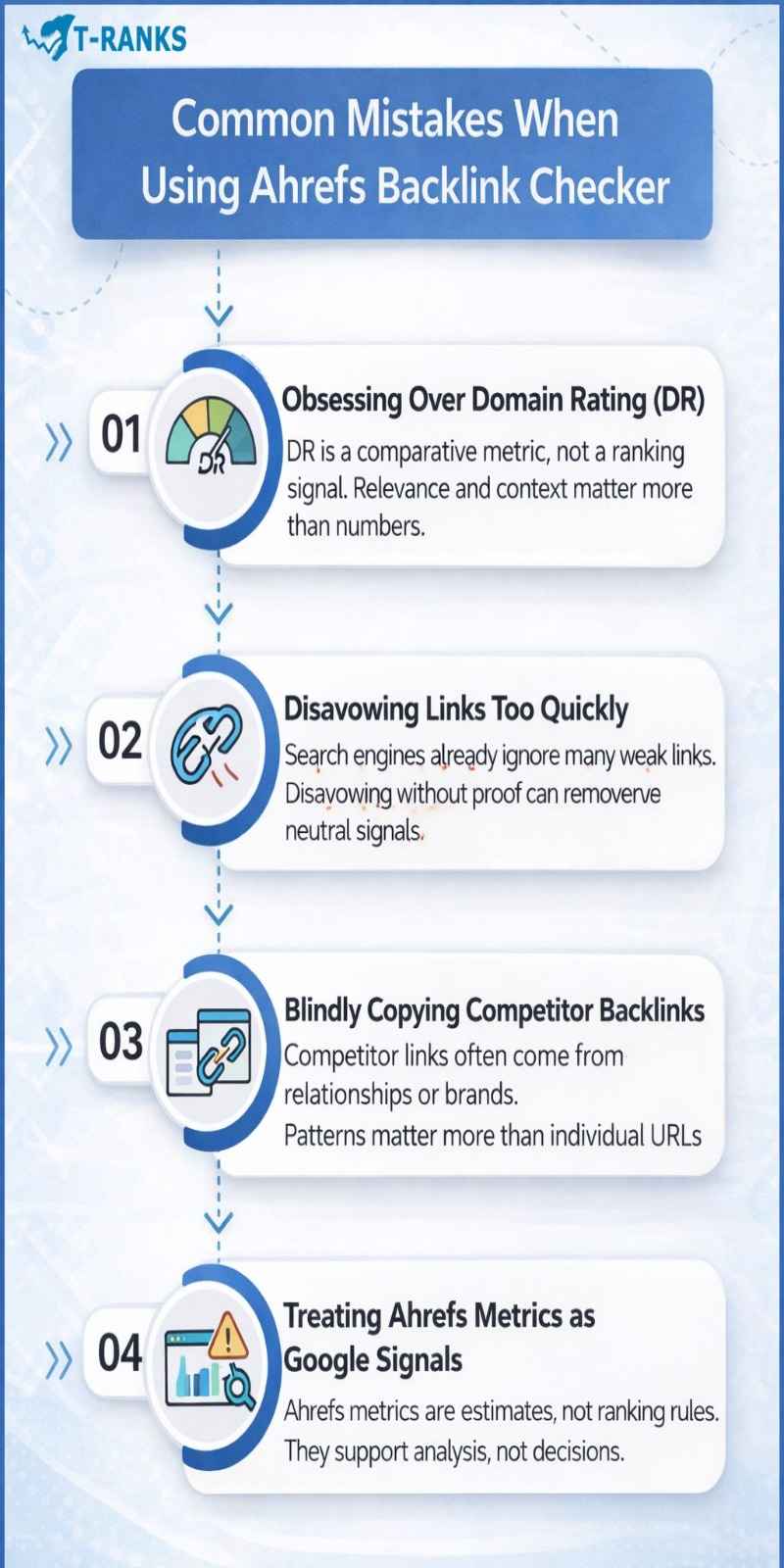
This section resets expectations. Most backlink problems do not come from bad links. They come from misreading data and overreacting to what tools show. Understanding these mistakes helps you use the Ahrefs Backlink Checker with judgment instead of fear.
Obsessing Over Domain Rating (DR) Alone
Domain Rating is a comparative metric created to estimate relative authority across sites. It is not a ranking signal and it does not measure link value on its own. A high DR does not automatically make a link valuable, and a low DR does not make a link harmful. What matters more is whether the link is relevant to your topic, placed in meaningful content, and fits naturally within the page context.
Disavowing Links Too Quickly
Many site owners panic when they see unfamiliar or low quality looking links in a report. In reality, search engines already ignore a large share of weak or irrelevant links automatically. Disavowing without clear evidence of harm can remove neutral signals and disrupt natural link patterns, often creating more issues than it resolves.
Blindly Copying Competitor Backlinks
Competitor backlinks are often misunderstood. Some links exist because of brand mentions, partnerships, citations, or historical relationships that cannot be replicated. Copying individual URLs without understanding why those links exist usually produces little benefit. Effective analysis looks at broader patterns such as relevance, placement, and link types rather than isolated examples.
Treating Ahrefs Metrics as Google Signals
Ahrefs metrics are estimates based on Ahrefs’ own crawl data and models. They are useful for comparison and analysis, but they are not part of Google’s ranking system. Confusing these metrics with ranking rules leads to reactive decisions driven by numbers instead of understanding how search engines actually evaluate links.
Key takeaway:
The Ahrefs Backlink Checker is a support tool, not a decision maker. It provides visibility into backlink data, but the real value comes from interpretation. Strong backlink audits rely on experience, context, and reasoning rather than treating metrics as commands.
Using Ahrefs Backlink Checker for Competitor Backlink Analysis

Competitor backlink analysis is not about counting links or copying URLs. Its real purpose is to understand why certain pages rank and how backlink structure supports that performance. When used correctly, the Ahrefs Backlink Checker helps compare backlink profiles to explain ranking differences rather than encouraging imitation.
Instead of treating competitor data as a checklist, this approach focuses on structural insight. By reviewing how links are earned, placed, and distributed, Ahrefs allows you to see authority flow, relevance signals, and intent alignment that raw numbers alone cannot explain.
Compare Link Types, Not Just Link Counts
Backlink quantity rarely explains ranking differences by itself. What matters more is link type and placement, which Ahrefs makes easy to compare at a profile level.
When reviewing competitor backlinks in Ahrefs, focus on:
- Editorial vs non-editorial links Editorial links placed naturally within relevant content usually carry stronger contextual signals than non-editorial links such as directories, forum profiles, comments, or automated listings.
- Contextual placement differences Links embedded within meaningful content often signal relevance more clearly than links placed in footers, sidebars, author boxes, or navigation areas.
- Homepage vs inner-page links Some competitors concentrate authority on the homepage and distribute it internally, while others earn links directly to content or landing pages. Understanding this balance explains how authority flows instead of assuming all links contribute equally.
This comparison helps you understand how competitors build authority, not just how many links they have.
Find Backlink Gaps That Actually Explain Rankings
Competitors sometimes rank with fewer backlinks because their pages align more closely with search intent and topical relevance. In these cases, stronger relevance reduces the total number of links needed to compete.
When identifying backlink gaps in Ahrefs, focus on missing relevance rather than missing volume:
- Look for websites that consistently link to competitors within the same topical space. These links often reflect niche recognition rather than raw authority.
- Avoid treating every competitor backlink as a target. Some links exist due to brand strength, partnerships, citations, or historical mentions that cannot be replicated.
- Recognize that some competitor links may have little or no ranking impact, even if they appear strong in tools.
Effective gap analysis explains ranking differences instead of producing a list of URLs to copy.
Final Perspective
Competitor backlink analysis works best when it explains why rankings differ, not when it encourages blind replication. Context, intent, and relevance matter more than copying individual links.
Used this way, Ahrefs Backlink Checker supports insight and judgment. It helps reveal patterns and structure that guide SEO decisions, rather than automating strategy or replacing experience.
Free Backlink Checker Tools vs Ahrefs, What Each Is Best For

Free backlink checker tools and Ahrefs serve different purposes. The difference is not about accuracy or trust, but about depth and context. Understanding what each is best suited for helps you choose the right tool without overusing or misusing backlink data.
When Free Backlink Checker Tools Are Enough
Free backlink checker tools are useful when the goal is basic visibility. They work well for quick checks where you only need to confirm whether backlinks exist and where some of them come from.
In practice, free backlink tools are enough when:
- You are reviewing a small or new website
- You need a surface-level snapshot of backlink sources
- You want to validate backlink presence without deep analysis
- The goal is awareness, not a full audit
For these situations, a free backlink checker provides just enough information to answer simple questions without overwhelming the user.
Where Free Backlink Checkers Fall Short
Free backlink checker tools usually limit how much data you can see. They often show only a small sample of backlinks and referring domains backlink growth trends
, with little or no historical context.
Because of these limits, free tools struggle with:
- Understanding backlink growth or loss over time
- Analyzing anchor text distribution across the full profile
- Comparing backlink profiles between competitors
- Identifying structural patterns instead of isolated examples
This does not make free backlink tools unreliable. It simply means they are not designed for deeper audits or long-term analysis.
What Ahrefs Is Best Used For in Backlink Audits
The Ahrefs Backlink Checker is best used when context and completeness matter. It provides broader visibility into backlink profiles, allowing patterns to emerge that cannot be seen in limited samples.
Ahrefs is especially useful for:
- Full backlink audits that require complete profiles
- Referring domain and anchor text analysis at scale
- Competitor backlink comparisons
- Tracking backlink changes over time
The key distinction is purpose. Free backlink checker tools support quick discovery. Ahrefs supports interpretation and decision-making during backlink audits. Used together with SEO judgment, each tool fits naturally into the right stage of analysis rather than competing with one another.
Use Ahrefs Backlink Checker as an SEO Tool, Not a Verdict
In conclusion, Strong SEO foundations matter more than any tool. Content relevance, search intent, and site structure shape performance long before backlinks are counted, and no metric can replace those fundamentals.
Ahrefs Backlink Checker provides visibility into backlink data, but that data only becomes valuable when interpreted with context. Numbers alone do not explain rankings, and metrics are not instructions. Clear analysis looks for patterns, comparisons, and consistency rather than isolated signals.
If you want backlink audits that lead to confident decisions instead of guesswork, work with a team that prioritizes strategy over shortcuts. T-RANKS helps brands analyze, compare, and build backlinks with clarity, turning data into actions that support long-term SEO growth.
FAQs: Ahrefs Backlink Checker & Backlink Audits
What is Ahrefs Backlink Checker used for?
Ahrefs Backlink Checker is used to analyze backlinks pointing to a website or a specific page.
It helps review referring domains, anchor text distribution, link growth trends, and competitor backlink patterns for audits and analysis.
Is Ahrefs Backlink Checker free to use?
Yes, Ahrefs provides a free backlink checker with limited access.
The free version shows a small sample of backlinks and referring domains but does not include full data, history, or advanced filters.
What is the difference between Ahrefs free and paid backlink checker?
The free version offers a snapshot, while the paid version provides full backlink data.
Paid access unlocks complete backlink profiles, anchor text analysis, link history, competitor comparisons, and deeper filtering for audits.
Can Ahrefs Backlink Checker improve Google rankings directly?
No, Ahrefs Backlink Checker does not directly improve rankings.
It only provides backlink data, and rankings improve based on how that data is interpreted and applied within an SEO strategy.
How accurate is Ahrefs Backlink Checker data?
Ahrefs data is reliable for discovering links and analyzing backlink patterns.
However, it does not reflect Google’s internal evaluation, and some links shown may be ignored by search engines.
Are referring domains more important than total backlinks?
Yes, referring domains usually matter more than total backlink counts.
Links from multiple unique websites signal broader authority compared to many links from a single source.
Can Ahrefs Backlink Checker detect toxic or spam backlinks?
No, Ahrefs does not automatically label links as toxic or spam.
It provides backlink data that must be evaluated manually based on relevance, context, and link patterns.
Should I disavow links found in Ahrefs Backlink Checker?
No, links should not be disavowed based on tool data alone.
Disavowing is recommended only when there is clear evidence of manipulative or harmful links affecting performance.
Why do competitors rank higher with fewer backlinks?
Competitors can rank higher with fewer backlinks due to stronger relevance and intent alignment.
Backlink quantity alone does not determine rankings, especially when content quality and topical authority are stronger.
Can Ahrefs Backlink Checker be used for competitor backlink analysis?
Yes, it is effective for competitor backlink analysis.
It helps identify backlink patterns, link types, authority distribution, and gaps that explain ranking differences.
Are free backlink checker tools enough for SEO audits?
Free backlink checker tools are enough for basic discovery and surface-level checks.
Detailed audits, trend analysis, and strategic decisions require deeper backlink data and filtering.
How often should a backlink audit be done?
Most websites should review backlinks every few months or after major ranking or traffic changes.
More frequent audits are usually needed during active link building or recovery periods.