You can build backlinks for months and still see your rankings drop one day without knowing why. Nothing changed on your website. No penalty message appeared. Traffic just slowly declined. In many cases, the reason is simple. Some backlinks were lost, and no one noticed.
Backlinks change all the time. New links appear, old links disappear, and some links stop passing value quietly. If you are not tracking these changes, it becomes hard to understand what is really happening to your site in search results.
This is where a backlink tracker helps. It shows which backlinks you gain, which ones you lose, and which changes actually matter. In this guide, you will learn how a backlink tracker works and why backlink tracking matters today.
You will also learn how to track new and lost backlinks correctly and what to do when important links disappear.
The goal is to help you manage backlinks with clarity instead of guesswork.
What a Backlink Tracker Means in SEO

A backlink tracker is a way to monitor how backlinks change over time. It helps you see which links are added, which links are lost, and which links stop working. Instead of treating backlinks as a fixed number, a backlink tracker recognizes that links change as websites update content, delete pages, or restructure their sites.
In search results, the terms backlink tracker and backlink checker are often used as if they mean the same thing. In practice, they do different jobs. A backlink checker shows a snapshot of your backlinks at one moment. It tells you which links exist right now. A backlink tracker compares backlink data over time to show what has changed since the last check.
This difference is important for SEO. Total backlink numbers alone do not explain ranking changes. A site can look stable in a backlink checker while important links are quietly removed or weakened. Sometimes strong links are replaced by weaker ones, and the total count stays similar even though authority drops.
The purpose of a backlink tracker is clarity. It turns backlink data into a clear record of gains, losses, and link status changes. By focusing on movement instead of totals, backlink tracking helps you understand how your backlink profile is evolving and how those changes can affect rankings.
Why Backlink Tracking Matters in 2026

Backlink tracking matters in 2026 because backlinks change constantly. Links are added, removed, or weakened as websites update content, change structure, or shut down pages. When these changes are not tracked, rankings can decline without an obvious reason. Tracking backlinks over time helps explain how authority changes and why search performance moves.
Preventing Silent Authority Loss
Backlinks are often lost due to normal website activity, not penalties. These losses usually happen quietly and may not affect rankings right away.
Important links can be removed during content edits or redesigns.
Broken pages or incorrect redirects can stop links from passing value.
Authority can decline even when total backlink numbers look stable.
Backlink tracking helps identify these issues early, before small losses turn into noticeable ranking drops.
Supporting Brand Trust and Visibility in Modern Search
Search engines rely more on consistent brand signals across the web to judge trust and relevance. Backlinks and brand mentions both play a role in this process.
Mentions from relevant websites strengthen topical credibility.
Repeated references over time signal ongoing trust.
Lost mentions or links can weaken how a brand is perceived.
Tracking backlinks helps confirm whether a brand continues to earn recognition from authoritative and relevant sources.
Monitoring Link Decay and Lost Equity
Backlinks can hold value for a long time, but they are not permanent. Pages get deleted, domains expire, and site structures change.
High-quality links can break or be removed without notice.
Redirects may fail or stop passing authority.
Valuable links can lose impact quietly over time.
Backlink tracking makes it possible to spot lost equity and recover it when possible, often with less effort than building new links.
Identifying Competitive Gaps Over Time
Competitors are constantly gaining and losing backlinks. Ranking changes often reflect these gradual shifts rather than single events.
Competitors may earn links from shared industry sources.
Authority gaps grow when rivals gain links consistently.
Missed link opportunities become easier to spot through comparison.
Backlink tracking helps reveal where competitors are strengthening their backlink profiles and where strategic gaps exist.
Why Backlinks Get Lost

Most backlinks are lost because of normal web changes, not because of penalties or negative SEO. Websites are updated every day. Pages are edited, removed, or reorganized. When these changes happen, backlinks can disappear even if nothing was done wrong.
To understand backlink loss correctly, it helps to look at the most common situations where links naturally stop working.
Destination Pages Returning 404 Errors
Backlinks often stop passing value because the page they point to no longer exists.
- The page is deleted or moved
- The URL changes without a proper redirect
- The page returns a 404 error
When this happens, the backlink may still exist on the linking site, but it no longer contributes authority.
Editorial Updates Where Links Are Removed
Links are frequently removed during normal content updates.
- Articles are rewritten or shortened
- Old references are cleaned up
- Editors remove links they no longer consider useful
This type of link loss is common and usually not intentional.
Referring Domains Expiring or Shutting Down
Some backlinks disappear because the linking website itself goes offline.
- Domains expire and are not renewed
- Websites are abandoned or closed
- Old blogs or projects are taken down
When a referring site disappears, all backlinks from it are lost automatically.
Incorrect Redirects, Such as 302 Instead of 301
Redirect problems can cause backlinks to lose value even when pages still exist.
- Temporary 302 redirects do not pass full authority
- Redirect chains weaken link signals
- Incorrect redirect setup breaks link equity flow
Using correct 301 redirects helps preserve backlink value.
Understanding these causes helps prevent overreaction when backlinks are lost. Not every lost link requires action. When link loss is reviewed calmly and in context, it becomes easier to decide whether recovery is needed or whether the change is simply part of normal web activity.
What You Should Track in a Backlink Tracker

In a backlink tracker, you should focus on changes that affect authority, not total backlink numbers.
The most important things to track are new referring domains, lost referring domains, link status changes, dofollow or nofollow changes, and anchor text changes on important pages. These signals explain why rankings improve or decline. Total backlink counts alone do not.
New Referring Domains
New referring domains show when completely new websites start linking to your site. These links usually add more value than multiple links from the same source.
Tracking new referring domains helps you understand whether your authority is growing across the web or staying limited to the same group of sites.
Lost Referring Domains
Lost referring domains matter more than losing individual backlinks. When a domain stops linking to you, all authority from that source is lost at once.
Tracking lost referring domains link status changes
helps detect meaningful authority loss early, before rankings begin to drop.
Link Status Changes (Live, Lost, or Redirected)
Backlinks do not always disappear completely. Their status can change over time.
A link may become removed, broken, or redirected. Tracking link status changes helps explain sudden shifts in link value and prevents outdated or broken links from being counted as active authority.
Dofollow and Nofollow Changes
A backlink can stay visible on a page but change from dofollow to nofollow.
When this happens, the link may stop passing authority even though it still exists. Tracking dofollow and nofollow changes helps avoid assuming value where no authority is being transferred.
Anchor Text Changes for Important Pages
Anchor text can change during content edits on linking websites.
When anchor text pointing to important pages is altered, relevance signals can weaken. Tracking anchor text changes helps ensure that key pages continue to receive clear and supportive context.
Backlink Metrics That Help You Prioritize Actions

The most important role of backlink metrics is to guide decisions, not to impress dashboards. Metrics help explain which backlink changes matter and which ones can be ignored. When used correctly, they reduce confusion and bring focus to links that actually influence authority and rankings. But there is more to it.
Domain Authority or Domain Rating as Relative Strength
Domain authority or domain rating helps compare the relative strength of one linking site to another. These scores are not precise measures of value, but they are useful for identifying which link gains or losses are more likely to affect authority and deserve attention.
Losing or gaining a link from a stronger domain usually has more impact than changes involving weaker sources.
Trust Indicators to Assess Source Quality
A link can come from a site with reasonable metrics and still lack stability or credibility. Trust indicators help evaluate whether a linking source appears reliable, consistently maintained, and legitimate over time.
Tracking trust signals helps avoid focusing on links that look strong numerically but offer little long-term value.
Topical Relevance Between the Linking Site and Target Page
Topical relevance measures how closely the linking site aligns with the page being linked to. A backlink from a closely related topic often carries more weight than a higher-metric link from an unrelated niche.
Relevance helps explain why some links influence rankings more effectively than others, even when authority scores appear similar.
Whether the Link Points to a High-Value Page or a Low-Impact Page
Not all backlinks point to pages that matter equally. A link pointing to a key ranking or revenue page usually deserves more attention than a link pointing to a low-impact or supporting page.
Understanding where a backlink lands helps prioritize actions based on real SEO value, not just link presence.
Whatever backlink metrics you use, their purpose is the same. They should help you decide whether to act or do nothing. When metrics are used for prioritization instead of comparison, backlink tracking becomes clearer, calmer, and more effective.
Tools Used to Track New and Lost Backlinks
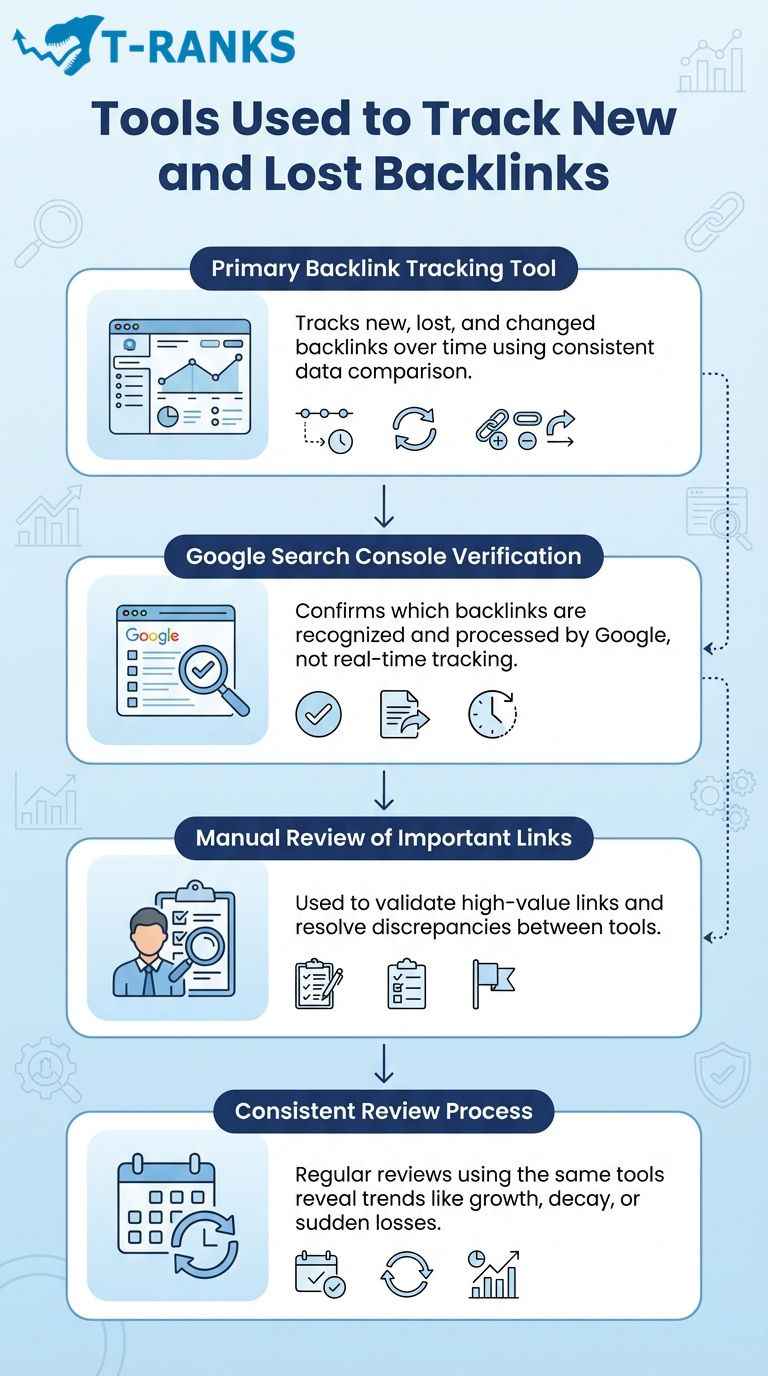
Backlink tracking does not require specialized software. It depends on using existing tools correctly and reviewing data on a regular basis. No single backlink tool is perfectly accurate, which is why cross-checking sources and manually verifying important links is essential. Effective tracking is a process, not a single report.
One Primary Backlink Tool for Ongoing Monitoring
A primary backlink analysis tool refers to platforms that crawl the web and report backlink changes over time, such as Ahrefs, Semrush, Moz, or similar SEO tools.
The value of this tool comes from comparison rather than totals. By reviewing the same data source consistently, it becomes easier to spot trends such as steady link growth, gradual decay, or sudden losses. Switching between tools often introduces noise, while sticking to one reference point makes patterns clearer and more reliable.
This approach helps explain link movement instead of reacting to fluctuating backlink counts.
Google Search Console to Confirm What Google Recognizes
Google Search Console provides confirmation of which backlinks Google has actually discovered and processed. It does not offer detailed change tracking or frequent updates, but it reflects Google’s own view of a site’s backlink profile.
Because updates are slower and data is more limited, Search Console should not be used alone for tracking changes. Its strength lies in verification. Comparing backlink tool data with Search Console helps confirm which links are recognized by Google and which may still be uncounted or ignored.
This comparison is especially useful when reviewing high-value or business-critical links.
Backlink tracking works best when tools are used together with consistent review habits. Regular checks, manual verification of important links, and steady use of the same data sources provide more clarity than relying on any single report.
How to Track New and Lost Backlinks Effectively

Effective backlink tracking is about interpreting link changes in a consistent way. Using the same tools, filters, and review logic each time helps separate real authority changes from normal web activity. Consistency matters more than how often backlinks are checked.
To Track New Backlinks
Tracking new backlinks helps confirm whether authority is growing naturally or whether new links are simply replacing older ones that were lost.
Select One Primary Backlink Tool
Choose one backlink tool and treat it as your main reference source. Different tools discover and refresh backlinks at different times, which can cause conflicting reports. By relying on one tool consistently, trends become clearer and link movement is easier to interpret over time.
Set Up the Project Correctly
Accurate setup is critical for reliable data. Make sure the correct domain version, protocol, and subdomain settings are used. A small setup mistake can cause backlinks to appear missing, duplicated, or misattributed, which leads to incorrect conclusions about link growth or loss.
Filter Backlinks by New or Recent Date
Date-based filters help isolate backlinks that were discovered since the last review. This keeps analysis focused on current changes rather than the entire backlink history. Without filtering, new links are easily overlooked or mixed with older data that no longer matters.
Review Link Source and Target Page
Every new backlink should be reviewed in context. Look at the linking site, the content surrounding the link, and the page it points to. Relevance, placement, and the importance of the target page often matter more than the presence of the link itself.
Mark or Note High-Value Links
Not all backlinks are equal. Links from trusted, relevant sources should be marked for ongoing review. Tracking these high-value links over time helps ensure that important authority signals remain stable and are not lost without notice.
To Track Lost Backlinks
Tracking lost backlinks helps explain ranking or authority drops that are not caused by on-page or technical changes.
Filter Backlinks by Lost or Removed Status
Use lost or removed filters to identify backlinks that are no longer active. This creates a clear list of links that require review and prevents time from being wasted on links that are still live.
Identify Whether the Link Was Removed, Redirected, or Broken
Understanding why a link was lost is essential. The link may have been removed during an editorial update, broken because the target page no longer exists, or affected by an incorrect redirect. Each scenario requires a different response, and not all losses can or should be recovered.
Check If the Link Was Dofollow
Confirm whether the lost link was dofollow or nofollow. Losing a dofollow link usually has a greater impact on authority and rankings. This distinction helps prioritize which losses deserve attention first.
Check Whether It Pointed to an Important Page
Review the page that the backlink pointed to. Losses affecting key ranking or revenue pages are usually more important than losses to low-impact or supporting pages. This helps avoid overreacting to minor link changes.
Decide Whether to Ignore, Reclaim, or Redirect
Not every lost backlink requires action. Some losses are normal and can be ignored. Others can be reclaimed through outreach or recovered with proper redirects. The decision should be based on link value, relevance, and impact, not emotion.
Context matters more than volume. Effective backlink tracking focuses on meaningful authority changes, not raw link counts. When link changes are reviewed calmly and consistently, backlink tracking becomes a practical tool for understanding SEO performance and protecting long-term visibility.
How Often You Should Monitor Backlinks
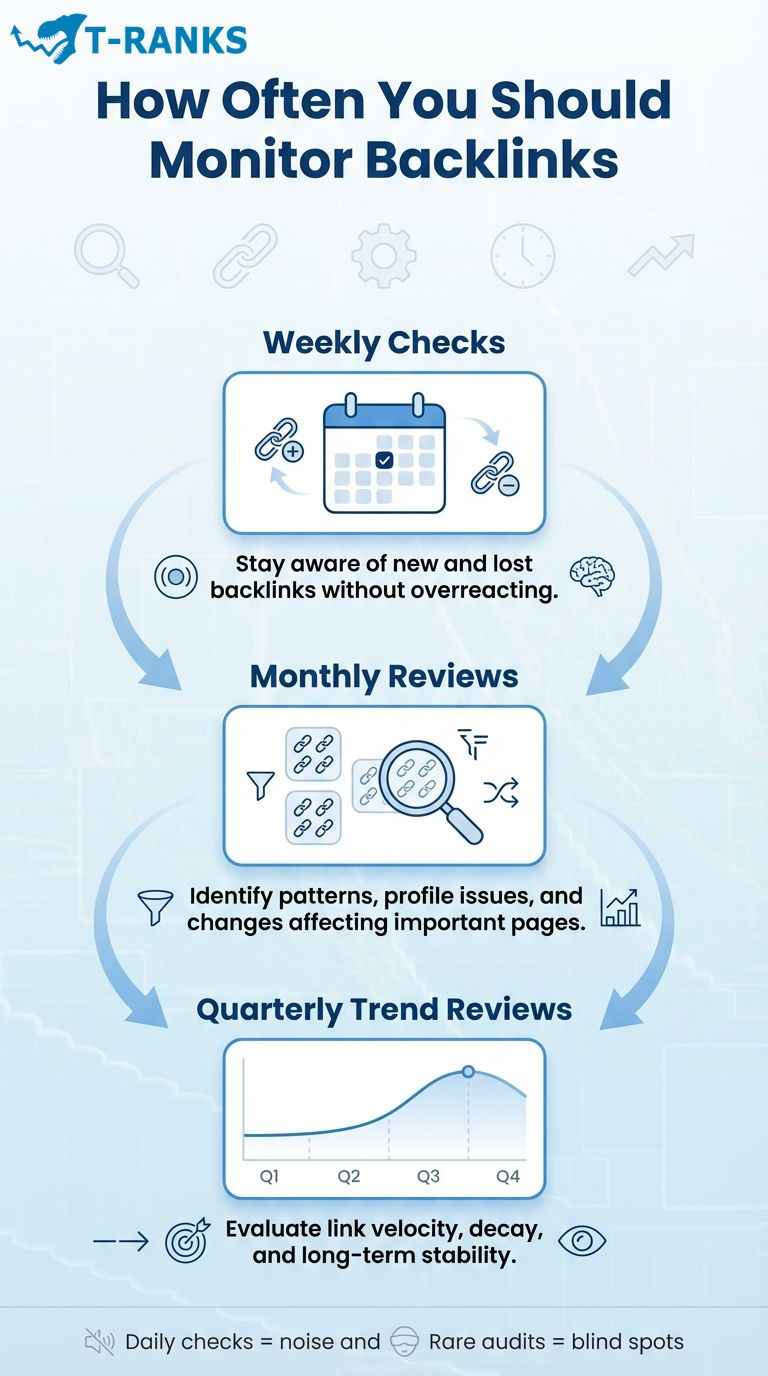
Backlinks should be monitored on a weekly, monthly, and quarterly basis.
This cadence balances visibility and control without creating noise. Checking too often leads to overreaction, while checking too rarely allows important link losses to go unnoticed. A structured schedule helps you understand backlink movement clearly and act only when it matters.
Step 1: Weekly Checks for New and Lost Backlinks
Weekly checks help you stay aware of meaningful backlink changes as they happen. The goal at this stage is visibility, not deep analysis.
You should look for new backlinks that may be worth tracking and lost links that affect important pages. Weekly reviews catch early warning signs, such as the loss of a strong link or repeated removals from the same source, before small issues turn into authority problems.
Step 2: Monthly Reviews for Backlink Profile Issues
Monthly reviews focus on patterns rather than individual links. This is where you step back and assess overall backlink health.
Look for repeated link losses, changes in dofollow status, shifts affecting priority pages, or unusual anchor text changes. Monthly reviews connect weekly observations into clearer insights and help decide whether follow-up actions are needed.
Step 3: Quarterly Trend Reviews for Link Velocity and Decay
Quarterly reviews are used to understand long-term backlink trends. Instead of reacting to short-term changes, you evaluate link growth, link decay, and overall stability across several months.
This level of review helps determine whether authority is steadily growing, slowing down, or quietly declining. Quarterly insights are especially useful for planning future link building, reclamation efforts, and SEO strategy adjustments.
Daily backlink tracking usually creates noise and encourages unnecessary reactions. Infrequent audits miss gradual damage. A weekly, monthly, and quarterly monitoring routine keeps backlink tracking calm, focused, and effective.
What to Do When You Lose Backlinks
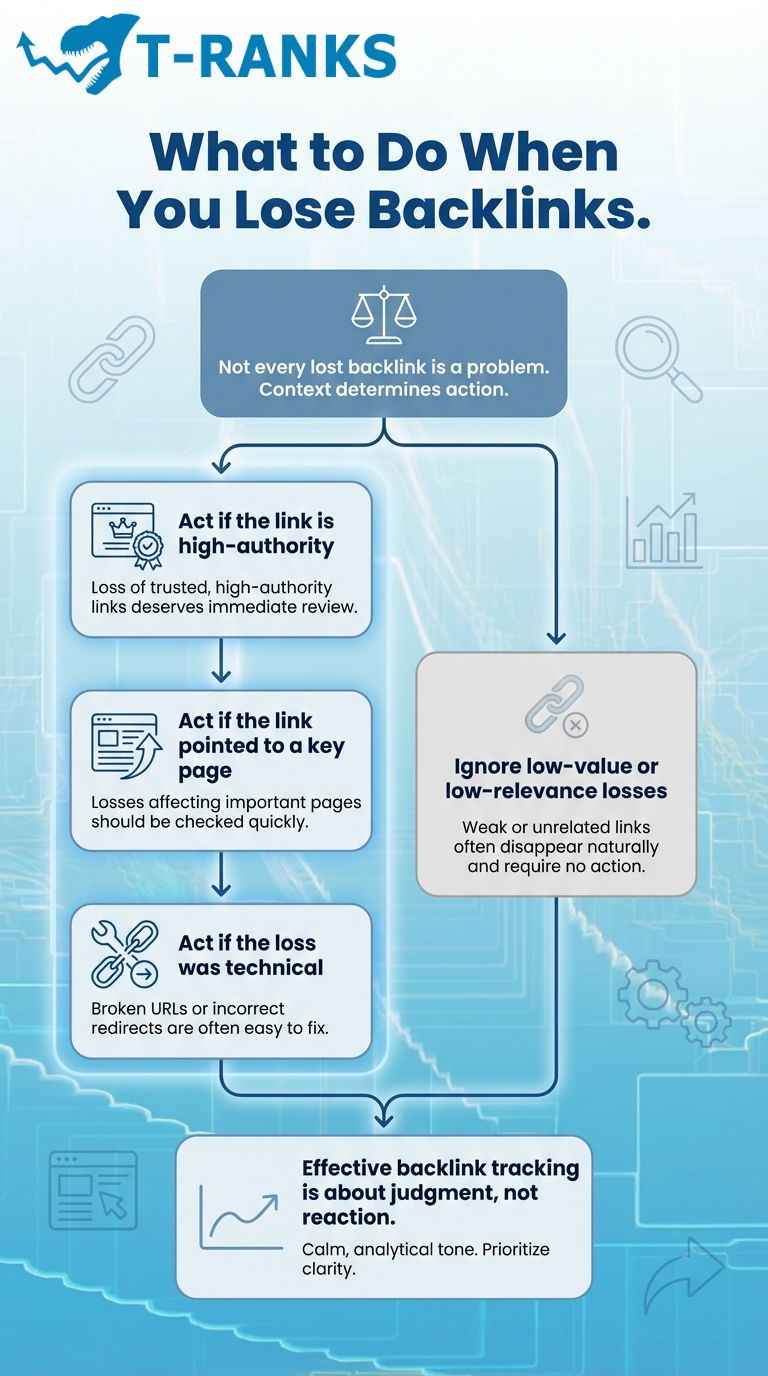
Not every lost backlink is a problem. Many links disappear due to normal web changes and do not affect rankings or authority. The key is knowing when to act and when to ignore a loss. Calm evaluation prevents wasted effort and keeps backlink tracking focused on what actually matters.
Act Quickly When a High-Authority Link Is Lost
If a backlink from a strong or trusted website disappears, it deserves immediate attention. These links often contribute meaningful authority, and their loss can have a noticeable impact. Review why the link was lost and determine whether it can be recovered or replaced.
Act When a Link to a Key Ranking Page Disappears
Links pointing to important ranking or revenue pages carry more weight than links to low-impact content. When one of these links is lost, check whether the target page changed, the URL broke, or the link was removed during an update. Losses affecting key pages should be reviewed and addressed quickly.
Act When a Technical Issue Caused the Loss
Some backlinks are lost due to technical problems rather than editorial decisions. Broken pages, incorrect redirects, or protocol changes can stop links from passing value. These issues are often the easiest to fix and should be prioritized as soon as they are identified.
Ignore Low-Relevance or Low-Value Link Loss
Links from unrelated, weak, or low-impact sources are often lost naturally and usually do not require action. Trying to recover every lost backlink creates noise and distracts from more important work. These losses can safely be monitored without intervention.
Effective backlink tracking is about judgment, not reaction. Focus effort on losses that affect authority and performance, and let harmless link decay pass without concern.
Simple Link Reclamation After Detection

Once a valuable backlink loss is identified, recovery should start with the simplest and least disruptive solution. Link reclamation is about restoring authority that already exists, not creating new links or launching fresh outreach campaigns. A calm, methodical approach often recovers lost equity faster than building from scratch.
Add a 301 Redirect for Removed Pages
If a backlink points to a page that no longer exists, a proper 301 redirect is often the fastest fix. Redirecting the old URL to the most relevant live page helps preserve link value and restores authority flow without requiring any outreach. This should always be the first step when a technical issue caused the loss.
Contact the Site Owner About Broken or Outdated Links
When a backlink was removed or broken due to content updates, a simple outreach message can sometimes restore it. Politely point out the broken or outdated reference and provide the correct URL. Reclamation outreach works best when the original link was editorial and contextually relevant.
Reclaim Unlinked Brand Mentions
Some backlink losses are not true removals but missed opportunities. Brand mentions without links can often be converted into backlinks with minimal effort. Identifying these mentions and requesting a link helps recover authority that already exists in name but not in link form.
Link reclamation works because it focuses on recovering existing equity rather than chasing new links. When handled early, it reduces authority loss and keeps backlink profiles stable without unnecessary effort.
Backlink Tracking vs Backlink Audits

Backlink tracking is the ongoing process of monitoring new, lost, and changed backlinks over time, while backlink audits are periodic evaluations of backlink quality, relevance, and risk at a specific point in time.
Although these terms are often used interchangeably, they serve different roles in SEO. Understanding the difference helps apply each process correctly and prevents gaps in backlink management.
Backlink tracking focuses on ongoing change. It monitors how a backlink profile evolves from week to week, helping protect authority as it shifts. Regular tracking surfaces silent link losses, unusual patterns, and reclamation opportunities before rankings are affected. Its main value is early awareness and control.
Backlink audits focus on overall condition. They are performed at defined intervals to assess backlink quality, relevance, and potential risk across the entire profile. An audit helps identify links that may need removal or disavowal and correct issues that tracking alone cannot address.
Both processes are necessary for stable SEO growth. Tracking helps you notice problems early, while audits help clean and correct the backlink profile when deeper issues exist. Used together, they support a healthier and more resilient backlink strategy.
Backlink Tracking vs Backlink Audits: Key Differences
| Aspect | Backlink Tracking | Backlink Audits |
| Definition | Ongoing monitoring of backlink changes | Periodic evaluation of backlink quality |
| Timing | Continuous | Scheduled, point-in-time |
| Core focus | New, lost, and changed links | Relevance, trust, and risk |
| Primary benefit | Early detection and protection | Cleanup and correction |
| Typical actions | Monitor, reclaim, prioritize | Remove, disavow, restructure |
| SEO role | Manages change over time | Improves overall link quality |
Conclusion
In conclusion, backlinks are not permanent assets. They change, decay, and disappear as websites evolve, content is updated, and technical issues occur. Without consistent monitoring, valuable authority can be lost quietly, creating gaps between link building efforts and actual SEO performance.
A backlink tracker helps maintain control by showing how links change over time, highlighting what is gained, what is lost, and what truly matters. When backlink tracking is paired with sensible review routines, clear prioritization, and timely reclamation, SEO decisions become calmer, more informed, and more effective.
If you want to protect existing authority, reduce unnecessary link loss, and make smarter decisions around link building, set up a consistent backlink tracking process and review it regularly. A disciplined approach turns backlinks from a risky variable into a manageable SEO asset.
Frequently Asked Questions About Backlink Trackers
What is a backlink tracker in SEO?
A backlink tracker is a method for monitoring new, lost, and changed backlinks over time. It focuses on link movement and status changes rather than total backlink counts.
Is a backlink tracker the same as a backlink checker?
No, a backlink tracker monitors changes over time, while a backlink checker shows a snapshot.
Most tools include both, but tracking requires regular comparison and review.
Why is backlink tracking important for rankings?
Backlink tracking is important because lost links reduce authority without warning.
Untracked link loss is a common reason rankings decline unexpectedly.
How often should backlinks be tracked?
Backlinks should be tracked weekly to catch important gains and losses early.
Monthly and quarterly reviews help identify long-term link decay and trends.
What backlinks should be tracked first?
Backlinks pointing to key ranking or revenue pages should be tracked first.
Losses on high-value pages usually have the greatest SEO impact.
How do you track new backlinks effectively?
New backlinks are tracked by filtering links by recent discovery dates in an SEO tool.
The source, link type, and target page should always be reviewed for relevance.
How do you track lost backlinks?
Lost backlinks are tracked by filtering links marked as removed or lost.
You should check whether the link was deleted, broken, or affected by a redirect.
Do you need special software to track backlinks?
No, special software is not required to track backlinks.
Most site owners use existing SEO tools with a consistent monitoring routine.
Can Google Search Console be used as a backlink tracker?
Google Search Console confirms backlinks that Google recognizes.
However, it updates slowly and does not show detailed link change history.
What backlink metrics matter most for tracking?
Referring domains, link status, and relevance matter most for tracking.
Total backlink count alone does not explain authority or ranking changes.
Should you worry if backlinks are lost?
You should only worry if the lost backlink was strong, relevant, or important.
Low-quality or unrelated link loss is usually normal and harmless.
What should you do when a valuable backlink is lost?
You should first check for technical issues like broken pages or incorrect redirects.
If needed, link reclamation or outreach can help restore lost authority.