Growing a small business is not just about getting noticed, it is about being trusted. Before choosing a product or service, most people search online to see what others are saying. They look for signs that a business is real, reliable, and worth their time.
This is where digital PR becomes helpful for small businesses. It allows your brand to appear in trusted articles, local stories, and industry websites instead of relying only on paid ads. These mentions feel more genuine and help people feel confident about choosing you.
In this guide, you will learn how digital PR helps small businesses build trust, improve visibility, and compete with larger brands using simple and affordable methods. Everything is explained in an easy way so you can understand how to get started without feeling overwhelmed.
What Is Digital PR for Small Businesses

Digital PR for small businesses is the practice of earning online mentions and editorial coverage from relevant websites to build trust and visibility. Instead of relying on paid advertising, it focuses on third-party validation through articles, features, and brand mentions that help establish credibility.
For small businesses, digital PR is less about mass exposure and more about being visible in the right places. The goal is to appear trustworthy, established, and relevant to customers who research before making decisions.
Example: A local service business being featured in a regional news site or quoted in an industry blog builds credibility far more effectively than self-promotional ads.
Why Digital PR Matters for Small Businesses Today

Digital PR matters for small businesses because people want proof before they buy. Most customers search online, read articles, and look for trusted opinions before choosing a product or service. If your business appears in these trusted places, people are more likely to believe in you.
Competing with bigger brands on realistic budgets
Big companies spend a lot on advertising to stay visible. Small businesses usually cannot do that. Digital PR helps by earning mentions in blogs, local news sites, and industry websites. One good feature or mention can give a small business strong visibility without large spending.
Building trust early in the buying process
Customers trust what others say more than what a business says about itself. When your business is mentioned in articles, expert lists, or local publications, it acts like a recommendation. This outside validation helps customers feel safe choosing you.
Growing brand authority over time
Digital PR builds authority slowly but steadily. Each mention, quote, or feature adds to your reputation. Over time, people begin to see your business as knowledgeable and reliable in its field.
Supporting SEO and long-term visibility
Digital PR helps search engines understand your business better. Mentions and links from trusted websites signal that your business is real and credible. This supports long-term visibility, not just short-term traffic.
Matching how people discover businesses today
People no longer rely only on search results. They read blogs, follow local guides, and trust expert opinions. Digital PR places your business in these spaces so people find you naturally while researching.
Helping visibility in AI-driven search tools
AI systems prefer businesses that are mentioned by trusted sources. When your business appears in reliable publications, AI tools can recognize and reference it more easily in their answers.
Creating content you can reuse
Stories, insights, and ideas used for digital PR can also be shared on your website, emails, and social media. This allows one idea to bring value across many channels.
Making marketing decisions easier
Digital PR is easy to measure. You can see where traffic comes from, which mentions drive interest, and what content performs best. This helps you focus on what works.
Reducing risk from platform changes
Relying on one platform is risky. Digital PR spreads your visibility across many trusted websites. This protects your business from sudden algorithm or platform changes.
In simple terms, digital PR matters because it builds trust, improves visibility, and helps small businesses grow without depending on large advertising budgets.
How Digital PR Works for Small Businesses (Core Model)
Digital PR works for small businesses by helping people and search engines trust the business over time. Instead of paying for ads, a business earns real mentions on websites that people already trust. These mentions act like signals that say, “This business is worth paying attention to.”
When a small business appears regularly in the right online places, customers feel more confident choosing it. Search engines and AI systems also begin to recognize the business as reliable and relevant. This is the basic way digital PR builds long-term visibility and authority.
Earned media builds trust from the outside
When a small business is mentioned in an article, quoted as an expert, or included in a local or industry feature, it creates outside approval. People trust these mentions more than ads because they come from independent sources. Even one relevant feature can make a business feel more credible to someone seeing it for the first time.
Brand mentions grow authority over time
One mention helps introduce a business, but repeated mentions help people remember it. As a business appears again and again on trusted websites, it starts to feel familiar and established. Over time, this builds strong brand awareness and authority within a specific niche.
Relevance is more important than being everywhere
Small businesses do not need mass exposure to succeed. Being mentioned on websites that match their industry or local area has a much stronger impact. Relevant coverage reaches people who are already interested, which makes those mentions more valuable and more likely to lead to real engagement.
Trust signals support search visibility
Digital PR helps search engines understand what a business does and why it matters. Mentions from trusted sources provide useful context, even when there is no direct link. These trust signals support long-term search visibility and increase the chances of appearing in search results and AI-powered summaries.
Consistency makes digital PR stronger
Digital PR works best when it is done regularly. Each new mention strengthens previous ones and makes future coverage easier to earn. Over time, this steady recognition helps a small business move from being unknown to being trusted and easy to discover.
In simple terms, digital PR works by earning regular, credible mentions, staying relevant to the right audience, and building trust that grows stronger over time.
Digital PR vs Traditional PR for Small Businesses
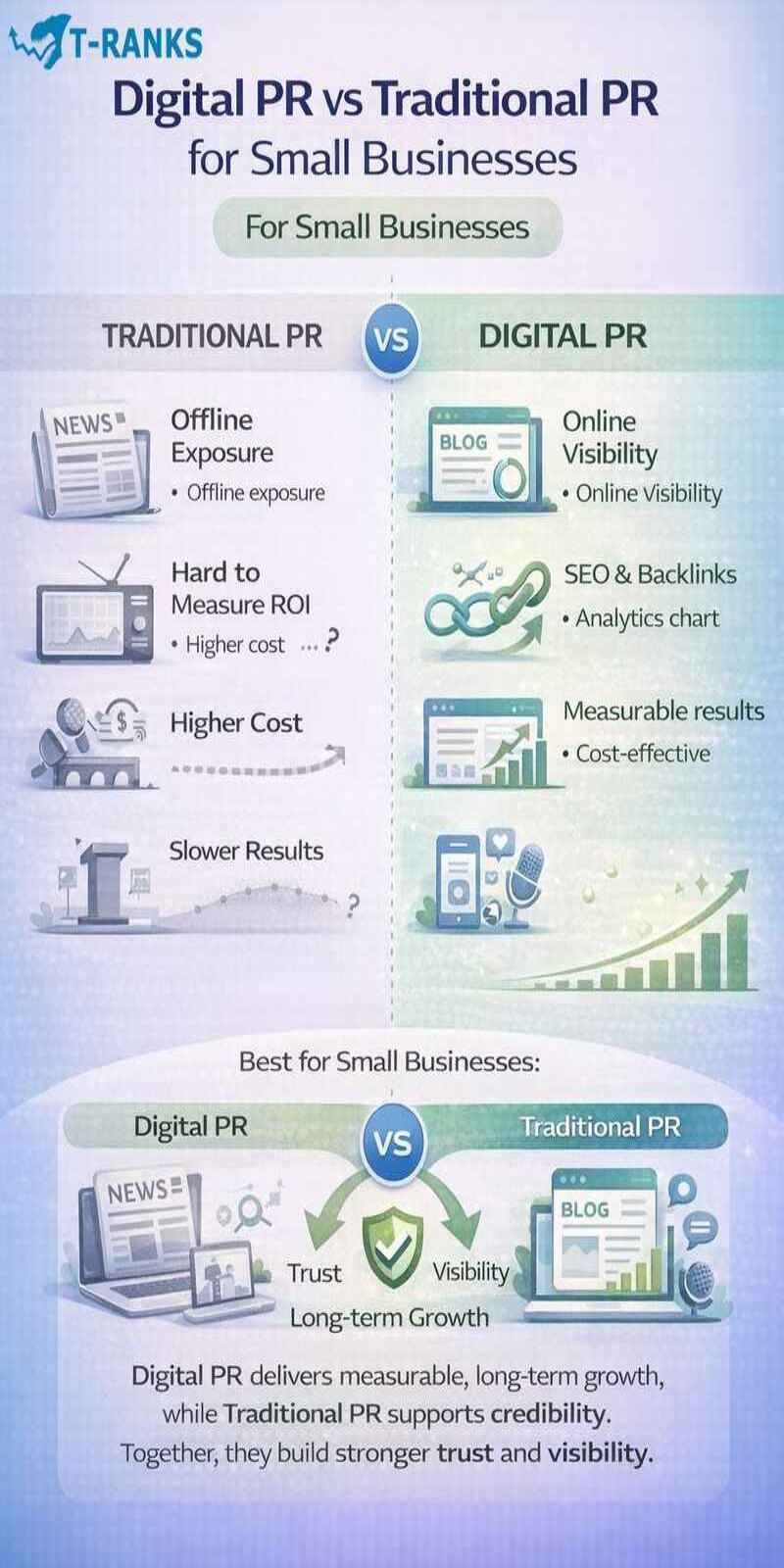
Digital PR and Traditional PR both aim to increase brand awareness, but they differ in how trust, visibility, and results are created for small businesses. Traditional PR focuses on offline exposure and broad recognition, while Digital PR builds online authority through searchable content, measurable performance, and long-term visibility where customers actively research and compare options. Understanding this difference helps small businesses invest their time and budget more effectively.
Key Differences: Digital PR vs Traditional PR
| Aspect | Traditional PR | Digital PR |
| Channels | Print media such as newspapers and magazines, TV, radio, and in-person events | Online publications, blogs, social media platforms, podcasts, influencer collaborations, and websites |
| Primary Goals | Broad brand awareness, reputation management, and general credibility | Strong online visibility, improved SEO through backlinks, and consistent website traffic |
| Audience Engagement | Mostly one-way communication with passive audience interaction | Two-way engagement through comments, shares, and direct interaction |
| Measurement | Difficult to measure ROI accurately, often relying on circulation figures or advertising value estimates | Highly measurable using analytics tools that track backlinks, referral traffic, visibility, and rankings |
| Speed and Agility | Slower due to longer lead times and fixed editorial schedules | Faster and flexible, allowing timely responses to trends or breaking news |
| Cost | Often higher because of production, placement, and agency costs | More cost-effective and scalable, relying mainly on earned media |
Which Is Better for Small Businesses?
Digital PR is usually more practical for small businesses because it delivers measurable results and supports long-term online growth. Earning high-quality backlinks and trusted mentions improves search visibility and drives ongoing traffic over time.
Traditional PR still plays an important role in building strong credibility. Coverage in a respected newspaper or a local TV feature can quickly increase trust, especially among audiences that rely less on digital media.
The most effective approach is a hybrid strategy. For example, a data-driven online campaign launched through Digital PR can be reinforced by a local TV interview or print feature using Traditional PR. This combination allows small businesses to build lasting trust while reaching customers across both online and offline touchpoints.
Practical Digital PR Strategies That Work for Small Businesses
Practical digital PR strategies work best for small businesses when they focus on relevance, credibility, and consistency rather than scale. Instead of trying to reach everyone, these approaches help small brands earn attention from the right audiences through thoughtful media outreach and credible recognition. Each strategy below explains what it is and when it makes the most sense to use it.
Local digital PR opportunities
Local digital PR focuses on earning visibility through regional news sites, city blogs, community publications, and local business platforms. These outlets regularly highlight businesses that contribute value to their area through insights, services, or community involvement.
This strategy is especially effective for businesses that serve a defined location. Being featured locally builds immediate trust, increases familiarity, and supports visibility where customers are actively searching for nearby options.
Founder led story pitching
Founder led pitching uses the real experiences, lessons, and perspectives of the business owner as the core story. Journalists often prefer these human narratives because they feel authentic and grounded in real world experience.
This approach works best when the founder has direct industry knowledge or a meaningful journey to share. It helps small businesses earn coverage by emphasizing expertise and authenticity instead of brand size.
Guest posting with a PR first approach
Guest posting as a digital PR strategy prioritizes authority and recognition over promotion. Instead of focusing on links, the goal is to contribute useful ideas, frameworks, or insights to respected industry publications.
This strategy makes sense when a business has clear knowledge to share or recurring insights from its work. Over time, consistent guest contributions strengthen positioning and support long term brand trust.
Journalist request platforms
Journalist request platforms connect reporters with experts who can provide timely insights. When a business responds with relevant and well framed input, it earns inclusion in editorial coverage that readers already trust.
This strategy works well for businesses that can clearly explain topics in their niche. Repeated appearances through these platforms gradually build visibility and reinforce credibility with both audiences and search systems.
Data and insight driven digital PR campaigns
Data driven digital PR campaigns use original insights to tell a story. These insights may come from internal trends, customer behavior, surveys, or localized observations that help explain a broader pattern.
This approach is most effective when a business can present information that journalists can reference. Even small data sets can create strong digital PR campaigns if the insight is relevant and clearly framed.
Niche focused visibility strategies
Small businesses often see stronger results by focusing on niche audiences rather than broad exposure. Mentions in specialized blogs, industry newsletters, or focused communities can create deeper impact than general coverage.
This strategy works best when the audience is clearly defined. Targeted visibility helps build brand authority by reinforcing relevance instead of chasing attention from unrelated audiences.
Why these strategies work together
Each of these digital PR strategies supports digital brand awareness in a different way. Local coverage builds trust nearby, founder stories humanize the brand, guest content establishes expertise, and data driven stories create reference value. When used consistently, they reinforce each other and create a durable presence across trusted online spaces.
How to Do Digital PR for a Small Business (Step by Step)
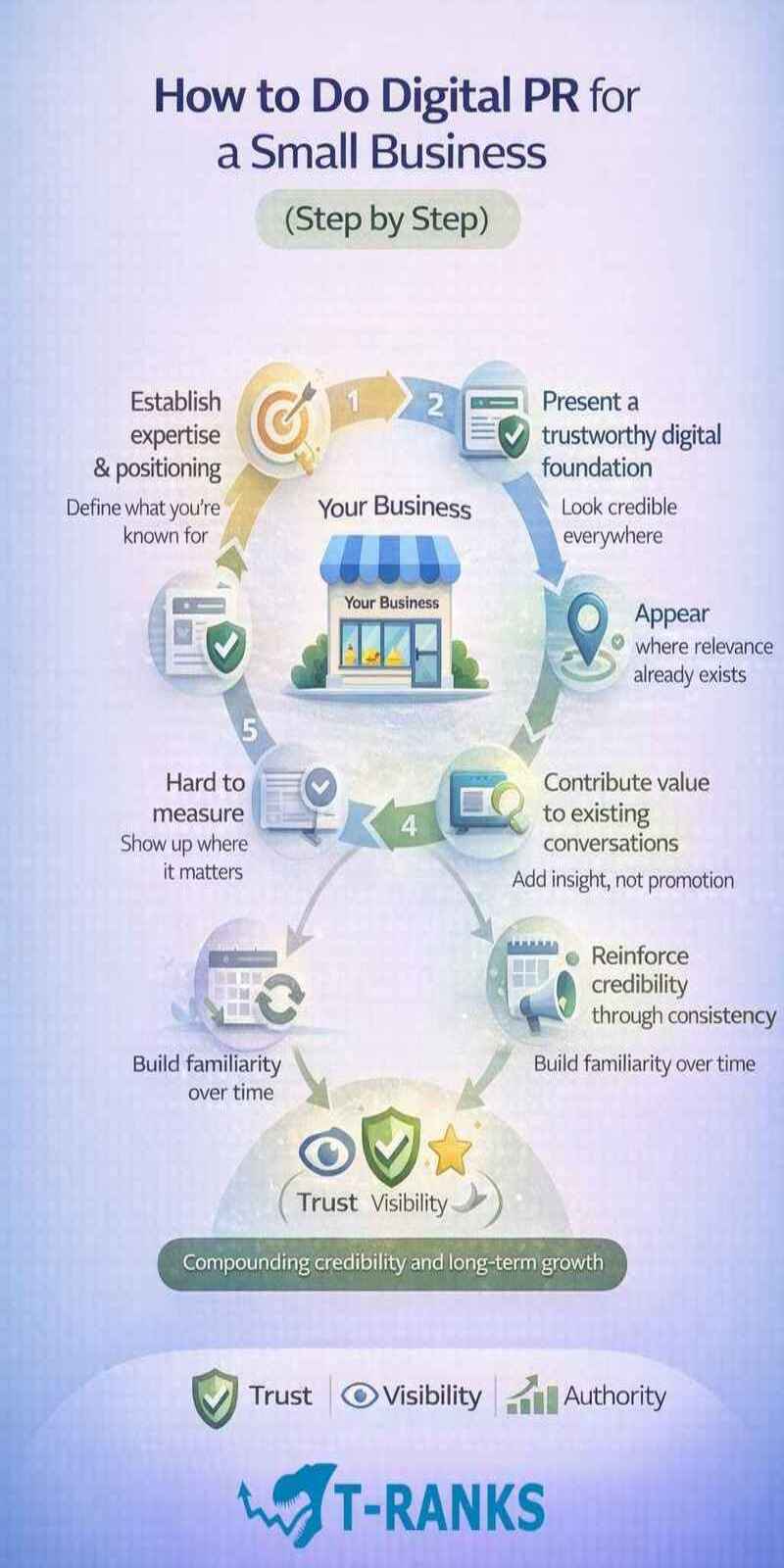
Digital PR for small businesses works as a structured cycle that builds credibility, visibility, and recognition over time. Instead of chasing short-term attention, this process focuses on how a business becomes understood and trusted by customers, search engines, and AI systems through consistent, meaningful signals.
To understand how this process builds results, it helps to follow the stages in the order they naturally occur.
Step 1: Establish clear expertise and positioning
Digital PR begins with clarity. A small business must be associated with specific topics it genuinely understands and solves. This step defines how the brand is framed in public conversations and sets expectations for future coverage. When expertise is clear and focused, recognition feels earned rather than promotional.
Step 2: Present a trustworthy digital foundation
Once positioning is clear, trust must be visible. When a business is mentioned or referenced, people and systems verify it. A consistent and professional digital presence reinforces trust signals and ensures that earned visibility strengthens brand authority instead of creating doubt.
Step 3: Appear where relevance already exists
Visibility only works when it is contextual. Small businesses benefit most from appearing in places their audience already trusts and follows. This step aligns exposure with intent, allowing editorial coverage to reach people who are already open to the message.
Step 4: Contribute value within existing conversations
At this stage, digital PR shifts from presence to participation. Businesses gain recognition by adding insight, clarity, or perspective to topics already being discussed. When the contribution is genuinely useful, coverage acts as validation rather than advertising.
Step 5: Reinforce credibility through consistent communication
Recognition strengthens with consistency. Ongoing, professional communication builds familiarity and signals reliability over time. Even without immediate results, this step increases trust and makes future coverage more likely and more impactful.
Step 6: Extend recognition across owned channels
Earned visibility becomes more powerful when reinforced. Repeating mentions across the brand’s own platforms improves digital brand awareness and helps both audiences and search systems connect the business with trusted sources.
Step 7: Learn from signals and refine direction
Digital PR improves through reflection. Each cycle reveals what resonated, where authority grew, and how visibility shifted. Using these signals to refine direction turns digital PR into a system that strengthens with every iteration.
How the Core Model Works in Practice
In simple terms, digital PR for small businesses works by earning credible mentions, reinforcing relevance through repetition, and building trust through consistency. Each stage strengthens the next, creating a compounding effect that transforms visibility into long-term authority.
Digital PR Assets Small Businesses Need Before Outreach

Digital PR works best when a small business is already prepared to be evaluated. Before any coverage happens, journalists, readers, search engines, and AI systems look for clear signals that confirm legitimacy and trust. These core assets create the foundation that determines how impactful each earned mention becomes.
Press or media page essentials
A press or media page gives journalists a fast way to verify your business. It summarizes who you are, what you do, and how to reference you accurately. When this information is easy to find, editors feel more confident mentioning or featuring your brand.
Founder bio and positioning
For small businesses, the founder often represents the brand. A clear founder bio highlights experience, expertise, and perspective without selling. This humanizes the business and strengthens authority by showing there is real knowledge behind the name.
Proof signals and credibility indicators
Trust grows through visible evidence. Reviews, certifications, memberships, awards, and past mentions act as proof signals that others already recognize your business. These indicators reduce risk for journalists and reassure audiences that the brand is reliable.
Clear brand story and messaging
Consistent messaging improves how coverage is understood. A clear brand story explains who you serve, the problems you solve, and why your approach matters. When this narrative is aligned across your site and profiles, earned mentions reinforce authority instead of causing confusion.
Supporting visual and identity assets
Basic visual assets support credibility. Professional images and clear branding help ensure your business is presented accurately when referenced. Consistent visuals increase recognition and make coverage feel polished and trustworthy.
In simple terms, these assets make a small business easy to understand and easy to trust. Strong preparation ensures that when attention arrives, every mention contributes to lasting authority rather than standing alone.
Real Digital PR Examples for Small Businesses
Digital PR works best when small businesses appear in trusted places their customers already pay attention to. The examples below show how everyday businesses gain trust and visibility online without advertising or complex strategies.
Local Service Business Example
A local plumbing business is mentioned on a city news website after sharing tips on preventing pipe damage during winter. The article focuses on helping residents, not promoting services. People who read the article remember the business as helpful and reliable, which builds trust and makes the company easier to find when they need a plumber.
B2B Small Business Example
A small IT consultant is quoted in an industry blog explaining common email security mistakes businesses make. The post is educational and not sales focused. Readers begin to see the consultant as knowledgeable, and other businesses feel more confident reaching out for advice or services.
Ecommerce or Startup Example
A small online store selling eco friendly kitchen products is included in a blog post about simple ways to reduce plastic at home. The mention feels natural because the products match the topic. Shoppers interested in sustainability notice the brand and trust it more because it appears in a useful, relevant article.
Why These Examples Work
In each case, the business gains attention by being useful and relevant, not by trying to reach everyone. Digital PR helps small businesses build trust step by step by showing up in places people already trust and read.
Digital PR on a Small Business Budget
Digital PR works well for small businesses because it does not depend on big spending. It depends on sharing real knowledge, showing up consistently, and earning trust over time. You can start with almost no budget and slowly add support only when it makes sense.
Zero to Low Budget Digital PR
At this level, digital PR is mostly about effort, not money. Small business owners handle things themselves by sharing useful ideas, responding to media questions, and being visible in places their customers already trust.
Free tools make this possible, but time is the main cost. Results grow slowly, yet every mention builds credibility that keeps working long after the effort is done.
Low Cost Paid Support
As results start to appear, small paid help can save time. This usually means getting help with simple tasks so the business owner can focus on expertise and messaging.
Paid tools or services only make sense when they reduce workload or improve consistency. Expensive agencies or long contracts are unnecessary at this stage and often waste budget.
In simple terms
Small businesses do not need large budgets for digital PR. Starting small, staying consistent, and adding support only when needed keeps costs low while building long term trust and visibility.
Essential Digital PR Tools for Small Businesses

Essential Digital PR Tools for Small Businesses help simplify media outreach, track visibility, and measure credibility without adding unnecessary cost or complexity. Small businesses get the best results by using a small, focused set of tools that support mentions, monitoring, and performance rather than managing large software stacks.
Outreach and Contact Discovery Tools
These tools help small businesses connect with journalists and content creators who are actively looking for expert input.
- Connectively (formerly HARO)
Shares daily journalist questions, giving businesses a chance to earn mentions by providing useful answers. - Featured
Connects business owners with article opportunities that value real experience and practical insights. - Qwoted
Organizes expert responses and helps journalists quickly find reliable sources. - Hunter
Helps locate verified email addresses when direct contact with writers or editors is required.
These tools make media access possible without agency relationships.
Media Monitoring and Mention Tracking
Tracking mentions helps small businesses see where trust is forming and how visibility grows over time.
- Google Alerts
Notifies you when your business name appears online at no cost. - Mention
Tracks brand references across websites and social platforms. - Brand24
Monitors mentions in real time and shows how conversations develop.
Mention tracking supports long term credibility and awareness building.
Performance and Visibility Tracking
These tools help connect digital PR efforts to real visibility and recognition.
- Google Analytics
Shows which media mentions send visitors to your website. - Google Search Console
Reveals growth in branded searches and search presence. - Ahrefs
Tracks backlinks, referring domains, and authority signals. - Semrush
Monitors search visibility, mentions, and competitive positioning.
Together, these tools show whether digital PR is strengthening your online presence.
Keeping the Tool Stack Lean and Affordable
Using too many tools creates confusion and wasted expense. Most small businesses only need one outreach tool, one monitoring tool, and one tracking tool. Starting simple keeps digital PR manageable and focused on building trust rather than managing software.
Common Digital PR Mistakes Small Businesses Make
Digital PR can deliver strong, long term results for small businesses, but only when it is approached correctly. Many businesses struggle not because digital PR does not work, but because of avoidable mistakes that weaken trust, relevance, and credibility. Below are the most common digital PR mistakes small businesses make, along with clear guidance on how to fix them.
Being overly promotional in pitches
One of the biggest mistakes is treating digital PR like advertising. Journalists and publishers are not looking to promote products or sales messages. When a pitch focuses too much on the business instead of the audience, it quickly gets ignored.
The solution is to lead with value. Focus on insights, experience, or useful information that helps the reader. When the story is helpful first, brand visibility follows naturally.
Targeting irrelevant publications
Many small businesses send the same pitch to dozens of websites without checking relevance. This creates weak coverage and damages credibility with editors who receive off topic messages.
The fix is prioritizing relevance over reach. Coverage in a niche blog, local site, or industry publication your customers already trust is far more valuable than mentions on unrelated high traffic websites.
Expecting instant results
Digital PR builds authority gradually, not overnight. Expecting immediate traffic spikes or sales after one mention often leads to frustration and abandonment of the strategy.
The solution is patience and consistency. Digital PR works through repeated exposure, where each mention strengthens trust and recognition over time.
Ignoring follow-ups
Many opportunities are lost simply because there is no follow up. Journalists receive large volumes of emails and often miss good pitches.
A polite, professional follow up reinforces interest without pressure. Consistent follow ups also build familiarity, which increases the chances of future coverage.
Chasing volume instead of quality
Some businesses focus on getting as many mentions as possible, even if the sources are low quality or irrelevant. This creates noise rather than authority.
The better approach is fewer, stronger mentions. High quality editorial coverage builds trust signals that matter to both people and search systems.
Lacking clear positioning
When a business does not clearly communicate what it stands for or what it is an expert in, coverage becomes inconsistent and confusing.
Clear positioning solves this. When messaging is focused, mentions reinforce the same themes, helping the brand become associated with specific expertise.
Stopping after one success
Some small businesses stop digital PR after a single feature or backlink, assuming the work is done.
The solution is continuity. Digital PR compounds when done consistently. Ongoing effort turns early wins into lasting authority and dependable visibility.
How to Measure Digital PR Success for Small Businesses
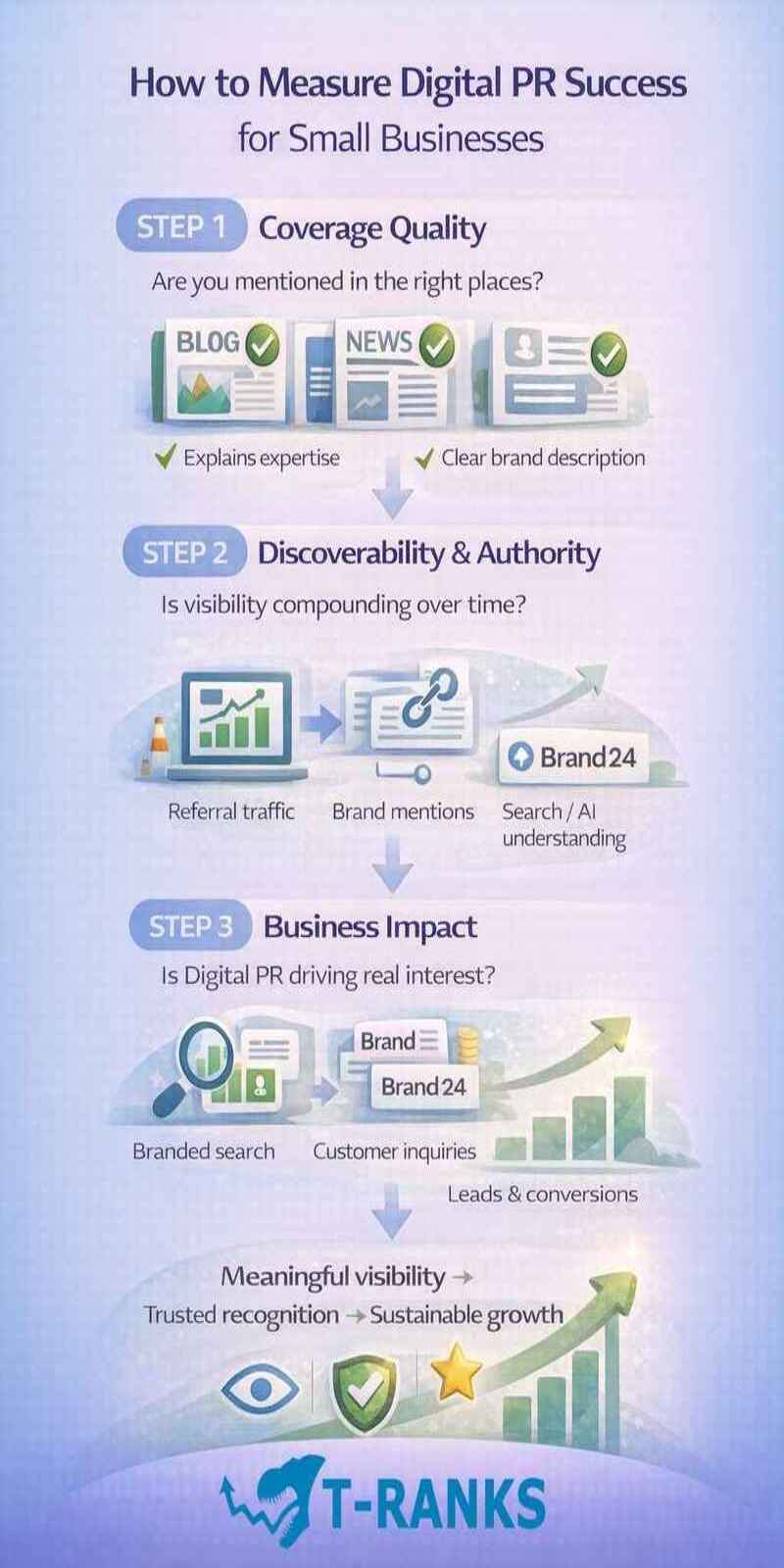
Measure Digital PR for Small Businesses by checking whether your brand is gaining meaningful visibility, trust, and recognition in the right places. The first and most important signal is coverage quality. Look at where your business is mentioned and how it is described. Mentions in relevant blogs, news sites, and industry publications that clearly explain your expertise indicate that digital PR is building real credibility.
Next, evaluate how that coverage supports discoverability. Referral traffic from articles, repeat brand mentions across trusted sites, and backlinks from reputable sources all show growing authority. Even when links are not present, consistent mentions help search engines and AI systems understand who you are and what you are known for, supporting long-term visibility rather than short-term rankings.
Finally, connect digital PR to business outcomes. Track increases in branded searches, inquiries that reference articles or features, and gradual lead or conversion growth. When digital PR contributes to steady awareness, stronger trust, and measurable interest over time, it is fulfilling its purpose and delivering lasting value for a small business.
Is Digital PR Worth It for Small Businesses?
Yes, digital PR is highly worth it for small businesses because it provides a cost-effective way to build trust, improve visibility, and strengthen long-term authority. By earning credible online mentions, media features, and contextual backlinks, small businesses can compete with larger brands without relying heavily on paid advertising. Digital PR supports steady growth by improving how customers, search engines, and AI systems perceive your brand.
Key Benefits for Small Businesses:
Builds credibility and trust: Features in respected publications or mentions by trusted sources act as third-party validation, helping customers feel confident choosing your business.
Supports SEO and rankings: Quality backlinks and brand mentions signal credibility to search engines, supporting stronger search visibility over time.
Expands targeted visibility: Digital PR introduces your brand to relevant audiences who are already interested in your industry or services.
Remains cost-effective: It delivers lasting exposure without the ongoing costs of traditional advertising.
Drives traffic and growth: Improved visibility and trust naturally lead to more site visits, inquiries, and conversions.
Establishes authority: Consistent coverage positions your business as a knowledgeable and reliable voice in your niche.
Getting Started With Digital PR for Small Businesses
Getting started with digital PR for small businesses is less about promotion and more about preparation. Before reaching out to any publication, a business should clearly communicate who it serves, what problems it solves, and why its experience can be trusted. When this foundation is clear, journalists, readers, and search systems can quickly understand the business without confusion.
The simplest way to begin is by starting small and staying consistent. Many small businesses gain early traction by focusing on one manageable activity, such as sharing useful insights with relevant publications or responding to media requests within their niche. These early mentions help establish credibility and create a visible presence across the web.
Digital PR works best when relevance, consistency, and credibility guide every effort. Showing up in the right places with clear messaging builds trust over time. By keeping activities focused and realistic, small businesses can turn digital PR into a sustainable part of long-term growth rather than a short-term push.
Conclusion
Digital PR is a realistic and effective growth channel for small businesses that want to build trust, visibility, and authority without relying on large advertising budgets. By earning credible mentions, focusing on relevance over reach, and showing up consistently in trusted online spaces, small businesses can compete with larger brands through reputation rather than spend.
Digital PR delivers the strongest results when approached with patience and clarity. Starting small, preparing the right assets, avoiding common mistakes, and measuring progress over time allows authority to compound naturally. When done consistently, digital PR supports SEO, strengthens brand credibility, and improves how customers and modern search systems discover and trust a business.
To move forward, start with one clear story, focus on delivering value, and commit to consistency. Digital PR rewards businesses that show up with insight, credibility, and long-term intent.
FAQs About Digital PR for Small Businesses
What is digital PR for small businesses?
Digital PR for small businesses is the process of earning online mentions and editorial coverage to build trust and visibility. It relies on credibility, relevance, and third-party validation rather than paid advertising.
How is digital PR different from traditional PR for small businesses?
Digital PR focuses on online visibility and measurable signals like mentions and authority. Traditional PR prioritizes offline exposure and broad awareness with limited tracking.
Is digital PR affordable for small businesses?
Yes, digital PR is affordable because it depends more on time, insight, and consistency than budget. Many effective efforts require minimal financial investment.
Can a small business do digital PR without hiring an agency?
Yes, small businesses can handle digital PR on their own. Agencies can help later, but they are not required to get started or see results.
How long does digital PR take to show results?
Digital PR usually shows early visibility within a few months. Strong authority and trust signals build steadily over time with consistent effort.
Does digital PR help SEO and search rankings?
Yes, digital PR supports SEO by strengthening trust, brand authority, and external validation. It works alongside SEO rather than replacing it.
What is the difference between digital PR and link building?
Digital PR focuses on editorial coverage and brand mentions. Link building focuses mainly on backlinks, which are often a byproduct of digital PR.
Do brand mentions without backlinks matter?
Yes, brand mentions without links still matter. They help search engines and AI systems recognize and trust a business.
Is digital PR effective for local and service-based businesses?
Yes, digital PR is highly effective for local and service businesses. Regional coverage builds trust and improves local visibility.
What type of content works best for digital PR?
Content that shows expertise, insight, or real value works best. Promotional or sales-driven content usually performs poorly.
What are the biggest digital PR mistakes small businesses make?
The biggest mistakes are being overly promotional and expecting instant results. Digital PR requires patience and consistency.
Is digital PR worth it for very small or new businesses?
Yes, digital PR is valuable for very small or new businesses. It helps build credibility early and supports long-term growth.