You are publishing content regularly but your organic traffic is not moving. You have optimised your pages, added keywords, and maybe even built a few links. Yet the results are still disappointing.
The problem is usually not what you are doing. It is what you are not seeing. Most sites that stay stuck are overlooking a small set of hidden SEO factors that quietly control how fast a site grows.
These are not complicated tactics. They are things like search intent, topical authority, internal linking, and site structure. This guide breaks each one down so you know exactly what to fix and where to start.
Why Some Websites Stay Stuck Even When They Are Doing SEO
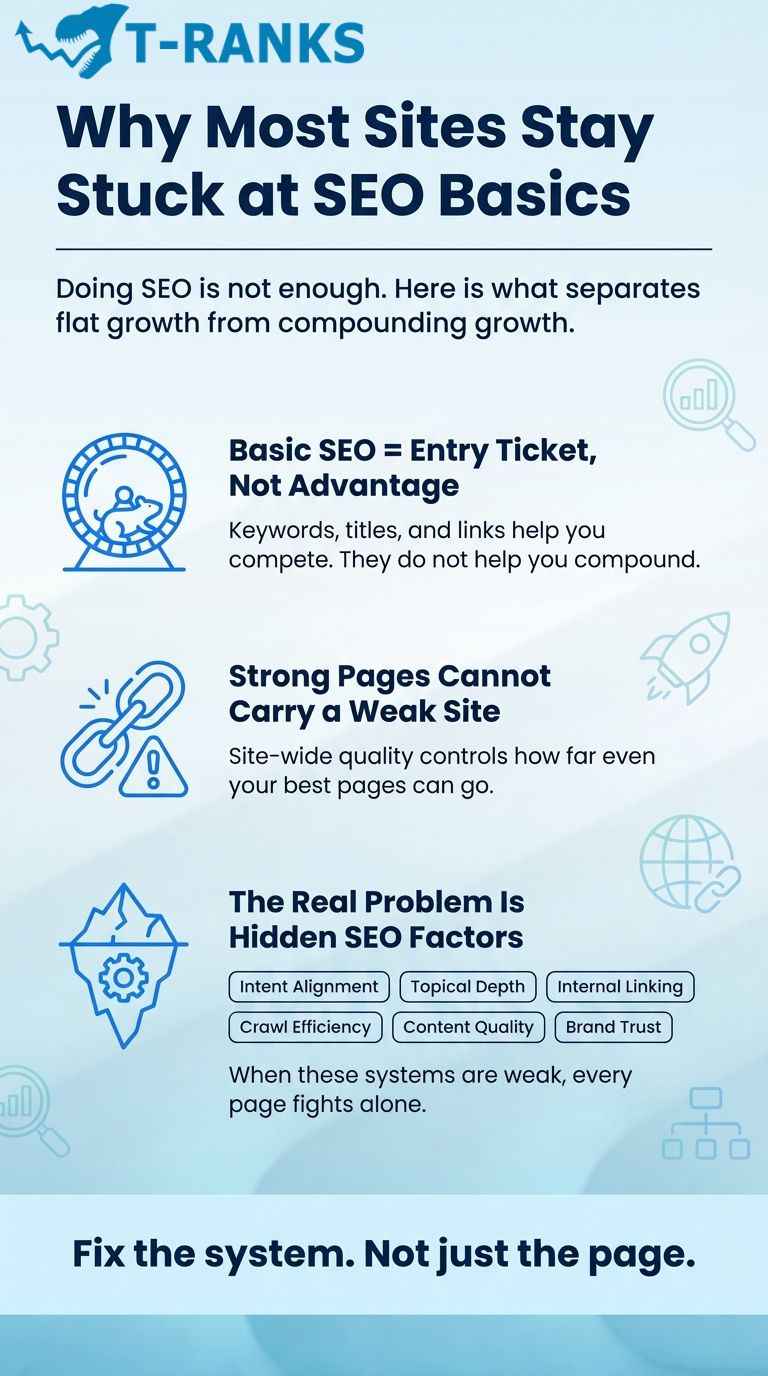
Most websites stay stuck not because they ignore SEO, but because they stop at the basics. They publish articles, target keywords, improve titles, and build some links. Growth still stays flat.
The reason is simple. Basic SEO is now the baseline, not the advantage. Google Search Central confirms that Google prioritises helpful, reliable, people-first content — and most competitors are already meeting that minimum standard.
Basic SEO Helps Pages Compete, Not Sites Compound
Keyword targeting, page speed, and title optimisation help a page enter the race. They rarely create real separation from competitors. A site can publish hundreds of pages and still plateau.
This happens because each new page adds only a small gain when the deeper systems are weak. Poor intent alignment, repetitive content, and thin supporting pages all limit how far any page can go.Google advises creators to produce unique content that genuinely satisfies users, not content built primarily to rank.
A Few Strong Pages Cannot Carry a Weak Site
A site can have strong pages and still grow slowly. When the same domain also has weak or outdated pages, the overall quality profile stays low. That low profile limits even the strongest pages on the site.
Google’s helpful content guidance is clear that site-wide quality matters, not just individual page optimisation. AI search has made this more urgent.Pew Research Center found that users clicked a traditional result in only 8% of visits where an AI summary appeared, compared to 15% without one.
The Real Issue Is Usually Hidden SEO Factors
Hidden SEO factors are the systems most site owners overlook. They include intent alignment, topical depth, internal linking, crawl efficiency, content quality, and brand trust. When these systems are weak, every page fights alone.
When they work together, each new page benefits from the trust and structure the site has already built. The sections below explain each one clearly.
What Hidden SEO Factors Actually Are

Hidden SEO factors are the site-wide systems that affect how search engines understand, trust, and rank your entire website. They are not secret tricks. They are the deeper signals working in the background that most site owners overlook because they are harder to spot than keywords or backlinks.
Visible SEO basics like title tags, backlinks, and page speed improve individual pages. Hidden SEO factors determine how all your pages perform together. That is the core difference.
Here are the hidden SEO factors this guide covers:
- Search intent alignment — whether your page gives the searcher what they actually want
- Content quality and information gain — whether your content adds something new instead of repeating what already ranks
- Topical authority — whether your site covers a subject deeply enough to be trusted as an expert source
- Internal linking — how authority and relevance move from one page to another across your site
- Site structure and crawl efficiency — whether Google can find and prioritise your most important pages
- Trust and brand signals — whether your site looks like a real, credible source people recognise and mention
- Content pruning and updating — whether weak or outdated pages are pulling down your stronger ones
When these systems are weak, every page fights alone. When they work together, each new page benefits from the trust and structure the site has already built.
Search Intent Is Still the First Hidden Growth Factor

Search intent is the real reason behind a search. It is not just the keyword a user types. It is the goal they have in mind — to learn something, compare options, find a specific page, or make a purchase.Google Search Central confirms its systems focus on content that is helpful, reliable, and satisfying. That is why intent comes before everything else.
Matching the Real Search Intent, Not Just the Keyword
A page can target the right keyword and still disappoint the user. Keywords describe the topic. Intent describes the job.
There are four intent types. Informational users want to learn, for example “what is crawl budget.” Navigational users want a specific page, for example “Google Search Console login.” Commercial users want to compare options, for example “best SEO tools for beginners.” Transactional users are ready to act, for example “buy SEO audit service.”
Matching the wrong intent is a common reason pages fail to grow. A sales page will not rank well when users want a comparison article. A short definition will not win when users want a step-by-step guide. Before writing any page, check the top-ranking results and ask what format, depth, and type of content is already satisfying that query.
Why Some Pages Rank but Never Grow
Many pages get some visibility but stay stuck because they only solve part of the problem. A page targeting “best CRM for small business” that covers only one tool leaves the searcher unsatisfied. A guide on “technical SEO audit” that gives a definition without steps, tools, or examples does the same. These pages answer the first question but miss the full set of needs behind the search.
Users rarely want just one answer. They want to know how something works, how to do it, which tools to use, and what mistakes to avoid. Pages that skip those follow-up needs miss the wider long-tail traffic that comes from covering a topic completely.Google’s helpful content guidance states the goal is to reward content where visitors feel they had a satisfying experience.
Google also confirms that users are now asking longer, more specific questions. Intent alignment has never mattered more. Do not optimise only for the keyword. Optimise for the full job the searcher wants done.
Topical Authority Helps Sites Grow Faster

Topical authority means Google sees your site as a real expert on a subject because you cover it deeply, not just in one article but across many connected pages. A single well-written article can rank for a keyword. But a site that covers every important angle of a topic across 15, 20, or 30 interlinked pages builds something much stronger. Google begins treating the whole site as a trusted source on that subject, which helps every page within that topic rank better and faster.
This is not a theory.Google officially introduced the concept of topic authority in May 2023. The 2024 Google API leak confirmed that Google uses internal signals called “siteFocus” and “siteRadius” to measure how tightly a site’s content stays around its core topics.
How Topic Clusters Build Trust
The structure behind topical authority is called a topic cluster. One broad pillar page covers the main subject at a high level, supporting pages go deeper into specific subtopics, and all pages link back to each other and to the pillar. Think of it as a web of content where every piece makes the others stronger.
This matters because new pages in an established cluster do not start from zero. They inherit trust from the pages already there, which means they tend to rank faster than a standalone article on a site with no topical depth.Research from HireGrowth suggests content in clusters drives around 30% more organic traffic and holds rankings 2.5 times longer than standalone pieces.
Why Focused Coverage Beats Scattered Publishing
Many sites publish without a clear topical plan. One week it is SEO, the next it is social media, the week after it is email marketing. Each post may be decent on its own, but Google has no clear signal about what the site actually specialises in. Every unrelated article weakens the topical signal instead of building it.
Google sees a generalist. And for competitive queries, specialists consistently outrank generalists.
Smaller niche sites regularly beat major publications on specific topics not because they have more backlinks or higher authority, but because they have deeper, more connected coverage of one subject. Focused coverage is one of the most underused growth levers in SEO.
Internal Linking Quietly Shapes SEO Growth
Internal links are links that go from one page on your site to another page on the same site. Most site owners add them as an afterthought. But internal linking is one of the most powerful free tools in SEO, and most sites barely use it.
Google’s John Mueller has called internal linking “super critical for SEO” and one of the biggest things you can do for a website. Yet a 2024 Ahrefs study found that 66.2% of web pages have only one internal link pointing to them.
How Internal Links Help Your Site Grow
Internal links do three things that directly affect your rankings and traffic.
First, they move authority around your site. Every page has a certain amount of ranking power. When a strong page links to a weaker one, it shares some of that power. Without internal links, only a few pages on your site get strong signals while the rest are ignored. A Zyppy/Ahrefs study of over 23 billion internal links found that pages with 40 to 44 internal links pointing to them got four times more organic traffic than pages with very few links.
Second, they help Google find your content. Google follows links to discover pages. If a page has no links pointing to it, Google may never find it or may not treat it as important. Pages that are reachable within 2 to 3 clicks from your homepage get crawled more often and tend to rank better. A 2024 JetOctopus study found that fixing internal link structure improved crawl rates from 40% to 70%.
Third, they tell Google what your pages are about. The words you use in a link — called anchor text — give Google a signal about the page being linked to. If ten pages on your site link to your “SEO audit guide” using clear, descriptive anchor text, Google gets a much stronger signal about what that page covers and which searches it should show up for.
Internal Linking Mistakes That Hold Sites Back
Most sites do have some internal links. The problem is that they are added without any real plan.
- Random links with no logic. Automated “related posts” widgets at the bottom of articles are not a strategy. They add links without thinking about which pages need more authority or which topics are related. The best internal links are added manually, inside your main content, where they make sense in context.
- Vague anchor text. Links that say “click here,” “learn more,” or “this post” tell Google nothing useful. Use anchor text that describes what the linked page is actually about.
- Orphan pages. An orphan page is a page on your site that no other page links to. Google has a hard time finding and ranking these pages. If a page is worth having, it needs at least a few internal links pointing to it.
- Key pages buried too deep. If an important page is more than 3 clicks away from your homepage, it gets crawled less and carries less authority. Link to your most important pages from higher-level pages to bring them closer to the surface.
Internal linking is free, fully in your control, and one of the fastest improvements you can make to your site’s SEO.
Site Structure and Crawl Efficiency Shape How Fast You Grow
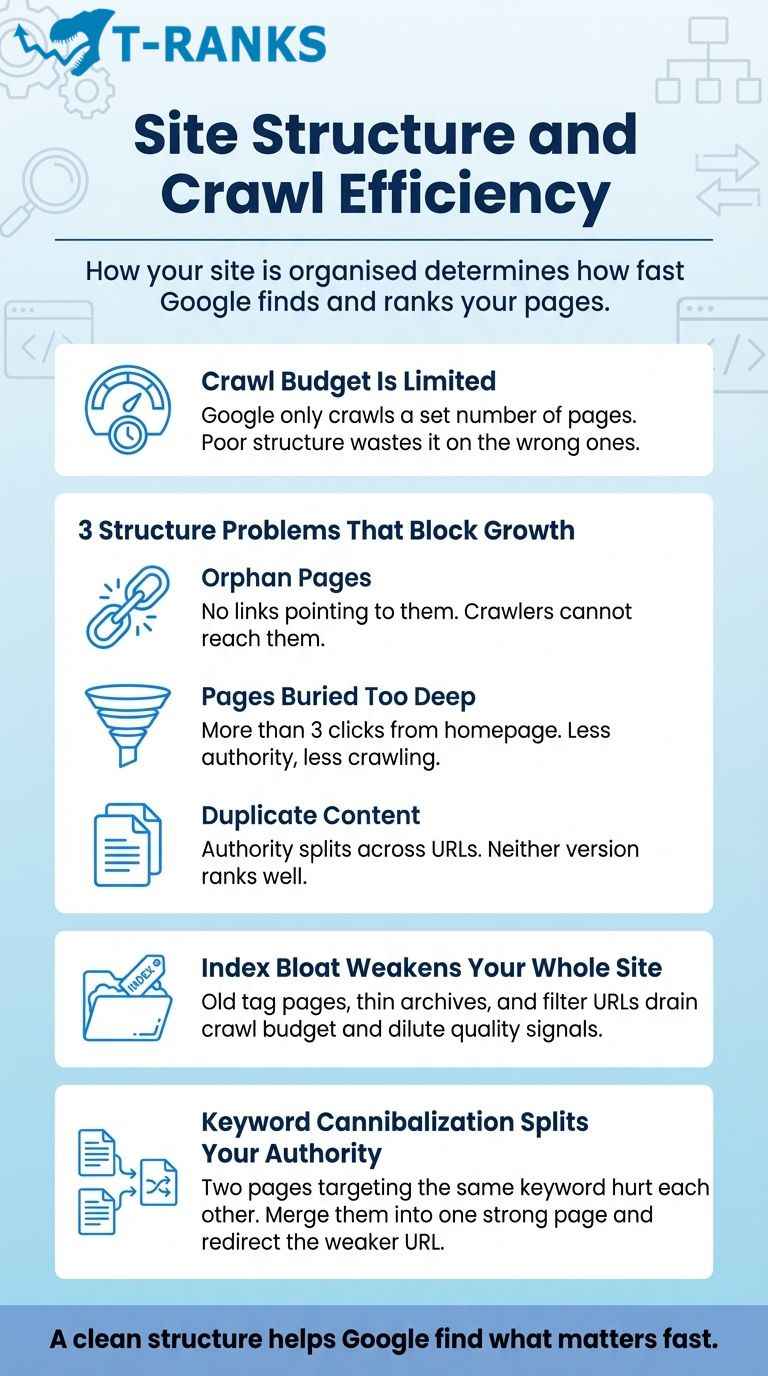
Site structure is how your pages are organised and connected. A clean structure helps Google find your most important pages fast. A messy one sends crawlers through duplicates, dead ends, and low-value pages.
Google has a limit on how many pages it will crawl on your site in a given time. This is called a crawl budget. If your site is poorly organised, Google wastes that budget on the wrong pages and may never properly reach the ones that matter.
How Poor Structure Stops Google Finding Your Best Pages
Three problems cause this most often.
Orphan pages. These are pages no other page links to. Google discovers content by following links, so a page with no links pointing to it has no reliable path for crawlers to reach it — even if it is listed in your sitemap.
Pages buried too deep. Pages more than 3 clicks from your homepage get crawled less and carry less authority.Digital Silk’s 2025 research found 56% of users expect to find what they need within 3 clicks. Google follows similar logic.
Duplicate content. When the same content exists on more than one URL, Google splits authority between them. Neither version ranks as well as one single consolidated page would.
Index Bloat and Keyword Cannibalization
Index bloat means too many low-value pages are in Google’s index — old tag pages, thin archives, filter URLs. Each one wastes crawl budget and weakens your site’s overall quality signal.
Keyword cannibalization happens when two pages compete for the same keyword. Google picks between them and both perform worse than one strong page would. You can spot it in Google Search Console when traffic for one keyword is split across multiple URLs. The fix is to merge competing pages into one and redirect the weaker URL.
Trust Signals Beyond Backlinks

Backlinks still matter, but they are no longer the full picture of how Google evaluates trust. Google now looks at a wider set of signals to decide whether a site is credible, recognized, and worth ranking. Brand presence, real-world reputation, and demonstrated experience carry significant weight alongside traditional link metrics.
According to Sistrix and Semrush visibility studies, brands with strong direct search demand recover faster from algorithm updates and maintain more stable rankings overall.
Brand Signals and Why Google Pays Attention to Them
Brand signals tell Google that real people recognize your site as a legitimate, trusted entity. These signals go beyond your pages and backlink profile. They reflect how the broader web and real users interact with your brand.
Branded Search Volume
When people type your brand name directly into Google, it tells the algorithm that real users already know and trust you. Google uses the frequency of these brand-specific searches to gauge relevance and credibility. According to Semrush’s link studies, sites with a high percentage of branded anchor text hold their rankings more consistently across algorithm updates.
Unlinked Brand Mentions
Google does not only follow links. It also reads context. When your brand is mentioned naturally in articles, forums, reviews, or social platforms without a hyperlink, Google still registers it as a relevance signal. According to Yoast’s 2025 SEO wrap-up, brands mentioned frequently and clearly across the web were more likely to surface in both traditional results and AI-generated answers.
Entity Recognition
Google’s Knowledge Graph connects brands, people, products, and topics into a web of relationships. When your brand has consistent information across the web, same name, same descriptions, same associations, Google builds a stronger entity profile for it. According to Builtvisible’s 2025 brand SEO research, brands excelling in both authority and user trust are increasingly favored in search results over sites relying on offsite SEO alone.
How to Demonstrate Experience and Credibility
E-E-A-T stands for Experience, Expertise, Authoritativeness, and Trustworthiness. It is not a direct ranking score. It is a quality framework Google uses to evaluate whether content deserves to rank. You do not need formal degrees or certifications to demonstrate it.
At T-Ranks, our team applies E-E-A-T through a simple checklist on every piece of content we publish. This is the same approach we recommend to clients regardless of their site size or industry:
- Show firsthand experience. Include original examples, real screenshots, case study results, or testing data. “We tested this on three client sites and traffic increased 25%” always outperforms “experts recommend this approach.”
- Make authors visible. Add clear author bios with relevant background and links to published work. Use author schema markup so Google can connect your writers to their credentials across the web. Anonymous content consistently carries weaker trust signals.
- Cite reliable sources. Link to primary sources, official documentation, and original research when stating facts or figures. Pages that reference authoritative sources outperform pages that make unsupported claims.
- Be transparent about your site. Include clear contact information, a detailed “About” page, and honest disclosure of AI usage or affiliate relationships. Google’s quality rater guidelines treat transparency as a core trust indicator, especially for topics covering health, finances, or safety.
These are not complex changes. Most can be implemented in a single afternoon. But their impact compounds over every page and every month. The sites growing fastest in 2026 are not just well-optimized. They are well-recognized, well-mentioned, and well-trusted across the web.
Hidden SEO Factors in the AI Search Era

In 2026, search visibility means more than ranking in the blue links. It also means being clear enough to appear in AI-driven results. Google says AI Overviews and AI Mode are changing how people search. Users are asking newer, more complex questions, and AI Overviews now appear in over 120 countries and territories and 11 languages.
This does not mean you need a completely different SEO strategy. In most cases, content that works well in AI search is simply content that is easier to understand, easier to trust, and easier to navigate.
What Helps Content Perform in Google AI Overviews and AI Search
Content is more likely to surface in AI-driven results when the main answer is easy to find and the page is easy to follow. That usually means:
- a direct answer near the top
- clear headings for each subtopic
- facts, steps, and examples separated cleanly
- simple wording that is easy to summarize
This matters because AI features often show a short overview before the user visits the page. If your answer is buried deep in the introduction or mixed with too many ideas at once, it becomes harder to use. Google’s own guidance says creators should focus on unique, useful content, not generic material that says the same thing as everyone else.
A strong page in this environment usually does three things well. It answers the main question quickly. It supports that answer with useful detail. And it presents the information in a format that is easy to scan.
Why Clear Structure, Entity Clarity, and Direct Answers Matter More Now
AI-friendly content is usually better-organized content. The same things that improve classic SEO also help AI-driven visibility:
- intent alignment, so the page answers the real question
- topical depth, so the page covers the subject properly
- structured data, so search engines understand what the page is about
- trust signals, so the content looks reliable
Google says it uses structured data to understand page content and gather information about the web more broadly. That does not guarantee AI visibility. But it does help make meaning clearer.
Entity clarity matters for the same reason. If a page clearly identifies the topic, brand, product, process, or person being discussed, it becomes easier to interpret. Direct answers matter too. A clear answer near the top helps users immediately and gives search systems a stronger signal about the page’s core point.
The takeaway is simple: content that is clear, well-structured, and trustworthy has a better chance to perform in both classic search and AI-driven search.
Content Pruning and Updating Can Unlock Faster Growth
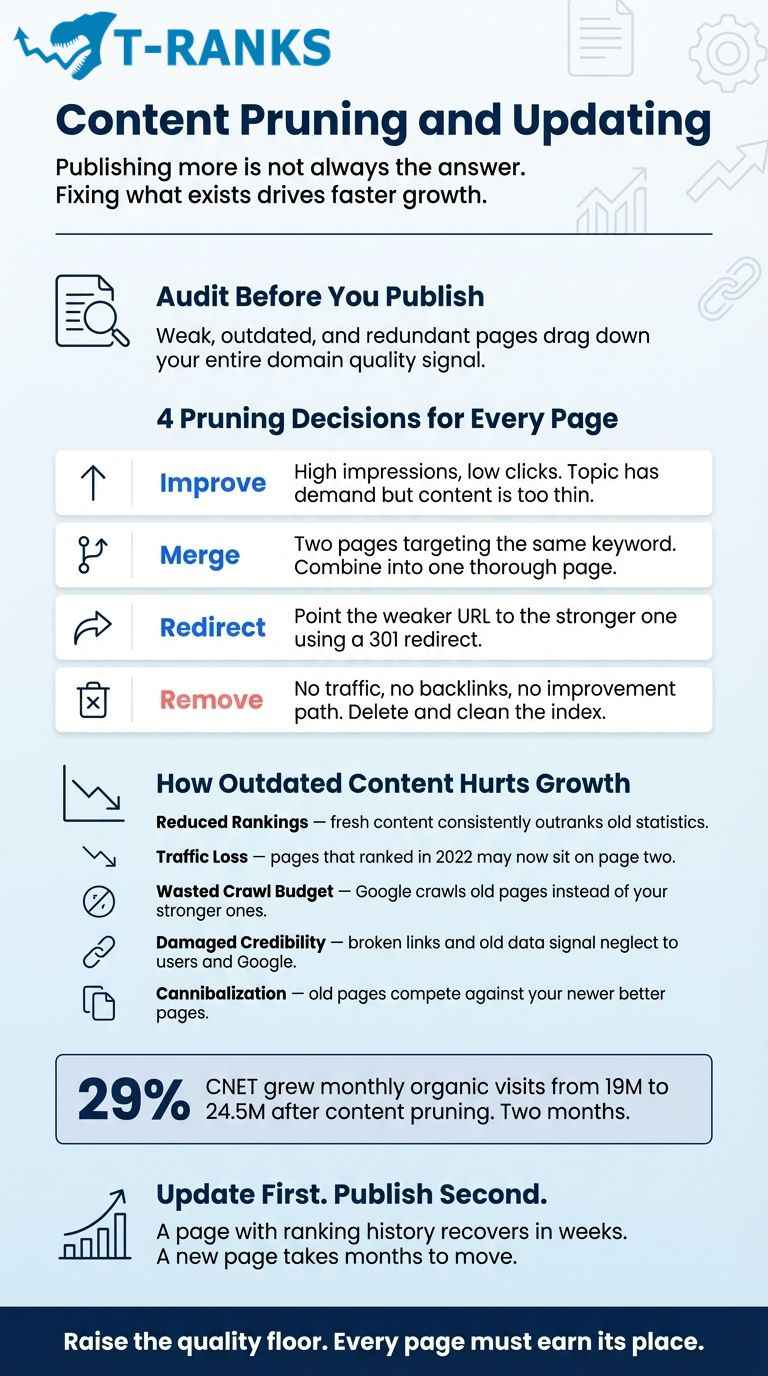
Most site owners publish more content when growth stalls. But the problem is often the content already on the site. Weak, outdated, or redundant pages drag down the pages that are actually performing, and Google reads that broader quality signal across the whole domain.
Content pruning means auditing existing pages and making a deliberate decision about each one. The biggest culprit behind content quality problems is losing track of what content exists on the site, its purpose, and the search terms each page targets. The goal is to make sure every indexed page earns its place.
When to Improve, Merge, or Remove a Page
The right action depends on why the page is weak. Four decisions apply to most cases:
- Improve a page when the topic has real search demand but the content is too thin, outdated, or incomplete. Signs include high impressions in Google Search Console but very few clicks.
- Merge two pages when they target the same keyword or intent and neither ranks well alone. Combining them into one thorough page usually performs better than two competing weak ones.
- Redirect the weaker URL after merging using a 301 redirect so any existing authority transfers to the stronger page.
- Remove a page when it has no traffic, no backlinks, and no realistic path to improvement. Outdated, auto-generated, or purely duplicate pages qualify.
Low-quality pages dilute the SEO value of backlinks. Pruning them concentrates link equity on more important pages, which increases visibility to both search engines and AI engines.
Why Outdated Content Slows Down Growth
Outdated content does not just lose rankings quietly. It actively weakens trust, wastes crawl budget, and competes against your own stronger pages. Here is how content decay hurts growth in practice:
- Reduced rankings. Search engines prioritize fresh, relevant content. Pages with outdated information and old statistics gradually lose position to competitors who keep their content current.
- Traffic loss. Even high-performing pages lose value over time as topics evolve and search intent shifts. A page that ranked well in 2022 may now sit on page two with a fraction of its original traffic.
- Wasted crawl budget. Google’s crawlers spend time on low-value old pages instead of re-crawling your stronger ones. Pruning frees that budget and directs Google’s attention where it matters most.
- Damaged credibility. Outdated statistics, broken links, and old product information signal to both users and search engines that the site is not actively maintained.
- Keyword cannibalization. Old unupdated pages often compete with newer, better pages on the same site for the same keywords, splitting authority and hurting overall performance.
Updating an existing page almost always produces faster results than publishing a new one. A page with ranking history and existing internal links can recover within weeks after a strong update. A new page on the same topic often takes months to show any movement. CNET’s content pruning strategy coincided with a 29% increase in estimated monthly organic visits within two months, moving from 19 million to 24.5 million visits.
Uncontrolled content expansion creates the opposite effect. Each new thin or loosely related page adds to the index without strengthening topical authority. Pruning and updating raises the quality floor of the entire site, which is what drives steady compounding growth.
Hidden SEO Factors in the AI Search Era
In 2026, search visibility means two things: ranking in traditional results and being cited in AI-driven answers. These are no longer the same goal. AI Overviews now appear on approximately 48% of all tracked queries, up from just 6.49% in January 2025. Sites optimising only for traditional rankings are now competing in less than half the search landscape.
What Helps Content Get Cited in AI Overviews
AI Overviews pull short, self-contained answers from pages that are easy to extract and verify.They average 157 words per response, with 99% staying under 328 words. That brevity demands precision from the content it cites.
Here is what makes content easier to surface in AI-driven results:
- Direct answers near the top. 44.2% of all AI citations come from the first 30% of a page’s text, based on analysis of 18,012 verified citations from 1.2 million ChatGPT responses. Starting each section with a clear, standalone answer significantly improves citation potential.
- Clear headings and structured formatting. Q&A and structured formats with headings and lists consistently outperform dense paragraphs in AI search. Flat walls of text are harder for AI systems to extract cleanly.
- Fresh, factual content with cited sources. 85% of AI Overview citations come from content published in the last two years, with 44% from 2025 alone. Generic, opinion-heavy writing rarely gets selected.
- Neutral, non-promotional language. AI systems avoid pages that are overly persuasive or promotional because such content is harder to reuse safely across different answer contexts.
Being cited in AI Overviews carries real commercial value.Brands cited inside an AI Overview earn 35% more organic clicks and 91% more paid clicks than competitors not cited, per Seer Interactive’s analysis of 25.1 million impressions across 42 organisations.
Why Structure, Entity Clarity, and Direct Answers Matter More Now
The signals that improve AI citation potential are the same signals that strengthen classic SEO rankings. Both systems reward content that is clear, complete, and trustworthy. Four factors drive performance in both:
- Intent alignment — the page answers the real question behind the search, not just the keyword. Both traditional rankings and AI citations favour pages that fully satisfy the query.
- Topical depth — the page covers the subject thoroughly enough to stand alone as a reliable source. Shallow pages that only mention a topic rarely rank competitively or get cited.
- Entity clarity — the page clearly identifies what it is about, the topic, product, process, or brand, so search systems can place it accurately in their knowledge graph.
- Structured data — Google uses structured data to understand page content and gather information about the web more broadly, which improves both indexing and AI interpretation.
The practical takeaway is direct. 97% of AI Overviews cite at least one source from the top 20 organic results for the same query. Strong classic SEO remains the foundation. AI visibility is what gets built on top of it.
The Silent SEO Problems That Hold Sites Back

Silent SEO problems are rarely one big mistake. They are several smaller, overlapping issues that build up quietly and limit the site’s ability to grow consistently.
Thin Content, Intent Mismatch, and Inconsistent Quality
Weak pages do not just underperform on their own — they pull down the pages around them. Google evaluates the overall quality profile of a site, not just individual pages. When a significant portion of indexed pages are thin or repetitive, the stronger pages on the same domain carry less weight as a result.
The most common quality problems look like this:
- Thin supporting pages — for example, a pillar page on “technical SEO” surrounded by cluster pages that each cover a subtopic in only 200 to 300 words without real depth or original insight
- Repetitive articles — multiple posts targeting the same topic with slightly different titles but nearly identical content, for example “best SEO tools 2024” and “top SEO tools for beginners” covering the same tools with the same points
- Shallow answers — pages that address the surface question but skip the follow-up questions users actually have, such as how to apply the advice, what tools to use, or what mistakes to avoid
Google confirmed after completing its March 2024 core update that low-quality, unoriginal content in search results was reduced by 45% — higher than the 40% initially projected. That update confirmed that inconsistent quality across a site limits the performance of its stronger pages, not just the weak ones. A site with 10 strong pages and 60 thin ones does not perform like a site with 10 strong pages. The weak pages dilute the domain’s quality signal and slow overall authority building.
Technical Issues That Do Not Look Obvious at First
Technical SEO problems rarely announce themselves clearly. They show up as slow ranking growth, unstable positions, or pages that never gain traction despite strong content. The most common silent technical problems include:
- Crawl inefficiency — too many low-value URLs consuming Google’s crawl budget, leaving important pages crawled less often and ranked lower
- Duplicate content — the same or near-identical content appearing on multiple URLs, for example HTTP and HTTPS versions, or filtered category pages splitting authority between versions
- Weak canonical tags — missing or incorrect canonicals leave Google guessing which page version to prioritise, often resulting in the wrong version being indexed
- Poor site hierarchy — important pages buried four or more clicks from the homepage carry less authority and get crawled less frequently
- Underlinked pages — pages with few or no internal links pointing to them remain nearly invisible to crawlers regardless of content quality
Three careless practices also introduce accidental spam risk that many site owners overlook:
- Unreviewed AI content published at scale without expert editing often lacks the depth and original perspective that Google’s quality systems actively filter out
- Cheap backlinks from low-quality directories or link schemes create weak or toxic signals that can trigger algorithmic penalties
- Low-value scaled publishing — producing large volumes of similar articles to cover keyword variations — creates index bloat and cannibalization without building real topical authority
If a Googlebot visited every indexed page on your site today, how many would genuinely serve a searcher’s need? For most sites, the honest answer reveals more technical and quality debt than expected.
How These Hidden Factors Compound Together
No single hidden factor transforms a site on its own. Fixing only internal links helps, but not much if the content has intent mismatches. Improving content quality helps, but less if the site structure buries important pages. Each factor produces limited results when it works in isolation.
The reason some sites grow steadily while others stay flat is rarely one big advantage. It is compounding. When multiple hidden factors improve together, they reinforce each other and produce results larger than any single fix could explain:
- Intent-aligned content attracts the right visitors and satisfies their full query, improving engagement signals and broadening keyword reach
- Strong internal linking distributes growing authority across the site, lifting pages that would otherwise stay invisible
- Topical authority means new pages inherit trust from existing content, so they rank faster and need less external link building to compete
- Technical clarity ensures Google finds, crawls, and understands all of the above efficiently, without wasting crawl budget on low-value pages
- Trust and brand signals add stability, so the site recovers faster from algorithm updates instead of losing ground each time one rolls out
A site improving all five areas simultaneously does not get five times better results. It gets results that multiply over time because each improvement makes the others more effective. One strong article surrounded by thin content, poor internal links, and disorganised structure is still fighting alone. The surrounding system is what determines whether that article compounds into broader growth or stays isolated.
The sites that grow consistently are the ones where intent, structure, topical depth, technical health, and trust all move in the same direction at the same time.
What to Fix First for Faster SEO Growth

Start by identifying which problem is costing you the most, then work in order from there. Trying to fix everything at once usually means fixing nothing well. The right approach is to match your symptoms to the right problem area before deciding what to work on.
High-Impact Fixes for Beginners and Intermediate Site Owners
Four symptom patterns point to four different root causes.
If your pages rank but get very few clicks, the issue is most likely intent mismatch. Your content is visible but not matching what users actually want from that query. Compare your page format and depth against the top three results currently ranking for the same keyword.
If your pages get clicks but visitors leave quickly, the issue is usually content satisfaction. The page attracted the right visitor but did not fully answer their question. Pages that address the surface query but skip the follow-up questions users have will consistently underperform on engagement and rankings.
If your pages are not ranking or not getting indexed, the problem is most likely structural or technical. Orphan pages, weak internal linking, crawl inefficiency, or duplicate content are the most common causes. These issues block Google from finding and prioritising content regardless of its quality.
If your site has solid content and clean structure but still grows slowly, the issue is often insufficient topical authority or trust. The site has not yet built enough concentrated expertise in one subject for Google to treat it as a reliable source across related queries.
A Simple Priority Order to Avoid Overwhelm
Work through improvements in this sequence. Each step builds the foundation the next one depends on.
- Align existing content with real search intent. Open Google Search Console and find your highest-impression pages with low click-through rates. Compare those pages against what currently ranks — look at format, length, and what questions competitors answer that yours does not.
- Fix internal linking and reduce orphan pages. Run a free crawl with Screaming Frog, which audits up to 500 URLs at no cost, and identify pages with no internal links pointing to them. Every important page needs at least one contextual link from a related, higher-authority page on the same site.
- Audit for cannibalization, thin pages, and outdated content before publishing anything new. In Google Search Console, look for multiple URLs sharing impressions for the same query — that signals cannibalization. For thin and outdated pages, decide whether to improve, merge, or remove each one.
- Build topical authority with focused supporting content. Once existing content is cleaned up, expand deliberately by adding pages that cover specific subtopics your pillar page does not fully address. Each new page should answer one clear question and link back to the main pillar.
- Strengthen trust and brand signals over time. Add visible author information, cite primary sources, build a clear About page, and create content that earns genuine mentions across the web. Trust compounds slowly but makes every other SEO signal more stable and durable.
Google Search Console is free. Screaming Frog’s free version handles sites up to 500 pages. The constraint for most site owners is not access to tools — it is having a clear order to work through them.
Conclusion
In conclusion, hidden SEO factors are not secret techniques. They are overlooked systems that most site owners skip because they are harder to see than keywords or backlinks. Intent alignment, content quality, topical authority, internal linking, technical clarity, and trust determine whether a site grows or stays flat.
Basic SEO helps pages compete. These deeper systems are what make growth compound over time. No single factor works alone. Strong content surrounded by weak structure still struggles. A clean site with thin or misaligned pages still sends mixed signals to Google. Real growth happens when these systems improve together.
The sites winning in 2026 are not doing more SEO. They are doing it more completely.Not sure what is holding your site back? T-Ranks offers a free SEO audit. It shows exactly where your biggest growth gap is. Book your free audit today and get a clear picture of what to fix first.
FAQs
What are hidden SEO factors?
Hidden SEO factors are site-wide systems like intent alignment, internal linking, topical authority, and content quality that affect how search engines understand and rank your site. They are overlooked because they are harder to spot than keywords or backlinks.
Which hidden SEO factors matter most in 2026?
Search intent alignment, content quality, and topical authority have the highest impact. Clear structure and entity clarity matter more now because they also affect AI Overview visibility.
Why is my website not growing even though I am doing SEO?
Most sites stall because deeper systems like internal linking, content quality, and intent alignment are still weak. Growth stays flat when each page fights alone instead of benefiting from a strong site-wide structure.
Do backlinks still matter in 2026?
Yes, but they are no longer enough on their own. Google now weighs brand signals, unlinked mentions, and topical authority alongside traditional backlinks.
How does internal linking help SEO growth?
Internal links distribute authority across your site and help Google discover and prioritise your content. Pages with strong internal linking consistently rank better and get crawled more often.
What is topical authority in simple words?
Topical authority means Google treats your site as a trusted expert on a subject because you cover it deeply across many connected pages.
Does updating old content help rankings?
Yes, and it often works faster than publishing new content. A page with existing ranking history can recover within weeks after a strong update.
Is SEO still worth it in the AI search era?
Yes. 97% of AI Overviews cite at least one source from the top 20 organic results. Strong SEO improves both classic rankings and AI citation potential at the same time.