Organic traffic means people visit your website from search engines without you paying for ads. It is still one of the best ways to grow a website. But in 2026, getting that traffic feels harder than before.
Google now shows AI Overview summaries at the top of the page. It also displays featured snippets, AI-cited sources, videos, and discussion threads before the traditional search results. Many users read these answers and leave without clicking a website. This means ranking on page one does not always guarantee traffic.
In this guide, you will learn what organic traffic really means today and why it sometimes drops even when you are doing SEO. Most importantly, you will discover 10 proven methods that can help you increase organic traffic in a steady and long-term way.
Why Organic Traffic Is Harder to Grow Today

Organic traffic has become harder to grow because search has shifted from sending users directly to websites to delivering answers inside search environments.
Traditional organic clicks have declined in some cases due to AI Overviews and AI-generated summaries appearing at the top of results. Many users now find their answer without visiting a page. However, this dotraditional ranking signals
es not mean organic traffic has disappeared. It has changed form.
In our experience, organic visibility now exists in multiple layers. Traffic can come from traditional blue links, from AI Overviews, from featured answers, and even from LLM-based tools that cite or recommend trusted sources. If content is structured clearly and recognized as authoritative, it can still attract meaningful traffic through these new surfaces.
What has changed is the requirement. Ranking number one in traditional results is no longer enough. A site must now compete both in standard search listings and within AI-driven answer systems. This dual visibility challenge is what makes growth feel more difficult.
At the same time, competition has intensified. The web is saturated with repetitive or automatically generated content. Search systems respond by consolidating visibility around fewer, stronger sources with clear expertise and topical authority.
Organic traffic is not declining as a channel. It is evolving. The challenge today is not simply to rank, but to become a trusted source across search systems. Websites that adapt to this shift continue to grow, while those relying only on traditional ranking signals struggle to maintain momentum.
What Organic Traffic Really Means Today

Organic traffic refers to visitors who reach your website through unpaid search results. It does not include paid ads, sponsored placements, or direct visits. Traditionally, organic traffic meant users clicking your page from a list of blue links in search engine results.
That core definition still applies. Organic traffic is still unpaid search traffic. What has changed is how users interact with search results and how often they decide to click.
In today’s search environment, results pages often provide summaries, featured answers, videos, and discussion threads before users reach a website. Because of this, impressions, rankings, and clicks no longer move together in a predictable way.
An impression means your page appeared in search results. A ranking shows your position. A click happens only when a user believes your page offers more value than what is already visible. Many pages now receive strong impressions and decent rankings but generate fewer clicks because the initial query is partially answered on the results page.
This does not mean organic traffic has disappeared. It means organic traffic has become more selective. It now represents qualified visits from users who want deeper insight, practical guidance, or clearer explanation beyond the summary provided in search.
In other words, organic traffic today is not just about being visible. It is about earning the decision to be opened.
Why Organic Traffic Drops Even When You Are Doing SEO
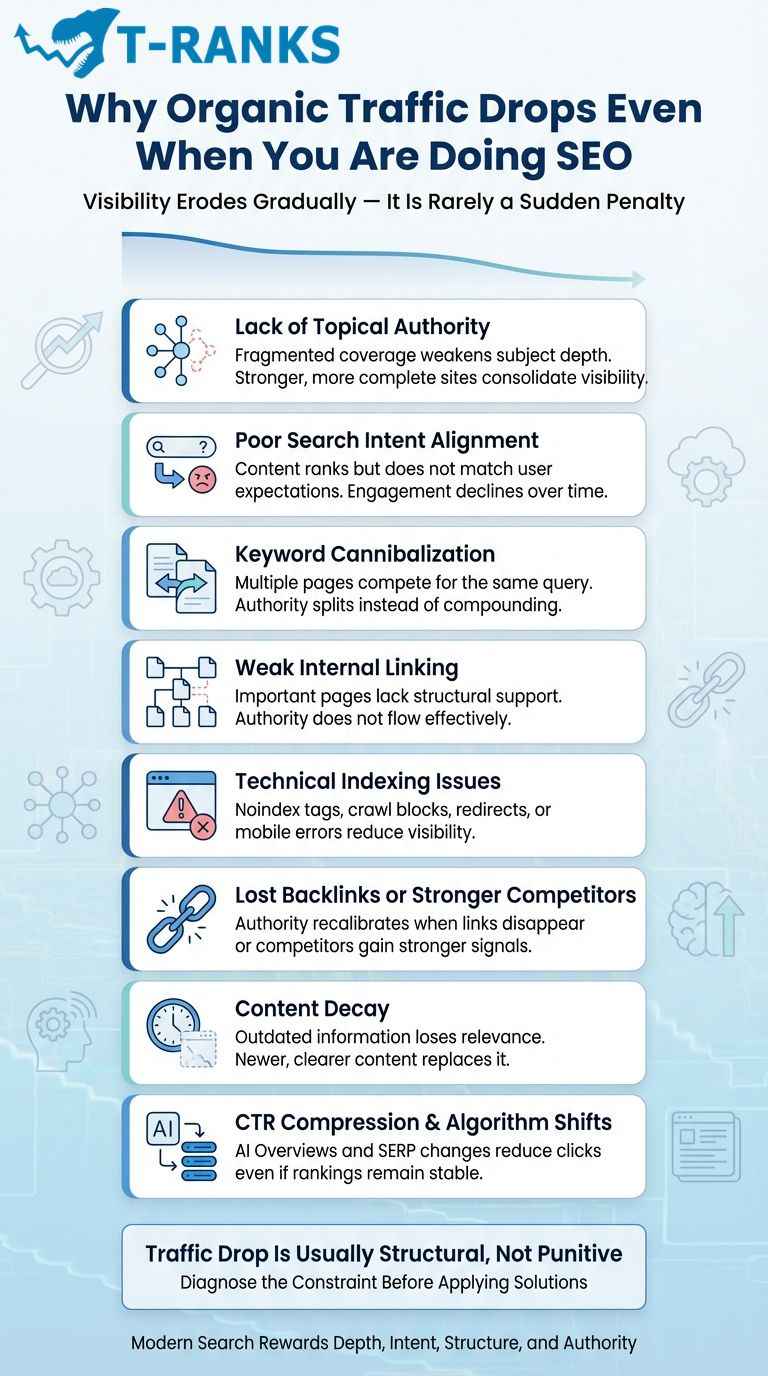
Organic traffic can decline even when SEO work continues because search systems and user expectations evolve faster than most websites adapt. These declines are rarely caused by sudden penalties. More often, visibility erodes gradually as competing pages improve, search intent shifts, and engagement signals change.
Lack of Topical Authority
Traffic drops when a website covers a subject only partially. Publishing a few related articles is no longer enough. Search systems favor sites that demonstrate depth across an entire topic. When coverage is fragmented, visibility consolidates around competitors with clearer expertise.
Poor Search Intent Alignment
A page may rank but still lose traffic if it does not match the dominant intent in the results. Search intent can shift over time. What once satisfied users may no longer align with what users expect. When engagement drops, impressions gradually decline.
Content Overlap and Keyword Cannibalization
Traffic weakens when multiple pages target the same topic or keyword. Search engines struggle to determine which page represents the primary answer. Rankings split, authority diffuses, and traffic stalls instead of compounding.
Weak Internal Linking
Internal links signal hierarchy and importance. When key pages are poorly connected, search engines may misinterpret their priority. Even strong content can lose traction if authority is not distributed intentionally.
Technical Indexing and Crawl Issues
Sudden traffic drops often trace back to technical problems. Noindex tags, blocked resources, broken redirects, slow load times, or mobile errors can quietly remove pages from meaningful visibility.
Lost Backlinks or Stronger Competitors
Search authority recalibrates continuously. When valuable backlinks disappear or competitors earn stronger links, rankings shift. In competitive topics, small authority changes can lead to noticeable traffic loss.
Old Content Losing Relevance
Information evolves. Content that is not updated gradually becomes less competitive. Impressions and clicks taper over time as newer and clearer pages replace outdated ones.
CTR Compression and Algorithm Adjustments
Traffic can decline even when rankings appear stable. AI Overviews, featured answers, and evolving SERP layouts reduce click-through rates. Algorithm updates also re-evaluate helpfulness and authority, lowering visibility for pages that do not provide distinct value.
The 10 Core Methods That Drive Sustainable Organic Traffic Growth
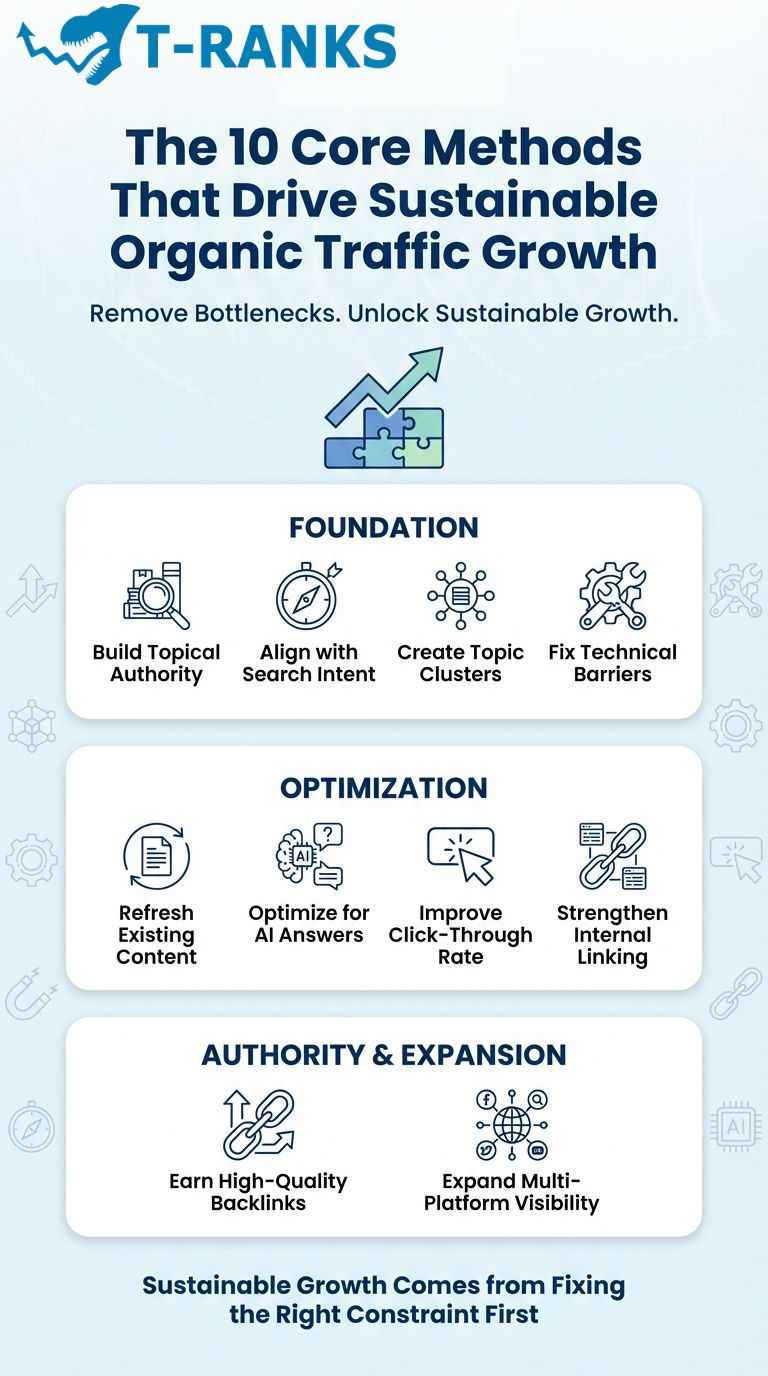
Sustainable organic traffic growth does not come from applying isolated SEO tactics. It happens when structural bottlenecks are identified and removed in the correct order.
Most traffic stagnation can be traced to one dominant constraint. Some websites lack topical authority. Others misalign with search intent. Some struggle with weak internal structure, declining click-through rates, or insufficient trust signals. Growth accelerates when the primary limitation is addressed instead of spreading effort across everything at once.
The methods below represent the core mechanisms that support long-term organic visibility. Each one removes a different limitation within the organic traffic system.
- Build strong topical authority
- Align content precisely with search intent
- Create structured topic clusters
- Refresh and expand existing content
- Fix technical barriers that block visibility
- Optimize content for AI answers and featured results
- Improve click-through rates on ranking pages
- Strengthen internal linking to distribute authority
- Earn high-quality backlinks to reinforce trust
- Expand visibility through search-adjacent platforms
In the following sections, each method is explained in detail, including when to prioritize it and how it contributes to sustainable organic traffic growth.
Method 1: Build Topical Authority Around a Clear Niche
Topical authority means becoming the most trusted source within a clearly defined subject area. It is not built by publishing one strong article. It is built by consistently covering a topic from multiple angles so that your entire website reinforces expertise.
Search systems no longer evaluate pages in isolation. They assess how well your site explains a subject overall. A single well-written article on a competitive topic is rarely enough to rank if the rest of the site lacks related depth.
Search Engines Evaluate Site-Level Authority
Google and AI systems assess the broader context of your website. For example a generic site publishing one article about “how to index backlinks” may struggle to rank. Meanwhile, a niche site focused entirely on backlinks can rank more easily because surrounding content strengthens topical association. Context and concentration matter.
When your site consistently covers related subtopics, search engines build a stronger connection between your domain and that subject. This increases trust and improves visibility across multiple related queries.
Authority Compounds Across Related Pages
Topical authority grows through structured depth. When you publish content covering definitions, advanced strategies, tools, mistakes, comparisons, and case studies within one niche, each page reinforces the others.
Internal linking strengthens this ecosystem. Over time, rankings become more stable because the site is viewed as an expert resource rather than a single-page attempt.
AI systems also prefer clearly concentrated expertise. Websites that demonstrate consistent subject knowledge are more likely to be summarized or referenced in AI-generated answers.
Topical authority is a long-term asset. Once established, it reduces volatility and supports sustainable organic traffic growth.
Method 2: Choose Keywords Based on Search Intent, Not Just Volume

Search intent means understanding why a user is searching, not how many people search for a keyword. In 2026, traffic loss often happens because pages target popular keywords without matching what users actually want. High search volume does not guarantee clicks, engagement, or conversions. Intent does.
There are four main types of search intent Informational intent means the user wants to learn or understand something. Commercial intent means the user is comparing options or researching before a decision. Transactional intent means the user is ready to buy or take action. Navigational intent means the user wants to reach a specific brand or website. Each intent needs a different type of content to succeed.
Intent matters more than keyword volume in 2026
High volume keywords often have mixed or unclear intent. Users arrive with different expectations, which leads to poor engagement. Lower volume keywords usually show clearer intent and bring more focused, high quality traffic. Search engines now reward usefulness, not just popularity.
Mismatched intent leads to low traffic even when rankings exist.
A page can rank well but still fail if it does not satisfy intent. For example, ranking a product page for an informational query causes users to leave quickly. Low engagement tells search engines the page is not helpful, which reduces clicks and long term visibility.
Always match keywords to the right page type
Informational keywords should lead to guides, tutorials, or explanations. Commercial keywords should lead to comparison or review pages. Transactional keywords should lead to service or product pages with clear actions. When content format matches intent, engagement and traffic improve naturally.
Long tail and conversational searches are growing fast
AI assistants and voice search encourage longer, more natural questions. These searches usually show strong intent and bring visitors who are closer to action. Pages written in clear, simple language perform better for these queries.
One clear intent per page prevents keyword cannibalization
Each page should target one main intent. When multiple pages chase the same intent, they compete with each other. Clear intent assignment keeps rankings stable and traffic focused. Choosing keywords based on intent instead of volume helps attract the right visitors, increase engagement, and protect organic traffic growth in 2026.
Method 3: Create Topic Clusters Around a Core Page
Topic clusters are not just a content organization tactic. They are a structural authority system. In 2026, search engines evaluate how well your entire site explains a subject, not just how strong one article appears. Topic clusters signal depth, clarity, and ownership.
Instead of publishing disconnected articles, you build one central page around a broad topic and support it with focused pages that explore specific subtopics in detail. This creates a connected content ecosystem that strengthens visibility across related searches.
Pillar Pages and Supporting Cluster Content
A pillar page covers a broad subject at a high level. It introduces the key ideas, explains the overall concept, and acts as the central authority hub. Cluster pages then expand on individual components, answering detailed questions and targeting specific related queries.
This structure clarifies hierarchy. The pillar establishes primary authority. Cluster pages provide depth. Together, they prevent overlap and reduce keyword cannibalization by clearly defining which page owns which intent.
Instead of competing internally, your pages reinforce each other.
Why Topic Clusters Strengthen Rankings in 2026
Topic clusters improve rankings because they solve multiple structural problems at once.
First, they improve crawl clarity. Search engines can easily understand how your content is organized and which page is most important.
Second, they consolidate authority. Internal links from cluster pages back to the pillar concentrate ranking strength instead of scattering it.
Third, they expand keyword reach naturally. Each cluster page targets a related variation or sub-intent, allowing you to rank for a wider range of queries without weakening your main topic focus.
Fourth, they improve AI mapping. AI systems analyze how topics are connected. A clearly structured cluster makes it easier for models to identify your site as a comprehensive source on that subject.
A single article can rank temporarily. A structured cluster creates sustained visibility. When content operates as a connected system, rankings become more stable and traffic growth becomes more predictable.
Method 4: Refresh and Expand Existing Content Using Real Search Data

Refreshing and expanding existing content is one of the fastest ways to increase organic traffic in 2026 because you are improving pages that already have visibility.
Content naturally loses strength over time. New competitors publish better guides. Search intent evolves. AI systems prefer more complete and updated answers. Even high-ranking pages slowly decline if they are not maintained.
Content Decay Happens Faster in AI-Driven Search
AI systems constantly compare multiple sources and prioritize the most accurate and comprehensive information. Pages with outdated statistics, missing subtopics, or weak explanations lose impressions gradually. Rankings may not drop immediately, but clicks decline over time.
Freshness today means completeness and clarity, not just recent publication dates.
Use Google Search Console to Identify Hidden Growth Opportunities
The most effective refresh strategy starts with data.
Look inside Search Console for:
- Pages with declining impressions
- Pages ranking in positions 6–20
- Queries generating impressions but very few clicks
- Queries not fully covered inside the article
These signals show where content is underperforming.
When you expand sections to address untapped queries, improve headings to match search intent, and clarify answers, rankings often improve quickly because the page already has authority.
Updating Existing Pages Is Faster Than Creating New Ones
Existing pages already have:
- Backlinks
- Crawl history
- Ranking signals
- User engagement data
Improving them builds on that foundation instead of starting from zero. In many cases, content refresh delivers faster gains than publishing new articles.
Real Updates Mean Structural and Contextual Improvements
Refreshing content is not about changing the publish date.
It means:
- Adding missing subtopics
- Improving clarity and structure
- Updating statistics and examples
- Strengthening internal links
- Removing outdated advice
- Improving answer sections for AI inclusion
At T-RANKS and across client projects, we consistently observe that structured refresh cycles produce measurable traffic lifts within weeks, not months.
In 2026, content maintenance is no longer optional. Sustainable organic growth depends on continuously strengthening what already ranks.
Method 5: Fix Technical Issues That Prevent Pages from Ranking
Technical SEO ensures search engines can crawl, index, and trust your website properly. You can have great content and strong backlinks, but if search engines cannot access or understand your pages, they will not rank. Technical issues quietly block organic traffic and are often missed.
Crawl and indexing issues stop pages from appearing
If important pages are blocked in robots.txt, marked as noindex, or missing from your sitemap, Google may ignore them. Pages with 404 errors or broken redirects also disappear from search results. If a page is not indexed, it cannot bring traffic.
Duplicate versions confuse search engines
When the same page exists in multiple versions, such as HTTP and HTTPS or with and without www, search engines struggle to decide which one to rank. This splits authority and weakens visibility. Clear canonical signals and proper redirects solve this issue.
Mobile-first indexing makes mobile experience critical.
Google mainly ranks the mobile version of your website. If your site is not responsive, loads poorly on phones, or has layout problems, rankings suffer. A clean, mobile friendly design is now a basic requirement.
Core Web Vitals reflect real user experience
Core Web Vitals measure speed, visual stability, and responsiveness. Slow loading pages or layouts that shift while loading frustrate users. When users leave quickly, engagement drops and rankings decline.
Poor site structure blocks authority flow
If important pages are buried too deep or not linked properly, search engines cannot understand their priority. Orphan pages without internal links are especially weak. Clear structure and descriptive internal links help distribute authority correctly.
Technical SEO is the foundation, not the strategy itself
Technical fixes alone do not guarantee traffic growth. However, without a strong technical base, content and backlinks cannot perform. Technical SEO allows all other strategies to work effectively. In 2026, technical health is not advanced optimization. It is essential maintenance. When search engines can easily crawl, index, and trust your site, organic traffic growth becomes possible.
Method 6: Structure Content to Appear in AI Answers and Featured Results
In 2026, search engines choose clear answers first, not just ranked pages. AI Overviews, featured snippets, and answer boxes select content that is easy to understand and extract. If your content is long, unclear, or poorly structured, it is less likely to appear in these answer driven results.
Modern search is answer driven, not link driven
Search engines try to solve the user’s question directly on the results page. This reduces clicks to websites. To stay visible, your content must provide direct, clear answers that AI systems can summarize.
Place direct answers at the start of sections
Each important section should begin with a short and clear answer. Around 40 to 60 words is enough. This helps AI systems quickly identify the main point and improves your chances of being featured.
Use clear sections with one idea per heading
Break content into simple H2 and H3 sections. Each section should explain one idea only. This structure makes it easier for AI systems to understand and reuse your content accurately.
Use lists, summaries, and short paragraphs
Bullet points and numbered lists help organize information clearly. Short paragraphs improve readability. These formats make it easier for AI systems to scan and extract key details.
Add FAQ and How To formats when relevant
FAQ sections answer related questions directly. How To sections provide step by step instructions. These formats are commonly selected for featured snippets and AI answers.
Use structured data to improve machine readability
Schema markup such as FAQ or How To helps search engines understand page purpose. It supports better extraction and improves visibility in rich results.
Clarity builds trust for both AI and users.
Clear structure does not only help search engines. It improves user experience and builds trust. When users find answers quickly, engagement improves and traffic becomes more stable.Structuring content for AI answers increases visibility without relying only on rankings. In 2026, clarity, structure, and direct answers are key to earning attention in answer driven search results.
Method 7: Increase Click-Through Rate on Pages That Already Rank
Increasing click-through rate is one of the fastest ways to grow organic traffic because it converts existing visibility into real visits.
In 2026, many pages rank on page one but receive fewer clicks due to AI summaries, featured snippets, and crowded SERPs. When impressions are high but traffic is low, the problem is not ranking. It is positioning.
Optimize Titles and Snippets Using Real Search Data
The most effective CTR improvements start in Google Search Console.
Look for:
- Pages ranking in positions 3–10
- Queries with high impressions but low CTR
- Queries slightly different from your main keyword
Rewrite titles to match how users actually search. Place the main keyword early. Use clarity over cleverness. Add specificity such as numbers, outcomes, or time frames when appropriate.
Meta descriptions should reinforce the promise. They must align with the search intent and clearly state what the user will gain by clicking.
Small changes in title structure often produce measurable traffic lifts without any ranking improvement.
Engineer Snippets to Stand Out in Crowded SERPs
SERPs in 2026 contain AI Overviews, videos, ads, and rich results. Organic listings compete for limited attention.
Use structured data such as FAQ or review schema to increase snippet visibility. Ensure headings are clear enough to qualify for featured snippets. Match the tone and format of top-ranking results when appropriate.
Most importantly, ensure your page truly delivers what the snippet promises. When intent alignment is strong, both clicks and engagement improve.
CTR optimization is leverage. It increases traffic without earning new rankings. When impressions already exist, improving click-through rate is often the most efficient growth move available.
Method 8: Use Internal Links to Push Authority to Important Pages

Internal links control how authority flows inside your website. In 2026, internal linking is one of the few SEO factors you fully control. It helps search engines understand which pages are important and how topics are connected. When used correctly, it can improve rankings without building new backlinks.
Internal links help search engines discover and prioritize pages Search engines crawl your site by following links. Pages that receive more internal links are seen as more important. If a page has very few links pointing to it, it may be crawled less often and rank lower.
Understand priority pages and supporting pages
Priority pages are the ones that drive conversions, target important keywords, or represent your main topic. Supporting pages provide additional information and context. Internal links should push authority from supporting pages toward priority pages to strengthen them.
Internal linking concentrates relevance and trust
When related pages link to a main page, they send a strong relevance signal. This builds topical consistency and trust. Over time, this concentrated authority helps the priority page rank for more related searches.
Use natural and descriptive anchor text
Anchor text should clearly describe the linked page. Avoid generic phrases like “click here.” Use clear, natural wording that reflects the topic of the target page. This helps search engines understand the connection between pages.
Link from strong pages to weaker pages
Pages that already receive traffic or backlinks can pass authority to newer or underperforming pages. Linking from high-performing pages speeds up indexing and improves ranking potential.
Strong internal linking accelerates ranking improvements
When authority flows clearly across your site, important pages gain strength faster. This often leads to quicker ranking gains compared to waiting for external backlinks.
Internal linking is not just a navigation feature. It is a strategy to control authority, improve crawl efficiency, and support long term organic traffic growth.
Method 9: Build High-Quality Backlinks to Compete at the Top
High-quality backlinks help you compete when content alone is not enough. In 2026, strong content and structure are required, but in competitive topics, backlinks still decide who ranks at the top. They act as proof that other trusted websites value and recognize your content.
Backlinks still signal authority and trust
When respected websites link to you, search engines treat it as a vote of confidence. The more relevant and trusted the source, the stronger the authority signal. In competitive search results, this trust often makes the difference.
Backlinks are citation authority, not just ranking power
Backlinks now work like citations in research. They show that your site is referenced and acknowledged by others in the field. This builds credibility around your topic, not just ranking strength.
Brand mentions also strengthen topical recognition
Even when your brand is mentioned without a link, it helps build authority. Repeated mentions across industry sites, newsletters, or expert discussions create topical consensus. Search systems use these signals to measure trust.
Quality matters more than quantity
A few relevant, authoritative links are more powerful than many weak ones. Good backlinks usually come from industry publications, expert roundups, podcasts, newsletters, or trusted blogs in your niche.
Backlinks reinforce authority, they do not create
Links work best when your content already shows expertise and structure. Backlinks amplify existing authority. They cannot fix weak or thin content.
Avoid low-quality or manipulative link building
Spammy links, paid link schemes, or irrelevant placements can damage trust. Modern search systems detect unnatural patterns easily. Low-quality links often hurt rankings instead of improving them.
Building high-quality backlinks helps break ranking plateaus and move from page one to the top positions. In 2026, links strengthen credibility and support long-term organic growth.
Method 10: Expand Visibility Across Social and Discussion Platforms

Organic growth in 2026 is no longer confined to Google. Search behavior now spans Reddit, YouTube, LinkedIn, industry forums, and community platforms. Visibility across these spaces strengthens brand authority, increases discovery, and supports sustainable organic traffic.
Search engines increasingly surface discussion threads, user reviews, and community conversations directly in search results. If your brand appears in those conversations, your visibility expands beyond your own website.
Search Everywhere Strengthens Brand and Entity Signals
Modern search systems analyze brand mentions, topic associations, and co-occurrence across platforms. When your brand is repeatedly connected with a specific topic in discussions, videos, and community answers, search engines build stronger entity recognition around that subject.
This increases the likelihood of:
- Branded searches
- Higher trust signals
- AI citation inclusion
- Improved ranking stability
Social presence supports organic growth indirectly by reinforcing authority signals beyond your website.
Strategic Participation Builds Long-Term Trust
The goal is not viral reach. It is consistent, value-driven participation.
Answering relevant questions, contributing insights, and engaging in niche communities strengthens real-world credibility. These platforms often rank in Google results themselves, creating additional entry points into your brand ecosystem.
Over time, multi-platform visibility compounds. Users encounter your brand in search results, discussions, and AI summaries. This repeated exposure increases trust and improves the probability of organic clicks.
Social and discussion platforms do not replace SEO. They amplify it. In 2026, sustainable organic growth depends on being visible wherever your audience searches and interacts.
How to Choose the Right Method for Your Website

Choose the method that fixes your biggest traffic problem first. Do not try all strategies at once. Organic growth becomes easier when you identify where traffic is blocked and apply the right solution. Use data from Google Search Console to guide your decision.
Focus on technical fixes when visibility drops suddenly
If impressions fall sharply, pages disappear from search, or crawl errors increase, start with technical SEO. Fix indexing issues, mobile problems, speed, or broken links. Without technical health, other efforts will not work properly.
Refresh content when traffic declines slowly
If rankings slowly drop over months, the issue is often content decay. Update outdated information, improve clarity, and add missing details. This usually restores traffic faster than creating new content.
Improve CTR when impressions are high but clicks are low
If your page ranks well but receives few clicks, focus on titles and meta descriptions. Make them clearer, more specific, and aligned with user intent. Small improvements here can increase traffic quickly.
Build authority and backlinks when stuck below top positions
If your page ranks on page two or the bottom of page one and cannot move higher, the issue is often authority. Strengthen topical coverage and earn high-quality backlinks to compete at the top.
Match actions to the real problem
Low impressions often point to technical or authority issues. High impressions but low clicks suggest a CTR problem. Gradual decline usually means content decay. Identify the pattern first, then apply the right method.
Organic traffic growth is not about doing everything. It is about solving the right problem at the right time.
How to Measure Organic Traffic Growth in 2026
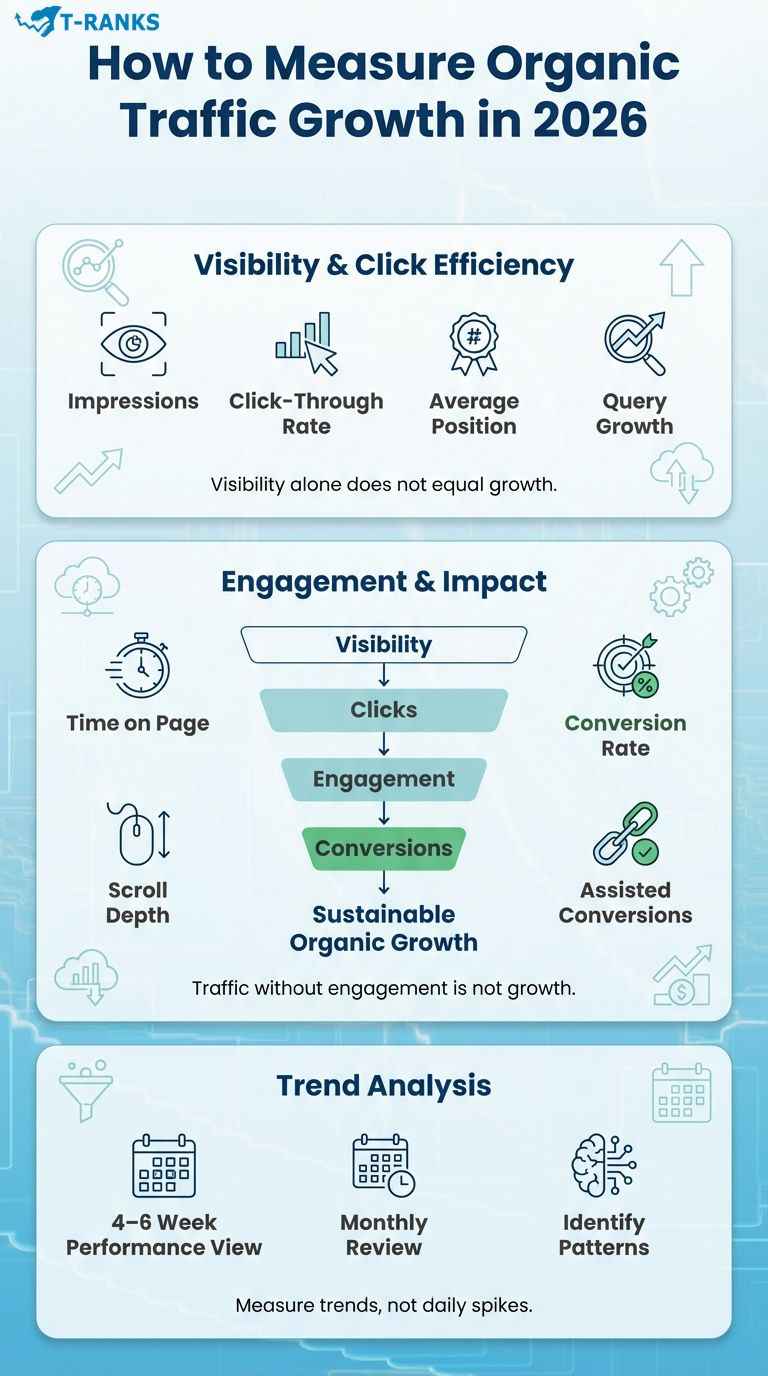
Organic traffic growth in 2026 must be measured through visibility, engagement, and conversion impact, not just total visits.
Rankings and traffic numbers alone do not reflect performance in an AI-driven search environment. A page may gain impressions but lose clicks. Traffic may increase while conversions decline. Accurate measurement requires understanding how visibility translates into meaningful outcomes.
Measure Visibility and Click Efficiency Using Search Console
Google Search Console is the primary source of organic performance data. It shows impressions, clicks, average position, and search queries.
Focus on:
- Growth in non-branded impressions
- Click-through rate improvements
- Queries expanding beyond your original target
- Pages ranking in positions 3–10 with opportunity to grow
Impressions indicate visibility. Click-through rate shows snippet effectiveness. Query expansion reveals topical authority growth. These metrics together indicate structural improvement.
Evaluate Engagement and Business Impact
Traffic without engagement is not growth.
Use analytics tools to measure:
- Time on page
- Scroll depth
- Conversion rate
- Assisted conversions from organic sessions
Strong engagement confirms intent alignment. Conversions confirm commercial impact.
Organic growth is sustainable only when traffic contributes to business outcomes, not just page views.
Focus on Trends, Not Daily Fluctuations
Search traffic naturally fluctuates due to seasonality, SERP changes, and algorithm updates.
Measure performance over 4–6 week windows to identify real patterns. Weekly checks help detect technical issues. Monthly reviews reveal strategic progress.
Organic growth in 2026 is defined by steady improvement in visibility, click efficiency, engagement quality, and conversion impact.
When these metrics improve together, your organic strategy is working.
Conclusion
Organic traffic growth in 2026 is no longer driven by isolated tactics. It is driven by structured systems that remove visibility bottlenecks and strengthen authority over time.
There is no single adjustment that suddenly increases traffic. Growth happens when topical authority, search intent alignment, content structure, technical clarity, click optimization, and trust signals work together. When one component is weak, performance slows. When the system is aligned, traffic becomes more stable and more predictable.
Search has evolved. AI systems summarize answers. SERPs are crowded. Competition is higher. This makes organic traffic feel harder. But it does not make it impossible.
Websites that treat SEO as an interconnected framework rather than a collection of tricks continue to grow. They build depth instead of volume. They improve existing assets instead of constantly chasing new ones. They focus on clarity, authority, and long-term relevance.
Organic traffic in 2026 rewards structure, expertise, and consistency. When SEO is approached as a strategic system, growth stops feeling random and starts becoming intentional.
FAQs About How to Increase Organic Traffic
How long does it take to increase organic traffic?
Organic traffic typically improves within 3 to 6 months for established websites and longer for new domains. Sustainable growth depends on competition, topical authority, and consistent optimization rather than quick fixes.
Why does organic traffic drop even when rankings stay the same?
Organic traffic drops when click-through rates decline due to AI Overviews, SERP layout changes, or stronger competitor snippets. Rankings show visibility, but traffic depends on whether users choose to click.
Can organic traffic grow without backlinks in 2026?
Yes, organic traffic can grow without backlinks for low-competition and long-tail keywords. However, backlinks are usually required to compete for high-value and competitive search terms.
What matters most for organic traffic in 2026?
Topical authority, search intent alignment, structured content, and trust signals matter more than isolated SEO tactics. Search systems reward sites that demonstrate consistent expertise across related topics.
How do AI Overviews affect organic traffic?
AI Overviews reduce clicks to shallow pages but increase exposure for authoritative and well-structured sources. Clear answers and strong topical depth improve the chance of being summarized or cited.
Is keyword research still important for organic traffic growth?
Yes, keyword research remains essential, but understanding intent and topic relationships matters more than search volume alone. Intent-driven targeting leads to stronger engagement and stable growth.
How often should content be updated to maintain organic traffic?
Important pages should be reviewed every 3 to 6 months using Search Console data. Updates should improve clarity, expand subtopics, and address new search queries.
Does internal linking really help increase organic traffic?
Yes, internal linking improves crawlability, distributes authority, and clarifies topic relationships. Strong internal structure improves ranking stability and visibility.
Can social media help increase organic search traffic?
Yes, social visibility supports organic growth by increasing brand recognition, mentions, and branded searches. These indirect signals strengthen long-term authority.
How should new websites approach organic traffic growth?
New websites should focus on long-tail keywords, clear niche positioning, and consistent publishing. Early growth may be slow, but structured topical depth creates compounding results.
What tools are most important for tracking organic traffic?
Google Search Console is essential for tracking impressions, clicks, and queries. Analytics tools should be used to measure engagement and conversion impact.
What happens if I publish new content but never update old pages?
Organic traffic often declines because outdated pages lose relevance. Refreshing existing content is one of the fastest ways to regain lost visibility.
Is technical SEO still necessary in 2026?
Yes, technical SEO remains critical. Crawl errors, indexing issues, and poor performance can block visibility even if content quality is strong.
Can AI tools replace SEO for organic traffic growth?
No, AI tools cannot replace SEO. They change how content is discovered, but authority, structure, and relevance still determine organic visibility.