Search is changing fast and if you do SEO for your website, you need to understand what is happening right now.
Google is no longer just showing ten blue links when someone searches. It is now displaying AI-generated summaries at the top of the page called AI Overviews. Platforms like ChatGPT and Perplexity are also answering questions directly without sending users to any website at all. This means websites are getting fewer clicks even when they rank well. In fact, organic click-through rates have dropped by up to 61% for searches where an AI Overview appears.
This is where AI SEO comes in. AI SEO is about making sure your content is not just found by Google but also understood, trusted, and cited by AI-powered search systems. In this guide, you will learn exactly what AI SEO means, how it is different from traditional SEO, and what practical steps you can take to stay visible in search in 2026.
What Is AI SEO in 2026?
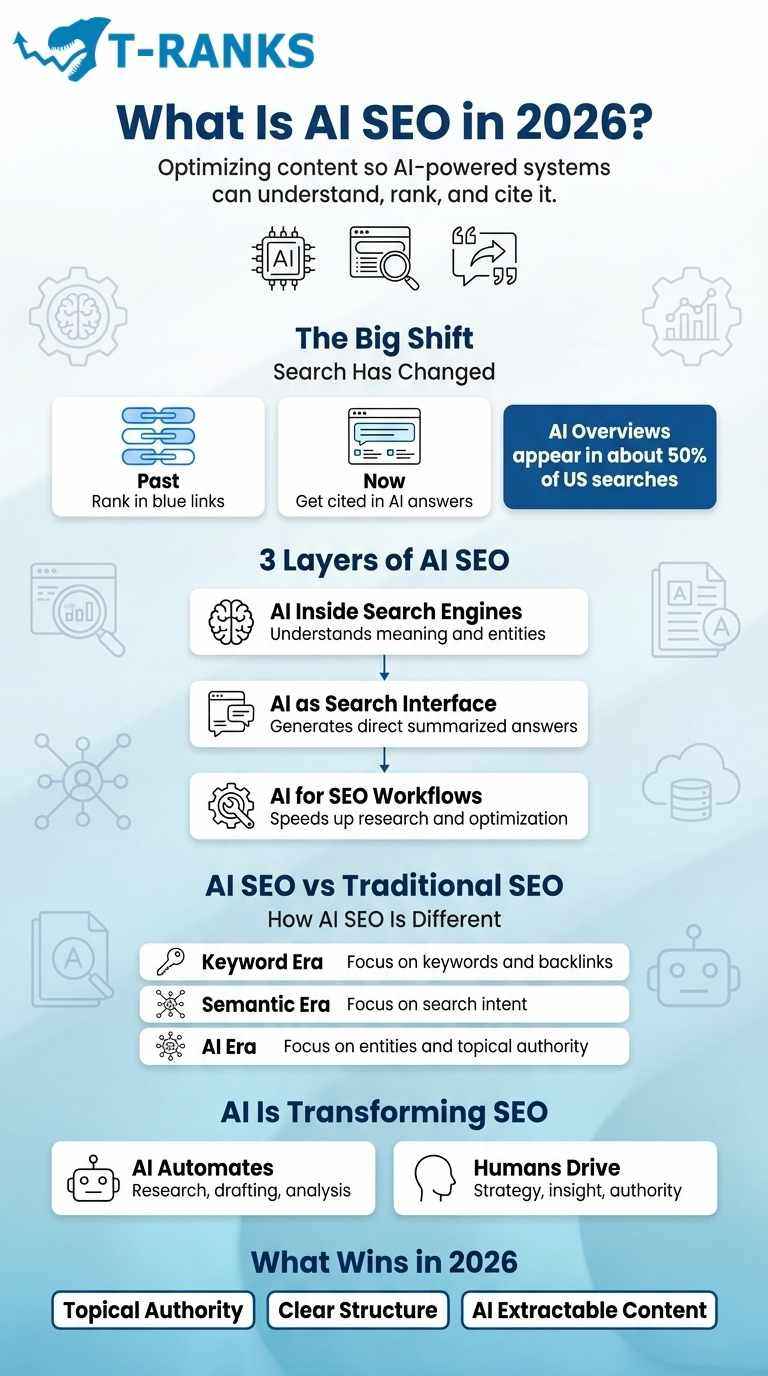
AI SEO is the process of optimizing content so AI-powered search systems can understand, rank, and reference it. These systems include Google AI Overviews, ChatGPT, and Perplexity.
In the past, SEO focused mainly on ranking pages in search results. In 2026, search has expanded beyond traditional results pages. Many users now receive answers directly from AI systems that summarize information and cite sources.
Because of this shift, SEO is no longer only about ranking first on Google. It is also about making your content easy for AI systems to read, understand, and trust.
This change is happening quickly.In 2026, this change is already here. Google AI Overviews now appear inapproximately 50% of all US searches and reach1.5 billion users every month across more than 200 countries.
For websites that depend on search traffic, adapting to AI-driven search is now essential.
AI SEO works across three connected layers.
AI inside search engines
Search engines now rely heavily on artificial intelligence to understand queries.
Instead of matching exact keywords, systems use technologies such as machine learning and natural language processing to interpret meaning. They analyze topics, entities, and relationships between concepts to determine whether a page fully answers a user’s question.
For example, Google’s Knowledge Graph connects related entities and helps the search engine understand how concepts relate to each other.
AI as a search interface
AI tools are now becoming search platforms themselves.
Systems such as Google AI Overviews, ChatGPT Search, and Perplexity generate summaries directly in their interface. These summaries combine information from multiple sources and often include citations.
This changes how visibility works. Instead of only competing for ranking positions, websites must also compete to be referenced inside AI-generated answers.
AI for SEO workflows
AI is also changing how SEO professionals work.
Many tasks that once required manual research can now be accelerated using AI tools. These tools help with:
• keyword clustering
• topic research
• content outlines
• structured data generation
• technical audits
AI increases speed and scale, but it does not replace expertise. Strategy, competitive analysis, and original insights still depend on human judgment.
Understanding this shift makes it easier to see how AI SEO differs from traditional SEO.
How Is AI SEO Different From Traditional SEO?
AI SEO focuses on meaning and topic coverage, while traditional SEO focused more on keywords and links.
The goal of SEO has always been the same: gaining visibility in search results. What has changed is how search engines evaluate content.
Search has evolved through three major stages.
| Era | Core Focus | How Ranking Worked |
| Keyword Era | Exact keyword matching | Keyword density and backlinks dominated |
| Semantic Era | Topics and search intent | Context and user signals became important |
| AI-Driven Era | Intent depth and structured answers | Entity relationships and topical authority drive visibility |
Keywords are still important today. They signal what a page is about.
However, AI-driven systems now evaluate additional factors, such as:
• how well the topic is explained
• how related concepts are connected
• how clearly the information is structured
• whether the content fully answers the user’s question
A page that only repeats keywords but does not explain the topic clearly appears shallow to modern search systems.
In 2026, strong rankings come from complete topic coverage, clear structure, and meaningful connections between ideas.
The shift toward AI-driven search is already happening. It is not a future trend. It is the environment SEO now operates in.
Is AI Replacing SEO or Transforming It?
AI is transforming SEO, not replacing it.
Search engines still rely on high-quality content to answer user questions. Users still need trustworthy sources that explain topics clearly.
What AI changes is how SEO work is done, not whether SEO is needed.
AI tools can automate tasks such as:
• keyword research
• data analysis
• draft generation
• content optimization
These tools help SEO professionals work faster and analyze larger datasets.
However, AI cannot replace important parts of SEO strategy, such as:
• deciding which topics to target
• understanding audience needs
• building brand authority
• creating original insights
• developing long-term strategy
AI handles repetitive tasks well, but strategic thinking still requires human expertise.
In 2026, successful SEO professionals use AI as a powerful tool, not a replacement for strategy.
The real question is no longer whether SEO will survive AI. The real question is whether your SEO strategy has adapted to how AI systems now evaluate and retrieve information.
Here is a simplified and clearer rewrite of the section. I kept the meaning intact but improved clarity, flow, and readability so it is easier for readers to understand while still working well for SEO and AI extraction.
How Artificial Intelligence Changed the Way Search Engines Work
Artificial intelligence has completely changed how search engines work.
In the past, search engines mainly looked for exact keywords. If a page contained the same words as the search query and had enough backlinks, it could rank well even if the content did not fully answer the user’s question.
Today, search engines use artificial intelligence to understand meaning and intent. Instead of matching words, they try to understand what the user actually wants to know.
Google processes more than 8.5 billion searches every day, and AI systems now help evaluate every one of those queries.
This change did not happen overnight. It developed through several major updates.
RankBrain (2015) was Google’s first machine learning system used in search. It helped Google understand new or unfamiliar queries by connecting them with related ideas and concepts.
BERT (2019) improved Google’s understanding of language. Instead of reading individual words separately, BERT analyzes the full context of a sentence. This helps Google understand how words relate to each other.
Gemini (2023–present) is the latest AI system behind many of Google’s search capabilities. Gemini can process text, images, and complex questions at the same time. It also helps power features such as Google AI Overviews, which summarize answers from multiple sources.
Together, these systems changed search from a simple keyword index into a system that understands intent, context, and relationships between topics.
Modern search engines now evaluate several factors before ranking a page, including:
- the meaning behind the search query
- the entities and topics connected to the query
- how clearly the content explains the topic
- whether the page fully answers the user’s problem
- signals of trust and authority
Because of this shift, repeating keywords is no longer enough. Search engines now prefer pages that explain topics clearly, connect related ideas, and provide complete answers.
Understanding how Google interprets a search query helps explain why content structure, topic coverage, and entity clarity are now more important than keyword density.
How Does Google Use AI to Understand Search Intent?
Google uses artificial intelligence and natural language processing to understand what a user actually means when they search.
When someone types a query, Google does not simply scan pages for matching keywords. Instead, it breaks the query into concepts and entities and connects them with information stored in the Google Knowledge Graph. This database contains billions of real-world entities such as people, places, organizations, and topics.
This process allows Google to understand the context of a search before evaluating any web pages.
For example, if someone searches for “apple benefits,” Google must determine whether the user means the fruit or the technology company. AI systems analyze context signals such as recent searches, location, and wording to decide which meaning is most likely.
Once Google understands the intent behind a query, it evaluates whether a page truly answers the user’s question.
Pages perform better when they:
- clearly define the topic
- explain why the topic matters
- answer related questions
- connect the topic to a broader subject
Pages that only repeat keywords or provide shallow explanations usually perform poorly because they do not fully solve the user’s problem.
In modern search, ranking well means writing content that answers the real question behind the search, not just matching the words typed into the search bar.
What Signals AI Search Engines Use to Rank Content
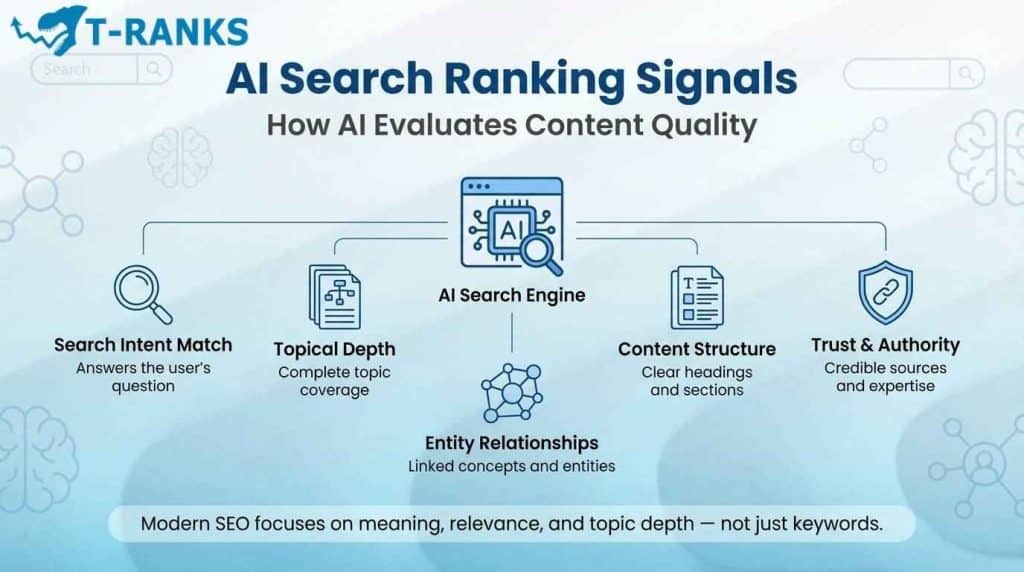
Modern search engines no longer rely mainly on keyword matching to rank pages. Instead, AI systems evaluate whether a page truly answers the user’s question and provides reliable information.
In earlier versions of search, repeating a keyword and building many backlinks could often push a page higher in the results. Today, AI-driven ranking systems look at a broader set of signals to understand the quality and usefulness of content.
Some of the most important signals AI systems evaluate include:
Search intent satisfaction
Search engines check whether a page actually solves the user’s problem. Content that clearly answers the question behind the query performs better than pages that only mention the keyword.
Topical coverage
AI systems prefer pages that explain a topic fully. A page that defines a concept, explains how it works, and answers related questions usually performs better than a page that only gives a short definition.
Entity relationships
Search engines now recognize entities such as people, companies, products, and concepts. When a page connects related entities naturally, it helps AI systems understand the topic more clearly.
Content structure and clarity
Well-organized content is easier for search engines to interpret. Clear headings, logical sections, and concise explanations help AI systems understand the information on the page.
Trust and authority signals
Search engines also evaluate signals that indicate credibility. These include backlinks from relevant websites, consistent topical expertise, and content that demonstrates real knowledge of the subject.
Because AI evaluates meaning rather than simple keyword repetition, ranking well now depends on clarity, depth, and topical relevance. Pages that fully explain a subject and connect related ideas are more likely to rank than pages built only around keyword placement.
AI SEO vs AEO vs GEO What Is the Difference?
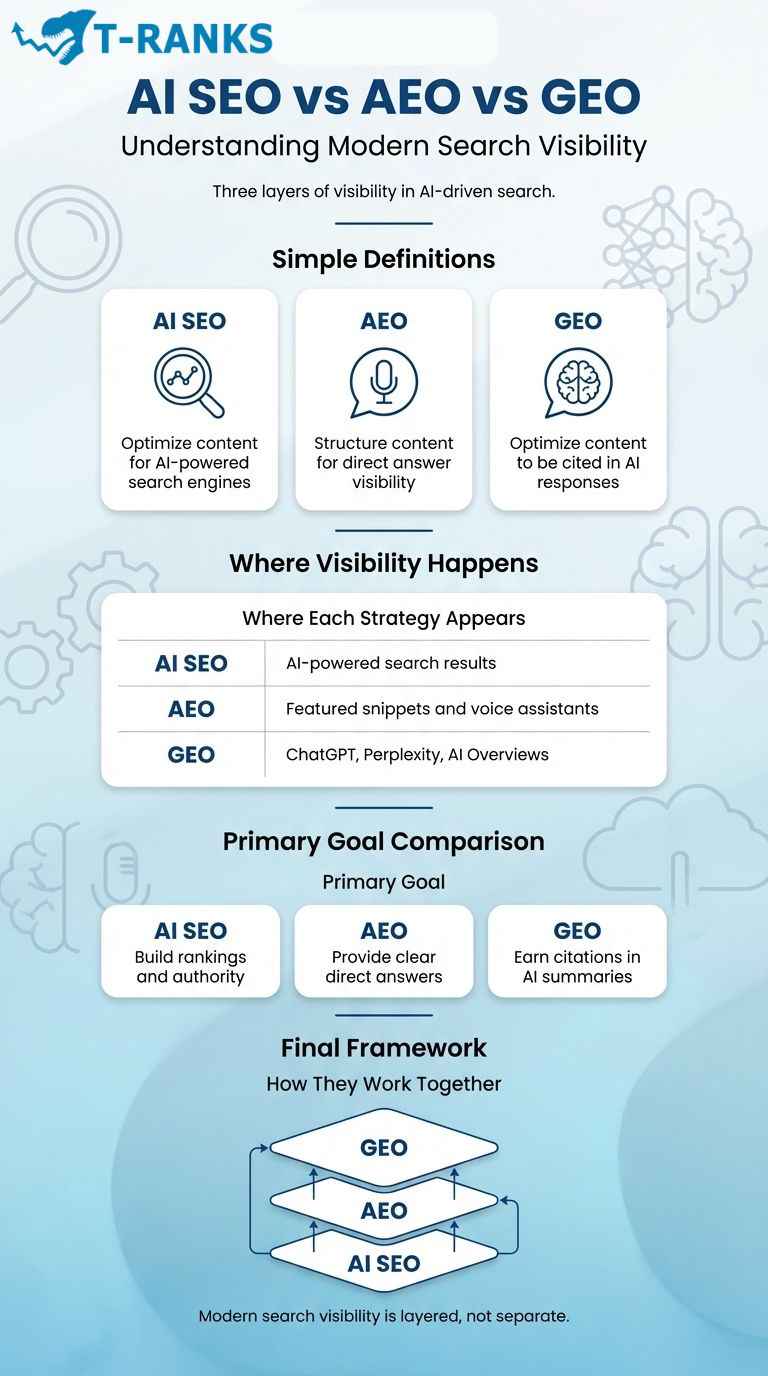
AI SEO, AEO, and GEO describe three related ways content becomes visible in modern search systems. They are not competing strategies. Instead, they represent different layers of how search engines and AI platforms discover, understand, and present information.
In simple terms:
- AI SEO focuses on optimizing content for AI-powered search engines.
- AEO (Answer Engine Optimization) focuses on structuring content so it can appear as direct answers.
- GEO (Generative Engine Optimization) focuses on getting content cited inside AI-generated responses.
These approaches work together to improve visibility across both traditional search engines and AI-driven platforms.
The difference becomes clearer when comparing where each one earns visibility.
| Optimization Type | Where Visibility Happens | Primary Goal |
| AI SEO | Search engine results powered by AI ranking systems | Rank pages and build search visibility |
| AEO | Featured snippets, voice assistants, and answer boxes | Provide direct answers to user questions |
| GEO | AI systems like ChatGPT, Perplexity, and Google AI Overviews | Be cited or referenced inside AI-generated responses |
Rather than replacing each other, these three approaches work together as layers of modern search visibility.
What Is Answer Engine Optimization (AEO)?
Answer Engine Optimization (AEO) is the process of structuring content so search engines and voice assistants can extract it as a clear, direct answer.
Today, search engines often provide answers directly on the results page. Instead of clicking a website, users may receive a definition, explanation, or step-by-step guidance immediately.
To appear in these answer formats, content must be easy for systems to understand and extract.
AEO usually focuses on:
- clear definitions of concepts
- short explanations that answer a specific question
- structured formatting such as lists or tables
- natural language phrasing that matches conversational queries
Example: When someone searches for “What is AI SEO?”, Google may display an AI Overview or direct answer box at the top of the results page, as shown in the screenshot above. Instead of only listing websites, Google generates a short summary that explains the concept using information extracted from trusted sources.
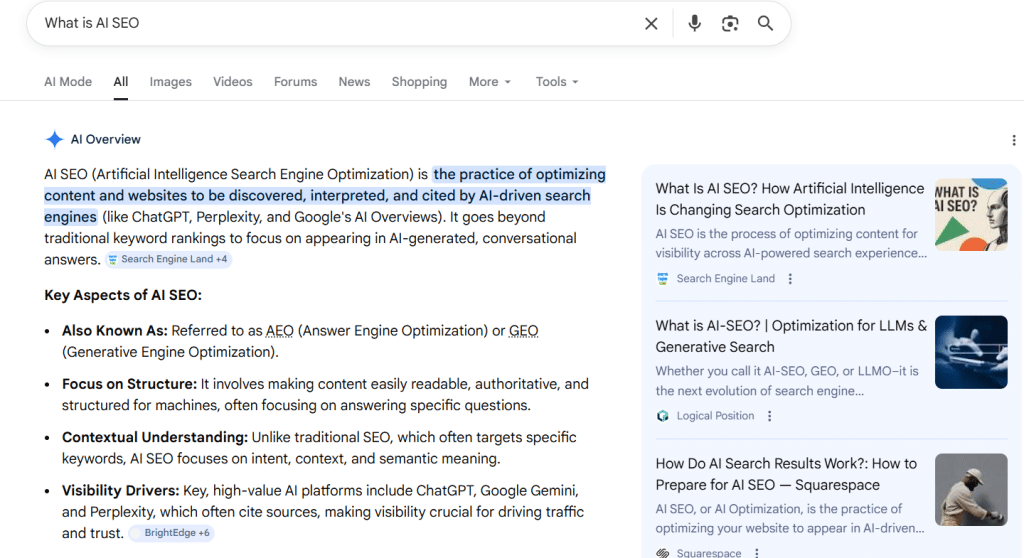
This is where Answer Engine Optimization (AEO) becomes important. If your content provides a clear definition, structured explanation, and easy-to-extract information, search engines are more likely to use it as a source for these AI-generated answers.
.
What Is Generative Engine Optimization (GEO)?
Generative Engine Optimization (GEO) focuses on helping content appear inside AI-generated responses.
Generative search systems such as ChatGPT, Perplexity, and Google AI Overviews summarize information from multiple sources to produce a single answer. Instead of listing links, these systems retrieve reliable content and combine it into a response.
GEO aims to increase the likelihood that your content will be included as a trusted source in those summaries.
Content that performs well in generative systems usually demonstrates:
- strong topical authority on a subject
- clear references to relevant entities and concepts
- trustworthy signals such as credible sources and accurate information
- original insights, explanations, or examples
When AI systems identify a page as reliable and informative, they are more likely to reference it when generating answers.
Do You Need All Three — SEO, AEO, and GEO?
You do not need completely separate strategies for SEO, AEO, and GEO because they overlap significantly.
Traditional SEO remains the foundation. It helps search engines discover your website, evaluate its authority, and rank it in search results.
AEO improves how individual sections of content appear when search engines extract direct answers.
GEO increases the chances that your content will be cited by AI systems when they generate summaries and responses.
In practice, well-structured and authoritative content can support all three at the same time. When a page clearly explains a topic, answers related questions, and demonstrates expertise, it becomes easier for search engines and AI systems to understand, rank, and reference it.
This is why modern SEO strategies increasingly focus on semantic depth, structured content, and topical authority rather than treating SEO, AEO, and GEO as separate disciplines.
Are Backlinks Still Important in AI SEO?

Yes, backlinks are still important in AI SEO, but the way search engines evaluate them has changed. Modern AI-driven ranking systems do not rely only on the number of links pointing to a page. Instead, they analyze link relevance, topical context, and overall site authority.
In earlier SEO models, backlinks acted mainly as popularity signals. Pages with more links often ranked higher, even if those links were loosely related. Today, AI systems evaluate links in a deeper and more contextual way. They use backlinks to determine whether a page is trustworthy, whether it belongs to a recognized topic area, and whether the linking relationship appears natural.
Backlinks now help search engines:
- identify trustworthy and authoritative websites
- confirm expertise within a specific topic
- discover related content across the web
- detect manipulative or unnatural link patterns
Because of this shift, a few relevant and authoritative backlinks can be more valuable than hundreds of unrelated links. Links still contribute to rankings, but they must align with the page’s topic and the site’s overall expertise.
In modern AI SEO, backlinks work best when they support topical authority and semantic relevance, rather than simply increasing link volume.
Why Topical Authority Now Matters More Than Link Volume
Topical authority has become a stronger ranking signal because AI systems evaluate expertise across an entire content ecosystem rather than judging pages individually.
Instead of looking at a single article, search engines now examine how well a website covers a subject overall. They analyze whether the site consistently publishes content about related topics, connects those topics through internal links, and demonstrates clear expertise within a defined subject area.
For example, a website that publishes multiple high-quality articles about AI SEO, content optimization, and search algorithms builds a stronger authority profile than a site that publishes only one isolated article on the topic. When backlinks point to content within a well-developed topic cluster, those links reinforce the site’s expertise.
This means a site with strong topical coverage and a moderate number of relevant backlinks can outperform another site with hundreds of unrelated links. In AI-driven search, authority is built through both content depth and relevant external references.
How AI Evaluates Link Quality Differently
AI-based ranking systems analyze backlinks using deeper contextual signals than earlier search algorithms.
Rather than counting links as simple votes, AI models evaluate the relationship between the linking page and the page receiving the link. They examine whether the two pages discuss related topics, whether the link appears naturally within the content, and whether the surrounding text supports the relevance of the link.
Important signals include:
- topical alignment between the linking page and the target page
- context surrounding the link within the article
- entity relationships between the subjects discussed on both pages
- natural linking patterns across the website
For example, a backlink from an article discussing AI search strategies that references an AI SEO guide is highly relevant. In contrast, links placed on unrelated sites or inside low-quality directories provide little value and may even raise trust concerns.
AI systems are also much better at detecting manipulative link schemes. Networks of paid links, repeated anchor patterns, and irrelevant placements can now be identified more easily than in earlier search models.
Because of this, editorial links placed naturally inside relevant content are far more valuable than artificial or mass-produced links.
Does Anchor Text Still Matter in 2026?
Anchor text still plays a role in SEO, but it is now evaluated within its surrounding context rather than as a simple keyword signal.
In earlier SEO practices, repeating exact-match anchor text could strongly influence rankings. Today, AI systems analyze anchor text together with the content around it. They evaluate whether the phrase naturally fits the topic and whether the link contributes meaningful context.
Healthy anchor text patterns usually include:
- descriptive phrases that explain the linked content
- branded anchors referencing a company or website name
- links placed naturally inside relevant discussions
Risk increases when links rely heavily on repeated exact-match keywords, keyword stuffing, or forced placements that do not fit the surrounding content.
Because AI systems understand language and context more accurately, natural linking patterns are now far more effective than aggressive keyword targeting.
How to Use AI in Your SEO Workflow — 4 Core Applications
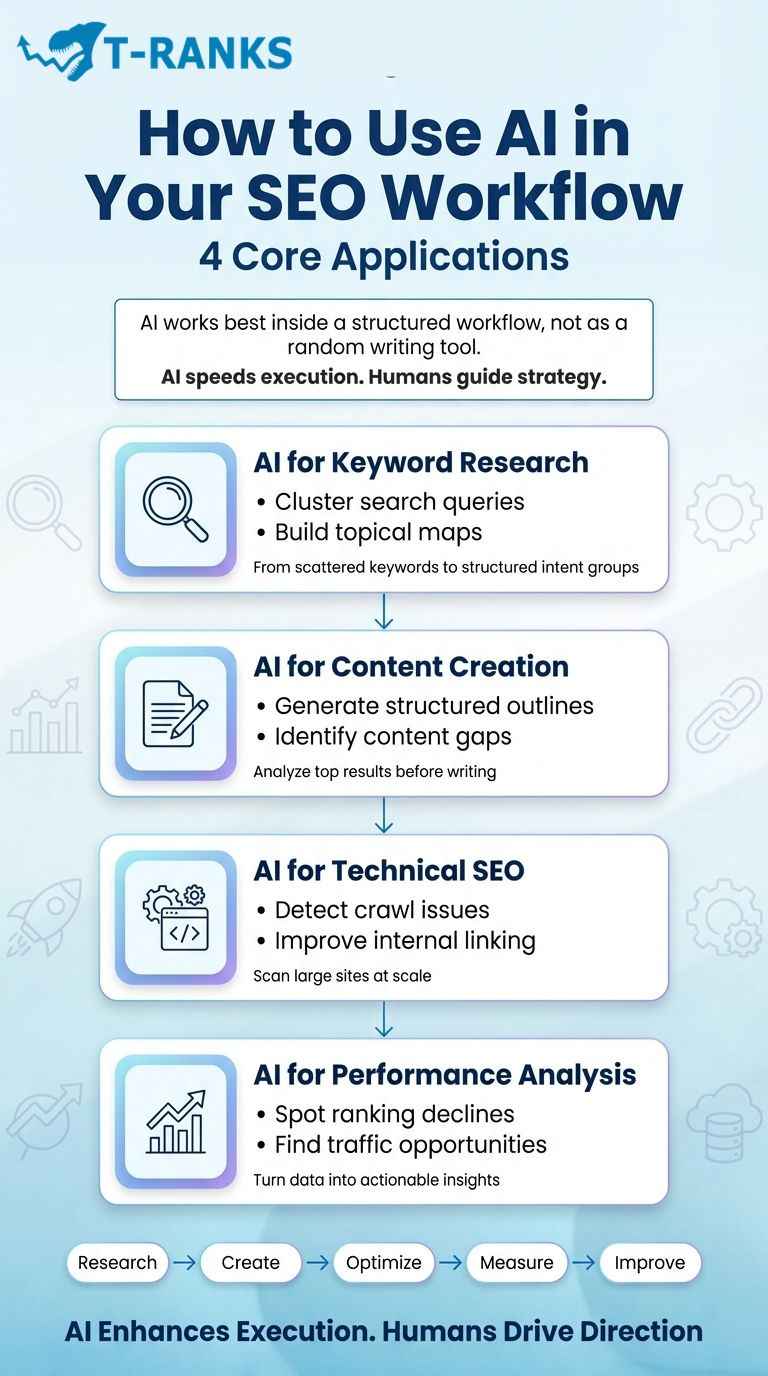
AI becomes valuable in SEO when it is used as part of a structured workflow, not as a random writing tool. When applied to the right tasks, AI can dramatically reduce the time required for research, analysis, and content preparation.
Many SEO teams report that tasks such as keyword clustering, content briefing, and technical audits can now be completed in hours instead of days with the help of AI-powered tools. However, the most effective workflows combine AI efficiency with human strategic judgment.
In practice, AI strengthens four key areas of an SEO workflow:
- Keyword research and topical clustering
- Content creation and optimization
- Technical SEO analysis at scale
- Performance analysis and reporting
When used correctly, AI speeds up execution while human expertise guides priorities, quality, and strategic direction.
AI for Keyword Research and Topical Clustering
AI improves keyword research by organizing search queries into structured topic clusters rather than scattered keyword lists.
Traditional keyword research often produces hundreds of isolated keywords. AI tools can group these queries by search intent and semantic relationships, helping you build a clearer content strategy.
A practical workflow looks like this:
- Start with a seed topic such as “AI SEO.”
- Use an AI-assisted tool like Semrush, Ahrefs, or ChatGPT to generate related queries and questions.
- Cluster these queries into topic groups based on intent and relevance.
- Assign one main page to each cluster and supporting articles to related subtopics.
For example, AI might group queries about AI SEO definitions, tools, backlinks, workflows, and ranking impact into separate clusters. This allows you to build a complete topical map rather than publishing isolated articles.
AI can also surface emerging queries, related entities, and conversational search questions, helping you expand coverage of a topic more quickly and build stronger topical authority.
AI for Content Creation and Optimization
AI helps accelerate content production by assisting with research, structure, and optimization before an article is written.
Instead of starting with a blank page, AI tools can analyze top-ranking content and generate structured outlines or content briefs that cover the most important subtopics.
Tools such as Surfer SEO, Clearscope, or ChatGPT can help with tasks like:
- analyzing top search results for a topic
- identifying missing subtopics or content gaps
- suggesting related entities and semantic terms
- recommending headings and logical structure
For example, an AI content tool might analyze the top 20 search results for “AI SEO strategy” and reveal that most ranking pages include sections on AI Overviews, keyword clustering, and backlink evaluation. If your article lacks one of these sections, AI can highlight the gap before publication.
AI can also help refine readability and structure, making content easier for both readers and search systems to interpret. However, human editing remains essential for verifying facts, adding original insight, and ensuring the content aligns with the brand’s expertise and goals.
AI for Technical SEO at Scale
AI is particularly useful for analyzing large websites where technical issues are difficult to detect manually.
Technical SEO tools such as Screaming Frog, Sitebulb, and AI-assisted crawlers can scan hundreds or thousands of pages quickly and surface patterns that would otherwise take hours of manual analysis.
AI-powered technical analysis can help identify:
- broken links and crawl errors
- weak internal linking structures
- slow or poorly optimized pages
- missing or incorrect schema markup
- duplicate or thin content patterns
For example, an AI-assisted crawler can analyze an entire website and highlight pages that receive little internal linking, helping you strengthen the site’s link structure.
Technical analysis is also becoming more important as AI crawlers such as GPTBot, ClaudeBot, and PerplexityBot index content across the web. These systems rely on clear site structure and accessible content, meaning technical issues can directly affect how AI systems discover and interpret your pages.
AI for SEO Performance Analysis and Reporting
AI can also improve how SEO teams interpret performance data.
Modern SEO involves analyzing large datasets from tools such as Google Search Console, Google Analytics, and ranking platforms. AI tools can process this information quickly and identify trends that might be difficult to detect manually.
AI-assisted analysis can help with tasks such as:
- identifying pages with declining rankings
- detecting emerging keyword opportunities
- spotting traffic patterns across topic clusters
- highlighting pages that need content updates
For example, an AI analysis of Search Console data may reveal that several pages are receiving impressions for related keywords but are not ranking highly. This insight can guide targeted content improvements or new supporting articles.
Instead of manually reviewing hundreds of rows of performance data, AI helps SEO teams focus on the patterns and opportunities that matter most.
Can AI-Generated Content Rank on Google?

Yes, AI-generated content can rank on Google. Google evaluates content based on quality, usefulness, and trustworthiness rather than how it was created.
Google has confirmed that the method of creation does not matter. What matters is whether the content genuinely helps users and demonstrates experience, expertise, authoritativeness, and trustworthiness (E-E-A-T).
However, this does not mean that all AI-generated content performs well. Google’s Helpful Content System evaluates whether a page provides real value instead of simply repeating information already available online.
Google also introduced manual actions targeting scaled content abuse in 2025. This policy targets websites that mass-publish large volumes of low-value AI content without meaningful human oversight. When content is produced automatically at scale and offers little original insight, it can trigger spam signals or manual penalties.
In practice, AI content ranks when it:
- clearly satisfies search intent
- demonstrates real expertise or experience
- provides accurate and reliable information
- is well structured and easy to understand
- adds information gain, meaning it contributes something new beyond existing pages
AI can help produce drafts and organize information, but the final quality still depends on the human expertise guiding the process.
Why Some AI Content Fails to Rank
Many AI-generated articles fail to rank because they only summarize information that already exists online.
AI models are trained on existing data. When used without deeper research or editing, they often produce content that repeats common explanations without adding new insights. As a result, many AI-generated articles look similar to each other and provide little additional value.
Another common problem is that writers rely entirely on AI to produce the article without first researching the topic or analyzing competing content. Without understanding the subject deeply, it becomes difficult to identify what important information is missing or how to improve the explanation.
Successful content usually involves real research before writing begins. This includes studying competing pages, identifying gaps in their explanations, and organizing the topic into a clear structure. AI can then assist with drafting and organizing information, but the strategy and insight must come from the writer.
When content includes deeper explanations, practical examples, or clearer frameworks than competing pages, it provides the information gain that search engines look for.
How to Make AI Content Rank Safely
The most effective approach is to treat AI as a research and drafting assistant, not as a fully automated content generator.
A practical workflow usually starts with human research. Writers analyze the search results, review competing articles, and identify what information users still need. After that foundation is established, AI tools such as ChatGPT, Claude, Surfer SEO, or Clearscope can help generate outlines, organize ideas, and accelerate drafting.
From there, the most important step is human refinement. Writers should improve the article by adding clearer explanations, real examples, and insights that AI alone cannot provide.
In practice, high-ranking AI-assisted content usually follows this process:
- Research the topic and analyze competitor content
- Build a clear outline that covers the full search intent
- Use AI to help generate and organize the first draft
- Edit the draft to add examples, insight, and clarity
- Verify facts and strengthen credibility with sources
Simply asking AI to generate an article from a short prompt often produces generic results. When writers guide the process through research, structured thinking, and careful editing, AI becomes a powerful tool for producing high-quality content.
Used this way, AI speeds up the workflow while human expertise ensures the content remains original, useful, and trustworthy.
How AI Overviews Are Changing SEO Traffic and How to Adapt

AI Overviews are reducing organic traffic from simple informational searches and shifting SEO from click focused performance to visibility focused performance.
When Google shows a summarized answer at the top of the page, many users no longer need to click traditional search results. Studies confirm this shift. Research from Seer Interactive found that organic click through rates dropped by about 61 percent when AI Overviews appeared in results. Ahrefs reported that the position one result can lose around 58 percent of its clicks when an AI Overview is present.
This change affects mostly basic informational searches such as definitions, quick explanations, and simple comparisons. However, SEO remains critical. The strategy is evolving. Instead of focusing only on clicks, websites must now build topical authority, structured content, and brand visibility so their information can be referenced within AI summaries.
Why AI Overviews Are Reducing Organic Clicks
AI Overviews reduce organic clicks because they provide answers directly inside the search results page.
When users search for quick information, Google can summarize the answer immediately. This removes the need to open multiple websites. For example, a search such as “What is AI SEO?” may show a short definition and explanation directly inside the overview.
This effect is strongest for:
• top of funnel informational queries
• simple definitions and explanations
• basic product or concept comparisons
In these cases the user receives the core information instantly. More complex searches, especially those involving decisions or implementation, still require deeper research and continue to generate clicks.
How to Still Get Traffic in a Zero Click World
To maintain organic traffic, content must go beyond the information that AI summaries provide. Users still click when they need deeper understanding, practical guidance, or real examples.
Websites that continue to attract traffic usually focus on:
• bottom funnel content such as pricing guides, detailed comparisons, and implementation tutorials
• original insights including case studies, experiments, and first hand experience
• comprehensive resources that explain strategies, workflows, and real use cases
• strong brand authority that encourages users to search the brand directly
For example, an AI Overview might summarize the basics of AI SEO, but users will still click a page that explains advanced workflows, provides real campaign examples, or presents a structured strategy.
Content should also be clearly structured with concise answers and logical headings. This increases the chance that Google can extract key insights while still encouraging users to visit the page for deeper information.
How to Structure Content to Be Cited in AI Overviews

Appearing inside AI Overviews requires content that is easy for search systems to understand, extract, and summarize.
Pages that are frequently cited usually include:
• a direct answer immediately under each heading
• short definition paragraphs that clearly explain the concept
• structured lists or steps that simplify complex ideas
• strong topical authority across multiple related articles
• credible sources that reinforce trust and accuracy
This structure helps search engines identify the most important information quickly. When content clearly answers a query and supports it with deeper explanations, it becomes easier for AI systems to reference it in summaries.
Being cited inside AI Overviews increases visibility even when users do not click immediately. Over time this exposure strengthens brand recognition and authority.
How Your SEO KPIs Should Change in 2026
In an AI driven search environment, SEO success cannot be measured only by rankings and clicks. Visibility and influence across search experiences are becoming equally important.
Traditional SEO metrics focused mainly on:
• ranking position
• click through rate
• organic traffic volume
Modern SEO measurement also includes:
• impressions and visibility in AI summaries
• brand mentions and branded search growth
• engagement signals such as time on page and return visits
• assisted conversions influenced by search exposure
For example, a user may see your brand referenced inside an AI Overview, leave the results page, and later search for the brand directly. That visibility still contributes to business growth even though the first search did not generate a click.
In the evolving search ecosystem, SEO performance is measured not only by traffic numbers but by presence, authority, and long term influence across search platforms.
What Content Do AI Systems Cite?
AI systems cite content that is clear, authoritative, and easy to extract.
Large language models retrieve information from sources that provide direct answers, reliable facts, and structured explanations. Content that clearly defines concepts and organizes information logically has a higher chance of being referenced.
AI visibility is different from traditional search ranking. Ranking focuses on position in search results, while AI citation depends on whether a page is easy for AI systems to understand and extract.
In 2026, successful SEO content must achieve two goals. It must rank in search engines and also be structured in a way that AI systems can confidently retrieve and cite.
The 4 Content Types AI Systems Favor as Citations

AI systems prefer content that is easy to verify, summarize, and retrieve.
Certain content formats appear frequently in AI-generated answers because they provide clear information and structured explanations.
Comprehensive guides
Long-form guides that cover a topic completely are often cited. These pages provide enough context for AI systems to understand relationships between ideas and summarize them accurately.
Original data and statistics
Research findings, surveys, and case studies provide verifiable facts. AI systems often prefer citing information backed by numbers because statistical evidence strengthens credibility.
Comparison tables and structured lists
Tables and structured comparisons are easy for AI systems to extract and summarize. When pages clearly compare tools, methods, or strategies, models can quickly identify the key differences.
Direct-answer FAQs
Question-and-answer sections are frequently cited because they match user queries directly. When a page begins with a concise answer and then expands with explanation, it becomes highly extractable for AI responses.
Content that combines depth, structure, and verifiable information has the highest probability of being cited.
Why Some Pages Are Invisible to AI Crawlers
Even well-structured content may never appear in AI responses if AI systems cannot access the page.
Many modern websites rely heavily on client-side JavaScript frameworks such as React or Vue. While search engines can often render JavaScript, many AI crawlers do not execute complex scripts when retrieving pages.
As a result, important content may not be visible to AI systems during crawling.
To avoid this problem, websites should ensure that important content is accessible through server-side rendering or static HTML output. When the main content is available directly in the page source, AI crawlers can easily retrieve and process it.
Ensuring crawlable, server-rendered content significantly improves the chances of being cited by AI systems.
How to Structure Any Page So AI Can Extract and Cite It
To increase citation probability, pages should be structured for clarity, extraction, and semantic understanding.
Several structural principles help AI systems retrieve information more effectively.
Front-loaded answers: Begin sections with a direct explanation before adding detailed discussion.
Content chunking: Break information into short paragraphs and clearly separated ideas so AI systems can retrieve individual knowledge blocks.
Question-first structure: Answer the main question first, then expand with supporting explanations and examples.
Entity clarity: Clearly mention important concepts, tools, and terminology so AI systems can understand relationships between topics.
Structured data: Use schema markup such as FAQ schema or Article schema to help search systems interpret page content.
When a page is easy for humans to read, verify, and navigate, it is also easier for AI systems to extract and cite.
In AI-focused SEO, clarity, structure, and authority significantly increase citation probability.
The Bottom Line — What AI SEO Really Requires in 2026
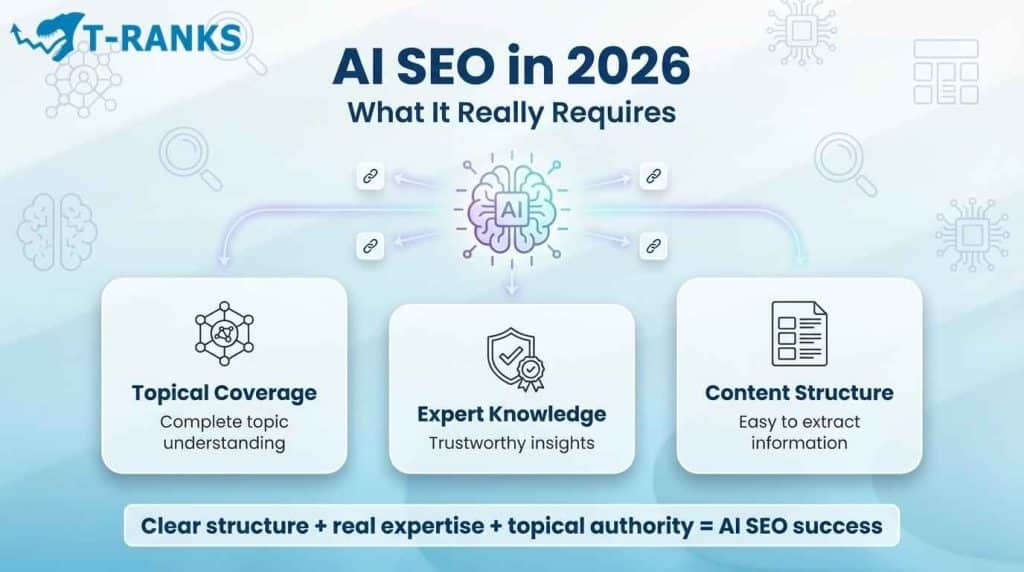
AI SEO in 2026 is no longer focused only on ranking pages. It is about becoming a reliable source that AI systems can understand, extract, and cite. Search visibility now extends beyond traditional results into AI answers, summaries, and conversational search experiences.
Content that clearly explains concepts, covers topics deeply, and demonstrates real expertise has the greatest chance of being referenced across these systems.
The sites that succeed in this environment combine three things: strong topical coverage, genuine expertise, and clear content structure.
When pages provide complete explanations, trustworthy information, and well-organized formatting, they become easier for both users and AI systems to interpret. Over time, this combination builds authority, increases citation visibility, and strengthens long-term search presence.
Frequently Asked Questions About AI SEO
What is AI SEO in simple terms?
AI SEO is optimizing content for AI-driven search systems while also using AI tools to improve SEO workflows. It focuses on semantic relevance, structured answers, and visibility across traditional search and generative AI platforms.
Is AI SEO different from traditional SEO?
AI SEO builds on traditional SEO but emphasizes semantic context, entity optimization, and AI-friendly structure. While traditional SEO prioritized keywords and backlinks, AI SEO focuses more on extractability and topical authority.
Is AI replacing SEO experts?
No, AI is changing how SEO is executed but not replacing expertise. AI automates tasks, but strategy, judgment, and original insight still require human involvement.
Can AI-written content rank on Google?
Yes, AI-written content can rank if it is helpful, accurate, and original. Google evaluates content quality rather than whether it was created by AI.
Does Google penalize AI-generated content?
Google does not penalize AI content solely for being AI-generated. It penalizes low-quality or manipulative content regardless of how it was produced.
What is the difference between SEO, AEO, and GEO?
SEO targets traditional search rankings, AEO focuses on answer-based visibility, and GEO is an industry term for optimizing content for generative AI systems. All three overlap in modern search environments.
How do AI Overviews affect SEO traffic?
AI Overviews can reduce clicks for some informational queries by providing direct answers in search results. This increases the importance of brand authority and structured content.
How can I get my content cited in AI-generated answers?
Clear definitions, structured sections, and strong topical authority improve the chances of being cited. Content must be easy for AI systems to extract and interpret.
Are backlinks still important in AI SEO?
Yes, backlinks remain a ranking signal.
However, contextual relevance and topical alignment matter more than raw link volume.
How does AI evaluate backlink quality?
Google uses machine learning systems to assess link relevance, trust signals, and unnatural patterns. Natural context and authority are more important than aggressive anchor optimization.
Can AI automate SEO completely?
No, AI cannot fully automate SEO strategy. It can assist with research and execution, but strategic planning and competitive positioning require human expertise.
What happens if I rely only on AI tools for SEO?
Relying only on AI tools can result in generic content with little differentiation. Without original insight and experience, long-term authority is difficult to build.
How should SEO performance be measured in 2026?
SEO performance should be measured through visibility trends, brand search growth, engagement metrics, and overall search presence rather than rankings alone.
Is AI SEO worth it for small businesses?
Yes, AI SEO can help small businesses scale content and research more efficiently. The key is focusing on niche topical authority rather than competing on broad keywords.
How can I future-proof my SEO strategy in the AI era?
You can future-proof your SEO strategy by building topical authority, strengthening brand signals, and structuring content clearly for AI retrieval systems.