You built your website. You added content. You tried to improve your SEO. But when you search on Google, your website is nowhere to be found. This makes many people ask one simple question: why my website is not ranking?
If your website is not ranking on Google, it does not always mean something is broken. In most cases, there are clear reasons behind it. It could be an indexing issue, weak keyword targeting, low authority, technical problems, or content that does not match what users are searching for.
The good news is that ranking problems can be fixed. In this guide, you will learn the 7 real reasons your website is not ranking and the simple steps you can follow to improve your visibility the right way.
Why Websites Fail to Rank on Google

Most ranking problems fall into three diagnostic layers: indexing, relevance and authority, or visibility performance. These are not the only possible causes, but nearly every ranking issue fits within one of these layers.
When traffic is low, it often feels like something is broken. In most cases, nothing is technically wrong. Google is simply not confident enough to position the page above stronger, clearer, or more relevant competitors.
To understand ranking failure properly, separate three core concepts:
• Indexing means Google has added your page to its database.
• Ranking depends on how relevant and authoritative your page is compared to competing results.
• Visibility means your page earns impressions and clicks in search results.
A page can be indexed but still not rank. Indexing only makes a page eligible to appear. Ranking depends on search intent alignment, keyword competition, internal linking support, content quality, technical clarity, and trust signals.
If you are wondering why your website is not ranking, the issue usually sits inside one of these layers. Most ranking failures are not caused by a single mistake. They are stacked weaknesses across indexing, relevance, authority, or structure.
For example:
• The page is indexed, but the keyword is too competitive.
• The content exists, but it does not fully match user intent.
• The site is crawlable, but internal linking is weak.
• SEO work was done, but authority is still too low.
In 2026, ranking systems are more selective and competition is stronger. Small weaknesses that once went unnoticed can now limit visibility.
Before applying fixes, identify which layer is limiting performance. In the next section, we will clearly list the main reasons websites fail to rank so you can diagnose the real cause with confidence.
The 7 Real Reasons Your Website Is Not Ranking on Google

If your website is not ranking on Google, the problem usually falls into one of these eight common causes. These are the core ranking issues behind indexed but no traffic situations and ongoing visibility problems.
- Your pages are not properly indexed by Google.
If Google has not added your pages to its index, they cannot appear in search results. - Your site is indexed but not ranking or getting impressions.
Your pages exist in Google but rank too low to generate visibility. - Your content does not match search intent.
If your page does not clearly answer what users are searching for, Google will prioritize other results. - You are targeting keywords that are too competitive.
Competing against stronger domains can prevent new or low-authority sites from ranking. - Your pages lack focus or internal linking support.
Weak structure and unclear topical signals reduce ranking potential. - Your site has not built enough authority or trust.
Limited trust signals or backlinks can hold rankings back. - Technical or structural issues limit crawl and evaluation.
Site architecture or crawl problems can reduce visibility. - Algorithm changes or stronger competitors reshaped the SERP.
Updates or improved competitors can push your rankings down.
In the next sections, we will break down each of these causes in detail and explain how to identify and fix them in the correct order.
1)Is Your Website Indexed or Just Invisible in Google

If your website is indexed but receiving no traffic, the issue is usually not access. It is ranking strength. Many websites exist inside Google’s index but generate zero impressions.
Indexing and ranking are different.
• Indexing means Google has added your page to its database.
• Ranking means Google chooses where your page appears in search results.
Indexing only makes a page eligible to appear. It does not guarantee visibility.
This is why “indexed but not ranking” situations are common. A page may exist in Google’s index but rank too low to earn impressions. Sometimes Google keeps a page indexed but rarely shows it because the content is weak, outdated, or less useful than competing pages.
To confirm what is happening, check Google Search Console. Use URL Inspection to verify indexing status and review Index Coverage to understand crawl and exclusion messages such as:
• Crawled, currently not indexed
• Discovered, currently not indexed
• Excluded by search intent alignment
These messages clarify crawlability versus indexability. Crawlability means Googlebot can access the page. Indexability means Google decides the page deserves to stay in the index.
If your page is indexed but not ranking, the problem is no longer technical access. It is about relevance, authority, and competitive strength.
2)Your Content Looks Fine, But It Does Not Rank
If your content is published but not ranking, the issue is usually not writing quality. It is usefulness and intent alignment. Many pages look strong at first glance. They are well structured, clear, and optimized. But deeper review often reveals a mismatch between the content and what users actually expect.
Content quality is not the same as content length. A long article is not automatically strong, and a short article is not automatically thin. Thin content means the page does not add enough value. It may repeat common information, lack depth, or fail to solve the main problem completely.
Rewriting competitors also does not improve rankings. If your page offers the same information in slightly different wording, Google has no reason to prioritize it. Stronger structure, clearer answers, and practical value are what create ranking advantage.
Search intent mismatch is one of the biggest causes of content published but not ranking. Intent is not just the keyword. It includes the full expectation behind the search.
When auditing underperforming pages, ask:
• Does this page directly solve the main problem behind the query?
• Does it cover related sub-questions users expect?
• Is the format aligned with what users want, such as steps, comparisons, or quick answers?
• Does the content provide practical clarity rather than general explanation?
• Would a user leave feeling the question is fully answered?
Topic authority grows when content addresses the subject from multiple relevant angles, not just one narrow explanation. If your page does not fully satisfy intent, even strong writing and optimization will struggle to rank.
Google prioritizes pages that clearly solve problems. If your content is not performing, shift your audit from surface optimization to intent fulfillment and completeness.
3)SEO Basics Missing That Quietly Block Rankings

If your pages are crawled but not ranking, simple on page SEO issues may be holding them back. Many website owners focus on advanced strategies and forget the basics that help Google clearly understand a page.
Even small structural mistakes can quietly reduce visibility without showing obvious errors. Let’s look at the most common fundamentals that block rankings.
Title and Heading Misalignment
Your title and headings tell Google what the page is about. If they are not aligned, Google gets a confusing message.
Common on page SEO issues include:
• The page title targets one topic, but the content talks about something else
• The H1 does not match the main keyword
• Headings mix unrelated ideas
• Important keywords are missing from key headings
When titles and headings are not focused, Google cannot clearly define the page topic. This reduces ranking strength.
Page Focus Confusion
Each page should answer one main question. If a page tries to cover too many topics, it loses clarity.
Signs of focus problems:
• Multiple unrelated keywords on the same page
• Content that jumps between subjects
• No clear primary topic
• Headings that do not follow a logical structure
Google prefers pages with a clear purpose. When focus is weak, ranking potential drops.
Internal Linking Issues and Orphan Pages
Internal linking helps Google understand which pages are important. Without proper links, even good pages can struggle.
Common internal linking issues:
• Important pages have very few internal links
• Orphan pages have no links pointing to them
• Anchor text is unclear or generic
• The site has no clear structure connecting related topics
Orphan pages are especially harmful. If a page has no internal links, Google may crawl it but treat it as low priority. This often results in pages crawled but not ranking.
Discoverability vs Optimization
Discoverability means Google can find your page. Optimization means Google understands and values it.
A page can be discoverable but poorly optimized. For example:
• The page is indexed but the topic is unclear
• The content exists but lacks structured headings
• The page is buried deep in the site with weak internal paths
In these cases, the page exists in Google but does not perform well. Reviewing these basic SEO elements often reveals why rankings remain weak, even when no major technical errors are visible.
4)Your Website Has No Authority Yet

If your website is not ranking even after SEO, the problem may be low authority, not poor optimization. Google ranks websites it trusts. If your domain is new or weak compared to competitors, it may struggle to earn strong positions.
Many people think backlinks alone guarantee rankings. They do not. Authority vs backlinks is not the same thing. A few random links will not build trust. Google looks at the overall strength of your site, not just the number of links pointing to it.
Real authority usually grows through:
• Links from relevant and trusted websites
• Consistent publishing over time
• Clear focus on one main topic or niche
• Transparent business or author information
If your domain authority is too low compared to other sites on the first page, your content may remain buried even if it is helpful.
Why Cheap Links Do Not Build Real Trust
Buying low quality backlinks may look like a shortcut. In reality, it often fails to improve rankings. Weak or unrelated links do not send strong trust signals. In some cases, they reduce credibility.
Trust signals vs backlinks is important to understand. One strong, relevant link from a respected site can help more than dozens of poor quality links. Google evaluates the source, context, and natural placement of links.
New Domain vs Established Site
A new domain starts with no history. An established site may have years of content, backlinks, and user engagement. This creates an advantage.
If your new domain is not ranking, it may simply need time to build signals. Growth is rarely instant. Trust develops as your site shows consistency and value.
Authority Builds Gradually, Not Evenly
Authority does not increase at the same speed for every page. Some topics may rank sooner. Others may take longer.
This uneven progress is normal. As your site gains stronger trust signals and more relevant backlinks, visibility improves step by step.
If your website is not ranking even after SEO work, check whether the real issue is domain authority too low. Authority takes time, steady effort, and quality signals to build.
5)Technical Issues That Stop Rankings Without Obvious Errors

If your website is not ranking even after improving content, keywords, and authority, technical SEO problems may still be blocking progress. These issues are often invisible. The site works. Pages load. There are no clear warnings. But rankings remain weak.
Earlier, we reviewed content quality, keyword targeting, and authority. If those areas are solid, the next step is to check technical foundations. Small structural problems can quietly limit how Google crawls and evaluates your pages.
Crawl Blocks That Do Not Show Clear Errors
Some crawl and index problems do not break your website. They simply reduce efficiency.
Common silent crawl issues include:
• Important pages placed too deep in the site structure
• Multiple redirects before reaching the final page
• Old noindex tags left active after testing
• Blocked files that prevent proper page rendering
These problems affect crawl budget. Crawl budget means how much time Googlebot spends exploring your site. If Google wastes time on low value pages, it may not revisit important pages often. This slows down ranking improvements.
Mobile and Page Experience Issues
Google uses mobile first indexing. It mainly evaluates your mobile version.
If the mobile experience is poor, rankings can drop even if desktop looks fine.
Typical technical SEO problems include:
• Slow loading pages
• Layout issues on small screens
• Large images that delay loading
• Popups covering main content
Poor performance weakens overall visibility. Even strong content can struggle if user experience is poor.
Site Migrations and URL Changes
If your site is not ranking after a redesign, technical mistakes may have occurred during the transition.
Common problems include:
• Missing 301 redirects from old URLs
• Broken internal links
• Changed URLs without proper redirection
• Duplicate versions of the same page
When Google cannot connect old pages to new ones, authority signals can drop. This often leads to sudden ranking loss.
Structural Depth and Crawl Paths
Site structure issues affect how easily Google finds and understands your content.
Problems may include:
• Important pages hidden several clicks away from the homepage
• No clear structure linking related topics
• Weak internal linking between main and supporting pages
• Too many low value pages distracting crawl focus
A page can be indexed but still underperform because it is hard to discover or lacks structural support.
Technical SEO problems often work quietly. There may be no manual penalty and no visible error. Yet small structural weaknesses can reduce ranking strength over time. If your website is not ranking despite solid content and targeting, reviewing technical foundations is essential.
6)Why Fixes Fail Even When You Do Everything Right
If SEO is done but no results appear, the issue is usually not effort. It is misdiagnosis, poor sequencing, or unrealistic expectations. Many website owners improve content, optimize pages, and build links, yet rankings do not move. This leads to the belief that SEO does not work sometimes. In most cases, the real cause was never fixed.
Even strong improvements fail when they target symptoms instead of root causes.
Fixing Symptoms Instead of Root Causes
Many sites treat what looks wrong instead of what is actually blocking growth.
Common examples:
• Publishing more content when the real issue is low authority
• Building backlinks when the page does not match search intent
• Improving design while indexing problems still exist
• Optimizing keywords while internal linking is weak
If the main blocker remains, rankings stay stuck. The first step is always to identify the primary limitation.
Applying Changes in the Wrong Order
SEO works in layers. If you skip the foundation, advanced tactics will not help.
Typical sequencing mistakes:
• Targeting new keywords before confirming pages are indexed
• Building links before fixing structure and internal linking
• Updating content without validating user intent
• Improving titles while technical crawl problems remain
When steps are applied in the wrong order, improvements do not stack properly. Ranking strength builds only when each layer supports the next.
Making Too Many Changes at Once
Large, sudden updates can slow progress instead of speeding it up.
Examples include:
• Rewriting multiple pages at the same time
• Changing URLs and structure together
• Updating titles, headings, and links in one round
When everything changes at once, it becomes difficult to measure what worked. Search engines also need time to reassess new signals.
Ignoring Data and Feedback Signals
Another common reason fixes fail is ignoring performance data. Many website owners make changes without checking impressions, click-through rates, or query data in search reports. Without reviewing real data, adjustments are based on assumptions instead of evidence. SEO decisions should be guided by measurable patterns, not guesses.
Ranking improvements require clear diagnosis, logical order, controlled updates, and continuous review of data.
7)How Algorithm Changes and Competition Affect Rankings
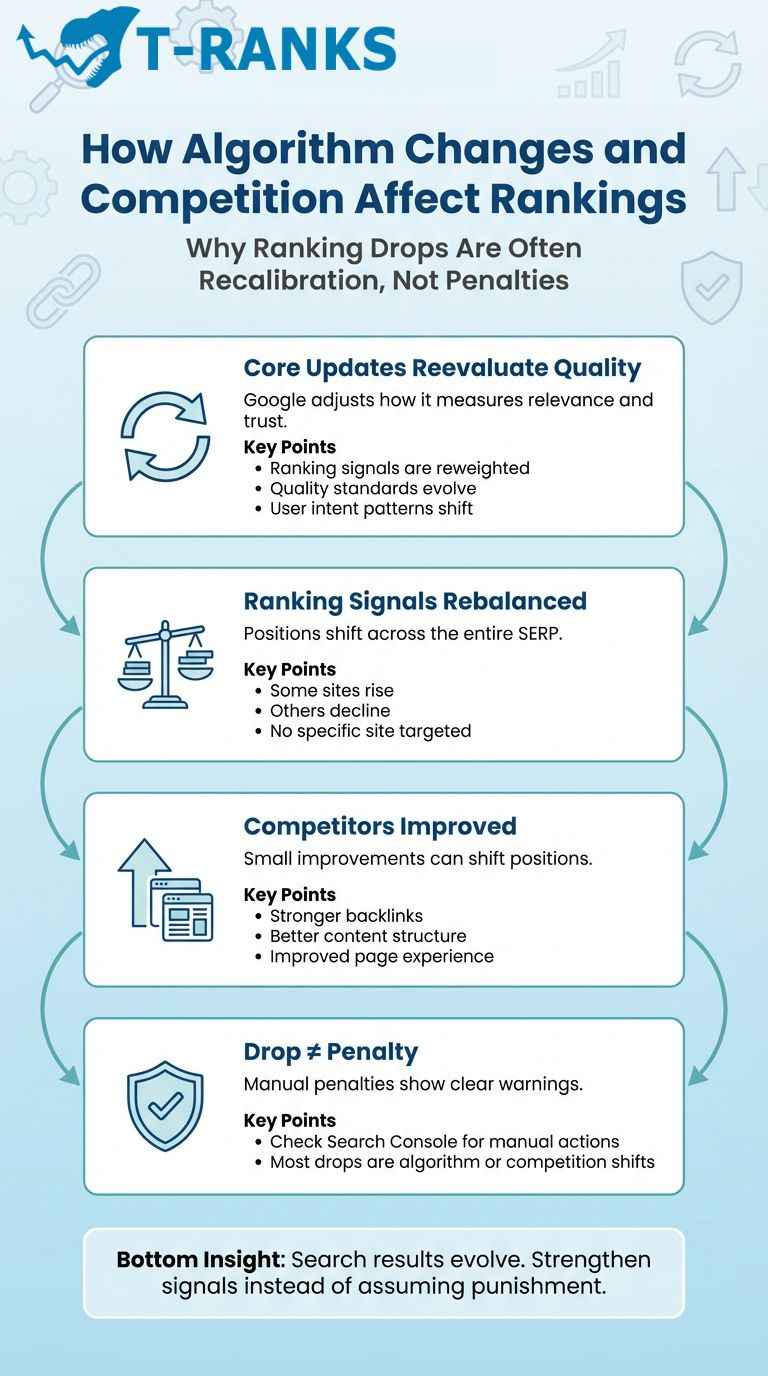
If your rankings dropped suddenly or your site ranking disappeared, it is often due to Google algorithm updatesor stronger competitors, not a penalty. Many ranking drop reasons are caused by changes outside your website.
Google updates its search system regularly. These updates are called core updates. They do not target one specific site. Instead, they adjust how Google measures quality, relevance, and trust across all websites.
Core Updates Reevaluate Quality
During a Google algorithm update, rankings can shift even if you did nothing wrong.
A drop may happen because:
• Google now values different quality signals more strongly
• Certain content types are seen as more helpful
• User intent has shifted
• Competitor pages better match updated ranking standards
Core updates are not personal. They reweight ranking signals for everyone. Some sites gain traffic, while others lose positions.
Competitors May Have Improved
Search results are competitive. Your page is compared directly with other pages targeting the same keyword.
If competitors:
• Published more detailed or updated content
• Earned stronger backlinks
• Improved page speed and mobile experience
• Structured their content more clearly
They may now deserve higher positions. Even small improvements from competitors can push your page down.
A Ranking Drop Is Not Always a Penalty
Many website owners panic when rankings fall. They assume a penalty. In most cases, there is no penalty.
A real penalty usually comes with a manual action notice in Google Search Console. If there is no warning, the ranking drop is likely due to algorithm recalibration or competitive shifts.
Google algorithm updates constantly reshape search results. Rankings move because standards evolve and competitors improve. Instead of assuming punishment, focus on strengthening your content quality, authority, and user value.
How to Make Your Content Visible in AI Overviews
If your content is not showing in AI Overviews, the problem is usually how it is structured and explained, not how many keywords you used. In 2026, Google AI Overviews and other AI systems select content that is clear, direct, and easy to extract.
AI systems scan pages differently from humans. They look for clear answers, organized sections, and strong topic focus. If your content is confusing or scattered, it becomes difficult for AI to trust and summarize it.
Why Structure Matters
AI Overviews prefer structured content because it is easier to interpret.
Good structure means:
• Clear H2 and H3 sections
• One main topic per section
• Logical order from question to explanation
• No mixing of unrelated ideas
When your page follows a clean hierarchy, AI systems can quickly detect what the section is about and what answer it provides.
Clear Sections and Direct Answers
AI systems prioritize pages that answer questions immediately. If the main answer is hidden deep inside long paragraphs, it may not be selected.
To improve visibility:
• Start each section with a direct statement
• Explain the idea in simple language
• Avoid long introductions before the answer
• Stay focused on the specific query
This makes it easier for AI Overviews structured content
to extract your content as a reliable source.
Answer First Formatting
Answer-first formatting increases LLM visibility because it mirrors how AI summarizes content.
The ideal flow is:
• Give the clear answer in the first sentence
• Add a short explanation
• Provide supporting details
This format signals to AI systems that your page directly addresses the question.
Consistency and Clarity
AI systems value consistency. If your page shifts between different topics or uses inconsistent terms, it becomes harder to summarize.
Improve clarity by:
• Using the same main phrase consistently
• Avoiding vague language
• Keeping paragraphs short
• Connecting sections logically
AI Overviews favor structured content that is easy to read, easy to understand, and easy to extract. If your content is not appearing in these summaries, review whether your page clearly answers the question in a structured and direct way.
A Simple Step by Step Checklist to Fix Ranking Problems
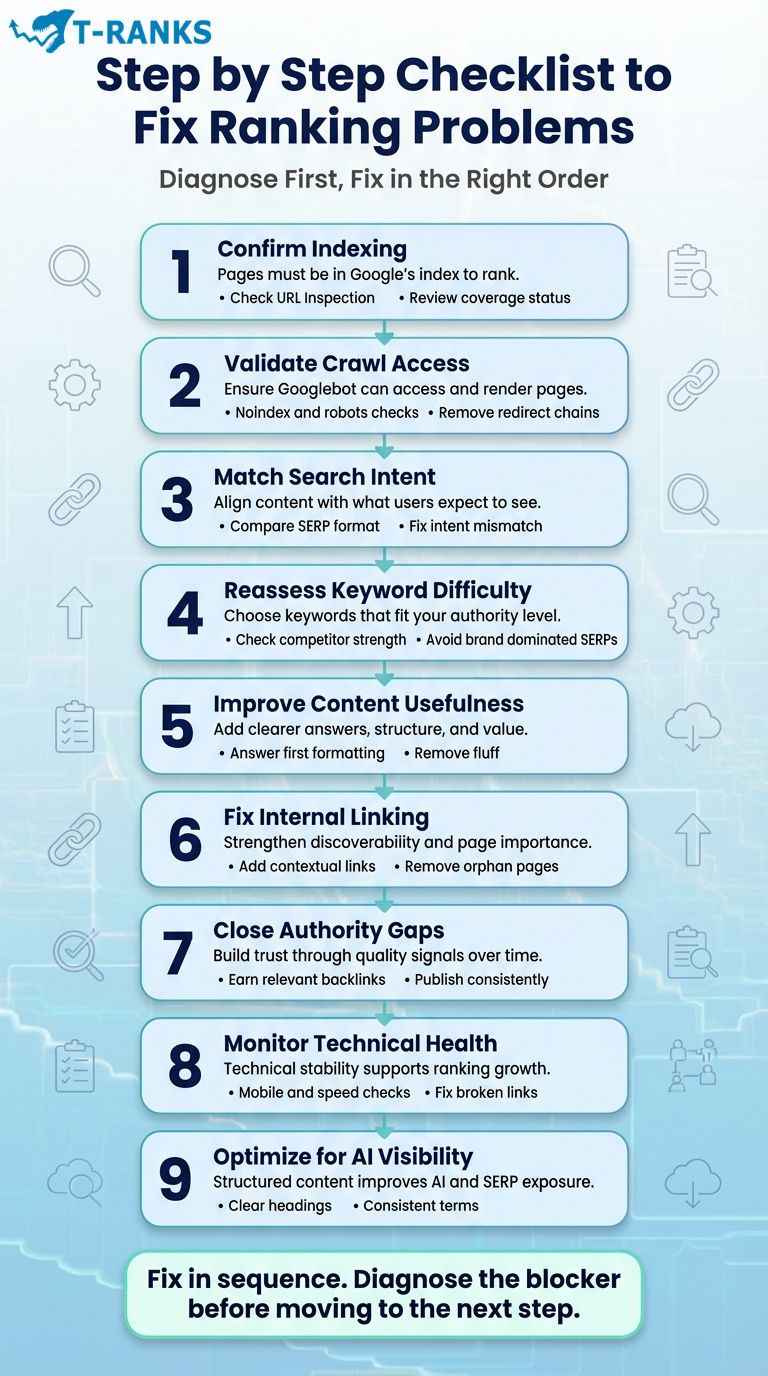
If your website is not ranking, follow this checklist in order. Ranking issues must be diagnosed layer by layer. Fixing the wrong problem first wastes time and creates confusion.
1. Confirm Indexing and Coverage
Start by verifying that your pages are actually in Google’s index. If a page is not indexed, it cannot rank.
• Check URL status in Google Search Console
• Review Index Coverage for excluded pages
• Identify pages marked “Crawled, currently not indexed”
• Confirm important URLs are eligible to appear
Solve indexing problems before adjusting content or keywords.
2. Validate Crawl Access
Next, confirm Googlebot can properly access and evaluate your pages.
• Check for accidental noindex tags
• Review robots.txt restrictions
• Ensure important pages are not blocked
• Remove unnecessary redirect chains
Crawl and index issues must be resolved before optimization begins.
3. Review Search Intent
Examine the current top results for your target keyword. Ranking depends on matching what users expect.
• Identify whether results are informational, transactional, or navigational
• Compare content depth, structure, and format
• Check if your page truly answers the same intent
If intent mismatch exists, rankings will remain weak regardless of word count.
4. Reassess Keyword Difficulty
Evaluate whether your target keyword is realistic for your site’s current authority.
• Compare your site strength to top ranking domains
• Review competitor backlink profiles
• Check if large brands dominate the results
If competition is too strong, shift toward more specific and lower difficulty queries.
5. Improve Content Usefulness
Strengthen your page by increasing clarity and practical value.
• Add clear, direct answers near the top
• Improve structure and readability
• Remove repetition or unnecessary sections
• Add examples or actionable guidance
Usefulness consistently outweighs length.
6. Strengthen Internal Linking
Internal linking helps Google understand page importance.
• Add contextual links from related pages
• Reduce orphan pages
• Use descriptive anchor text
• Clarify your content hierarchy
Well-supported pages rank more consistently.
7. Address Authority Gaps
If authority signals are weak, rankings will struggle.
• Earn relevant, high quality backlinks over time
• Expand coverage within a focused topic
• Build consistent publishing patterns
Authority develops gradually through trust and relevance.
8. Review Technical Stability
Even strong content can be limited by technical issues.
• Improve page speed and mobile performance
• Review Core Web Vitals internal linking
• Fix broken links and crawl errors
• Maintain clean URL structure
Technical stability supports ranking growth.
9. Optimize for AI Visibility
Modern visibility includes AI Overviews and LLM citations.
• Use clear headings and structured sections
• Apply answer first formatting
• Keep explanations simple and direct
• Maintain consistent terminology
Structured clarity improves both AI visibility and traditional rankings.
Fix ranking problems by following this checklist in sequence. Diagnose the real blocker first, apply focused improvements, and review data before moving to the next step. Structured progress prevents wasted effort and leads to steady growth.
Conclusion
In conclusion, if your website is not ranking, the problem is usually not a mystery or a penalty. It is often a combination of indexing gaps, search intent mismatch, unrealistic keyword targeting, weak authority, structural issues, or competitive pressure. Ranking failures rarely come from one mistake. They come from layers that need to be checked in the correct order.
The right approach is diagnostic and structured. First confirm indexing and crawl access. Then evaluate intent, keyword difficulty, and content usefulness. After that, strengthen internal linking, authority signals, and technical performance. Finally, refine structure for AI visibility. When these layers align, rankings improve steadily instead of randomly.
SEO takes time because trust, authority, and competitive strength build gradually. Consistent updates, clear focus, and controlled changes produce better results than shortcuts or sudden overhauls.
If your website is not ranking, start applying the checklist step by step today and monitor real data instead of assumptions. A structured approach is the most reliable way to achieve long term search visibility.
FAQs About Why My Website Is Not Ranking on Google in 2026
Why is my website not ranking on Google even after SEO?
Your website is not ranking even after SEO because one core layer such as indexing, search intent, authority, or keyword targeting is still weak. SEO improvements only work when technical access, relevance, and trust signals crawl budget
align together.
Is it normal for a new website not to rank?
Yes, it is normal for a new website not to rank at first. New domains need time to build authority, gain backlinks, and prove relevance before competing with established sites.
How long does it take for a website to rank on Google?
Most websites see measurable ranking movement within three to six months. Competitive keywords can take longer because authority, trust, and content depth must grow gradually.
Can a website be indexed but not rank?
Yes, a website can be indexed but not rank. Indexing only means the page is stored in the Google Index, but ranking depends on relevance, competition, and authority.
Why is my website indexed but getting no traffic?
Your website is indexed but getting no traffic because it is not earning impressions for competitive queries. This usually happens due to weak search intent match, low authority, or targeting keywords that are too difficult.
Why is my website not showing on Google at all?
Your website is not showing on Google if it is not indexed or blocked by technical settings. Check Google Search Console for crawl errors, noindex tags, or robots.txt restrictions.
Why are my blog posts not ranking on Google?
Your blog posts are not ranking because they may not fully match search intent or add enough unique value. Even well written content must directly solve the user’s problem better than competing pages.
Do backlinks guarantee rankings?
No, backlinks do not guarantee rankings. Backlinks improve authority, but they must be relevant, natural, and supported by strong content and technical structure.
Why is my ranking stuck on page 5?
Your ranking is stuck on page 5 because your page has moderate relevance but weaker authority or signals than top competitors. Improving intent alignment, internal linking, and authority can help move it higher.
Why did my website ranking drop suddenly?
Your website ranking dropped suddenly due to algorithm updates or competitor improvements in most cases. A drop is rarely a penalty unless you receive a manual action notice.
Does SEO take time to work?
Yes, SEO takes time because search engines must crawl updates, reassess signals, and compare your site to competitors. Trust and authority build gradually, not instantly.
What should I do first if my website is not ranking?
You should first confirm indexing and crawl access before changing content or building links. If the page is not accessible or indexed correctly, other optimizations will not produce results.