Affiliate sites do not fail because of bad content. Most fail because they never earn enough trust to rank.
In 2026, Google still uses backlinks to decide which affiliate websites deserve visibility and which ones fall behind. Paid traffic is expensive, margins are tight, and organic search remains the most reliable way for affiliate sites to grow. But content alone is no longer enough.
What has changed is how links are judged. Google no longer rewards link volume. It looks at relevance, intent, and trust. Many affiliate links stay live but stop helping rankings, which makes bad strategies hard to notice.
This guide explains how affiliate link building works in 2026, which backlink strategies still help rankings, what no longer works, and how to build links safely for long-term growth.
What Is Affiliate Link Building?

Affiliate link building is the process of earning backlinks to an affiliate website to improve its trust, authority, and visibility in search results. These backlinks help Google decide whether a monetized site is reliable enough to rank for competitive queries.
Unlike general link building, affiliate link building is judged more strictly because the site earns money from referrals. Search engines look closely at why a link exists, how naturally it fits the content, and whether it genuinely helps users.
For this reason, affiliate link building is not about collecting large numbers of links. It focuses on earning relevant, editorial links that signal credibility and long-term trust. This definition sets the foundation for understanding how affiliate backlinks work in 2026 and why quality matters more than volume.
Why Affiliate Sites Still Need Link Building in 2026
From what we see working with affiliate sites, link building is still necessary in 2026 because Google continues to rely on external signals to judge trust and authority. Even strong content struggles to compete in affiliate niches without support from relevant backlinks that signal trust and authority.
Why Affiliate Sites Still Depend on Organic Search Traffic
Affiliate sites rely heavily on organic search because it delivers consistent traffic without ongoing ad costs. Paid traffic is expensive and difficult to scale with affiliate margins, while organic rankings can drive steady visitors over long periods. For most affiliates, organic search remains the main source of sustainable revenue.
Why SEO Remains the Most Scalable Channel for Affiliate Revenue
SEO allows affiliate sites to grow without increasing costs every time traffic increases. Once a page ranks, it can generate clicks and commissions continuously. As AI Overviews and zero-click results reduce available clicks, holding strong organic positions has become even more important for long-term stability.
Why Backlinks Still Signal Trust and Authority to Google
Google still uses backlinks to understand whether an affiliate site is trusted beyond its own claims. When other relevant websites reference affiliate content, it signals usefulness and credibility. This helps Google decide which sites deserve to rank for competitive buyer-focused searches.
Why Competition Makes Links Unavoidable in Affiliate Niches
Most profitable affiliate niches are highly competitive. Many sites publish similar content with comparable on-page optimization. In these situations, backlinks often become the deciding factor. Sites with stronger and more relevant link profiles usually outperform those with similar content but weaker authority.
What Has Changed in How Google Evaluates Affiliate Backlinks
What has changed is how carefully Google evaluates affiliate backlinks. The focus has shifted away from link volume and toward relevance, placement, and intent. Low-quality or manipulative links are often ignored instead of penalized, while high-quality, niche-relevant links still strengthen trust and authority.
How Affiliate Backlinks Affect Rankings Today

Affiliate backlinks affect rankings today in a very different way than they did a few years ago. From what we see working with affiliate sites, links no longer act as a direct ranking boost just because they exist. Instead, they help Google and AI-driven systems decide which sites can be trusted.
Search has changed. Many queries are now answered through AI Overviews or language models, which means fewer users click through to websites. This has made trust signals more important than ever. Sites with strong backlink profiles are more likely to be referenced, summarized, or cited by AI systems, even when clicks are limited.
Backlinks also still matter for traditional organic rankings. Google uses them to understand whether affiliate content is supported by other credible websites or created only to earn commissions. When links come from relevant sources and fit naturally within content, they help affiliate pages stay competitive in commercial search results.
What has changed is consistency. We often see affiliate sites build links but experience no ranking improvement. In most cases, those links are quietly ignored because they lack relevance or real editorial value, a process known as link devaluation rather than an outright penalty. This is link devaluation, where links remain live but stop influencing rankings, rather than causing a penalty.
In our own work at T-RANKS, including a recent case study on backlinks and AI Overviews, we consistently see the same pattern. Pages backed by strong, relevant backlinks maintain visibility in organic results and are far more likely to appear in AI-generated answers as well.
Today, affiliate backlinks work only when they reinforce genuine trust and relevance. When they do, they support rankings across both traditional search results and modern AI-driven SERPs. When they do not, they are simply ignored.
Why Affiliate Sites Are More Sensitive to Bad Links
Affiliate sites are more sensitive to bad links because Google applies stricter trust evaluation to monetized content. From recent affiliate SEO work, we consistently see that Google has far less tolerance for weak or manipulative signals when a site’s main purpose is commercial.
Affiliate pages influence purchasing decisions, which increases risk from Google’s perspective. Because of this, backlinks pointing to affiliate sites are reviewed more closely for relevance, intent, and editorial fit. Links that may still help an informational site often provide little or no benefit to an affiliate site if they feel forced or unrelated.
Content quality also affects how much risk an affiliate site can absorb. Many affiliate pages follow similar review and comparison formats. When content lacks originality or first-hand experience, it has almost no buffer for weak links. In these cases, even a small number of low-quality backlinks can neutralize the impact of stronger ones.
In 2026, Google evaluates affiliate trust holistically. Backlinks are assessed alongside content depth, anchor patterns, topical consistency, and overall site reputation. Over-optimized anchors, repeated link sources, or anchor manipulation are detected quickly and discounted.
Affiliate sites are more vulnerable to bad links because:
- Commercial intent triggers higher scrutiny
- Thin or templated content offers little trust buffer
- Weak or irrelevant links are devalued faster
- Anchor manipulation is detected more easily
- A few poor signals can affect site-wide trust
Because of this, affiliate sites usually experience silent link devaluation rather than clear penalties. Rankings stall or fail to improve even as links are added, which is why careful link selection and quality control are essential for sustainable affiliate SEO in 2026.
Where Affiliate Backlinks Should Point

Affiliate backlinks should point to pages that build trust first and support monetized pages second. Where a backlink lands plays a major role in how Google evaluates its value for an affiliate site.
Direct links to money pages like reviews and comparison pages can work, but only in limited situations. These links need to come from highly relevant content and fit naturally within the page. When used too often, direct money page links receive higher scrutiny and tend to lose effectiveness.
Informational pages are a safer and more reliable link target. Guides, tutorials, and educational content attract links more naturally and help establish site-wide trust. Once these pages gain authority, that value can be passed internally to affiliate pages through well-placed internal links.
This approach mirrors how strong websites grow over time. By directing most backlinks to informational content and using internal links to support commercial pages, affiliate sites reduce risk while maintaining both ranking and conversion potential.
Affiliate Link Building Strategies That Still Work
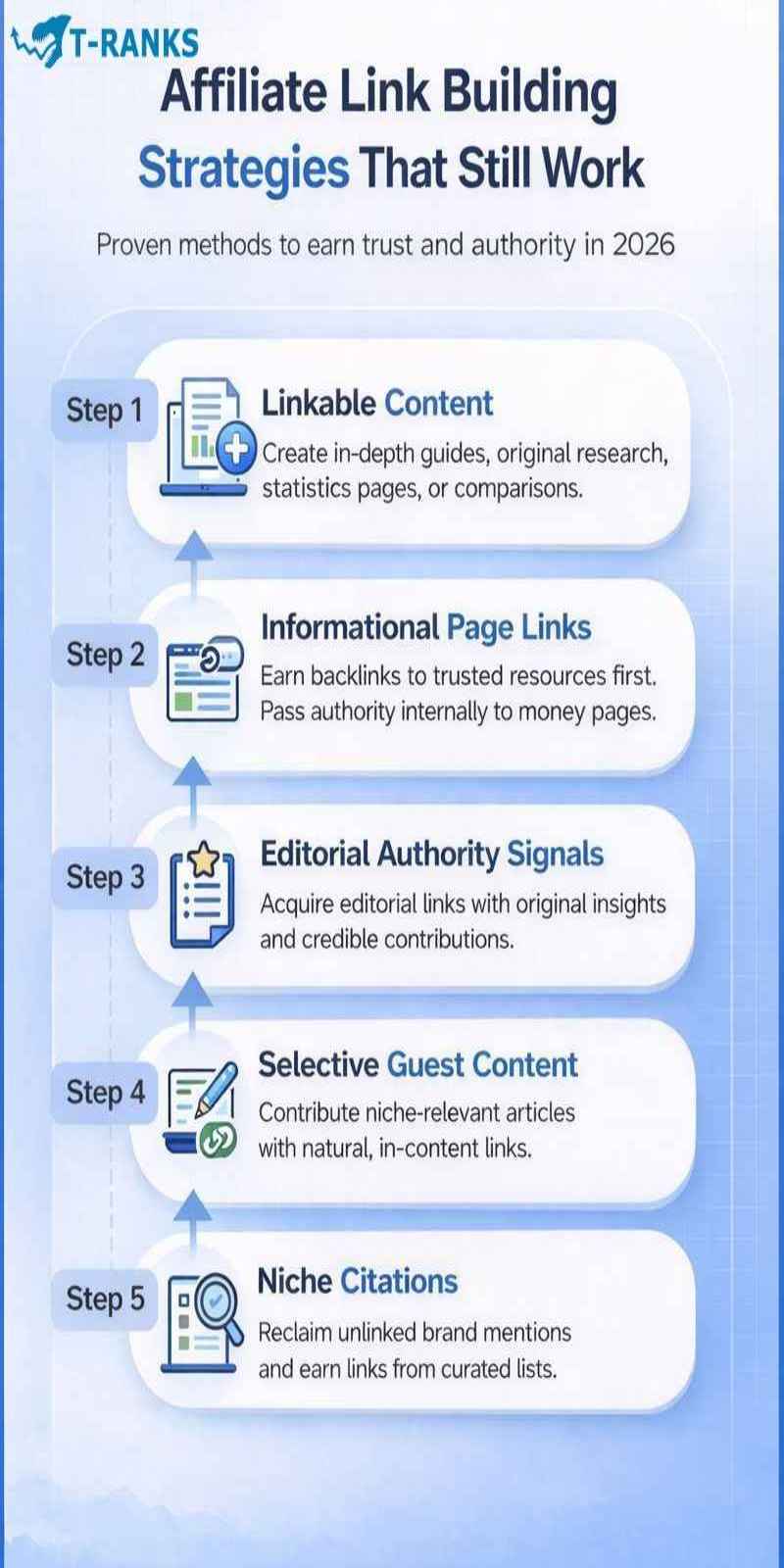
Affiliate link building still works in 2026, but only when it is built around editorial trust and long-term authority. In real affiliate campaigns today, the links that move rankings are not created through scale, automation, or shortcuts. They come from content that other websites choose to reference because it adds value.
Google has become very good at ignoring links that exist only for SEO. As a result, affiliate strategies now succeed when they match natural publishing behavior and fail when they try to force link volume. The goal is not to build more links, but to earn the right links.
Creating Linkable Content That Earns Editorial Links
The strongest affiliate links start with content that works as a reference, not a sales page. In-depth guides, original research, statistics pages, and well-structured comparisons give publishers something useful to cite. These pages help other writers explain a topic, support a claim, or add credibility to their own content.
Because this type of content is informational and non-promotional, it attracts links naturally. Editors are more willing to link to it, and Google is more willing to trust those links. Over time, these backlinks remain stable because they are tied to usefulness rather than commercial intent.
Building Links to Informational Pages First
Successful affiliate sites rarely build links directly to review or comparison pages. Instead, they focus on earning backlinks to informational content that establishes topical authority and trust. This mirrors how real websites grow and reduces the risk that links are ignored or devalued.
Once informational pages gain authority, internal links are used to pass that value to affiliate pages. This allows money pages to benefit from backlinks without being the direct target. In 2026, this approach consistently performs better because it aligns with how Google evaluates trust across an entire site, not just individual URLs.
Earning Editorial Links Through Authority Signals
Editorial links remain one of the strongest backlink types for affiliate sites in 2026. These are links that publishers add because your content contributes insight, data, or expertise, not because it was pitched as a link placement.
For affiliate sites, editorial links are usually earned through original observations, data-backed insights, expert commentary, or clear explanations that help other creators support their content. This includes sharing unique findings, contributing expert opinions to articles, or publishing resources that journalists and bloggers can reference confidently.
Google treats editorial links differently because they are difficult to manipulate. When an affiliate site earns these links, it signals real credibility rather than manufactured authority. In practice, a small number of true editorial links often has more ranking impact than dozens of generic placements.
Using Guest Content Selectively and Contextually
Guest posting still works for affiliate link building, but only when used carefully and sparingly. In 2026, successful guest content looks like real publishing activity, not a link-building tactic.
Effective guest posts appear on niche-relevant websites, provide genuine value to the audience, and place links naturally within the main content. These links usually point to informational resources rather than money pages, which lowers scrutiny and improves long-term value.
What no longer works is guest posting at scale. Generic articles published across unrelated sites are commonly ignored by Google, even if the links remain live. For affiliate sites, guest posting should support authority and relevance, not attempt to manufacture volume
Securing Resource Page and Niche Citation Links
Resource page links and niche citations continue to be reliable for affiliate sites when they are genuinely relevant. These links come from curated lists, industry resources, and recommendation pages where editors actively maintain useful references.
For affiliate sites, these links work best when the content being linked solves a specific problem or provides clear educational value. Guides, tools, calculators, and detailed explanations are more likely to be included than review or comparison pages.
Because resource pages are designed to help users, Google generally treats these links as editorial endorsements. When the fit is natural, they provide stable authority without increasing risk.
Replicating Competitor Backlinks Strategically
Analyzing competitor backlinks remains effective when done selectively. The goal is not to copy every link but to identify patterns that reveal what Google already values in the niche.
Affiliate sites benefit most by replicating backlinks that point to informational content, studies, or guides rather than direct money pages. These links show where editors are willing to link and what type of content earns trust.
By focusing on similar content assets and improving them, affiliate sites can earn comparable links in a natural way. This strategy works because it follows existing editorial behavior instead of trying to invent new link placements.
Reclaiming Unlinked Brand Mentions
Reclaiming unlinked brand mentions remains one of the safest affiliate link building strategies in 2026. These links come from websites that already reference your brand, content, or data but do not include a clickable link.
Because the mention already exists, the editorial intent is established. Adding a link simply improves attribution rather than introducing new promotional content. This makes unlinked mention reclamation low risk and highly effective for affiliate sites.
In practice, these links often carry branded or natural anchors and appear in relevant context. Google treats them as clean signals of trust, and they rarely trigger devaluation. As an affiliate site grows, monitoring and reclaiming these mentions becomes an efficient way to strengthen authority without increasing link profile risk.
Affiliate Link Building Tactics That No Longer Work
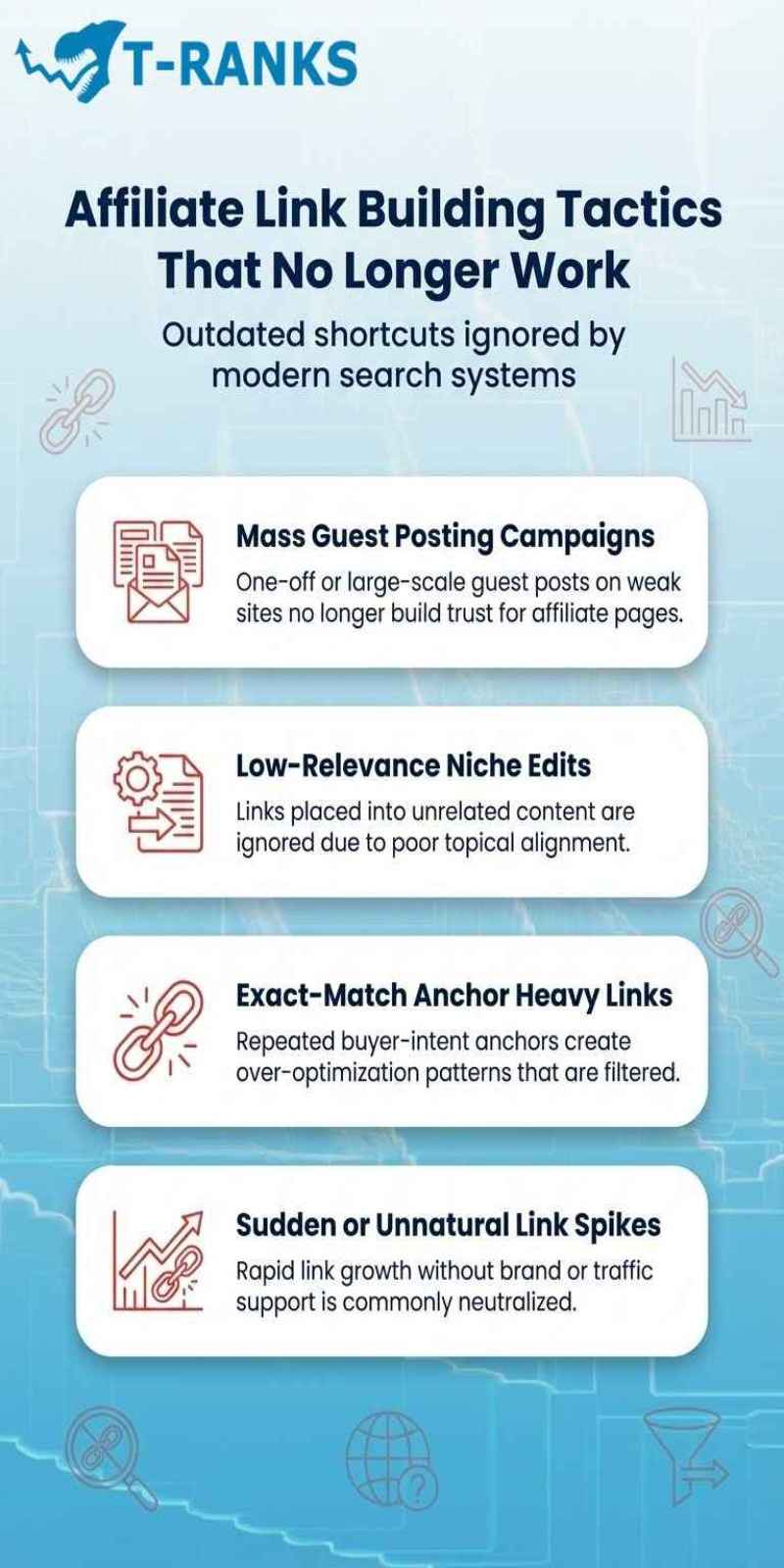
Affiliate link building tactics no longer work when they rely on scale, shortcuts, or artificial patterns instead of editorial trust.
In 2026, most outdated tactics are not punished with penalties. They are quietly ignored, which makes them ineffective and risky.
Mass Guest Posting Campaigns
Mass guest posting across unrelated or low-quality blogs no longer produces authority for affiliate sites. These campaigns create recognizable footprints that Google can easily detect.
Because affiliate content already carries commercial intent, links from large-scale guest posting are often discounted faster. In many cases, they add no ranking value and can suppress overall trust rather than improve it.
Low-Relevance Niche Edits
Niche edits placed into irrelevant or outdated content rarely pass value today. When links are inserted into pages that were not written to support the topic, they signal manipulation instead of endorsement.
Google evaluates topical alignment closely. If the linking page does not naturally relate to the affiliate content, the link is likely to be ignored and may dilute trust signals in competitive niches.
Exact-Match Anchor Heavy Links
Exact-match anchor-heavy links are one of the clearest signs of over-optimization in affiliate SEO. Repeating buyer-intent keywords across backlinks creates unnatural patterns that Google now filters aggressively.
Affiliate sites perform better with branded, partial, or neutral anchors. Exact-match anchors rarely improve rankings and often accelerate link devaluation.
Sudden or Unnatural Link Spikes
Rapid link growth that does not match traffic, content output, or brand visibility raises immediate red flags. Sudden spikes, especially from low-authority sources, resemble artificial link bursts.
For affiliate sites, these patterns are more likely to result in suppression rather than growth. The links may remain live, but their ranking impact is often neutralized.
Anchor Text Rules for Affiliate Backlinks

Anchor text is one of the strongest signals Google uses to understand why a backlink exists. For affiliate sites, this makes anchor text especially sensitive because monetized content is evaluated more strictly.
In affiliate SEO, anchor text is less about ranking keywords and more about maintaining trust and long-term stability.
Exact-Match Anchors Are High Risk for Affiliate Sites
Exact-match anchors clearly signal an attempt to influence rankings. When commercial keywords are repeated across multiple backlinks, they create patterns that Google’s spam systems can easily recognize.
For affiliate sites, exact-match anchors rarely produce lasting results. Even when the links come from decent websites, overuse often leads to link devaluation. The links stay live, but their ranking impact fades over time.
Branded, Partial, and Generic Anchors Are Safer
Natural anchor types reflect how people actually link. Branded anchors, partial descriptive phrases, generic terms, and naked URLs fit naturally into editorial content.
These anchors support context and readability instead of forcing keywords. As a result, links using these anchors are more likely to retain value and continue supporting rankings.
Branded Anchors Help Protect Rankings Over Time
Branded anchors play a stabilizing role for affiliate sites. When a large portion of backlinks reference a brand name or site name, Google is more likely to view the link profile as organic.
This reduces over-optimization risk, strengthens site-level trust, and helps affiliate rankings remain steady during algorithm updates.
Link Velocity Rules for Affiliate Sites

Link velocity for affiliate sites is about growing backlinks at a pace that matches real visibility, authority, and content growth. In 2026, Google evaluates not just how many links you gain, but whether that growth looks earned or artificially accelerated.
The goal is not speed. It is consistency and credibility.
Maintain Natural Consistency
Healthy affiliate sites show steady backlink growth over time. Links usually increase as content gets discovered, shared, and referenced. Sudden spikes followed by inactivity often signal manipulation and lead to link devaluation.
Match Velocity to the Niche
Link growth should look similar to what already ranks in the niche. When an affiliate site grows links much faster than competitors with similar authority, it stands out unnaturally. Matching the existing competitive baseline makes growth appear credible.
Align Growth With Site Age and Trust
New affiliate sites naturally attract links slowly. As content depth, traffic, and brand recognition increase, link velocity can rise gradually. Rapid link acquisition without established trust increases scrutiny and reduces effectiveness.
Diversify Sources and Patterns
Natural link growth comes from different websites, varied anchor text, and multiple content types. Repeated links from the same sources or identical placement patterns weaken trust signals, even when growth appears slow.
Prioritize Quality Over Speed
Link velocity alone does not improve rankings. A small number of relevant, authoritative links earned gradually has far more impact than fast accumulation of low-quality placements. In 2026, Google rewards consistency and relevance, not acceleration.
How Affiliate Backlinks Can Hurt SEO
Affiliate backlinks can hurt SEO when they weaken trust instead of strengthening it. In 2026, Google rarely penalizes sites outright for bad links. Instead, it quietly ignores or neutralizes them, which causes rankings to stall or slowly decline.
This is why many affiliate site owners continue building backlinks without seeing improvement. The links exist, but they no longer pass value.
Silent Link Devaluation Is the Most Common Risk
The most common way backlinks hurt affiliate sites today is through link devaluation. When Google detects weak relevance, poor editorial context, or manipulative patterns, it simply stops counting those links.
There is usually no warning in Google Search Console. Rankings do not crash. Pages just stop improving, even as more backlinks are added. Google has repeatedly stated that most unnatural links are now ignored rather than penalized, especially for monetized content.
Real Example: Google’s Site Reputation Abuse Enforcement
A documented example of backlinks hurting visibility comes from Google’s enforcement against site reputation abuse. Google strengthened its policy to target monetized content that relies on borrowed authority, aggressive linking, or weak editorial oversight.
Industry analysis published by Search Engine Journal explains how affiliate and coupon-style content lost visibility through algorithmic suppression rather than manual penalties.
This confirms that affiliate SEO damage often happens silently, through devaluation and trust reduction, not sudden penalties.
Over-Optimization Suppresses Ranking Potential
Affiliate sites are especially sensitive to over-optimization. Repeated exact-match anchors, too many backlinks pointing directly to review pages, or links from low-quality guest post networks can limit ranking growth.
In these cases, pages often get stuck on page two or three. Adding more backlinks does not help because the underlying pattern has already reduced trust. This is not a penalty. It is an algorithmic ceiling.
Why More Backlinks Can Make Things Worse
When links are already being devalued, adding more of the same type often reinforces the problem. Instead of increasing authority, it strengthens the signal that the site is manipulating backlinks.
This is why modern affiliate SEO focuses on relevance, editorial intent, and careful link placement rather than volume.
A Simple Safety Checklist for Affiliate Link Building
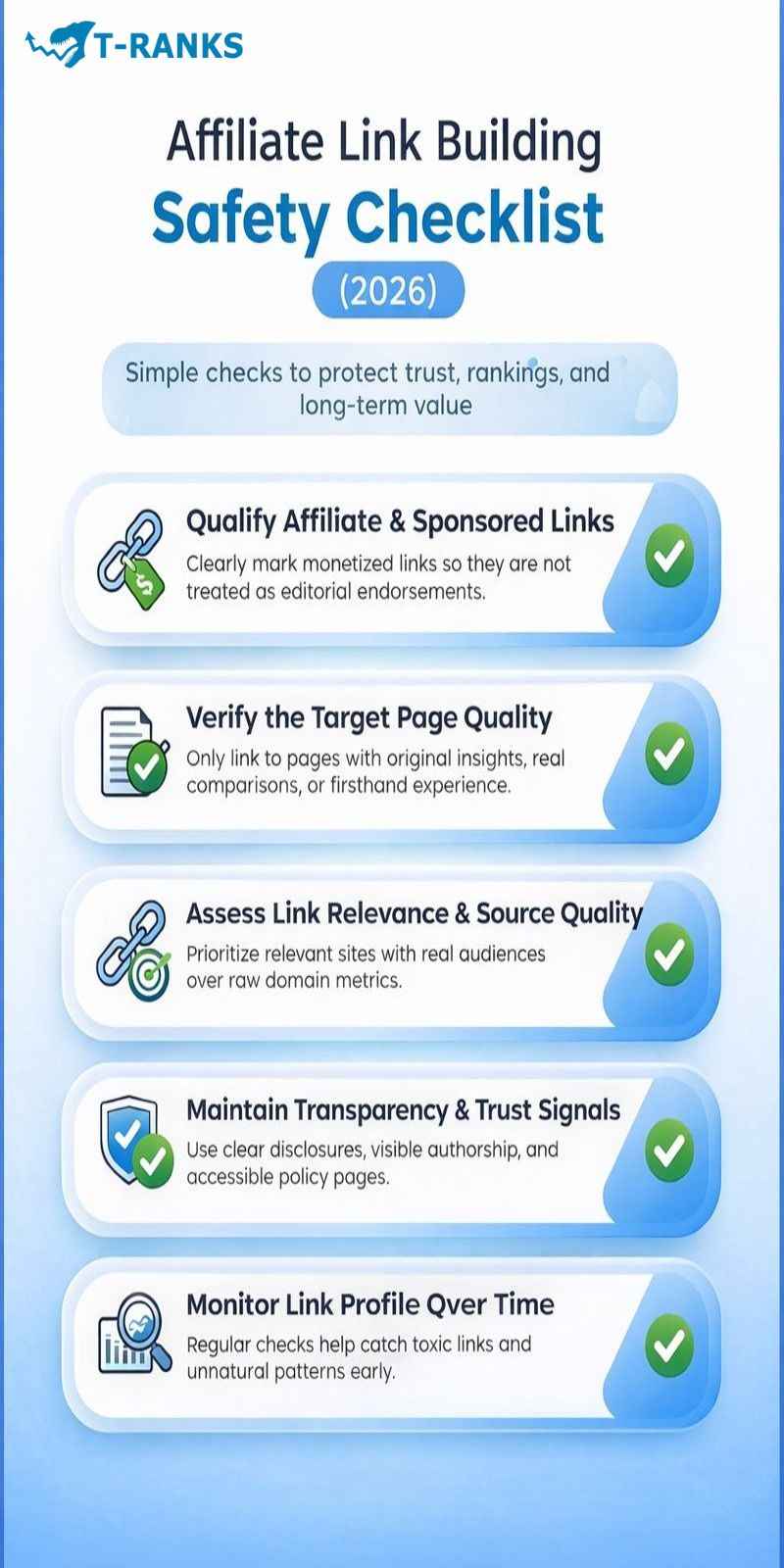
This checklist helps affiliate sites build backlinks that strengthen trust instead of triggering devaluation. In 2026, link building works best when every link passes basic relevance, intent, and quality checks.
1. Confirm the Page Is Worth Linking To
Before building any backlink, review the target page. Affiliate pages should offer original insight, clear comparisons, or real experience. Thin content, copied descriptions, or excessive outbound links limit the value of both content and backlinks.
2. Check Link Intent and Placement
Ask why the link exists. Safe links appear naturally within helpful content and support the surrounding topic. Links placed only to influence rankings or push commissions are more likely to be ignored.
3. Qualify Affiliate and Sponsored Links Correctly
Monetized links should be clearly disclosed and properly qualified. Google expects affiliate relationships to be transparent so commercial links are not treated as editorial endorsements.
4. Evaluate Source Quality and Relevance
Not every backlink helps SEO. Prioritize links from websites that are topically aligned, have real audiences, and use natural anchor text. Relevance and editorial context matter more than domain metrics alone.
5. Protect Trust Signals Across the Site
Affiliate sites are evaluated more strictly. Visible author information, clear disclosures, and accessible policy pages reinforce credibility and reduce scrutiny on backlinks.
6. Monitor Link Patterns Over Time
Link safety is ongoing. Monitor backlink growth, anchor distribution, and source diversity regularly. Catching unnatural spikes or weak patterns early is far easier than fixing devaluation later.
Conclusion: Final Thoughts on Affiliate Link Building in 2026
Affiliate link building in 2026 is no longer about getting as many links as possible. It works when links build trust, match the topic of the site, and grow naturally over time. Backlinks still matter, but only when they help Google see an affiliate site as reliable and useful.
Strong affiliate sites earn links to helpful informational content first. They then use internal links to support review and comparison pages. This approach lowers risk and helps backlinks pass value without triggering link devaluation. Anchor text variety, steady link growth, and natural placement now play a key role in whether links help or stop working.
The safest way to build affiliate links is to think long term. Clean link profiles, relevant sources, and editorial-style links perform better than aggressive tactics. Sites that focus on consistency and trust are more likely to keep their rankings stable through algorithm updates.
Affiliate link building in 2026 rewards patience and clarity. When links are earned for real value, not shortcuts, they support growth instead of holding it back.
FAQs About Affiliate Site Link Building
What is affiliate link building?
Affiliate link building is the process of earning backlinks to an affiliate website to improve search visibility and authority. These links help Google evaluate trust, relevance, and credibility, which affects how affiliate pages rank in competitive search results.
Does link building still work for affiliate sites in 2026?
Yes, link building still works for affiliate sites in 2026 when links are relevant and editorial. Low-quality, paid, or manipulative links are usually ignored rather than rewarded.
Why are affiliate sites more sensitive to bad backlinks?
Affiliate sites are more sensitive because their pages have commercial intent. Google applies stricter trust and spam checks to monetized content, making poor-quality links more likely to be devalued.
Should affiliate backlinks point directly to money pages?
No, most affiliate backlinks should point to informational pages instead of money pages. Authority can then be passed internally to affiliate pages in a safer and more natural way.
What types of backlinks work best for affiliate sites today?
Editorial backlinks from relevant websites work best for affiliate sites. Links to guides, research content, and contextual mentions align with natural linking behavior and reduce risk.
Why do some affiliate backlinks stop working over time?
Affiliate backlinks stop working when Google devalues them after reassessing quality and relevance. The links remain live but no longer pass ranking value.
What is link devaluation in simple terms?
Link devaluation means Google ignores a backlink instead of penalizing the site. The link still exists but stops contributing to rankings.
Is link devaluation different from a Google penalty?
Yes, link devaluation removes link value quietly, while a penalty causes clear ranking drops. Most affiliate sites experience devaluation rather than formal penalties.
Are guest posts still safe for affiliate link building?
Yes, guest posts are safe only when they are relevant, editorial, and add real value. Mass-produced or low-quality guest posts are commonly ignored.
How important is anchor text for affiliate backlinks?
Anchor text is important, but exact-match anchors are risky for affiliate sites. Branded and partial-match anchors are safer and appear more natural to Google.
How fast should affiliate sites build backlinks?
Affiliate sites should build backlinks slowly and consistently. Sudden spikes without matching traffic or visibility growth often signal manipulation.
What is the safest long-term link strategy for affiliate sites?
The safest strategy is building links to high-quality informational content and supporting affiliate pages through internal linking.