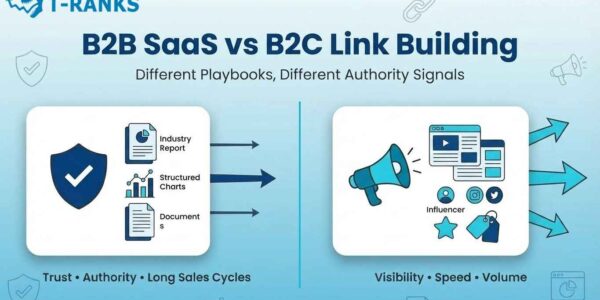
Link building helps websites gain trust in search results, but it does not work the same way for every type of business. In 2026, B2B SaaS companies and B2C brands earn backlinks in very different ways.
B2B SaaS buyers do not make quick decisions. They take time to compare tools, involve multiple people, and look for proof that a product is reliable. Because of this, backlinks for SaaS act as trust signals. Search engines look closely at where these links come from and whether they clearly support industry expertise.
Many SaaS companies struggle because they use B2C link building tactics that focus on speed and large numbers of links. These methods can work for consumer brands, but they usually fail for SaaS products with long sales cycles.
This section explains how B2B SaaS link building works today, which strategies help build real authority, and how understanding B2C link building helps you avoid mistakes and focus on long-term B2B growth.
What Is B2C Link Building?
B2C link building is the process of acquiring backlinks for Business-to-Consumer brands that sell products or services directly to individual buyers.
In B2C markets, link building focuses less on long-term trust validation and more on visibility, discovery, and brand awareness.
Because B2C purchase decisions are usually faster and driven by emotion or convenience, backlinks act as popularity signals. Search engines interpret widespread mentions, media coverage, and influencer links as indicators of consumer interest and relevance.
This is why B2C link building relies more on:
- Visibility and reach, links help products get discovered quickly.
- Buzz and repetition, frequent mentions reinforce brand recall.
- Volume and speed, large numbers of links acquired over short periods are more common and often natural.
Unlike B2B SaaS link building, where authority builds gradually, B2C link building rewards momentum, exposure, and cultural relevance.
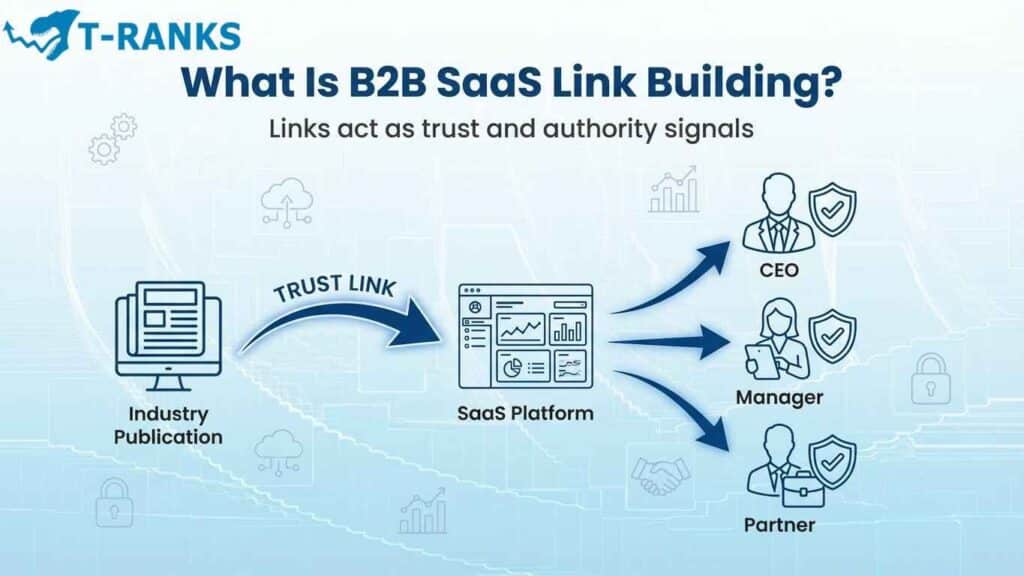
Effective B2B SaaS link building focuses on earning editorial, industry-aligned links that reinforce expertise and reduce buyer risk, rather than chasing high link counts or short-term traffic.
B2B SaaS vs B2C Link Building (Quick Comparison)
| Factor | B2B SaaS Link Building | B2C Link Building |
| Primary Goal | Trust and authority | Visibility and awareness |
| Buying Process | Long, research-driven | Short, impulse-driven |
| Decision Makers | Multiple stakeholders | Single buyer |
| Link Meaning | Verification signal | Popularity signal |
| Quality vs Volume | Quality over volume | Volume over precision |
| Link Sources | Industry sites, partners | Media, influencers |
| Link Velocity | Slow and consistent | Fast and campaign-based |
| Risk of Irrelevant Links | High | Lower |
Why B2B and B2C Link Building Follow Different Rules
B2B and B2C link building follow different rules because search intent, buyer risk, and authority signals are fundamentally different.
Google evaluates backlinks in context. It considers who is searching, why they are searching, and what happens if the recommendation is wrong.
Differences in Buying Behavior and Search Intent
B2B buyers search with intent to evaluate, compare, and reduce risk. Their queries are often informational or commercial-investigative, such as solution comparisons, implementation concerns, or vendor credibility. Backlinks that support this intent must reinforce expertise, reliability, and domain authority over time.
B2C buyers search with intent to discover, choose quickly, or be entertained. Queries are broader and more transactional. In this environment, visibility and repetition matter more than deep validation, which is why high-coverage links perform better.
Differences in Risk and Cost of Failure
In B2B SaaS, the cost of failure is high. A poor decision can disrupt operations, expose security risks, or lock a company into long-term contracts. Because of this, both buyers and search engines rely heavily on trusted third-party references. Links act as reassurance signals that reduce perceived risk.
In B2C markets, the cost of failure is lower. Consumers can easily switch products, request refunds, or try alternatives. As a result, Google is more tolerant of broader link signals and less precise topical alignment.
Differences in How Google Interprets Authority
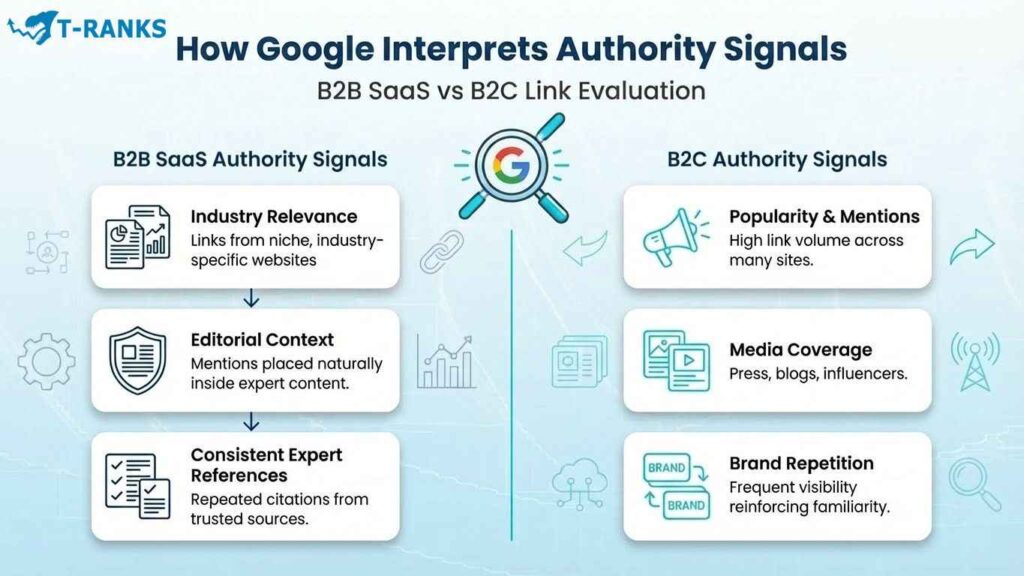
For B2B SaaS, Google interprets authority through topical consistency, editorial validation, and entity alignment. Links from industry-specific publications, partners, or data-driven resources help confirm that a brand belongs within a professional ecosystem.
For B2C brands, authority is often inferred from popularity and consensus. High volumes of mentions, media exposure, and social reinforcement signal demand and relevance, even if individual links are less specialized.
These differences explain why link building tactics cannot be shared across models. A strategy that signals popularity may help a consumer brand but dilute authority for a SaaS company. This is why B2B SaaS link building must prioritize intent alignment, trust, and relevance rather than speed or volume.
How Buying Cycles Shape Link Building Strategy
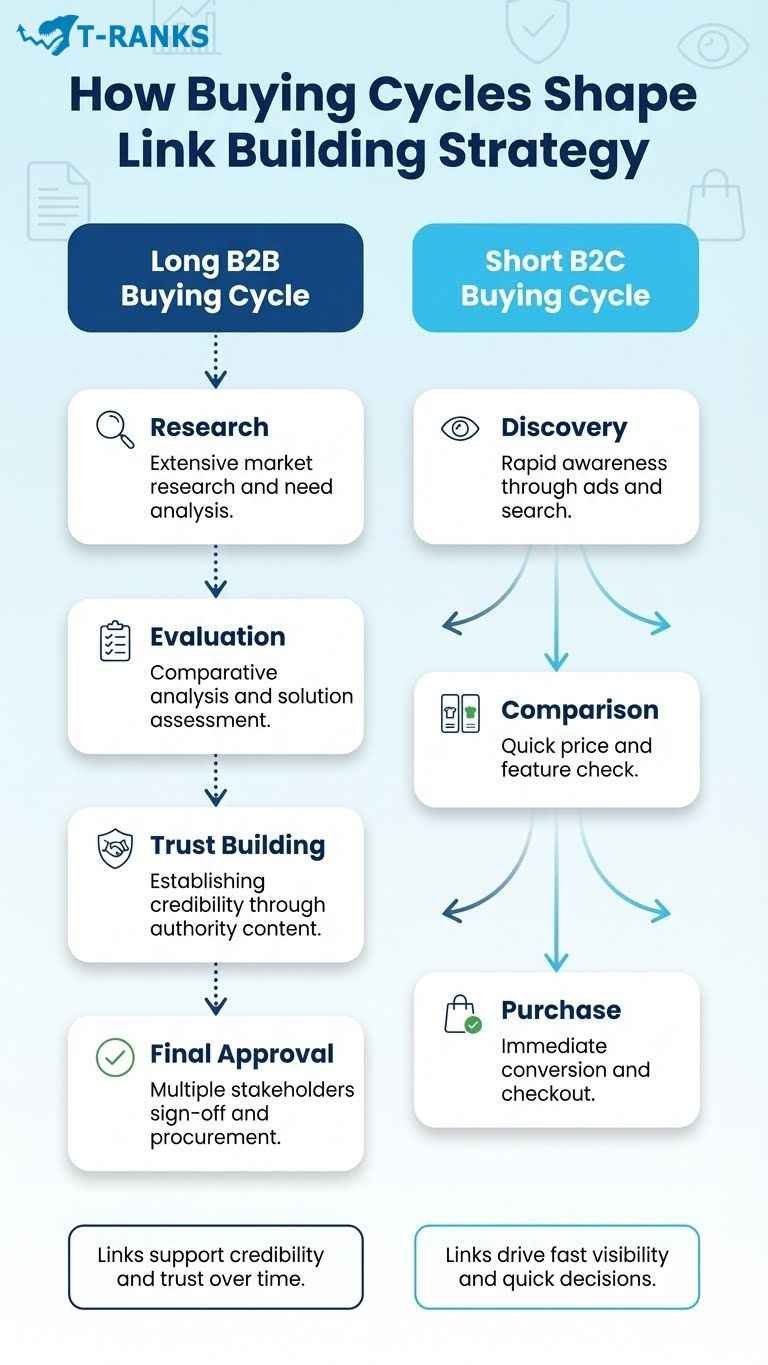
A buying cycle is the process a buyer follows from first discovering a product to making a final decision.
The length of this cycle directly affects how link building should be done, because backlinks support buyers at different stages of decision-making.
In simple terms:
- Long buying cycles need trust
- Short buying cycles need visibility
This difference explains why B2B and B2C link building strategies cannot be the same.
Long B2B Sales Cycles and Trust-Driven Links
B2B SaaS products are rarely purchased quickly. Businesses take time to research, compare options, and assess risks before committing. Decisions often involve multiple people, such as managers, technical teams, and finance departments.
Because the buying cycle is long, backlinks must help buyers build confidence over time. Links from industry websites, trusted publications, or partners act as proof that a SaaS company is credible and reliable. These links support research, internal discussions, and final approvals rather than immediate conversions.
Search engines recognize this behavior. They reward B2B SaaS websites that earn consistent, relevant links from authoritative sources, because these signals reflect long-term trust rather than short-term attention.
Short B2C Buying Cycles and Visibility-Driven Links
B2C purchases usually happen much faster. A single buyer discovers a product, compares a few options, and makes a decision quickly, often in minutes or days.
In this case, backlinks serve a different purpose. They help products get noticed. Frequent mentions across media sites, blogs, and campaigns increase exposure and brand familiarity. This repetition makes it easier for buyers to choose quickly.
For search engines, these patterns signal popularity and demand. That is why B2C link building often focuses on reach, campaigns, and short-term visibility instead of slow authority building.
Why This Matters
When link building matches the buying cycle, it supports how real buyers behave. When it does not, links lose effectiveness or even weaken authority. This is why B2B SaaS link building must prioritize trust-driven links, while B2C strategies emphasize visibility and speed.
Trust Signals vs Popularity Signals in Backlinks
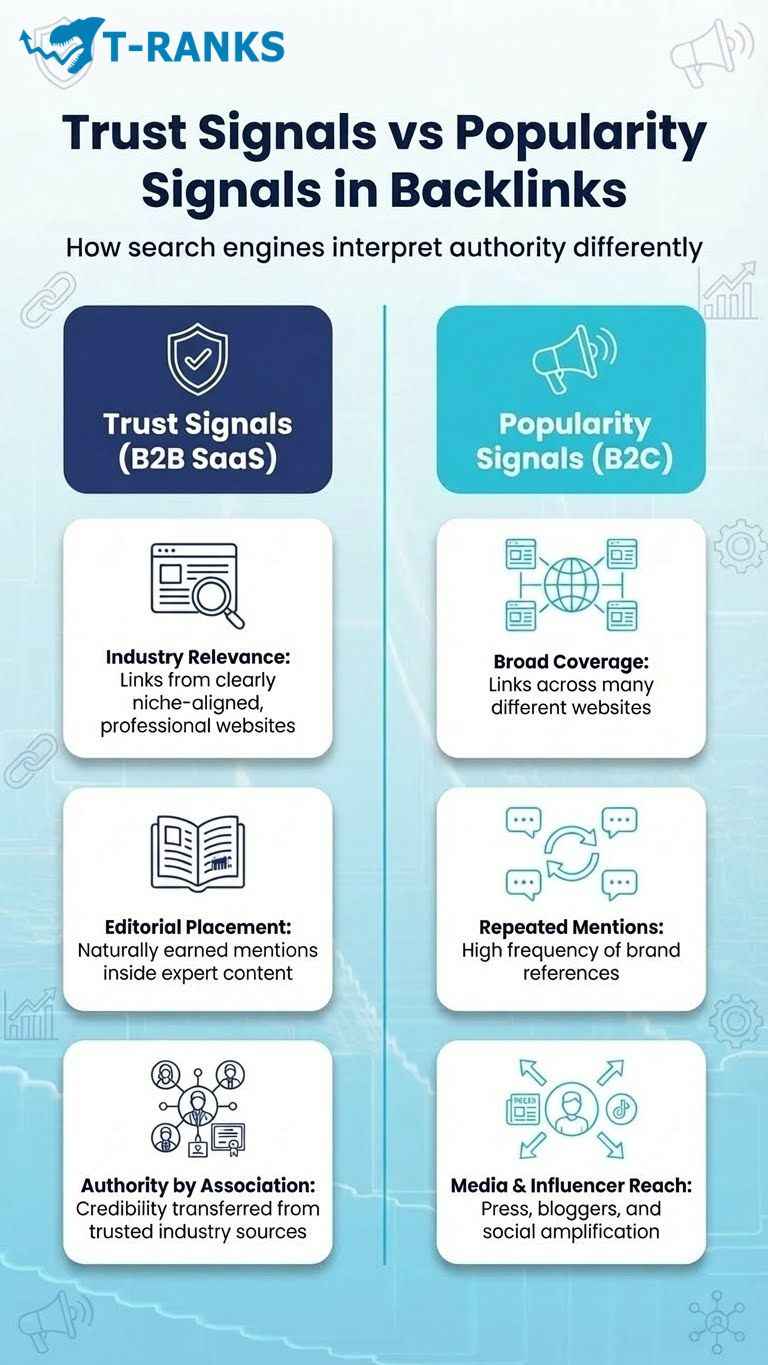
Not all backlinks tell search engines the same story.
Some links suggest that a brand is trusted and credible, while others simply indicate that it is widely known. The difference between these two signals is one of the main reasons B2B and B2C link building strategies cannot overlap.
For SaaS companies selling to businesses, trust must be established before interest can turn into action. For consumer brands, awareness often comes first, and trust follows later.
What Search Engines Look for in B2B SaaS Links
When Google evaluates links pointing to a B2B SaaS website, it is trying to answer a specific question:
Is this company a legitimate and reliable solution within its industry?
To answer that, search engines pay close attention to where the link comes from and why it exists.
Links from industry-relevant websites help define topical boundaries. They show that the SaaS product belongs in a specific professional space rather than being loosely associated with many unrelated topics. Context matters just as much. A mention inside a detailed article, report, or analysis carries more weight than a link dropped into a generic list.
There is also a compounding effect. When multiple authoritative sources reference the same SaaS company over time, Google begins to associate that brand with expertise and stability. This association is especially important for ranking pages that target high-intent, evaluation-focused searches.
In short, B2B SaaS links work best when they confirm legitimacy, not when they simply increase exposure.
What Search Engines Reward in B2C Links
Consumer brands operate in a very different environment. Here, the primary challenge is not proving long-term reliability but gaining attention in crowded markets.
For B2C websites, Google often interprets backlinks as signals of demand. When a brand appears repeatedly across blogs, media outlets, and campaigns, it suggests that people are actively talking about it. That volume of discussion helps search engines determine what is popular right now.
In this context, a single highly detailed editorial link is helpful, but it is not always decisive. What matters more is repetition across many sources. Media mentions, product roundups, influencer coverage, and campaign-driven links all contribute to a broader picture of relevance and popularity.
This is why B2C link profiles often look noisier, faster, and less precise than B2B SaaS profiles, yet still perform well.
Why Mixing These Signals Causes Problems
Problems arise when link signals do not match the business model.
A B2B SaaS company that attracts large volumes of low-context links may gain visibility but lose topical clarity. A B2C brand that focuses only on narrow, slow authority-building may struggle to gain traction.
Search engines reward alignment. When backlinks match how buyers behave and how decisions are made, authority becomes easier to interpret and rankings become more stable
Where Backlinks Should Point in B2B vs B2C
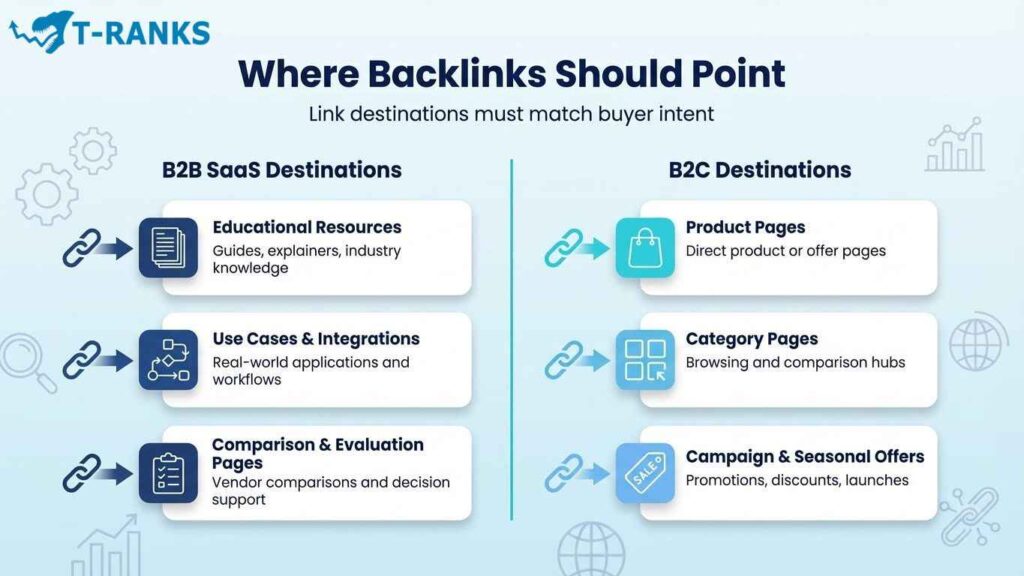
Where a backlink points matters because it signals what the brand wants to be trusted for. Search engines look at link destinations to understand whether links support education, evaluation, or direct conversion.
This is where B2B and B2C link building start to diverge in practical ways.
Best Link Destinations for B2B SaaS
B2B SaaS backlinks should support learning and evaluation, not immediate selling. Buyers need context before they commit, and links help guide that process.
In most cases, effective B2B SaaS links point to:
- Educational pages that explain problems or solutions
- Use cases or integration pages that show real-world application
- Product explanation or comparison pages used during evaluation
These destinations help search engines associate the brand with expertise and relevance rather than short-term promotions.
Best Link Destinations for B2C Brands
B2C backlinks usually aim to speed up discovery and action. Buyers are closer to making a decision and want quick access to options.
Common B2C link destinations include:
- Category pages for browsing and comparison
- Product or collection pages highlighted in reviews
- Campaign or seasonal pages tied to promotions
In this model, links help move users quickly from interest to purchase.
Why Destination Choice Matters
When backlinks align with buyer intent, authority signals become clear. When they do not, links lose effectiveness. B2B SaaS benefits from evaluation-focused destinations, while B2C brands benefit from conversion-focused ones.
Factors to Consider Before Building Links for B2B SaaS
Before choosing tactics or outreach methods, B2B SaaS teams need a filtering mindset. Not every link opportunity is worth pursuing, and some can quietly weaken authority if they conflict with how SaaS buyers and search engines evaluate trust.
The factors below help you decide what type of links make sense before you build them.
Sales Cycle Length
B2B SaaS sales cycles are usually long. Buyers research, compare, and revisit options over time. Link building should support this process with steady, durable links rather than short-lived spikes.
Stakeholder Complexity
Most B2B purchases involve more than one decision-maker. Executives, technical teams, and finance all look for different signals. Links that point to clear explanations, use cases, or integrations help satisfy these varied concerns.
Industry Relevance
Relevance matters more than raw authority in B2B SaaS. Links from websites that clearly belong to the same industry help search engines understand where your product fits and who it is for.
Content Depth and Expertise
B2B links work best when they support content that demonstrates real expertise. Thin pages struggle to hold authority, even with good links. Your content needs to justify why a trusted source would reference it.
Risk Tolerance
Because SaaS brands rely on long-term trust, risky link tactics carry higher consequences. A small number of low-quality or off-topic links can dilute authority faster than they would for consumer brands.
Link Velocity Expectations
Link growth for B2B SaaS should look natural and consistent. Slow, steady acquisition aligns better with long sales cycles and avoids sending mixed signals to search engines.
Why This Matters
These factors act as a decision framework. When link building choices align with sales cycles, stakeholders, and risk levels, links reinforce authority instead of creating noise. This is what separates sustainable B2B SaaS link building from short-term experimentation.
Top 7 Link Building Strategies That Work Best for B2B SaaS
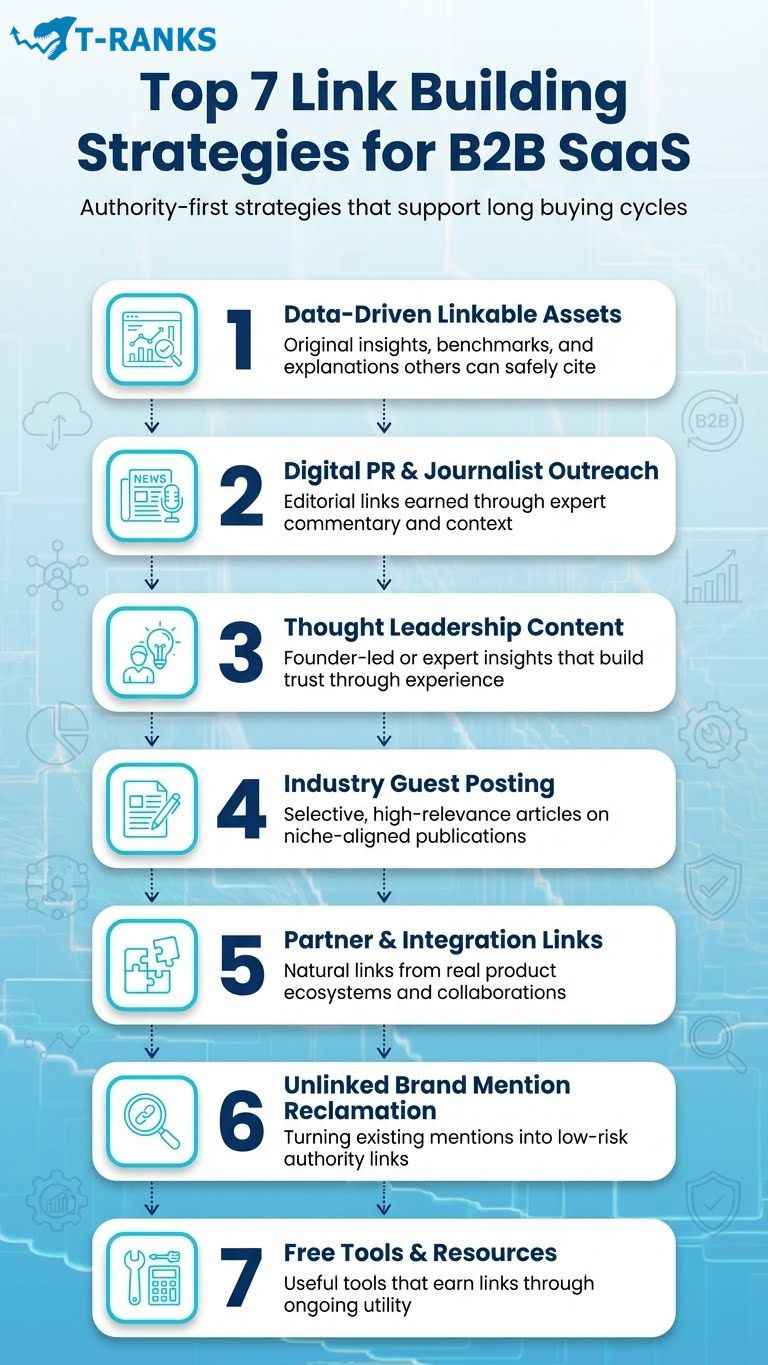
B2B SaaS link building works best when links are earned through usefulness and credibility, not chased as isolated SEO tasks. Buyers, publishers, and search engines all respond to value first.
The strategies below focus on creating that value in ways that naturally attract relevant, high-trust backlinks over time
1. Data-Driven Linkable Assets
Some of the strongest B2B SaaS backlinks come from content that others rely on as a reference.
SaaS companies often sit close to real-world insights, patterns, and observations. Even without massive datasets, structured analysis, comparisons, or trend summaries can become linkable when they help clarify something others struggle to explain.
Practical ways to apply this:
- Turn internal knowledge into focused industry insights
- Publish original explanations, benchmarks, or simplified breakdowns
- Prioritize clarity and usefulness over volume or presentation
The aim is not to impress readers. It is to create a page that feels safe and credible for others to cite.
2. Digital PR and Journalist Outreach
Digital PR works when SaaS brands contribute meaningfully to existing conversations instead of trying to promote themselves.
Journalists and editors link to sources that add context, explanation, or expert perspective. When a SaaS company shows up as a knowledgeable voice, links follow naturally as part of editorial coverage.
Practical ways to apply this:
- Share informed perspectives on industry shifts or changes
- Offer expert commentary without mentioning product features
- Engage only where your experience genuinely adds value
Links earned through digital PR carry strong trust signals because they are included by editorial choice, not placement requests.
3. Thought Leadership and Founder-Led Content
In B2B SaaS, people often trust people before they trust brands. Thought leadership works when expertise is visible, specific, and consistent.
Founder-led content, expert interviews, and informed opinions help position the company as a credible participant in its industry. When insights feel experience-based rather than promotional, other sites are more willing to reference and link to them.
Practical ways to apply this:
- Share real lessons from building, scaling, or operating the product
- Participate in podcasts, interviews, and expert discussions
- Publish opinion pieces that explain why something works, not just what works
These links tend to be editorial and long-lasting because they are tied to expertise, not campaigns.
4. Guest Posting on Industry-Relevant Sites
Guest posting still works for B2B SaaS when it is selective and editorial, not scaled or automated.
Links from industry-aligned publications help reinforce topical authority when the content genuinely fits the audience. Problems begin when guest posting becomes a volume exercise instead of a relevance-driven strategy.
Practical ways to apply this:
- Target sites that already publish content for your exact audience
- Pitch ideas that solve real industry problems, not SEO keywords
- Treat each post as a standalone resource, not a backlink container
A small number of well-placed guest articles usually outperform dozens of low-quality placements.
5. Integration, Partnership, and Ecosystem Links
Partnership links are some of the most natural and defensible backlinks in B2B SaaS.
When products integrate or collaborate, links serve a real user purpose. Partner directories, joint case studies, and shared documentation confirm that the SaaS exists within a broader ecosystem.
Practical ways to apply this:
- Ensure listings exist on integration and partner pages
- Create “better together” content that explains combined use cases
- Publish joint success stories or implementation guides
These links are difficult to fake and easy for search engines to trust because they reflect real business relationships.
6. Unlinked Brand Mentions and Link Reclamation
Many B2B SaaS brands already have authority that is not fully captured in links.
Mentions without links often appear in blog posts, reviews, reports, or partner content. Reclaiming these links is one of the lowest-risk and highest-efficiency ways to strengthen a backlink profile because the relevance and trust already exist.
Practical ways to apply this:
- Identify pages that mention your brand but do not link
- Reach out with a simple clarification or update request
- Focus on existing content rather than asking for new placements
Because the relationship is already established, these links are usually easier to secure and align well with Google’s trust signals.
7. Free Tools and Interactive Assets
Free tools attract links because they provide ongoing utility, not opinions.
Calculators, estimators, and simple interactive resources help users solve specific problems. When these tools are genuinely useful, they are naturally referenced by blogs, resource pages, and industry guides.
Practical ways to apply this:
- Build small tools that solve one clear problem
- Keep the tool simple, focused, and easy to access
- Position it as a helpful resource, not a lead trap
Even basic tools can earn consistent backlinks over time when they are practical and easy to recommend.
These seven strategies work because they align with how trust is built in B2B SaaS. They focus on relevance, usefulness, and credibility instead of shortcuts or volume tactics.
Why Many Popular Link Building Tactics Fail for B2B SaaS
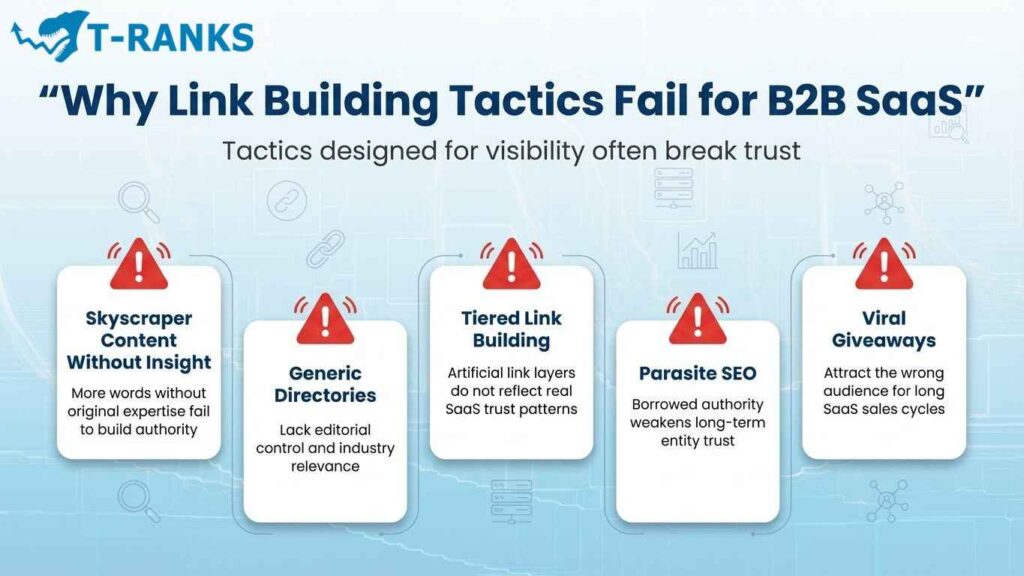
Many link building tactics fail in B2B SaaS because they support discovery and attention, while B2B buyers and search engines prioritize evaluation and verification.
In SaaS, links are expected to confirm expertise, relevance, and credibility over long decision cycles. Tactics designed for fast visibility often send signals that do not align with how enterprise software is researched or chosen.
Skyscraper Content Without Real Differentiation
The skyscraper technique fails in B2B SaaS when it focuses on length rather than insight.
Rewriting existing content with more words does not create authority if it does not introduce original experience, explanation, or perspective. In competitive SaaS niches, content must help readers evaluate, not just consume information.
Directory and Submission-Based Links
Generic directories rarely contribute meaningful authority in B2B SaaS.
These links usually lack editorial judgment, industry alignment, and contextual relevance. Over time, they add noise to the link profile and weaken topical clarity instead of reinforcing it.
Tiered Link Building and Artificial Link Layers
Tiered link building attempts to manufacture authority rather than earn it.
For B2B SaaS, these artificial structures do not resemble how real software companies are referenced online. Search engines increasingly discount such patterns, especially in high-consideration commercial spaces.
Parasite SEO and Borrowed Authority
Publishing SaaS content on unrelated high-authority domains may create short-term exposure, but it often undermines long-term trust.
These placements confuse entity signals and detach the brand from its core industry context. In B2B SaaS, borrowed authority rarely supports sustained rankings or buyer confidence.
Viral Giveaways and Broad Campaigns
Viral campaigns generate attention, but they often attract the wrong audience for SaaS.
Links from giveaways, deal sites, or unrelated blogs tend to reflect browsing behavior, not evaluation intent. For products with long sales cycles, these signals do little to support rankings for high-intent searches.
Why This Matters for SaaS SEO
B2B SaaS link building fails when tactics are chosen for reach instead of fit.
Search engines expect SaaS brands to earn links the same way trust is built in real markets: through relevance, expertise, and industry alignment. This difference explains why many tactics succeed in B2C but produce weak or unstable results in SaaS.
How to Choose the Right Link Building Playbook
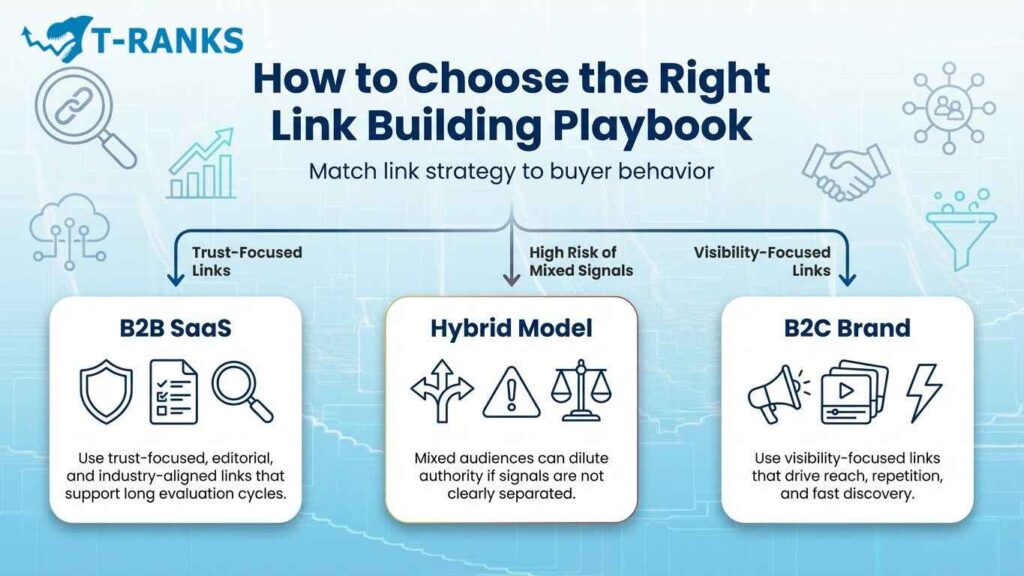
Choosing the right link building playbook depends on how buyers evaluate your product and how search engines interpret trust signals in your market.
Use the framework below to align your link strategy with your business model.
If You Are a B2B SaaS Company
B2B SaaS link building should be selective and trust-focused.
Your links should support long evaluation cycles and reinforce credibility at multiple decision points.
Focus on:
- Editorial mentions in industry-relevant publications
- Partner and integration ecosystem links
- Data-backed resources, reports, and expert commentary
Avoid:
- High-volume link campaigns
- Broad consumer-style placements
- Tactics designed purely for traffic spikes
In SaaS, relevance and durability matter more than scale.
If You Are a B2C Brand
B2C link building benefits from reach and repetition.
Your goal is to signal popularity and demand across many touchpoints.
Focus on:
- Product reviews and listicles
- Influencer mentions and media coverage
- Campaign-based and seasonal content
Here, link velocity and visibility play a larger role than precision.
If You Operate a Hybrid Model
Hybrid businesses face the highest risk of signal confusion.
If one audience clearly drives revenue, your link strategy should reflect that first.
Best practices include:
- Prioritizing links that support the primary buyer type
- Separating consumer and business content where possible
- Keeping messaging and link sources consistent within each segment
When hybrid signals mix without structure, authority becomes diluted.
How to Avoid Mixing Authority Signals
Authority signals weaken when link tactics contradict your core positioning.
To stay aligned:
- Match link sources to your target buyer
- Point links to pages built for that buyer stage
- Maintain consistent acquisition patterns over time
Search engines reward clarity. The clearer your link intent, the stronger your long-term rankings.
Conclusion
In conclusion, B2B SaaS and B2C link building follow different rules because buyer behavior and risk levels are not the same. B2B SaaS link building succeeds when links reinforce trust, relevance, and credibility across long evaluation cycles. Volume alone does not create authority in SaaS.
B2C strategies rely more on visibility, reach, and repetition, which work well for fast, consumer-driven decisions but often fail in enterprise contexts. Mixing these approaches weakens authority signals instead of strengthening them.
The most effective link building strategy is one that aligns with how buyers evaluate products and how search engines interpret trust. When links reflect real-world decision making, rankings become more stable and growth becomes sustainable.
If you want consistent B2B SaaS growth, focus on earning links that validate expertise and support buyer confidence, not shortcuts that chase attention.
FAQS ABout B2B Saas Link Building
How Do Buying Cycles Shape Link Building Strategy?
Buying cycles determine whether links should build trust or drive visibility.
Long B2B sales cycles require credibility-focused links that support evaluation, while short B2C cycles benefit from links that maximize exposure and speed decisions.
How Do Long B2B Sales Cycles Affect Link Building?
Long B2B sales cycles require links that reinforce trust over time.
Because multiple stakeholders research solutions in depth, links function as validation signals rather than quick traffic drivers.
How Do Short B2C Buying Cycles Affect Link Building?
Short B2C buying cycles reward visibility and repetition.
Links help buyers discover products quickly, and campaign-based link spikes are often natural and effective.
What Is the Difference Between Trust Signals and Popularity Signals in Backlinks?
Trust signals validate expertise, while popularity signals indicate broad acceptance.
B2B SaaS depends on trust signals, whereas B2C brands benefit more from widespread visibility and mentions.
What Do Search Engines Look for in B2B SaaS Backlinks?
Search engines look for relevance, editorial context, and authority alignment in B2B SaaS links.
Links from industry-specific, editorially controlled sources strengthen topical authority and trust.
What Do Search Engines Reward in B2C Backlinks?
Search engines reward coverage, brand mentions, and media exposure for B2C brands.
Broad visibility signals consumer interest and cultural relevance.
Where Should Backlinks Point for B2B vs B2C?
Backlink destinations should match how buyers evaluate products.
B2B links should support research and evaluation, while B2C links can point closer to products and offers.
Where Should B2B SaaS Backlinks Point?
B2B SaaS backlinks should point to educational and evaluation-focused content.
Use cases, integrations, and comparison pages build trust more effectively than early sales pages.
Where Should B2C Brand Backlinks Point?
B2C backlinks often point directly to product, category, or campaign pages.
This supports fast discovery and conversion during short buying windows.
What Factors Should You Consider Before Building Links for B2B SaaS?
B2B SaaS link building must balance trust, relevance, and risk.
Sales cycle length, stakeholder complexity, topical relevance, content depth, and controlled link velocity all influence long-term success.