Many agencies build backlinks every month and still see little improvement in rankings. The links look strong. The reports look good. But traffic and positions do not move.
The reason is simple. Backlink budget is often spent in the wrong place.
Backlink budget is not just money. It is the total link building capacity an agency has, including authority, time, outreach effort, and how many links a site can safely handle. That capacity is limited. When it is used without clear priorities, rankings stall even if the links are high quality.
Most backlink problems are not about link quality. They are about allocation. Links are sent to the wrong pages, spread too thin, or built before the page is ready.
This guide explains 12 practical ways agencies waste backlink budget and shows how to fix each mistake next month without buying more links.
What “Backlink Budget” Means for Agencies

A backlink budget is the total amount of link building resources an agency can safely and realistically use to improve rankings. It is not just money. It includes authority capacity, team time, outreach effort, and how many links a site can handle without creating instability.
Every backlink assigns authority to a specific page. Once that authority is used on one URL, it cannot be moved somewhere else. That is why backlink budget is a limited allocation decision, not a monthly link quota.
Backlink budget includes financial spend on placements and tools, the time your team spends on outreach and follow up, vendor capacity, and the safe number of links a site can earn in a given period.
It also includes site health capacity. A new or unstable website cannot absorb unlimited backlinks at once. Adding too many links too quickly can create volatility instead of growth. The amount of authority a site can safely handle within a timeframe is part of the backlink budget.
In simple terms, backlink budget is the plan for how to use limited authority resources where they can produce real ranking movement.
Why Good Backlinks Fail When Allocation Is Wrong

Good backlinks fail when they are assigned without strategic alignment. The link itself may be strong, but authority only works when it is placed on the right page, at the right time, and with the right intent.
A backlink passes authority to a specific URL. If that page cannot convert authority into rankings, the impact remains weak. Allocation determines performance, not just link quality.
Allocation usually fails in three predictable ways: wrong page selection, weak structural readiness, and intent mismatch.
Links Sent to Pages With No Ranking Opportunity
This happens when backlinks are placed on pages that have little realistic chance of entering competitive search results.
Agencies often build links to pages targeting weak keywords, pages stuck far from page one, or URLs that are not tied to meaningful commercial goals.
Why rankings stall:
Authority becomes trapped on low-potential pages. Competitive URLs that are close to ranking remain unsupported. As a result, visibility does not improve even though links are being built.
How to correct allocation next month:
Review page-level ranking data. Identify URLs already gaining traction or targeting high-value queries. Redirect backlink allocation toward those pages so authority supports genuine ranking opportunities.
Links Built Before Structural Support Exists
This happens when backlinks are added before the page has proper internal support or clear positioning within the site structure.
The page may receive external authority but remain weak internally, with limited contextual links and poor integration into the site hierarchy.
Why performance weakens:
Search engines use internal links to understand page importance and topical relationships. Without internal support, external authority cannot flow effectively. The foundation is weak, so rankings remain flat.
How to correct allocation next month:
Pause new backlink placements. Strengthen internal linking from relevant, authoritative pages. Ensure the target URL is clearly positioned within the site structure. Once the foundation is strong, resume backlink allocation.
Links Built Without Search Intent Validation
This happens when backlinks are directed to a page that does not match the dominant search intent in the SERP.
For example, an informational article may target a transactional query, or a sales page may compete against comparison content.
Why growth is limited:
Search engines prioritize intent alignment. If the page format does not match user expectations, authority alone cannot push it higher. Even strong backlinks cannot override intent mismatch.
How to correct allocation next month:
Analyze the current top-ranking pages. Identify the dominant intent and content format. Adjust the page structure and depth to match that intent before allocating more backlinks.
Good backlinks do not fail because they lack strength. They fail because they are deployed without precision. When allocation improves, backlink performance improves.
12 Ways Agencies Waste Backlink Budget (And How to Fix Each One)

Once you understand why good backlinks fail when allocation is wrong, the next step is identifying where backlink budget breaks down in practice.
Backlink budget is rarely wasted because links are weak. It is wasted because authority is misdirected, diluted, or deployed before the page is ready.
The twelve patterns below show exactly how this happens and how to correct it next month.
1. Sending Strong Backlinks to Pages That Don’t Matter
This mistake is a prioritization failure. Strong backlinks are assigned to pages that have little ranking opportunity or limited business value.
Authority is often sent to outdated blog posts, thin informational pages, or URLs targeting weak keywords. These pages may receive powerful links, but they are not positioned to compete or convert visibility into results.
Why rankings stall:
Authority is spent on pages that cannot realistically enter competitive positions. Meanwhile, high-value commercial pages remain underpowered. The backlink budget is consumed, but strategic pages see no benefit.
What to change next month:
Reassess page-level opportunity. Identify URLs close to page one or tied to important revenue queries. Concentrate backlink allocation on pages that can realistically move rankings or pass authority internally to strategic sections.
2. Spreading Backlinks Across Too Many URLs
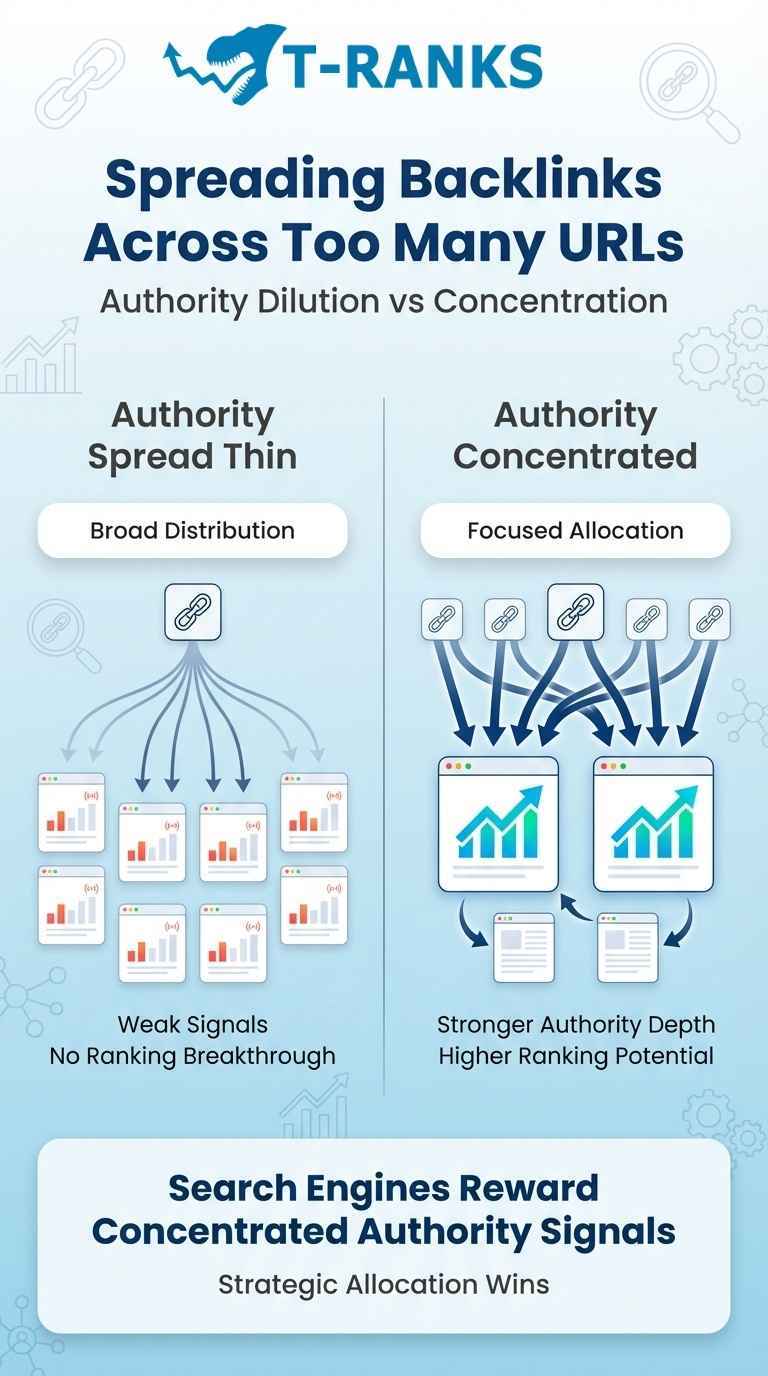
This mistake is an authority dilution problem. Backlinks are distributed broadly instead of being concentrated where competitive strength is required.
When links are evenly spread across blog posts, service pages, and support content, no single URL gains enough authority depth to break into top positions.
Why rankings stall:
Search engines respond to concentrated authority signals. Thin distribution weakens impact. Each page receives partial strength, but none reach the authority threshold needed to compete.
What to change next month:
Limit backlink targets to a small group of priority pages. Build authority depth before expanding coverage. Concentration creates stronger competitive signals than broad but shallow distribution.
3. Building Backlinks Before Pages Are Internally Supported
This mistake is a sequencing failure. External authority is added before the internal structure is prepared to distribute and reinforce it.
A page may receive strong backlinks but remain weakly connected within the site. It may lack contextual links from related content or clear placement in the hierarchy.
Why rankings stall:
Internal linking determines how authority flows. If the structure is weak, external strength cannot amplify effectively. Authority remains isolated instead of reinforcing topical clusters.
What to change next month:
Strengthen internal support before adding more external links. Add contextual links from relevant pages and ensure the target URL is properly positioned in the site architecture. Once internal amplification is strong, resume backlink allocation.
4. Sending Too Many Links to the Homepage
This mistake is a distribution failure. Agencies concentrate a large share of backlinks on the homepage instead of directing authority toward specific ranking pages.
The homepage feels safe and universal. It represents the brand, so it becomes the default link target. Over time, most of the backlink budget strengthens the root domain while deeper commercial or category pages receive little direct authority.
Why rankings stall:
Homepages rarely rank for specific transactional or long-tail keywords. Search engines typically rank internal pages for targeted queries. When authority stays concentrated on the homepage, it does not automatically transfer enough strength to product, service, or category pages. Internal linking may distribute some value, but it often lacks the precision required to move competitive URLs.
Another hidden issue is keyword mismatch. The homepage usually targets broad brand terms, while competitive revenue keywords sit on inner pages. Sending backlinks to the homepage does not directly strengthen those target URLs.
What to change next month:
Use the homepage as an authority distributor, not the primary ranking target. Strengthen internal links from the homepage to key commercial and category pages. At the same time, shift new backlink allocation directly toward priority URLs that target competitive keywords. Direct authority creates stronger ranking signals than relying on indirect flow.
5. Chasing High DR Links Without Ranking Impact

This mistake is a metric obsession problem. Agencies prioritize high DR or DA scores instead of evaluating contextual alignment and ranking impact.
A link may come from a powerful domain, but if the page is topically unrelated or poorly aligned with the target keyword cluster, the authority transfer weakens. The backlink looks impressive in reports, but its ranking influence is limited.
Why rankings stall:
Search engines do not rank pages based on third-party metrics. They evaluate contextual relevance, topic consistency, and SERP alignment. A high DR backlink placed on a loosely related article provides weaker semantic reinforcement. Authority without relevance does not create competitive positioning.
There is also a placement issue. Sometimes the link is buried in low-visibility sections of a page or placed in content with little contextual depth. Even strong domains cannot compensate for weak placement context.
What to change next month:
Shift evaluation criteria away from domain metrics alone. Prioritize contextual alignment, topical similarity, and placement quality. Study the current SERP and identify what type of supporting content surrounds top-ranking pages. Secure backlinks from pages that reinforce the same topic cluster and search intent, not just high metric domains.
6. Building Backlinks Without Checking Search Intent
This mistake is an intent alignment failure. Agencies build backlinks without confirming whether the target page matches the dominant search intent.
A page may target the right keyword, but its format may not match what users expect. An informational blog post may compete against transactional pages. A sales page may compete against detailed comparison guides.
Why rankings stall:
Search engines prioritize intent satisfaction. If a page does not match the structure, depth, and purpose of top-ranking results, authority alone cannot elevate it. Backlinks may increase domain signals, but user behavior and content alignment will prevent sustained ranking growth.
Intent mismatch often leads to short-term movement followed by stagnation. The authority signal exists, but the page fails to meet user expectations.
What to change next month:
Before allocating backlink budget, analyze the top-ranking pages for the target keyword. Identify whether the dominant intent is informational, commercial investigation, or transactional. Align the page format, content depth, and structure accordingly. Only after the page matches intent should backlinks be deployed.
7. Ignoring Topical Relevance in Link Placement

This mistake is a contextual alignment failure. Backlinks are acquired from websites or pages that are not clearly related to the target page’s topic.
A link may come from a strong domain, but if the surrounding content has no meaningful connection to the target keyword theme, the authority signal weakens.
Why rankings stall:
Search engines evaluate topical consistency across link profiles. When backlinks come from unrelated niches, the authority signal becomes fragmented. The page does not build clear topical reinforcement within its subject area. Over time, this weakens semantic trust and limits ranking growth, especially in competitive niches.
Topical relevance helps search engines understand why a page deserves authority. Random niche links fail to strengthen that understanding.
What to change next month:
Prioritize backlinks from pages that are contextually aligned with the target topic. Ensure the linking content logically supports the keyword cluster of the target page. Building within a consistent topical environment strengthens how search engines interpret relevance and authority.
8. Outsourcing Link Building Without Clear Page Priorities
This mistake is a strategy communication failure. Agencies outsource link building without defining which specific pages should receive authority.
Vendors are asked to “build links” without clear URL targets, ranking objectives, or page-level strategy. As a result, backlinks are placed wherever convenient.
Why rankings stall:
Without clear page priorities, authority is scattered randomly. Vendors focus on delivery volume rather than allocation precision. Important commercial pages remain underpowered, while low-impact pages accumulate unnecessary links. The backlink budget is spent, but strategic positioning does not improve.
Outsourcing is not the problem. Lack of direction is.
What to change next month:
Before outsourcing, define a short list of priority URLs based on ranking potential and business value. Provide vendors with exact target pages and anchor guidelines. Monitor placements to ensure authority is concentrated on pages that can produce measurable movement.
9. Using Aggressive Anchor Text Too Early
This mistake is an anchor profile imbalance. Highly optimized keyword anchors are applied before the page has built stable authority.
New or low-authority pages receive backlinks with exact match or heavily optimized anchors. Instead of building a natural anchor distribution, the link profile becomes overly focused on one keyword.
Why rankings stall or become unstable:
Search engines evaluate anchor text patterns as part of link quality assessment. When aggressive anchors appear too early, ranking volatility increases. The page may struggle to maintain stable positions because the profile appears forced rather than naturally developed.
Anchor progression matters as much as link placement.
What to change next month:
Adopt gradual anchor progression. Start with branded, URL-based, or natural anchors. Allow the page to build foundational authority and stability. Introduce partial or exact match anchors carefully over time instead of concentrating them at the beginning.
10. Continuing to Build Links to Pages That Are Not Moving

This mistake is a diagnosis failure. Agencies continue spending backlink budget on pages that show no ranking improvement without investigating why.
The assumption is often that more authority will solve the problem.
Why rankings stall:
If a page is not responding, the limitation may not be authority. It could be search intent mismatch, insufficient content depth, poor internal support, or stronger competitor positioning. Adding more backlinks does not correct structural weaknesses. It only increases cost.
Authority amplifies readiness. It does not replace it.
What to change next month:
Pause backlink allocation for stagnant pages. Reassess using three checks: SERP intent alignment, content competitiveness, and internal support. Correct the limiting factor first. Resume link building only when the page has a realistic path to movement.
11. Not Measuring Backlink Results at the Page Level
This mistake is a performance tracking failure. Agencies measure total backlinks built instead of measuring how individual pages respond.
Reports highlight link counts rather than ranking movement.
Why rankings stall unnoticed:
Link quantity does not equal ranking improvement. Some pages convert authority into visibility gains, while others absorb links without measurable movement. Without page-level tracking, agencies cannot identify which URLs justify continued investment and which are draining the budget.
Lack of measurement leads to repeated misallocation.
What to change next month:
Track performance at the URL level. Monitor keyword position changes, organic traffic trends, and visibility improvements for each linked page. Reallocate backlink budget toward pages that demonstrate upward movement and pause investment on those that do not respond.
12. Sticking to a Fixed Link Plan Instead of Reallocating Budget
This mistake is an allocation rigidity problem. Agencies follow preset monthly link quotas without adjusting based on real performance data.
Authority is distributed according to schedule, not opportunity.
Why rankings stall:
Search conditions evolve. Some pages gain traction and require additional authority to break into top positions. Others show no response and need structural adjustments instead of more links. A fixed plan prevents authority from shifting toward momentum. Budget is spent evenly, but not strategically.
What to change next month:
Review page-level performance at the end of each month. Identify pages gaining visibility and increase allocation to support their growth. Reduce or pause links to stagnant pages and reassess their structural readiness. Monthly reallocation ensures authority follows opportunity rather than habit.
How to Fix a Wasted Backlink Budget in the Next 30 Days
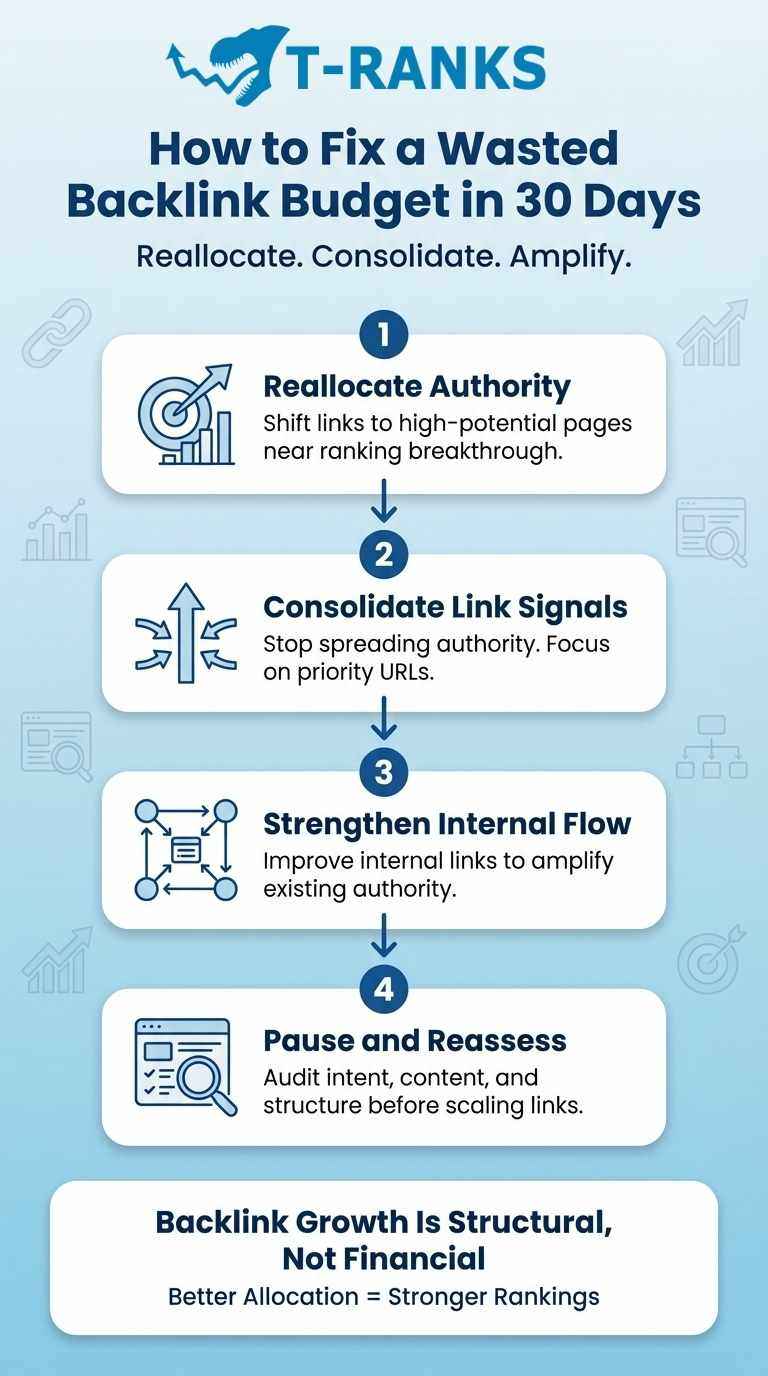
Fixing a wasted backlink budget does not require buying more links. It requires correcting allocation. In most cases, authority already exists within the backlink profile, but it is spread across the wrong pages or not supported internally.
The goal in the next 30 days is simple. Stop leaking authority. Concentrate it on pages that can realistically rank. Strengthen internal distribution so existing backlinks work harder. Backlink budget problems are usually structural, not financial.
Reallocate Authority to Pages With Real Potential
Begin with a full page level review. Identify which URLs have backlinks and compare their ranking performance. Some pages may have strong links but no measurable movement. Others may be close to page one and only need concentrated support.
Pause backlink building to low response pages. Shift authority toward URLs that target valuable queries and show ranking traction. If certain low performing pages have accumulated links but provide little value, consider consolidating them into stronger pages through proper redirection. This prevents authority from remaining trapped on weak URLs.
Consolidate Scattered Authority
When backlinks are distributed across too many URLs, ranking signals become diluted. Concentration increases impact.
For the next 30 days, narrow your link allocation to a small group of priority pages. Avoid evenly spreading links across the entire site. Instead, focus on building depth of authority where ranking potential already exists. Consolidation strengthens competitive positioning.
Strengthen Internal Amplification
Many backlink budgets fail because internal structure is weak. External links add authority, but internal linking determines how efficiently that authority flows.
Improve internal linking to priority pages from relevant, high authority sections of the site. Ensure key pages are clearly supported within the site hierarchy. Strengthening internal amplification allows existing backlinks to produce stronger ranking signals without additional spend.
Pause and Reassess Before Adding More Links
If a page has received backlinks but is not moving, the issue is often not link quantity. It may be intent mismatch, weak content alignment, or structural limitations.
Stop adding links temporarily. Analyze SERP alignment, content competitiveness, and internal support. Fix the limiting factor first. Resume link building only after the page has a realistic opportunity to respond.
A wasted backlink budget is usually the result of poor allocation, not insufficient volume. Within 30 days, authority can be repositioned, concentrated, and amplified to unlock ranking movement without increasing link spend.
How Smart Agencies Get More Results From the Same Backlink Budget
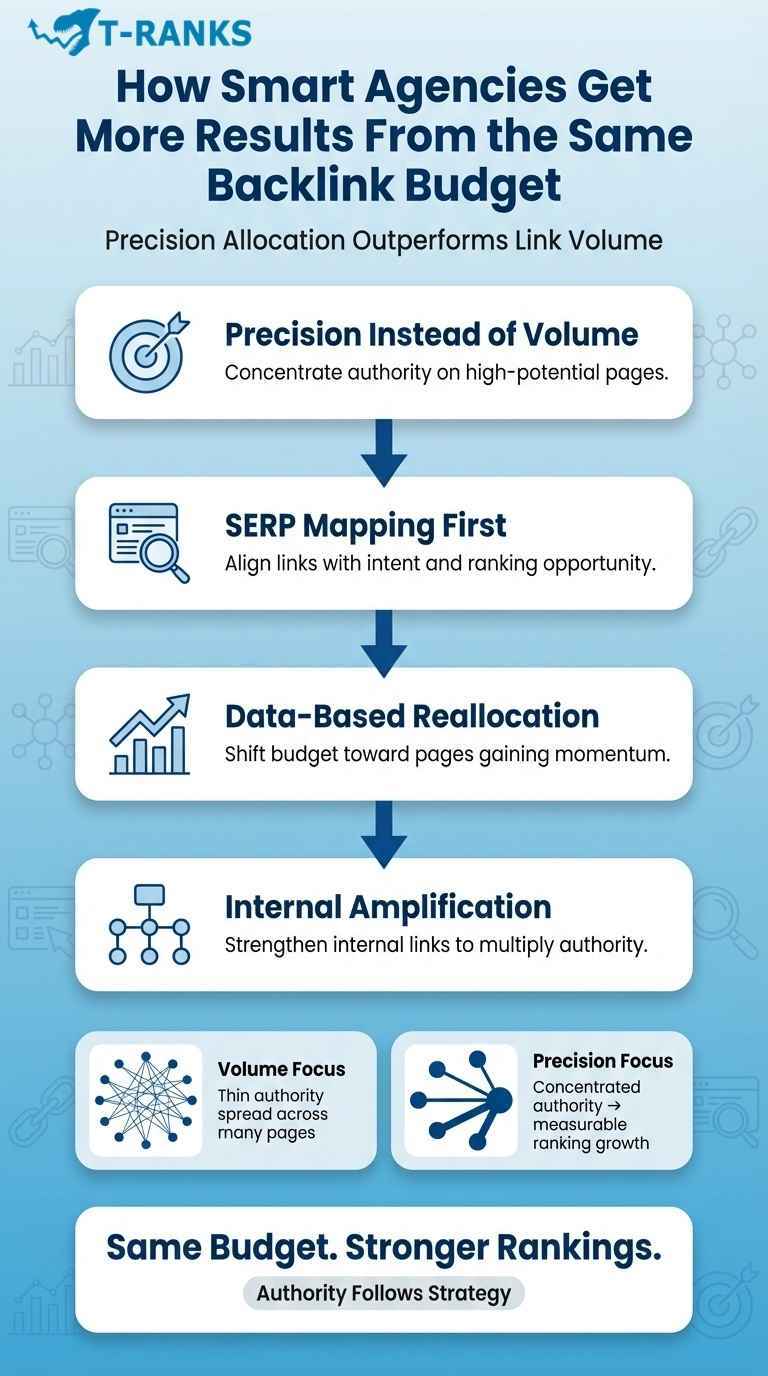
Smart agencies do not increase backlink volume. They increase allocation precision. The difference is not how many links are built, but where and why they are placed.
Backlink budget becomes efficient when every link has a defined page level objective.
Precision Instead of Volume
Volume focused agencies aim to build a fixed number of links each month. Links are spread across multiple pages to maintain activity.
Precision focused agencies reduce randomness. Instead of building ten average links to different URLs, they may build three highly targeted links to one high potential page. The goal is authority concentration, not coverage.
Concentrated authority increases the likelihood of measurable ranking movement.
SERP Mapping Before Link Placement
Smart agencies analyze the current search results before allocating backlinks. They identify:
- Which pages are close to top positions
- What type of content dominates the SERP
- Whether the page aligns with intent
Links are then mapped to pages that have realistic upward potential. This prevents authority from being wasted on pages that cannot compete.
Data Based Monthly Reallocation
Instead of following a fixed link plan, smart agencies review page velocity. If a page shows ranking movement, it receives more authority. If it stalls, link building pauses and the page is reassessed.
Budget follows performance signals, not habit.
Internal Amplification Multiplies Results
Smart agencies also strengthen internal linking to priority pages. This amplifies existing external authority without increasing spend. Internal support ensures that backlinks work harder across the site structure.
The result is simple. The same backlink budget produces stronger ranking gains when authority is concentrated, aligned with SERP intent, and reallocated based on page level data.
Final Thoughts: Backlink Budget Should Be Spent Strategically

Backlinks rarely fail because of quality alone. They fail because of poor allocation.
The backlink budget is a limited authority resource. When it is scattered across low impact pages, misaligned with search intent, or deployed without internal support, results remain weak even if the links are strong.
Most ranking problems discussed in this article come from one issue, allocation failure. Authority is either sent to the wrong page, spread too thin, or continued without reassessment. In each case, the budget is spent, but ranking movement does not follow.
Strategic spending means:
- Prioritizing pages with real ranking potential
- Concentrating authority instead of distributing it evenly
- Supporting pages internally before adding external links
- Adjusting allocation based on page level performance
When authority is assigned intentionally, the same backlink budget produces stronger results. When allocation is careless, even high quality links underperform.
Backlink success is not determined by how many links are built. It is determined by how precisely authority is deployed.
If allocation improves, backlink performance improves.
Frequently Asked Questions About Backlink Budget
What is a backlink budget in SEO?
A backlink budget is the total amount of resources an agency can realistically invest in building backlinks. It includes money, outreach time, vendor capacity, link opportunities, and risk tolerance. It is not just financial spending. It is a limited authority resource that must be allocated carefully.
How do agencies usually waste their backlink budget?
Agencies waste backlink budgets by sending strong links to the wrong pages or spreading them across too many URLs. This prevents authority from concentrating enough to produce measurable ranking or conversion impact.
Can good backlinks still fail to improve rankings?
Yes. Good backlinks can fail if they point to pages with weak search intent alignment, poor internal support, or low ranking potential. Link quality alone does not guarantee results without correct placement and structure.
Is sending backlinks to the homepage a waste of budget?
In many cases, yes. Overusing homepage backlinks limits ranking impact. Homepages rarely rank for transactional queries and should mainly distribute authority internally to strategic pages.
Why does spreading backlinks across many URLs reduce results?
Spreading backlinks across too many URLs dilutes authority. Search engines respond more strongly to concentrated signals than to thin authority spread across multiple pages.
Should internal linking be done before building backlinks?
Yes. Internal linking should be strengthened before adding external backlinks. Pages without internal support cannot efficiently use external authority.
Do high DR backlinks always justify their cost?
No. High DR backlinks do not guarantee ranking improvements. If relevance, intent alignment, or page level strategy is missing, the return on investment remains low.
How does search intent affect backlink ROI?
Backlinks are ineffective when they point to pages that do not match user intent. Even strong authority cannot rank a page that fails to satisfy what users expect in the search results.
Is topical relevance important for backlink efficiency?
Yes. Topical relevance strengthens authority transfer. Links from unrelated niches produce weaker signals and reduce alignment with the target page’s subject.
Can outsourcing link building increase backlink budget waste?
Yes. Without clear URL priorities and strategy, vendors often place links randomly. This scatters authority and reduces ranking efficiency.
When should aggressive anchor text be avoided?
Aggressive anchor text should be avoided on new or unstable pages. Early over optimization increases volatility and weakens long term stability.
What should be done if a page is not ranking despite backlinks?
Pause link building for that page and reassess. Check search intent alignment, content competitiveness, and internal structure before investing further budget.
How should backlink ROI be measured properly?
Backlink ROI should be measured at the page level, not by link count. Track ranking movement, organic traffic trends, and how authority flows internally.
Can a wasted backlink budget be fixed without buying more links?
Yes. Most backlink budget problems can be corrected through reallocation, consolidation, and internal amplification. Better allocation often unlocks results without increasing spend.
How long does it take to fix backlink budget mistakes?
Improvements often appear within 30 to 60 days. Reallocating authority and correcting targeting usually produces faster gains than building new links.
Is backlink budget management more important than link volume?
Yes. How backlinks are allocated matters more than how many are built. Precision allocation consistently outperforms high volume link building.
What is the biggest mistake agencies make with backlink budgets?
The biggest mistake is treating backlinks as unlimited resources. Backlinks are finite authority assets and must be deployed strategically.
Is backlink budget more important than content quality?
No. Backlink budget does not replace content quality. Backlinks amplify pages that already meet search intent and content standards.