Backlink checker data helps you understand how strong your website’s links are and how you compare to competitors. Tools like Ahrefs, Semrush, and Moz show metrics such as DR, DA, spam scores, anchor text, and referring domains. These numbers look clear and precise, but they are not Google ranking signals.
Many SEO mistakes happen when people misunderstand what these metrics really mean. Backlinks are important, but they are only one part of ranking. Without checking search intent and live SERPs, backlink data can be misleading.
In this guide, you will learn the most common backlink checker data mistakes and how to interpret these metrics correctly in 2026.
Why Most SEOs Misinterpret Backlink Checker Data
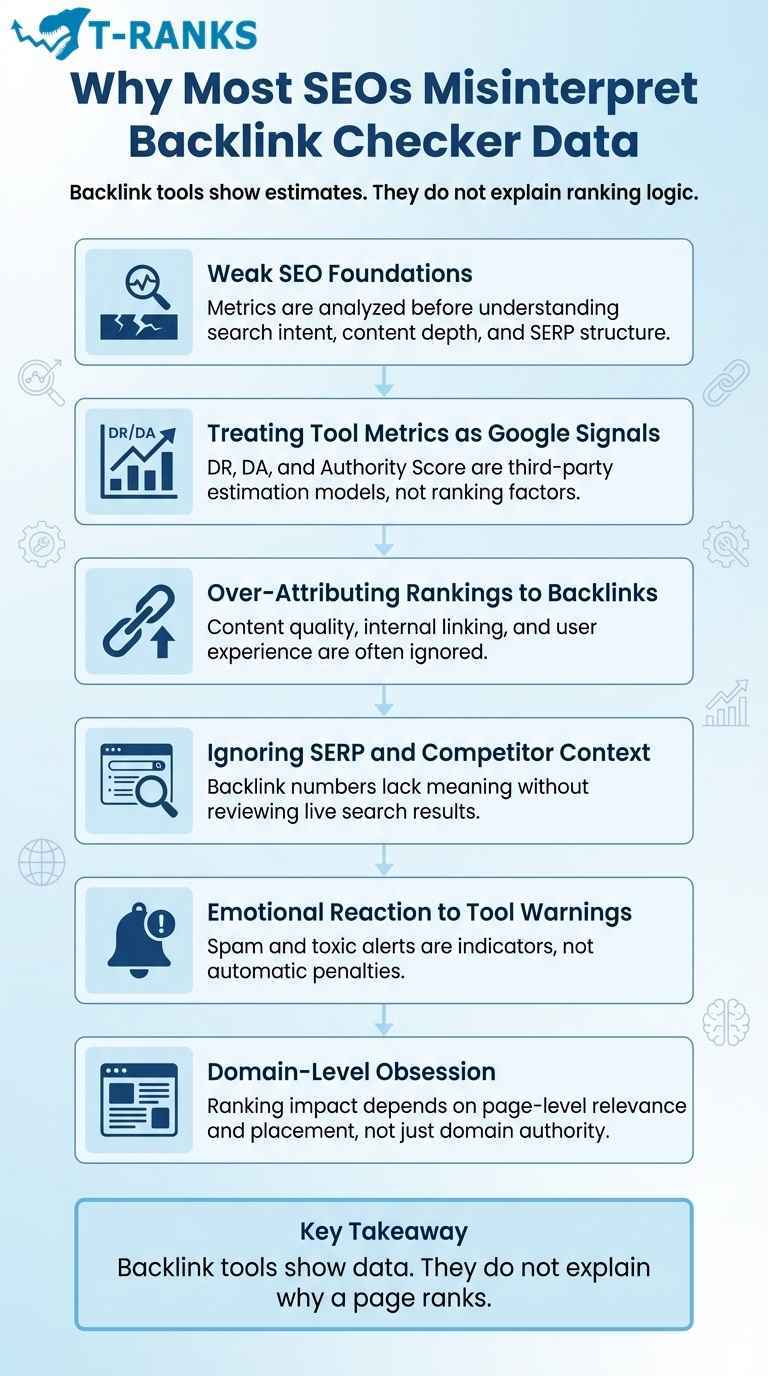
Most SEOs misinterpret backlink checker data because they rely on tool metrics without fully understanding how search rankings actually work. Backlink tools show estimates and indicators, but they do not explain ranking logic.
Below are the main reasons this confusion happens:
1. Weak SEO Foundations
Many professionals start analyzing DR, DA, or toxic scores before understanding ranking fundamentals like search intent, content depth, and SERP structure. Without this foundation, backlink data is interpreted in isolation.
2. Treating Third-Party Metrics as Google Signals
Metrics like DR, Authority Score, and DA are estimation models built by tools such as Ahrefs, Semrush, and Moz. They are not used by Google directly. Confusing these with ranking signals leads to incorrect conclusions.
3. Over-Attributing Rankings to Backlinks
When a competitor ranks higher, backlinks are often blamed or credited immediately. In reality, rankings are influenced by multiple factors including content quality, topical authority, internal linking, and user experience.
4. Ignoring SERP and Competitor Context
Backlink data does not explain why a page ranks for a specific query. Without analyzing live search results and competitor positioning, backlink metrics lack context.
5. Reacting Emotionally to Tool Warnings
Spam scores, toxic labels, and lost link reports often trigger panic. These alerts are indicators, not verdicts. Acting without manual review leads to unnecessary SEO changes.
6. Analyzing Links Without Page-Level Perspective
Many SEOs evaluate backlinks at the domain level instead of the page level. However, ranking impact depends on page relevance, placement, and intent alignment, not just domain authority.
Backlink tools show data. They do not explain why a page ranks.
When SEO fundamentals are strong, backlink checker data becomes clear and actionable. When fundamentals are weak, the same data creates confusion.
Why SEO Tools Are Often Treated as Ranking Systems

SEO tools are often treated as ranking systems because they provide fast, simplified, and measurable data in a space where Google offers limited transparency. However, platforms like Ahrefs, Semrush, and Moz are third-party analytical systems, not Google ranking engines.
Their metrics, such as DR, Authority Score, DA, and Spam Score, are estimation models built for comparison and competitive research. They are not direct ranking signals used by Google.
Because these tools provide daily rank tracking, competitor visibility, simplified authority metrics, and optimization scorecards, they create a strong perception of authority. Over time, these numbers begin to feel like official indicators rather than analytical approximations.
This perception leads to a series of common interpretation mistakes when analyzing backlink checker data.
The most frequent mistakes include:
• Confusing third-party metrics with Google ranking signals
• Believing high DR or DA automatically guarantees link impact
• Trusting spam scores and toxic labels without manual verification
• Misinterpreting new and lost backlink reports
• Overanalyzing anchor text ratios
• Assuming more backlinks always improve rankings
• Ignoring SERP and competitor context when reviewing backlink data
Understanding why tools are perceived as ranking systems makes it easier to recognize these mistakes and correct them.
In the following sections, I break down each of these mistakes in detail and explain how backlink checker data should actually be interpreted in real SEO practice.
Mistake 1: Confusing Tool Metrics With Google Ranking Signals
One of the biggest backlink checker data mistakes is believing that tool metrics are Google ranking signals. They are not.
Ahrefs shows Domain Rating (DR) and URL Rating (UR). Semrush shows Authority Score. Moz shows Domain Authority (DA) and Page Authority (PA). These numbers look official and are widely used in SEO reports. Because of this, many people assume Google uses them to rank websites.
That assumption is incorrect.
Google does not use DR, DA, or Authority Score in its ranking system. These metrics are created by third-party tools. Each tool builds its own scoring system based on the links it discovers. The purpose of these scores is to compare websites within the tool, not to copy Google’s algorithm.
Another common mistake is comparing these metrics across tools. DR is calculated differently from DA. Authority Score follows a different formula. A score of 60 in one tool does not mean the same thing in another. Treating them as equal ranking indicators leads to confusion.
The correct way to view these metrics is simple. They help you estimate link strength and compare domains. They do not decide rankings.
When you understand this difference, backlink checker data becomes clearer and easier to interpret.
Mistake 2: Believing High DR or DA Automatically Means Strong Link Impact

A common backlink checker data mistake is assuming that a high DR or DA link will automatically improve rankings. This belief has become widespread because the SEO industry often treats Domain Rating and Domain Authority as shortcuts for quality.
Agencies report DR growth. Link marketplaces price backlinks based on DR. Competitive tools display domain-level strength prominently. Over time, many SEOs begin to equate high DR with guaranteed ranking power.
However, SEO tools measure domain-level strength. Google evaluates link impact at the page level.
This is why some high DR links fail to move rankings. A strong domain does not guarantee that the specific linking page has authority, relevance, or contextual alignment with your target keyword. At the same time, a lower DR website with highly relevant content and contextual placement can sometimes produce stronger ranking impact.
Several factors influence real link impact:
- Relevance of the linking page to your keyword
- Contextual placement within meaningful content
- Strength of the linking page itself, not just the domain
- Internal linking structure that distributes link equity
- Competitive authority threshold within the live SERP
A high DR homepage link placed in unrelated content may pass minimal value. A relevant contextual link from a moderate DR site that directly supports the search intent can contribute more meaningfully.
The key insight is simple: domain strength is an indicator, not a ranking guarantee.
Link impact is determined at the page level, shaped by relevance, context, and competitive comparison.
When you shift from domain obsession to contextual evaluation, backlink checker data becomes far more accurate and actionable.
Mistake 3: Trusting Spam Scores and Toxic Labels Without Manual Review
A common backlink checker data mistake is assuming that a high spam or toxic score automatically means penalty risk.
Tools like Semrush provide a Toxic Score, and Moz offers a Spam Score. These metrics estimate the likelihood that a website or backlink profile contains characteristics commonly associated with low-quality or manipulative links.
A high spam score does not mean Google has penalized your site. It usually means the tool has detected patterns such as:
- Links from low-quality domains
- Unnatural anchor text patterns
- Links from sites with thin or duplicate content
- Large numbers of links from unrelated niches
These are warning indicators, not confirmations of harm.
SEO tools are designed to avoid missing real risks, so they often over-flag suspicious links. It is safer for a tool to show a warning than to ignore a potentially problematic pattern. As a result, even websites that have not intentionally built harmful links may see elevated spam or toxic scores.
This is where manual review becomes essential.
If you notice a high spam score, do not act immediately. Instead, manually verify the situation using a simple checklist:
- Visit a sample of flagged linking pages. Do they look automated, malicious, or clearly spammy?
- Check whether the linking pages are indexed in Google.
- Review anchor text usage. Does it look manipulative or natural?
- Analyze patterns. Are there hundreds of similar links from the same type of site?
- Monitor rankings. Has there been a measurable drop that correlates with these links?
Google evaluates link patterns, intent, and overall behavior across the entire profile. One low-quality link rarely causes ranking issues. Even multiple low-quality links are often ignored rather than penalized, especially when there is no clear manipulation.
The biggest mistake is reacting emotionally and disavowing links without verification. Removing or disavowing neutral or harmless links can reduce link equity and create unnecessary instability.
Spam scores are diagnostic tools.
They are not penalty alerts.
Mistake 4: Misinterpreting New and Lost Backlink Data
A common backlink checker data mistake is assuming that lost backlinks automatically cause ranking drops.
Tools like Ahrefs show new and lost backlinks along with referring domain fluctuations. When numbers decline, many SEOs panic and immediately blame rankings on link loss. In reality, link churn is normal.
Websites update content, remove pages, change URLs, or clean up old articles. As a result, some backlinks naturally disappear. Not every lost link carries meaningful ranking weight.
The real mistake is reacting without verification.
If you notice lost backlinks, first confirm the situation:
- Identify which specific pages lost links.
- Visit the linking page and check whether it was deleted, updated, or noindexed.
- Review the relevance and authority of that linking page.
- Check whether rankings for the target keyword actually changed.
In most cases, there is nothing to “fix.” You cannot control external websites. What you can control is understanding why the link was lost. If it disappeared due to poor content quality, weak relationship outreach, or broken URLs on your own site, you can correct those weaknesses to avoid similar losses in the future.
Lost links only require action when rankings and SERP behavior confirm real impact.
Backlink tools show link movement.
They do not automatically explain ranking changes.
When data is combined with manual review and SERP validation, you can separate normal fluctuation from meaningful authority loss.
Mistake 5: Overanalyzing Anchor Text Ratios

Another common backlink checker data mistake is treating anchor text ratios as fixed formulas rather than contextual signals.
Tools like Ahrefs and Semrush display anchor distribution charts that categorize links as branded, exact match, partial match, or generic. When these percentages shift, many SEOs immediately assume over-optimization or penalty risk.
Anchor text optimization is one of the most important backlink factors. Overuse of exact match keywords in anchors can look manipulative and may trigger ranking instability, especially in competitive niches. Ignoring anchor data completely is not wise.
However, the mistake happens when anchor ratios are treated as rigid mathematical thresholds instead of being analyzed in context.
Anchor profiles naturally evolve over time. New links are added. Old links disappear. Content focus shifts. Small changes in percentages do not automatically mean there is a problem.
What matters more than raw percentages is:
- Whether exact match anchors are being used unnaturally across many unrelated sites
- Whether anchor text aligns with the linking page’s content
- Whether competitors in the same SERP show similar anchor patterns
- Whether rankings remain stable despite anchor fluctuations
If tools highlight possible over-optimization, the correct response is not immediate panic. The correct response is manual verification.
Start by reviewing the linking pages. Check whether the anchor appears forced or natural within the content. Analyze patterns rather than isolated links. Compare anchor distribution with top-ranking competitors. Finally, observe ranking behavior before making changes.
If over-optimization is confirmed, then adjustments such as increasing branded anchors, improving content diversity, or earning more natural links can help rebalance the profile gradually.
Anchor text data should be analyzed carefully and deliberately. It is an important ranking factor, but it must be evaluated in context rather than by fixed percentage rules.
Mistake 6: Assuming More Backlinks Always Lead to Better Rankings
One of the most common backlink checker data mistakes is assuming that a higher number of backlinks automatically means a stronger or more competitive site.
SEO tools display backlink growth charts and total backlink counts. When these numbers increase, it feels like progress. However, many SEOs overlook an important detail: the difference between total backlinks and referring domains.
A site may show 500 backlinks, but if those links come from only 10 domains, the profile is not as strong as it appears. Multiple links from the same domain do not provide the same value as links from diverse, relevant domains. In some cases, excessive links from a limited number of sites can even look unnatural.
This is where quantity bias creates confusion.
Backlink tools measure volume easily, but competitive strength depends more on link diversity, relevance, and contextual authority. A competitor may rank well not because they have thousands of backlinks, but because they have strong links from a wide range of authoritative, relevant domains.
Diminishing returns also exist in link building. After a certain point, adding low-quality or repetitive links does little to improve rankings. Weak or irrelevant links may add noise instead of strength.
Before judging competitiveness based on link count, evaluate:
- The ratio of backlinks to referring domains
- The relevance of linking domains
- Whether links are spread across unique sources
- How competitors structure their link diversity
More backlinks do not automatically equal more authority.
Strategic backlinks from diverse, relevant domains outperform large volumes of repetitive, low-impact links.
Mistake 7: Analyzing Backlink Data Without SERP and Competitor Context

The most serious backlink checker data mistake is analyzing backlinks without studying the live SERP and real competition.
Backlink tools show link numbers and authority metrics. They do not explain why a page ranks.
Many SEOs review backlink profiles and assume that higher authority automatically means stronger competition. This often leads to the belief that a site cannot be outranked because it has more backlinks or higher DR.
That assumption is frequently incorrect.
Rankings depend on intent alignment, content quality, internal structure, and overall authority balance within the SERP. A competitor may have higher domain authority but weak page-level optimization. Their authority may be diluted across many pages. Their content may lack depth, clarity, or proper user experience.
Without manually reviewing the top-ranking pages, backlink data alone creates misleading conclusions.
Before deciding that a competitor is “too strong,” analyze:
- Whether their page fully satisfies search intent
- Whether their content is comprehensive and well-structured
- Whether their authority is concentrated or diluted
- Whether internal linking supports their ranking page
- Whether UI and content presentation create trust
In many cases, improving content quality, structure, and relevance can outperform backlink volume. Strategic page improvement sometimes produces greater ranking movement than acquiring additional links.
Backlinks are one part of ranking.
SERP analysis reveals the real competition.
When backlink data is evaluated alongside manual competitor review, SEO decisions become strategic rather than reactive.
What Actually Matters When Interpreting Backlink Checker Data
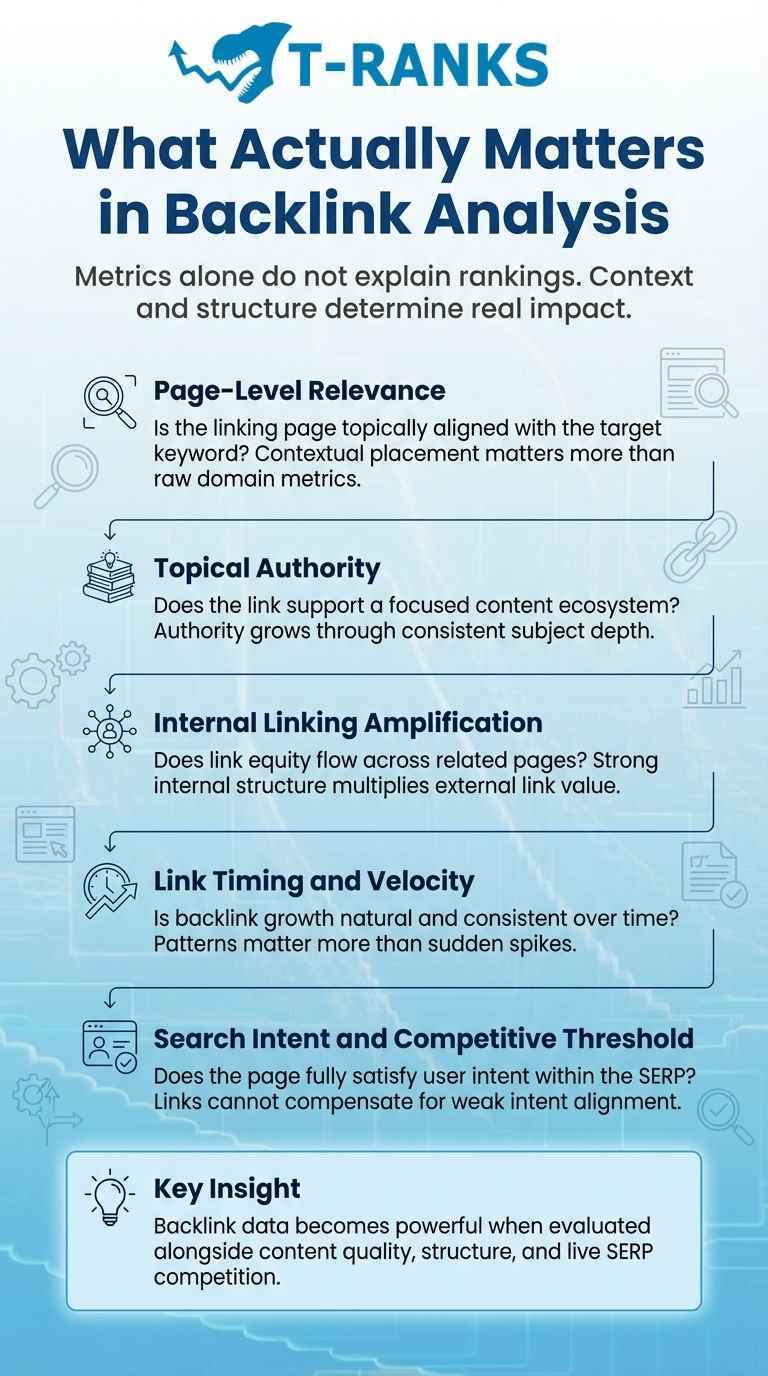
After reviewing the common mistakes, the next step is understanding what truly matters when analyzing backlink checker data. Metrics alone do not explain rankings. Meaningful interpretation requires evaluating how links interact with content, structure, intent, and competition.
Below are the core factors that should guide backlink analysis.
Page-Level Relevance
Backlink impact is determined primarily at the page level, not the domain level. When evaluating a link, the first question should be whether the linking page is topically aligned with the target keyword.
A contextual link placed within highly relevant content sends a stronger signal than a generic link from an unrelated article, even if the domain has higher authority. Relevance strengthens semantic consistency and reinforces keyword alignment. Without topical connection, link strength weakens regardless of DR or DA.
Always evaluate the linking page itself. Review its content, keyword focus, structure, and authority. The domain matters, but the linking page matters more.
Topical Authority
Backlinks are most effective when they support a structured topical ecosystem. A site that consistently publishes related content and builds authority around a focused theme sends stronger signals than a site with scattered, unrelated topics.
Topical authority develops when multiple pages support a central subject through interlinked content clusters. External backlinks strengthen this ecosystem when they reinforce the same theme.
When interpreting backlink data, consider whether the links are contributing to a clear topical strategy or simply increasing raw metrics.
Internal Linking Amplification
External backlinks pass authority to specific pages. Internal linking determines how that authority flows across the site.
If internal linking is weak, disorganized, or shallow, the impact of strong backlinks may be limited. Proper internal structure allows link equity to support related pages, strengthen content clusters, and improve overall ranking stability.
When reviewing backlink data, evaluate whether internal linking supports authority distribution. A strong external link combined with intelligent internal linking often produces greater results than multiple isolated backlinks.
Link Timing and Velocity
Backlink growth should appear natural over time. Search engines analyze patterns, not isolated events.
Sudden spikes in link acquisition, especially from unrelated sources, can create instability. Consistent and context-driven link growth aligns better with content promotion and natural visibility.
When analyzing backlink velocity charts, focus on pattern sustainability rather than short-term growth bursts.
Search Intent Match and Competitive Threshold
Even strong backlinks cannot compensate for poor intent alignment. If a page does not fully satisfy user expectations, additional links may not improve rankings.
Backlink analysis must always be paired with live SERP evaluation. Compare authority levels, content depth, and intent match among top-ranking pages. Sometimes rankings stall not because of weak backlinks, but because the page fails to exceed the competitive threshold within the SERP.
Understanding authority balance within the live search results provides clarity on whether additional links are necessary or whether content improvement will yield better results.
How to Use Backlink Checker Data Correctly in 2026
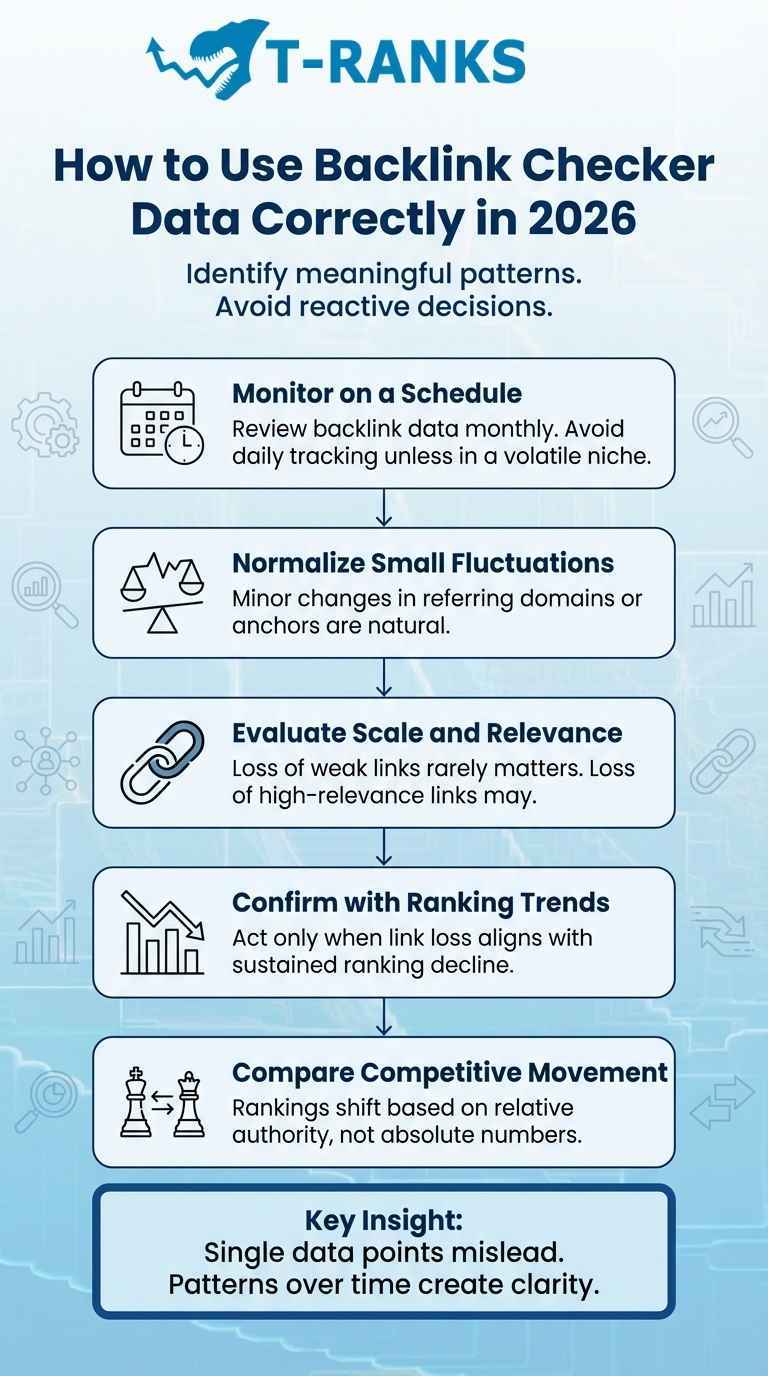
Backlink checker data should be reviewed consistently, but not obsessively. The objective is not to react to every fluctuation, but to identify meaningful patterns over time.
For most websites, reviewing backlink data once or twice per month is sufficient. Highly competitive industries may require closer monitoring, but daily tracking often creates unnecessary reactions. Backlink profiles naturally fluctuate as pages are updated, removed, or restructured across the web.
Minor changes can usually be ignored. Small shifts in referring domains, modest anchor distribution adjustments, or isolated lost links rarely affect rankings. The impact depends on scale. Losing five weak links on a site with hundreds of referring domains is insignificant. Losing one highly relevant, authoritative link to a key page may require attention.
Action becomes necessary only when multiple indicators align over time. A meaningful scenario may include:
- Noticeable loss of high-relevance links
- A sustained ranking drop across several weeks
- Visible competitor movement within the same SERP
- Clear authority imbalance compared to top-ranking pages
Single data points do not justify aggressive changes. Patterns do.
Competitive context also matters. Before attributing ranking changes to backlinks, analyze whether competitors gained stronger links, improved content depth, or adjusted their intent alignment. Rankings shift because of relative strength, not absolute numbers.
Patience is often the smarter move. Search engines evaluate link behavior across timeframes, not daily fluctuations. Sustainable SEO performance comes from steady authority building, content improvement, and internal linking optimization rather than reactive link removal or volume chasing.
In 2026, using backlink checker data correctly means interpreting weight, scale, timing, and competition together. Metrics inform strategic decisions, but they do not replace informed judgment.
Final Thoughts: Strong SEO Foundations Eliminate Backlink Data Confusion
In conclusion, backlink checker data only becomes misleading when it is interpreted without strong SEO fundamentals. Metrics like DR, DA, Authority Score, spam labels, anchor ratios, and link growth charts are useful indicators, but they do not explain rankings by themselves.
Rankings are shaped by page relevance, search intent alignment, topical authority, internal structure, and competitive balance within the live SERP. Backlink data must be analyzed alongside manual competitor review and real search behavior, not in isolation.
When metrics are evaluated strategically rather than emotionally, decisions become clearer and more effective.
Backlink tools do not rank pages. SEO understanding does.
If you want consistent ranking growth in 2026, strengthen your SEO foundation first, then use backlink tools to support informed, strategic decisions.
FAQs About Backlink Checker Data and Interpretation
1. Does Google use DR, DA, or Authority Score to rank websites?
No, Google does not use DR, DA, or Authority Score in its ranking systems.
These are third-party metrics designed to estimate link strength for comparison, not official Google signals.
2. Can a high DR backlink fail to improve rankings?
Yes, a high DR backlink can fail to improve rankings if it lacks relevance or contextual placement.
Link impact depends on page-level alignment, intent match, and competitive balance within the SERP.
3. Does losing backlinks automatically cause ranking drops?
No, losing backlinks does not automatically cause ranking drops.
Impact only occurs when high-relevance links are lost and ranking decline is confirmed over time.
4. What does a high spam score actually mean?
A high spam score indicates that a tool has detected patterns associated with potentially risky links.
It does not confirm a Google penalty and requires manual verification before action.
5. Should I disavow links if my toxic score increases?
No, you should not disavow links solely because a toxic score increases.
Manual review is necessary to confirm whether links are truly manipulative or harmful.
6. Are more backlinks always better for SEO?
No, more backlinks do not automatically improve rankings.
Strategic links from diverse, relevant domains are more effective than large volumes of weak or repetitive links.
7. Why is referring domain count more important than total backlinks?
Referring domain count reflects link diversity, which signals broader authority.
Multiple links from the same domain often provide diminishing ranking value.
8. Can low DR links still help rankings?
Yes, low DR links can help if they are highly relevant and contextually placed.
Relevance and page-level authority often matter more than raw domain metrics.
9. How often should backlink data be reviewed?
Backlink data should generally be reviewed once or twice per month.
Frequent monitoring can lead to overreaction unless operating in a volatile niche.
10. What happens if my anchor text ratio changes?
Minor anchor ratio changes are normal and rarely harmful.
Only consistent overuse of exact-match anchors across multiple domains may create optimization risk.
11. Why should backlink data be analyzed alongside SERP results?
Backlink data alone does not explain ranking behavior.
Live SERP analysis reveals intent alignment, content strength, and competitive thresholds that tools cannot measure fully.
12. Can backlink tools predict ranking outcomes?
No, backlink tools cannot predict rankings with certainty.
They provide analytical estimates, while actual performance depends on content quality, intent match, and competition.