One of the most common questions in SEO is simple. How many backlinks do I need to rank. The problem is that there is never a clear or fixed answer. Rankings change, competitors improve, and what works for one page may fail for another. This uncertainty is exactly why backlink forecasting matters.
Backlink forecasting does not try to find a guaranteed number of backlinks. There is no fixed number that ensures rankings. Instead, it focuses on comparing your page with the pages that already rank, understanding the authority gap between them, and planning backlinks in a safe and realistic way. This approach helps avoid guessing, wasted budgets, and unstable link strategies.
In this guide, you will learn how backlink forecasting works as a practical process. You will see how to analyze ranking pages, estimate backlink ranges rather than exact totals, and plan steady link growth over time. You will also understand how strong backlink authority supports visibility in AI Overviews as a natural result of trust and relevance, not as a separate system.
What Backlink Forecasting Means

Backlink forecasting is the process of estimating how many backlinks may be needed to compete for a keyword by comparing your page with the pages that already rank.
Instead of guessing or relying on fixed backlink numbers, backlink forecasting uses the live search results as the benchmark. It looks at the authority signals of ranking pages, such as referring domains and topical relevance, to understand what Google is already rewarding for that keyword.
The goal of backlink forecasting is planning, not prediction. It helps you decide whether a keyword is realistic to target, how much link building effort may be required, and how to approach backlinks in a controlled way instead of building links blindly and hoping for results.
How Many Backlinks Do You Need to Rank?

There is no fixed number of backlinks that triggers rankings.
Search results do not work on a threshold where rankings suddenly improve after reaching a specific link count. The number of backlinks required always depends on the competitiveness of the keyword, the strength and trust of your website, and the quality and relevance of the links involved.
Because ranking systems evaluate authority in a relative and non-linear way, backlink forecasting works with ranges rather than exact totals. Factors such as niche competition, existing authority, content quality, and E-E-A-T signals all influence how many links are actually needed before meaningful movement occurs.
In most SERPs, referring domains matter more than total backlink counts. Links from a wider set of relevant websites signal stronger authority than repeated links from the same source. Once a site has already linked to you, additional links from that same site usually add limited new value, which is why raw backlink totals can be misleading when forecasting rankings.
This is also why fewer high-quality links can outperform larger volumes of weaker ones. Contextual links from authoritative, topically aligned websites tend to build trust faster and close authority gaps more effectively than dozens of generic or unrelated backlinks. When relevance and quality are high, the total number of links required to compete is usually lower, and the results are more stable over time.
Backlink Forecasting Method: How to Estimate the Backlinks Needed to Rank
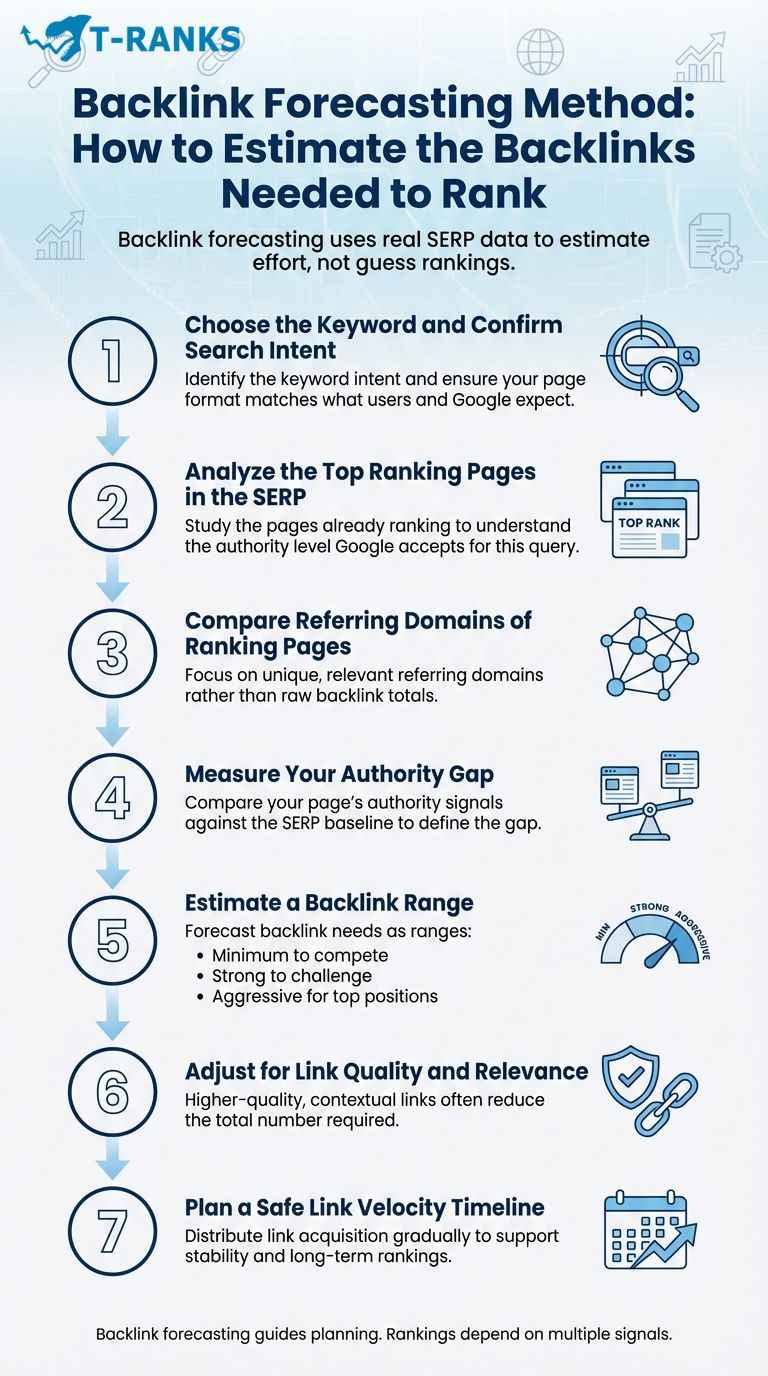
Backlink forecasting is a comparison process, not a guessing exercise.
The goal is not to find a fixed backlink number, but to understand what level of authority already works in the SERP and how far your page is from competing. By comparing your page with ranking pages, backlink data becomes a planning signal instead of a raw metric.
Step 1: Choose the Keyword and Confirm Search Intent
Backlink forecasting only works when the page intent matches the keyword intent.
If your page does not satisfy what users expect, backlinks will have limited impact regardless of quality.
Start by identifying whether the keyword is informational, commercial, transactional, or local. Then confirm that your page format, depth, and focus align with what currently ranks. Forecasting backlinks for the wrong page type almost always leads to wasted effort.
Step 2: Analyze the Top Ranking Pages in the SERP
The SERP sets the authority requirements, not SEO tools.
Tools provide data, but ranking pages show what Google already accepts for that query.
Review the pages ranking on the first page, especially the top positions. Focus on the actual URLs, not just overall domain strength. This step grounds your forecast in real ranking behavior instead of assumptions.
Step 3: Compare Referring Domains of Ranking Pages
Referring domains provide a clearer authority benchmark than raw backlink totals.
Multiple links from the same website usually add limited new value compared to links from unique, relevant sources.
Compare the referring domain profiles of the ranking pages. Look for patterns in volume, diversity, and topical alignment. This establishes a realistic authority baseline for the SERP you are targeting.
Step 4: Measure Your Authority Gap
Forecasting becomes actionable once you identify the authority gap.
This gap represents how much effort is required before your page can realistically compete.
Compare your page’s authority signals with those of the ranking pages. Smaller gaps often require fewer links and shorter timelines. Larger gaps usually mean more time, stronger links, or both.
Step 5: Estimate a Backlink Range
Backlink forecasts should always be expressed as ranges, not exact numbers.
Search rankings do not respond to links in a linear or predictable way.
A practical forecast usually includes:
- A minimum range to become competitive
- A stronger range to challenge higher positions
- An aggressive range for top placement goals
These ranges help guide planning without creating false expectations or unnecessary risk.
Step 6: Adjust the Forecast Based on Link Quality and Relevance
Link quality directly affects how many backlinks are actually needed.
Relevant and contextual links often reduce the total volume required, while low-quality or unrelated links increase risk and weaken predictability.
This step refines the forecast rather than replacing it. Strong links improve efficiency. Weak links make outcomes harder to control.
Step 7: Plan a Safe Link Velocity Timeline
Backlink forecasting includes time, not just quantity.
Authority growth that happens too quickly often fails to produce stable results.
Plan link acquisition at a pace that matches your site’s current strength and history. Gradual growth supports trust signals and increases the likelihood of sustained ranking improvements.
When Backlink Forecasting Tells You Not to Build Links
Backlink forecasting is not only about estimating how many backlinks are needed. In some situations, forecasting clearly shows that building backlinks is not the right next step. Recognizing these signals early helps avoid wasted effort, unrealistic expectations, and unstable SEO outcomes.
An Authority Gap That Is Too Large
If ranking pages are supported by significantly stronger authority and your page is far behind, forecasting may show that closing the gap would require unrealistic time or resources. In these cases, link building alone rarely delivers meaningful progress without broader authority or content improvements.
SERPs Dominated by Major Brands or Platforms
Some search results are controlled by well-established brands, marketplaces, or authoritative platforms. Forecasting often reveals that backlinks alone are insufficient to compete, especially for newer or mid-authority sites targeting highly competitive queries.
Search Intent Misalignment
If your page does not match the intent satisfied by ranking results, backlinks will have limited impact. Forecasting helps surface this mismatch early and signals that content format or intent alignment must be corrected before link building can be effective.
Content Quality as the Primary Limitation
Backlinks amplify strong pages but do not fix weak ones. When ranking pages provide greater depth, clarity, or usefulness, improving content usually produces better returns than increasing backlink volume.
Weak Internal Linking and Site Structure
In some cases, the authority gap exists because internal signals are not supporting the page properly. Strengthening internal linking and contextual relevance is often required before external backlinks can generate reliable results.
Timelines or Budgets That Do Not Match the Forecast
Backlink forecasting helps set realistic expectations. If the estimated effort exceeds available time or budget, the smarter decision may be to deprioritize the keyword rather than pursue it aggressively.
Backlink forecasting delivers the most value when it informs smarter decisions, not just more link building. Knowing when not to build backlinks is often as important as knowing how many are needed.
How Backlink Forecasting Differs by Page Type
Backlink forecasting does not apply uniformly across all pages. The number and type of backlinks needed to rank can change significantly depending on the page’s purpose, intent, and position within the site. Forecasting without considering page type often leads to inaccurate expectations and inefficient link building.
Informational and Blog Content
Informational pages usually compete on topical depth and relevance rather than raw authority. Backlink forecasting for blog content often requires fewer links when the content clearly satisfies search intent and demonstrates subject-matter expertise. In many cases, a smaller number of highly relevant backlinks combined with strong internal linking is enough to close the authority gap.
Commercial and Service Pages
Commercial pages typically face higher competition and stronger authority benchmarks. Forecasting for these pages often involves larger backlink ranges because ranking pages tend to be supported by consistent authority signals and broader referring domain profiles. Link relevance and trust are critical, as aggressive or low-quality links can reduce stability.
Ecommerce Category Pages
Category pages often require more sustained authority growth than individual product pages. Backlink forecasting for these pages must account for broader keyword coverage, internal link support, and long-term competitiveness. These pages usually benefit from steady backlink acquisition internal linking
rather than short bursts of link building.
Local Service Pages
Local pages rely on a mix of authority, relevance, and location-based signals. Forecasting backlinks for local pages often requires fewer links than national pages, but relevance and trust are more important than volume. Strong local citations, contextual backlinks, and internal support can significantly reduce the total backlink effort needed.
New Pages vs Existing Ranking Pages
Forecasting differs greatly depending on whether a page is new or already ranking. Pages that already appear on page two or three often require fewer backlinks to improve visibility. New pages usually need more foundational authority before backlinks produce noticeable results, which affects both timelines and expectations.
Backlink forecasting works best when page type is considered early in the planning process. Treating all pages the same ignores intent, competition, and authority dynamics that directly influence ranking outcomes.
How Backlink Forecasting Helps Set Realistic SEO Timelines
Backlink forecasting plays a critical role in setting realistic SEO timelines by grounding expectations in measurable authority gaps rather than assumptions. One of the most common SEO failures is expecting immediate results from link building, even when competition and authority signals suggest otherwise.
By analyzing what already ranks and how strong those pages are, backlink forecasting helps establish realistic timeframes for movement instead of relying on generic or overly optimistic timelines.
Why Rankings Rarely Improve Immediately After Building Links
Search engines do not respond to backlinks instantly. New links must be discovered, evaluated, and integrated into broader authority signals before they influence rankings. Even high-quality backlinks often require time to produce visible results, especially in competitive SERPs.
Backlink forecasting accounts for this delay by aligning expectations with how authority typically compounds over time.
Short-Term vs Long-Term Forecasting Expectations
Forecasting helps distinguish between situations where early movement is realistic and those that require sustained effort. Smaller authority gaps or lower-competition SERPs may respond sooner, while competitive queries often demand longer timelines and consistent authority growth.
How Authority Gaps Influence Ranking Timelines
The size of the authority gap directly affects how long ranking improvements take. When ranking pages are supported by strong and diverse referring domains, closing that gap requires time even with steady link acquisition.
Forecasting ties expected timelines to measurable authority differences rather than arbitrary deadlines.
Managing Expectations During Ranking Plateaus
SEO progress is rarely linear. Rankings often move in stages, with periods of little visible change followed by sudden improvements. Backlink forecasting prepares for these plateaus by setting expectations around gradual authority accumulation rather than constant upward movement.
This prevents premature strategy changes when progress appears slow but remains structurally sound.
When to Reassess a Backlink Forecast
Backlink forecasts are not static. Changes in SERP competition, algorithm behavior, or content quality can alter required effort and timelines. Periodic reassessment ensures link building remains aligned with current conditions rather than outdated assumptions.
Backlink forecasting improves SEO timelines by replacing vague promises with informed planning. It helps teams stay patient, consistent, and focused on long-term results.
Factors That Change Backlink Forecasting Results
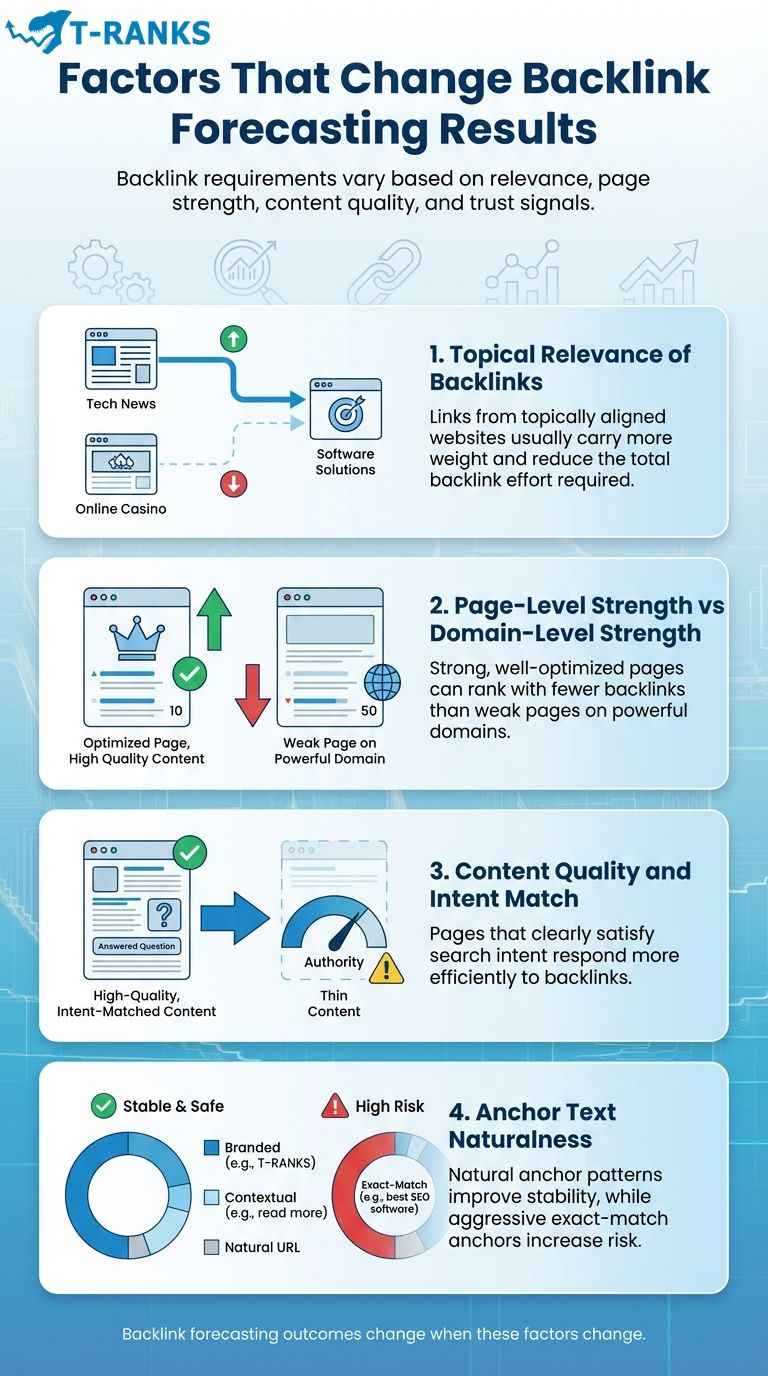
Not all keywords or pages require the same backlink effort. Backlink forecasting changes based on contextual factors that either strengthen or limit how much impact backlinks can realistically have. Ignoring these factors often leads to inflated forecasts or unnecessary link building.
Topical Relevance of Backlinks
Links from websites closely aligned with your topic usually carry more weight than links from unrelated sources. Strong topical relevance reinforces authority and trust, often reducing the total number of backlinks needed to compete. Off-topic links may still count, but they dilute impact and make forecasts less efficient.
Page-Level Strength vs Domain-Level Strength
Rankings are often driven by the strength of individual pages, not just the overall domain. A well-optimized page with strong internal links and existing relevance can require fewer external backlinks than a weak page on a powerful domain. Backlink forecasting should prioritize page-level authority content quality
, with domain strength acting as support.
Content Quality and Intent Match
Backlinks amplify page strength, but they do not correct weak content or intent mismatch. Pages that clearly satisfy search intent link velocity and provide depth respond more efficiently to links. Thin content or poor intent alignment increases the backlink effort required and limits ranking potential.
Anchor Text Naturalness
Natural anchor text patterns improve forecast stability. Branded, generic, and contextual anchors help backlinks contribute authority safely. Overuse of exact-match anchors increases risk and reduces predictability, making forecasts less reliable.
Internal Linking Support
Strong internal linking reduces reliance on external backlinks. Pages that are well supported internally distribute authority more effectively and often require fewer external links to compete. Weak internal structure increases the external backlink effort needed to see movement.
Existing Site Trust and History
Older, trusted websites typically respond faster to backlinks than new or inconsistent sites. A clean history and established authority reduce friction, while newer or previously unstable sites often require more effort and time for the same impact.
SERP Competitiveness and Stability
Some SERPs are stable, while others change frequently. Highly competitive or volatile SERPs usually require stronger authority and ongoing effort. Stable SERPs may respond to fewer, well-placed links, making forecasting more conservative and predictable.
How Backlink Forecasting Influences AI Overviews and Citations
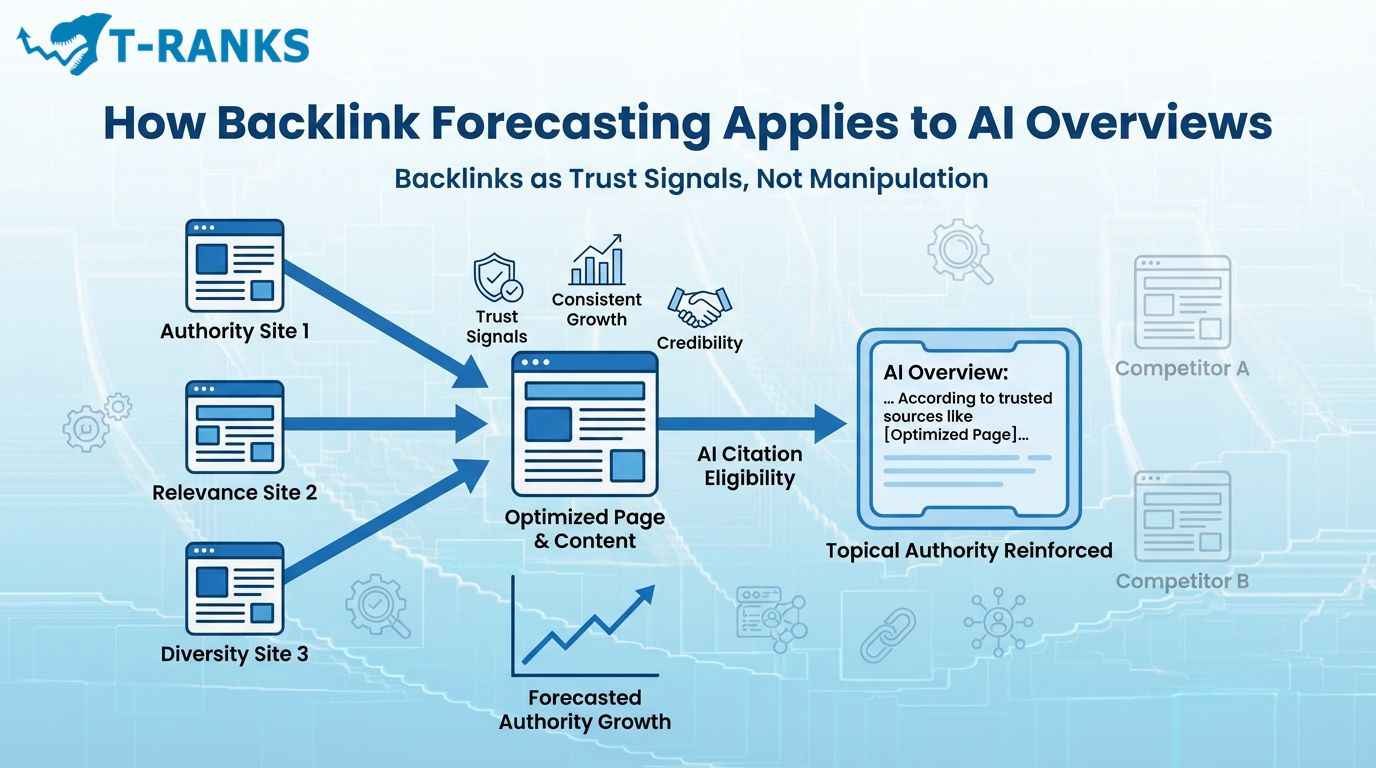
Backlink forecasting plays an important role in AI Overviews by helping identify which authority-building efforts are most likely to result in citations within AI-generated summaries. While AI Overviews prioritize clear, helpful, and well-structured content, backlinks remain a core signal for evaluating trust, credibility, and source reliability.
Increasing Citation Likelihood
Pages with strong and diverse backlink profiles are more likely to be selected as sources in AI Overviews. In most cases, AI systems reference pages that already demonstrate organic authority, making backlink strength a predictor of visibility rather than a separate optimization tactic.
Reinforcing Authority Signals Used by AI Systems
The same authority signals that support traditional rankings also support AI citation decisions. Referring domain diversity, topical relevance, and consistent trust indicators help confirm that a page represents established expertise, making it safer for AI systems to reference.
Strengthening Topical Authority Through Links
Backlink forecasting shifts focus from link volume to topical alignment. Links from websites recognized as authorities within a niche reinforce subject-matter credibility, which increases the likelihood of being cited in AI summaries.
Identifying Authority Gaps Against Competitors
Forecasting helps reveal backlink gaps between your page and competitors that already appear in AI Overviews. By understanding which authority signals those pages have earned, you can plan backlink efforts that move your content closer to the same level of trust.
Supporting Long-Term Visibility, Not Short-Term Optimization
AI Overviews tend to rely on sources with sustained authority rather than short-term spikes. Backlink forecasting encourages steady, reliable authority growth that benefits both organic rankings and AI visibility over time.
This relationship is supported by real-world results. In the T-RANKS AI Overviews case study, pages that improved the diversity and relevance of their referring domains achieved stronger inclusion in AI-generated summaries. The gains came from forecasting backlink effort and building authority methodically, not from targeting AI systems directly
Common Backlink Forecasting Mistakes
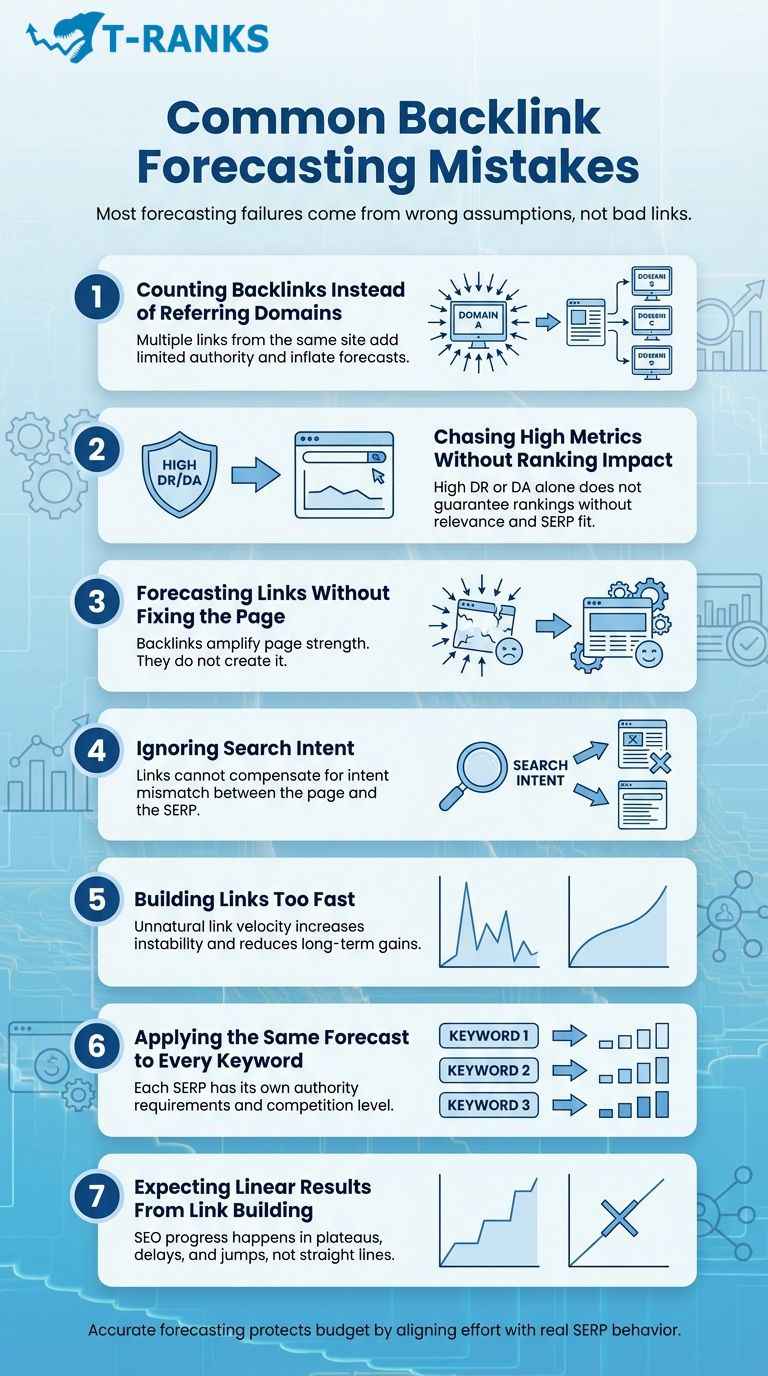
Most backlink forecasting mistakes happen because of incorrect assumptions, not because backlinks do not work. These errors often lead to wasted budget, unstable growth, and weak visibility in both search rankings and AI Overviews.
Counting Total Backlinks Instead of Referring Domains
Forecasting based on raw backlink counts inflates expectations. Authority is built through links from unique and independent websites, not repeated links from the same source.
Over-Prioritizing DR or DA Metrics
High DR or DA scores do not guarantee ranking impact. Ignoring topical relevance and SERP alignment weakens both ranking performance and AI citation potential.
Forecasting Backlinks Before Fixing the Page
Backlinks amplify existing strength. They do not correct weak content, poor structure, or unclear intent. Forecasting links for an unprepared page leads to disappointing results.
Ignoring Search Intent During Forecasting
When a page targets a different intent than the ranking results, backlink estimates become unreliable. Links cannot compensate for intent mismatch.
Building Backlinks Too Aggressively
Unnatural growth patterns reduce trust and stability. Forecasting must account for pacing, not just volume, to support long-term rankings and AI visibility.
Using the Same Forecast for Every Keyword
Each SERP has its own authority baseline. Applying a single backlink forecast across different keywords ignores competition differences and leads to inaccurate planning.
Expecting Linear Progress From Link Building
SEO and AI visibility rarely improve in steady increments. Progress often happens in plateaus, delays, and sudden jumps, which forecasting must account for.
Conclusion: Forecast First, Build Smarter

In conclusion, backlink forecasting makes SEO more predictable by replacing assumptions with structured comparison and planning. Instead of guessing how many backlinks might work, it helps you analyze what already ranks, measure real authority gaps, and estimate backlink effort using realistic ranges rather than fixed numbers. This approach reduces wasted budget, avoids overbuilding, and leads to more stable ranking outcomes.
Backlink forecasting works best when it focuses on high-value pages, strong content, and gradual authority growth. When backlinks are planned around relevance, intent, and realistic timelines, they support long-term visibility in both organic search results and AI Overviews without introducing unnecessary risk.
If you want to apply backlink forecasting correctly and build authority with clarity and control, T-RANKS can help you plan and execute backlink strategies that are data-driven, safe, and designed for sustainable growth.
FAQs: Backlink Forecasting & Ranking
What is backlink forecasting in SEO?
Backlink forecasting is the process of estimating the backlink effort needed to compete for a keyword based on the current SERP. It compares your page with ranking pages to plan links realistically instead of guessing.
How many backlinks do I need to rank on Google?
There is no fixed number of backlinks required to rank. The required range depends on keyword competition, referring domains of ranking pages, and backlink quality and relevance.
Can you rank with fewer backlinks than competitors?
Yes, it is possible to rank with fewer backlinks if your page matches search intent better and has stronger topical relevance. High-quality content can reduce the total link effort needed.
Are referring domains more important than total backlinks?
Yes, referring domains usually matter more than raw backlink counts. Links from multiple unique and relevant websites signal stronger authority than many links from the same site.
Does backlink quality affect forecasting results?
Yes, backlink quality directly affects forecasting accuracy. Relevant and contextual links often reduce the number of backlinks needed to see ranking improvements.
How long does it take for backlinks to impact rankings?
Backlinks typically take weeks or months to influence rankings. The timeline depends on site authority, link velocity, and how competitive the SERP is.
Does link velocity matter in backlink forecasting?
Yes, link velocity is a critical factor. Building links too fast can reduce trust, while steady and natural growth supports more stable rankings.
Can backlink forecasting guarantee rankings?
No, backlink forecasting cannot guarantee rankings. It helps estimate effort and reduce uncertainty, but algorithms, competitors, and intent changes remain outside control.
Do backlinks help with AI Overviews and AI citations?
Yes, strong backlink profiles increase the likelihood of appearing in AI Overviews. The same authority signals that support rankings also influence AI citation selection.
Is backlink forecasting useful for new websites?
Yes, but forecasts for new websites usually involve longer timelines and higher effort. New domains often need foundational authority before backlinks produce strong results.
What happens if I build fewer backlinks than forecasted?
Building fewer backlinks can slow or limit ranking progress. Forecast ranges help set minimum effort expectations, and underbuilding often leads to stalled results.
Should I forecast backlinks for every page on my site?
No, backlink forecasting should focus on high-value pages only. Forecasting links for low-impact or weak pages usually wastes budget and effort.