Are you building backlinks without knowing whether they will actually improve your rankings?
Many websites invest time and effort into link building, only to see little or no impact.
Backlink prediction helps reduce this uncertainty. It is a way to estimate how a backlink is likely to affect rankings and visibility before it is built. Instead of relying on guesswork, it looks at patterns from past link behavior to guide better decisions.
This article explains backlink prediction as a planning concept, not a tool or a report. You will learn what backlink prediction means, why it matters today. How it differs from backlink analysis, and how it supports smarter link building decisions.
Why Backlink Prediction Matters Today
Backlink prediction matters today because link building has become more competitive, expensive, and pattern driven. Understanding likely impact before acquiring links is now essential for building authority in a sustainable way.
Not All Backlinks Improve Rankings
Not every backlink produces lasting value. Building links without understanding their likely impact increases wasted effort and leads to inconsistent results. As competition increases, pursuing low impact links becomes more expensive, making careful selection more important than volume.
Link Building Requires Time, Budget, and Planning
Link building requires sustained outreach, budget, and resources. When effort is spent on links that add little value, overall efficiency declines. Backlink prediction helps prioritize opportunities that are more likely to justify the investment.
Search Engines Evaluate Link Patterns Over Time
Search engines assess backlinks as patterns that develop over weeks and months, not as isolated placements. They evaluate relevance, consistency, timing, and source behavior rather than reacting to single links.
Backlink prediction helps align link acquisition with how modern search systems interpret authority.
Reducing Risk Before Resources Are Invested
Backlink prediction helps reduce risk before time and budget are committed. By estimating expected impact in advance, SEOs can avoid links that are likely to be ignored, diluted, or misaligned with existing link behavior.
Supporting Long Term Authority Signals
Backlink prediction supports alignment with modern search evaluation methods. It helps ensure link acquisition strengthens long term authority instead of contributing to unstable or unnatural patterns.
In today’s SEO environment, success depends on planning rather than accumulation, and backlink prediction provides the foresight needed to build links that support sustainable visibility and authority growth.
Backlink Prediction vs Backlink Analysis
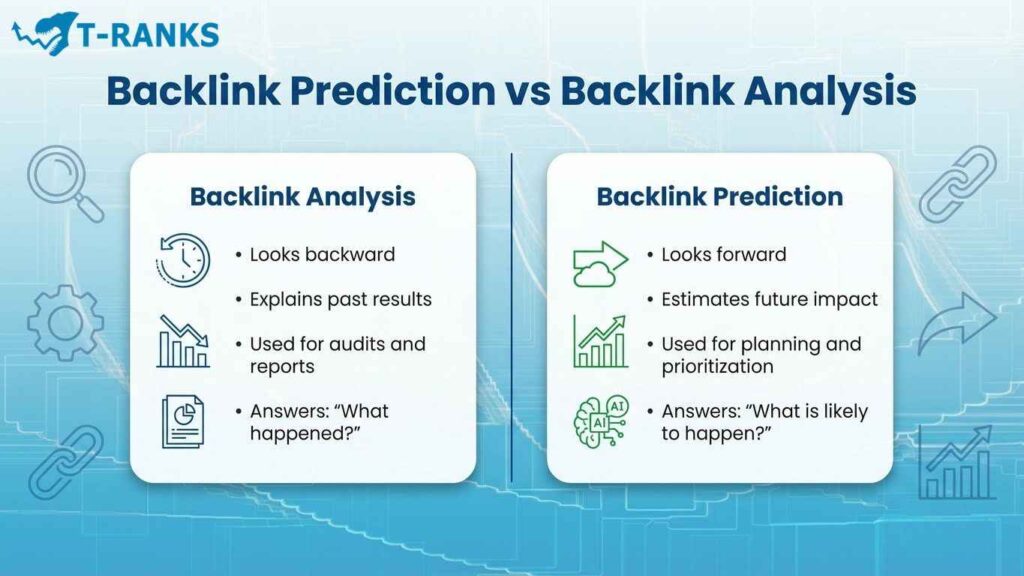
Backlink analysis explains past link performance, while backlink prediction estimates future ranking influence from potential backlinks. These two approaches serve different purposes and are used at different stages of an SEO strategy.
Backlink analysis supports reporting, audits, and evaluation after links are acquired. Backlink prediction supports planning, prioritization, and decision making before outreach and link placement begin.
The difference between backlink analysis and backlink prediction is mainly about timing and intent, as shown below.
Key Differences
| Aspect | Backlink Analysis | Backlink Prediction |
| Time orientation | Backward looking at existing links | Forward looking at potential links |
| Primary purpose | Reporting, audits, and link evaluation | Planning and prioritizing link opportunities |
| Core data | Current backlink profile, anchors, authority signals | Pattern simulations, relevance, timing, risk likelihood |
| Output | Metrics such as traffic contribution or authority change | Forecasts such as expected uplift or impact probability |
| Typical use | Explaining what caused past results | Estimating what is likely to happen next |
When to Use Each
Backlink analysis is most effective after links are acquired. It helps explain ranking changes, validate link quality, and support accountability in reporting.
Backlink prediction is most effective before outreach begins. It helps simulate possible outcomes, avoid low impact opportunities, and guide smarter allocation of time and budget.
How AI Estimates Backlink Ranking Impact
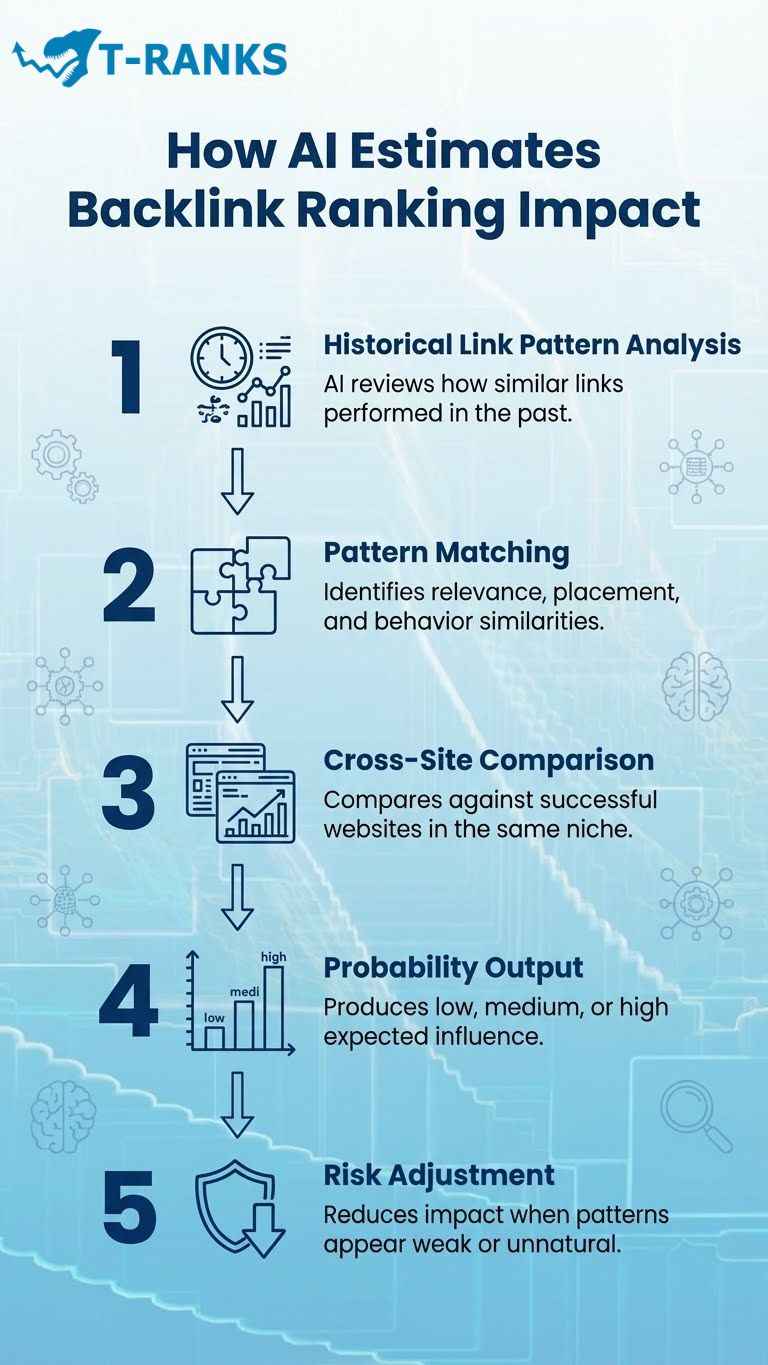
AI estimates backlink ranking impact by analyzing backlink behavior at scale, not by guessing rankings. In practice, this is done using AI systems and automation workflows that study how backlinks behave across many websites over time.
Instead of treating each backlink as a single event, AI looks at patterns across thousands of links to understand which types of backlinks tend to support rankings and which are usually ignored.
How AI Is Actually Used in Backlink Prediction
In real SEO workflows, AI systems are used to process large backlink datasets that humans cannot analyze manually. These systems review backlink profiles, competitor link behavior, and historical ranking movement to detect repeatable patterns.
For example, AI agents built with platforms like ChatGPT can be used to summarize backlink profiles, group links by topic, placement type, and anchor usage, and highlight similarities between links that preceded ranking improvements.
Automation systems such as n8n or Make are often used to connect SEO tools, backlink data, and AI models. These systems continuously collect backlink information, track changes over time, and feed structured data into AI models for analysis.
Learning From Competitor Backlink Behavior
AI-based workflows are especially useful for competitor analysis. Automation systems can monitor how competitors earn links, how quickly those links appear, and what types of sources are involved.
AI then evaluates which competitor backlinks were followed by ranking gains and which had no visible effect. This allows SEOs to identify patterns that suggest higher or lower expected impact before pursuing similar links.
Estimating Impact Before Outreach
When evaluating a potential backlink, AI compares it against patterns learned from historical and competitor data. It checks whether the opportunity aligns with link behavior that has previously supported ranking growth in similar situations.
Instead of predicting rankings, AI assigns a likelihood of positive influence. Links that closely match successful patterns are flagged as higher priority, while links that resemble commonly ignored behavior are deprioritized.
Supporting Smarter Outreach Decisions
Backlink prediction also supports outreach planning. AI-assisted workflows can help prioritize outreach targets, sequence link acquisition over time, and avoid sudden patterns that search systems may discount.
By combining backlink analysis, competitor monitoring, and AI interpretation, SEOs can decide which links to pursue first, which to delay, and which to avoid altogether.
Why This Is Not Just Theory
Backlink prediction is not a standalone AI model making guesses. It is the result of combining backlink data, competitor behavior, and automation-driven analysis into a decision-support system.
AI helps by reducing manual analysis, identifying patterns humans miss, and turning large backlink datasets into practical signals that guide planning before links are built.
Key Signals Used in Backlink Prediction
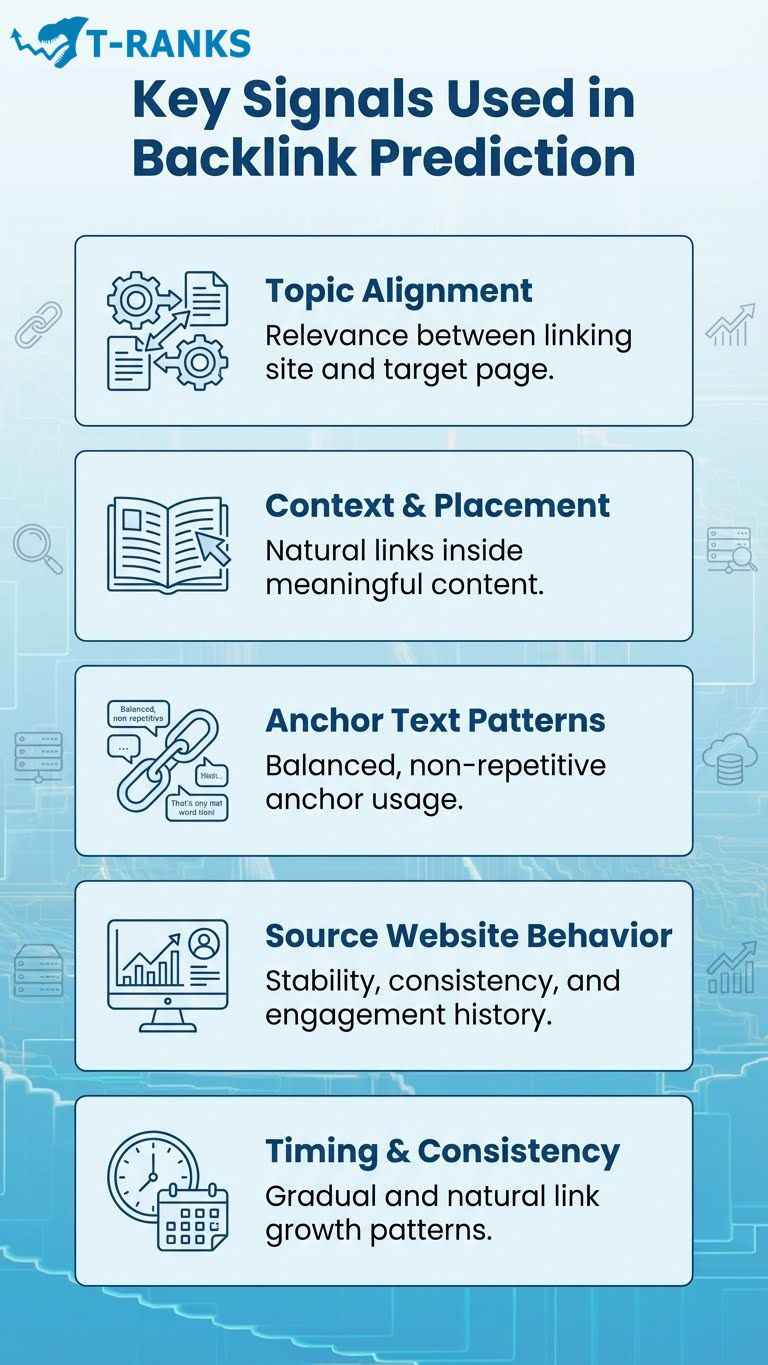
Backlink prediction evaluates whether a backlink fits into patterns that search systems have historically rewarded or ignored. Instead of relying on raw metrics, it focuses on contextual and behavioral signals that indicate how a link is likely to be interpreted over time.
These signals help estimate whether a backlink is likely to strengthen authority, remain neutral, or gradually lose influence.
Topic Alignment
Topic alignment reflects how closely the linking website relates to the subject of the target page. Backlinks from sources that consistently publish within the same topic area are more likely to reinforce authority signals than links from unrelated or loosely connected sites.
In prediction, stronger topical alignment increases the likelihood that a backlink will contribute positive influence.
Context and Placement
Context and placement describe where and how a backlink appears within the page content. Links embedded naturally within relevant paragraphs tend to carry more influence than links placed in footers, sidebars, or repeated sections.
Prediction models treat contextual placement as a signal of editorial intent rather than mechanical linking.
Anchor Text Usage Patterns
Anchor text patterns show how links are described across a backlink profile. Natural variation in anchor intent supports stable link behavior, while heavy repetition often signals manipulation or over-optimization.
Backlink prediction uses anchor patterns to estimate whether a new link will blend naturally or disrupt existing link behavior.
Long-Term Source Website Behavior
The long-term behavior of the linking website affects how its backlinks are interpreted. Sites with stable publishing history, consistent indexing, and sustained engagement tend to pass more reliable influence than sources with irregular or unstable patterns.
Prediction increases confidence when backlinks come from sources with predictable behavior over time.
Timing and Consistency of Link Growth
Timing and consistency refer to how backlinks are acquired over weeks and months. Gradual and steady link growth aligns more closely with natural discovery patterns, while sudden spikes are often discounted or ignored.
Backlink prediction adjusts expected impact based on whether a new link fits into a consistent acquisition pattern.
Taken together, these signals help estimate whether a backlink strengthens existing authority patterns or blends into behavior that search systems commonly discount.
How SEOs Use Backlink Prediction to Evaluate Link Opportunities
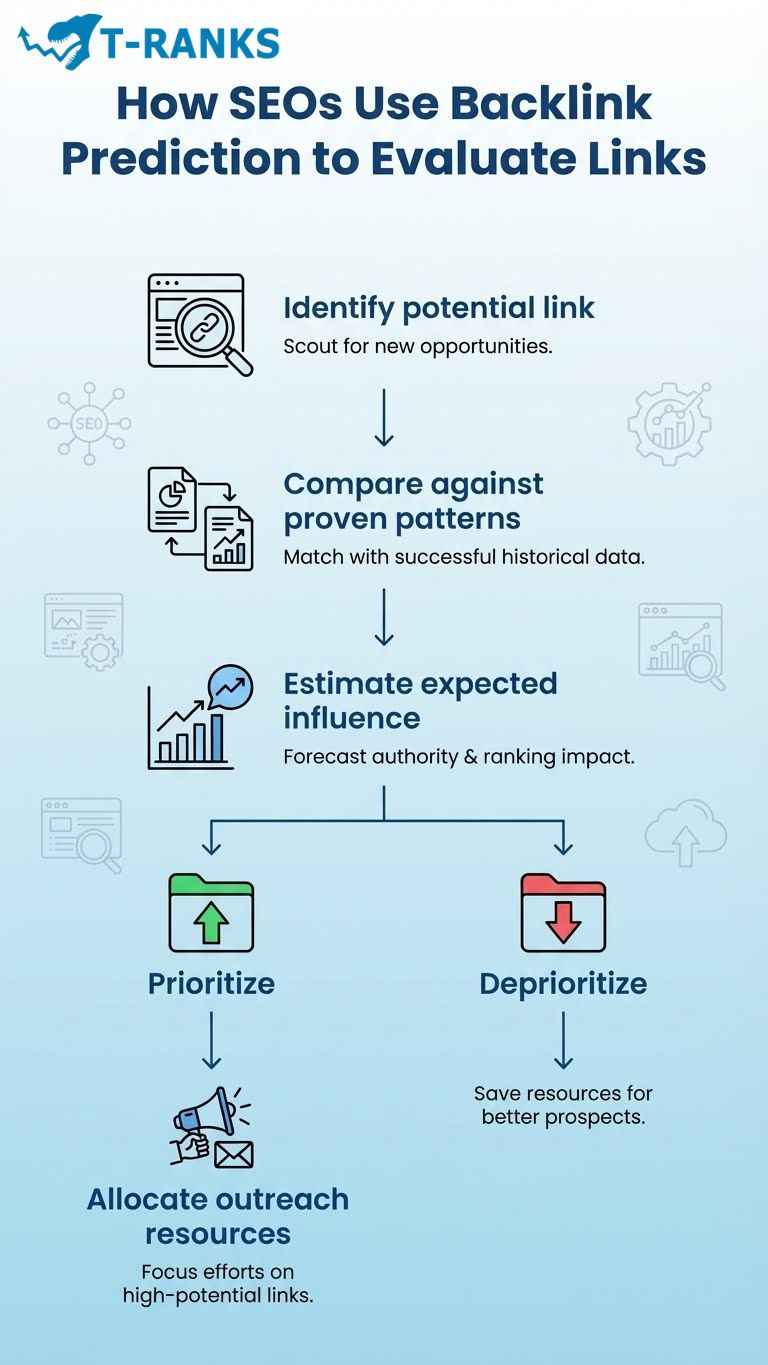
SEOs use backlink prediction to evaluate link opportunities before outreach begins, when time, budget, and effort can still be controlled. Instead of reacting to results later, prediction helps decide whether a backlink is worth pursuing in the first place.
Evaluating a Backlink Opportunity Before Outreach
When assessing a potential backlink, SEOs do not look at the link in isolation. They compare it against patterns that have historically supported ranking improvement on similar websites.
The first question is whether the opportunity matches links that have previously delivered value. This includes checking topical relevance, editorial context, and whether similar links have shown positive influence in comparable situations.
Assessing Alignment With Proven Link Patterns
Backlink prediction helps SEOs evaluate how well an opportunity aligns with existing authority patterns. Links that resemble past successful placements, such as those embedded in relevant content on topic-consistent sites, are given higher priority.
Links that deviate from proven patterns, such as unrelated sources or inconsistent placement, are treated with caution or deprioritized before any outreach begins.
Using Prediction to Prioritize Outreach Targets
Instead of contacting every possible website, SEOs rank link opportunities by expected influence. Backlinks with higher predicted impact are pursued first, while opportunities likely to remain neutral or be discounted are delayed or ignored.
This approach helps focus outreach efforts on links that justify the time and cost involved.
Separating Data From Decision-Making
SEO tools provide historical data such as backlink profiles, competitor links, and placement examples. Backlink prediction begins where tools stop, by interpreting that data and identifying repeatable patterns.
Metrics provide context, but prediction depends on judgment. The decision to pursue a backlink is based on how closely it matches behavior that has previously supported ranking growth.
Reducing Wasted Outreach and Improving Consistency
By estimating expected influence before committing resources, SEOs reduce wasted outreach and avoid inconsistent link acquisition. Backlink prediction makes link building decisions more deliberate, defensible, and aligned with long-term strategy rather than trial and error.
Why Backlink Prediction Uses Probability, Not Guarantees
Backlink prediction uses probability because search rankings are influenced by many factors, not backlinks alone. Even a strong backlink can work slowly, deliver limited impact, or produce no visible change depending on competition, content quality, and timing.
Search systems evaluate backlinks alongside broader ranking signals, and their relative weight can change over time. Because of this, backlink prediction does not make promises. It provides estimated impact ranges that help reduce uncertainty while acknowledging that rankings can never be guaranteed.
Backlink Prediction for New vs Established Websites
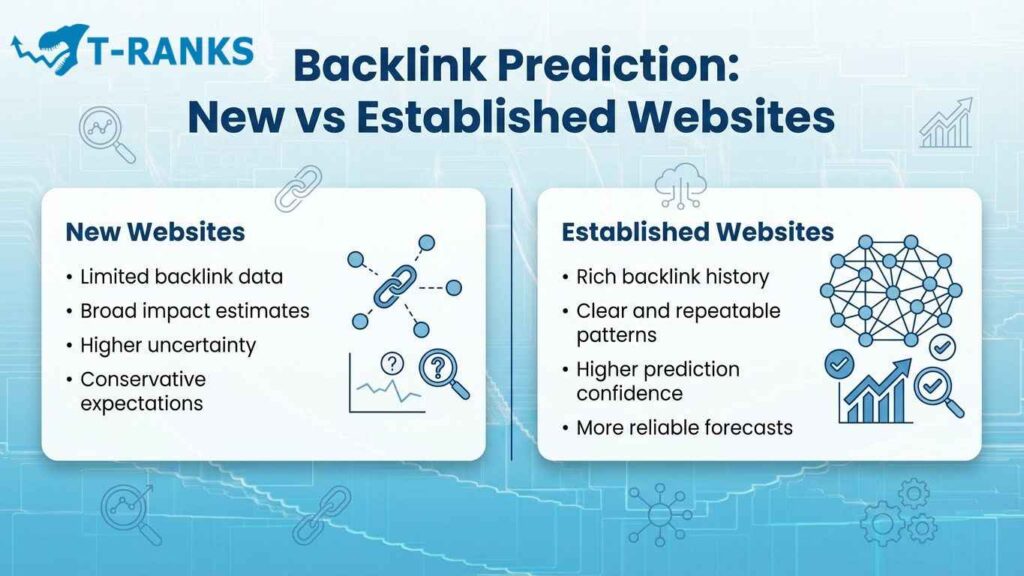
Backlink prediction behaves differently for new and established websites because prediction relies on historical link patterns. New sites have limited data, which leads to broader and more cautious estimates, while established sites show stable behavior that allows more reliable forecasting.
Key Differences
| Aspect | New Websites | Established Websites |
| Data availability | Limited backlink history | Large and mature backlink profiles |
| Pattern clarity | Weak or inconsistent patterns | Stable and repeatable patterns |
| Prediction stability | Broader estimates with higher uncertainty | Narrower estimates with higher confidence |
| Forecast reliability | Conservative and cautious | Generally more reliable |
For new websites, backlink prediction relies more on external reference patterns from similar sites in the same topic area. The focus is on safe alignment and gradual growth rather than aggressive expectations.
For established websites, prediction draws heavily from internal link history. New opportunities are evaluated against proven behavior within the existing profile, allowing clearer estimates of expected influence.
This distinction ensures backlink prediction is applied based on site maturity rather than treated as a one-size-fits-all approach.
How Backlink Prediction Helps Link Building Strategy
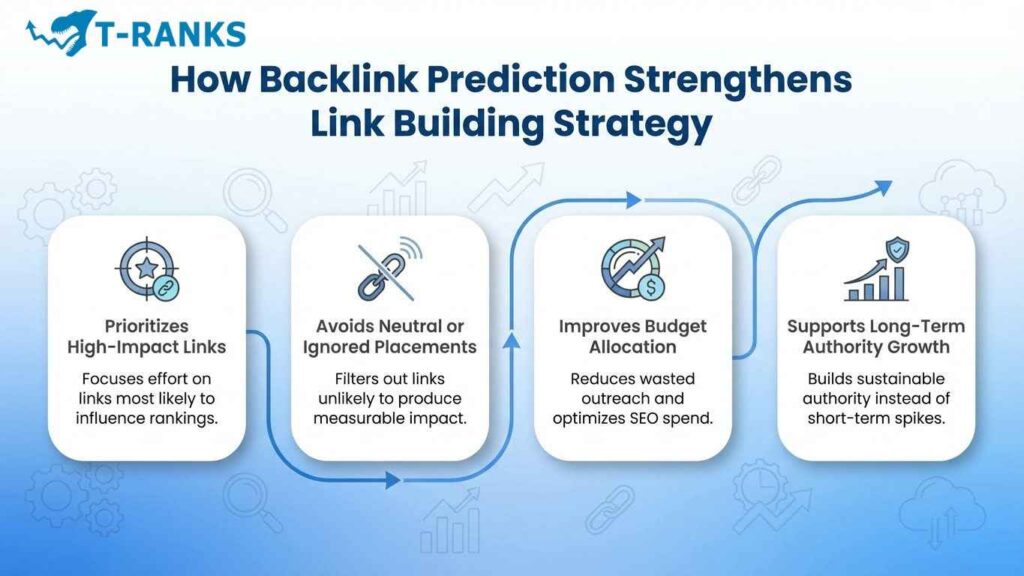
Backlink prediction changes link building strategy by shifting decisions earlier in the process. Instead of measuring success after links are built, it helps SEOs plan which links to pursue before time, budget, and effort are committed.
This moves link building from trial-and-error execution to impact-focused planning.
Shifting Link Building From Volume to Expected Impact
Traditional link building often prioritizes quantity, assuming more links increase results. Backlink prediction shifts this mindset by estimating which links are more likely to influence rankings.
By focusing on expected impact rather than link count, SEOs can build fewer links with stronger strategic value.
Prioritizing Link Opportunities Before Outreach Begins
Backlink prediction helps rank link opportunities before outreach starts. Opportunities that closely match patterns associated with past ranking improvements are prioritized, while lower-probability links are delayed or ignored.
This ensures outreach effort is focused where it has the highest chance of return.
Avoiding Links That Are Likely to Be Neutral or Discounted
Not all backlinks are harmful, but many are simply ignored. Backlink prediction helps identify opportunities that resemble link patterns frequently discounted by search systems.
Avoiding these links prevents wasted outreach and keeps link profiles aligned with stable authority signals.
Improving Budget Allocation and Campaign Consistency
By estimating impact in advance, backlink prediction supports smarter budget decisions. Resources are directed toward links that align with long-term growth rather than short-term experimentation.
This leads to more consistent campaigns, clearer justification for link decisions, and stronger alignment with overall SEO strategy.
Backlink Prediction and AI-Driven Search Results
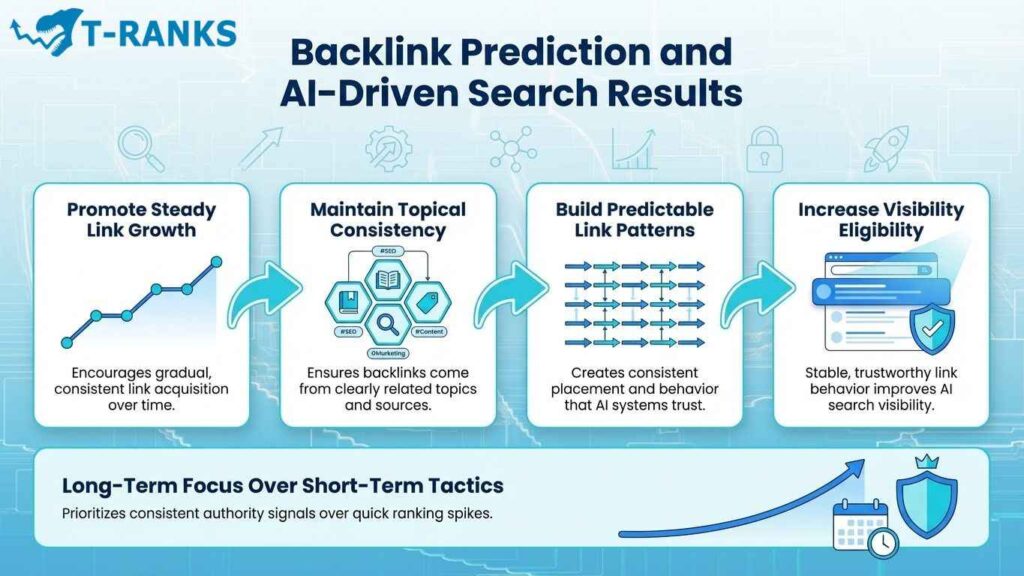
Backlink prediction helps align link building with how AI-driven search systems evaluate trust, relevance, and stability. Instead of reacting to short-term ranking changes, it supports steady link behavior that search systems can interpret with confidence over time.
AI-driven search systems prioritize sources that show consistent and predictable patterns. Backlink prediction encourages link acquisition that develops gradually, reinforcing signals of natural authority rather than sudden or erratic activity.
Topical consistency is another key factor. By favoring backlinks from sources that clearly relate to the same subject area, backlink prediction supports stronger relevance signals that AI-driven systems rely on when selecting trusted references.
Predictable link placement and contextual consistency also improve interpretation. When backlinks follow familiar patterns of editorial placement and meaning, search systems are better able to evaluate them as reliable endorsements rather than mechanical signals.
Websites that demonstrate stable, trustworthy link behavior are more likely to remain eligible for visibility in AI-driven search results. Backlink prediction supports this by guiding link acquisition toward long-term patterns instead of short-term tactics.
Limits of AI-Based Backlink Prediction
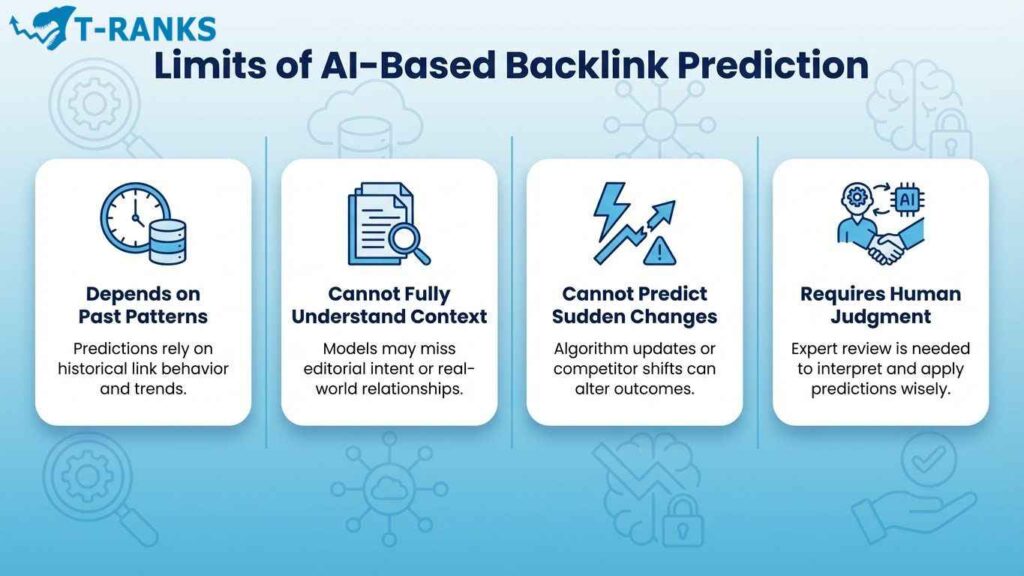
Backlink prediction improves planning, but it does not remove uncertainty or guarantee ranking outcomes. It should be used as guidance for decision-making, not as a promise of results.
Backlink prediction relies on historical link behavior. When search systems evolve, competition shifts, or ranking priorities change, patterns that once worked may lose accuracy over time.
Prediction models also have limited understanding of real-world context. They cannot fully interpret editorial intent, brand relationships, or the underlying reasons why a link exists beyond its visible signals.
Sudden changes cannot be anticipated with precision. Algorithm updates, competitor improvements, or shifts in search intent can quickly alter outcomes in ways prediction models cannot foresee.
For these reasons, human judgment remains essential. Backlink prediction supports SEO expertise but does not replace it. Strategic review is needed to interpret predictions, recognize edge cases, and apply experience-driven decisions.
Understanding these limits keeps backlink prediction realistic and trustworthy. When used correctly, it functions as a planning aid that reduces risk rather than a system that promises outcomes.
The Future of Backlink Prediction in SEO
Backlink prediction is becoming a core part of SEO planning as link building decisions grow more complex and costly. As search systems increasingly evaluate patterns rather than isolated actions, estimating impact before links are acquired is becoming more important than measuring results afterward.
From Measuring Links to Estimating Impact
The future of link building places less emphasis on volume and more on expected influence. Backlink prediction supports this shift by helping SEOs assess which links are likely to contribute to visibility and authority instead of treating all links as equal signals.
Stronger Alignment With Trust and Authority Signals
Backlink prediction aligns closely with how trust and credibility are evaluated in modern search. By encouraging consistent, relevant, and predictable link behavior, it reinforces the signals search systems rely on when determining which sources deserve sustained visibility.
Planning Earlier in the SEO Process
SEO strategies are increasingly shaped before execution begins. Backlink prediction helps guide decisions early, reducing wasted effort and improving long-term outcomes across link acquisition campaigns.
Decision Support, Not Automation Shortcuts
Backlink prediction is not about automation or shortcuts. Its role is to support better decision-making by clarifying expectations and reducing uncertainty while keeping human judgment at the center of strategy.
As backlink prediction becomes standard practice, SEO will continue moving toward thoughtful planning and sustainable growth rather than reactive or volume-driven link building.
Conclusion
in conclusion, backlink prediction helps reduce uncertainty by estimating link impact before time and budget are committed.
By focusing on patterns, probability, and expected influence, it shifts SEO from guesswork to structured planning.
Backlink prediction supports strategy rather than shortcuts.
It prioritizes links with higher expected value, avoids those likely to be neutral, and aligns link building with how modern search systems evaluate trust and authority.
Strong SEO outcomes are built before links are acquired.
When decisions are guided by long-term patterns instead of short-term tactics, link building becomes more efficient, reliable, and sustainable.
If you want to plan links with clarity instead of trial and error, explore strategic SEO frameworks and modern link evaluation insights at T-Ranks.
FAQs About AI-Based Backlink Prediction
What is backlink prediction?
Backlink prediction is the process of estimating how a backlink is likely to influence rankings, authority, or visibility before it is built. It focuses on forecasting impact using patterns and probability rather than reviewing past results alone.
Is backlink prediction the same as backlink analysis?
No, backlink prediction is different from backlink analysis. Backlink analysis explains past link performance, while backlink prediction estimates future impact to support planning and decision-making.
Can AI accurately predict backlink ranking impact?
AI can estimate backlink impact with probability, not certainty. It identifies likely influence ranges based on historical patterns and comparable link behavior rather than predicting exact rankings.
Does backlink prediction guarantee ranking improvements?
No, backlink prediction does not guarantee ranking improvements. Search rankings depend on many factors, including competition, content quality, timing, and overall site authority.
What signals are used in backlink prediction?
Backlink prediction uses signals such as topical relevance, link placement context, anchor text patterns, source site behavior, and link growth timing. These signals help estimate how similar links have behaved over time.
Is backlink prediction more accurate for established websites?
Yes, backlink prediction is generally more reliable for established websites. Older domains provide stable historical patterns, while predictions for new sites improve as link history develops.
Can backlink prediction help reduce SEO risk?
Yes, backlink prediction helps reduce SEO risk by identifying links that are likely to have low or neutral impact. This supports safer decision-making before investing time and budget.
Can backlink prediction help avoid wasted link building budget?
Yes, backlink prediction helps prioritize links with higher expected impact. This reduces spending on links that search systems are likely to ignore or discount.
Does backlink prediction replace manual link evaluation?
No, backlink prediction does not replace manual evaluation. Human judgment is still required to assess context, intent, and qualitative factors that models cannot fully interpret.
Are SEO tools alone enough for backlink prediction?
No, SEO tools alone are not enough. They provide historical data, but backlink prediction requires interpreting patterns and estimating future outcomes beyond raw metrics.
Is backlink prediction useful for SEO ROI planning?
Yes, backlink prediction supports SEO ROI planning by estimating potential impact before budget is spent. This helps align link building decisions with expected value.
Is backlink prediction a ranking algorithm?
No, backlink prediction is not a ranking algorithm. It is a forecasting approach used to estimate backlink influence, not a system that determines rankings.