Many businesses invest in link building but still struggle to answer one simple question. Is it actually making money? Backlinks can improve rankings and visibility, but their impact on real revenue is often unclear. This is where backlink ROI calculation becomes essential.
Backlinks do not deliver instant results. They work gradually by building trust, improving search visibility, and attracting more qualified visitors over time. Because these effects compound slowly, backlink ROI is harder to measure than traffic or conversions, but it is far more valuable for long-term decision making.
Link building costs are paid upfront, while results often appear months later, which is why understanding link building pricing is critical before evaluating campaign profitability.Accurate backlink ROI calculation helps teams focus on what truly matters, revenue growth, quality traffic, and assisted conversions, not short-term ranking changes.
This guide explains how backlink ROI calculation works, why common measurement methods fall short, and how to evaluate link building campaigns based on profit instead of surface-level SEO metrics.
What Is Backlink ROI in Modern SEO?
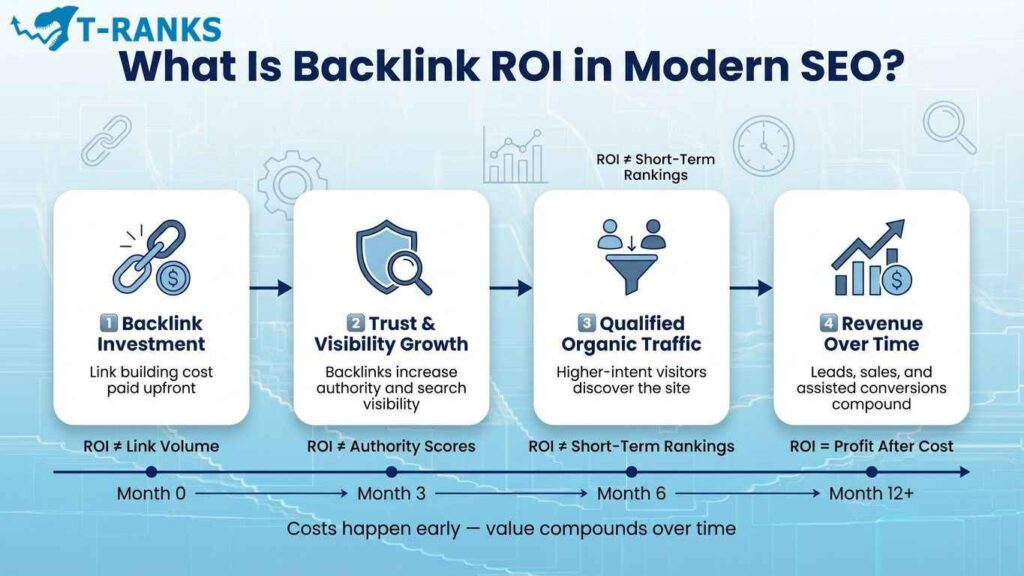
Backlink ROI is the profit a link building campaign generates compared to what it costs.
It shows whether backlinks help the business grow after all expenses are considered, not just whether rankings improve.
In modern SEO, backlink ROI is not measured by the number of links, authority scores, or short-term ranking gains. These signals may show progress, but they do not prove financial success. ROI is positive only when the value created by better search visibility is greater than the money and effort spent.
Backlinks do not produce revenue on their own. They work indirectly. By improving trust and rankings, backlinks increase visibility in search results. This visibility brings more relevant visitors, which creates chances for leads, sales, and assisted conversions later in the journey.
Time plays a major role in backlink ROI.
Link building costs are paid upfront, but results appear slowly. Rankings improve over weeks or months, not days. Once rankings stabilize, backlinks can keep sending traffic without additional cost, which is why ROI should be measured over longer periods.
Backlink ROI also depends on how and where links are placed. Links pointing to high-intent pages, coming from relevant sites, and staying live over time usually deliver stronger returns. Two campaigns with the same number of links can produce very different ROI because quality, relevance, and intent matter more than volume.
When viewed this way, backlink ROI helps teams treat link building as a long-term business investment, not a short-term ranking tactic.
Why Backlink ROI Is Hard to Measure Accurately
Backlink ROI is difficult to measure because backlinks do not create direct or instant results.
Unlike paid ads, there is no straight line from a backlink to revenue. Their impact appears slowly and works through several steps.
To understand why, we need to break down the main factors that make backlink ROI difficult to measure, which are explained below.
Rankings Are Not Linear or Predictable
Google rankings do not work in a simple cause-and-effect way. Backlinks interact with many factors at the same time, such as content quality, relevance, competition, and user behavior. When rankings improve, it is usually because several signals work together, not because of backlinks alone. This makes it hard to isolate their exact financial impact.
Backlinks Influence Results Indirectly
Backlinks do not act as direct conversion triggers. They improve trust and visibility in search results, which helps people discover a site. Most users do not convert on their first visit. They return later through branded searches, direct visits, or other channels, which separates the backlink from the final sale.
Costs Happen Before Value Appears
Link building costs are paid upfront. The benefits appear much later. Search engines need time to crawl links, reassess trust, and stabilize rankings. During this period, traffic and revenue may not change much, making ROI look negative even when long-term value is building in the background.
Other SEO Activities Affect the Same Results
Backlinks are rarely the only thing changing on a site. Content updates, conversion improvements, branding efforts, and seasonal demand often happen at the same time. When traffic or revenue grows, the impact of backlinks blends with these factors, making clean attribution difficult.
Short-Term Attribution Models Do Not Work
Because of these challenges, backlink ROI cannot be measured using short-term or last-click models. These approaches ignore delayed impact and early-stage influence. Backlink ROI must be evaluated over longer timeframes and viewed as contribution-based, not exact or immediate.
The Core Backlink ROI Formula (And Its Limits)
Backlink ROI shows whether link building makes or loses money.
At its simplest, it compares what you earn from a campaign to what you spend on it.
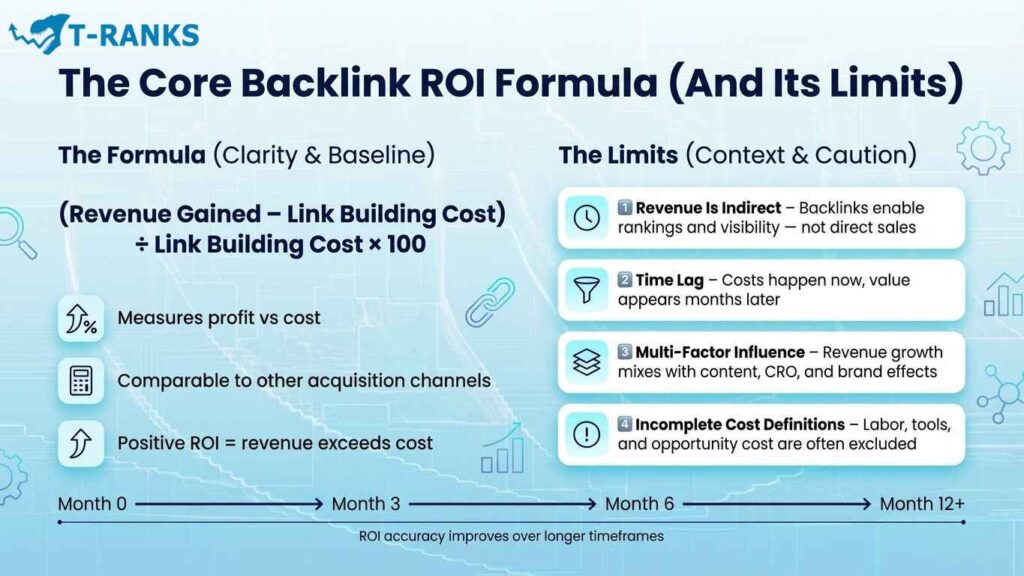
The basic backlink ROI formula is:
(Revenue gained − link building cost) ÷ link building cost × 100
This formula is widely used because it is easy to understand. It turns results into a percentage.
If the result is positive, the campaign is profitable. If the result is negative, it is not.
However, the formula is only as good as the numbers you put into it.
The biggest challenge is defining “revenue gained.” Backlinks do not usually generate sales on their own. Instead, they help pages rank higher, increase visibility in search results, and attract more relevant visitors. These visitors may convert later, often after several visits. Because of this, revenue must be estimated from incremental improvements, not from a single link or click.
Timing also limits accuracy.
Link building costs are paid upfront. Results appear later. Rankings take time to improve, and traffic grows gradually. If ROI is measured too early, a campaign may look unprofitable even though it is building long-term value.
Another limitation is that backlinks rarely work alone. Revenue growth often happens at the same time as content updates, technical fixes, conversion improvements, or brand growth. The formula reflects the combined effect of these changes, not backlinks in isolation.
Cost definition matters as well. Many calculations include outreach fees and content costs but ignore internal labor, tools, or opportunity cost. When these inputs are missing, ROI can appear higher than it truly is.
For these reasons, the backlink ROI formula should be used as a guide, not a precise score.
It works best when applied over longer timeframes, with realistic assumptions, and supported by more detailed ROI models that account for timing, attribution, and risk.
Simple Backlink ROI Calculation Example
To understand backlink ROI calculation, let’s look at a simple example.
Assume a business spends $2,000 on a link building campaign.
The links help improve rankings for a key page over several months.
Before link building:
- Monthly organic traffic to the page: 1,000 visits
- Monthly revenue from the page: $3,000
After link building:
- Monthly organic traffic increases to 1,400 visits
- Monthly revenue increases to $4,200
This means link building generated $1,200 in additional monthly revenue.
Now apply the ROI formula:
Revenue gained = $1,200 × 6 months = $7,200
Link building cost = $2,000
Backlink ROI calculation:
($7,200 − $2,000) ÷ $2,000 × 100 = 260\%
This means the campaign returned 260% ROI over six months.
The key takeaway is that backlinks did not create revenue instantly.
They increased visibility and rankings first, which later resulted in higher traffic and sales.
Defining Cost and Value in Backlink ROI Calculation
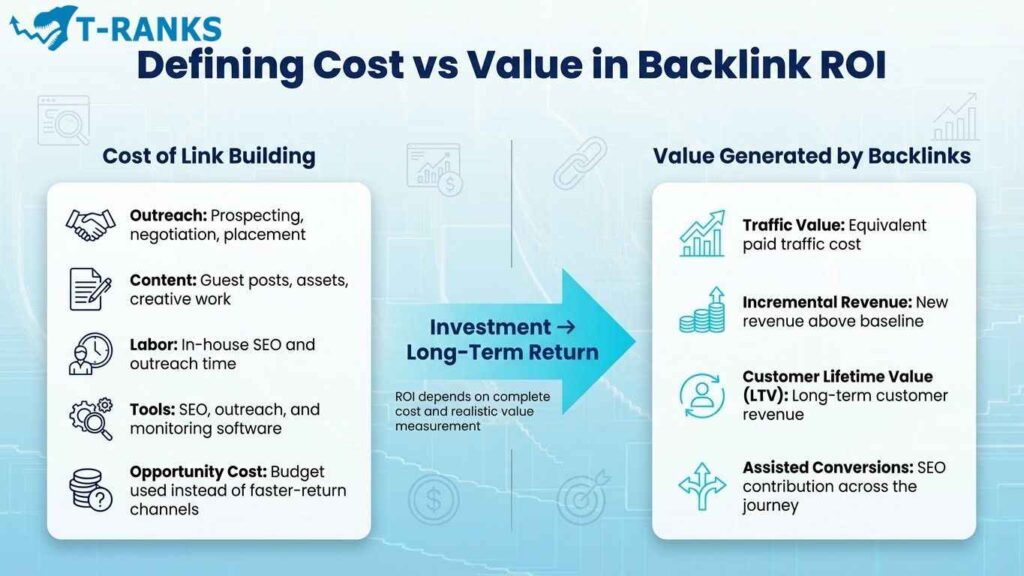
Backlink ROI is only accurate when both cost and value are defined correctly.
If either side is missing or unrealistic, the final ROI number becomes misleading, no matter which formula is used.
What Counts as the Cost of Link Building
The cost of link building includes everything required to earn and maintain backlinks.
The most visible cost is outreach or agency fees. These cover research, outreach, negotiation, and placement. Prices vary based on niche, competition, and link quality, and using only these numbers often understates the real investment.
Content creation is another major cost. Writing guest posts, creating linkable assets, and designing visuals all require time and budget. In many campaigns, content work represents a large portion of total cost.
In-house time and tools also matter. Hours spent by SEO managers, outreach specialists, and writers have a real cost. The same applies to paid tools used for prospecting, analysis, and link monitoring.
Opportunity cost completes the picture. Money and time spent on link building could have been used for faster-return activities such as paid ads or conversion improvements. Including opportunity cost allows link building ROI to be compared fairly with other growth channels.
What Counts as the Value Generated by Backlinks
Value should be measured by business outcomes, not surface-level SEO signals.
Organic traffic value is often used as a starting point because it estimates what similar visits would cost through ads, making organic traffic value useful for ROI comparisons.
It estimates what extra organic visits would have cost if they were purchased through ads. This is useful for comparison, but it does not represent true profit.
Incremental revenue provides a stronger measure. This looks at how much additional revenue appears after links are built, compared to a clear pre-campaign baseline. It avoids crediting backlinks for growth that was already happening.
For lead-based and subscription businesses, lead value and customer lifetime value are critical. Backlinks may generate fewer immediate conversions, but those conversions can produce revenue over months or years. Lifetime value helps capture this long-term return.
Assisted conversions should also be included. Backlinks often help users discover a brand early. Even if the final sale happens through another channel, organic search may have played a key role in the decision.
Defining both cost and value this way keeps backlink ROI grounded in real business impact, not just SEO metrics. It also creates a reliable foundation for long-term ROI analysis and planning.
The Four Practical Models for Backlink ROI Calculation
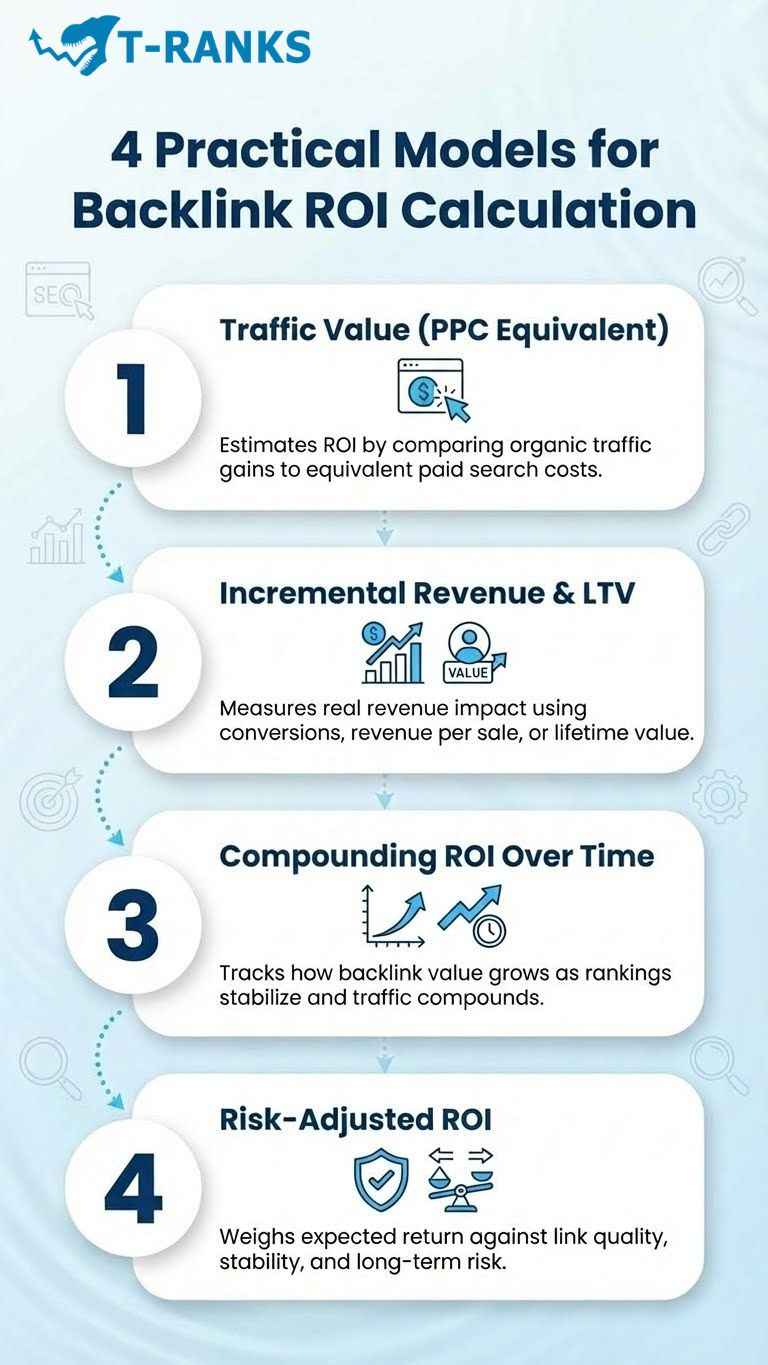
Different businesses require different ROI models because no single method accurately reflects every link building campaign. The appropriate model depends on business type, conversion path, and how directly backlinks influence revenue.
Model 1 – Traffic Value Equivalent (PPC Comparison)
This model answers what the same organic traffic would have cost if acquired through paid advertising. It is commonly used when direct revenue attribution is limited.
The calculation multiplies the cost per click of target keywords by the incremental organic traffic gained after link building. This produces a traffic value estimate that is easy to explain and compare against paid channels.
This model is fast, simple, and stakeholder-friendly. It works well for early validation and for content-heavy or non-transactional sites where conversions are indirect or delayed.
Its main limitation is underestimation. Organic traffic often converts better than paid traffic due to higher trust and intent, but this model treats them as equal, resulting in conservative ROI estimates.
Model 2 – Incremental Revenue and LTV Model
This model answers how much real revenue link building generated. It focuses on financial outcomes rather than proxy metrics.
Performance before link acquisition is compared with post-campaign results. Increases in traffic are combined with page-level conversion rates to calculate incremental conversions, which are then multiplied by average revenue per sale or customer lifetime value.
This model is best suited for ecommerce, SaaS, and lead-driven businesses where conversion tracking and revenue data are reliable. It provides stronger decision-making insight but requires clean analytics and sufficient time for results to stabilize.
Model 3 – Compounding Campaign ROI Over Time
This model answers when link building breaks even and becomes profitable. It treats backlinks as long-term assets instead of one-time costs.
The approach tracks month-by-month traffic growth while accounting for rolling link costs. As traffic compounds and costs remain fixed, ROI improves. Key outputs include the payback period and the breakeven month.
Most campaigns reach breakeven over months rather than weeks. This model typically evaluates ROI over a twelve to twenty-four month horizon, which reflects how backlinks perform in competitive search environments.
Model 4 – Risk-Adjusted ROI by Link Type
This model answers whether the expected return justifies the associated risk. Not all backlinks offer the same stability or sustainability.
Different link types carry different risk profiles. Editorial links from trusted sources tend to be durable, while aggressive placements or low-quality links may decay or introduce penalty risk. These factors directly affect long-term ROI.
Risk-adjusted ROI weighs potential return against link lifespan and stability. Higher-risk links require higher short-term returns to justify their exposure, while lower-risk links compound more reliably over time.
Together, these four models provide practical ways to evaluate backlink ROI across business types, campaign stages, and risk levels.
Understanding the Backlink ROI Timeline
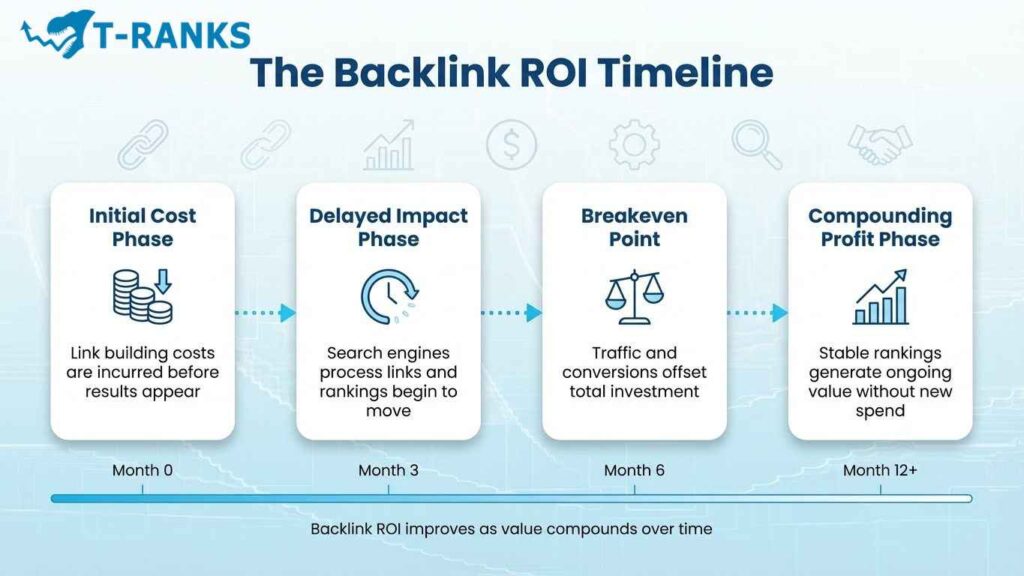
Backlink ROI develops over time, not instantly.
Link building is a long-term investment where costs appear first and returns grow gradually as rankings and visibility improve.
The Initial Cost Phase
This is the stage where spending begins. Time and money are invested in outreach, content creation, and link placements. Rankings and traffic usually show little or no movement. ROI is negative at this point because costs are incurred before any measurable value appears.
The Delayed Impact Phase
Search engines need time to discover, crawl, and evaluate new backlinks. As trust builds, rankings start to improve and organic traffic begins to increase slowly. Performance may rise and fall during this phase, even though progress is happening in the background.
The Breakeven Phase
Breakeven occurs when total returns match the amount spent on link building. Traffic and conversions from improved rankings begin to offset earlier costs. The timing of breakeven depends on competition, existing authority, and link quality, but it typically happens several months into a campaign.
The Profit and Compounding Phase
After breakeven, backlinks continue generating value without additional spending. Rankings stabilize, traffic becomes more consistent, and returns grow faster over time. ROI improves as results compound, turning link building into a sustained profit source.
Realistic expectations are essential when evaluating this timeline.
Early negative ROI is normal and does not indicate failure. Long-term ROI comes from stable rankings that continue delivering qualified traffic and conversions well after the initial investment.
How to Attribute Revenue to Link Building
Revenue cannot be directly traced to a single backlink, but the contribution of link building can be measured.
Backlinks support growth through a sequence of effects rather than a single, trackable action.
Why Backlinks Cannot Be Tracked to a Single Sale
Backlinks do not act like ads that send users straight to a purchase. Their role is indirect. They improve trust and authority, which helps pages rank higher in search results. This ranking improvement increases visibility, but it does not immediately produce conversions.
How Backlinks Create Demand Before Conversion
As visibility improves, more relevant users discover the site through organic search. These users are often researching, comparing, or learning. Most do not convert on their first visit. They return later, explore more pages, or re-engage through other channels before taking action.
Why Last-Click Attribution Undervalues Link Building
When a conversion finally happens, the last interaction is often branded search, direct traffic, email, or paid media. Last-click attribution gives all credit to that final step. This hides the earlier influence of backlinks and organic discovery that made the conversion possible in the first place.
Using Assisted Conversions to Measure Real Impact
Organic search often assists conversions rather than closing them directly. To measure backlink ROI accurately, assisted revenue must be included. Reviewing assisted conversions, conversion paths, and incremental lift shows how link building supports revenue even when it does not receive final-click credit.
Attributing revenue to link building is about understanding contribution, not precision.
Backlinks should be evaluated at the page, campaign, and time-based level, where their influence appears consistently over time, even when it cannot be tied to a single sale.
Using Control Groups to Isolate Link Impact
Control groups help you understand how much improvement comes from backlinks, not from other SEO changes.
They provide a simple comparison method to estimate link impact more reliably.
What a Control Group Means in Link Building
A control group is a similar page that does not receive new backlinks.
You compare it with a page that does receive links. Both pages should belong to the same site and exist during the same time period. This makes the comparison fair.
How to Choose the Right Pages
Start with one page that receives new backlinks. Then select another page that stays unchanged.
Both pages should target similar keywords, have similar content quality, and serve a similar search intent. The closer they are, the more accurate the comparison will be.
Removing Market-Wide Effects
Traffic often grows for reasons unrelated to backlinks. Seasonality, brand awareness, or industry trends can lift many pages at once.
When both the linked page and the control page experience these changes, the shared growth can be ignored. What matters is the difference between them.
Measuring the True Link Impact
After removing shared effects, compare the results.
If the linked page shows stronger ranking improvements, traffic growth, or conversions than the control page, the extra lift can be reasonably attributed to backlinks.
Why Control Groups Improve ROI Accuracy
Control groups reduce false ROI claims.
Without comparison, normal growth or unrelated SEO work may be credited to link building. This inflates ROI numbers and leads to poor decisions.
Control groups do not create perfect precision, but they increase confidence.
They help backlink ROI calculations rely on evidence rather than assumptions, making investment decisions more disciplined and realistic.
ns.
Backlink Lifespan, Decay, and Long-Term Value
Backlinks do not keep the same value forever.
They should be treated as assets that lose or change value over time, not permanent ranking wins.
Why Backlinks Lose Value Over Time
Backlinks can weaken or disappear as the web changes. Websites update content, remove pages, shut down, or change how links are handled. Even strong links can lose impact if the linking page is removed, deindexed, marked as nofollow, or moved to a less visible part of the site.
Link Rot and Link Loss
Link rot refers to backlinks that stop working or disappear completely.
This can happen when a page is deleted, a site goes offline, or a link is removed during a content update. Link loss is normal and affects all types of websites, not just low-quality ones.
Competition Reduces Link Impact
Backlink value can also decline even when a link stays live.
As competitors earn more or stronger links, the advantage from older links becomes smaller. Rankings depend on relative strength, so link impact naturally erodes as the competitive landscape changes.
How Link Type Affects Lifespan
Not all backlinks last the same amount of time.
Editorial links from trusted, well-maintained sites tend to stay live longer and provide steady value. Lower-quality or unstable placements often disappear sooner or lose influence more quickly.
Measuring Backlinks by Lifetime Value
Because backlinks change over time, they should be evaluated by lifetime value, not short-term results.
A backlink’s lifetime value includes all traffic, conversions, and assisted revenue it generates while it remains active and influential.
ROI should be measured across the full lifespan of a backlink.
Short-term reports often understate value, while long-term evaluation shows whether a backlink continues to justify its cost as part of a sustainable SEO strategy
Planning Backlink ROI Before You Build Links
This approach helps teams decide where to spend link building budget before results appear.
Instead of reacting after a campaign runs, planning backlink ROI allows more controlled and informed decisions.
Estimating ROI Before Building Links
Before building links, teams can estimate likely outcomes using existing data. This includes current rankings, keyword competition, page relevance, and past performance. These inputs help estimate possible traffic growth and potential revenue if rankings improve.
These estimates are not exact predictions. Their purpose is to check whether a campaign is reasonable before investing time and money.
Using Best, Average, and Worst Scenarios
Because SEO outcomes are uncertain, ROI should be viewed as a range.
A best-case scenario assumes strong ranking gains and stable links.
An average scenario reflects steady but realistic improvement.
A worst-case scenario accounts for slow movement, limited impact, or partial link loss.
Looking at all three reduces overconfidence and prevents overspending based on optimistic assumptions.
Evaluating ROI Across Multiple Pages
Link building rarely supports just one page. Some links help product or service pages that generate direct revenue. Others support informational pages that build authority and topical strength.
ROI should be evaluated across all supported pages together. Strong performers often offset slower or indirect ones. This reflects how link building actually works at scale.
How Informational Pages Support Revenue
Informational content often earns links more easily than commercial pages. These links increase overall site authority and pass value internally through internal linking.
Even if an informational page does not convert directly, it can still support revenue by improving rankings and performance of commercial pages connected to it.
This planning approach does not aim for perfect prediction.
Its goal is better prioritization, smarter budgeting, and lower risk when investing in link building at scale.
Common Backlink ROI Calculation Mistakes
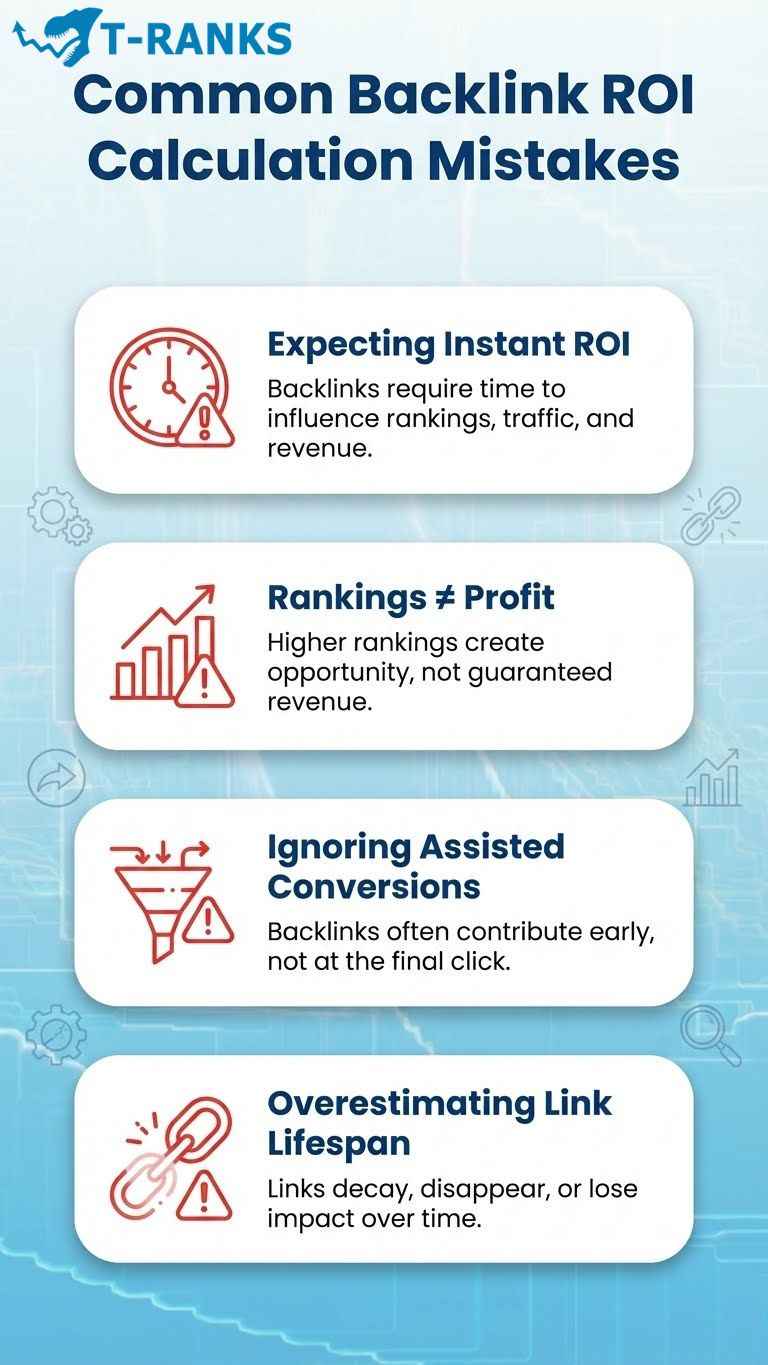
Most backlink ROI calculation mistakes come from unrealistic assumptions rather than flawed math. These errors inflate expectations, distort reporting, and lead to poor strategic decisions.
Expecting Instant ROI
Backlinks rarely produce immediate traffic or revenue. Rankings typically improve over several months as search engines crawl links, reassess trust signals, and adjust results. Measuring ROI within short timeframes often misses most of the value and leads to premature conclusions.
Treating Rankings as Profit
Ranking improvements do not equal financial return. Higher positions only create opportunity. Actual ROI depends on search intent, click-through rates, and conversion performance. Rankings must be translated into traffic and revenue impact to reflect real value.
Ignoring Assisted Conversions
Backlinks often contribute earlier in the customer journey by increasing discovery and credibility. When only last-click conversions are counted, the impact of link building is understated. Assisted conversions must be included to capture SEO’s full contribution.
Overestimating Link Lifespan
Backlinks do not retain full value indefinitely. Links can be removed, devalued, or weakened as competition increases. Assuming permanent impact inflates ROI projections and hides the natural decay that affects long-term performance.
Treating All Links Equally
Not all backlinks deliver the same value. Differences in relevance, authority, placement, and stability significantly affect performance. High-quality contextual links tend to compound value, while low-relevance or unstable links often deliver limited returns.
Avoiding these mistakes leads to more accurate backlink ROI measurement and better long-term link building decisions focused on sustainable growth rather than inflated short-term results.
Practical KPIs for Measuring Backlink ROI
Backlink ROI works best when tracked as trends over time rather than isolated numbers. Individual metrics can fluctuate, but consistent movement across a focused set of KPIs shows whether link building is creating sustainable value.
Incremental Organic Revenue
Incremental organic revenue is the most important KPI. It measures the additional revenue generated by pages that gained new backlinks compared to a pre-campaign baseline. Tracking revenue lift over longer periods captures compounding effects and avoids overstating short-term noise.
Revenue per Backlink or Referring Domain
Revenue per backlink or referring domain evaluates efficiency. By dividing attributed revenue by the number of new links or referring domains acquired, teams can identify which sources deliver the strongest returns. This KPI often reveals that a small portion of links drives most of the value.
Cost per Incremental Visit
Cost per incremental visit compares total link building spend against additional organic visits generated by linked pages. As backlinks compound traffic without proportional cost increases, this metric should improve over time if ROI is healthy.
Link Retention Over Time
Link retention over time protects long-term ROI. Measuring how many backlinks remain live and effective shows whether value is compounding or eroding. Declining retention signals the need for monitoring or replacement to prevent gradual ROI decay.
Assisted Conversions Involving Organic Search
Assisted conversions involving organic search complete the measurement picture. Backlinks often influence earlier stages of the buyer journey, so tracking assisted conversions shows how organic discovery contributes to revenue even when it is not the final touchpoint.
Together, these KPIs provide a practical framework for measuring backlink ROI in a way that reflects long-term performance rather than short-term fluctuations.
How to Increase Backlink ROI Without Buying More Links
Backlink ROI improves faster by increasing value per visit rather than increasing link volume. Improving how existing traffic converts often delivers stronger returns than acquiring additional backlinks.
Target High-Intent Pages
Focusing backlinks on high-intent pages is one of the fastest ways to improve ROI. Pages aligned with commercial or transactional intent, such as product, pricing, or service pages, generate significantly higher revenue per visit than purely informational content. Even modest ranking improvements on these pages can produce meaningful revenue gains.
Use Conversion Optimization as a Multiplier
Conversion optimization multiplies the impact of existing backlinks. Improvements to page speed, clarity of messaging, trust signals, and calls to action increase the revenue generated from the same traffic. When conversion rates improve, backlink ROI increases automatically without additional acquisition costs.
Support Link Campaigns With Evergreen Content
Evergreen content extends the effectiveness of link building over time. Timeless guides, tools, and resources continue attracting links and traffic long after publication. These assets also pass authority internally to revenue-driving pages, increasing site-wide ROI without ongoing link spend.
Apply Risk-Managed Link Acquisition
Risk management protects long-term ROI. Prioritizing stable, relevant links reduces decay and loss while minimizing future cleanup or recovery costs. Conservative anchor usage, topical relevance, and diversified link sources help ensure that backlink value compounds instead of eroding.
By aligning backlinks with intent, improving conversion efficiency, investing in evergreen assets, and managing risk carefully, backlink ROI can increase substantially without buying additional links.
How to Report Backlink ROI to Stakeholders
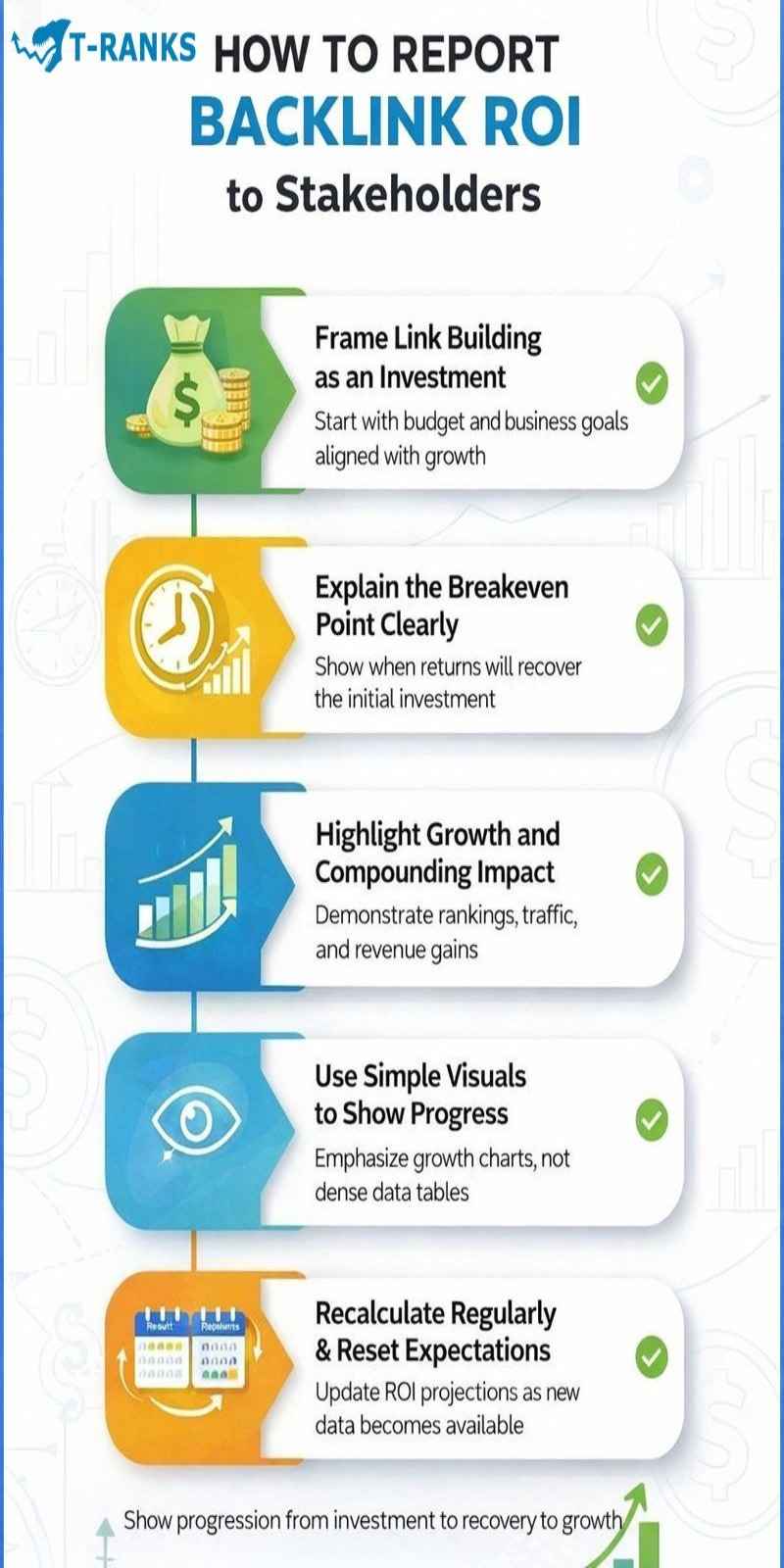
Backlink ROI should be explained as a clear story, not a list of metrics.
Stakeholders want to know what was invested, when it pays back, and how it supports long-term growth.
Start With the Investment, Not the Metrics
Begin by explaining how much was invested in link building and why.
Describe what the campaign was meant to achieve and which business goals it supports, such as revenue growth, lead generation, or market visibility. This helps stakeholders see link building as a planned business decision, not an abstract SEO task.
Explain When the Investment Pays for Itself
Next, explain the breakeven point in simple terms.
Show when the returns from improved rankings and traffic are expected to match the original spend. Make it clear that early negative ROI is normal and does not mean the campaign is failing. This sets realistic expectations from the start.
Show What Happens After Breakeven
Once breakeven is reached, shift the focus to growth.
Explain how backlinks continue to deliver value without additional spending. Rankings stabilize, traffic becomes more consistent, and revenue or leads grow over time. This is where link building turns from a cost into a compounding asset.
Use Simple Visuals to Support the Story
Visuals make the explanation easier to understand.
Use simple charts that show cumulative cost versus cumulative return, or a timeline that moves from investment to breakeven to profit. These visuals should highlight direction and progress, not detailed SEO data.
Review Results Regularly and Update Expectations
Backlink ROI should be reviewed over time, not reported once.
As links compound or decay, projections should be updated. Sharing progress, delays, and revised expectations builds trust and helps stakeholders make informed budget decisions.
When backlink ROI is presented as a clear journey from investment to recovery to growth,
stakeholders are more likely to trust link building as a long-term revenue strategy rather than a short-term SEO expense.
Conclusion
In conclusion Backlink ROI becomes clear when link building is treated as a long-term business investment.
It cannot be measured correctly using short-term rankings or isolated metrics. Accurate ROI depends on realistic timelines, clear cost and value definitions, and understanding how backlinks contribute to revenue over time.
Backlinks create value by improving visibility, supporting assisted conversions, and compounding results after breakeven. When ROI is measured through profit and long-term impact, the real business value of link building becomes easier to see.
Using the right ROI models, avoiding common measurement mistakes, and reporting results clearly helps teams invest more in what works and stop spending on what does not.
If you are looking for backlink strategies focused on measurable profit and long-term growth,
T-RANKS helps businesses build high-quality backlinks designed to deliver sustainable ROI over time.
FAQs About Backlink ROI
What is backlink ROI calculation?
Backlink ROI calculation measures the profit a link building campaign generates compared to its total cost.
It evaluates financial impact over time rather than focusing on rankings, traffic volume, or authority metrics.
Is backlink ROI the same as SEO ROI?
No, backlink ROI focuses only on returns from link acquisition.
SEO ROI includes the combined impact of content, technical SEO, on-page improvements, and backlinks.
What is the basic formula for backlink ROI?
The basic formula is revenue gained minus link building cost, divided by link building cost.
Its usefulness depends on how realistically revenue is estimated and attributed.
Can backlink ROI be calculated accurately?
Yes, backlink ROI can be estimated with reasonable accuracy when assumptions are clearly defined.
It cannot be exact because backlinks influence rankings indirectly and results develop over time.
How long does it take to see positive backlink ROI?
Backlink ROI usually takes several months to turn positive.
Early negative ROI is common before breakeven and long-term gains appear.
Does higher Domain Authority guarantee higher backlink ROI?
No, higher Domain Authority alone does not guarantee higher ROI.
Returns depend on relevance, search intent, conversion potential, and revenue impact.
Can traffic value be used for backlink ROI calculation?
Yes, traffic value can be used as a comparison method by estimating paid CPC costs.
However, it often understates true value because organic traffic tends to convert better.
How do assisted conversions affect backlink ROI?
Assisted conversions show how backlinks influence early discovery and trust.
They matter because organic search often supports conversions that close through other channels.
Can you measure ROI for individual backlinks?
Individual backlink ROI can be estimated, but results are more reliable at page or campaign level.
Backlinks usually work together, making isolated measurement less accurate.
What happens to backlink ROI if links decay or disappear?
Backlink ROI declines as links lose strength or disappear.
This is why link lifespan, decay, and retention should be included in ROI evaluation.
Is backlink ROI worth measuring if rankings fluctuate?
Yes, backlink ROI remains valuable even when rankings change.
Longer timeframes reveal trends and compounding effects that short-term data misses.
Can backlink ROI be forecast before building links?
Yes, backlink ROI can be forecast using ranking, click-through, and conversion assumptions.
Forecasts should use conservative ranges instead of guaranteed outcomes.