Most community backlinks fail for a simple reason. People try to place links instead of earning attention. When a link feels forced, it breaks the conversation and gets ignored or removed, sometimes even harming trust.
Community backlinks are earned when your content is shared naturally inside forums, groups, or discussions because it genuinely helps someone solve a problem. In 2026, search engines and AI systems focus on intent, context, and real user behavior. Helpful contributions build credibility. Self-promotion does not.
This guide explains what community backlinks really are, why they still matter for SEO, and how search engines judge them based on behavior rather than placement. You will learn which communities are worth joining, what type of content people choose to share, and when community backlinks are not worth pursuing at all.
Community backlinks work when participation comes first and linking comes second. This article shows how to build trust, visibility, and long-term value without triggering spam signals.
What Are Community Backlinks
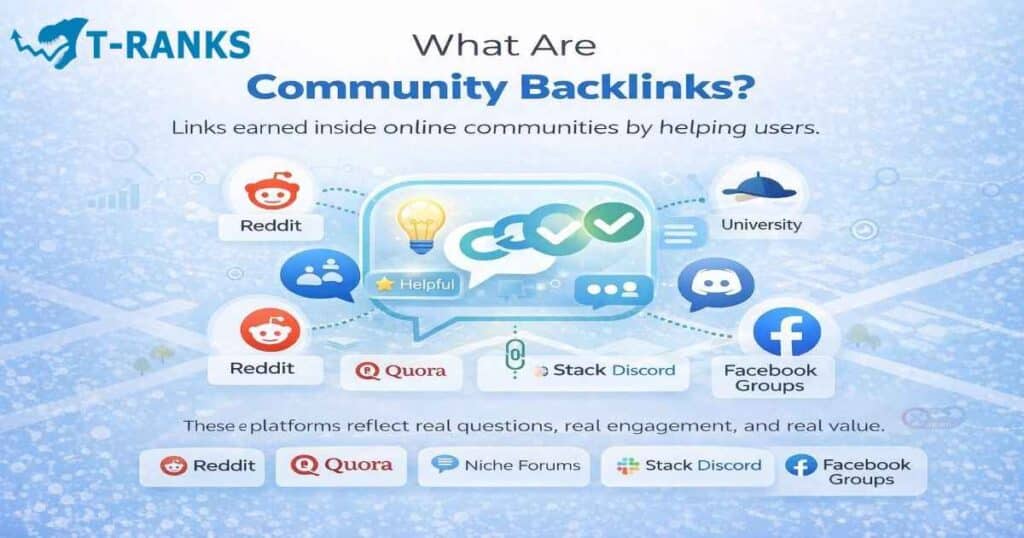
Community backlinks are links earned when your website is referenced inside online communities such as Reddit, Quora, Discord, or niche forums because it helps answer a real user question.
These links appear naturally within discussions, replies, or shared resources where the primary goal is knowledge exchange, not promotion.
Unlike traditional link building, community backlinks are a byproduct of participation. They happen when a contribution is valuable on its own, and the link simply extends that value for users who want deeper information.
Online communities exist to help people learn, troubleshoot, and make decisions. Search engines and AI systems increasingly prioritize these environments because they reflect real user intent, real engagement, and real problem solving, not manufactured signals.
A Simple, Real-World Example
Imagine you run a digital marketing blog. Someone asks on Quora, “How can a small business get more website traffic?”
You reply with a clear, practical explanation written in your own words. The answer fully stands on its own. At the end, you add a link to a detailed guide on your site for readers who want deeper insights.
The value comes from the answer, not the link. The link exists to extend usefulness, not to replace it.
That is a community backlink.
Common Community Platforms Where These Links Appear
Community backlinks most often come from platforms built around discussion and peer learning, such as:
- Reddit communities focused on specific topics or industries
- Quora and other question-and-answer platforms
- Niche forums and industry discussion boards
- Professional Slack and Discord communities
- Moderated Facebook Groups with active participation
These platforms are valuable because they surface authentic user behavior. After recent search updates, user-driven platforms like Reddit have seen significant visibility and traffic growth, reinforcing that search engines now prioritize conversations where people actively help each other. This shift confirms that communities are no longer secondary signals, they are core trust environments.
How Community Backlinks Differ From Spammy Community Links
Community spam is not new, but it is different from general web spam. Spammy community links are links placed inside communities with the primary goal of manipulating visibility rather than helping users.
Community backlinks exist to improve the discussion.
Spammy community links exist to exploit the discussion.
Spammy community links typically show these patterns:
- The reply is thin or generic and relies on the link to carry value
- The same link is repeated across multiple threads or communities
- The account shows little genuine participation beyond linking
- The link feels disconnected from the actual question being asked
A reliable test makes the difference clear.
If the reply is still genuinely useful after removing the link, it qualifies as a community backlink. If removing the link leaves nothing of value, the link exists for spam purposes.
Search engines and AI systems are very good at detecting this distinction because they evaluate behavior over time, not just individual posts. Communities amplify this process through moderation, voting, and user feedback, which further reinforces trust signals.
Why Community Backlinks Still Matter for SEO Today
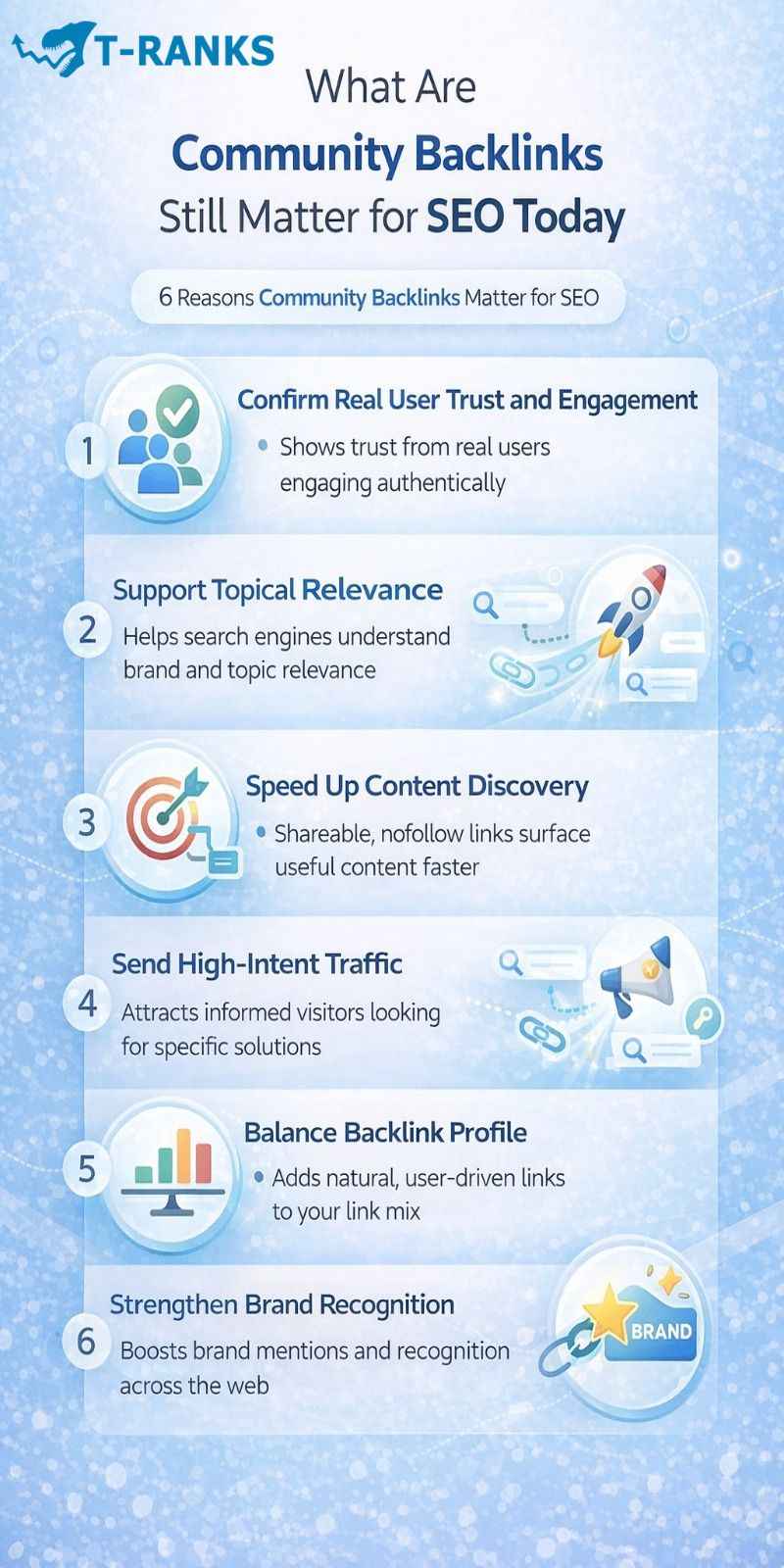
Community backlinks still matter for SEO today because they reflect real user behavior, not manufactured link signals. Modern search engines and AI systems place more weight on credibility, context, and genuine discussion than on raw link authority alone.
Below are the key reasons community backlinks remain relevant.
They confirm real user trust and engagement
When people reference your content inside communities, it shows genuine trust. These mentions happen because users find the content useful, not because links were requested or placed artificially. Search engines treat this as a strong authenticity signal.
They support topical relevance and entity understanding
Repeated mentions across niche communities help search systems understand what your brand represents and which topics it is associated with. This strengthens topical alignment without relying on keyword-heavy tactics.
They help search engines and AI systems discover content faster
Links shared inside active discussions often expose content to crawlers and AI systems earlier. Community platforms act as discovery layers where useful content surfaces naturally.
They send high-intent referral traffic
Community backlinks often bring visitors who already understand the problem they are trying to solve. This results in stronger engagement signals, which support long-term SEO health.
They make backlink profiles look natural
A backlink profile built only on editorial or guest links can appear engineered. Community backlinks add nofollow links, branded mentions, and user-driven references that reflect organic growth patterns.
They strengthen brand recognition across the web
Seeing a brand mentioned repeatedly in trusted discussions increases familiarity. This recognition supports brand searches, return visits, and long-term authority signals.
They align with how AI-driven search works
Modern AI systems rely heavily on real conversations to understand authority. Community discussions provide context-rich signals that help AI models identify trusted sources beyond traditional link metrics.
For these reasons, community backlinks act as a supporting trust layer rather than a ranking shortcut. They do not replace editorial links, but they help confirm credibility, relevance, and authenticity in modern SEO.
How Google Evaluates Community Backlinks
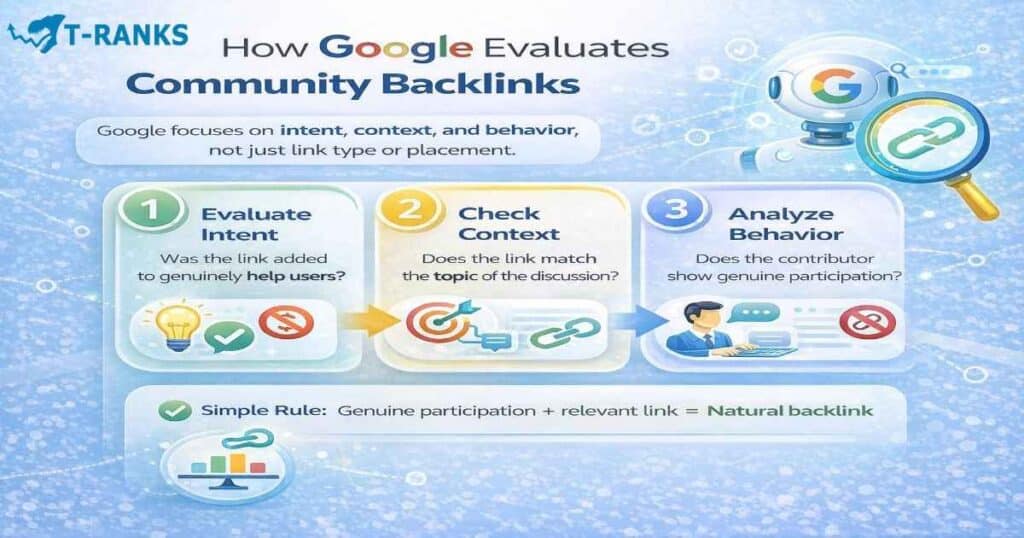
Google evaluates Community Backlinks by focusing on intent, context, and behavior, not on link type, placement, or whether a link is dofollow.
The goal is to understand whether a link exists to help users or to manipulate search visibility.
To make this easier to understand, Google’s evaluation can be broken down into clear steps.
Step 1: Google Evaluates Intent
The first thing Google looks at is why the link exists.
If a Community Backlink supports a helpful answer, it is treated as natural. If it exists mainly to promote a website, it loses value.
Google recognizes helpful intent when:
- The answer explains the topic clearly before adding a link
- The link provides extra detail rather than acting as the solution itself
- The language focuses on helping, not selling
When the link is the main purpose of the post, the intent looks manipulative.
Step 2: Google Checks Context and Relevance
Next, Google evaluates whether the link fits the discussion.
It compares three elements: the topic of the thread, the content of the reply, and the page being linked.
A Community Backlink is seen as relevant when:
- The linked page matches the exact topic being discussed
- The surrounding text explains why the link is useful
- The discussion itself is active and meaningful
Links placed in unrelated or low quality threads are usually ignored.
Step 3: Google Analyzes Contributor Behavior
Google then looks at how the account behaves over time.
One helpful post is not enough. Patterns matter more than single actions.
Positive behavior signals include:
- A history of helpful participation without frequent links
- An established account that contributes regularly
- Engagement from other users such as replies or upvotes
Negative behavior signals include:
- New accounts posting links quickly
- Repeating the same link across many discussions
- Sudden increases in community links with similar wording
These patterns help Google separate genuine contributors from spammers.
Step 4: Google Uses Link Attributes as Hints
Most Community Backlinks are marked as nofollow or user generated.
Google treats these attributes as hints, not strict rules.
A helpful and relevant link from a trusted contributor can still support trust and relevance, even if it does not pass traditional ranking power.
Step 5: Google Looks for Long Term Signals
Finally, Google evaluates consistency over time.
Repeated mentions in relevant communities help confirm that a brand is genuinely trusted and associated with specific topics.
This long term pattern strengthens entity understanding and credibility.
The Simple Rule Google Follows
If a Community Backlink improves the discussion, Google treats it as natural.
If the discussion exists mainly to place the link, Google neutralizes it.
That is why Community Backlinks work when they are earned through real participation and fail when they are treated as shortcuts.
Community Backlinks vs Spam, Where Google Draws the Line
Community backlinks and spammy links often come from the same platforms, but Google treats them very differently. The difference is not the platform, the format, or even the link itself. The difference is how and why the link is used inside a community.
Both types are community links. One is earned through participation. The other is created by abusing community platforms to manipulate visibility.
What Makes a Community Link Legitimate or Spammy
A community backlink becomes legitimate when it exists to support a discussion.
The same type of link becomes spam when it exists to exploit the discussion.
Google does not see spammy community links as a separate category of links. It sees them as community links used with manipulative intent.
The distinction becomes clear when comparing behavior patterns.
Community Backlinks vs Spammy Community Links
Community Backlinks
- Added to genuinely help answer a question
- Shared after a complete and useful explanation
- Closely aligned with the discussion topic
- Uses natural or branded wording
- Shared by accounts with visible participation history
- Often receives replies, upvotes, or positive engagement
- Improves the quality of the conversation
Spammy Community Links
- Added mainly to promote a website
- Used as a replacement for real explanation
- Weakly related or unrelated to the discussion
- Uses keyword-heavy or promotional wording
- Posted by new, inactive, or link-focused accounts
- Gets ignored, reported, or removed by moderators
- Disrupts or degrades the conversation
Both links come from communities. Only one aligns with how communities are meant to function.
How Google Draws the Line
Google does not judge community links by platform or placement. It judges them by intent, relevance, and behavioral patterns.
First, Google evaluates intent.
If the link exists to help users understand something better, it is treated as a natural community backlink. If the link exists mainly to promote a site, it is neutralized or discounted.
Next, Google evaluates context.
The discussion topic, the surrounding text, and the linked page must align closely. When they do not, the link loses value regardless of where it appears.
Then, Google evaluates behavior over time.
Accounts that contribute consistently and link occasionally build trust. Accounts that repeatedly drop links without meaningful participation trigger spam signals.
Finally, Google observes human response.
Links that survive moderation, receive engagement, and remain visible indicate user value. Links that are removed or ignored reinforce spam classification.
The Simple Rule to Remember
If a community link improves the discussion, Google treats it as a legitimate community backlink.
If the discussion exists mainly to place the link, Google treats it as a spammy community link.
That is where Google draws the line, and it applies across all forums, groups, and community platforms.
Do Nofollow and UGC Community Links Still Help SEO
Yes, nofollow and UGC community links still help SEO, but their value comes from trust, visibility, and user validation, not from directly passing ranking authority. In modern search systems, these links help confirm whether a brand is genuinely discussed and relied on by real users.
Most community backlinks are automatically marked as nofollow or user generated. These attributes were introduced to reduce manipulation, not to eliminate value. Google treats them as signals and hints, which means they can still contribute to understanding brand relevance, topic association, and real-world usage across the web.
Brand and entity recognition becomes stronger
Repeated mentions inside trusted community platforms help search engines and AI systems understand what a brand represents and which topics it is associated with. Even without passing PageRank, these references reinforce entity recognition and topical alignment.
AI and LLM visibility depends heavily on community signals
Modern AI systems rely on real discussions to surface sources. Community platforms are frequently analyzed to identify credible information, making nofollow and UGC links important for visibility in AI-generated answers and citations.
User-generated links reflect genuine trust
UGC links are created by users, not publishers. When people voluntarily reference a resource inside a discussion, it signals real usefulness. This kind of validation is difficult to fake and carries strong trust value.
Discovery and topical relevance improve naturally
Links shared inside active discussions help search engines and AI systems discover content faster and understand the problems it solves. These contextual references strengthen relevance without relying on keyword manipulation.
Referral traffic quality supports long-term SEO health
Community links often attract users who are already researching a specific problem. These visitors tend to engage more deeply, which supports behavioral signals that contribute to long-term search performance.
A natural backlink profile is reinforced
A backlink profile built only on dofollow editorial links can appear engineered. Nofollow and UGC community links add diversity, branded mentions, and organic patterns that reduce spam risk and improve profile stability.
What these links do not do
Nofollow and UGC community links are not ranking shortcuts and should not replace editorial or authority links. Their role is supportive. They strengthen trust, relevance, discovery, and visibility so that stronger links can work more effectively over time.
In 2026 SEO, these links are no longer optional signals. They are part of how search engines and AI systems confirm that a brand is genuinely used, discussed, and trusted by real people.
The Value-First Approach to Earning Community Backlinks
The value-first approach means links are never the goal when you participate in a community. The goal is to help. Links happen later, only when they genuinely add something to the conversation.
People who successfully earn community backlinks do not think like link builders. They think like contributors. They join discussions to answer questions, share experience, and reduce confusion. When someone joins a community mainly to drop links, it shows immediately. Replies feel shallow, the timing feels wrong, and trust never forms.
In real communities, trust is built quietly. It comes from explaining things clearly, showing patience, and helping without asking for anything in return. When other members start recognizing your name or responding to your answers, that is when links become acceptable. At that point, a link feels like a helpful reference, not a promotion.
A simple rule guides experienced contributors. If your reply is not useful without the link, do not add the link. Strong community replies stand on their own. The link, if added, only extends the value for readers who want more detail.
This approach usually looks like:
- Explaining the solution fully in your own words
- Sharing personal experience or real examples, not recycled advice
- Staying in the discussion to answer follow-up questions
- Linking only when the resource clearly saves time or adds depth
Search engines evaluate this behavior over time, not post by post. Accounts that help consistently without linking build credibility naturally. When those same accounts occasionally share a relevant resource, the link aligns with normal community behavior instead of triggering spam signals.
The value-first approach works because it mirrors how real people participate online. Help comes first. Recognition follows. Links appear as a by-product of trust, not as a tactic. This is what makes community backlinks safe, durable, and effective in the long term.
Types of Online Communities Where Backlinks Can Appear Naturally
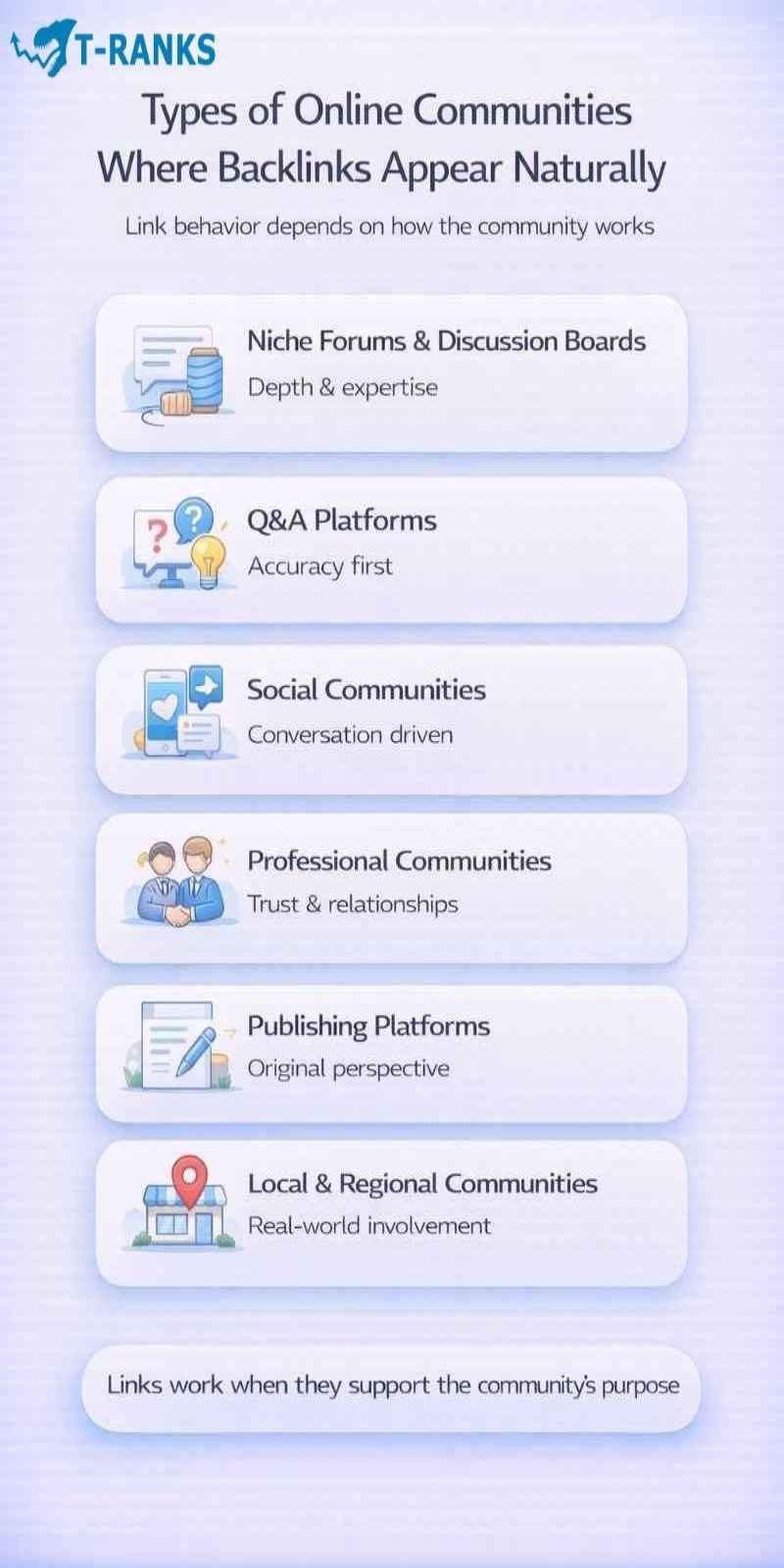
Community backlinks can appear across many types of online communities, but each community treats links differently based on its purpose, moderation style, and user expectations. A link that feels helpful in one environment can look spammy in another.
Search engines understand these differences. They evaluate community backlinks in relation to how the community functions, not just where the link is placed.
Below are the main types of online communities where backlinks can appear naturally, along with examples and how link behavior is typically interpreted in each.
Niche Forums and Discussion Boards
Niche forums are built around specific industries, skills, or interests. These communities value depth, accuracy, and real experience. Links are accepted when they expand on a complete explanation and support a detailed discussion.
Common examples include:
- Warrior Forum
- Digital Point
- WebmasterWorld
- Industry-specific forums related to SaaS, health, finance, or development
Threads often remain searchable for years, which allows genuinely useful links to retain value over time. Consistent participation matters more than link frequency.
Question-and-Answer Platforms
Question-and-answer platforms focus on solving one specific problem clearly and efficiently. Users expect direct answers, not promotion. Links are tolerated only as optional references after the answer is complete.
Common examples include:
- Quora
- Stack Overflow
- Superuser
Excessive linking is quickly flagged, and credibility comes from answer quality rather than how often links are shared.
Social Community Platforms
Social communities emphasize conversation and shared experience over documentation. Content moves quickly, and engagement matters more than permanence. Links are accepted only when they clearly benefit the group.
Common examples include:
- Reddit
- Facebook Groups
Personal insight is usually valued more than external resources. Links may drive quick attention but often have short visibility windows.
Professional and Networking Communities
Professional communities focus on collaboration, peer learning, and trust. Participation is relationship-driven, and links are shared as resources rather than promotions.
Common examples include:
- LinkedIn Groups
- Slack
- Discord
Many valuable backlinks from these environments appear indirectly through partnerships, recommendations, or mentions outside the platform.
User-Generated Publishing Platforms
These platforms allow individuals to publish content within a shared ecosystem. Links work when the content adds original insight or perspective, not when it is reused or promotional.
Common examples include:
- Medium
- Blogger
- Substack
These platforms support awareness and content distribution more than direct authority signals.
Local and Regional Communities
Local communities are built around geography and real-world involvement. Trust comes from visible participation rather than online promotion. Links usually reflect genuine relationships.
Common examples include:
- Local chamber of commerce websites
- City or regional business associations
- Community event pages and local sponsorship sites
- Neighborhood blogs and local news portals
Geographic relevance outweighs volume, which makes these links especially valuable for local trust and visibility.
Why Backlink Behavior Differs Across Communities
Each community exists to serve a different purpose. Forums prioritize depth, Q&A platforms prioritize accuracy, social groups prioritize interaction, professional communities prioritize trust, and local communities prioritize real-world involvement.
Community backlinks appear naturally when links support that purpose. When links ignore it, they are treated as spam regardless of intent. Understanding these differences is essential for earning community backlinks safely and consistently in modern search ecosystems.
Local Community Backlinks Without Looking Manipulative
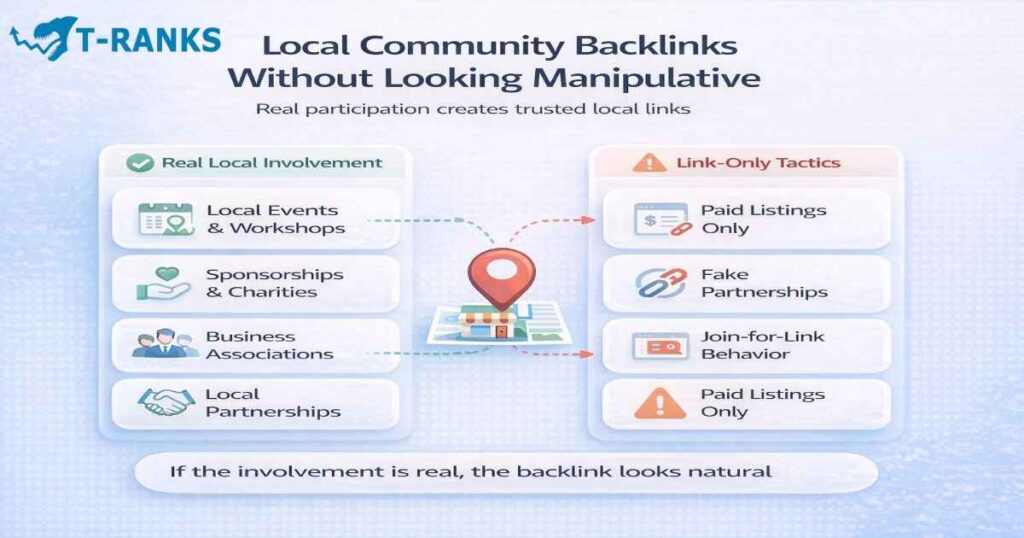
Local community backlinks are earned when a business’s real-world involvement is naturally reflected online through local mentions and citations. In local SEO, links are trusted when they document genuine participation, not when they are actively pursued for rankings.
Google’s local algorithms are designed to connect users with businesses that are genuinely part of a geographic area. Because of this, local backlinks are evaluated less as traditional SEO signals and more as proof of real presence, real relationships, and local recognition.
Most trusted local community backlinks begin offline, not on websites. When a business participates in its local environment, that activity is often mentioned online as part of normal community communication.
How Real-World Participation Turns Into Trusted Local Links
Local backlinks usually appear as a natural record of real activity, such as:
- Sponsoring local events, sports teams, or charities
- Hosting or speaking at workshops, meetups, or community sessions
- Joining chambers of commerce or local business associations
- Collaborating with nearby businesses on shared initiatives
These actions often lead to mentions on event pages, sponsor listings, community calendars, association websites, or local blogs, without any deliberate link outreach.
Google treats these links differently because they are difficult to fake. They are tied to physical locations, real organizations, and verifiable relationships. From a search perspective, they show that a business operates in a specific area, is recognized locally, and is being referenced to inform users rather than manipulate rankings.
Trusted local community backlinks typically come from sources such as:
- Chamber of commerce and business association websites
- Local event listings and sponsor pages
- Community organizations and non-profit sites
- Neighborhood blogs and hyper-local news platforms
- Schools, clubs, and local partner websites
Local backlinks start to look manipulative when the offline connection does not exist. Paying for listings without involvement, joining organizations only for directory links, or creating artificial partnerships breaks the connection between real-world activity and online mention. When that connection is missing, the backlink no longer reflects reality and loses trust.
The rule for local community backlinks is simple.
If the local involvement is real, the backlink looks natural.
If the involvement exists only to get a link, it looks manipulative.
Local community backlinks work best when they document genuine presence, real relationships, and consistent participation within a local community.
What Type of Content Communities Naturally Link To
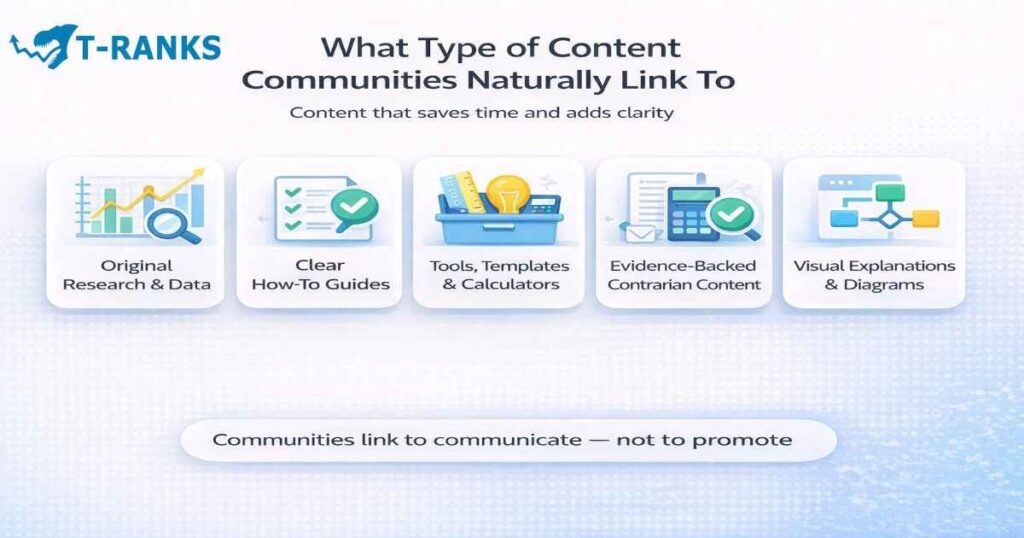
Communities do not link to content because it is well written or optimized. They link to content because it makes conversations easier. In 2026, online communities are highly resistant to thin, generic, or promotional material. Links appear only when a resource clearly improves an ongoing discussion.
Community members share links to avoid repeating explanations, settle disagreements, or provide clarity faster than typing everything out again. For that reason, only certain types of content consistently earn community backlinks.
Original Research and Data That Settles Questions
Communities frequently debate topics where opinions differ. When someone introduces original data, it shifts the discussion from speculation to evidence. Research is linked because it becomes a reference point.
This works best when the data directly answers a question already being discussed, such as salary ranges, performance benchmarks, or usage trends. Community members link to research to support claims, validate arguments, or provide credibility, not to promote the publisher.
Clear, Complete How-To Resources
Step-by-step guides earn links when they allow a community member to say, “This explains it better than I can here.” These resources are shared when they cover the full solution clearly, not just a partial answer.
Communities link to guides that reduce repetition. Instead of rewriting the same instructions in every thread, members reference a guide that already explains the process from start to finish.
Tools, Templates, and Calculators That Save Time
Interactive resources earn links because they solve problems instantly. When a tool produces an immediate answer, it becomes easy to recommend during a discussion.
Once discovered, these resources are reused repeatedly whenever the same problem appears. Community members often bookmark them and share them again without prompting.
Content That Challenges Common Assumptions
Well-reasoned content that challenges widely accepted beliefs often gets linked because it fuels discussion. These links appear when someone wants to question an assumption, introduce a different perspective, or spark debate.
Contrarian content earns community backlinks only when it is supported by logic, data, or real-world experience. Unsupported opinions are ignored.
Visual Resources That Clarify Complex Ideas
Diagrams, charts, and visual explanations earn links when text alone would be slow or confusing. Communities reference visuals to explain systems, workflows, or comparisons quickly.
These assets are commonly linked when a discussion reaches a point where explanation becomes inefficient without visual support.
The Pattern Behind Community Link-Worthy Content
Across all community platforms, the same pattern appears. Content earns links when it:
- Saves time during a discussion
- Replaces long explanations with clarity
- Provides evidence instead of opinion
- Helps others explain something more easily
Community backlinks are not rewards for publishing content. They are tools community members use to communicate better. That is why some content earns links consistently, while other content never does.
How to Measure the Real Impact of Community Backlinks
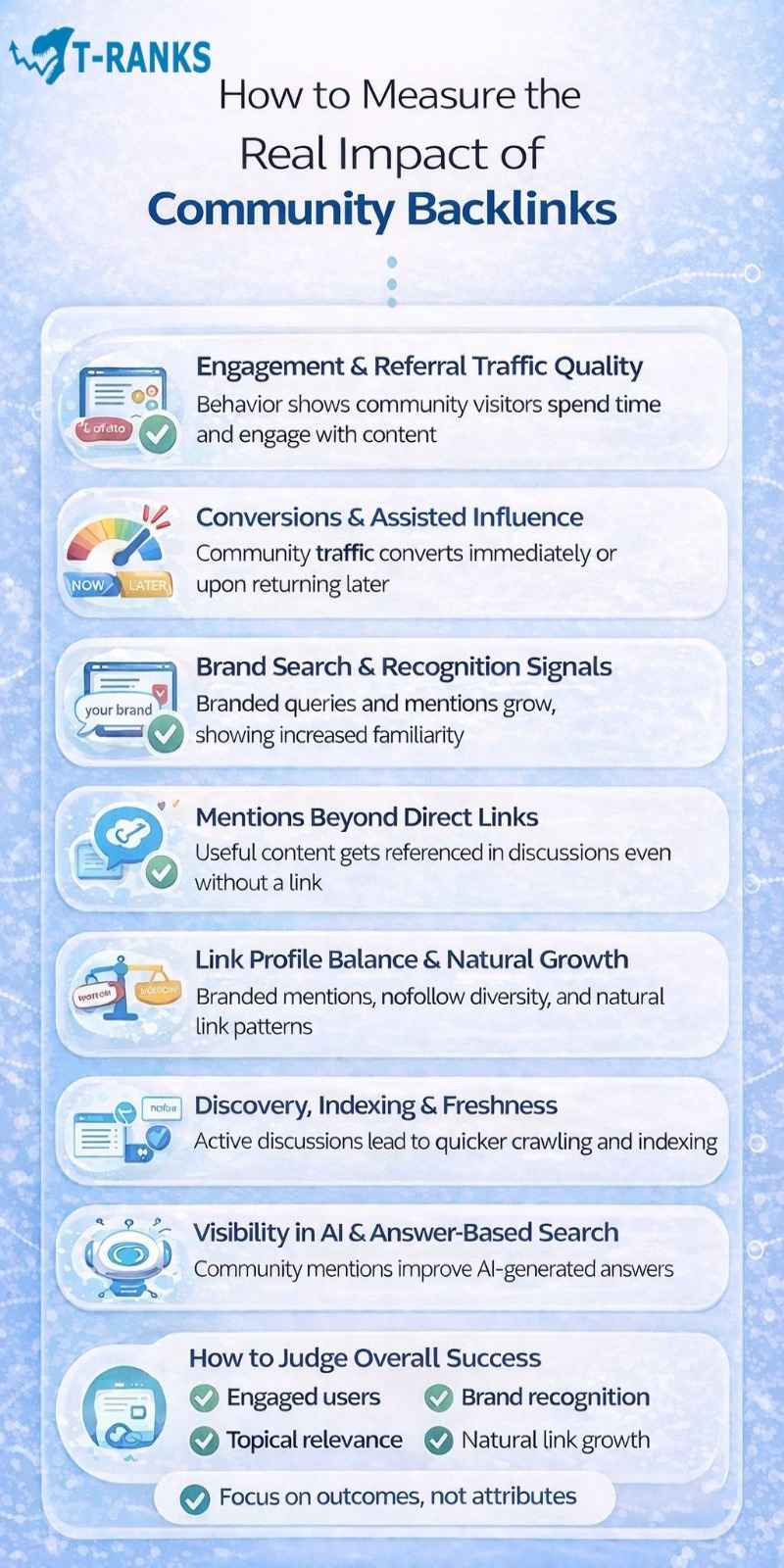
The impact of community backlinks is not measured through dofollow status or raw link authority. Because most community links are nofollow or user generated, their value shows up in engagement, visibility, and trust signals, not in immediate ranking jumps.
To evaluate community backlinks correctly, it is important to shift away from traditional link metrics and focus on how these links influence real user behavior and brand recognition over time.
Engagement and Referral Traffic Quality
One of the clearest indicators of impact is how users behave after arriving from a community link. When a link comes from a relevant discussion, visitors tend to spend more time on the site, explore additional pages, and interact meaningfully with the content.
High engagement signals confirm that the link was placed in context and delivered real value, which is exactly how community backlinks are meant to function.
Conversions and Assisted Influence
Community traffic often enters during the research or consideration stage. Users may not convert immediately, but they frequently return later through search or direct visits.
Measuring both direct conversions and assisted conversions helps reveal the true influence of community backlinks across the user journey. Strong assisted impact indicates that community exposure is shaping decisions, even when conversions happen later.
Brand Search and Recognition Signals
Effective community backlinks increase familiarity and trust. Over time, this shows up as growth in branded searches, including brand-only queries and brand-plus-product or service searches.
Search engines treat these patterns as signs of authority and relevance, which indirectly support stronger organic performance.
Mentions Beyond Direct Links
Community backlinks often trigger wider visibility. As useful content spreads, users may reference it in new discussions without linking, or mention the brand when explaining a concept to others.
Unlinked mentions, repeated references, and organic sharing confirm that the content is being used as a trusted resource rather than a promotional asset.
Link Profile Balance and Natural Growth
Community backlinks contribute to a healthier backlink profile by adding branded anchors, natural phrasing, and nofollow diversity. A profile that reflects real usage patterns is more resilient and less likely to trigger spam signals over time.
This balance supports long-term SEO stability rather than short-term gains.
Discovery, Indexing, and Freshness Effects
Community exposure often helps new content get discovered and indexed more quickly. When content is shared inside active discussions, search systems are more likely to crawl it sooner and associate it with relevant topics.
Faster discovery is a strong signal of visibility and relevance, even without direct ranking impact.
Visibility in AI and Answer-Based Search
Modern AI systems rely heavily on real discussions to identify reliable sources. Community mentions increase the likelihood that content is recognized, summarized, or referenced in AI-generated answers and conversational search results.
While this visibility cannot be measured with precision, consistent community presence strongly supports modern authority signals.
How to Judge Overall Success
Community backlinks should not be judged individually. Their value appears through patterns over time.
If community backlinks consistently:
- Send engaged users
- Increase brand recognition
- Strengthen topical relevance
- Support a natural link profile
then they are working, even if direct ranking changes are subtle.
The Correct Measurement Mindset
Measuring community backlinks is about outcomes, not attributes. When you stop focusing on dofollow status and start observing real user impact, visibility, and trust, their true value becomes clear.
Common Mistakes That Make Community Backlinks Look Like Spam
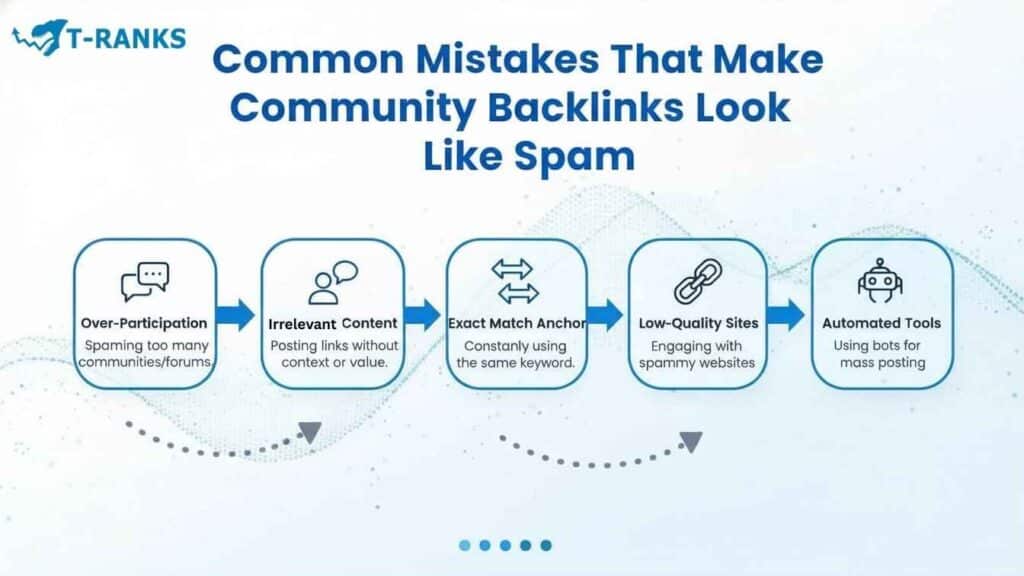
Community backlinks stop working the moment your actions look promotional instead of helpful. In modern search systems and moderated communities, spam is not defined by a single link. It is defined by repeated behavior patterns that show intent to promote rather than participate.
Below are the most common mistakes that cause Community Backlinks to trigger moderation or spam signals, even when the content itself is good.
Posting Links Without Contributing First
Sharing a link before adding value is one of the fastest ways to lose trust.
When a link appears without a clear explanation or helpful answer, it signals that the goal is visibility, not assistance. Communities and search systems expect links to support an already useful contribution, not replace it.
Targeting Irrelevant or Off Topic Communities
Topical relevance is mandatory, not optional.
Posting links in communities that do not align with your subject creates confusion and weakens credibility. Even strong content looks manipulative when the audience has no reason to need it.
Using Keyword Heavy or Sales Focused Language
Community discussions are conversational, not optimized.
Exact match keywords, promotional phrasing, or forced anchor text immediately stand out. Natural language and brand references fit naturally into discussions, while SEO style wording triggers spam detection.
Relying on New or Inactive Accounts
Trust is tied to participation history.
Links shared from new profiles or accounts that rarely engage outside of linking appear opportunistic. Communities and algorithms both reward consistent contributors who build credibility before sharing resources.
Repeating the Same Link Across Multiple Discussions
Scale turns usefulness into spam.
Posting the same URL repeatedly across threads or communities creates an unnatural pattern. Spam systems evaluate repetition and velocity, not intent. Even helpful resources lose value when overused.
Using Automation or Scaled Posting Tools
Automation removes the human signal.
Bots, scheduled replies, or mass posting tools create predictable footprints that are easy to detect. Sudden spikes in link activity are one of the strongest spam indicators.
Linking to Thin or Promotional Content
Communities link to resources, not pitches.
Sales pages, landing pages, or low effort content fail to meet community expectations. When users click and leave quickly, it reinforces negative quality signals.
Ignoring Community Rules and Cultural Norms
Every community has boundaries.
Posting links where they are discouraged, ignoring reputation requirements, or using the wrong tone leads to removals. Removed links often send stronger negative signals than nofollow links.
Dropping a Link and Leaving the Discussion
Participation does not end with posting.
Failing to respond to follow up questions or continue the conversation shows that the link was the goal. Ongoing engagement signals genuine intent and protects link value.
When Community Backlinks Are Not Worth Pursuing
Community backlinks can be valuable, but a mature SEO strategy recognizes that not every opportunity is worth the effort. In some situations, the time, consistency, and risk involved outweigh the potential benefit. Chasing community backlinks blindly can dilute focus and weaken an overall link strategy.
Below are situations where pursuing community backlinks is usually a poor choice.
When the Community Lacks Trust or Moderation
Communities with weak moderation often provide little SEO value. When discussions are dominated by spam, off-topic content, or automated posts, search engines tend to treat these environments as low quality. Links from such communities are frequently ignored and may associate a site with poor-quality neighborhoods.
When Topical Relevance Is Weak or Forced
Relevance is the foundation of effective backlinks. If a community’s focus does not closely align with your content, the backlink offers little value. Modern search systems easily detect topical mismatches and discount them, making the effort ineffective.
When Ongoing Participation Is Not Possible
Community backlinks are earned through presence, not placement. They are not worth pursuing if you cannot participate consistently, respond to follow-up questions, or build a visible contribution history. Without continued involvement, links appear transactional and lose trust quickly.
When Links Are Hidden or Rarely Seen
Not all community links are useful. Links limited to profile pages, signatures, or low-visibility sections rarely receive clicks or engagement. When users never see the link, both referral value and SEO impact remain minimal.
When Speed or Immediate Authority Is the Priority
Community backlinks work slowly. They are a poor fit when fast ranking movement, immediate authority signals, or short-term campaign results are the primary goal. In these cases, editorial coverage, PR mentions, or expert citations are usually more effective.
When the Content Cannot Withstand Scrutiny
Communities expose content to real users, not algorithms. If the content is thin, generic, promotional, or unclear in its value, sharing it inside communities often leads to ignored links or negative reactions rather than benefit.
When Stronger Link Opportunities Are Already Available
Community backlinks should support broader visibility, not replace higher-impact strategies. If you already have access to industry publications, trusted media outlets, or established partnerships, community backlinks should remain a secondary, supporting layer.
Community backlinks are most effective when they are used selectively. Knowing when not to pursue them is just as important as knowing how to earn them.
Where Community Backlinks Fit in a Balanced Link Strategy
Community backlinks play a supporting role in a balanced link strategy. They are not designed to be the primary drivers of rankings. Instead, they strengthen trust, relevance, and credibility by showing that real people are actively discussing and sharing your content.
In a complete SEO strategy, different types of links serve different purposes. Editorial links and high-quality guest posts build authority and signal expertise. Community backlinks confirm that this authority is recognized and discussed in real-world environments where users exchange knowledge.
This combination matters. Authority without real discussion can look engineered. Community mentions without authority lack depth. Together, they create a more believable and resilient signal profile that search engines are more likely to trust over time.
Community backlinks also help stabilize a link profile. They introduce nofollow links, branded mentions, and diverse sources that reflect organic growth rather than controlled placement. This diversity reduces risk and supports long-term SEO performance instead of short-term ranking spikes.
From a strategic perspective, community backlinks are most effective when they reinforce strong content and authoritative links. They help amplify visibility, support topical relevance, and confirm genuine user interest, without being overused or relied on as the main growth lever.
How T-RANKS Approaches Community Backlinks Safely
T-RANKS treats community backlinks as trust signals, not link placements. The goal is never volume or speed. The goal is to support authority by participating in real communities in a way that mirrors how experienced professionals naturally contribute.
The process begins with community qualification, not posting. Before any participation happens, T-RANKS evaluates whether a community is worth engaging at all. This includes moderation quality, discussion depth, topical relevance, and how links are historically treated. Communities that show spam tolerance or weak engagement are deliberately avoided.
How the T-RANKS Methodology Works in Practice
Once a community is selected, the focus shifts to behavior alignment. Participation follows how long-term members already interact. This means understanding discussion tone, response expectations, and what types of contributions the community values. At this stage, no links are shared. The only objective is to become a recognizable and helpful presence.
Linking is treated as a secondary outcome, not a tactic.T-RANKS establishes credibility first by answering questions, clarifying complex topics, and sharing practical insight without referencing external resources. Only after consistent contribution does linking become appropriate, and even then, links are added sparingly and only when they clearly improve the discussion.
Every community link must pass a simple internal check:
- The response remains useful even if the link is removed
- The link adds depth, not promotion
- The discussion benefits regardless of referral traffic
Success is not measured by link volume. Community backlinks are evaluated through engagement quality, referral behavior, brand recognition, and secondary visibility signals such as unprompted mentions or reuse of content in later discussions. This mirrors how modern search systems evaluate trust over time.
By prioritizing relevance, restraint, and consistency, T-RANKS uses community backlinks as a supporting layer that strengthens authority without triggering spam signals or moderation issues. This approach protects clients from short-term risk while building durable, long-term visibility.
Conclusion
In conclusion, community backlinks work best when they come from real participation and honest effort. They are built through trust, relevance, and helping people, not through shortcuts or automated posting. Search engines now focus on intent, context, and user behavior, which makes useful contributions far more effective than mass link placement.
Community links support visibility, brand recognition, and referral traffic, even when they are nofollow or user generated. Their value shows through engagement and trust, not through raw link metrics. When links are shared only to improve a discussion and not to promote a website, their impact becomes clear.
To build community backlinks safely, focus on understanding each community and contributing consistently. Share links only when they add real value. For long-term results without spam risk, commit to genuine participation or work with a team that follows these principles carefully.
FAQs About Community Backlinks in 2026
What are community backlinks in simple terms?
Community backlinks are links earned when people share your content inside online or local communities because it helps them.
They appear naturally in discussions as references, not as promotions, which is why search engines treat them differently from spam.
Are community backlinks still good for SEO in 2026?
Yes, community backlinks are still useful for SEO in 2026.
They support trust, topical relevance, and brand discovery even though most of them do not pass strong ranking power.
Do community backlinks help SEO if they are nofollow or UGC?
Yes, nofollow and UGC community backlinks help SEO indirectly.
They contribute to brand mentions, referral traffic, and a natural link profile that search engines associate with legitimacy and real usage.
Can community backlinks cause ranking or spam issues?
Yes, community backlinks can cause issues if they follow manipulative patterns.
Repeated link drops, keyword heavy anchors, or links from new or inactive accounts often trigger moderation or spam filters.
How does Google evaluate community backlinks?
Google evaluates community backlinks based on intent, context, and behavior.
The focus is on why the link exists, how relevant it is to the discussion, and whether it comes from genuine participation.
What is the difference between community backlinks and forum spam?
Community backlinks help users by adding relevant references, while forum spam exists mainly to promote a website.
The difference is defined by value, relevance, and contribution quality rather than the platform itself.
Are forum backlinks still safe to use in 2026?
Yes, forum backlinks are safe in 2026 when earned through real participation.
They become risky when automated, repetitive, or focused only on link placement instead of helping the community.
How many community backlinks should a website build?
There is no fixed number of community backlinks that guarantees results.
A small number of relevant and natural mentions is far more effective than a large volume of low quality links.
Which types of communities are best for earning backlinks?
Niche focused and well moderated communities work best for earning backlinks.
Forums, Q&A platforms, professional groups, and trusted local communities provide safer and more valuable opportunities.
What type of content earns community backlinks naturally?
Content that solves specific problems earns community backlinks most naturally.
Guides, original research, tools, templates, checklists, and real case studies are commonly referenced in discussions.
How do community backlinks support brand authority?
Community backlinks support brand authority by increasing recognition and trust through repeated mentions.
Over time, these references signal expertise and familiarity to both users and search engines.
Are community backlinks better than guest posts or PR links?
No, community backlinks are not better than guest posts or PR links.
They serve a different role by building trust and relevance, while guest posts and PR links usually provide stronger authority signals.