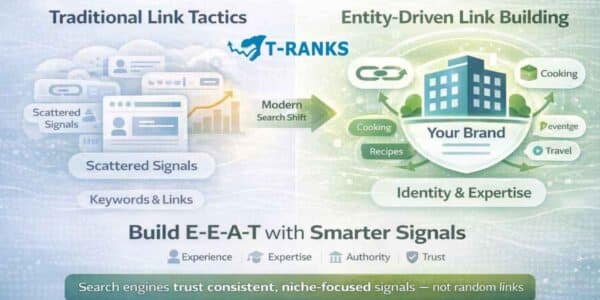
Search engines no longer evaluate websites only by keywords or link counts. They aim to understand who a brand is, what it represents, and whether its information can be trusted. This shift toward entity understanding has made entity-driven link building one of the most effective ways to build sustainable visibility in modern search.
Entity-driven link building focuses on earning links and mentions that confirm identity and expertise, not just rankings. When your brand is referenced consistently by relevant and authoritative sources, search engines gain clarity about your topical relevance and authority. These signals help connect your brand to the subjects you want to be known for and strengthen trust over time.
This guide explains how entity-driven link building works, why it is more effective than traditional link tactics, and how it strengthens E-E-A-T. You will learn how to build long-term authority through clear entity signals and why this approach improves visibility across both search results and AI-powered experiences.
What Is Entity-Driven Link Building?
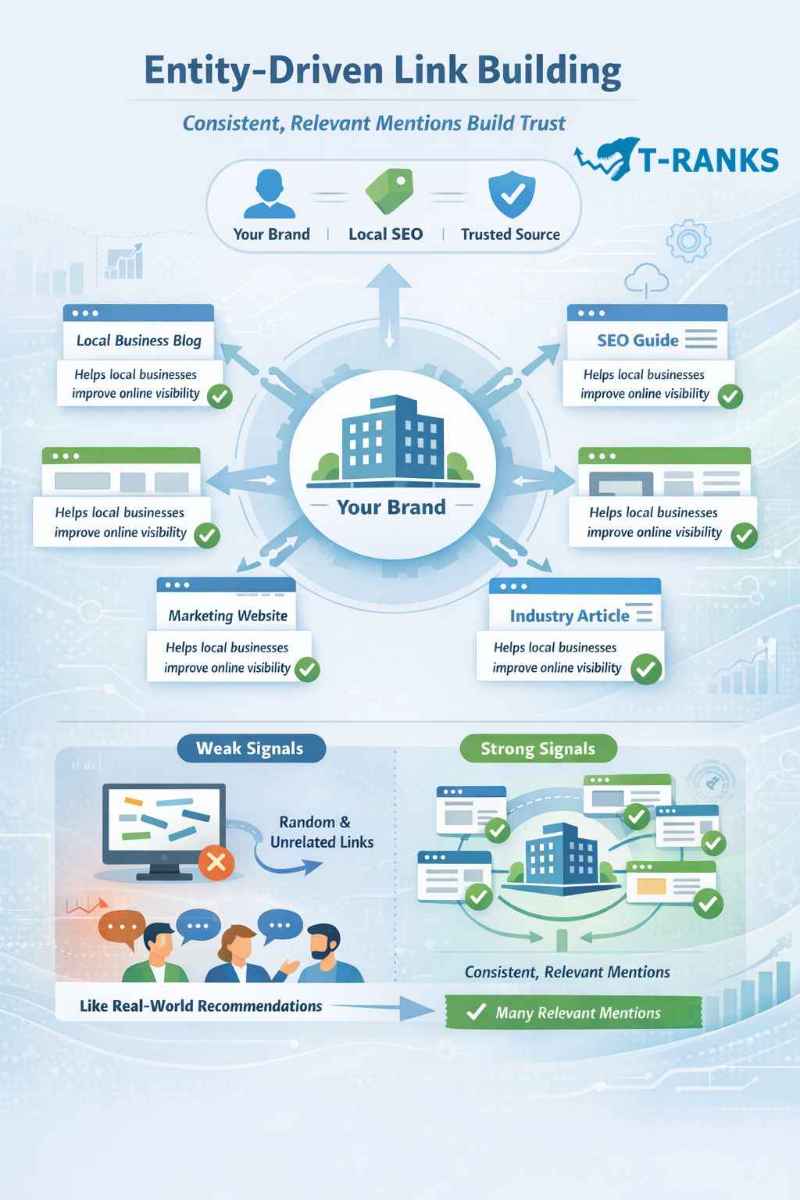
Entity-driven link building is a way of earning links and mentions that clearly show what your brand is about and why it can be trusted.
Instead of focusing on how many backlinks you have, this approach focuses on what those links say about you.
In simple terms, it helps search engines understand:
- who your brand is
- what topics you are known for
- whether other trusted websites recognize your expertise
Search engines do not judge websites based on a single link. They look for patterns. When many relevant websites mention your brand in the same context and topic area, it creates a strong and reliable signal about your identity.
You can think of it like building a reputation in everyday life. One recommendation is helpful. But when several respected people recommend you for the same skill, your credibility grows much faster. Online links and mentions work in the same way.
Simple Example
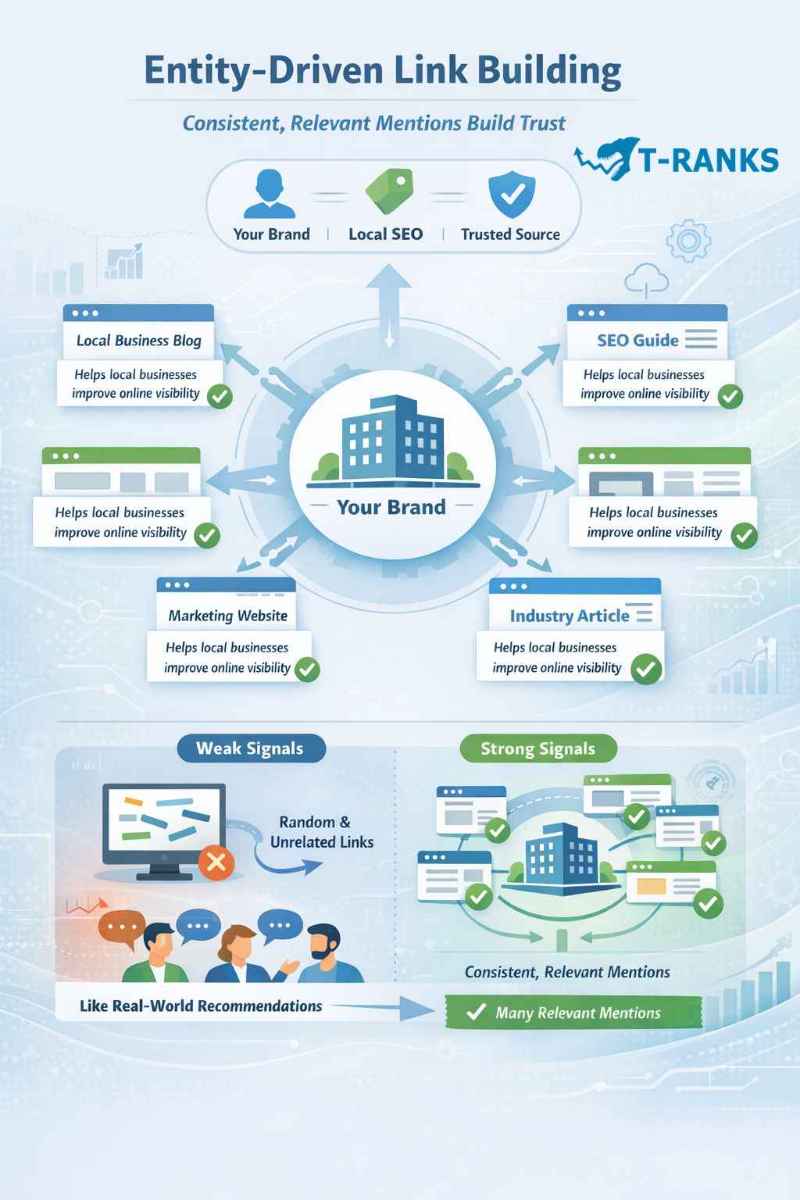
Imagine you run a digital marketing agency that specializes in local SEO.
Over time, your agency is:
- mentioned on local business blogs
- referenced in articles about local search strategies
- quoted in SEO guides that discuss local visibility
- invited to contribute insights on marketing websites
Each time your brand is mentioned, it is described in the same way:
as an agency that helps local businesses improve their online presence.
Even if you do not have hundreds of backlinks, search engines begin to see a clear pattern. Your brand is repeatedly connected with local SEO across trusted and relevant websites. That repeated confirmation builds trust.
This is entity-driven link building. The links and mentions are not just pointing to your website. They are confirming what your brand is known for.
This approach is very different from traditional link building. Older methods focused mainly on collecting as many backlinks as possible, even from unrelated websites. That often created mixed or unclear signals. Today, relevance and consistency matter more than volume.
When your links and mentions consistently place your brand within the right topics, your authority becomes easier to recognize. This leads to stronger trust signals, better E-E-A-T performance, and more stable rankings over time.
What Is an Entity and Why Google Cares About It
An entity is a real, identifiable thing that Google can clearly recognize and understand.
It can be a brand, a person, a business, a product, a place, or even a well-defined topic. What matters is that the entity has a clear identity that stays the same wherever it appears online.
Google relies on entities because they help the search system understand meaning, not just words. Keywords can change depending on how people search, but an entity represents one specific thing. When Google sees the same name, description, and topic connections repeated across trusted websites, it forms a clear picture of what that entity represents.
Entities also help remove confusion. A single keyword can refer to many things, but an entity refers to only one. For example, the word “Apple” could mean a fruit or a technology company. When Google sees related signals like “iPhone” and “MacBook,” it understands that the search is about the company, not the fruit. This clarity helps Google deliver more accurate and helpful results.
Consistency is what strengthens entities. When your brand name, descriptions, and topic focus appear in the same way across your website and other reputable platforms, Google gains confidence in your identity. When those signals are mixed or unclear, trust is weaker.
This is why understanding your entity comes before building links. If your identity is not clear, backlinks cannot reinforce it properly. When your entity is well defined, every relevant link and mention works together to build trust and authority in your niche.
How Entity SEO and Entity-Driven Link Building Work Together
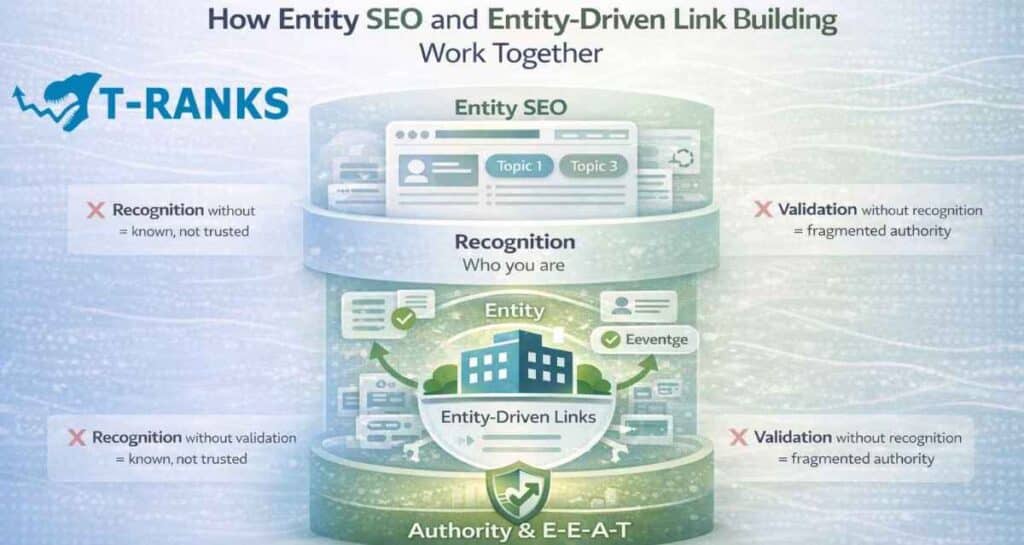
Entity SEO and entity-driven link building operate as two interdependent layers of the same authority system.
One establishes identity. The other confirms credibility. Search engines rely on both to evaluate trust at scale.
Entity SEO establishes recognition
Entity SEO defines who you are in a way search engines can reliably understand.
It focuses on making your brand, author, or organization unambiguous across your own digital properties.
This includes:
- consistent naming and descriptions
- clear topical boundaries
- structured content and internal linking
- supporting entity signals such as basic schema
These signals allow search engines to assign a stable identity to your brand and associate it with specific subject areas. Without this recognition layer, external signals lack a reliable reference point.
Entity-driven link building provides validation
Entity-driven link building confirms that your recognized identity is trusted beyond your own website.
Once an entity is clearly defined, contextual links and mentions from relevant third-party sources act as independent verification.
These references demonstrate that:
- your expertise is acknowledged externally
- your brand is discussed within the correct topical context
- trusted publishers associate your entity with specific subjects
This external validation strengthens E-E-A-T by showing that authority is earned, not self-declared.
Why recognition and validation must align
Recognition without validation creates understanding without trust.
Search engines may know who you are, but lack evidence that your expertise is accepted by others.
Validation without recognition creates fragmented authority.
Links exist, but their value is diluted because they are not consistently connected to a single, well-defined entity.
Only when both layers align can search engines confidently consolidate signals and evaluate authority.
The authority-building sequence search engines follow
Recognition → Validation → Authority
- Entity SEO enables recognition
- Entity-driven links provide validation
- Repeated confirmation produces authority
This sequence reflects how modern search systems reduce uncertainty and identify entities that deserve sustained visibility.
Entity-Driven Link Building vs Traditional Link Building
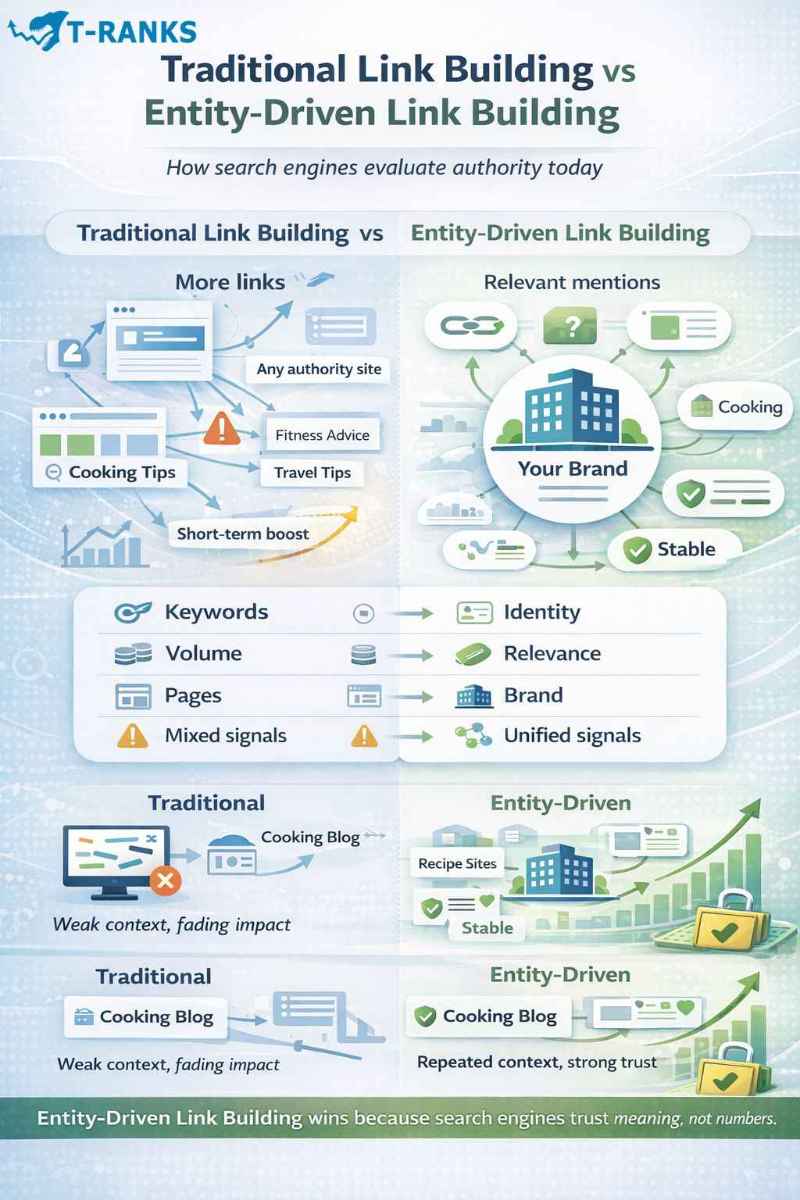
Traditional link building and entity-driven link building both aim to improve visibility, but they are based on very different assumptions about how search engines evaluate authority.
Traditional link building focuses on pages and keywords. Entity-driven link building focuses on brands, expertise, and topic recognition.
How traditional link building works
Traditional link building is built around volume and authority metrics.
The primary goal is to collect backlinks that point to a page in order to improve rankings for specific keywords.
This approach often targets:
- any high-authority website
- regardless of industry relevance
- with an emphasis on anchor text and link counts
While this can produce short-term ranking improvements, it often fails to build lasting credibility because the links do not consistently reinforce what a brand represents or which topics it specializes in.
How entity-driven link building works
Entity-driven link building is built around clarity, relevance, and consistency.
Instead of maximizing link quantity, it prioritizes earning mentions and links from sources that already have authority within the same topic area.
These contextual references:
- connect your brand to specific subjects
- reinforce a clear identity across the web
- help search engines understand where your expertise belongs
When multiple trusted websites describe your brand in similar ways, search engines receive a strong, unified signal that is easier to trust and evaluate.
Key differences at a glance
| Aspect | Traditional Link Building | Entity-Driven Link Building |
| Primary focus | Keywords and link volume | Identity, relevance, and topic alignment |
| Main goal | Improve rankings for target keywords | Strengthen brand authority and E-E-A-T |
| Link sources | Any high-authority site | Niche-relevant, industry-specific sites |
| Anchor usage | Exact or partial match anchors | Natural language and branded mentions |
| Signal consistency | Often mixed or scattered | Strongly unified across platforms |
| Algorithm resilience | Higher risk during updates | More stable under semantic search systems |
| Success metrics | Link count and rankings | Mentions, topical visibility, and trust |
Practical example
Traditional approach:
A cooking blog earns a backlink from a large general news website simply because the site has high authority. The link may offer a small ranking benefit, but it does little to clarify what the blog is known for. The context is weak, so the signal fades quickly.
Entity-driven approach:
The same cooking blog is mentioned by recipe websites, food publications, chef interviews, and culinary organizations. Each reference places the brand in the same topic context. Over time, search engines clearly associate the brand with cooking and recipes, leading to stronger trust and more stable visibility.
Why entity-driven strategies outperform over time
Entity-driven link building focuses on meaning, not numbers.
Traditional link building can help with early visibility, but entity-driven strategies align with how modern search systems evaluate trust, expertise, and authority. This makes them more resilient, more predictable, and better suited for long-term growth.
How Links Validate Entities and Build E-E-A-T
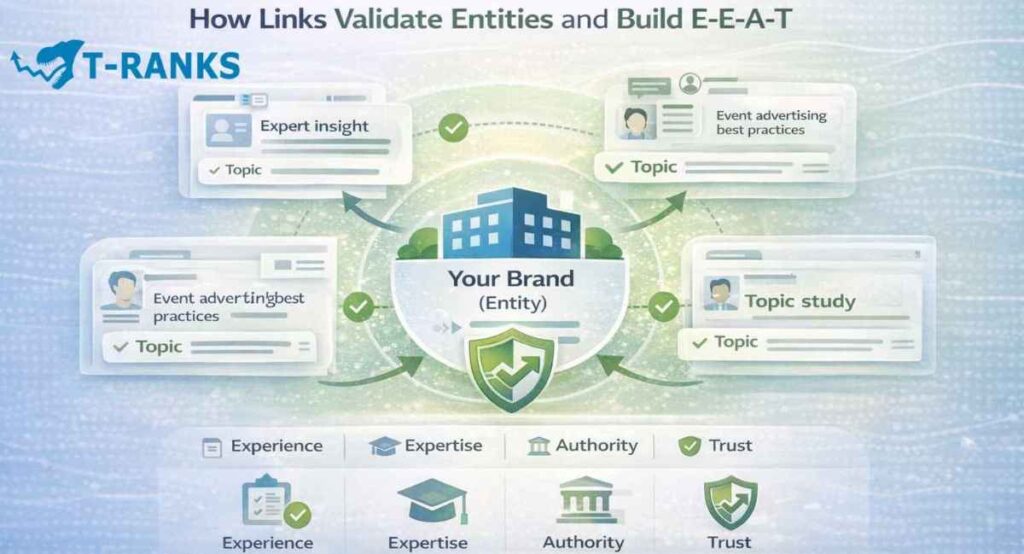
Links validate entities by providing third-party confirmation of who you are, what you are known for, and whether your expertise is recognized in the right topic space. When trusted websites reference your brand in relevant contexts, search engines gain stronger evidence that your entity is credible and deserves visibility.
A single link can help, but search engines trust patterns, not isolated signals. Repeated mentions from reputable, niche-relevant sources build a clearer identity profile over time. This consistency reduces ambiguity and strengthens the connection between your brand and the topics you want to own.
Context is what turns a link into a meaningful signal. A mention inside an article, interview, case study, or expert contribution explains why your brand belongs in that topic. That surrounding language helps search systems interpret the relationship between your entity and the subject being discussed.
Brand and authorship signals add another layer of validation. When respected publishers mention your brand name, cite your work, or reference your experts, it strengthens identity and reinforces credibility. Unlinked brand mentions also matter because they show your name appears naturally within real industry conversations.
High-quality links support E-E-A-T in specific ways:
- Experience is reinforced when links reference real results, case studies, or first-hand insights.
- Expertise is reinforced when niche publications cite your explanations, research, or specialist content.
- Authoritativeness grows when you earn editorial features, industry recognition, and repeated citations in your field.
- Trustworthiness increases when multiple reputable sources mention your brand consistently and accurately.
Entity-driven link building works best when links reinforce your core topic areas. Links from unrelated websites may still pass some authority, but they do not strengthen entity identity. Links from relevant sources help search engines categorize your brand more confidently and associate it with the right subject area.
When these signals become consistent, they create a strong foundation for stable rankings and wider visibility. This is also why entity-validated brands are more likely to be referenced in AI Overviews and AI assistants, because the entity is easier to trust.
Types of Links That Strengthen Entity Trust
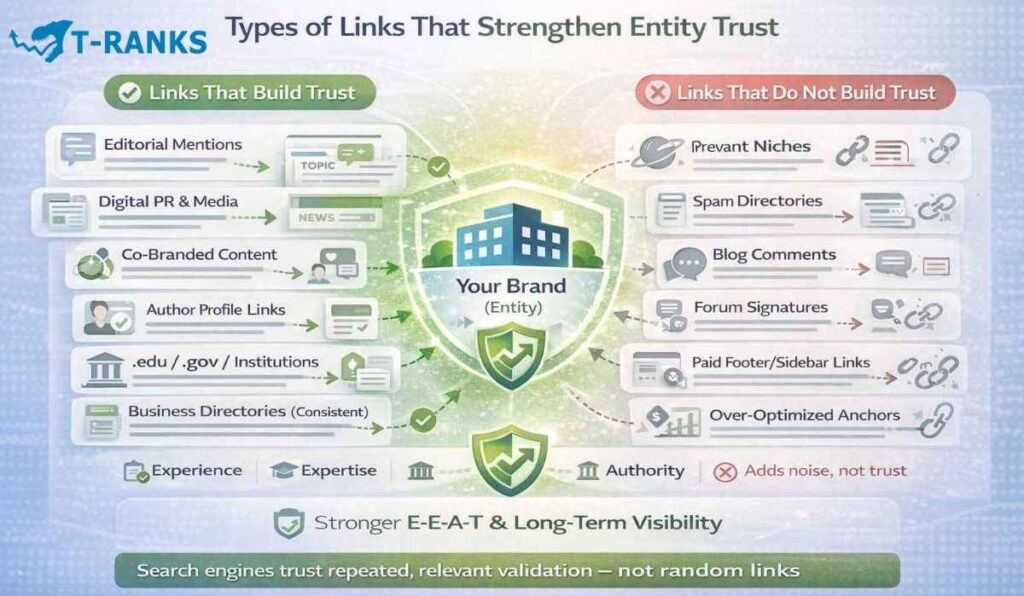
The strongest links do more than improve rankings. They help search engines trust who you are, what you are known for, and whether credible sources recognize your expertise. These links validate your entity by reinforcing identity, relevance, and authority in consistent ways.
The following link types are the most effective at building that trust when earned from relevant and reputable sources.
Editorial Mentions from Topic-Relevant Websites
Editorial links are earned when your content is referenced naturally within articles, guides, reports, or expert discussions. These mentions signal that knowledgeable publishers consider your information valuable enough to cite. Because they appear in meaningful context, they help search engines understand why your brand belongs in a specific topic area.
Example:
A marketing analytics blog links to your case study while explaining campaign measurement, reinforcing your identity within the analytics space.
Digital PR Links and Media Coverage
Links from journalists, news outlets, and business publications validate real-world relevance and credibility. Media coverage shows that your brand is visible beyond your own website and recognized by authoritative third parties. These links often carry strong trust signals because they are editorially earned.
Example:
A business magazine features your startup’s growth story and links to your website, signaling legitimacy and industry relevance.
Co-Branded Content and Partnership Links
When you collaborate with other reputable brands, search engines observe relationships between entities. Co-created webinars, reports, interviews, or guides indicate shared authority and topical alignment. These links help define where your brand fits within a professional ecosystem.
Example:
You collaborate with a project management tool to publish a productivity guide, with both brands linking to the resource.
Author Profile Links and Verified Bio Mentions
Author profile links help validate the people behind the content. When respected publications include your author bio, credentials, and links, they confirm that real experts are associated with your brand. This strengthens both the author entity and the brand entity.
Example:
An author bio on a respected SEO publication links to your site and lists your professional background.
Resource Page Links and Reference Citations
When websites list your content as a recommended resource, it signals reliability and usefulness. These links show that others depend on your information to educate or support their audience, reinforcing topical authority.
Example:
An educational institution includes your research in a digital marketing resource library.
Trusted Seed Sites and Institutional Links
Links from highly vetted sources such as educational institutions, government resources, or reputable nonprofit organizations carry strong credibility signals. These sites sit at the core of trust networks and help validate entity legitimacy.
Example:
A government small-business portal links to your guide on writing business plans.
Structured Business and Niche Directory Citations
Foundational citations help search engines verify that your brand exists and is consistent across platforms. While these links are not powerful on their own, accurate and consistent listings reduce confusion and support entity stability.
Example:
Your business details match across Google Business Profile, Yelp, and industry directories.
Strategic Guest Posts on High-Quality Niche Sites
Guest posts strengthen entity trust when they appear on relevant, reputable websites and contribute real value. The contextual link within the main content helps associate your brand with the topic being discussed.
Example:
You publish an in-depth analytics guide on a respected SaaS publication and receive a contextual link.
Expert Quotes, Roundups, and HARO Mentions
Being quoted as an expert shows that journalists and publishers trust your insights. These mentions validate influence and reinforce authority within a specific subject area.
Example:
Your commentary appears in a “Top Email Marketing Trends” article and links back to your site.
Unlinked Brand Mentions and Citation Signals
Even without clickable links, unlinked mentions still strengthen entity recognition. Search engines can interpret these mentions as signals of relevance and recognition within industry conversations.
Example:
A podcast transcript references your brand multiple times without linking.
Links That Do Not Strengthen Entity Trust
Not all links help entity clarity. Irrelevant high-authority backlinks, generic low-quality directories, blog comments, forum signatures, paid footer placements, and over-optimized anchor text often add noise rather than trust. For example, a cryptocurrency blog linking to a fitness coaching website creates a topical mismatch that weakens identity.
Why These Link Types Matter
Entity-strengthening links work because they consistently confirm the same story: who you are, what you do, and the topics you belong to. When these confirmations repeat across trusted sources, search engines gain confidence in your entity, leading to stronger E-E-A-T and long-term visibility.
How to Build an Entity-Driven Link Building Campaign (Step-by-Step)
A successful entity-driven link building campaign starts long before outreach. It begins with defining a clear identity, narrowing topical focus, and earning links that consistently reinforce the same story about your brand. When done correctly, each link strengthens recognition, validates expertise, and builds long-term E-E-A-T rather than short-lived rankings.
Step 1: Define Your Primary Entity Clearly
Start by making your main entity unambiguous. Search engines must be able to recognize exactly who you are without confusion. This means your brand name, key people, offerings, and purpose should appear consistently wherever your business is mentioned.
Focus on defining:
- your official brand name and common variations
- founders, authors, or subject-matter experts
- products or services you want to be associated with
- the audience you serve
Example:
For a SaaS product, define its name, category, primary use case, and target customers in a consistent way across your website and profiles.
Step 2: Set Clear Topical Boundaries
Next, decide what topics your brand should be trusted for and what falls outside your expertise. Entity-driven link building works best when search engines can easily place your brand within a specific subject area.
Limit your focus to:
- three or four core topic areas
- closely related supporting topics
- content that reinforces those themes
Avoid expanding into unrelated niches, even if they seem attractive for traffic. Clear boundaries help every future link strengthen the same topical signal.
Example:
A fitness brand may focus on strength training, nutrition, and home workouts, while avoiding unrelated topics like finance or travel.
Step 3: Understand Your Current Entity Signals
Before building new links, understand how your brand is already perceived. Look at existing mentions, citations, and references to see what signals search engines are likely associating with your entity.
Pay attention to:
- how your brand name is written across sites
- which topics you are already mentioned for
- whether mentions are linked or unlinked
- gaps where competitors appear but you do not
This step is about diagnosis, not outreach. It shows where your entity signals are strong and where they need reinforcement.
Example:
If your brand is frequently mentioned in analytics discussions but rarely linked, those mentions represent easy opportunities to strengthen validation.
Step 4: Target Your Entity Neighborhood
Identify the publishers, platforms, and creators that already define authority in your topic space. These form your entity neighborhood. Search engines expect trusted brands to be mentioned alongside other recognized entities within the same field.
Choose targets based on:
- topical relevance
- editorial credibility
- shared audiences
- natural contextual fit
Links earned from within this neighborhood reinforce where your brand belongs and make entity associations clearer.
Example:
A project management SaaS targeting productivity blogs, SaaS publications, and workflow-focused podcasts reinforces its position in the productivity ecosystem.
Step 5: Earn Links That Reinforce Consistency
Focus on earning links through contribution and relevance, not volume. Each link should support the same identity and topic associations you defined earlier. Over time, this repetition creates strong trust signals.
High-impact approaches include:
- contributing expert insights
- publishing original research or data
- collaborating on guides, webinars, or reports
- earning editorial mentions and expert quotes
As links accumulate, ensure your brand name, descriptions, and author information remain consistent across all mentions. Consistency turns individual links into a unified entity signal.
Example:
An expert quote cited across multiple industry articles consistently reinforces your authority within the same topic area.
Why This Process Works
Entity-driven link building succeeds because it aligns with how modern search systems evaluate trust. Instead of relying on isolated backlinks, this approach builds recognition first, validation second, and authority over time. When links consistently reinforce the same identity and topics, search engines gain confidence in your entity and reward it with more stable visibility.
Illustrative Examples of Entity-Driven Link Building in Practice
Examples help clarify how entity-driven link building works in real situations. The scenarios below illustrate common patterns showing how different types of entities earn meaningful mentions that reinforce identity, relevance, and authority. These are not case studies, but representative examples of how entity validation typically happens across industries.
SaaS Brand: Product Recognition Through Contextual Mentions
A workflow automation SaaS publishes an original data study on how AI reduces task completion time for remote teams. Industry blogs reference the study while discussing productivity trends. Influencers and analysts mention the findings, and a technology publication highlights the research in an editorial feature.
Each mention places the SaaS brand in the same topical context: workflow automation, AI-driven productivity, and remote team efficiency. Over time, these consistent references help search engines clearly associate the brand with those subjects and treat it as a relevant entity within that space.
Agency Brand: Authority Built Through Thought Leadership
An SEO agency produces a detailed guide explaining entity-based search strategies. Search marketing blogs reference the guide when discussing semantic SEO and modern ranking systems. The agency’s founder is invited to share insights on podcasts and expert panels, generating additional contextual mentions.
This pattern reinforces two entity signals at once: the agency’s topical expertise and the founder’s personal authority. Repeated references from industry-specific platforms help search engines recognize the agency as a credible source within advanced SEO topics.
Personal Expert: Identity Reinforced Through Authorship
A cybersecurity consultant contributes articles to niche security publications. Each article includes a consistent author bio that connects back to the consultant’s professional profiles. Over time, newsletters, expert roundups, and podcasts begin referencing the consultant’s insights.
These repeated authorship signals help search engines confirm that the individual is a real, recognizable expert associated with cybersecurity topics. The consistency across platforms strengthens both identity and trust.
Local Business: Geographic Trust Through Community Mentions
A dental clinic is mentioned in local news articles, community blogs, and event websites. Nearby institutions reference the clinic as a partner for health programs, and all mentions use consistent business details.
These signals help search engines confidently associate the clinic with its location and services. Consistent local references reinforce geographic relevance and strengthen trust in local search results.entity-driven link building
What These Examples Show
Across all scenarios, the pattern is the same.
Entity-driven link building works by repeating consistent, relevant signals across trusted sources. The goal is not volume, but clarity. When mentions align around the same identity, topics, and context, search engines gain confidence in the entity and treat it as authoritative.
Common Mistakes That Break Entity-Driven Link Building
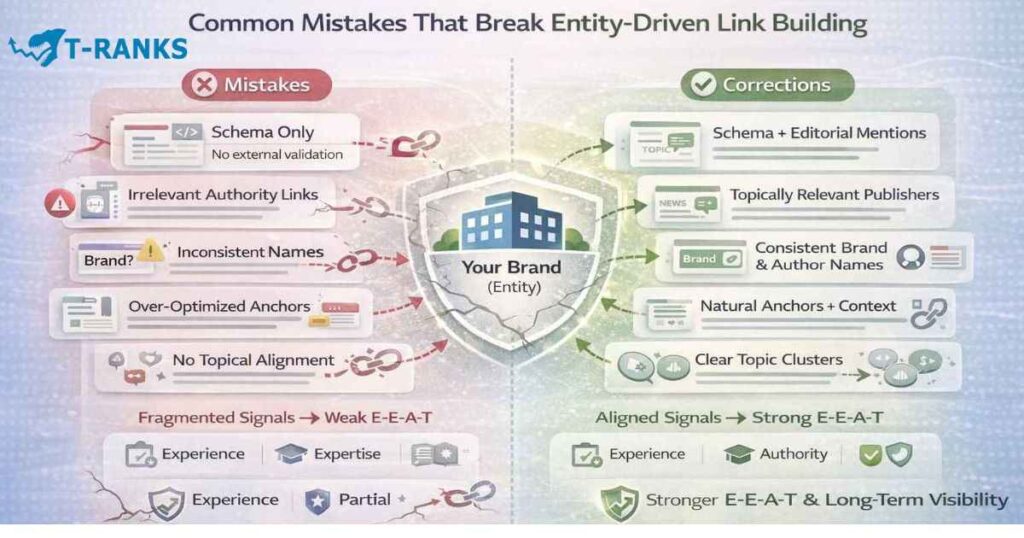
Entity-driven link building fails when signals become fragmented, inconsistent, or disconnected from a clear topical identity. These breakdowns weaken E-E-A-T, introduce ambiguity, and prevent search engines from forming a stable understanding of your entity. The following mistakes are the most common reasons entity-focused strategies lose effectiveness.
Treating Entity SEO as a Schema-Only Tactic
Schema markup helps search engines interpret structured information, but it does not establish trust on its own. When schema exists without supporting editorial mentions or contextual links, it becomes isolated data rather than a validation signal. Search systems rely on external confirmation, not self-declared structure.
Correction: Use schema to reinforce signals that already exist across trusted third-party sources, not as a substitute for them.
Chasing Irrelevant Publishers for Authority Metrics
High-authority links are not inherently valuable if they come from unrelated topics. When links originate from publishers with no semantic connection to your niche, they add noise instead of clarity. Over time, this weakens topical associations and dilutes entity identity.
Correction: Prioritize publishers with strong topic overlap and editorial relevance. A single aligned mention contributes more to entity trust than multiple mismatched placements.
Inconsistent Brand and Author Naming
Variations in brand names, author bios, or business details fragment entity recognition. Search engines may interpret these variations as separate entities, causing link equity and trust signals to scatter instead of consolidate.
Correction: Standardize brand names, author identities, and key details across all platforms. Consistency allows search systems to confidently connect mentions to the same entity.
Over-Optimizing Anchors While Ignoring Context
Exact-match anchor text manipulation is an outdated tactic that often disrupts semantic patterns. Modern algorithms evaluate the surrounding language, intent, and topical relevance of a link. Forced anchors break natural context and reduce trust signals.
Correction: Favor natural, branded, and partial-match anchors supported by meaningful editorial context.
Ignoring Topical Alignment
Links earned across unrelated subject areas prevent search engines from mapping expertise accurately. When a backlink profile lacks topical focus, entity signals become scattered, making it difficult for systems to determine what the brand should be trusted for.
Correction: Build links within clearly defined topic clusters and focus on publishers that exist within your semantic neighborhood.
How Entity-Driven Link Building Leads to AI Visibility
AI-powered search systems are designed to reduce uncertainty. Before generating answers or citations, they evaluate whether an entity is clearly identifiable, consistently represented, and supported by reliable external confirmation. Entity-driven link building strengthens exactly these signals, making it easier for AI systems to trust and surface your brand in Google AI Overviews, ChatGPT responses, and Perplexity citations.
To understand how this trust is formed, it helps to look at the specific signals AI systems rely on when deciding which entities are safe to reference.
AI Systems Prioritize Clearly Resolved Entities
AI models begin by identifying entities they can confidently recognize across multiple data sources. Brands with consistent names, attributes, and topic associations are easier to resolve. When an entity appears repeatedly in similar contexts across authoritative websites, AI systems treat it as stable and real rather than ambiguous or speculative.
Entity-driven link building reinforces this clarity by ensuring mentions consistently describe the same identity and subject matter.
External Validation Reduces AI Uncertainty
AI systems do not rely on self-published claims alone. They cross-check information using independent sources to verify accuracy. Contextual links and editorial mentions act as third-party confirmation that an entity’s expertise is recognized beyond its own website.
When multiple trusted publishers reference your brand in aligned contexts, AI interprets this as consensus rather than coincidence.
E-E-A-T Signals Guide AI Trust Decisions
Experience, expertise, authoritativeness, and trustworthiness are not abstract concepts for AI systems. They are inferred through patterns:
- first-hand insights cited by others
- expert commentary referenced across publications
- authoritative mentions from respected industry sources
- consistent, accurate information across platforms
Entity-driven links naturally reinforce these patterns, making it easier for AI systems to classify an entity as credible.
Knowledge Graph and Semantic Alignment Matter
Contextual links contribute structured facts and relationships that help enrich Knowledge Graph understanding. They clarify what an entity does, how it relates to other entities, and which topics it belongs to.
This semantic grounding allows AI systems to associate your brand with relevant queries more confidently, especially for explanatory and informational searches.
AI Systems Favor Low-Risk Sources
AI-generated answers aim to minimize the chance of misinformation. Entities with fragmented signals, inconsistent identity, or weak validation are treated as higher risk and are often excluded.
When entity-driven link building creates consistent, well-supported signals across trusted sources, AI systems perceive the brand as a safer source to reference. This increases the likelihood of inclusion in summaries, citations, and AI-generated explanations.
Why This Leads to Visibility Across AI Platforms
Google AI Overviews favor entities with strong E-E-A-T and stable Knowledge Graph signals.
ChatGPT relies on multi-source validation and semantic consistency.
Perplexity prioritizes credibility, contextual authority, and verifiable references.
Across all platforms, entity-driven link building works because it builds clarity, confidence, and trust, not just backlinks.
In Simple Terms
A clear entity leads to stronger validation, stronger E-E-A-T, higher AI trust, and more visibility across generative AI systems.
Entity-Driven Link Building is the mechanism that makes this possible.
Conclusion
Entity-driven link building works because it matches how modern search and AI systems evaluate trust. Instead of relying on link volume, it builds clear, consistent signals that help search engines and AI models understand identity, expertise, and relevance.
As AI-powered results continue to replace traditional rankings, brands with strong entity validation are more likely to appear in Google AI Overviews, be cited by ChatGPT, and surface in platforms like Perplexity. This approach supports E-E-A-T, strengthens Knowledge Graph signals, and creates visibility that lasts beyond algorithm updates.
If you want to strengthen your entity signals and improve your chances of being referenced in AI-generated results, T-RANKS can help you build a strategy focused on long-term authority and trust.
FAQs On Entity-Driven Link Building
What is entity-driven link building?
Entity-driven link building is a strategy that earns contextual links and mentions to confirm a brand’s identity, expertise, and topical relevance. It focuses on validating entities rather than increasing link volume.
How is entity-driven link building different from traditional link building?
Entity-driven link building strengthens recognition and trust through relevance and context. Traditional link building primarily targets rankings through link quantity and authority metrics.
What is the relationship between entities and link building?
Entities define who or what a brand is, while links act as external proof that this identity is trusted. Contextual links help search engines and AI systems confirm authority within a topic.
Why does entity-driven link building matter for E-E-A-T?
It matters because links and mentions from credible sources provide independent evidence of experience, expertise, authoritativeness, and trustworthiness. These signals validate real-world credibility.
Do entities matter for AI Overviews and language models like ChatGPT?
Yes. AI systems prefer clearly defined and consistently validated entities. Strong entity signals reduce uncertainty and make a brand safer to cite in AI-generated answers.
What types of links strengthen entity trust the most?
Editorial links, contextual brand mentions, expert interviews, and digital PR references from niche-relevant publishers provide the strongest entity validation.
Can unlinked brand mentions help entity-driven link building?
Yes. Unlinked mentions still reinforce entity recognition when they appear consistently on authoritative websites. AI systems can associate these mentions with topics even without clickable links.
How do I start an entity-driven link building campaign?
Start by defining your primary entity and its core topics. Then earn contextual mentions from relevant publishers that reinforce authority and topical alignment.
Why do relevant links outperform unrelated high-authority links?
Relevant links strengthen topical clarity and expertise. Unrelated high-authority links introduce noise and weaken entity understanding.
Is entity-driven link building suitable for small businesses and personal brands?
Yes. Entity validation relies on relevance, not scale. Local publications, niche blogs, and expert mentions can strongly validate smaller entities.
Is schema required for effective entity-driven link building?
No. Schema supports entity recognition, but trust comes from external validation through links and mentions.
Why is entity-driven link building safer than aggressive link tactics?
It aligns with how search engines and AI systems naturally evaluate trust. The strategy builds authority through relevance and verification rather than manipulation.