
Guest post price in 2026 is no longer about paying for a high DR. Guest posting still works because you publish helpful content on a real, niche-relevant website and earn a contextual backlink that Google trusts. It remains one of the safest white-hat link-building methods, but the pricing has changed.
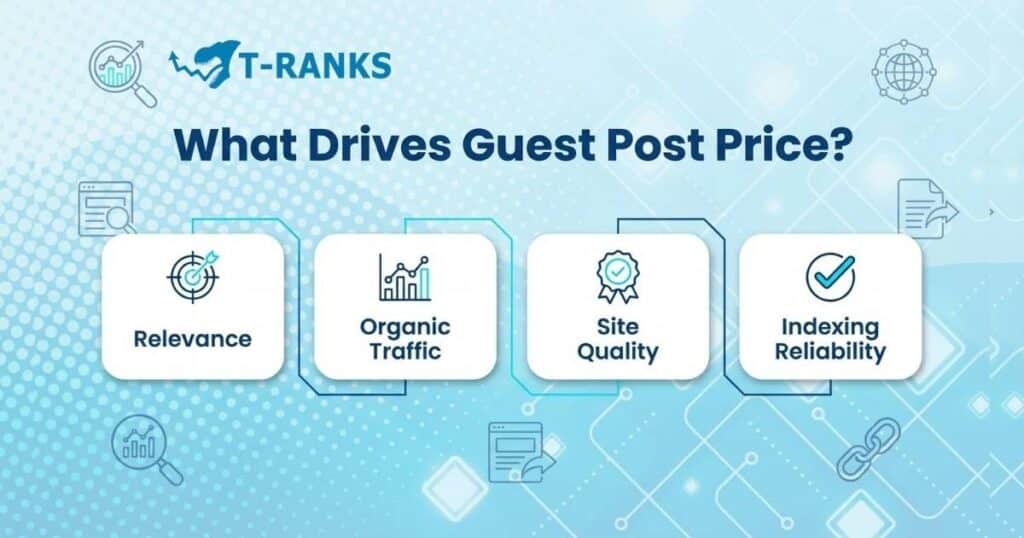
Today, guest post cost depends on more than authority metrics. Real value comes from four signals working together: relevance, organic traffic, site quality, and indexing reliability. These factors decide whether a link is worth 40 dollars or 400 dollars.
This T-RANKS pricing guide explains how to evaluate those signals, avoid inflated low-quality offers, and choose placements that actually help you rank in 2026.
Why Guest Posting Still Matters in 2026
Guest posting still matters in 2026 because search engines and AI systems depend on trusted, context-rich backlinks to understand expertise, establish topical authority, and decide which brands deserve visibility.When a reputable site publishes your content, it proves that your work is trusted. This gives your brand stronger entity signals and helps you build safer and more stable long-term rankings.
Below are the core reasons guest posting continues to be one of the most reliable white-hat link-building strategies.
1. Links Still Matter for Rankings and AI Overviews
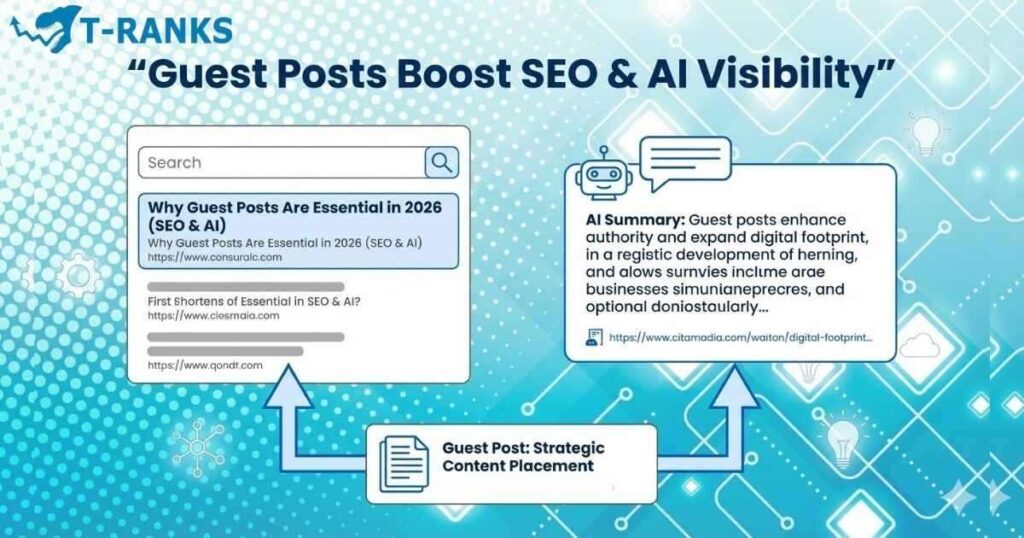
Google and AI assistants like ChatGPT, Perplexity, and Gemini still use backlinks as a primary way to measure online reputation. A relevant, contextual link signals that your brand is trusted by real publishers.
What matters most today:
- Search engines value quality over quantity
- Relevance between your site and the host site influences ranking strength
- AI Overviews evaluate context, entities, and expertise
- Links from real websites increase the chances of being cited in AI-generated answers
Why it still works:
A single link from a credible, niche-aligned publication sends a powerful topical signal that improves stability across both SERPs and AI surfaces.
Guest Posting Is a Safe White-Hat Link Strategy
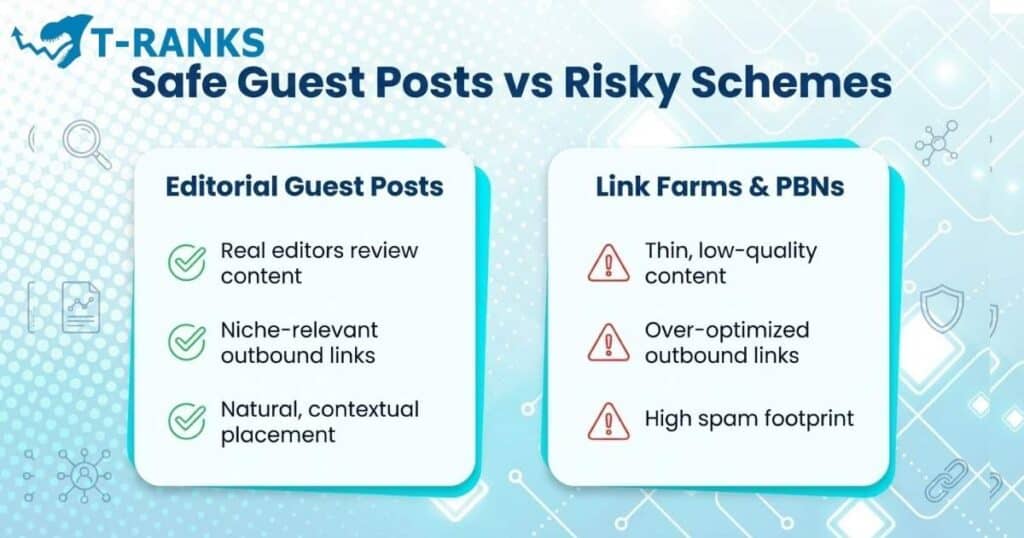
Google’s 2026 updates made manipulative link practices riskier, but editorial guest posting stayed firmly within compliance because it involves real content, human editors, and value-driven articles.
What keeps guest posting safe:
- Sites have real human editors and traffic
- Articles are reviewed and improved before publishing
- Content is helpful, informative, and aligned with user intent
- Outbound link profiles are natural and niche-relevant
- Contributors are real authors, not AI spam accounts
This is why guest posting continues to outperform PBNs, automated link schemes, and cheap marketplaces in long-term safety.
3. Real-Site Mentions Build Trust and Authority
In the AI era, your brand is treated as an entity, not just a collection of keywords. When reputable websites reference your brand in meaningful context, search engines better understand who you are and what topics you should rank for.
Benefits of real contextual mentions:
- Improved entity recognition in Google’s systems
- Stronger topical relevance for your keywords
- Higher credibility in AI-generated summaries
- A natural, stable link profile that survives core updates
Example:
A brand mention like “According to InvoiceFlow…” helps Google understand the entity “InvoiceFlow” as a trusted source in the finance or SaaS domain. This signal is far stronger than forcing an exact-match anchor inside a low-value article.
Website Metrics That Determine Guest Post Price
Guest post prices depend on a few key factors such as Domain Rating, page-level traffic, niche relevance, and overall site quality. These signals show how strong, trustworthy, and useful a backlink will be for your rankings. Each factor influences the final price because it helps predict how well the link may perform in Google and AI systems. Therefore before starting Guest post outreach you must understand these basic concepts of website metrics.
Domain Rating and Authority Metrics
Domain Rating (DR) and Domain Authority (DA) are usually the first numbers sellers look at when deciding guest post prices. The guest post market is shaped heavily around these metrics. A site can charge between ten dollars and one thousand dollars simply because its DR moves from ten to seventy or higher.
However, from our work with hundreds of clients, we have learned that high DR alone does not guarantee results. Many people focus on DR because it looks impressive, but in real SEO campaigns, relevance often performs better than raw authority. A DR 25 site inside your niche can outperform a DR 50 site that has nothing to do with your topic.
This is why you should not pay based only on DR. Always check whether the site is relevant, active, and maintains real editorial quality. While DR, DA, AS, TF/CF, and Spam Score all influence price, relevance and the site’s actual trustworthiness matter just as much.
Page-Level Traffic vs Domain Traffic
Page-level traffic is another important factor to check before buying a guest post. Many sites show high domain traffic, but most of that traffic may be concentrated on the homepage or a few old pages. If the blog posts themselves have little or no traffic, your guest post will not gain visibility or trust signals.
This matters even more for niche edits, because the link is placed on an existing page. If that page has no real readers, the link’s value drops sharply.
A site with steady page-level traffic shows that Google trusts its content and regularly indexes its articles. Sometimes a DR 40 website with good page-level traffic can be more valuable than a DR 60 site where no individual pages rank.
Niche Relevance and Topical Fit
Niche relevance has become one of the strongest ranking factors in 2026. A backlink from a site within your exact niche carries deeper trust than a link from a high-DR site in a different field. Google sees a relevant link as a strong signal that your brand belongs to that topic area.
Our client results clearly show that relevant sites produce faster ranking improvements, stronger entity signals, and better long-term stability compared to unrelated high-DR placements. A DR 25 site inside your industry can outperform a DR 70 site outside your topic if the match is strong.
A simple rule always holds true: if the site is relevant, the link is powerful. If the site is not relevant, even high DR cannot make up for the mismatch.
Traffic Quality Signals
Traffic quality often tells more about a website than its traffic volume. A site with real, steady, keyword-driven traffic is more trustworthy than a site with inflated or spammy numbers.
High-quality traffic usually comes from Tier 1 countries, grows slowly and naturally, includes branded searches, and has a healthy keyword spread. Low-quality traffic usually includes sudden spikes, irrelevant geo-locations, and thin keyword patterns.
These signals help you judge whether a website is stable, trusted, and worth paying for.
Outbound Links and Spam Score
A site’s outbound link behavior says a lot about its quality. If an article contains too many external links or links to irrelevant websites, it may be operating like a link farm. This reduces the value of your backlink and increases long-term risk.
Clean, selective sites tend to charge more because they pass stronger link equity and follow natural editorial practices. Low outbound link counts, relevant external links, and low spam scores are good signs that the site is a genuine and safe place to earn a backlink
Quality and Technical Factors That Influence Cost
Guest post prices also depend on quality, editorial effort, link type, and the technical health of the site. These factors decide whether your link will index, appear in search, and deliver long-term ranking value. High-quality sites charge more because they require stronger content, real editorial review, and a stable technical environment that Google trusts.
Content Quality and Editorial Standards
Content quality plays a major role in guest post pricing. Real websites expect original, helpful, and niche-relevant writing. In 2026, thin, AI-spun, or poorly edited content often gets ignored by Google’s crawlers and fails to index.Therfore avoid free guest posting websites as they usually have Ai thin spam content.
High-quality content helps the page rank, strengthens entity signals, and builds trust with both editors and search systems. Human-edited or expert-written content performs better because it matches the site’s tone, answers user intent, and satisfies Google’s helpful content expectations.
Better writing increases cost because it takes more time, research, and professional review.
Link Type (Dofollow, Sponsored, Nofollow, UGC)
The type of link you receive directly affects guest post pricing. Each link attribute carries a different level of SEO value and trust.
Dofollow links pass the strongest authority and ranking signals, so they cost the most. Sponsored links are common on major publishers and still provide value, but with reduced impact. Nofollow and UGC links pass little SEO authority and are mainly used for referral traffic, exposure, or brand awareness.
Because dofollow links help with rankings, indexing, and entity authority, they naturally come with a higher price.
Placement Type (Contextual vs Author Bio)
Placement also influences what you pay. Contextual links placed inside the body of the article outperform author bio links in every area. They receive more engagement, carry stronger relevance, and send clearer semantic signals to Google’s crawlers.
Author bio links sit at the bottom of the page, are often ignored by readers, and sometimes carry nofollow attributes. They are cheaper because they provide limited ranking impact. If your goal is SEO and visibility, contextual placements are worth the extra cost.
Indexing Guarantees and Link Permanence
A guest post has no value unless Google indexes it. With stricter crawling systems in 2026, indexing is now a major concern, especially on newer, slower, or low-authority websites.
Short or weak articles often fail to index. Duplicate, heavily rewritten content gets deprioritized. Sites with low authority get crawled slowly, meaning your link may sit for weeks without being discovered.
To reduce this risk, reliable providers offer indexing guarantees, replacement policies for unindexed posts, and link permanence for several months. These protections add to the cost but ensure your investment produces real SEO results.
Anchor Text Type (Branded, Partial, Generic)
Anchor text also influences guest post pricing. Editors prefer natural anchors, while over-optimized keyword anchors require more negotiation and carry higher risk.
Branded anchors help build entity authority and are the safest option. Partial-match anchors balance relevance and safety. Generic anchors are harmless but weak for ranking. Exact-match anchors have the highest SEO potential but are closely reviewed by editors and often rejected on premium sites.
A natural anchor text mix leads to better indexing, stronger trust signals, and safer long-term growth.
Why Relevance Matters More Than High DR
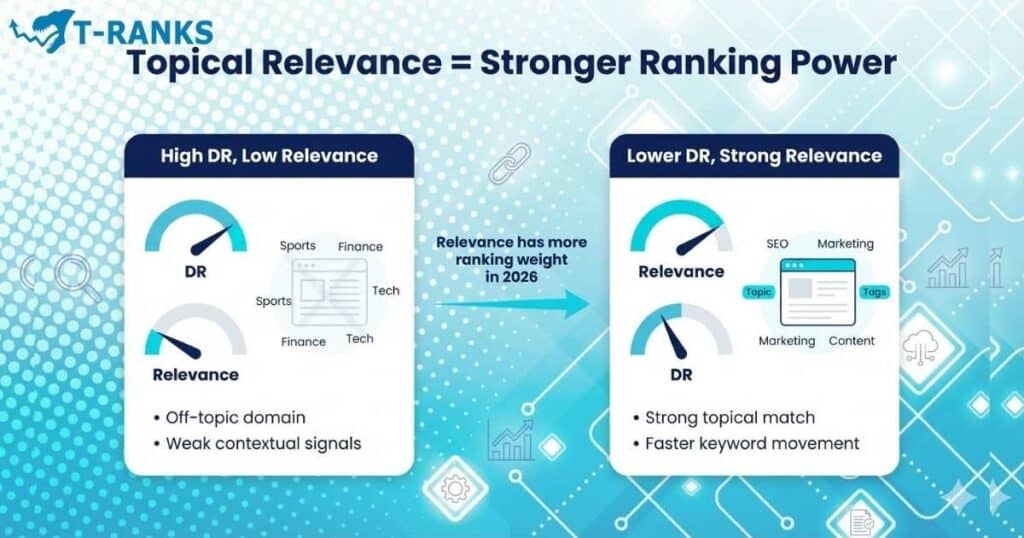
Relevance is the strongest ranking factor for guest posts in 2026. Google and AI systems now rely more on contextual signals than raw authority. A link from a closely related website tells Google what your page is about, strengthens your entity profile, and improves your ability to rank for the right keywords.
In many cases, a relevant DR 30 link can outperform an irrelevant DR 70 link because it fits naturally within your topic and keyword environment.
Why Topical Relevance Drives Faster Keyword Gains
Google measures how closely two topics relate by looking at their semantic distance. When a website in your niche links to you, that distance is small, meaning the signal is stronger and more precise. Relevant links cluster your content around the right keywords, which helps pages rank faster and with more stability.
A relevant backlink also helps Google understand how your brand fits into the topic. This clarity boosts both rankings and visibility across related search queries.
For example, a cybersecurity blog linking to a VPN tool strengthens rankings for privacy and security terms far faster than a general DR 70 blog with no cybersecurity focus.
Google Rewards Topical Matches, Not Just Authority
Google’s E-E-A-T and entity systems depend heavily on topic alignment. When multiple niche sources reference your brand, Google places you more confidently inside the Knowledge Graph for that subject. This makes the algorithm more certain about your authority in that field.
Google looks for natural topic matches, consistent terminology, and coherent context. When the linking site and your site share the same subject, the backlink carries more weight and helps you appear in AI summaries and SERP features.
This is why a DR 40 niche site often gives better ranking movement than a DR 80 broad publisher that covers random topics.
Niche-Specific Sites Deliver Better Results
Niche websites create content around tightly focused keyword groups. Their backlinks carry clean, context-rich signals that match your industry. This improves trust, relevance, and user engagement.
Relevant sites send more qualified traffic, produce better internal link context, and support your industry entity. In sectors such as finance, SaaS, and cybersecurity, niche-specific links consistently outperform large general sites.
For example, a DR 35 accounting blog linking to SaaS invoicing software gives better ranking improvements than a DR 70 lifestyle blog because the surrounding keywords and context fully support the financial software niche.
High DR Irrelevant Links Often Fail
High-DR links can be weak or even useless when the site has no topical connection. Google easily identifies mismatches between topics and reduces the value of such links, especially when they appear transactional.
For example, a DR 80 food blog linking to a B2B SaaS CRM tool creates zero contextual relevance. There is no entity overlap, no matching keywords, and no natural audience fit. Google treats this as noise, not a ranking signal.
A high DR cannot compensate for lack of relevance. Without topic alignment, authority becomes diluted and unreliable.
DR vs Traffic: Which Matters More?
Traffic is more important than DR when evaluating cost fairness. Real, organic traffic proves that Google trusts the site and its content. DR, on the other hand, can be inflated, manipulated, or inherited from an expired domain. In 2026, the safest and highest-ROI links come from websites that combine moderate authority with real, stable, topic-aligned traffic.
High DR with Poor Traffic (Overpriced Risk)
A high DR does not guarantee link value. Many websites inflate DR through mass link exchanges, cheap backlinks, or by reviving expired domains that still carry leftover authority but no active audience. These sites often charge premium prices simply because of their DR number, yet offer little or no ranking impact.
Clear warning signs:
- DR 60 or higher but fewer than 1,000 monthly organic visits
- Traffic heavily concentrated on one old page (homepage or aged blog post)
- Suspicious backlink profile with irrelevant or foreign-language links
- Noticeable gaps in content consistency or publishing history
- Site previously expired or repurposed from a different niche
These domains look strong externally but lack the organic trust signals that matter in 2026 SEO.
Lower DR but Strong Page Traffic (Hidden Value)
Lower-DR websites with real, verifiable traffic often outperform higher-DR domains because Google actively rewards content that real users engage with. A DR 20–30 blog showing consistent keyword growth and page-level traffic sends far stronger ranking signals than a DR 60 site with no user activity.
Why these sites deliver strong performance:
- High likelihood of fast indexing
- Real content clusters in your niche
- Strong semantic context passed to your website
- More qualified referral traffic
Example:
A DR 28 fitness blog with 8,000 monthly visits and active content pages can help a “home workout app” rank for related keywords within weeks, while a DR 60 general site with flat traffic barely moves rankings at all.
These “hidden value” placements often have the best cost-to-results ratio.
Ideal DR and Traffic Combination for 2026
The most reliable guest post wins come from sites with balanced authority and demonstrable traffic. The best-performing range in today’s environment is:
- DR 30–50
- At least 1,000 monthly page-level visits (not just domain-level)
- Traffic stability over the past 6–12 months
- Strong topic alignment with your site
Mini-scoring criteria:
- Page-level traffic above 1,000: +1
- Majority traffic from US/UK/CA/AU: +1
- Strong topical relevance: +2
- DR 30–50 authority baseline: +1
A score of 4 or 5 indicates a high-quality, fairly priced placement with excellent ROI potential.
How to Spot Manipulated Metrics
Manipulated metrics are common in the guest post market. Sites may appear authoritative, but their traffic or backlink profile reveals otherwise. Identifying these patterns prevents wasted budget and protects your SEO.
Red flags to watch for:
- Sudden DR jumps of 10–20 points in a single month
- Traffic spikes with steep drops (bot activity or failed penalty recovery)
- Backlinks from irrelevant, spammy, or foreign domains
- Ranking for meaningless or unrelated keywords
- Traffic coming mostly from non-target countries
- Content that looks overly generic or mass-produced
When DR and traffic tell different stories, always trust the traffic graph. Real traffic is the most reliable evidence of a site’s quality.
Guest Post Price Ranges in 2026
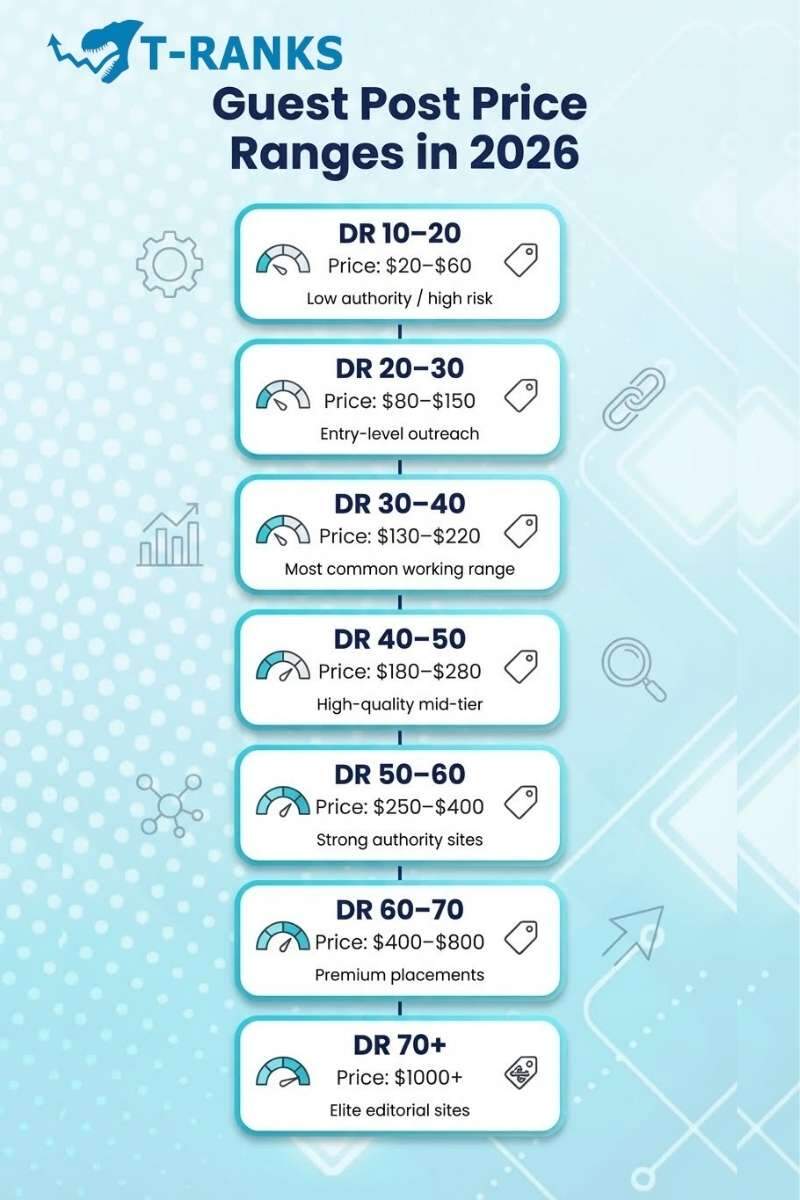
Guest post prices in 2026 range from 20 dollars to over 4,000 dollars. The price depends on Domain Rating, page-level traffic, niche relevance, editorial quality, and the type of link you receive. The goal is not to chase the cheapest link or the highest DR link. The goal is to choose placements that pass real authority, index properly, and help your pages rank.
At T-RANKS, we review DR, traffic authenticity, editorial standards, and niche relevance before placing a single link for any client. This ensures every dollar brings maximum long-term SEO value.
Low-Cost Options ($20–$80) and Their Risks
The lowest tier looks affordable, but these links rarely deliver ranking value. They mostly come from weak domains and open “Write for Us” sites that accept every niche.
Common patterns:
- DR 10–20
- 0–5k traffic (often fake, bot, or irrelevant)
- Thin content and low-quality guest post farms
- Outbound links to unrelated industries
Major risks:
- 40–60% of posts never index
- Articles often disappear after site cleanups
- Risky spam score and toxic link neighborhoods
- Very low topical authority
These placements are only useful for testing, diversity, or tier 2 support.
Never use them for your main money site.
From my personal experience, I avoid this tier completely for primary ranking campaigns. It can be useful for powering up tier 1 backlinks, but not for direct links to core pages.
Mid-Range Pricing ($80–$250)
This is the most reliable and practical tier for real-world SEO. It includes genuine niche sites, owned by individual webmasters, with real traffic and real editorial review. These sites reply faster, accept relevant topics, and provide the most balanced cost-to-value ratio.
Common metrics:
- DR 30–50
- 1k–10k organic traffic
- Normal editorial standards
- 70–90% indexing rates
Typical price brackets:
- DR 20–30 → $80–$150
- DR 30–40 → $130–$220
- DR 40–50 → $180–$280
Why this tier performs the best:
- Strong niche relevance
- Better topical context
- Real audiences and organic traffic
- Balance of cost and authority
In our experience, 80% of your link building budget should go into this category.
But always check for DR inflation from spam-heavy backlink profiles.
This tier consistently delivers meaningful ranking movement.
High-End Pricing ($250–$500+)
High-end placements come from reputable websites with real readership, expert-level content, and strong editorial control. These sites provide long-term stability and excellent authority signals.
Typical characteristics:
- DR 50–70
- 10k–100k+ monthly organic traffic
- Expert-reviewed content
- 95%+ indexing success
Typical pricing:
- DR 50–60 → $250–$400
- DR 60–70 → $400–$700
Why these links are valuable:
- Strong E-E-A-T signals
- Better entity reinforcement
- Higher referral traffic
- Ideal for competitive industries (SaaS, Health, Finance, Insurance, Legal, Cybersecurity)
- Long-term ranking stability
This tier is excellent for strengthening key pages and building industry authority.
Why DR 70+ Links Are Extremely Expensive
DR 70+ sites are rare and highly protected. Most of them are brand publications or major editorial companies with strict review processes, such as Forbes, New York Times, or top-tier niche magazines.
Because an entire editorial team runs these sites, securing a link requires significant budget, relationship-building, and professional outreach.
Public pricing:
- $1,000–$4,530+
Real negotiated pricing (through outreach relationships):
- $250–$600
Why these links cost so much:
- Limited editorial slots
- Strong brand safety policies
- High demand from enterprise SEO teams
- Multi-stage review and approval
- Domain-wide authority and trust
However, real-world data shows the ROI drops after DR 60.
A DR 50–60 niche-relevant placement often performs as well as a DR 70+ general site — sometimes better — because of stronger contextual alignment.
Use DR 70+ mainly for:
- PR
- Brand authority
- Launch events
- Ultra-competitive keywords
Not for routine backlink building.
My personal opinion:
Start with strong mid-tier links that match your niche. These give the best results for the majority of websites. High-DR placements help, but only when they are relevant. You only need a few of them to build momentum — not dozens.
2026 Guest Post Pricing Summary Table
| DR Range | Traffic | Price | Indexing | Vetting | Best Use |
| 10–20 | <1k | $20–$60 | 30–50% | Low | Avoid |
| 20–30 | 1k–5k | $80–$150 | 60–75% | Medium | Diversity links |
| 30–40 | 1k–10k | $130–$220 | 75–85% | Medium | Core budget |
| 40–50 | 5k–50k | $180–$280 | 80–90% | Medium-High | Core budget |
| 50–60 | 10k–100k | $250–$400 | 90–95% | High | Premium mix |
| 60–70 | 50k–500k | $400–$800 | 95%+ | High | Top-tier links |
| 70+ | 100k+ | $1,000–$4,530 (public) / $250–$600 (real) | 98%+ | Very High | Enterprise campaigns |
Niche Pricing Differences
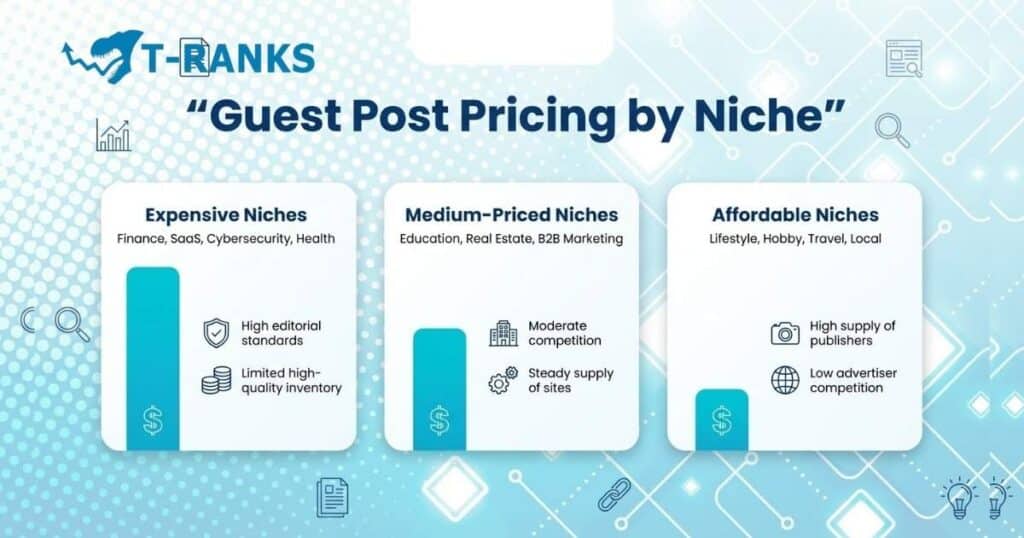
Guest post prices vary widely depending on the niche. Some industries have very few trustworthy editorial sites and strict content standards, which drives prices up. Others have a huge supply of blogs, lighter competition, and lower advertiser demand, making placements far more affordable. Understanding these niche-based differences helps you plan smarter and avoid overspending.
Expensive Niches: Finance, SaaS, Tech, Health
These are the highest-priced niches because they’re competitive and tightly regulated. Editors in these industries are selective and often require expert-level content, strong E-E-A-T signals, and original insights.
Why these niches cost more:
- Limited number of credible, topic-relevant sites
- High advertiser budgets push demand upward
- Strict editorial and compliance requirements
- Editors prefer expert contributors, not generic tips
Typical pricing:
- DR 40–60 sites: 250–600 dollars
- DR 60–70 sites: 400–1000 dollars
- DR 70+ major outlets: 1500–6000 dollars or more
These rates are common in finance, fintech, cybersecurity, enterprise SaaS, medical, and wellness industries.
Mid-Level Niches: Real Estate, Education, B2B
These niches sit in the middle: competitive enough to require quality content, but broad enough to offer plenty of legitimate websites. Pricing is more predictable and affordable compared to high-end niches.
What you can expect:
- More websites open to guest contributions
- Moderate editorial standards
- Reliable pool of DR 30–60 sites
- Good mix of relevance and affordability
Typical pricing:
- DR 30–50 sites: 120–250 dollars
- DR 50–60 sites: 200–400 dollars
These niches are ideal for service businesses, online education, B2B marketing, SaaS tools with broad appeal, and regional brands.
Affordable Niches: Lifestyle, Hobby, Local Blogs
These niches offer the lowest pricing because supply is extremely high. Tens of thousands of lifestyle, travel, hobby, and local blogs accept contributors and have flexible editorial policies.
Why these niches are cheaper:
- Large number of available sites
- Lower advertiser competition
- Faster editorial approval
- Minimal E-E-A-T demands
Typical pricing:
- DR 20–40 sites: 40–120 dollars
- DR 40–50 sites: 80–200 dollars
Great for lifestyle products, food and travel brands, DIY creators, home decor companies, and local service businesses.
Why Niche Scarcity Raises Costs
Guest post pricing follows simple economics: when a niche has very few trustworthy sites and many brands competing for visibility, prices rise sharply.
Key reasons scarcity increases cost:
- Limited editorial inventory
- Higher standards for topical expertise
- Brands with large budgets compete for the same sites
- Sensitive topics (finance, health) require fact-checking and compliance
In summary, the more competitive and regulated the industry, the more a high-quality guest post will cost. Broad, lifestyle-based niches remain the most affordable due to sheer supply.
Global Pricing Differences
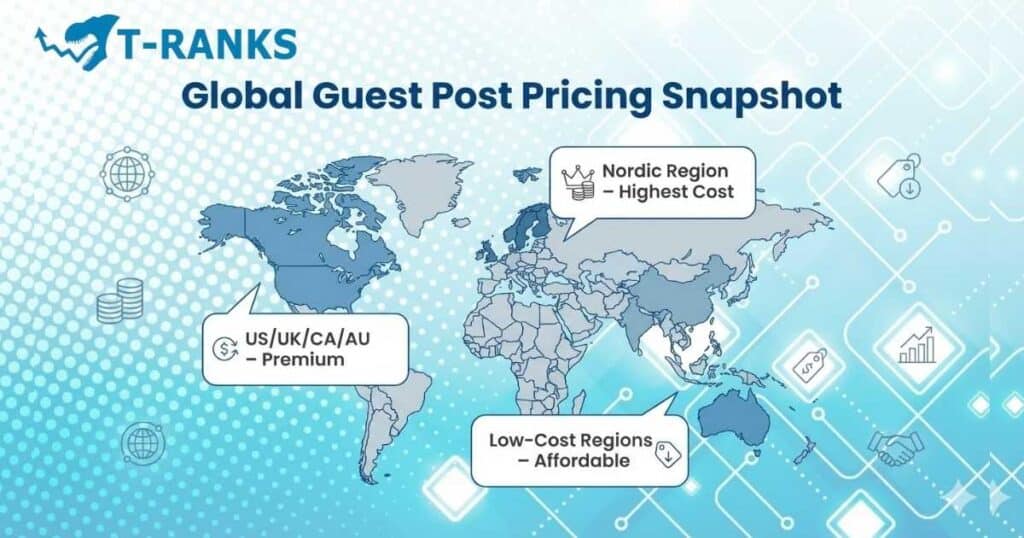
Guest post pricing changes significantly from region to region because editorial standards, labor costs, language, traffic quality, and SEO maturity vary across markets. A placement that costs 200 dollars in the US might cost 900 dollars in Scandinavia or 40 dollars in South Asia. Understanding these differences helps you avoid inflated prices and choose regions that match your business goals.
US, UK, Canada, Australia Pricing
These English-speaking markets sit in the premium tier. They offer strong editorial quality, trusted domains, and geo-relevant traffic for global SEO campaigns. Prices are higher because content creation costs are high, demand is strong, and these websites maintain strict review processes.
Typical pricing:
- DR 30–50 → 180–450 dollars
- DR 50–60 → 300–600 dollars
- DR 60–70 → 400–800 dollars
These regions provide a strong balance of trust, authority, and relevance , especially for businesses targeting English-speaking audiences.
Nordic Region Pricing (Most Expensive Globally)
Denmark, Sweden, Finland, and Norway are the highest-priced guest post markets in the world. Supply is limited, and editorial requirements are extremely strict. Labor rates are the highest globally, which further increases cost.
Typical pricing:
- DR 40–60 → 400–900 dollars
- DR 60–70 → 800–1500 dollars
- DR 70+ → 1500–3000+ dollars
These links are ideal only if you target Nordic audiences. For most businesses, US/UK placements provide far better ROI at lower cost.
Low-Cost Regions: Pros and Cons
Regions like South Asia, Southeast Asia, Africa, and some parts of Eastern Europe offer very cheap guest post options. The prices are attractive, but the quality varies a lot.
Pros:
- Very affordable sites (30–150 dollars)
- Large supply of publishers
- Faster editorial turnaround
Cons:
- Weak editorial standards on many sites
- Higher risk of spammy or irrelevant outbound links
- Traffic may not match US/UK markets
- More deindexing and quality issues
These regions are suitable for diversification or tiered link building — not core authority links for your primary site.
How Geography Influences Link Quality
Google evaluates backlinks based on language, audience region, relevance, and local domain trust. A backlink works best when the site’s audience matches your target market.
Important factors:
- English-language sites boost English SERPs
- US/UK audiences strengthen US/UK rankings
- Local domains (.se, .au, .ca, .uk) help regional SEO
- Developed markets provide higher editorial trust and safer link profiles
In short, choose link regions based on where your business wants visibility. Cheap links from unrelated markets may look good on paper but rarely create real ranking impact.
Types of Guest Post Services
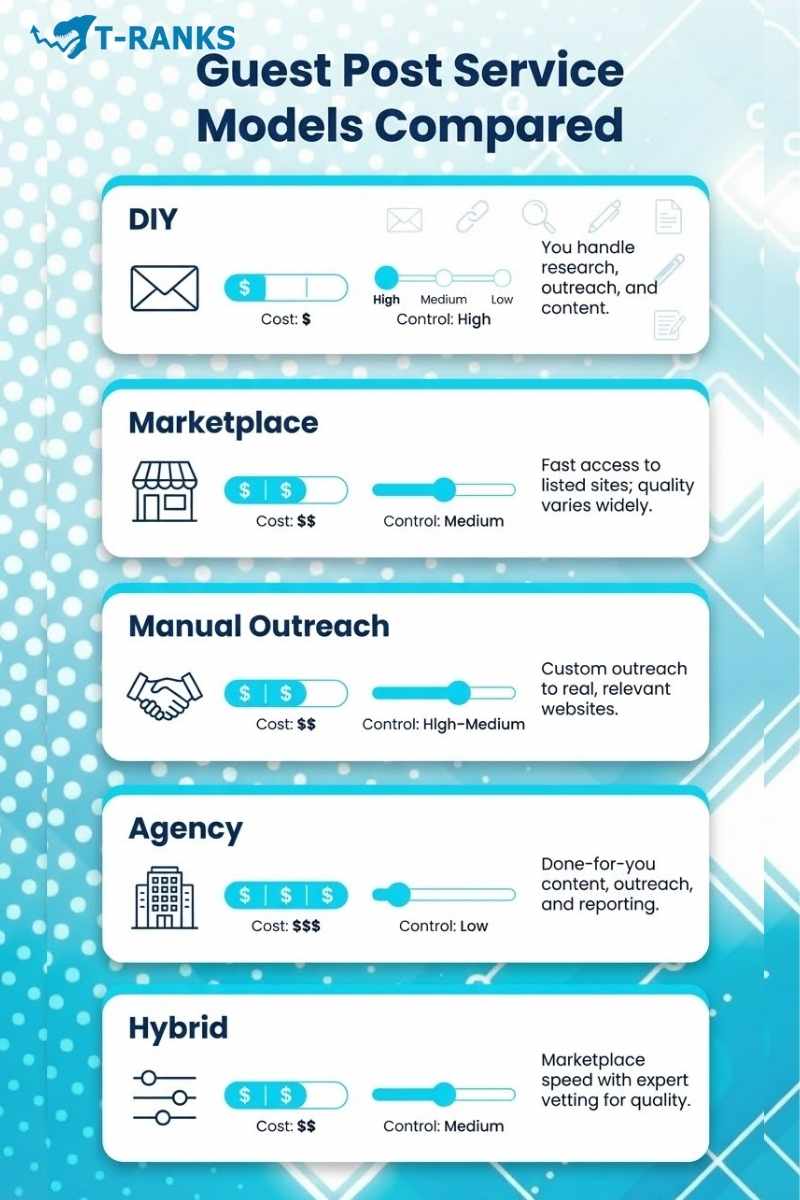
Guest posting services in 2026 fall into five main models: DIY outreach, marketplaces, manual outreach services, full agencies, and hybrid solutions. Each type has different costs, risks, and levels of control. At T-RANKS, we judge every option by relevance, traffic quality, editorial standards, and long-term safety.
DIY Outreach (Low Cost, High Time)
DIY outreach is the cheapest way to earn guest posts, but it takes the most time. You handle research, outreach, content, and follow-ups yourself.
- You find relevant websites and editor contacts.
- You pitch topics, send drafts, and manage revisions.
- Your main cost is time; writing can add 40–80 dollars per article if outsourced.
DIY works best for small teams, early-stage sites, or SEOs with more time than budget. It gives full control but requires patience and consistency.
Marketplaces (Medium Cost, Quality Varies)
Marketplaces list thousands of sites with fixed rates, but quality is mixed. Many sellers overprice DR while ignoring traffic and relevance.
- You often see sites priced at 200–400 dollars that are really worth 50–90.
- A high percentage are “made-for-guest-post” blogs with weak audiences.
- Traffic, indexing, and niche fit can be unreliable.
Marketplaces are fast and convenient, but you must know how to check DR inflation, traffic authenticity, and spam signals. Use them only if you can vet metrics properly.
Manual Outreach Services (Best Value Point)
Manual outreach services focus on real websites, not bulk marketplace lists. They pitch editors directly and prioritize niche relevance.
- Placements come from genuine blogs and publishers.
- Sites are chosen for relevance first, then DR and traffic.
- Indexing rates and long-term safety are usually higher.
This model offers the best balance of cost, quality, and control. It is ideal for businesses that want clean, safe, steady link growth without running outreach themselves.
Agency Services (High Cost, Done-for-You)
Agencies handle strategy, outreach, content, placement, and reporting. You pay more, but you also get full support.
- Pricing includes account managers, writers, editors, and link monitoring.
- Some agencies offer replacement or indexing guarantees.
- Typical cost ranges from 300 to 1,000+ dollars per placement depending on niche and authority.
This is best for brands in competitive industries that want a done-for-you system and are ready to invest in long-term campaigns.
Hybrid Models (Marketplace Lists with Expert Vetting)
Hybrid models combine the speed of marketplaces with the safety of manual vetting.
- You start from a marketplace-style list.
- A specialist reviews each site’s traffic, history, and relevance.
- Outreach and content happen only after the site passes quality checks.
This approach is faster than pure manual outreach and safer than buying blindly from marketplaces. It suits teams that want scale but refuse to compromise on link quality.
Hidden Costs Most Buyers Miss
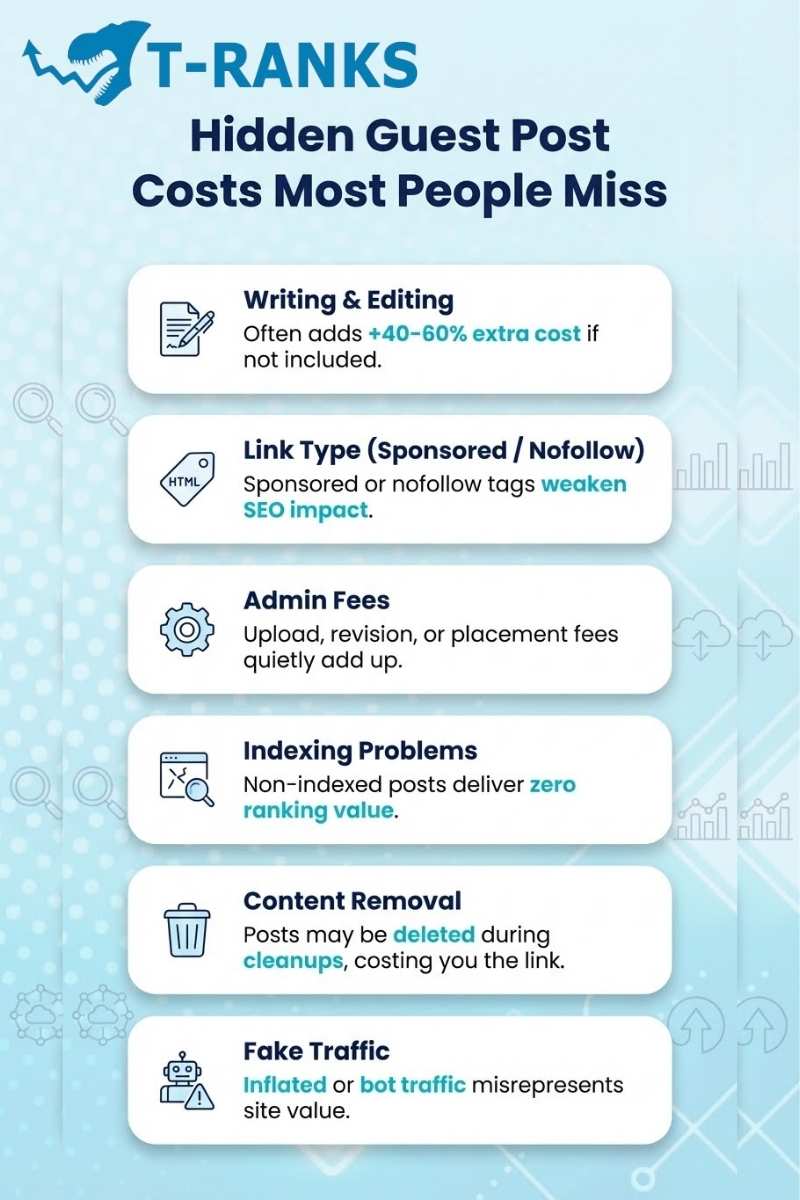
Guest post pricing often looks simple, but the real cost is usually higher than the listed fee. Writing, link type, admin charges, and indexing problems can add 30–70 percent more to the final amount. If you don’t check these details upfront, you can easily overpay or end up with links that deliver no ranking value at all.
Writing and Editing Costs
Most sellers do not include quality writing. Cheap listings often rely on AI-generated content that fails editorial review or never indexes. Good writing usually adds 40–150 dollars per article.
Sponsored or Nofollow Tags
Some sites quietly add “sponsored” or “nofollow” labels to paid links. These tags reduce or remove SEO value, even though you paid full price. Always ask for HTML proof of link type before paying.
Extra Admin and Placement Fees
Vendors often add small fees such as upload charges, rush publication fees, or anchor text change fees. These extras stack up and increase the final cost by 10–20 percent.
Indexing Problems
A guest post has zero value if Google does not index the page. Low-quality sites, weak content, and slow-crawling domains often fail to index new articles. Some pages drop out after a few months, leading to link decay.
Content Removal or Post Deletions
Some sites remove old guest posts during content clean-ups. This kills your backlink completely and wastes your money unless a replacement policy exists.
Traffic Misrepresentation
Many sites show inflated DR or fake traffic from bots or irrelevant countries. This makes the link look valuable on a spreadsheet but useless for real rankings.
Hidden Cost Summary Table
| Cost Area | Hidden Issue | Impact | How to Avoid |
| Writing & Editing | Quality content not included | +40–60% higher cost | Ask if writing is included and who writes it |
| Link Type | Nofollow or sponsored tags | Weak or zero SEO value | Request HTML proof of link attribute |
| Admin Fees | Upload, edit, or rush charges | +10–20% added cost | Ask for an all-in price |
| Indexing | Page never indexes or drops later | Total loss of SEO value | Choose sites with indexing guarantees |
| Content Removal | Post deleted after months | Lost link equity | Check permanence or replacement policy |
| Fake Traffic | Inflated metrics or bot traffic | Misleading value | Verify traffic with Ahrefs/Semrush |
How Much You Should Spend Based on Goals
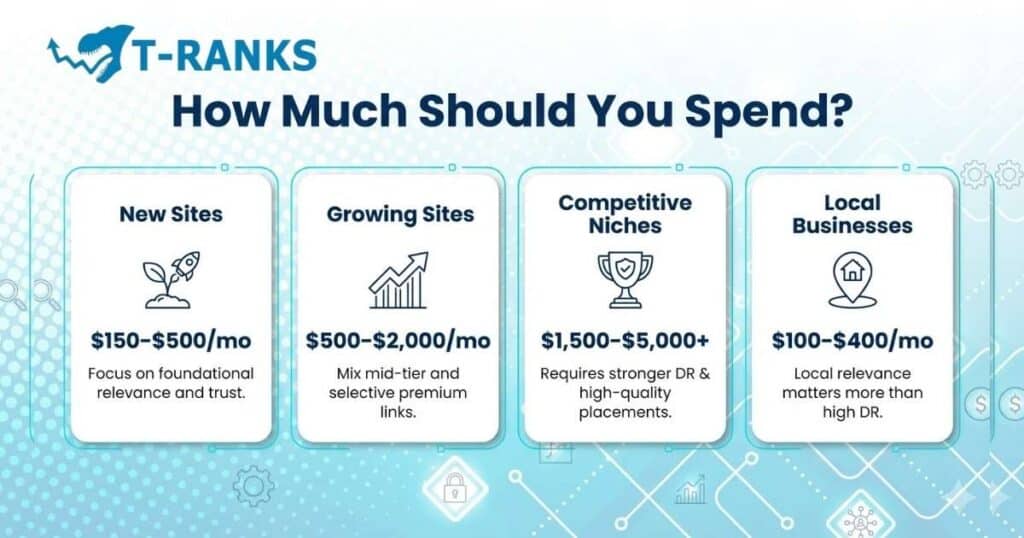
Your ideal guest post budget depends on your site’s stage and how fast you want to grow. There is no fixed number, but choosing the right spend becomes easy when you match your goals with your authority level and niche competitiveness. This simple framework is what we use at T-Ranks for all client campaigns.
New Websites (Budget-Friendly Plan)
New sites should avoid expensive DR links and focus on building basic trust.
- Target DR 20–40 with real organic traffic
- Build 3–5 relevant links per month
- Avoid marketplaces and link farms
Monthly budget: 150–500 dollars
Growing Websites (Balanced Mix Strategy)
Sites with some authority (DR 20–40) need a mix of mid-tier and a few premium placements.
- 40–60% budget on mid-tier links (120–250 dollars)
- 20–30% on premium links for authority
- 20% on small niche sites for diversity
Monthly budget: 500–2,000 dollars
Competitive Niches (Premium Needed)
Finance, SaaS, Legal, Tech, Health, and Cybersecurity require stronger authority.
- Prioritize DR 50–70 sites with 10k+ traffic
- Add a few DR 30–40 niche links
- Skip cheap placements entirely
Monthly budget: 1,500–5,000+ dollars
Local Businesses (Relevance Over DR)
Local SEO relies on location relevance, not global DR.
- Get links from local blogs, city magazines, and community sites
- DR 15–30 is enough if locally relevant
- Publish locally focused topics
Monthly budget: 100–400 dollars
Guest Posts vs Other Link Building Options
Choosing the right link-building method depends on your goals, timeline, and budget. Guest posts remain one of the most reliable and scalable options in 2026, but it’s important to compare them with alternatives so you understand where they truly shine—and where another method might work better.
Guest Posts vs Niche Edits
Niche edits insert your link into existing content, while guest posts create brand-new, context-rich articles tailored to your topic.
Guest Post Advantages
- You control the narrative and context
- Editors review the content, giving safer long-term value
- Higher indexing reliability compared to older pages that may be decaying
Drawbacks
- Requires more time (outreach, writing, review)
- Generally costs more than niche edits
When to choose niche edits:
If the page already has strong rankings and organic traffic.
When to choose guest posts:
When you want clean, topically aligned content and a safer long-term signal.
Guest Posts vs Digital PR
Digital PR is powerful but unpredictable. Guest posts offer guaranteed placements without relying on journalists or news cycles.
Digital PR Advantages
- Can earn top-tier links (DR 80–95+)
- Strong brand exposure and trust signals
- Often produces multiple links from one successful campaign
Digital PR Limitations
- Expensive to execute ($3,000–$20,000 per campaign)
- No guaranteed placements
- Requires newsworthy content or proprietary data
Guest Post Strength:
More affordable, predictable, and easier to scale while still earning editorially reviewed links on relevant sites.
Guest Posts vs Natural Outreach
Natural outreach earns links because your content is valuable enough to be cited organically. It’s ideal—but slow.
Natural Outreach Strengths
- Pure editorial approval (strongest trust signal)
- No payment required
- Excellent for long-term authority building
Natural Outreach Challenges
- Slow and unpredictable
- Requires publishing standout content consistently
- Outreach success rates are low (1–4% in most niches)
Where guest posts win:
Speed, guaranteed link placement, and greater control over anchors, context, and timing.
PPC vs Guest Post ROI
PPC gives instant traffic, while guest posts build long-term ranking power and reduce ad dependency over time.
PPC Realities
- Costs rise every year (Finance, Legal, SaaS CPCs often $20–$80 per click)
- Zero long-term SEO benefit
- Traffic disappears the moment you stop paying
Guest Post ROI
- A single $150–$300 link can support ranking for months or years
- Improves organic traffic, E-E-A-T, and entity signals
- Reduces reliance on high-cost PPC campaigns over time
Practical takeaway:
PPC buys attention. Guest posts build lasting authority that compounds.
How to Identify a Fair Guest Post Price
A fair guest post price in 2026 comes from evaluating the full picture , not just the DR. In our experience managing hundreds of campaigns at T-RANKS, the best-priced placements combine four signals: real traffic, niche relevance, clean authority, and long-term safety. When these four align, the quoted price is usually justified.
The T-RANKS Evaluation Matrix (Expert Method)
Most buyers overpay because they judge a site by DR alone. Our method scores Traffic, Relevance, Authority, and Safety together to determine whether a website deserves its price.
Traffic Quality
Look for stable, keyword-driven organic traffic. Avoid sites with sudden spikes, irrelevant geo traffic, or bot-like patterns. Real traffic means the site can actually rank your guest post.
Relevance
This is the most valuable part of the score. A DR 30 site with strong niche alignment often outperforms a DR 60 general website. Relevance determines link strength, indexing probability, and keyword movement.
Authority (DR/DA/AS/TF)
Authority metrics only matter when relevance already exists. High DR with poor relevance is one of the most common reasons people overpay for weak links.
Safety Signals
A fair-priced site should have:
- Low spam score
- Clean outbound link patterns
- No gambling/crypto/pills content
- Real authors or editorial history
A fair price is when all four signals match the cost.
If even one signal is weak, the actual value drops sharply.
Personal note from experience:
Most overpriced sites score high in DR but low in traffic or relevance. Most underpriced gems score high in relevance but average in DR.
Marketplace Red Flags (Strong Indicators a Price Is Not Fair)
Avoid any site that shows multiple warning signs. These signals usually mean inflated prices or low-quality editorial practices:
- Listed openly on public “guest post sites”
- Very little or zero organic traffic
- Outbound links to casino, crypto, CBD, payday loans, or gambling
- DR inflated with cheap foreign backlinks
- Generic “Write for Us” pages accepting all niches
- No real authors, only admin accounts
1 or 2 red flags = caution.
3 or more = skip the site completely.
Price-to-Value Ratio (Simple Math That Exposes Overpricing)
Use this fast calculation to judge whether a site’s price is fair:
(Organic Traffic × Relevance Score 1–5) ÷ Price
Examples:
- 1,500 traffic × relevance 5 ÷ $150 = Great value
- 800 traffic × relevance 2 ÷ $900 = Terrible value
Interpretation:
- 30+ = Excellent value
- 10–29 = Fair price
- Under 10 = Overpriced
This formula prevents overpaying for high-DR sites with weak SEO performance.
90-Second Vetting Checklist
Before buying a guest post, confirm these four points. If all are clean, the price is usually fair.
- Traffic: Real, stable, and from credible countries
- Relevance: Strong topical fit with your niche
- OBL (Outbound Links): Fewer than 10–15 external links per post
- Anchor Safety: Majority of branded/partial anchors on the site
If a site passes these checks, you are paying a fair price for its real SEO value.
Conclusion
In Conclusion Guest post pricing in 2026 comes down to one principle: pay for relevance, real traffic, and verifiable quality , not just DR. High authority metrics alone no longer guarantee SEO impact, and cheap placements often hide risks like weak indexing, inflated DR, or spam footprints. The strongest results come from mid-tier authoritative sites, selective premium placements for competitive niches, and a consistent vetting process that checks traffic authenticity, topical relevance, link safety, and editorial standards.
When you follow these signals, every backlink you secure contributes to stronger rankings, better visibility, and long-term authority growth.
Ready to choose safer, high-impact guest post sites? T-RANKS provides vetted, relevance-first recommendations designed for real results.
FAQs on Guest Post Costs and Pricing
1. What is the average cost of a guest post in 2026?
Most quality guest posts cost 80–350 dollars, while premium DR 70+ sites range from 800 to 3,000+ dollars depending on traffic and niche competition.
2. Why does the same DR website have different guest post prices?
Because pricing depends on seller markup, marketplace margins, indexing probability, and page-level traffic, not DR alone.
3. What matters more for pricing: DR or traffic?
Traffic matters more. It shows real engagement and indexing strength, while DR can be inflated or disconnected from performance.
4. Is buying guest posts safe in 2026?
Yes, if links come from real, relevant, traffic-verified sites. Avoid link farms, PBNs, and non-indexed pages.
5. Why are Finance, SaaS, and Health guest posts more expensive?
These niches have high competition, strict editorial standards, and limited trusted publishers.
6. How many guest posts should I build each month?
Building 2–6 relevant, high-quality links per month is ideal. Consistency beats volume.
7. Are cheap guest posts under 50 dollars worth it?
Usually not. They often come from link farms, expired domains, or pages that never index.
8. Should I choose guest posts based on homepage traffic?
No. Page-level traffic matters far more than domain-wide traffic averages.
9. Why is page-level relevancy important for guest post ROI?
Relevant pages strengthen topical authority and help search engines understand your keyword themes.
10. What is the best DR-to-traffic ratio for fair pricing?
A DR 30–50 site with 1,000+ monthly visitors on the posting page offers the strongest cost-to-value balance.
11. Why do some guest posts never get indexed?
Because of weak crawl budget, duplicated content, low-quality hosting, or missing internal links.
12. What is the most reliable way to estimate a fair guest post price?
Use the formula:
(Page Traffic × Relevance Score) ÷ Price
to spot underpriced or overpriced links.