Many website owners build backlinks and still see no real improvement. Rankings stay flat. Traffic barely moves. The problem is often not the backlinks themselves, but where those backlinks point.
Some pages are designed to grow with authority. Others are not. That is why choosing high value pages matters. When strong backlinks go to the wrong pages, effort is wasted and results stall. When they go to high value pages, rankings improve and authority spreads across the site.
In this guide, you will learn what high value pages are, which page types usually deserve stronger backlinks, and how to prioritize them based on your site goals. This makes link building clearer, more focused, and easier to manage.
Why Choosing the Right Pages for Backlinks Matters More Than Link Quantity
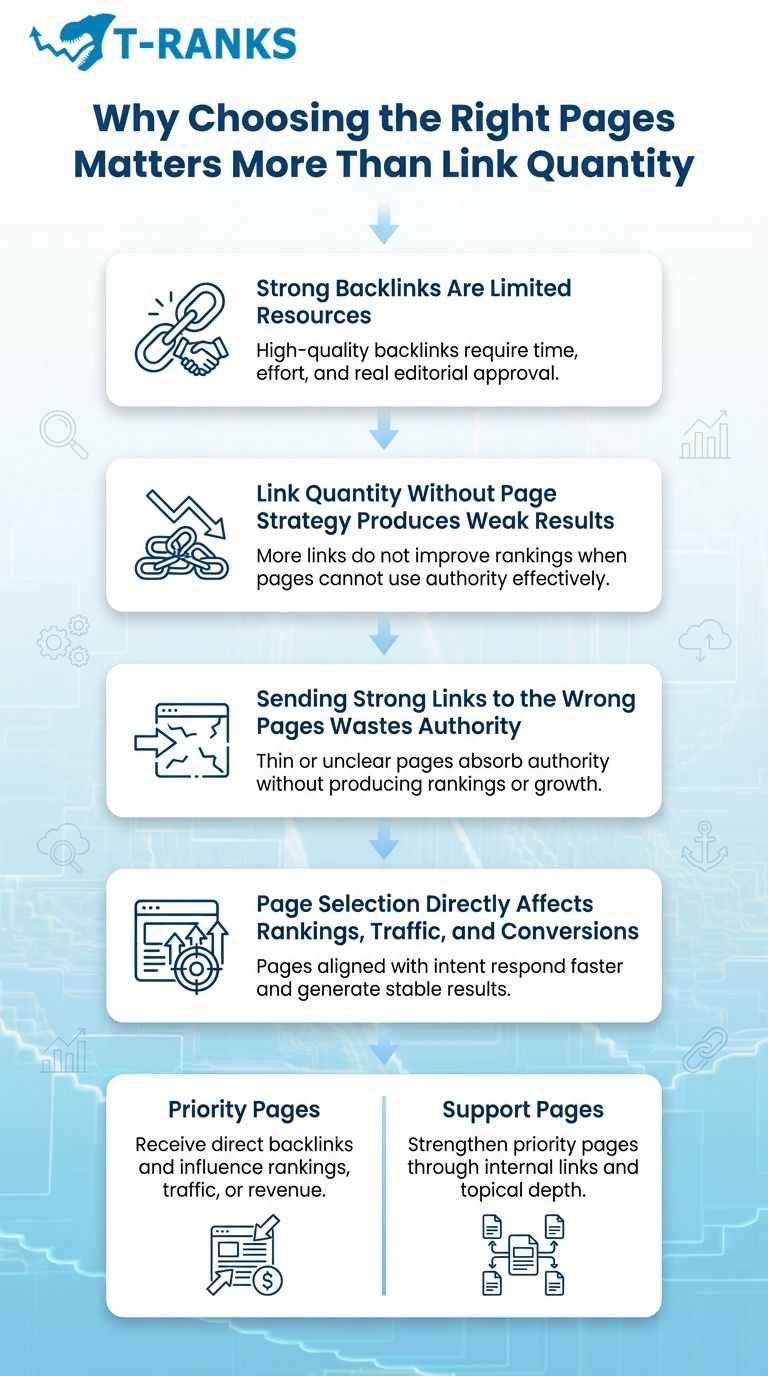
Choosing the right pages matters more than link quantity because backlinks only create real results when they support pages that can use authority effectively. Adding more links without thinking about page role often leads to little movement. The real impact comes from precision.
Below, I’ve listed why choosing the right pages matters before focusing on link volume.
Strong Backlinks Are Limited Resources
Strong backlinks are limited because they take real effort to acquire. High-quality links usually require solid content, outreach, editorial approval, or trusted relationships. They cannot be earned endlessly without cost or time.
Because of this, backlinks should be treated as valuable SEO assets, not something to spread across every page. When authority is used without intention, its impact fades quickly.
Link Quantity Without Page Strategy Produces Weak Results
Building more backlinks does not automatically improve rankings. When links are added without a clear page strategy, they often point to pages that cannot respond properly. This leads to higher link counts without meaningful growth in traffic or visibility.
Search engines care about where authority is placed, not just how much exists. Without direction, link building creates noise instead of progress.
Sending Strong Links to the Wrong Pages Wastes Authority
Sending strong backlinks to the wrong pages wastes authority because those pages cannot convert link equity into results. Thin content, tag pages, or pages with unclear search intent rarely rank well, even with added authority.
These pages usually do not compete for valuable keywords. They also fail to convert visitors or support business goals. Because of this, they cannot pass link equity efficiently to more important pages. In many cases, authority stops there instead of flowing through the site.
Page Selection Directly Affects Rankings, Traffic, and Conversions
Backlinks work best when they support pages that already align with search intent and site structure. Pages designed to rank or guide users toward action respond faster to authority and produce more stable results.
When strong links point to these pages, rankings improve, traffic quality increases, and conversion paths strengthen. Poor page selection slows progress and often forces unnecessary link building later.
Priority Pages vs Support Pages
Not all pages serve the same role in a website’s SEO structure. Priority pages are the pages that deserve direct backlinks because they influence rankings, traffic, or revenue. These include core service pages, main category pages, high-intent content, and authority hubs.
Support pages exist to strengthen priority pages through internal linking search intent
, topical coverage, and content depth. Most informational or secondary pages fall into this group and usually do not need strong external backlinks to perform their role effectively.
What We Mean by “High-Value Pages” in This Guide

High-value pages are the most important pages on your website. These are the pages that support your business goals, visibility, and overall site authority. They may drive traffic, generate leads or sales, build trust, or help other pages perform better through internal linking.
Not every page on a website has the same importance. Some pages play a central role in how a site ranks and converts. Other pages exist mainly for support and do not need strong external authority. In this guide, a page is considered high value only if it plays a meaningful role in growth or authority flow.
Because strong backlinks are limited, they should be used to strengthen these important pages first. When authority is placed on high-value pages, it does not stay isolated. It spreads through internal links and improves the performance of the site as a whole.
A high-value page usually fits into one or more of the following categories.
Pages That Rank Faster With Strong Links
Some pages respond quickly when authority is added. These pages already match search intent and have clear structure. Their content is relevant and their on-page SEO is acceptable. What they lack is enough external authority to compete.
These pages often sit just outside top positions, usually near the bottom of page one or early page two. When a strong backlink is added, rankings can improve faster than expected.
For example, a well-written page ranking at position twelve can move into the top five with one strong backlink. A weak or poorly aligned page may not move at all, even after several links.
Pages That Pass Authority to Other Pages
Some pages are valuable because they help distribute authority across the site. These pages act as hubs instead of isolated ranking targets. When they receive strong backlinks, the authority flows through internal links to other important pages.
This makes them especially useful in content clusters, category structures, and topical layouts. Strengthening one hub page can improve the performance of many connected pages.
For example, a strong category page or a cornerstone guide can pass authority to supporting articles, product pages, or sub-services. This improves overall site performance without needing direct backlinks to every page.
Pages That Drive Revenue, Leads, or Conversions
Some pages are high value because they directly support business outcomes. These pages are designed to turn visitors into customers, leads, or inquiries. Service pages, core product pages, and high-intent landing pages fall into this group.
Even when these pages are harder to rank, backlinks placed here often have higher practical value. They influence revenue, not just traffic.
For example, a service page ranking at position six may generate more business impact than an informational article ranking at position one. This makes such pages high value, even if ranking progress is slower.
15 Pages That Should Receive Your Strongest Backlinks First
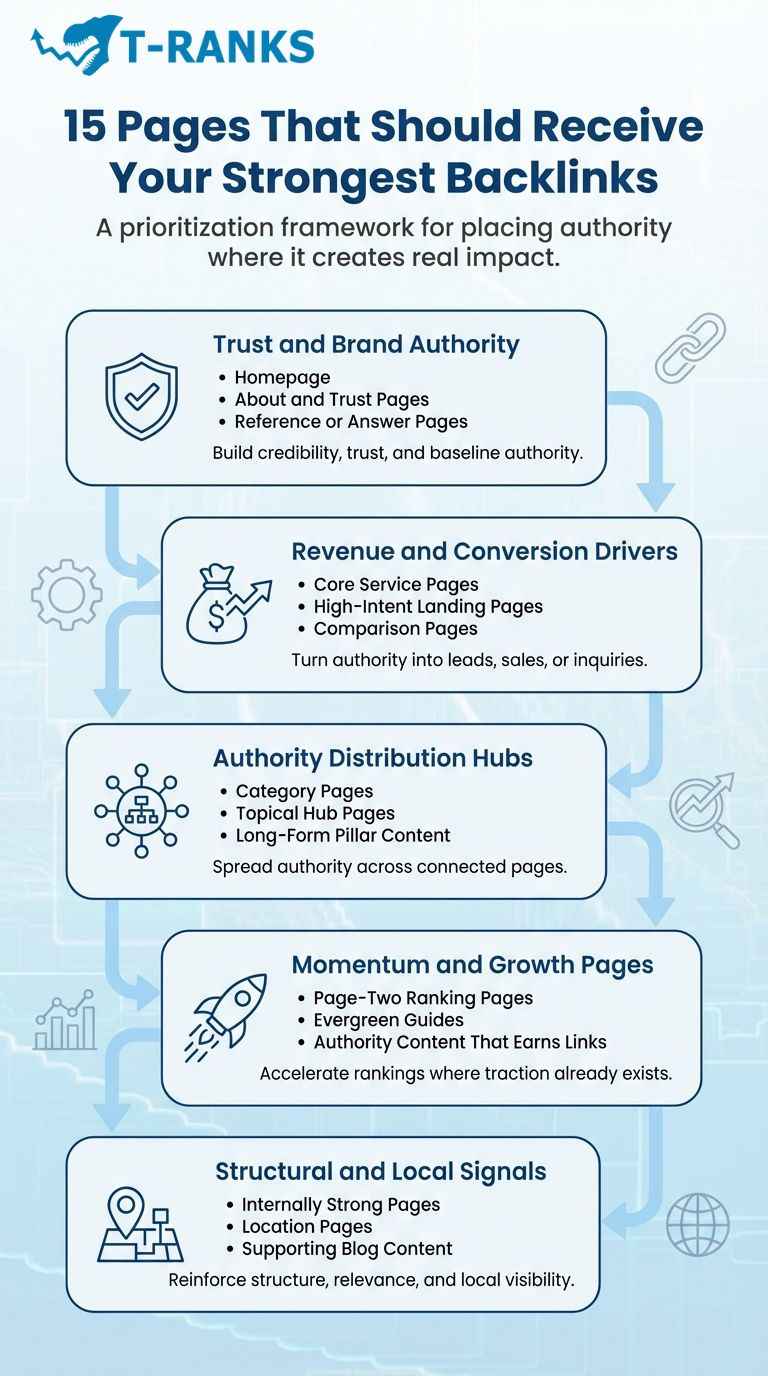
Not all pages benefit equally from strong backlinks. Some pages absorb authority and turn it into rankings, traffic, or revenue. Others show very little movement, even when powerful links are added. This section focuses on the page types that consistently deliver the highest return when they receive strong backlinks.
This is not a fixed formula. It is a prioritization framework. Different site models benefit from different pages. A service business, an ecommerce store, and a content-driven site will not allocate authority in the same way. The goal is to help you decide where strong backlinks matter most, based on how your site actually functions.
Each page type below is explained with context. You’ll see when it deserves direct backlinks and when it is better supported indirectly. The emphasis is not on volume, but on precision. Strong backlinks work best when they strengthen pages that can convert authority into lasting SEO gains.
1. Homepage (Brand Authority Anchor)
The homepage is usually the strongest trust signal on a website. It represents the brand, anchors the domain, and naturally attracts links over time. Strong backlinks to the homepage help establish credibility, strengthen brand trust, and support authority flow across internal pages.
However, the homepage should not absorb all link authority. Over-linking can slow overall growth if important inner pages remain underpowered. Homepage links matter most for new websites, brands building recognition, or domains that lack baseline trust. Once that foundation is in place, stronger returns often come from directing authority deeper into the site.
2. Core Service Pages (Primary Revenue Pages)
Core service pages are where rankings translate directly into leads and revenue. These pages usually face high competition and often need direct authority to perform well. When services are the primary source of income, strong backlinks to these pages can have a clear business impact.
Not every service page deserves the same level of attention. Primary services benefit most from direct backlinks, while sub-services or low-demand offerings often perform better when supported through internal links. This approach concentrates authority where it matters most instead of spreading link equity too thin.
3. Main Category Pages (Ecommerce and Large Sites)
Main category pages act as authority hubs for groups of products or content. They target broad, high-intent keywords and naturally link to multiple sub-pages. Strong backlinks to category pages help them rank while also passing authority to product pages beneath them.
This is often more effective than linking to individual products, especially on large sites where URLs change or inventory rotates. Category pages are high value only when they are well structured, internally connected, and built to rank. Thin or auto-generated category pages rarely benefit from strong backlinks.
4. Topical Hub Pages (Authority Builders)
Topical hub pages connect multiple related articles under one core theme. They act as central points that organize and give context to supporting content. Because of this structure, authority placed on a hub does not stay on one page. It flows outward through internal links and strengthens the entire content group.
This makes hub pages powerful backlink targets. One strong backlink can lift an entire content cluster instead of just a single page. These pages also attract links naturally because they are easy to reference. Guides, resource hubs, and topic overviews fit well with how authoritative sites link externally.
5. High-Intent Landing Pages Close to Conversion
High-intent landing pages sit just before a user takes action. Visitors often reach these pages right before signing up, making an inquiry, or completing a purchase. Authority on these pages helps in two ways. It improves rankings and increases user confidence. When a page looks trusted and well supported, hesitation drops and conversion rates improve.
At the same time, these pages require care. Forced or unnatural links can do more harm than good. Strong backlinks work best here when the page already has solid content, clear intent, and visible trust signals. When those elements are missing, adding authority alone rarely delivers results.
6. Pages Ranking on Page 2 (Quick-Win Pages)
Pages ranking on page two are often the fastest opportunities for growth. These pages already perform well and usually sit between positions eight and twenty. In many cases, the content is strong and aligned with search intent. What holds these pages back is a lack of authority.
Strong backlinks can push these pages onto page one faster than most other optimizations. The key is careful selection. Pages should have stable rankings, consistent impressions, and clear intent alignment. Pages that fluctuate heavily or target the wrong intent are poor candidates, even if they appear close to the top.
7. Evergreen Guides and Resource Pages
Evergreen guides and resource pages stay relevant long after they are published. They answer ongoing questions instead of short-term trends. Because of this, they hold authority longer and do not lose value quickly. When these pages are supported by strong backlinks, they can rank and attract traffic for years.
These pages also tend to earn links naturally over time. As their rankings improve, other sites begin to reference them as reliable resources. This creates a compounding effect, where one strong backlink helps attract additional links without extra effort.
8. Comparison and Alternatives Pages
Comparison and alternatives pages influence users who are close to making a decision. These pages help visitors evaluate options, services, or approaches side by side. Backlinks placed here strengthen trust at a critical point in the journey, often shortening the path to conversion.
Rankings on these pages usually lead to immediate business impact. They are especially valuable for SaaS and service-based businesses, where users actively compare providers before choosing. When these pages rank well, they capture demand at the moment intent is highest.
9. Core Blog Posts That Support Services or Categories
Not all blog posts deserve strong backlinks. Only posts that support important services or categories should be prioritized. High-value blog posts answer questions that naturally lead users toward core offerings. They help build intent and pass authority through internal links.
In some cases, these posts outrank money pages because they match search intent more closely. When that happens, strengthening the blog post also strengthens the entire conversion path. Authority placed on the content flows naturally toward the pages that matter most.
10. About and Brand Trust Pages
About and brand trust pages signal legitimacy and real-world presence. Search engines use these pages to understand who is behind a website and whether it represents a real business. Backlinks pointing to these pages help strengthen overall site credibility and reduce skepticism around the domain.
These pages support trust signals such as transparency and authenticity. They are especially important for new businesses, local brands, and sites competing against established players. While they rarely drive direct conversions, strengthening them helps the entire site appear more reliable and trustworthy.
11. Location Pages (Local SEO Sites)
Location pages often struggle to rank because many sites use similar templates. Thin or duplicated content limits their ability to compete. Backlinks are most effective when location pages are genuinely localized, clearly written, and tied to real services offered in that area.
Authority works best when it is combined with strong internal linking and unique local signals. Care is needed to avoid duplication issues across locations. In most cases, one strong page per location performs better than many weak or repetitive pages.
12. Authority Content That Already Earns Links
Pages that already attract backlinks have proven trust. They are validated by both search engines and other websites. Strengthening these pages often delivers strong returns because authority compounds faster where trust already exists.
Reinforcing pages that are already performing well is usually more effective than trying to force weak pages to rank. At the same time, restraint matters. These pages should receive links naturally and gradually. Over-optimization can reduce long-term stability instead of improving it.
13. Long-Form Pillar Content
Long-form pillar content is not defined by length alone. It is defined by structure and purpose. These pages cover a topic in depth and support multiple related subtopics. They act as central anchors for content clusters rather than standalone articles.
Because of their scope, pillar pages often rank for many related keywords. Strong backlinks placed here improve visibility across a wide semantic range. This makes them ideal backlink targets for informational and content-heavy sites, where authority needs to flow across multiple connected pages.
14. Pages Heavily Linked Internally
Strong internal linking signals importance to search engines. Pages that receive many internal links are already positioned as priorities within the site. External backlinks amplify this signal instead of creating it from scratch.
When internal and external authority align, rankings tend to improve faster and remain more stable. Using internal structure as a filter also helps identify which pages are most ready to benefit from strong backlinks. Pages that are already central within the site usually respond better to added authority.
15. Pages Designed to Be Reference or Answer Pages
Some pages are built to explain topics clearly and directly. They focus on answering specific questions or defining concepts in a way that is easy to understand. These pages often appear in summaries, featured snippets, and AI-generated answers.
Strong backlinks increase the likelihood that these pages are treated as trusted references. They are also future-proof targets because they align with how search engines and AI systems surface authoritative information. When these pages are strengthened, they help establish the site as a reliable source.
How to Distribute Backlinks Across Your Website (Simple Framework)
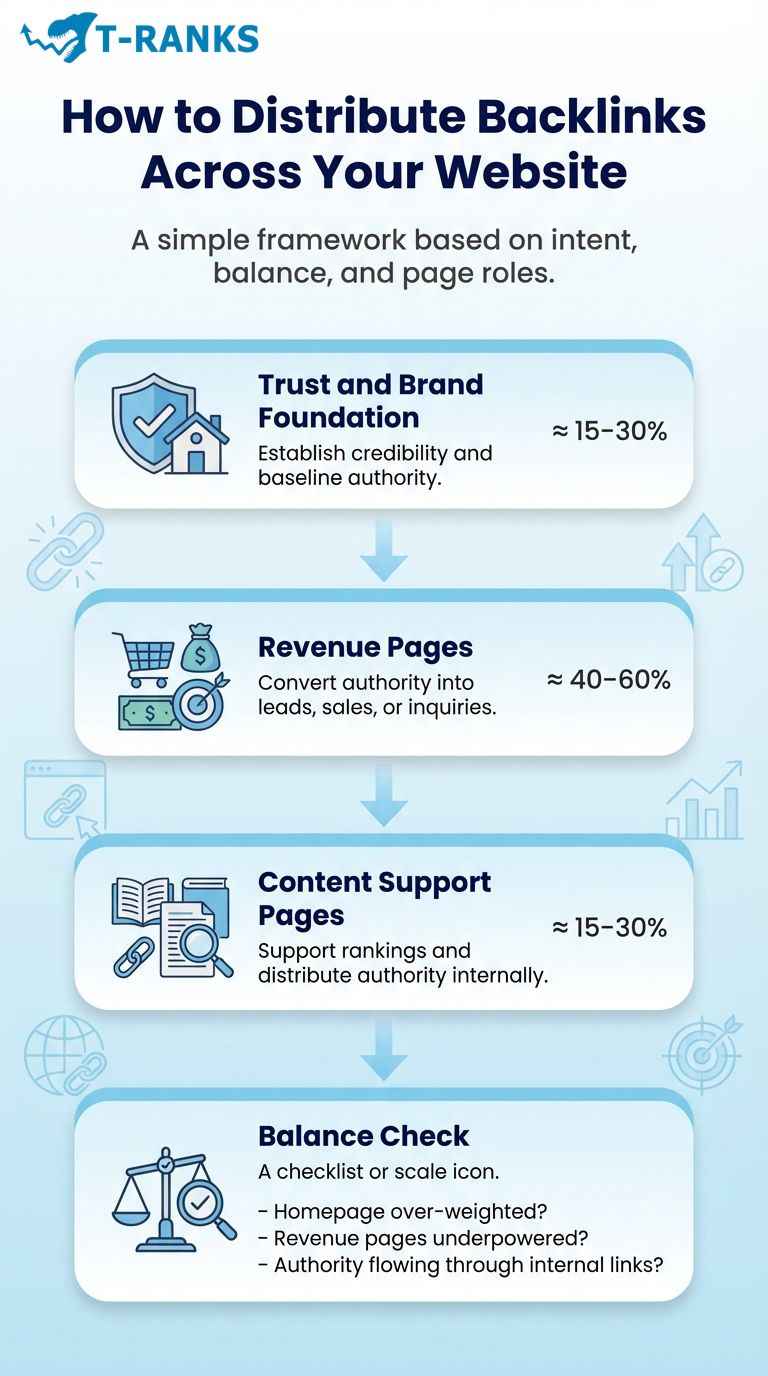
Backlink distribution is about intent and balance, not fixed formulas. There is no single ratio that works for every website. The right distribution depends on how your site earns value, how users convert, and which pages are meant to lead versus support.
The goal is simple. Strong backlinks should build trust at the top, drive growth where revenue happens, and support content that helps authority flow across the site. When links are spread randomly or pushed into one page type only, results usually flatten instead of compounding.
Below is a simple framework you can use to organize your pages and decide where backlinks should go.
Step 1: Start With Trust and Brand Foundation
Every site needs a trust anchor. This role is usually handled by the homepage and key brand pages.
The homepage signals legitimacy, brand presence, and overall domain credibility. A portion of strong backlinks should point here, especially for new sites or brands that are still building recognition. These links help establish authority that flows naturally into internal pages.
As a general starting point:
- 15–30% of strong backlinks can point to the homepage and brand trust pages
Once baseline trust is established, the homepage should no longer absorb most of your link power. Beyond that point, stronger results usually come from supporting deeper pages.
Step 2: Direct Authority Toward Revenue Pages
After trust is in place, focus on pages that turn rankings into business results. These are usually core service pages, main category pages, or high-intent landing pages.Evergreen guides
These pages face the strongest competition and often require direct authority to break into top positions. Backlinks placed here have clear impact because rankings directly influence leads, sales, or inquiries.
As a general guide:
- 40–60% of strong backlinks should support core revenue pages
Primary services or main categories should receive consistent authority. Secondary services or lower-priority offerings often perform better when supported indirectly through internal links.
Step 3: Use Content Pages to Support and Amplify Authority
Content pages play a supporting role. They build topical depth, answer user questions, and create internal linking paths that help authority move toward important pages.
Not every blog post needs backlinks. Strong backlinks work best when placed on:
- cornerstone guides
- topical hub pages
- content that supports conversion paths
These pages amplify authority rather than consume it.
As a practical range:
- 15–30% of strong backlinks can go to high-value content pages
When done correctly, authority placed on content flows naturally toward service and category pages through internal linking.
Step 4: Check Balance Before Adding More Links
Before building new backlinks, review where authority is already going.
Ask simple questions:
- Are all strong links pointing to one page type?
- Are revenue pages underpowered compared to content?
- Is the homepage absorbing more authority than needed?
Healthy backlink profiles reflect purpose, not symmetry. Too many links to one page type create imbalance. Too even a spread often wastes authority.
Instead of asking how many links a page needs, ask what role the page plays.
- Trust pages establish credibility
- Revenue pages convert
- Content pages support and distribute authority
When distribution matches intent, backlinks work together instead of competing.
How Link Distribution Changes by Website Type

Backlink distribution should change based on how a website is built and how it earns value. The same strategy does not work for every site. Authority flows differently on ecommerce sites, service businesses, content websites, and local businesses. Conversions also happen in different places.
The core principle stays the same. Backlinks should follow intent, not fixed formulas. What changes is where authority has the biggest impact. The sections below explain how link distribution should shift based on website type.
Ecommerce Websites
Ecommerce websites perform best when authority is focused on category pages. Category pages target broader, high-intent keywords and naturally support many products underneath them. Strong backlinks placed here help categories rank and pass authority internally to product pages.
This approach scales better than linking to individual products, especially on large stores where products change, rotate, or go out of stock. Direct backlinks to product pages should be limited and selective. They work best for flagship products, high-margin items, or products with long life cycles. Most products benefit more from internal authority than direct external links.
Service and Agency Websites
Service websites grow fastest when backlinks support service pages and authority content together. Core service pages usually face strong competition and often need direct authority to rank. Backlinks placed here have clear impact because rankings directly influence leads and inquiries.
Authority content plays a supporting role. Guides, resources, and educational pages help build topical trust and funnel authority toward service pages through internal links. The homepage acts as a trust layer. It should receive some strong backlinks to establish credibility, but not at the expense of service pages that drive actual business results.
Informational and Content Websites
Content-focused websites rely on pillar pages and topical hubs to organize authority. These pages define the main subjects of the site and distribute link equity across related articles. Strong backlinks should focus on pillar pages and hubs first.
Once these pages rank, supporting articles benefit through internal linking rather than needing direct backlinks. This structure allows content sites to rank for large keyword sets while keeping link acquisition efficient and scalable. Trying to build backlinks to every article usually spreads authority too thin.
Local SEO Websites
Local websites need authority focused on trust and location relevance. The homepage often serves as the main brand and trust signal, especially for small or new businesses. Strong backlinks here help establish credibility and support both map and organic rankings.
Main location pages also deserve strong backlinks when they are well localized and target real search demand. These pages help compete in local results when done correctly. Care is needed with service and location combinations.
Backlinks work best when pages are unique, useful, and clearly differentiated. Repeating thin location pages usually weakens results instead of improving them.
Pages That Usually Should Not Get Strong Backlinks

Not every page is a good target for strong backlinks, even if it looks useful at first glance. Strong backlinks are limited, costly, and carry risk. When they are placed on the wrong pages, authority is wasted and the overall link strategy becomes weaker instead of stronger.
This section exists to prevent common mistakes. The page types below usually fail to convert authority into lasting rankings, traffic, or trust, even when strong backlinks are added.
Thin Blog Posts
Thin blog posts lack the depth needed to hold authority. They often cover topics briefly, repeat existing information, or fail to fully satisfy search intent. When strong backlinks point to thin pages, rankings rarely last.
Even if a short-term boost happens, these pages struggle to sustain visibility because they cannot compete on quality. Before assigning strong backlinks, thin posts should be expanded, merged into stronger assets, or repositioned to serve a clearer role.
Temporary Pages
Temporary pages are not designed to retain long-term link value. Campaign pages, seasonal offers, event announcements, and short-term promotions fall into this category. Strong backlinks placed on these pages lose value once the page expires, redirects, or is removed.
Any authority gained is often diluted or lost completely. Backlinks work best when they support pages you plan to maintain and update over time, not pages built to disappear.
Isolated Content With No Internal Links
Pages without internal connections cannot distribute or retain authority. They sit outside the main site structure and provide no clear path for link equity to flow. When a strong backlink points to an isolated page, its impact usually stops there.
The rest of the site gains little benefit. If a page has no meaningful internal links pointing to or from it, it should be integrated properly before receiving strong backlinks.
Pages Without Clear Intent
Pages that lack clear intent struggle to perform. Unfocused content, mixed-purpose pages, or articles that target unrelated queries confuse both users and search engines. Strong backlinks cannot fix unclear intent.
Without a defined goal, rankings remain unstable and conversions stay weak. Before assigning backlinks, the purpose of the page should be obvious. Inform, convert, compare, or support. If intent is unclear, authority is better used elsewhere.
Common Backlink Targeting Mistakes Website Owners Make

Backlinks fail most often because they are pointed at the wrong pages. Even strong links lose effectiveness when page selection is based on habit, fear, or vanity metrics instead of SEO logic. These mistakes block link equity flow, weaken site structure, and slow ranking growth.
Sending strong backlinks to the wrong pages does not just waste authority. It limits what the site can realistically rank for.
1. Sending Too Many Links to the Homepage
Sending most backlinks to the homepage is one of the most common mistakes. The homepage already receives authority from brand mentions, navigation links, and natural citations. After a certain point, additional links here produce very little ranking lift.
This creates a bottleneck. Authority stays concentrated at the top of the site and never reaches pages that need it to rank. Service pages, category pages, and key content remain underpowered even when the site appears strong overall.
2. Avoiding Service Pages Completely
Many website owners avoid building backlinks to service pages. This often comes from fear of penalties or the belief that service pages should rank through internal links alone.
In competitive search results, this approach rarely works. Service pages target high-intent queries and compete against pages that receive direct authority. Without backlinks, they lack the external validation search engines expect. Relying only on indirect signals slows rankings and reduces conversion potential.
3. Treating All Blog Posts the Same
Not all blog posts serve the same role. Some exist to support topical depth. Others are meant to act as authority pages that rank and attract links.
When backlinks are spread evenly across all blog posts, no page receives enough authority to stand out. Link equity gets diluted across content that was never designed to rank competitively. As a result, pillar content underperforms and supporting articles receive authority they cannot use effectively.
4. Ignoring Pages That Already Perform Well
Many site owners focus only on weak pages and ignore content that is already ranking or attracting links. This is a missed opportunity.
Pages that already perform well have proven trust. Strengthening these pages often delivers faster and more stable results than trying to force weak pages to rank. Authority compounds best where trust already exists.
5. Chasing Metrics Instead of Outcomes
High DR or DA links are often mistaken for effective links. Metrics describe the domain, not the impact of the placement.
A high-metric backlink pointing to a low-value page produces little movement. A moderate link placed on a priority page can outperform it entirely. When metrics are chased without considering page role and intent, backlinks look impressive on paper but fail to move rankings or conversions.
6. Linking to Pages With No Internal Support
Strong backlinks do not work in isolation. Pages that lack internal links cannot distribute or retain authority.
When a strong link points to a page with weak internal connections, its impact often stops there. The rest of the site gains little benefit. Backlinks work best when pages are part of a clear internal structure that allows authority to flow.
7. Ignoring Search Intent When Choosing Pages
Backlinks cannot fix intent problems. Pages that target unclear or mixed intent struggle no matter how much authority they receive.
When links are sent to pages that do not clearly inform, convert, compare, or support, rankings remain unstable. Before assigning backlinks, the page’s purpose should be obvious. If intent is unclear, authority is better used elsewhere.
Final Thoughts: Strong Backlinks Should Be Used Strategically, Not Randomly
In conclusion, strong backlinks work best when they are placed with purpose, not scattered across random pages. Not every page deserves the same level of authority. Pages that matter most are those that support rankings, conversions, and internal authority flow. When backlinks are sent to pages with clear intent and a defined role, their impact spreads naturally across the site. When they are sent to weak or unfocused pages, authority is wasted and results stall. The key is to prioritize high-value pages first, maintain balance across page types, and align link placement with how the site actually grows.
If you want stronger and more predictable SEO results, start reviewing where your backlinks are pointing and realign them with your highest-impact pages.
FAQs About High-Value Pages for Backlinks
What are high-value pages for backlinks?
High-value pages are the most important pages on a website that benefit the most from strong backlinks. These pages typically support rankings, conversions, trust, or authority flow through internal links.
Which pages should receive strong backlinks first?
Pages that drive authority and growth should receive strong backlinks first. This usually includes the homepage for trust, core service or category pages for rankings and revenue, and main topical hub or pillar pages that support internal authority flow.
Should I send most backlinks to my homepage?
No. Sending most backlinks to the homepage can limit overall site growth. The homepage should receive some backlinks to build trust, but inner pages often produce better ranking and traffic gains once baseline authority is established.
How should backlinks be distributed across a website?
Backlinks should be distributed based on page role, not evenly. Trust pages build credibility, service or category pages drive rankings and conversions, and content pages support authority flow through internal linking.
Is there a fixed ratio for backlink distribution?
No. There is no fixed or universally safe backlink ratio. Proper distribution depends on website type, competition, business goals, and how internal links are structured.
Do all blog posts need strong backlinks?
No. Most blog posts do not need strong backlinks. Only posts that support core services, target competitive queries, or act as topical hubs should receive direct authority.
Are category pages better backlink targets than product pages?
In most cases, yes. Category pages target broader keywords and pass authority to multiple product pages through internal links. Product pages usually benefit more from internal authority unless they represent flagship or long-term offerings.
Should local SEO pages receive strong backlinks?
Yes, but selectively. The homepage and main location pages benefit the most. Supporting or secondary location pages usually perform better with internal links rather than direct backlinks to avoid duplication and dilution.
Can strong backlinks harm a page if used incorrectly?
Yes. Strong backlinks can be wasted or ineffective if they point to thin, unstable, or poorly structured pages. In some cases, they may also draw unnecessary scrutiny without delivering ranking benefits.
How can I tell if a page deserves strong backlinks?
A page deserves strong backlinks if it has clear intent, ranking potential, solid internal connections, and a defined role in the site structure. Pages that absorb authority without supporting other pages are usually lower priority.
Do backlink priorities change for different website types?
Yes. Ecommerce sites usually prioritize category pages, service sites focus on core services, content sites rely on pillar pages, and local sites emphasize the homepage and primary location pages.
Do AI Overviews and search systems care which page backlinks point to?
Yes. Modern search systems favor pages that are authoritative, clear, and structurally important. Backlinks pointing to well-organized, central pages increase the likelihood of being treated as trusted sources or summaries.