Many websites have good content but still struggle to rank. The reason is simple. Search engines no longer reward links based on numbers alone. They reward trust.
This is where influencer backlinks come in. When a creator people already follow and trust links to a website, it sends a strong signal of credibility. These links appear inside real content such as reviews, tutorials, and recommendations, not pages created only for SEO.
Google now looks at who is talking about a brand, how often it is mentioned, and whether those mentions come from trusted sources. Influencer backlinks help because they place brands inside content that users value and search engines recognize as genuine.
In this guide, you will learn what influencer backlinks are, why they carry stronger trust signals than traditional links, and how they help improve domain authority. You will also learn which influencer backlinks support SEO, how to evaluate creators correctly, and how to earn influencer backlinks safely within Google guidelines.
By the end, you will understand when influencer backlinks fit into an SEO strategy and how creator recommendations support rankings, brand trust, and long-term search visibili ty.
What Are Influencer Backlinks?

Influencer backlinks are links that creators add to their own content to recommend or reference a website they find useful for their audience. These links appear naturally inside blog posts, videos, reviews, or educational content created by people who already have trust and influence in a specific topic area.
Creators usually include these links to explain a concept more clearly, support a recommendation, or share a resource they personally use. Because the link is chosen by the creator and placed within relevant content, it feels natural and carries more credibility than links added only for SEO purposes.
Unlike ordinary backlinks that come from anonymous or purely technical websites, influencer backlinks come from real people with an established audience. Search engines can recognize that these links are part of genuine, user-focused content rather than artificial link placement.
Example
For example, a blogger or YouTuber who regularly reviews online tools may publish a post or video explaining which tools they personally use. If they include a link to a helpful website within that content, that link is considered an influencer backlink because it is based on real experience and recommendation.
Why Influencer Backlinks Carry Stronger Trust Signals Than Traditional Links

Influencer backlinks carry stronger trust signals than traditional links because they come from people who already have credibility with a real audience. While traditional backlinks often exist mainly to connect websites for SEO purposes, influencer backlinks are shared as part of genuine content created for users.
Trust Comes From Real People
Influencer backlinks are shared by creators who have built trust with their audience over time. People follow influencers because they value their opinions, explanations, and recommendations. When a creator links to a website, it feels like a personal recommendation rather than a technical SEO placement.
Search engines recognize this difference. A link shared by a trusted creator carries more confidence than a link placed on an unknown website with little real engagement.
Links Are Based on Real Experience
Creators usually link to websites they have personally used, learned from, or found helpful. The link is added to support something they are explaining, reviewing, or recommending.
Traditional backlinks can be created without real involvement. Influencer backlinks are tied to the creator’s personal experience and reputation, which makes them harder to fake and easier for search engines to trust.
Clear Context Explains Why the Link Exists
Influencer backlinks are rarely placed without explanation. Creators usually tell their audience why they are linking, such as sharing a useful resource, citing information, or recommending a tool.
This context helps search engines understand the purpose of the link. Instead of seeing just a URL, they can see how the link fits into the content, which makes it more reliable than traditional links added without a clear reason.
Engagement and Topic Relevance Strengthen Trust
When influencers share links, people often click them, read the content, and spend time on the website. This real interaction shows that the link is useful, not artificial.
Most influencers also focus on a specific topic. When they link to related websites, it helps search engines understand that both the creator and the linked site belong to the same subject area. This alignment improves clarity and strengthens trust signals over time.
Simple Comparison
Traditional backlinks mainly connect websites.
Influencer backlinks connect trust, context, and real human experience.
That is why influencer backlinks consistently send stronger trust signals than traditional links and play a bigger role in building long-term authority.
How Influencer Backlinks Support Domain Authority Signals
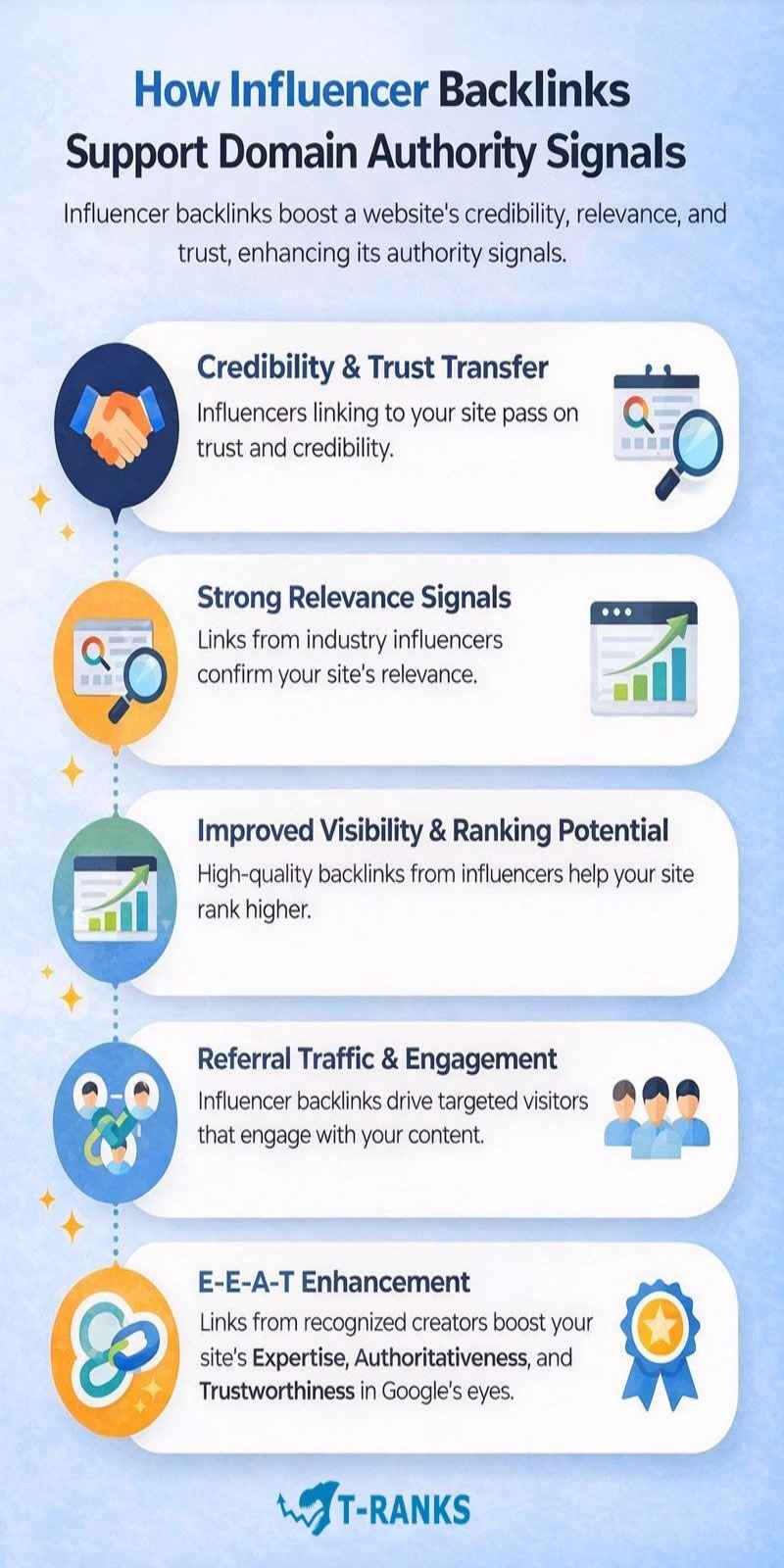
Influencer backlinks support Domain Authority (DA) signals by acting as strong third-party endorsements that increase a website’s credibility, relevance, and trust in the eyes of search engines.
When trusted creators and well-known industry sources link to your website, those links signal that your content is worth referencing. Over time, these signals help search engines determine which websites deserve higher authority and visibility.
Here is how influencer backlinks function as strong domain authority signals:
Credibility and trust transfer
When a respected influencer or an established website links to your content, it sends a clear signal that your site is reliable and valuable. Search engines treat these links as recommendations from trusted sources. This transfer of trust is a core principle behind how authority is evaluated across the web.
Strong relevance signals
Influencer backlinks are most powerful when they come from creators within the same niche or industry. Search engines evaluate how closely related the linking content is to your website. A link from a relevant influencer confirms that your site has expertise in that subject area, which helps build topical authority.
Improved visibility and ranking potential
Backlinks remain one of the strongest ranking signals. When your backlink profile includes high-quality influencer links, search engines are more likely to view your website as competitive and trustworthy. This often improves visibility and makes it easier to rank for important keywords over time.
Referral traffic and user engagement
Influencer backlinks do more than pass authority. They also drive targeted visitors from audiences that already trust the creator. These visitors tend to spend more time on your site and interact with your content, which reinforces signals of usefulness and quality.
E-E-A-T enhancement
Links and mentions from recognized creators support Google’s E-E-A-T framework. Being referenced by people with real experience and expertise positions your website as authoritative and trustworthy within its field. This reputation strength contributes directly to long-term domain authority growth.
Simple takeaway
Influencer backlinks help domain authority grow because they combine trust, relevance, and real audience validation. Search engines interpret these signals as proof that a website
Influencer Backlinks vs Other SEO Link Building Methods

Influencer backlinks differ from other SEO link building methods because they are driven by people and relationships rather than technical placement alone. Traditional link building strategies are often designed to meet algorithmic requirements, while influencer backlinks are created as part of real content shared with an active audience.
To understand where influencer backlinks fit within SEO, it helps to compare them with other commonly used link building approaches.
Comparison of Common SEO Link Building Methods
| Feature | Influencer Backlinks | Guest Posting | Broken Link Building |
| Primary focus | Trust and credibility | Link equity and visibility | Replacing dead links |
| How links are earned | Personal recommendation | Content contribution | Outreach to site owners |
| Authority source | Creator credibility | Website authority | Existing indexed pages |
| Audience involvement | High and active | Moderate | Low |
| Context around links | Clear and explained | Editorial | Functional |
| Risk level | Low when earned naturally | Medium if scaled | Low |
Key Differences That Matter for SEO
Influencer backlinks are built on trust and relationships, while most traditional link building methods focus on websites and technical placement. Guest posting relies on publishing content on external sites, and broken link building focuses on fixing outdated links. Influencer backlinks, in contrast, are created when a real person chooses to recommend a resource within their content.
Because search engines increasingly evaluate credibility, relevance, and user interaction, links that come from trusted creators and appear in meaningful context tend to send clearer trust signals than links placed primarily for technical SEO reasons.
Types of Influencer Backlinks That Actually Support SEO

Not all influencer links provide the same SEO value. In 2026, search engines focus on links that appear naturally inside relevant, high-quality content and reflect real experience and trust. The following types of influencer backlinks are the most effective for supporting SEO.
In-Content Blog Links
These are links placed naturally within the main content of an influencer’s blog post, such as a review, tutorial, or in-depth guide.
Because these links are surrounded by relevant text and added to support the topic, search engines treat them as strong authority signals. Links placed within the content are generally more valuable than links added to footers, sidebars, or author bios.
Creator-Owned Editorial Guest Content
Some influencers publish expert or brand-contributed content on their own websites when it fits their audience and topic focus. When done properly, these links appear as part of editorial content rather than promotional placements.
These backlinks work best when the content is useful, relevant, and aligned with the creator’s usual publishing style. In this context, the trust comes from the creator choosing to feature the content on their platform.
Resource Pages and Recommendation Lists
Many influencers maintain pages that list tools, resources, or websites they recommend within their niche. Being included on these pages acts as an ongoing endorsement rather than a one-time mention.
Search engines value these links because the page exists specifically to guide users toward helpful resources, which makes the link intent clear and trustworthy.
Video, Podcast, and Multimedia Description Links
Influencers often include links in YouTube descriptions, podcast show notes, or video summaries to share additional resources with their audience.
Even when these links are marked as nofollow, they add diversity to your backlink profile and can lead to additional organic links when other creators discover and reference your content.
Unlinked Brand Mentions
Sometimes influencers mention a brand or website without adding a clickable link. These mentions already signal trust and awareness.
When converted into backlinks through polite outreach, they become high-quality, natural links because the brand was already referenced organically. This makes them low risk and highly valuable for SEO.
How to Evaluate Influencers for SEO-Relevant Backlinks
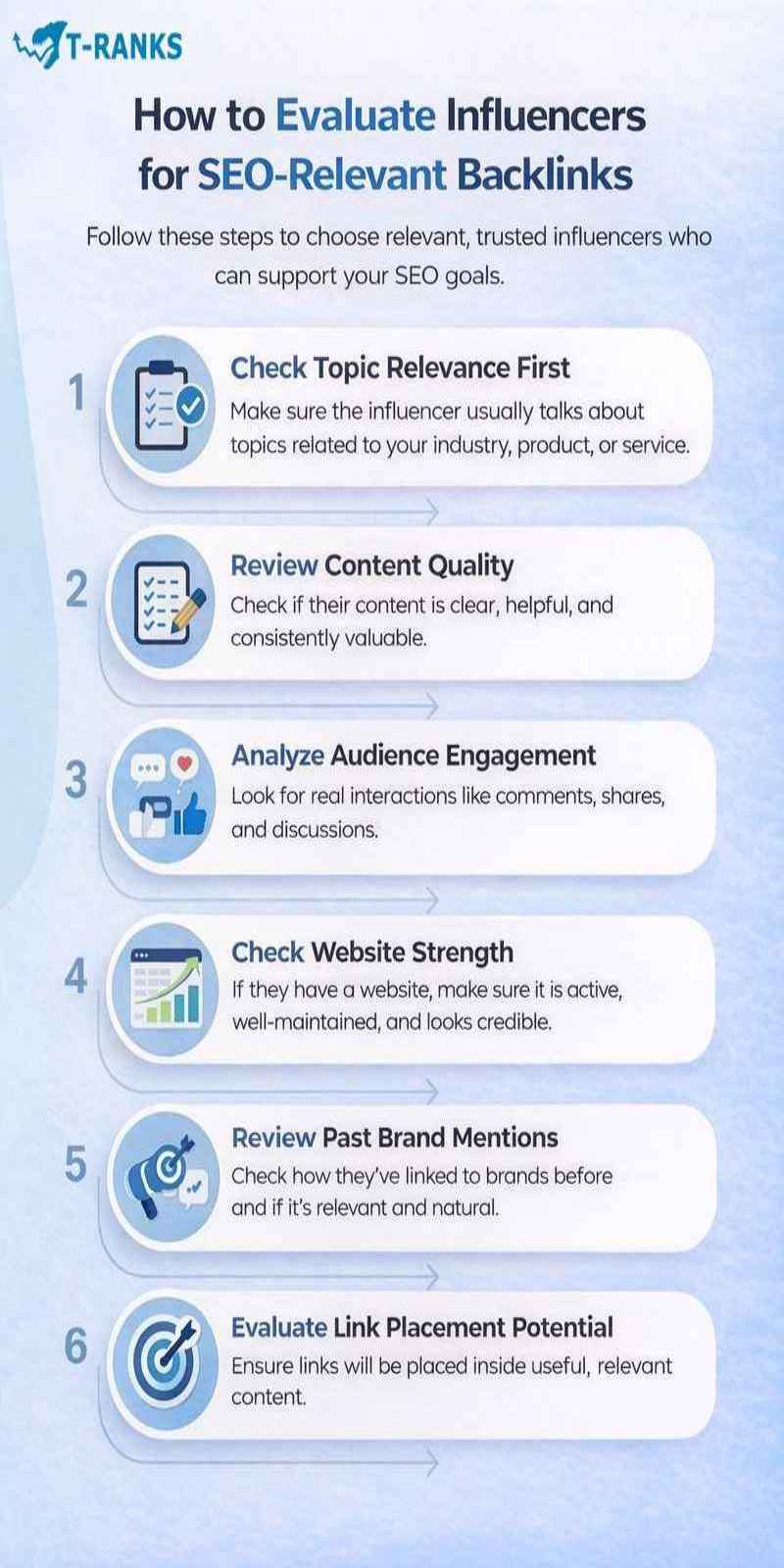
Evaluating influencers for SEO-relevant backlinks means choosing creators who are closely related to your topic, trusted by real audiences, and able to place links naturally inside useful content. The goal is not to find the biggest influencer, but the right one for long-term SEO value.
Start With Topic Relevance
The first thing to check is what the influencer regularly talks about. Their content should clearly match your industry, product, or subject area.
If an influencer covers unrelated topics, even a strong backlink can look out of place and provide little SEO value. Relevance matters more than follower count, because search engines use topic alignment to understand trust and authority.
Review Content Quality and Audience Engagement
Once relevance is clear, look at the quality of the influencer’s content and how their audience interacts with it. Strong influencers publish content that is clear, helpful, and consistent over time.
Pay attention to real engagement such as thoughtful comments, questions from followers, and ongoing discussions. These signals show that people actually trust the creator. High follower numbers without meaningful interaction are usually a warning sign.
Check Website Quality and Link Placement
If the influencer owns a website or blog, review it carefully. A healthy site should be well structured, actively updated, and filled with original content.
Also consider where links are usually placed. SEO-relevant backlinks appear inside blog content, tutorials, or resource pages where the creator explains why the link exists. Links placed only in footers, bios, or random sections with no context carry less value.
Look at Past Brand Mentions and Transparency
Finally, review how the influencer has mentioned brands in the past. Trustworthy influencers explain why they recommend something and avoid promoting many unrelated products.
Clear disclosure of partnerships and transparent linking practices help keep backlinks safe and compliant with search engine guidelines. This reduces risk and protects long-term SEO performance.
Simple Takeaway
The best influencer for SEO is not the largest one. It is the creator who is relevant, trusted, consistent, and careful about what they recommend. Evaluating influencers through these signals helps ensure each backlink strengthens authority instead of weakening it.
How to Earn Influencer Backlinks Without Violating Google Guidelines

Earning influencer backlinks safely means focusing on real value, honest collaboration, and editorial intent over time. Google favors links that exist to help users, not links created through payment, pressure, or manipulation. When influencer backlinks are earned naturally, they remain trustworthy and low risk.
Focus on Value Before Links
The safest influencer backlinks start when creators reference content because it genuinely helps them explain a topic, support a recommendation, or provide useful information to their audience.
Rather than prioritizing link placement, successful collaborations usually begin with resources, insights, or tools that naturally improve the creator’s content.
Build Relationships, Not Transactions
Influencer backlinks tend to come from ongoing professional relationships rather than one-time exchanges. Creators are more likely to reference websites they trust and understand.
When collaboration feels natural and aligned with the creator’s content style, links appear as part of the editorial process rather than as promotional placements.
Let Links Be Editorial and Natural
Google guidelines discourage requesting specific links or anchor text. Influencer backlinks are safest when creators choose to include them independently within relevant content.
Links that appear naturally inside articles, tutorials, or recommendations are more reliable than links placed in footers, bios, or sections created only for promotion.
Be Transparent About Partnerships
If any form of compensation, free access, or sponsorship is involved, transparency is essential. Clear disclosures protect both the creator and the website being linked.
Honest labeling builds trust with users and helps keep influencer backlinks compliant with search engine guidelines.
Monitor Quality and Stay Consistent
After influencer backlinks are earned, reviewing them periodically from an SEO perspective helps ensure they remain relevant and appropriately placed.
Long-term collaborations based on consistent value tend to produce safer and more reliable backlinks than short-term campaigns.
Simple Takeaway
The safest influencer backlinks are earned through helpful content, transparency, and patience. When creators link because your content genuinely benefits their audience, those links remain natural, compliant, and valuable over time.
Influencer Backlinks as Entity Signals for Google and AI Systems

Influencer backlinks do more than pass link value. They help Google and AI systems understand who your brand is, what it is known for, and which topics it belongs to. When trusted creators mention your brand within relevant content, those references act as real-world confirmation rather than just technical SEO links.
Google looks at repeated mentions of a brand across the web to build entity understanding. When niche influencers consistently describe your brand as knowledgeable in a specific area, and that message matches your website content and public presence, it strengthens how Google recognizes your brand inside its Knowledge Graph. This alignment supports trust and credibility signals used in search results and AI-generated summaries.
AI systems also analyze creator content across blogs, videos, and other platforms to identify which brands show reliable expertise. When multiple trusted creators reference your brand in similar contexts, it increases confidence that your brand is established and relevant.
Over time, these consistent influencer backlinks create a reinforcing effect. Instead of relying on a single high-authority link, your brand gains broader validation across the web. This makes your content more competitive in AI-driven search environments, where systems prefer brands supported by multiple trusted sources.
Common Mistakes That Reduce the SEO Value of Influencer Backlinks
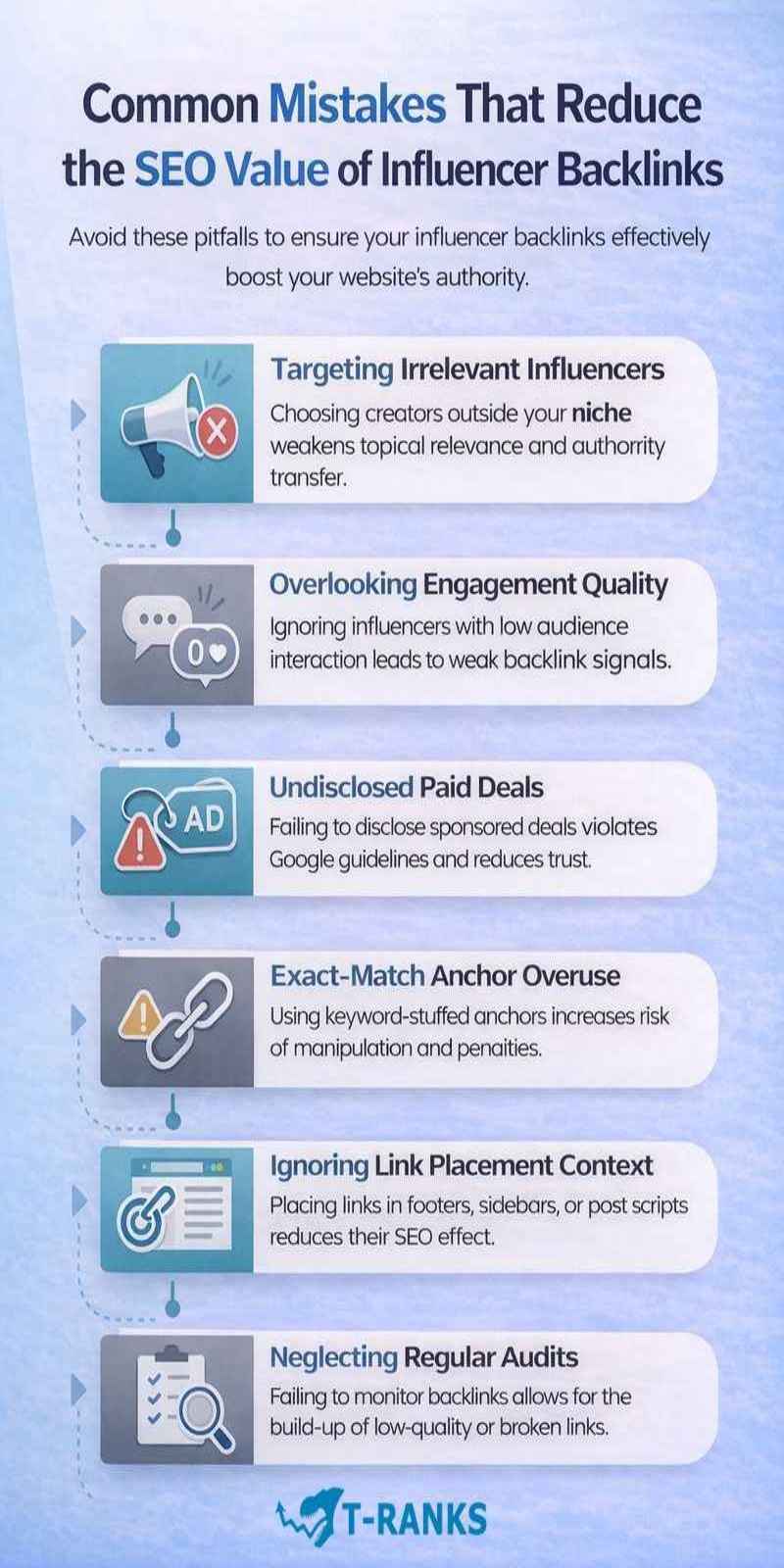
Influencer backlinks lose much of their SEO value when brands focus on short-term wins instead of long-term relevance, trust, and consistency. These mistakes weaken credibility signals and can cause search engines to ignore or discount links that should support authority and E-E-A-T.
To avoid wasting effort and budget, it is important to understand exactly where influencer backlink strategies commonly fail.
Targeting irrelevant influencers
Working with creators outside your niche creates a topical mismatch. When the influencer’s content and audience do not align with your industry, search engines struggle to associate the link with real expertise, reducing authority transfer.
Overlooking engagement quality
Choosing influencers with large follower counts but low interaction leads to weak results. Low engagement means fewer clicks, shares, and user signals, which limits the trust value of the backlink.
Undisclosed paid deals
Failing to use proper “sponsored” or similar disclosures violates Google and FTC guidelines. Undisclosed partnerships reduce transparency, increase risk, and weaken the trust that makes influencer backlinks effective.
Exact-match anchor overuse
Forcing keyword-heavy or overly optimized anchor text makes links appear manipulative. Search engines favor natural phrasing, brand mentions, and creator-chosen language.
Ignoring link placement context
Links buried in footers, post scripts, or side sections receive less attention from both users and search engines. Backlinks placed naturally within the main content carry significantly more SEO value.
Neglecting regular audits
Failing to review influencer backlinks over time allows low-quality or broken links to accumulate. Regular monitoring helps maintain a clean, healthy backlink profile.
One-off transactions
Treating influencer collaborations as single payments misses long-term benefits. Ongoing relationships create repeated mentions and stronger entity signals that build authority over time.
Regular reviews help catch most of these issues early, ensuring influencer backlinks remain valuable SEO assets rather than wasted opportunities.
When Influencer Backlinks Are the Right SEO Move
Influencer backlinks are most effective when the goal is to build trust, authority, and long-term visibility rather than quick ranking gains. They work best in situations where search engines and AI systems rely on strong human-backed signals to understand and evaluate a brand.
Influencer backlinks are a strong SEO choice in the following situations:
- Launching a new brand or product
New websites often lack historical trust and clear entity recognition. Mentions from established creators help introduce the brand to search engines, speed up discovery, and provide early third-party validation. - Industries that require strong trust signals
Niches such as health, finance, education, and software depend heavily on experience and credibility. Influencer backlinks support these requirements by showing real people with relevant expertise endorsing or referencing the brand. - Competing in crowded search results
In saturated markets, technical SEO and standard backlinks are often similar across competitors. Influencer backlinks add human credibility and social proof that cannot be easily replicated at scale. - Preparing for AI-driven search visibility
AI systems favor brands that are mentioned consistently by trusted sources. Influencer backlinks help reinforce brand recognition, improve entity understanding, and increase the chances of being referenced in AI-generated answers and summaries. - When traffic quality matters more than volume
Influencer backlinks tend to send more engaged and relevant users. This leads to better interaction, stronger trust signals, and more stable long-term SEO performance.
Influencer backlinks may not be the best approach when the primary goal is fast, low-cost link volume, short-term keyword movements, or when a niche has no active creator ecosystem. In those cases, traditional SEO tactics can be more efficient.
How to Integrate Influencer Backlinks Into a Balanced SEO Strategy
Influencer backlinks work best when they are used as a supporting authority signal rather than the foundation of an SEO strategy. They are most effective when combined with strong content, diverse backlink sources, and consistent site quality.
Instead of relying on influencer backlinks alone, they should play a complementary role within a broader SEO system.
Use Influencer Backlinks to Reinforce Trust, Not Replace SEO Basics
Influencer backlinks should sit on top of solid fundamentals such as technical SEO, quality content, and internal linking. Their role is to reinforce credibility and trust, not to compensate for weak foundations.
When influencer backlinks support an already strong website, they help confirm authority rather than trying to create it from scratch.
Balance Influencer Backlinks With Other Trusted Link Types
Search engines expect natural diversity in backlink profiles. Influencer backlinks work best alongside other editorial and authoritative links such as guest contributions, expert citations, and organic mentions.
This balance signals that your website earns attention from multiple sources rather than depending on a single link-building approach.
Align Influencer Backlinks With Core Content Topics
Influencer backlinks deliver more value when they point to content that represents your main expertise. Linking to pillar pages, in-depth guides, or closely related resources helps search engines understand what your site is known for.
Topical alignment also makes the backlink feel more natural to both users and algorithms.
Evaluate Impact Beyond Keyword Rankings
The value of influencer backlinks is not always visible through rankings alone. Improvements often appear first in branded searches, referral traffic, user engagement, and consistent brand mentions across the web.
These signals support long-term visibility and stability, especially in AI-driven search environments.
Treat Influencer Backlinks as Long-Term Assets
Influencer backlinks should be reviewed periodically to ensure they remain relevant, contextual, and valuable. Maintaining variety in creators and content types helps avoid repetition and keeps backlink profiles natural.
Long-term partnerships built around consistent value tend to produce more reliable SEO benefits than short-term campaigns.
Simple Takeaway
Influencer backlinks strengthen SEO most when they are integrated thoughtfully into a balanced strategy. Used alongside strong content and diverse backlinks, they help build trust, authority, and long-term visibility without increasing risk.
Conclusion
Influencer-driven backlinks are one of the most effective ways to build trust and authority in modern SEO. They work because they are based on real people recommending useful content, not artificial link placement.
When earned from relevant creators and placed naturally within quality content, influencer backlinks help search engines and AI systems understand and trust your brand. Used alongside strong content and other trusted link types, they support long-term visibility instead of short-term gains.
The key is to focus on relevance, transparency, and steady growth. Brands that treat influencer backlinks as part of a balanced strategy, rather than a shortcut, are better prepared for both traditional search and AI-driven results.
FAQs About Influencer Backlinks
What are influencer backlinks in SEO?
Influencer backlinks are links earned when trusted creators link to your website from their own content. These links come from blogs, videos, or creator-owned platforms and act as real recommendations that support trust, relevance, and authority in search engines.
Do influencer backlinks help SEO rankings?
Yes, influencer backlinks can support SEO rankings when they are relevant, natural, and earned editorially. They help search engines understand trust and authority rather than relying only on technical link metrics.
Are influencer backlinks better than traditional backlinks?
Influencer backlinks are not better in every case, but they are stronger for trust and credibility. Traditional backlinks help with scale and structure, while influencer backlinks add human validation and real engagement signals
Are influencer backlinks safe under Google guidelines?
Influencer backlinks are safe when they are earned naturally, disclosed properly, and not purchased for ranking manipulation. Google favors editorial links that exist to help users rather than influence algorithms
Do influencer backlinks need to be dofollow to work?
No, influencer backlinks do not need to be dofollow to add value. Nofollow links still contribute to brand recognition, referral traffic, and entity signals that support long-term SEO.
How many influencer backlinks does a website need?
There is no fixed number. A small number of high-quality influencer backlinks from relevant creators is more effective than many low-quality links. Quality and relevance matter more than volume.
Do influencer backlinks help with AI Overviews and AI search?
Yes, influencer backlinks help with AI-driven search by reinforcing brand mentions, entity recognition, and trust signals. AI systems prefer brands supported by multiple trusted sources across the web.
Can small creators provide SEO value through backlinks?
Yes, smaller creators can provide strong SEO value if they are relevant, trusted within their niche, and produce high-quality content. Influence matters more than audience size.
How long do influencer backlinks take to show SEO impact?
Influencer backlinks usually support SEO gradually. Their impact is often seen first through referral traffic, branded searches, and engagement before ranking changes appear.
Are influencer backlinks suitable for every niche?
Influencer backlinks work best in niches with active creator communities. In industries with little creator presence, other SEO strategies may be more effective.
What makes an influencer backlink high quality?
A high-quality influencer backlink is relevant, placed naturally within useful content, comes from a trusted creator, and exists to help the audience rather than promote rankings.
Can influencer backlinks replace other link-building methods?
No, influencer backlinks should support a broader SEO strategy. They work best when combined with strong content, editorial links, and technical SEO foundations