Link building for AI tools and Chrome extensions is not just about improving search rankings. It is about helping people find, trust, and use your product. Most users do not search for these tools by name. They discover them while reading reviews, comparing options, or following recommendations.
AI tools are judged quickly, and Chrome extensions are installed only when users feel confident about safety and value. This means links work best when you explain real use cases and come from trusted sources.
In this guide, you will learn how link building actually works for AI tools and Chrome extensions, which strategies support discovery and adoption, and how to avoid links that create exposure without building trust.
Why Link Building Works Differently for AI Tools and Chrome Extensions
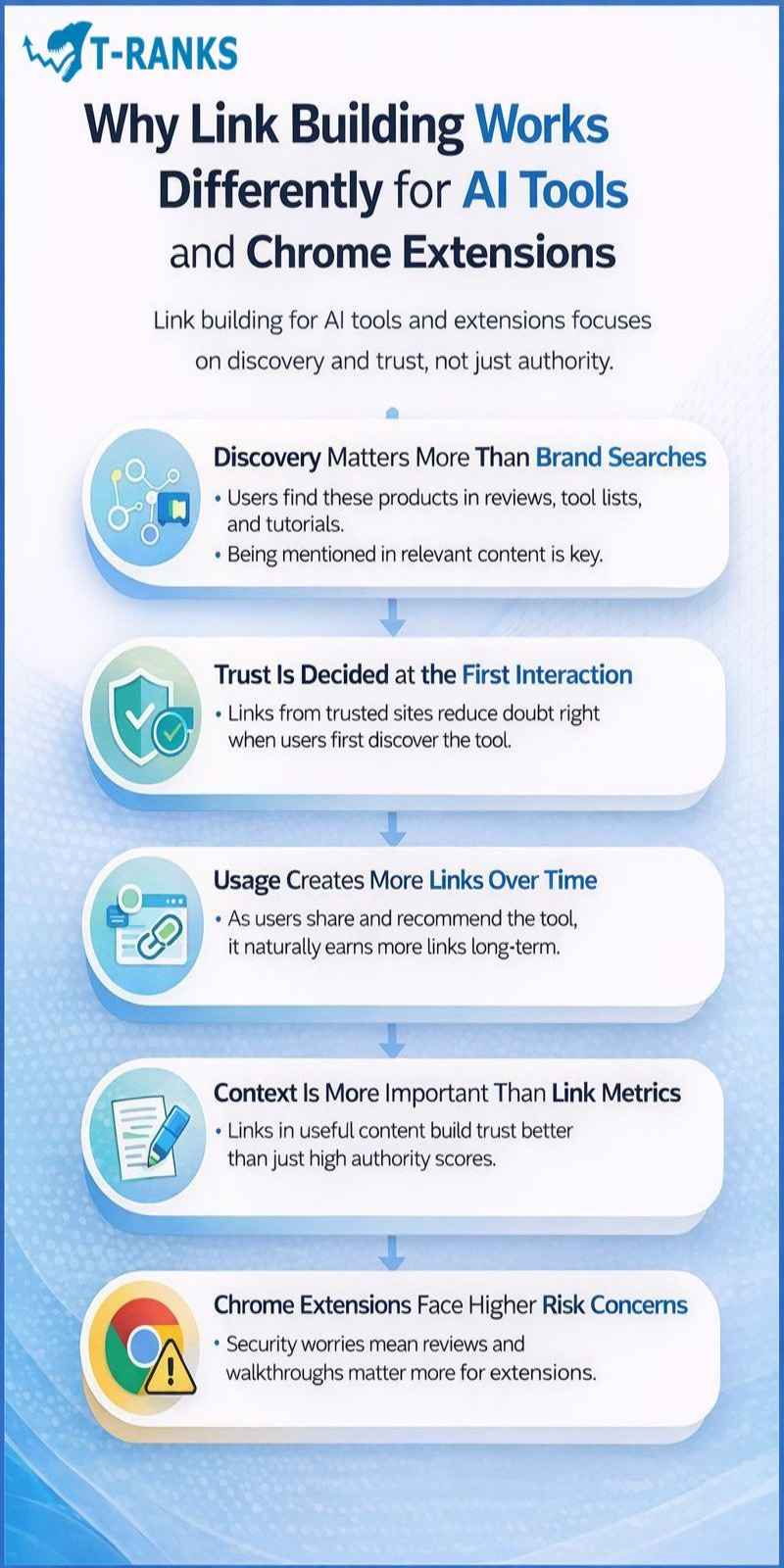
Link building for AI tools and Chrome extensions works differently because users discover these products before they ever trust a brand name.
Most people are not searching for a specific AI tool. They find it while reading an article, comparing options, or following a recommendation. This changes how backlinks create value.
Discovery Matters More Than Brand Searches
AI tools rarely get found through branded keywords. Users discover them inside reviews, comparison posts, tutorials, and curated tool lists.
In this environment, backlinks act as discovery points, not proof of an already known brand. Being mentioned in the right content matters more than having strong homepage authority.
Trust Is Decided at the First Interaction
Users judge AI tools and Chrome extensions very quickly. Within seconds, they decide if a product feels safe and useful.
Links from trusted websites help reduce doubt before a user tries the tool or installs the extension. Without this external trust, even good products struggle to gain users.
Usage Creates More Links Over Time
Once people start using an AI tool, they naturally talk about it. They share screenshots, write tutorials, and mention it in case studies or community posts.
This means one strong editorial mention can lead to many future links. Early visibility links often bring more long term value than large link volumes.
Context Is More Important Than Link Metrics
For AI tools and extensions, where and how a link appears matters more than link strength numbers.
A link that explains what the tool does and how it helps users builds more trust than a high authority link with no explanation.
Chrome Extensions Face Higher Risk Concerns
Installing a browser extension feels risky to many users. People worry about privacy, permissions, and security.
Reviews, walkthroughs, and developer community mentions help remove this fear before users even visit the Chrome Web Store page.
Traditional SEO Signals Alone Are Not Enough
High DR links do not guarantee growth for AI tools. Users care more about usefulness and credibility at the moment of discovery.
This shifts link building away from scale and toward visibility in places where users compare and decide.
Because of this, link building for AI tools and Chrome extensions must focus on discovery, trust, and real usage.
This approach explains why AI tools earn backlinks through visibility and adoption, not just outreach campaigns.
How AI Tools Earn Backlinks Through Discovery and Adoption

AI tools earn backlinks when people discover them, use them, and then reference them publicly.
Links are not the starting point. Visibility and adoption come first. Backlinks appear as a result.
Discovery Happens on Evaluation Surfaces
AI tools are discovered on pages where users are actively looking for solutions. These include reviews, comparisons, curated tool lists, newsletters, and community recommendations.
When a tool appears on these surfaces, it enters the evaluation stage. This is where first links usually appear.
Usage Turns Visibility Into Mentions
Once users try an AI tool, they begin to talk about it. They publish tutorials, share screenshots, include it in workflows, or mention it in guides and case studies.
These real world references often include natural backlinks. Usage creates reasons to link, not requests to link.
Secondary Mentions Multiply Over Time
One discovery driven mention can trigger many follow up references. Writers reuse examples. Creators recommend tools they personally tested. Communities share what works.
This is how AI tools earn backlinks at scale without constant outreach.
Adoption Links Are Different From Ranking Links
Ranking links are built to influence search engines. Adoption links exist to influence users.
Adoption links explain how a tool works, why it is useful, and when to use it. Search visibility improves later as a side effect of repeated, credible mentions.
This is why AI tools win backlinks by being visible and useful first, not by starting with link requests.
The Most Effective Link Building Strategies for AI Tools

The most effective link building strategies for AI tools focus on where users discover, compare, and decide.
Instead of chasing links for rankings alone, these strategies place AI tools inside content that users already trust when evaluating options. The same mechanisms apply to most AI tools and many Chrome extensions, because discovery and trust follow similar patterns.
Below are the strongest strategies that consistently earn visibility, adoption, and long term backlinks.
Editorial Features and “Best AI Tools” Roundups
Editorial roundups are one of the most powerful link sources for AI tools because they sit at the top of the discovery funnel.
Users reading “Best AI Tools” articles are actively looking for solutions, not browsing casually.
These listicles work well because:
- They introduce tools during evaluation, not after a decision
- They combine visibility, trust, and intent in one placement
- They often rank well and get reused by other writers
Editors usually look for clear qualification signals before featuring an AI tool. These include:
- A clear use case, not a vague product description
- Evidence of real usage or outcomes
- A working demo, free tool, or visible output
- Simple onboarding and easy explanation
AI tools that explain what problem they solve and who they are for earn these links more easily than tools that focus only on features.
Comparison, Alternative, and Evaluation Page Mentions
Comparison and alternatives content attracts users who are close to making a decision.
Pages like “Tool A vs Tool B” or “Best alternatives to X” often drive higher quality traffic than generic reviews.
These links convert better because:
- Users are already comparing options
- The tool is evaluated side by side with competitors
- Context explains strengths, weaknesses, and use cases
For AI tools, these mentions build trust fast. They show where the product fits and when it should be used.
From a link building perspective, comparison links also age well. They continue attracting users and secondary mentions as tools evolve and new alternatives appear.
This makes comparison based placements valuable for both adoption and long term visibility.
AI Tool Directories and Curated Discovery Platforms
AI tool directories work best when they are curated, niche focused, and actively used by real people.
These platforms help users explore options, compare tools, and discover new products in one place.
Legitimate directories usually have:
- Editorial review or approval before listing
- Clear categories and use case tagging
- Active updates and new tool additions
- Real traffic from users looking for AI solutions
Low value directories focus on volume, not discovery. They accept every submission, offer little context, and rarely send meaningful traffic.
Submitting to too many of these platforms does not improve trust and can dilute link quality.
The long term value of curated directories comes from persistent visibility.
Once listed, AI tools continue to appear in searches, recommendations, and follow up content created by writers who use these platforms for research.
Product-Led Link Earning Through Free Tools and Public Outputs
AI tools earn links naturally when they produce shareable outputs.
Free tools, demos, calculators, generators, and public results give users something concrete to reference.
Outputs attract links because:
- Writers can show results instead of describing features
- Users share examples in tutorials and guides
- Public demos lower the barrier to testing
When an output is useful or impressive, it becomes part of other content.
This creates backlinks without outreach, because the tool itself becomes the source being cited.
Developer, API, and Integration-Based Link Opportunities
Developer focused links are some of the most stable and long lasting backlinks AI tools can earn.
These links appear in documentation, API references, integration guides, and technical tutorials.
Common sources include:
- Developer docs and setup guides
- Integration listings and partner pages
- Technical blog posts explaining workflows
- Open source projects and examples
These links are valuable because they:
- Are context rich and highly relevant
- Rarely get removed
- Support both discovery and credibility
For AI tools with technical users, documentation and integrations often generate consistent backlinks over time without repeated outreach.
Link Building Strategies Specific to Chrome Extensions
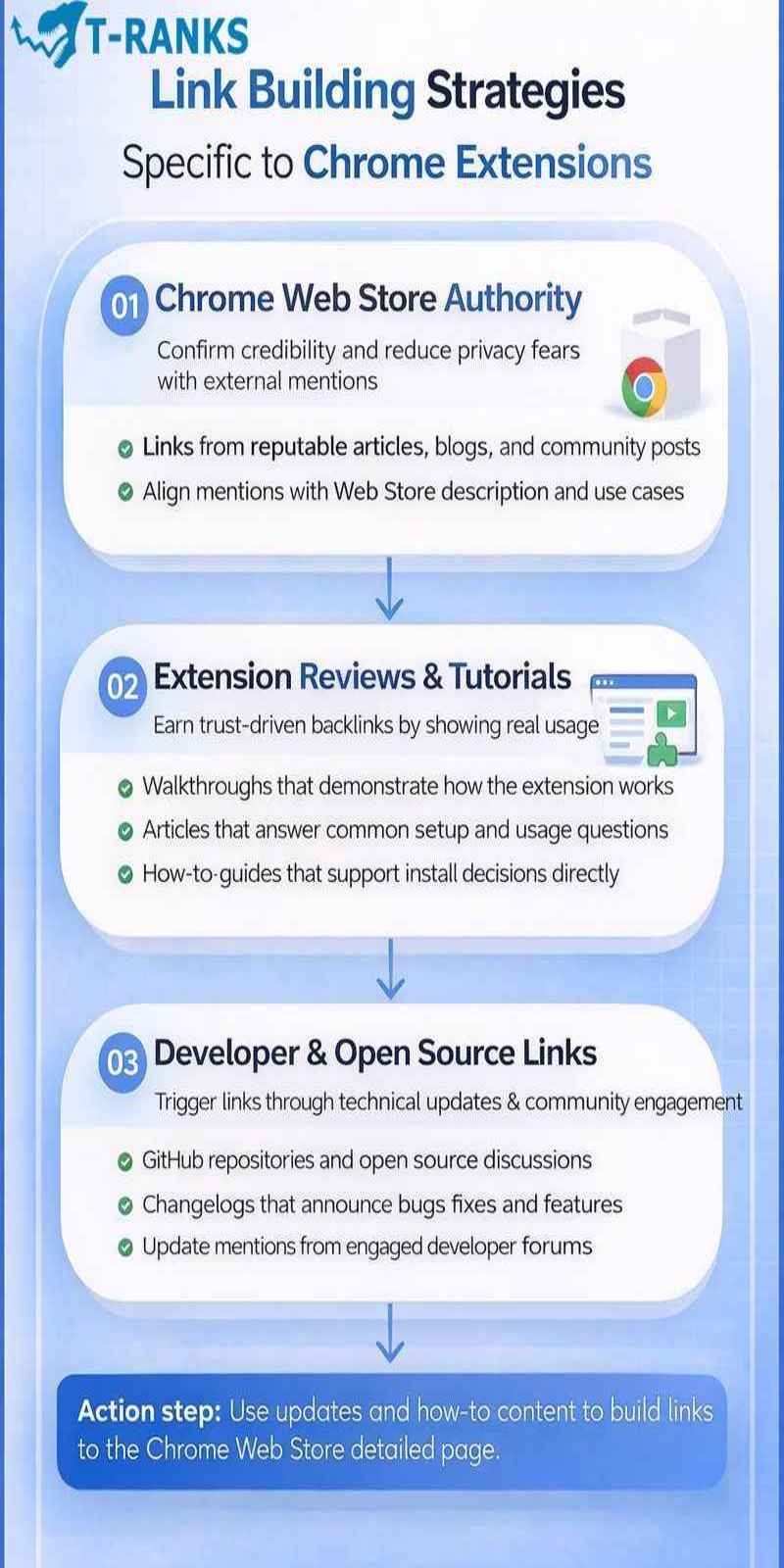
Chrome extensions require a more careful link building approach because users must trust the product before installing it.
Unlike AI tools that can be tested instantly in a browser, extensions ask for permissions and deeper access. This makes external validation more important.
The strategies I shared below focus only on extension specific mechanics without repeating general AI tool tactics.
Chrome Web Store Authority and External Trust Signals
The Chrome Web Store listing is the center of credibility for any extension. Users check ratings, reviews, update history, and permissions before installing.
However, the store alone is rarely enough to build full confidence.
External links support trust perception by:
- Confirming the extension is discussed outside the Web Store
- Showing that real users and publishers have tested it
- Reducing fear around privacy and security
Links from reputable articles, blogs, and community posts reinforce what users see in the store.
When external mentions align with the store description and use cases, installation hesitation drops.
Extension Reviews, Tutorials, and Use Case Content
Reviews and tutorials are the strongest link sources for Chrome extensions because they show real usage step by step.
Users trust walkthroughs more than feature lists, especially when an extension interacts with browser data.
These links perform well because:
- They demonstrate how the extension works in practice
- They answer common setup and usage questions
- They support install decisions directly
Install driven editorial links often come from writers who test the extension and document their experience.
This makes these placements valuable for both trust and adoption, not just visibility.
Developer Communities, Open Source, and Update Driven Mentions
Chrome extensions often earn links through technical updates and community activity.
GitHub repositories, changelogs, release notes, and open source discussions create natural reference points.
Updates trigger fresh links when:
- New features solve real problems
- Bug fixes or improvements are documented publicly
- Developers share changes in community forums or repositories
These links are especially durable. They remain relevant as long as the extension continues to evolve.
For technical extensions, ongoing updates and transparency create consistent link opportunities without forced outreach.
Anchor Text and Link Context for AI Tools and Extensions
Anchor text and link context play a critical role in how AI tools and Chrome extensions are understood by both users and search systems.
Because these products are discovered and evaluated quickly, links must feel natural, descriptive, and safe. Over-optimized anchors create friction instead of trust.
Branded and Product Name Anchors Work Best
Branded anchors and product names are the safest and most effective option for AI tools and extensions.
They signal legitimacy, reduce spam risk, and align with how users naturally reference products in reviews, tutorials, and comparisons.
These anchors work well because:
- Editors prefer neutral, non-promotional language
- Users recognize product names during evaluation
- Search engines associate the brand with real usage contexts
For new AI tools, branded anchors help build identity without forcing keyword relevance too early.
Feature Based Anchors Support Understanding
Feature based anchors explain what the tool does, not just what it is called.
Examples include references to a specific function, workflow, or outcome the tool provides.
These anchors are effective when:
- The feature solves a clear problem
- The link appears inside explanatory content
- The context shows how and when the tool is used
Feature based anchors improve clarity and help users understand value before clicking.
Avoid Over Optimization and Forced Keywords
Aggressive keyword anchors increase risk for AI tools and extensions.
Exact match phrases used repeatedly can look unnatural, especially when the brand is still new.
To stay safe:
- Avoid repeating the same anchor text across many links
- Let editors choose anchors naturally
- Focus on relevance and context, not keyword control
Strong link context matters more than anchor precision.
A clearly explained mention inside trusted content delivers better results than a perfectly optimized anchor with no real meaning.
Measuring Link Impact Beyond Rankings
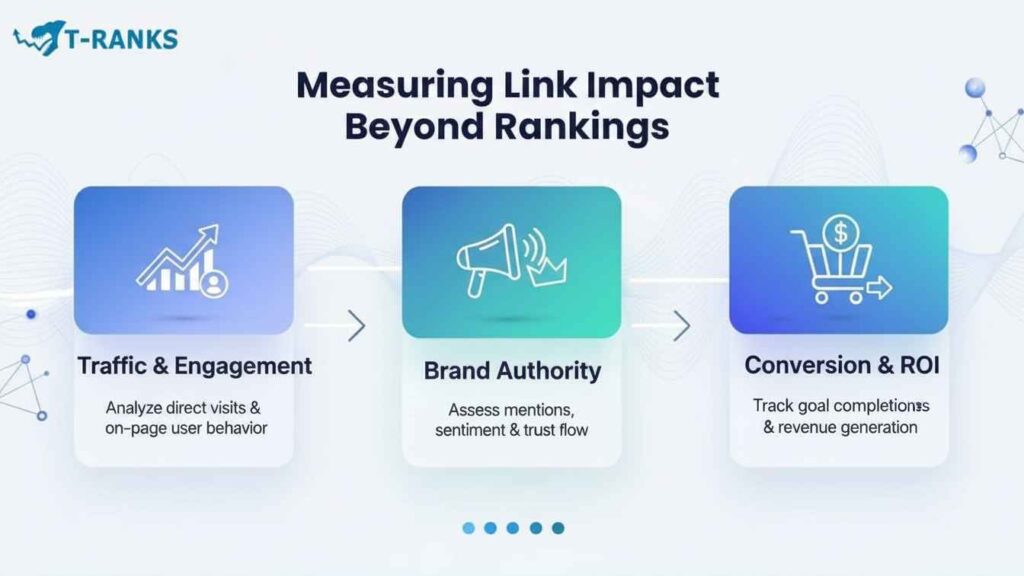
For AI tools and Chrome extensions, link building success cannot be measured by rankings alone.
The real value of a backlink is shown in adoption signals, not just search position changes. This requires tracking how links influence installs, usage, and brand visibility.
Install and Usage Correlation
Strong links often lead to installs or product usage before they affect rankings.
When a link appears in a review, tutorial, or comparison, users may try the tool immediately.
Key signals to watch include:
- Spikes in installs after a link goes live
- Increased sign-ups or tool usage from referral pages
- Repeat usage linked to specific content sources
These signals show whether a link is driving real engagement, not just passive traffic.
Referral Relevance Matters More Than Volume
Not all referral traffic has equal value.
Links from content that matches user intent send fewer but more qualified visitors.
High relevance referrals usually:
- Come from evaluation or use-case content
- Have longer session duration
- Lead to deeper product interaction
A small number of relevant referrals often outperform large volumes of low-intent traffic when measuring link impact.
Brand Search Lift and Secondary Mentions
Effective links increase brand awareness over time.
Users who discover a tool through content often search for it later by name.
Signs of link-driven brand lift include:
- Growth in branded search queries
- Mentions across blogs, newsletters, and communities
- New backlinks that appear without outreach
These secondary mentions indicate compounding visibility.
They show that link building is supporting discovery, trust, and long-term adoption beyond rankings.
Common Link Building Mistakes AI Tool Founders Make
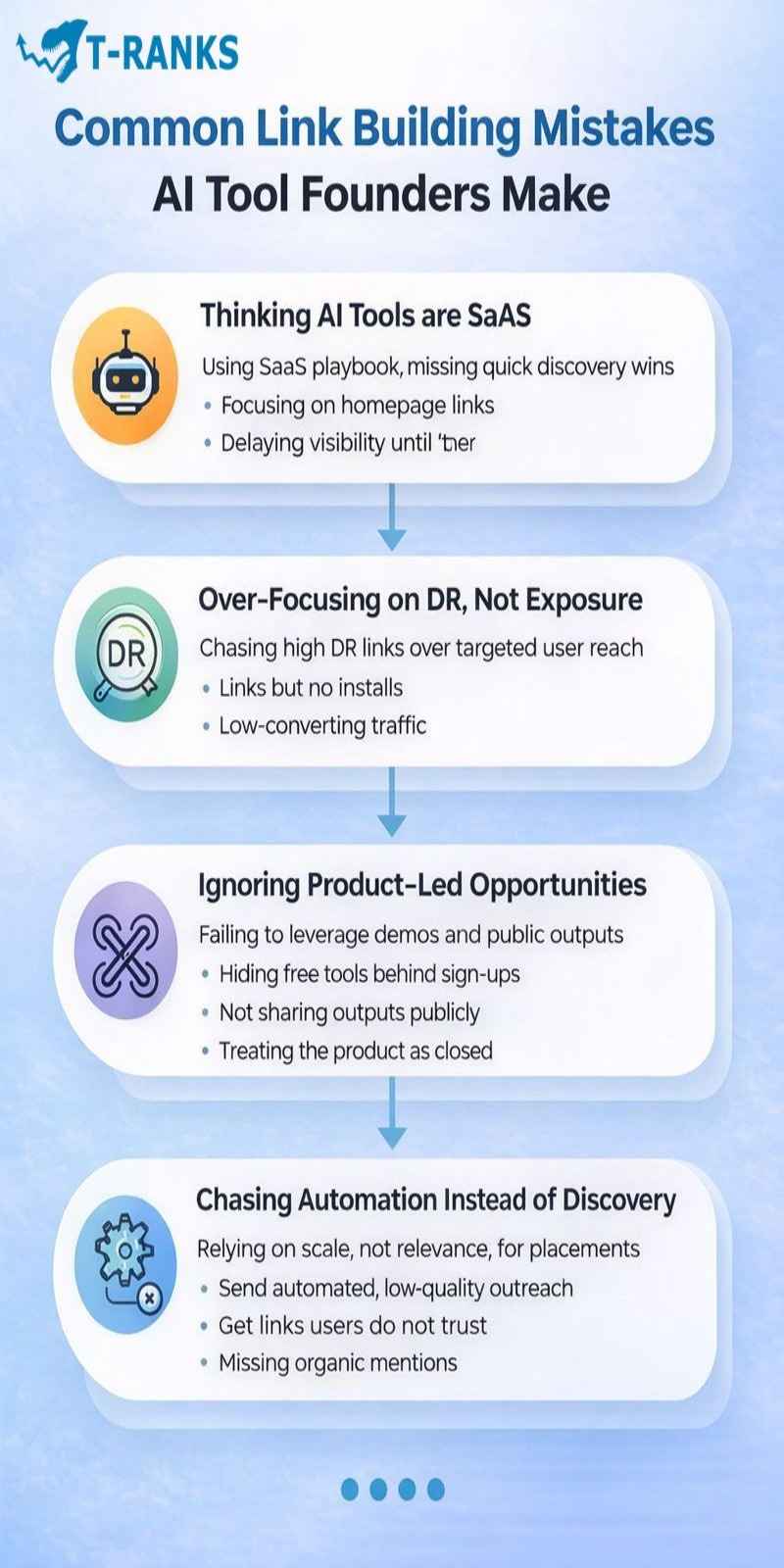
Many AI tool founders struggle with link building because they apply traditional SaaS SEO thinking to products that grow through discovery and usage. These mistakes waste time, limit visibility, and slow adoption.
Treating AI Tools Like Generic SaaS Products
AI tools are often evaluated quickly and informally.
When founders follow long-term brand authority playbooks designed for SaaS, they miss early discovery opportunities.
Common issues include:
- Focusing on homepage links instead of evaluation content
- Delaying visibility until “the brand is ready”
- Ignoring where users actually discover AI tools
AI tools need to appear where users compare, test, and decide, not only where brands compete for rankings.
Over-Focusing on DR Instead of Exposure
High DR links look impressive but do not always lead to users.
A link from a relevant article with real readers often outperforms a stronger domain with no context.
When exposure is ignored:
- Tools receive links but no installs
- Traffic does not convert
- Trust signals remain weak
Visibility in the right content matters more than raw link metrics.
Ignoring Product-Led Link Opportunities
Many AI tools generate linkable assets but fail to use them.
Free tools, demos, public outputs, and integrations naturally attract mentions.
Founders often miss links by:
- Hiding demos behind sign-ups
- Not showcasing outputs publicly
- Treating the product as closed instead of shareable
Product-led visibility reduces the need for aggressive outreach.
Chasing Automation Instead of Discovery
Automated outreach promises scale but often delivers low-quality placements.
For AI tools, this creates links without trust or adoption.
Discovery-driven link building focuses on:
- Being present where users search for solutions
- Supporting real use cases
- Letting usage create organic mentions
Automation should support visibility, not replace it.
When to Combine SEO Links With PR and Community Growth
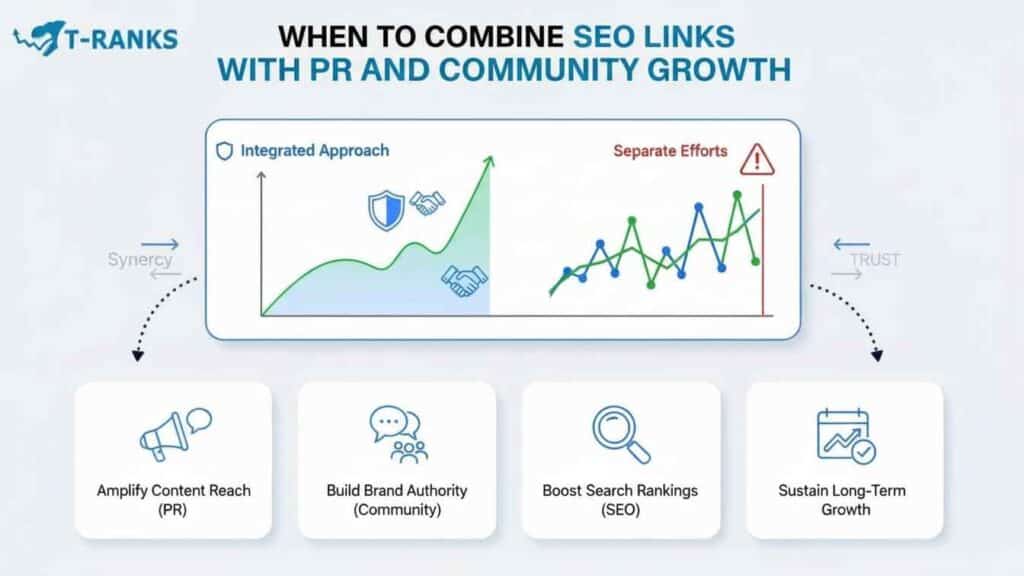
AI tools grow faster when SEO links, PR exposure, and community activity are aligned instead of working in isolation.
Each channel supports a different stage of discovery. When combined intentionally, they reinforce trust, visibility, and adoption at the same time.
Launch Driven Backlinks
Product launches are the natural starting point for this hybrid approach.
New features, major updates, or public releases give editors and publishers a clear reason to mention the tool.
When SEO and PR are aligned during a launch:
- PR introduces the tool to fresh audiences
- Editorial coverage generates authoritative backlinks
- Early users begin sharing and referencing the product
This creates a clean transition from announcement to long term discovery instead of a short attention spike.
Community Amplification
Once a tool is visible through launches and editorial mentions, communities extend its reach.
Users who discover the tool through articles often share it inside forums, developer groups, newsletters, and private networks.
Community amplification matters because:
- Peer discussion builds trust faster than promotion
- Shared experiences lead to tutorials and guides
- Organic mentions often appear without outreach
This stage turns initial visibility into sustained conversation, which naturally supports link growth.
Timing SEO With Releases
SEO link building works best when it follows real product activity.
Links feel more credible when they are supported by visible progress, updates, and improvements.
Strong timing means:
- Outreach aligns with new features or releases
- Documentation and demos reflect current functionality
- Editors have something new to reference
When SEO moves in sync with PR and community momentum, links appear natural, relevant, and easier to earn.
In practice, SEO builds lasting visibility, PR creates initial attention, and communities turn usage into ongoing mentions.
Combining them ensures link building supports real growth, not just rankings.
Conclusion
AI tools and Chrome extensions grow through visibility, trust, and real usage, not through brand recall or link volume. Users discover these products while comparing options, reading reviews, and testing solutions. Link building works when it supports this discovery process instead of trying to shortcut it.
Backlinks matter because they help users find, evaluate, and trust an AI tool at the right moment. The strongest links appear in editorial content, comparisons, tutorials, and product led examples that show how a tool is actually used. These links support adoption first. Rankings improve as a result, not as the primary goal.
A discovery first approach to link building compounds over time. One credible mention can lead to secondary references, community discussion, and repeated exposure across new content. When AI tools focus on being useful and visible, backlinks become a natural outcome of adoption rather than an isolated SEO task.
In the AI era, link building is not about chasing metrics. It is about earning attention, building confidence, and supporting real usage, consistently and sustainably.
FAQs About Link Building for AI Tools and Chrome Extensions
What is link building for AI tools?
Link building for AI tools is the process of earning backlinks that increase discovery, trust, and adoption of an AI product.
These links usually come from editorial features, comparisons, directories, and product-driven mentions.
Does link building help AI tools get users, not just rankings?
Yes, link building helps AI tools gain users by placing them in discovery and evaluation content.
Editorial mentions often drive installs, trials, and real usage alongside SEO benefits.
How is link building for AI tools different from normal SaaS link building?
Link building for AI tools focuses more on discovery and trust than long-term brand authority.
AI tools are often evaluated quickly, so links that show real use cases matter more.
Are “Best AI Tools” listicles good for link building?
Yes, listicles are one of the strongest link sources for AI tools.
They combine visibility, credibility, and high-intent traffic in one placement.
Do AI tools need backlinks if they already get traffic from launches or communities?
Yes, backlinks extend visibility beyond short-term launch spikes.
They support ongoing discovery, brand searches, and secondary editorial mentions.
Are AI tool directories worth submitting to?
Yes, curated and niche-focused AI tool directories can support discovery and trust.
Mass or low-quality directories should be avoided.
How do AI tools earn backlinks without direct outreach?
AI tools earn backlinks through free tools, demos, public outputs, and integrations.
These assets are referenced naturally when users or writers share results.
Does link building work differently for Chrome extensions?
Yes, Chrome extensions rely more on trust and install confidence than pure rankings.
Links from reviews, tutorials, and developer communities support credibility.
Do Chrome extensions need backlinks if they rank in the Chrome Web Store?
Yes, backlinks strengthen trust outside the Web Store environment.
External mentions help users feel safer installing the extension.
What anchor text works best for AI tools and Chrome extensions?
Branded, product-name, and feature-based anchors work best.
Aggressive keyword anchors increase risk and should be limited.
How long does link building take to show results for AI tools?
Early visibility and referral signals can appear within weeks to months.
Stronger impact compounds over time as mentions and trust grow.
Is link building worth the effort for AI tools and Chrome extensions?
Yes, link building is worth it because discovery and trust compound over time.
Well-earned links continue driving visibility and adoption long after placement.