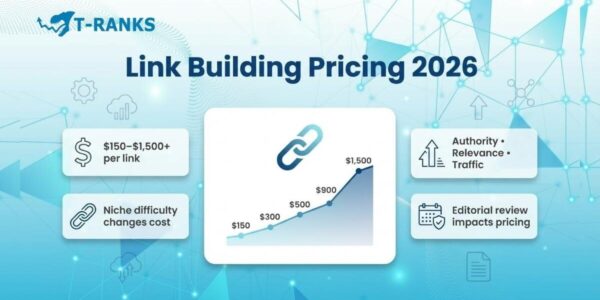
Link building prices are confusing. One agency may charge one hundred dollars for a link, while another charges more than one thousand. If you are new to SEO, it is difficult to know what is fair, what is risky and what actually works.
In this guide, I explain link building prices in the simplest way possible so you can build a clear understanding of how costs work in 2026. You will learn how much links really cost, why prices vary so much, which link types offer the best value and how to choose the right budget for your business. We also cover hidden costs, risk factors, ROI and the differences between DIY, freelancers and professional agencies.
By the end, you will know exactly what you are paying for, what to avoid and how to invest your budget safely for long term results.
What Determines Link Building Pricing in 2026?
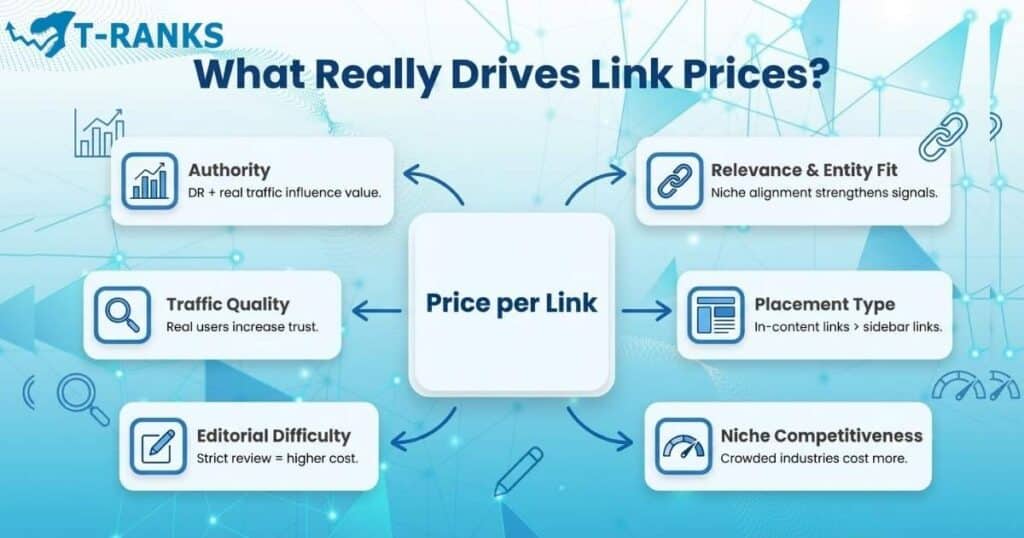
Link building pricing in 2026 is determined by authority, relevance, traffic quality, editorial difficulty, niche competitiveness, and link type. Most links cost between one hundred fifty dollars and one thousand five hundred dollars. Prices increase when the linking site has strong authority, real traffic, and strict review rules. Prices decrease when links come from low quality sites or networks with weak relevance. A link also becomes more expensive when it requires expert content, manual editing, or detailed approval.
Search engines now focus on topic alignment and entity clarity. This means a site must match your niche to pass strong signals. As a result, pricing is shaped by both traditional metrics and modern semantic relevance. Competitive niches raise prices because publishers accept fewer outbound links. Each factor combines to make link building pricing different for every brand and every industry.
Authority, Relevance, Traffic Quality, Placement Type
Authority, relevance, traffic quality, and placement type are the main factors that shape link building pricing. Authority reflects how trusted a website is. If a site ranks well and has strong organic visibility, the link costs more. A DR seventy site with real traffic can cost over eight hundred dollars. The same DR score without traffic can cost two hundred dollars.
Relevance increases value. A link from a website that matches your niche sends stronger ranking signals. A cybersecurity link on a cybersecurity blog costs more than the same link on a lifestyle blog. Traffic quality also shapes pricing. Sites with real readers charge more because they send visitors who care about the topic.
Placement type matters as well. Editorial links inside the main content are the most expensive because they require manual review. Sidebar or footer links cost less. A niche edit on an older post may cost one hundred fifty dollars. A new editorial link may cost five hundred dollars or more.
Entity Salience and Topical Alignment
Entity salience and topical alignment raise link building prices because search engines reward topic focused websites. Entity salience shows how strongly a website is connected to a subject. When a site builds deep content around one topic, its links become more valuable.
For example, a DR forty medical research blog may be stronger than a DR seventy general blog because it matches the topic better. A SaaS link from a SaaS industry blog carries more semantic strength than a link from a mixed content site. Publishers understand this advantage and charge more for links that match your niche closely.
This is why pricing in 2026 now focuses on topic relevance rather than metrics alone.
Editorial Difficulty and Approval Rate
Editorial difficulty and approval rate increase link building pricing because harder placements require more work. Some websites have strict rules and human editors who review every submission. These extra steps add time and cost.
A simple contributor post may require only one edit. An editorial link on a respected publication may need new content, sources, expert opinions, and several revisions. This can increase the cost two to three times. Approval rate also matters. If a site accepts only ten percent of pitches, outreach teams must contact many publishers to secure one link. This increases the final price.
For example, a lifestyle blog with a high approval rate may cost one hundred fifty dollars. A real tech publication with low approval may cost eight hundred dollars or more.
Niche Competitiveness and Industry Demand
Niche competitiveness affects link building pricing because some industries have fewer available placements and higher demand. Finance, legal, health, and SaaS receive many outreach requests. These sites have strict guidelines and limited space for outbound links. This raises pricing.
Low competition niches offer lower pricing. Travel, lifestyle, and hobby blogs often charge between one hundred dollars and three hundred dollars. In high competition niches, the same type of link can cost five hundred dollars or more.
When many brands want links from the same industry, publishers raise their prices. This creates a wide price gap between low cost and high cost niches.
Content Requirements and Production Costs
Content requirements influence link building pricing because many placements include writing and editing costs. Some websites accept simple articles with basic structure. Others require long content with data, references, quotes, and expert insights. These steps increase price.
A five hundred word article may keep the cost low. A one thousand word post with statistics and sources can raise the price. If the site requires visuals, expert interviews, or custom research, the cost increases again.
These content needs are included in link building pricing because vendors must produce material that meets publisher rules.
Market Shifts from 2024 to 2026
Market shifts from 2024 to 2026 raised link building prices because strong editorial sites became harder to access. AI content filled the internet with low quality blogs. Google updates removed many weak sites from search results. This reduced supply and made real websites more valuable.
Publishers increased their fees to cover higher editorial workload. Many added new review steps and stricter linking policies. Vendors also lost access to networks hit by updates. This forced the market to rely on real websites with stronger quality standards.
High authority sites reduced the number of outgoing links to protect their reputation. This limited supply further. All these changes combined to push link building pricing higher in 2026.
Link Building Pricing Breakdown by Link Type
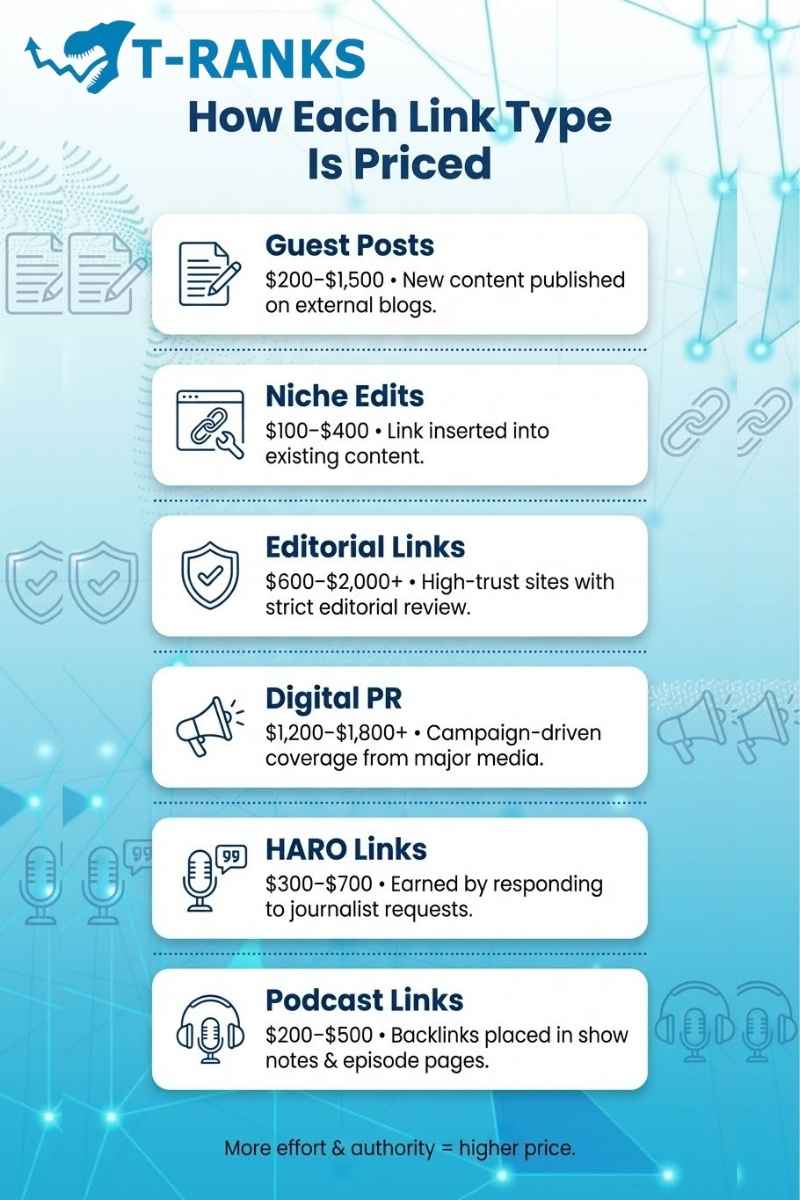
Link building pricing changes a lot by link type, but most quality backlinks cost between 150 dollars and 1,500 dollars each, with some digital PR and top tier editorial links going above 2,000 dollars. Guest posts and niche edits usually sit at the lower to mid range. Digital PR, HARO and podcast links sit at the upper range because they are harder to earn and come from stronger sites.
Studies from BuzzStream and Siege Media show that average costs per link cluster between 100 dollars and 1,500 dollars for most campaigns, with competitive niches going higher. When you plan link building prices, it helps to look at each link type separately, not just one average number.
Guest Post Pricing
Guest post pricing in 2026 usually ranges from about 200 dollars to 1,000 dollars per link when you buy directly from sites, and from about 700 dollars to 1,500 dollars or more per link when you go through vendors. Large media sites and special placements can charge several thousand dollars.
A large dataset from BuzzStream covering more than twenty six thousand sites found that the average guest post costs around 365 dollars. High quality guest posts on strong domains with real traffic often sit between 692 dollars and 957 dollars before any agency markup.
A recent breakdown by Mike Khorev shows many vendors then resell these placements at around 1,400 dollars to 1,500 dollars per link or higher.
At the low end, you can still find guest posts under 200 dollars. These usually sit on low quality blogs with weak traffic and loose editorial rules. At the high end, very strong sites in finance, legal or big media can charge several thousand dollars for a single guest post placement, but these are rare and not required for every brand.
Niche Edit or Link Insertion Pricing
Niche edit or link insertion pricing in 2026 often ranges from about 100 dollars to 400 dollars per link, with some agency level placements going higher. The typical link building price for a simple insertion is lower than a full guest post, because it does not always require new content.
The link building pricing study from BuzzStream found that link insertions average around 141 dollars per placement across many sites. A 2025 pricing update from Prestige Links that reviews Ahrefs data and vendor offers places many niche edits in the 50 dollar to 350 dollar band. When quality filters are applied, real niche edits on strong sites move closer to the 200 dollar to 400 dollar range.
These backlinks are cheaper because the page already exists. However, they have more link rot risk if the content is updated or removed. In practice, niche edits are often used as a way to reduce average backlink price inside a mixed link building package.
Editorial Backlink Pricing
Editorial backlink pricing in 2026 often sits between 600 dollars and 2,000 dollars per link for real placements on respected sites, and can go higher in very competitive niches. These are the links most people think of when they talk about high quality backlinks.
The pricing guide from Editorial.Link notes that a single paid link on a good DR 50 plus site can easily reach 600 dollars or more. In high value industries such as casinos, crypto, legal or finance, the same type of editorial backlink can pass the 1,000 dollar mark because demand is very high and inventory is limited.
Editorial links cost more because they sit inside articles that offer value to readers. They go through several review layers, often need strong content and can be risky for publishers if overused. The link building price you pay reflects that editorial effort and the trust of the domain.
Digital PR Link Pricing
Digital PR link pricing in 2026 usually ranges from about 1,200 dollars to 1,800 dollars per link when you look at full campaigns, with campaign budgets often starting around 5,000 dollars and reaching 15,000 dollars or more in competitive spaces. These links are among the most expensive, but also among the safest and most powerful for authority.
The 2025 link building pricing report from BuzzStream shows that digital PR backlinks often cost in the 1,250 dollar to 1,500 dollar band per unique linking domain when you divide campaign cost by links earned. Siege Media and other agencies share similar ranges and note that campaigns in crowded niches can push prices even higher.
Digital PR links are hard to control, because they depend on newsworthy stories, data, or creative assets. Many campaigns earn a mix of mid tier links and a few very strong ones. This is why link building pricing for digital PR is usually expressed as total campaign cost, not a fixed price per link.
HARO and Journalist Outreach Pricing
HARO and journalist outreach pricing in 2026 often lands between 300 dollars and 700 dollars per secured link when you outsource to a specialist agency, although some services charge below or above this range. Done in house, HARO can be cheaper in cash terms but very heavy in time.
The 2025 pricing guide from Create and Grow highlights that a HARO backlink often costs between 300 dollars and 600 dollars or more per link when managed by a PR provider. A full rundown from Contentellect shows that many done for you HARO services charge around 400 dollars to 700 dollars per successful placement, especially when links come from well known media sites. Some individual providers, such as HARO Links Builder, sell HARO links at around 230 dollars to 400 dollars, but these offers often come with stricter limits and less control over anchor text.
The effective backlink price also depends on success rate. If a service sends many pitches and only a few are published, the true cost per link can be higher than the list price. This is why HARO pricing must always be read together with expected volume and the authority of the sites involved.
Podcast Backlinks and Interview Links
Podcast backlinks and interview links in 2026 often work out to roughly 200 dollars to 500 dollars per link when you use podcast booking services, although some premium services sit much higher. The direct link building price is usually baked into a monthly booking fee rather than a clear per link tag.
Podcast booking agencies like Talks often charge from a few hundred dollars per month for basic outreach up to several thousand dollars per month for full service offers that include research, strategy and content assets. A case study shared in the pricing guide from Editorial.Link described one campaign that spent about 4,520 dollars to gain fourteen podcast backlinks, which works out at roughly 330 dollars per link.
Podcast backlinks are attractive because they often come from real brand properties that have loyal audiences. The links usually sit in show notes, episode pages or resource sections. This makes them low risk and strong for trust, even if you do not see the same raw anchor control as a classic guest post.
If you combine these link types inside one strategy, you can smooth out average backlink price while still hitting your authority and safety goals.
Link Building Packages and Monthly Subscription Models
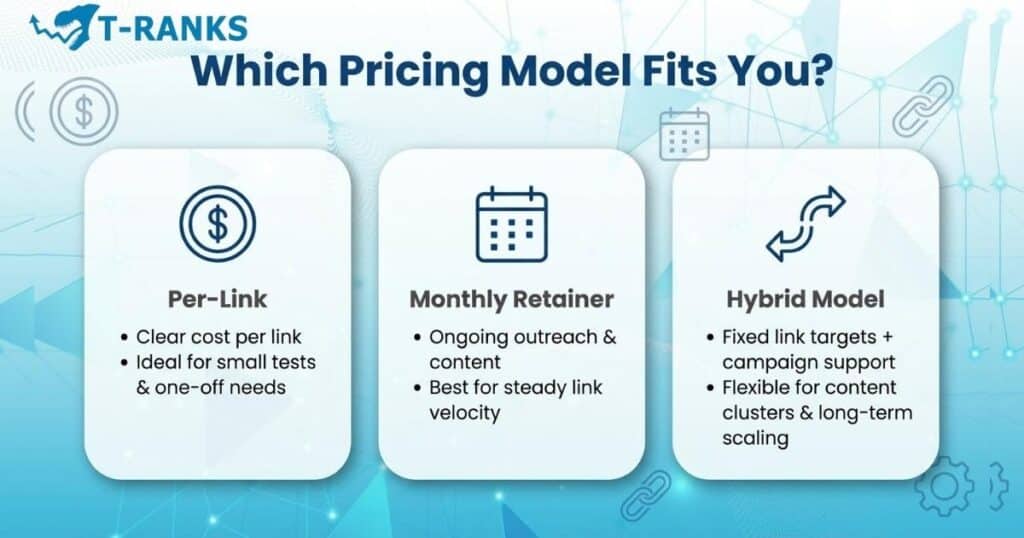
Link building packages in 2026 follow three main models. Monthly retainers, per link pricing and hybrid packages that mix both. Each model changes how agencies plan outreach, create content and maintain publisher relationships. Retainers offer predictable spending. Per link pricing offers full cost clarity. Hybrid packages give flexibility when campaigns need steady link velocity and fixed link numbers.
Industry reviews from {Siege Media} and BuzzStream show that most long term link building campaigns use retainers or hybrid models because they support continuous prospecting, higher approval rates and multi month planning. Packages also include hidden value such as established editor relationships and access to prequalified publisher lists. These assets reduce outreach time and improve quality.
Monthly Retainers vs Per Link Pricing
Monthly retainers offer predictable spending while per link pricing offers full transparency. Retainers work best for brands that need consistent authority growth. Per link pricing works for brands that want a fixed number of links without long term commitment.
Retainers support longer outreach cycles and allow agencies to test multiple angles and niche segments. They often deliver more links per month because work is not tied to a per link limit. This makes them ideal for ecommerce, SaaS and competitive markets where link velocity matters.
Per link pricing fits small brands or businesses running trial campaigns. You know exactly what each link costs. It is a good model for simple link needs or controlled testing. Industry reviews show that small businesses choose per link pricing for clarity, while larger companies move to retainers for scale, a pattern noted in {Siege Media}.
What Packages Really Include
Link building packages include many deliverables. Content writing, prospecting, outreach, inbox management and reporting. These visible tasks form only part of the work that creates each placement.
Typical deliverables inside a package include:
- Content for guest posts and editorial placements
- Prospecting for relevant publishers
- Pitch creation and personalization
- Inbox management and negotiation
- Link placement and verification
- Reporting on links earned and anchor text used
Packages also include hidden value that does not appear in the invoice:
- Long term editor relationships that improve approval rates
- Prequalified publisher databases that speed up prospecting
- Better outreach performance based on proven email templates
- Access to tools like Ahrefs, Pitchbox and BuzzStream
- Stronger topical alignment through curated site lists
Low cost vendors often skip important elements such as personalization, quality content or negotiation. This results in low authority links, weak relevance or poor approval rates.
Cheap vs Premium Packages
Cheap link building packages focus on volume. Premium packages focus on authority, safety and relevance. Cheap packages commonly rely on networks, unvetted sites or automated outreach. Premium packages rely on manual research and real editorial processes.
Common red flags in cheap packages:
- Guaranteed DA without real traffic
- Lists of unrelated sites
- Unrealistic delivery times with no editorial review
- Duplicate or spun guest post content
- Forced anchor text that violates search guidelines
Premium packages show different signals:
- Verified real traffic
- Clear topical relevance
- Manual outreach communication
- Flexible anchor text options
- Transparent placement reporting
Pricing studies from BuzzStream show that the gap between cheap and premium packages widened because publishers increased editorial control and became more selective. Cheap packages carry long term risk. They can create unnatural link patterns or require later cleanup. Premium packages cost more but deliver safer authority that lasts longer.
A simple example. A cheap package might deliver ten weak links that produce no ranking movement. A premium package might deliver four strong links that generate measurable results and require no future cleanup.
DIY vs Freelancers vs Agencies
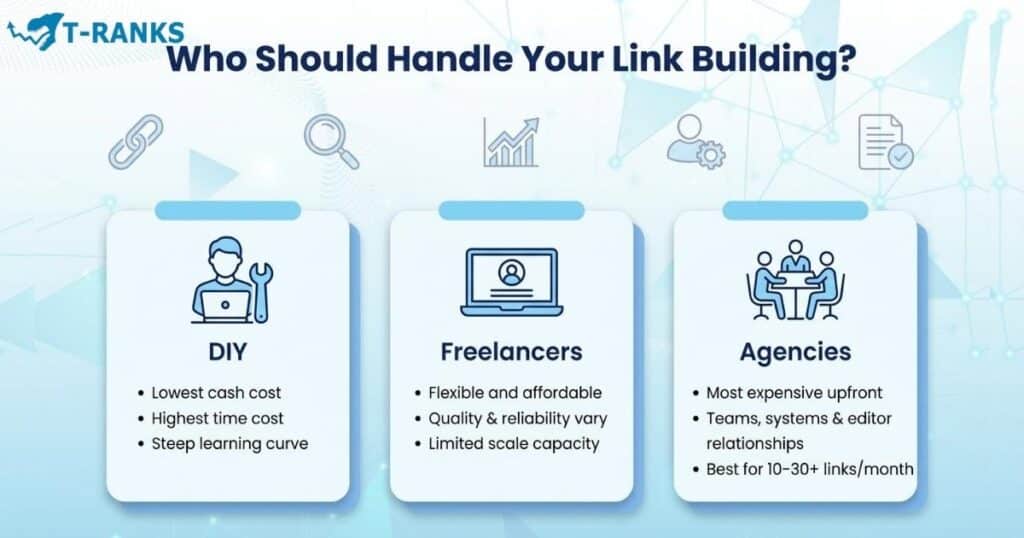
DIY link building, hiring freelancers and working with agencies are the three main ways to build backlinks, and each option has different costs, skills and scalability. DIY offers full control but requires the most time and tools. Freelancers reduce workload but have limited capacity. Agencies cost more upfront but deliver the highest scalability and consistency.
Most brands start with DIY or freelancers and move to agencies as competition increases. Operational bottlenecks in link building appear when outreach volume grows, success rates drop or when content needs exceed internal skills.
In-House Team Cost Breakdown
Building an in-house link building team is the most expensive option because you must cover salaries, tools and training. A typical team includes a content writer, an outreach specialist and an SEO strategist.
Approximate 2026 salary expectations:
- Outreach specialist: 35,000 to 55,000 dollars per year
- Content writer: 30,000 to 50,000 dollars per year
- SEO strategist or manager: 55,000 to 85,000 dollars per year
Tool costs also add up. Ahrefs, Pitchbox, BuzzStream, email warmup tools and AI writing tools can reach 400 to 1,000 dollars per month depending on usage. These tools are essential for prospecting and outreach.
Operational complexity increases as volume grows. The team must research sites, write content, send outreach emails, follow up and negotiate placements. If approval rates drop, more time is required. Studies from BuzzStream note that outreach success varies widely based on niche, content quality and pitch personalization.
In-house link building works for brands with high budgets and long timelines, but it demands ongoing coordination and strong SEO leadership.
Freelancers (Pros, Cons, Risks)
Freelancers offer a low cost and flexible option for link building, but quality and reliability vary a lot. They can handle small outreach tasks or one-off guest posts, which makes them useful for basic link acquisition.
Pros:
- More affordable than agencies
- Flexible workload
- Good for small projects or testing outreach
- Easy to hire for short-term needs
Cons:
- Quality varies between freelancers
- Limited access to strong publishers
- Slow delivery if one freelancer handles all tasks
- No established editor relationships
- Weak scalability for competitive niches
Freelancers are best for small websites, low competition niches or brands that only need a few links per month. They struggle with larger campaigns that require research, content production and consistent link velocity.
Agency Pricing Explained
Agencies appear more expensive at first, but they often deliver lower cost per link over time because they scale faster and operate more efficiently. They use teams, proven workflows and established publisher networks.
Why agencies are cost-efficient at scale:
- They use bulk tool subscriptions
- They maintain long-term relationships with editors
- They have multiple writers and outreach specialists
- They achieve higher approval rates
- They maintain link velocity better than DIY or freelancers
Industry reviews show that agencies outperform DIY and freelancers in approval rates, content quality and scalability. When campaigns need 10, 20 or 30 links per month, agencies deliver results consistently because they distribute the workload across teams.
Agencies work best for ecommerce, SaaS, national brands and competitive niches where strong authority growth is required.
Hidden Costs of Doing It Yourself
DIY link building looks cheap at first, but hidden costs make it more expensive than most businesses expect. The biggest cost is time. Outreach, writing, prospecting and negotiation require dozens of hours each month.
Hidden cost categories:
- Tool costs: Ahrefs, BuzzStream, outreach tools and AI assistants
- Time cost: founders or managers spending 15 to 25 hours monthly
- Content cost: articles for guest posts and editorial placements
- Failure rate: low approval means more outreach and more time
Simple example:
If a business spends 20 hours on outreach and earns only one link, the real cost per link becomes very high. Assigning even a 30 dollar hourly value means that single link effectively costs 600 dollars, not including tools or content.
DIY also slows growth. Without editor relationships or refined pitch angles, approval rates are low. This creates inconsistency and unpredictable link velocity.
DIY works for beginners, personal sites or brands with very low link requirements. For competitive niches, the hidden costs outweigh the savings.
Hidden Costs Behind Link Building
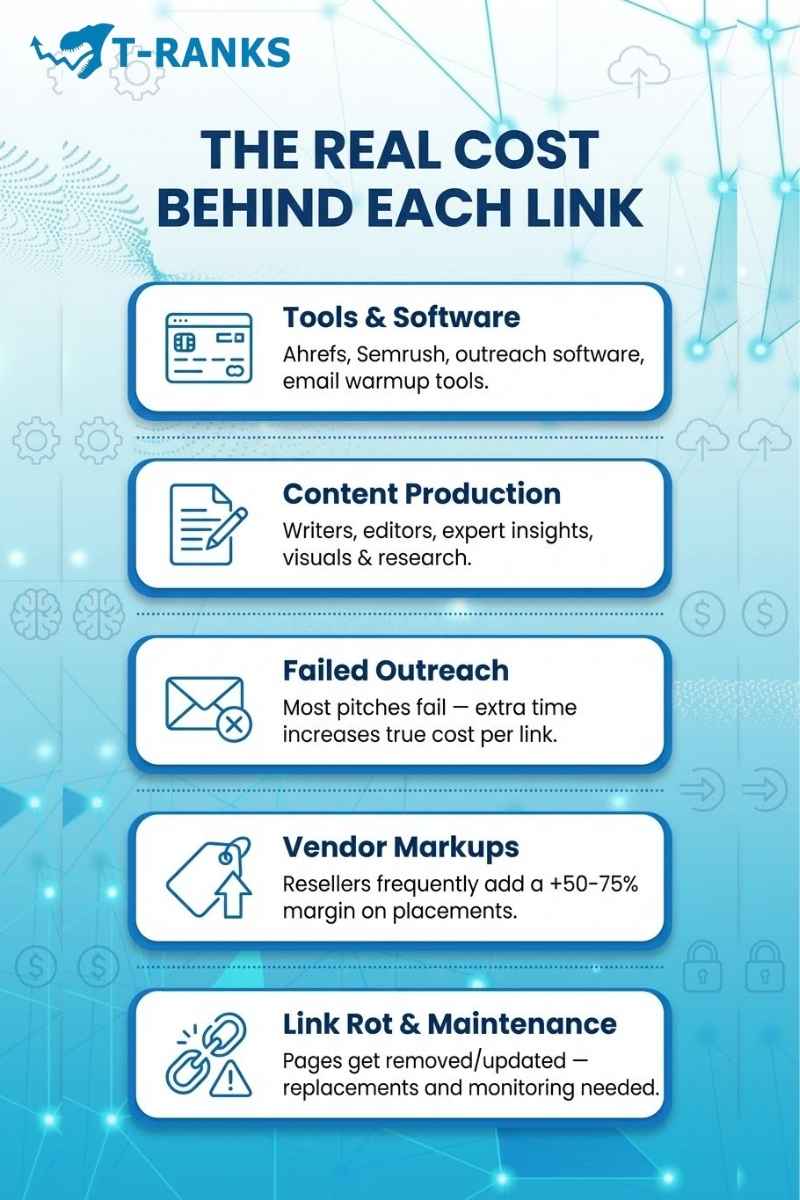
Link building has many hidden costs that influence final pricing. These costs come from software, content creation, failed outreach attempts, vendor markups and long term link maintenance. Most businesses only see the price of one link, not the layers of work, tools and risk involved. These hidden elements explain why quality link building is never cheap.
Software Stack Costs
Link building requires a full software stack, and these tools significantly increase operational costs. Essential tools include Ahrefs, Semrush, BuzzStream, Pitchbox, email warmup solutions and AI writing tools. In 2026, the combined monthly cost for these tools can range from 300 to 1,000 dollars depending on usage and team size.
These tools increase the final price of each link because agencies must recover their subscription costs. Studies from BuzzStream show that outreach efficiency, personalization and success rates depend heavily on the software stack, which is why quality providers invest in premium tools.
Editorial and Content Creation Costs
Every link requires content, and content creation is one of the biggest hidden costs. Guest posts, editorial placements and digital PR links need well written articles, custom examples and niche expertise. Many sites now require higher quality writing due to stricter editorial rules.
Content adds to link pricing because agencies must pay writers, editors and fact checkers. A single guest post may take several hours to produce, and these costs are included in the final link building fee.
Success Rate Math
Outreach success rates directly affect the cost per link. Many pitches never get a response, and some negotiations fail. If ten pitches are needed to secure one link, the time cost of the nine failed attempts becomes part of the final price.
This success rate math is one of the most important hidden costs in link building. Even skilled agencies face fluctuating acceptance rates depending on niche, topic and publisher demand.
Vendor Markups (75 Percent Insight)
Vendor markup is a common hidden cost in the link building market. Many resellers add 50 to 75 percent markup on top of the original publisher price. This markup covers their negotiation time, content cost and relationship assets.
You can detect inflated offers when a vendor guarantees fast placement, provides unclear site lists or charges the same rate for every domain. Real editorial sites have variable pricing, so identical pricing across many sites is a sign of resold inventory.
Link Rot and Permanent Placement Guarantees
Link rot is another hidden cost. It occurs when publishers remove or update content, causing backlinks to disappear over time. Even high quality sites remove old posts or change URLs, which reduces long term link value.
Some agencies offer permanent placement guarantees or free replacements to protect clients from link loss. These guarantees add to operational cost, but they reduce long term risk for the client by ensuring link retention.
Industry-Specific Link Building Pricing
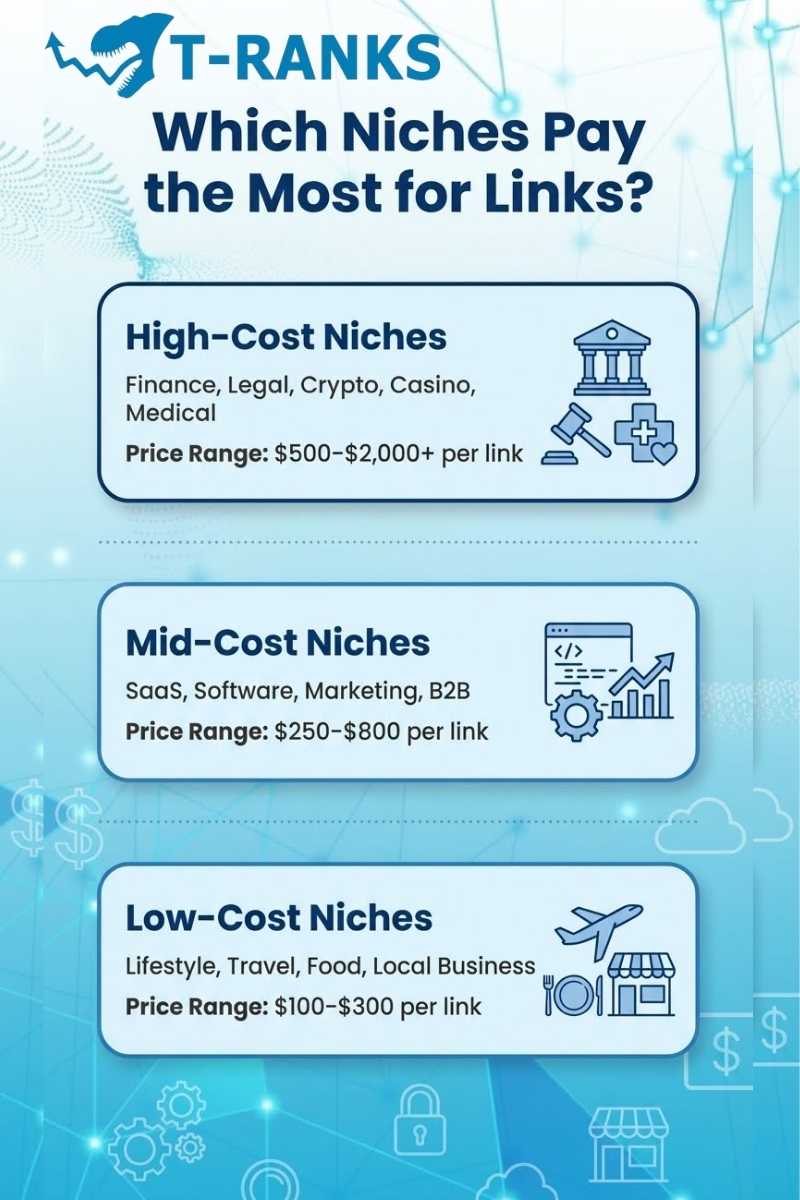
Link building pricing changes by industry because some niches are harder, riskier and more competitive. Niches with strict editorial rules or financial sensitivity often cost two to five times more than lifestyle or local niches. Publishers in these industries receive more outreach, have limited outbound link space and charge higher fees.
High-Cost Niches
Finance, legal, crypto, casino and medical sites often charge the highest prices. Rates commonly fall between 500 dollars and 2,000 dollars per link depending on authority and traffic. These industries require stronger compliance, fact-checked content and strict editorial review.
Competition is intense. Publishers receive constant outreach, so they raise prices and limit external links. A DR 60 finance blog may cost three to four times more than a DR 60 lifestyle blog because of scarcity and higher editorial standards.
Medium-Cost Niches
SaaS, software, marketing and B2B niches sit in the mid pricing range. Links usually cost between 250 dollars and 800 dollars depending on relevance, traffic and content depth.
These sites require practical examples, expert insights and clear value. Approval rates are higher than in finance or legal, but still competitive. SaaS and marketing blogs receive steady outreach volume, so prices stay moderate but not low.
Low-Cost Niches
Lifestyle, travel, food, parenting and local business niches are the most affordable. Links often cost between 100 dollars and 300 dollars because publishers are more open to guest contributions and have larger content calendars.
These niches have broader topic ranges and more available sites, so outreach success rates are higher. Lower editorial complexity reduces content cost and speeds up placement.
Why Niche Difficulty Matters
Niche difficulty matters because topical competitiveness influences pricing more than DR alone. A DR 50 crypto site is far harder to land than a DR 50 travel site, which is why prices differ so much.
Publishers raise prices when:
- The niche has strict accuracy requirements
- Outreach volume is high
- Demand exceeds supply
- Link guidelines are restrictive
For example, a DR 40 medical site with real traffic can cost more than a DR 70 lifestyle blog because the topical relevance and editorial standards are stronger.
How Long Link Building Takes to Work
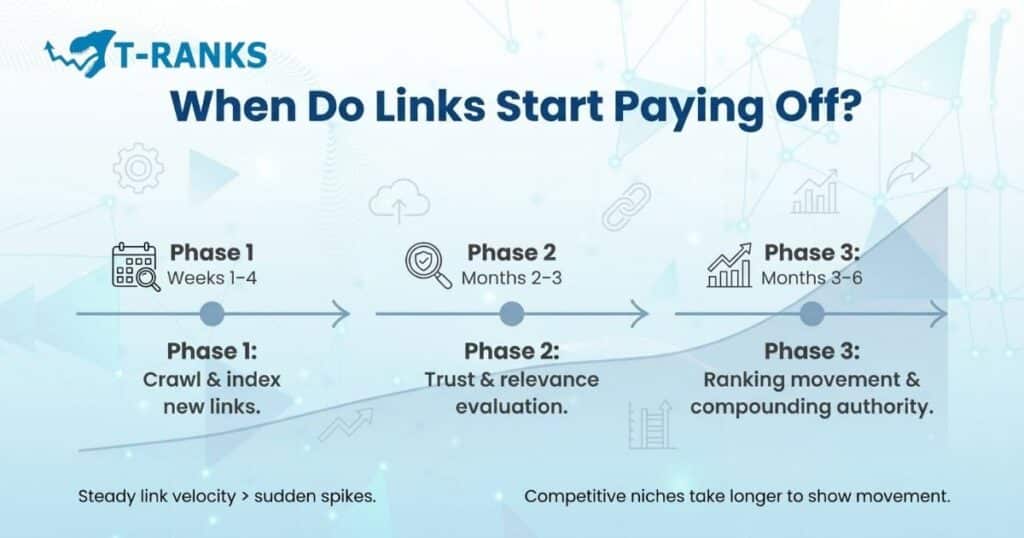
Link building usually takes three to six months to show measurable results. Search engines need time to crawl new pages, evaluate link relevance and assign trust signals. Competitive niches, slow crawling websites and weak content foundations can extend this timeline.
Links work gradually, not instantly. Their impact builds as more pages are indexed, topical authority strengthens and link velocity stabilizes.
Time to Index, Crawl and Trust
Most backlinks are crawled within a few days to a few weeks, but trust assignment takes longer. Search engines first detect the link, then evaluate its context, authority and placement quality.
The trust phase is slow. A link may appear in analytics quickly but only influence rankings after repeated crawls. Sites with stronger authority transfer benefits faster than low traffic blogs.
Link Velocity and Ranking Sensitivity
Link velocity, the pace at which links are earned, affects how quickly results appear. Sudden spikes in link volume can look unnatural, while steady month-by-month growth supports safer and clearer ranking signals.
Slow velocity causes slow results. Inconsistent link building delays authority growth and weakens the impact of each link. A stable flow of links helps search engines understand long-term credibility.
Timeline Differences Across Link Types
Different link types take different amounts of time to influence rankings.
- Niche edits may produce quicker movement because they are placed on indexed pages.
- Guest posts take longer because new pages need time to rank and accumulate trust.
- Digital PR links can show faster authority gains but depend on the publisher’s crawl rate.
- HARO and editorial links often deliver strong but gradual improvement due to high trust weighting.
Timeline differences do not change the price, but they influence expectations. A consistent link building strategy helps align both speed and cost.
How Much to Budget for 2026
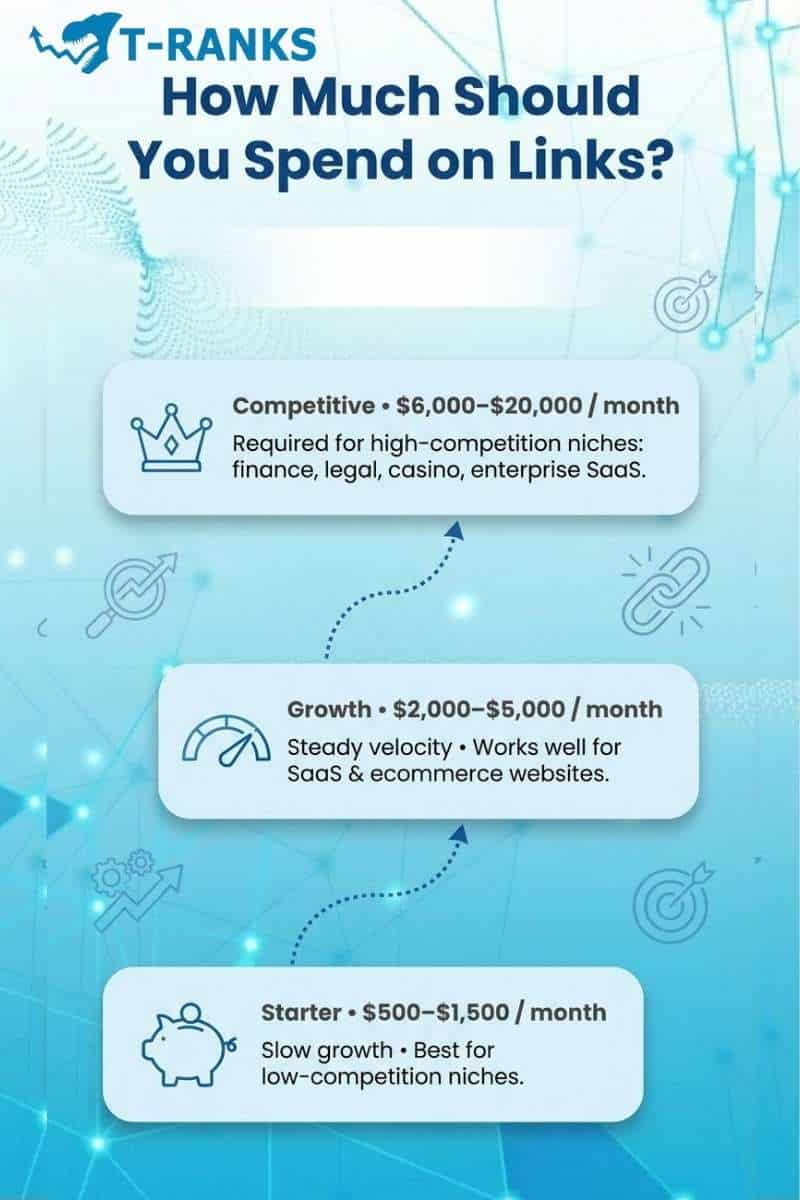
Link building budgets in 2026 depend on business maturity, niche difficulty and growth targets. Most brands fall into three spending tiers. Starter budgets, growth budgets and competitive budgets. Each tier determines how many links you can earn, how fast authority builds and how quickly rankings move.
Budgets should match both competition level and revenue goals. Underfunding link building slows progress, while overspending without strategy wastes resources.
Starter Budget
A starter budget of 500 dollars to 1,500 dollars per month supports slow but steady authority building. This tier works best for small websites, local businesses and low competition niches.
Starter budgets usually cover:
- A few niche edits or basic guest posts
- Slow link velocity
- Limited content creation
Results appear gradually because outreach volume and approval rates are low. This tier is ideal for websites that need foundational authority but do not require aggressive growth.
Growth Budget
A growth budget of 2,000 dollars to 5,000 dollars per month supports consistent link velocity and meaningful ranking movement. This tier fits ecommerce brands, SaaS companies and businesses operating in moderate competition niches.
Growth budgets allow:
- A mix of guest posts and niche edits
- Higher quality placements
- Stable month-by-month link building
- Better content creation
This range provides the momentum needed to compete for mid-level keywords. It is the most common budget for brands that want steady SEO performance.
Competitive Budget
A competitive budget of 6,000 dollars to 20,000 dollars per month is required in high competition niches such as finance, legal, casino or enterprise SaaS. These niches demand authoritative links, stronger content and strict editorial compliance.
Competitive budgets support:
- Digital PR
- Strong editorial links
- Higher outreach volume
- Greater success with difficult publishers
These industries receive heavy outreach from many brands, so link costs are higher. A competitive budget ensures both speed and stability in demanding search landscapes.
When to Scale Up
You should increase your link building budget when rankings plateau, competition grows or when your content library expands faster than your authority. Scaling also makes sense when early results confirm strong ROI from link building.
Signs it is time to scale:
- You are stuck on page two
- Competitors are building more links
- Your site launches new content clusters
- Link velocity is too slow for niche demand
Budget increases create momentum. They help maintain authority growth and ensure stable performance across multiple keyword groups.
Risks, Penalties and Link Safety in 2026
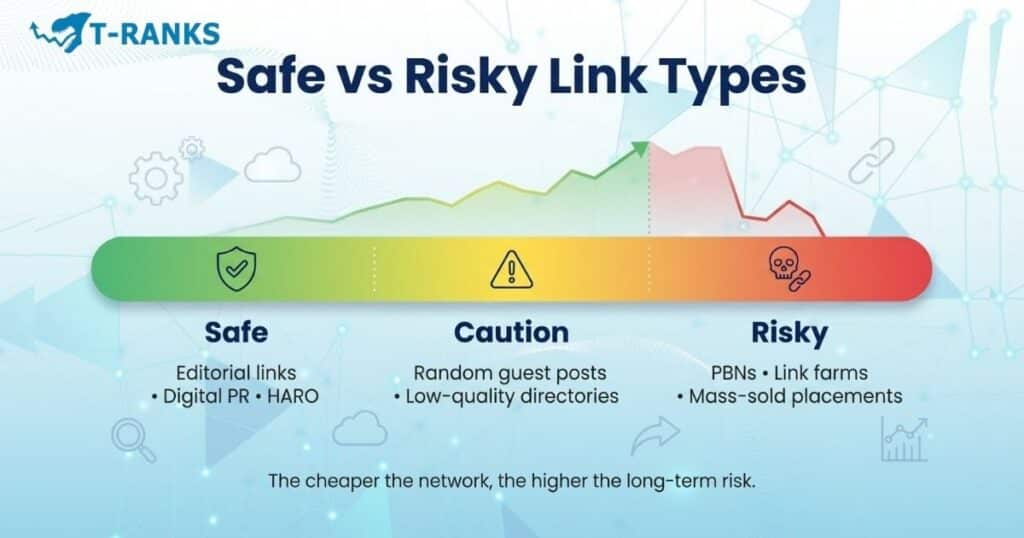
Link safety in 2026 affects pricing because high quality links carry lower risk, while cheap links often create long term penalties or cleanup costs. Search engines have stricter systems for detecting unnatural patterns, low quality networks and paid link footprints. Safe link building requires relevance, editorial standards and natural placement behavior.
Low cost links look attractive upfront, but they often cost more later. Riskier placements need disavows, replacements or full cleanup work. These hidden costs make quality links more expensive but safer over time.
Google’s 2026 Paid Link Policy
Google continues to enforce strict rules on paid links that manipulate rankings. The focus is now on pattern detection, link networks, and unnatural anchor text behavior rather than individual links alone.
Safe practices include:
- Relevant placements
- Natural anchor text
- Real traffic sites
- Clear editorial context
Unsafe practices include:
- Large DA lists
- Mass sold placements
- Repeated anchors
- Network based offers
Quality vendors follow safe guidelines, which increases labor cost and therefore link price.
Link Farms, PBNs and Vendor Networks
Link farms, outdated PBNs and vendor networks offer low prices but high long term risk. These sites have thin content, weak authority and predictable footprints. They often accept any contribution, which creates patterns that search engines can detect.
Warning signs include:
- Identical site structures
- Irrelevant articles
- Over-optimized anchors
- High outbound link volume
These risks explain why cheap links cost less upfront but more in long term ranking damage.
Disavow Protection and Safety Guarantees
Some providers offer replacement guarantees or disavow assistance for risky links. These services increase pricing because they protect you against future link rot, algorithm shifts or publisher removal.
A safety guarantee adds value when:
- The niche is competitive
- Links come from newer sites
- Editorial conditions may change
- Long-term ranking stability is needed
Guarantees reduce long term cleanup cost and protect ROI.
Why Cheap Links Cost More Long Term
Cheap links often cost more over time because they trigger penalties, require removal or fail to move rankings. A ten-link cheap package may deliver no results, while a few strong links may deliver lasting authority.
Hidden long term costs include:
- Disavow work
- Ranking drops
- Lost revenue
- Overlapping footprints
- Wasted content and outreach time
This is why pricing is tied closely to safety. Strong editorial links cost more because they protect your site and deliver long term value.
ROI, CPA and the True Value of Link Building
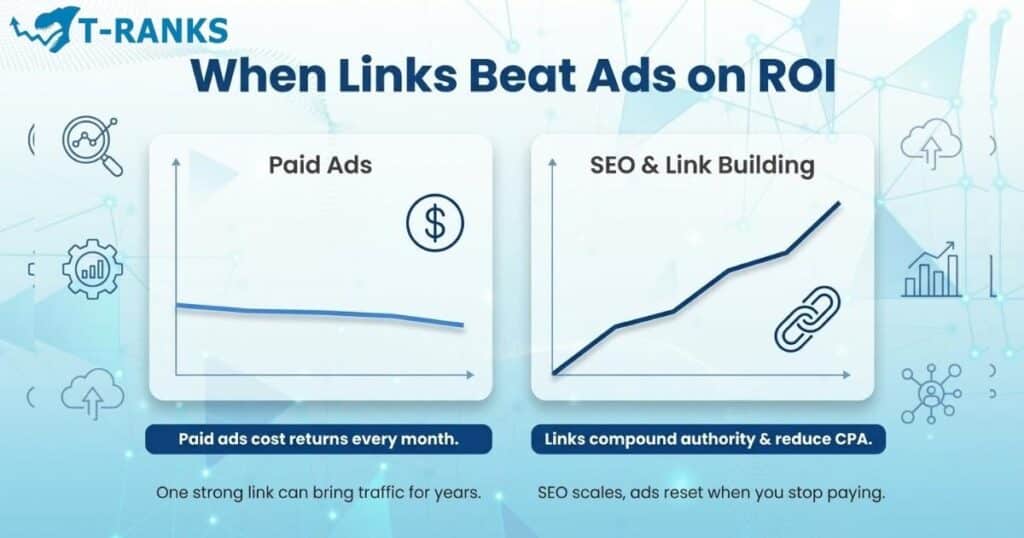
Link building ROI depends on ranking gains, revenue impact and long term authority growth. The cost per link alone is not a full measure of value. Strong links improve organic traffic, reduce ad spend and increase visibility across entire keyword clusters.
Good links last for years. Their compounding effect often makes them cheaper than paid ads when measured over time.
CPA vs CPL
CPL is the cost per link. CPA is the cost per acquisition influenced by that link. Strong links lower CPA by improving organic traffic and conversion opportunities.
A simple example:
- If a 600 dollar link moves a page into the top three positions
- And that ranking generates thousands of visits over months
- The cost per acquisition becomes lower than paid ads
This is why evaluating link value requires looking beyond CPL alone.
When Links Outperform Content
Links often outperform content when the competition is strong or when content alone cannot break into top results. Content needs authority to rank. Links provide that authority signal.
Links deliver faster ROI when:
- A page is stuck on page two
- Competitors have stronger backlink profiles
- The niche requires topical authority
- A website needs faster visibility for revenue pages
In these cases, link building unlocks returns that content alone cannot achieve.
Compounding Effects of Authority
Authority compounds over time when links are earned consistently. Each link strengthens the credibility of future content and reduces the ranking effort needed for new pages.
Compounding occurs because:
- Existing authority boosts new pages
- Internal links distribute gained trust
- Stronger domain signals reduce future SEO cost
This compounding effect explains why many brands maintain ongoing link budgets even after reaching their initial goals.
Final Pricing Summary and Decision Framework
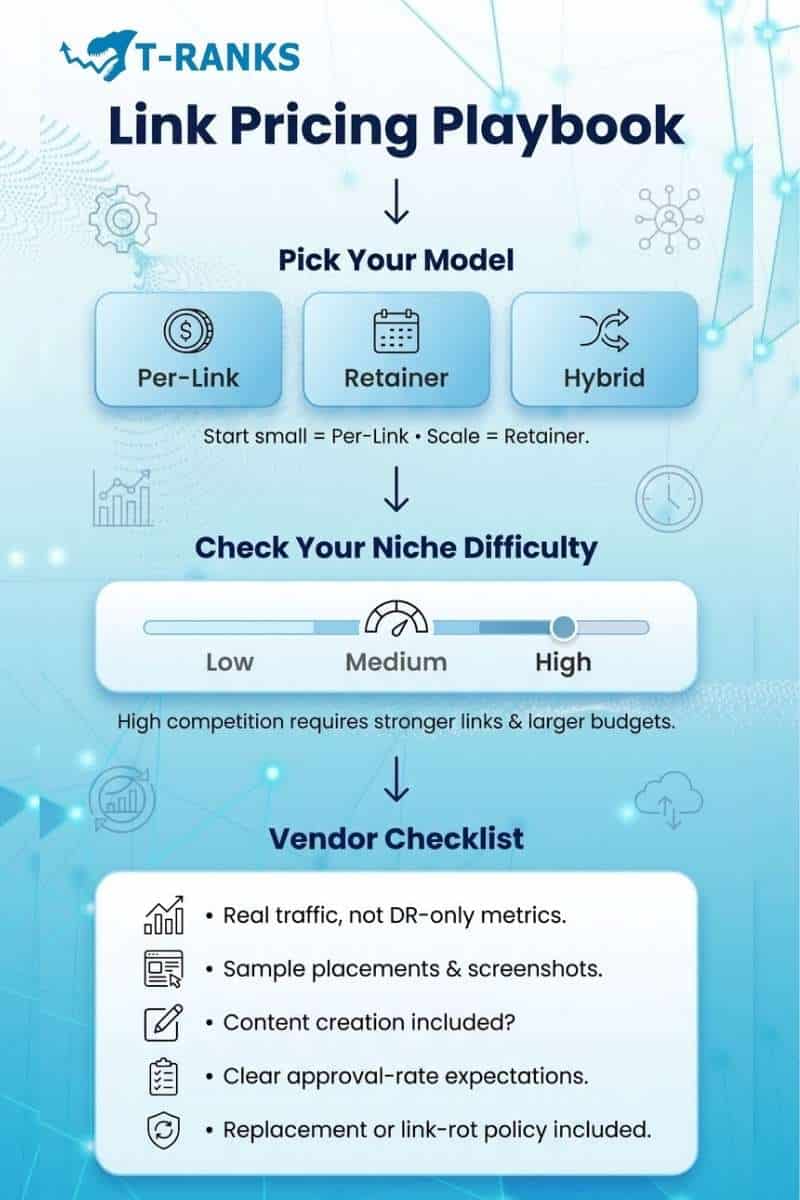
Link building pricing in 2026 follows clear patterns. Most quality links cost between 150 dollars and 1,500 dollars depending on niche, authority, link type and editorial difficulty. Digital PR and high-authority editorial links often exceed 2,000 dollars. Monthly budgets vary based on competition, with most brands falling into starter, growth or competitive tiers.
Choosing the right pricing model depends on goals, niche and resources. The best option balances cost, speed and long-term safety.
Summary of Cost Tiers
- Low tier (100 to 300 dollars)
Niche edits, basic guest posts, low competition niches. - Mid tier (300 to 800 dollars)
Strong guest posts, SaaS placements, moderate competition niches. - High tier (800 to 2,000 dollars+)
Editorial links, digital PR, finance, legal, crypto and medical niches. - Campaign budgets
Most sustainable campaigns fall between 2,000 and 10,000 dollars monthly depending on link velocity and niche difficulty.
How to Choose the Right Pricing Model
Use this simple decision framework to match your needs:
Choose Per-Link Pricing if:
- You need a small number of links
- You want full cost control
- You are testing a vendor
- Your niche is low to medium competition
Choose Monthly Retainers if:
- You need consistent link velocity
- You compete in SaaS, ecommerce, national or global niches
- You want scalable outreach and higher approval rates
- You prefer predictable monthly spending
Choose Hybrid Packages if:
- You want fixed link numbers plus ongoing outreach
- You plan content clusters that require steady authority growth
- You need flexibility for different link types
Quick Vendor Comparison Checklist
Use this checklist before choosing any provider:
- Do they show real traffic, not just DR?
- Do they personalize outreach, or use networks?
- Do they provide sample placements and editor relationships?
- Do they include content creation?
- Do they explain approval rates clearly?
- Do they offer replacement guarantees for link rot?
- Do they provide transparent reporting?
- Do their prices match niche difficulty?
A trustworthy vendor explains link sources, content workflow and expected timelines without avoiding questions.
Conclusion
Link building pricing in 2026 follows clear patterns shaped by niche difficulty, link type, editorial requirements and long term safety. High quality links cost more because they deliver stronger authority and lower risk. Cheap links appear attractive but often create hidden costs, low impact or future cleanup work.
Choosing the right budget depends on your industry, competition and growth goals. A steady, strategic approach with consistent link velocity produces the best long term results. When combined with strong content and relevance, link building becomes one of the most reliable ways to improve rankings, reduce acquisition costs and build lasting authority.
FAQs for Link Building Pricing
What is the average cost of link building in 2026?
The average cost of link building in 2026 ranges from 150 to 450 dollars for mid-tier links and 600 to 1,500 dollars or more for high-authority editorial links. Prices change based on authority, relevance, traffic quality and editorial review difficulty.
Why is link building so expensive in 2026?
Link building is expensive because outreach requires manual labor, publishers now charge higher fees, and AI-saturated markets reduced the number of high-quality sites. Scarcity, strict review processes and stronger editorial controls increase overall cost.
How much should a small business spend on link building?
Most small businesses should budget 500 to 2,500 dollars per month for link building. Lower budgets work for local or low-competition niches. Higher budgets are needed when competing nationally or in industries with stronger competitors.
Is buying backlinks safe in 2026?
Buying backlinks is safe only when links are editorial, relevant and placed naturally. Networks, link farms and unnatural anchors carry high penalty risks and should be avoided.
How long does link building take to show results?
Link building usually takes three to six months to show measurable ranking changes. Search engines need time to crawl the page, evaluate link context and assign trust.
What factors impact the price of a backlink the most?
Authority, relevance, traffic quality and editorial standards impact backlink pricing the most. Complex outreach requirements or low approval rates also increase costs.
Are cheap backlinks worth it?
Cheap backlinks are rarely worth it because they carry high risk and low ROI. They often trigger cleanup work, link rot or ranking drops over time.
What link types offer the best ROI in 2026?
Editorial backlinks, digital PR and niche-relevant contextual links offer the best ROI in 2026. They deliver stronger trust signals, safer placements and longer-lasting authority.
How do AI search engines evaluate links in 2026?
AI search engines evaluate links using brand mentions, entity consistency and trusted source citations. LLMs weigh contextual relevance and domain authority patterns more than raw DR scores.
Does link building still work after Google’s 2024–2026 updates?
Yes, link building still works because external authority and relevance signals remain core ranking factors. The focus is now on quality, not volume.
Are monthly link building packages worth the cost?
Monthly link building packages are worth it when they include strategy, research and personalized outreach. They also help maintain steady link velocity.
Why do high-authority sites charge publishing fees?
High-authority sites charge publishing fees because of editorial labor, strict review processes and limited outbound link space. These constraints increase placement value.
Can links disappear over time?
Yes, links can disappear due to redesigns, content updates or publisher edits. Permanent placement guarantees help protect against link rot.
How do I know if a link vendor is legitimate?
A legitimate vendor shows real-traffic sites, transparent sources and editorial screenshots. Avoid sellers who rely on DR-only metrics or bulk placement lists.
What is a good cost-per-link benchmark in competitive niches?
A good cost-per-link benchmark in competitive niches like SaaS, crypto or legal is 400 to 1,200 dollars or more. Harder outreach increases final cost.
Should startups invest in link building early?
Startups should invest in link building only after building strong content and achieving product–market fit. Early funds are better used on content and user validation.
How do link building agencies calculate pricing?
Agencies calculate pricing based on labor, tools, editorial difficulty, niche competition and success rates. Hidden costs include prospecting time, negotiation and content creation.
Can AI tools reduce link building costs?
AI tools reduce research and prospecting costs but cannot replace editorial review or publisher relationships. The most effective workflows combine AI speed with human judgment.