Most clients are not asking for more backlinks.
They are asking one simple question. Is this working?
When link building reports are unclear, that question becomes hard to answer. Long lists of links, complex metrics, and spreadsheets do not explain progress. They often create confusion instead of confidence.
Link building reporting is how you explain what backlinks are actually doing for a website. It shows how links support authority, visibility, traffic, and business results in a clear and simple way. Instead of showing activity, it explains outcomes.
Good reporting helps clients understand what changed, why it changed, and what to expect next. It also builds trust by setting realistic expectations and explaining progress over time, even during slow periods.
In this guide, you will learn how to do link building reporting the right way. We will cover the key metrics that matter, dashboards that are easy to understand, simple reporting frameworks, and templates that help explain link building results clearly.
What Is Link Building Reporting
Link building reporting means presenting the links and backlinks built for a client in a clear, simple, and easy-to-understand way.
It provides a complete overview of the link building work, showing what was done and how the campaign is progressing.
A link building report typically includes key details such as the number of links built, link type, completion date, link quality, and indexation status. All important link-related information is summarized in one place so clients can quickly understand the work without needing SEO knowledge.
This makes link building reporting one of the most important tasks in the entire process.
It is the stage where all efforts are documented and presented, so reports must be clean, well-structured, and self-explanatory. A good report should clearly communicate progress and value without requiring additional explanation.
Reporting Links vs Reporting Link Impact
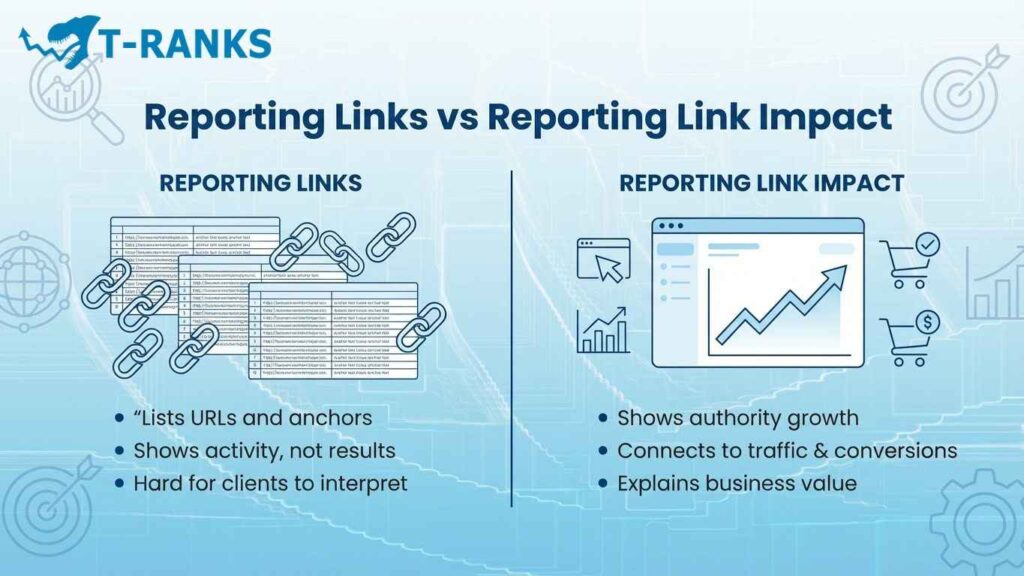
Reporting links shows activity. Reporting link impact shows value.
Reporting links usually includes details such as where links were placed, anchor text, and basic authority metrics. This confirms execution, but it does not explain outcomes.
Reporting link impact connects backlinks to referring domain growth, referral traffic, visibility improvements, and assisted conversions. This approach shows how link building supports broader performance instead of standing alone as a technical task.
What Clients Actually Expect From Link Building Reports
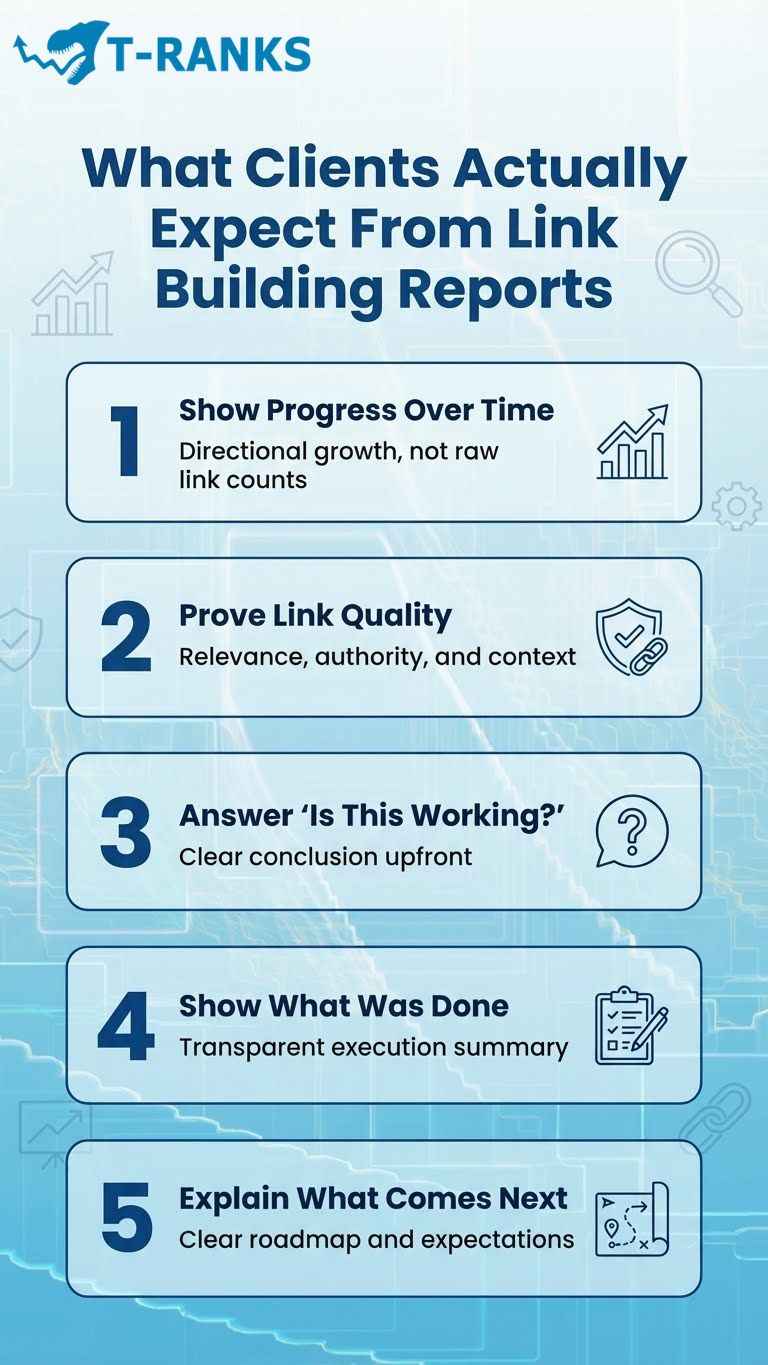
Clients expect link building reports to clearly explain progress, quality, and direction.
They are not looking for activity logs or raw backlink lists. They want a report that explains what is happening, why it matters, and what comes next.
Clear Evidence of Progress Over Time
Clients expect reports to show whether link building is moving in the right direction.
This includes steady growth in referring domains, link gains versus losses, and visible trends rather than isolated monthly numbers.
Progress should feel directional and consistent, helping clients understand that link building compounds over time.
Proof of Link Quality and Relevance
Clients expect reassurance that earned links are credible and relevant.
Reports should explain where links come from, how closely they align with the client’s industry, and whether they contribute to long-term authority rather than short-term risk.
Quality signals help clients trust that link building is strengthening their site, not exposing it to penalties.
A Direct Answer to “Is This Working?”
Clients expect clarity without digging through data.
A strong report clearly states whether link building performance is improving, stable, or facing challenges, supported by a small number of meaningful indicators.
When reports answer this question upfront, supporting metrics become confirmation instead of confusion.
Transparency Around What Was Done
Clients expect visibility into the work behind the results.
Reports should clearly outline what actions were taken during the reporting period, including outreach activity, links secured, links lost, and any adjustments made.
This transparency reassures clients that effort aligns with strategy, even when results take time.
Clear Direction and Next Steps
Clients expect reporting to look forward, not only backward.
Effective reports outline upcoming priorities, expected timelines, and what progress should look like in the next period.
When clients see a clear direction, reporting becomes a planning tool instead of a status update.
Essential KPIs for Effective Link Building Reporting
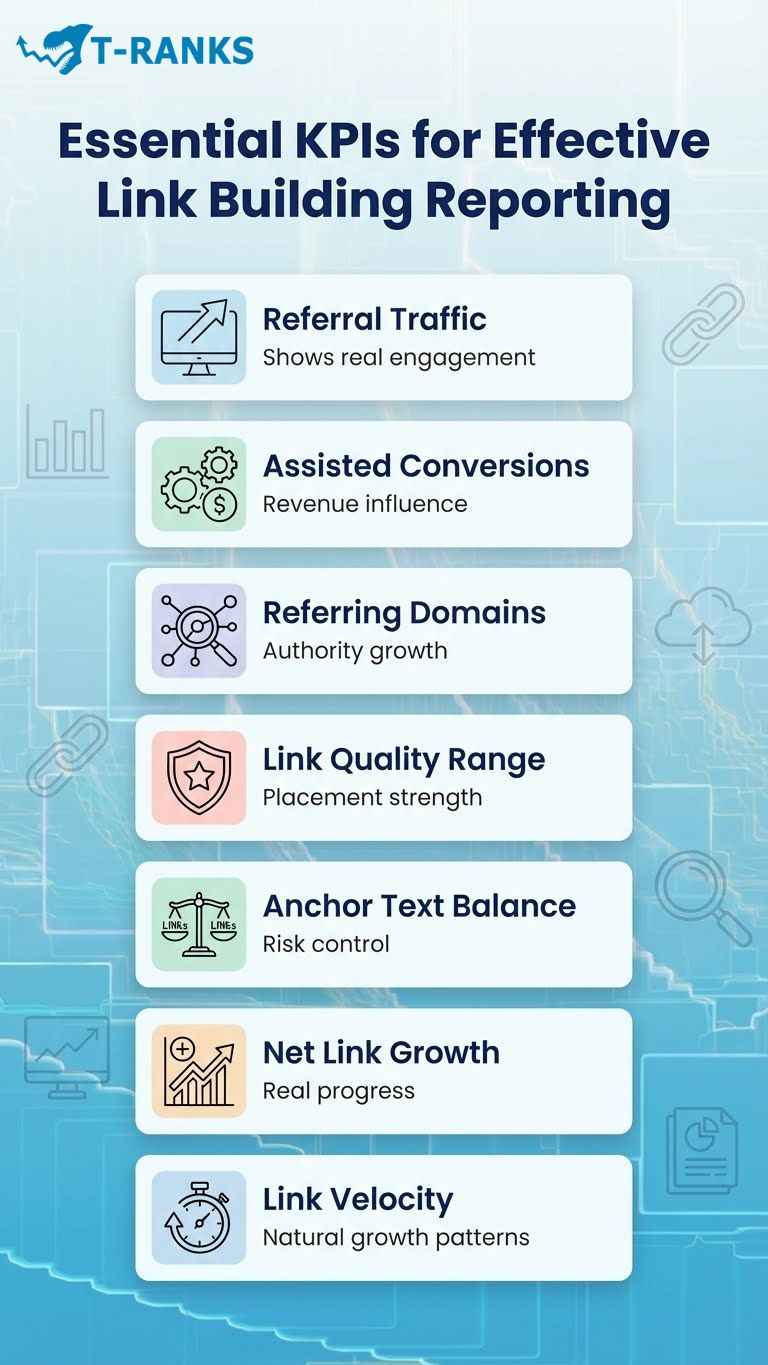
Not all metrics matter equally in link building reporting.
Clients expect reports to focus on a small set of KPIs that clearly explain progress, quality, and business impact without creating confusion.
The purpose of these KPIs is not to show everything that can be measured.
They exist to answer a few critical questions clients use to judge performance, direction, and value.
Referral Traffic from Backlinks
Clients expect reports to show whether backlinks attract real users.
Referral traffic indicates which links generate actual engagement, not just authority signals.
Even modest but consistent referral traffic shows relevance, placement quality, and audience alignment. When tracked over time, referral trends help clients understand how link value compounds rather than appearing instantly.
Conversions and Assisted Revenue
Clients expect clarity on how link building supports growth.
Conversions and assisted revenue show how backlinks contribute to leads or sales, even when they are not the final click.
Because link building often influences users early in their journey, assisted conversions help prevent underestimating its business impact. This KPI connects links to revenue outcomes instead of traffic alone.
Referring Domains Growth
Clients expect to see whether authority is expanding steadily.
Referring domains growth tracks how many unique websites link to the site over time, which is more meaningful than total backlink count.
Consistent growth in referring domains shows that the brand is earning recognition from a wider range of credible sources. This KPI communicates long-term stability and trust development clearly.
Authority Range of Linking Sites
Clients expect reassurance that links are high quality and balanced.
Authority range shows whether backlinks come from stronger, mid-level, or smaller but relevant websites.
Viewing links by authority range provides clearer insight than relying on a single score. A healthy mix signals sustainable growth rather than shortcuts or low-quality volume.
Anchor Text Balance
Clients expect link growth to be safe and natural.
Anchor text balance monitors how links are distributed across branded, generic, and contextual phrases.
Balanced anchor usage supports topical relevance and reduces risk. Reporting this KPI demonstrates that link building follows best practices and actively manages long-term stability.
Net Link Growth
Clients expect a realistic view of progress.
Net link growth compares new links earned against links lost during the same period.
Because links naturally disappear over time, reporting only new links creates a misleading picture. Net growth reflects actual improvement and builds trust through honest reporting.
Link Velocity
Clients expect link growth to appear natural and controlled.
Link velocity measures the pace at which backlinks are acquired over time.
Steady growth signals sustainable authority building, while sudden spikes or drops require explanation. This KPI helps set expectations and prevents misinterpretation during campaign scaling.
AI Visibility and Citation KPIs (Modern Reporting Layer)
AI visibility KPIs show how link building contributes to brand exposure and authority inside AI-generated answers.
These metrics are included in link building reports to explain visibility and influence that do not appear in traffic or ranking data.
In reports, AI visibility KPIs are presented as clear trend indicators rather than isolated performance claims.
AI Overview Citations
This metric shows how often client content is cited inside Google AI Overviews during the reporting period, along with changes compared to previous months.
An upward trend indicates that link building is strengthening trust and authority, even when traffic remains stable.
General AI Citations
This metric tracks brand mentions across AI tools such as ChatGPT, Perplexity, and Claude over time.
Consistent growth suggests that authority signals are spreading beyond Google into the wider AI search ecosystem.
Citation Percentage Growth
This metric summarizes how AI citations increase or decrease compared to the previous reporting period.
Steady growth reflects rising recognition and momentum, especially during periods when rankings or traffic move slowly.
Topical Authority Backlinks
This metric highlights backlinks pointing to core content assets such as FAQs, explainers, and research pages.
Growth in this area shows that link building is strengthening topic-level authority that AI systems prefer to reference.
Impression Equity
This metric reflects brand visibility gained through AI-generated answers and zero-click experiences.
Even without visits, consistent exposure builds awareness, trust, and recall, which supports long-term brand influence.
KPIs That Confuse Clients and Should Be De-Emphasized
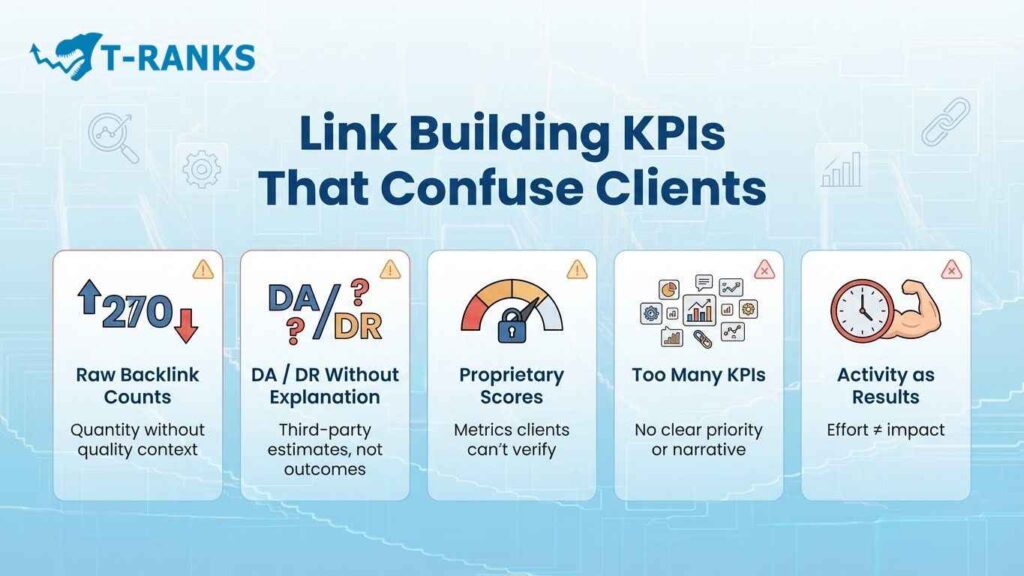
Some link building KPIs look impressive on paper but do not explain real progress.
In clear and effective link building reporting, these metrics should be de-emphasized because they distract clients from outcomes and often create confusion instead of clarity.
Good reporting focuses on transparency and business impact. This means avoiding metrics that sound important but do not clearly connect to rankings, traffic, or revenue.
Raw Backlink Counts Without Quality Context
Reporting total backlink numbers alone is misleading. A high link count does not explain link quality, relevance, or long-term value.
A statement like “100 new links built” provides little insight without explaining where those links came from or whether they strengthen authority. In many cases, a single high-quality editorial link is more valuable than dozens of low-quality ones.
Clients understand quality and diversity better than volume. Reports should focus on referring domains, relevance, and authority ranges instead of raw totals.
DA and DR Shown Without Clear Explanation
Authority scores often confuse clients when presented as performance goals.DA and DR are third-party estimates, not direct indicators of SEO success.
When shown without explanation, clients may overreact to small changes or assume progress has stalled. A rising score does not guarantee traffic growth, and a stable score does not mean link building failed.
These metrics are useful only when they support context, such as explaining link quality trends over time.
Proprietary or Abstract Metrics With No Clear Meaning
Custom or undefined scores reduce trust.
Metrics like “link juice,” “power score,” or unexplained visibility numbers are difficult for clients to understand or defend internally.
If clients cannot explain a metric to their team or leadership, it does not belong in a report.
Clear reporting relies on transparent metrics that clients can verify and understand without technical translation.
Too Many KPIs Presented at the Same Level
When everything looks important, nothing feels clear.Reporting too many KPIs at once overwhelms clients and leads to confusion.
Without prioritization, clients are forced to guess what matters most. This often results in misplaced concern over secondary metrics. Effective reporting highlights a small set of core KPIs and clearly separates primary signals from supporting details.
Activity Metrics Shown as Results
Effort is not the same as impact. Metrics such as emails sent, outreach volume, or links built do not represent success on their own.
When activity is presented as a result, clients may question why visible effort is not producing visible outcomes. Activity metrics should explain how results were achieved, not act as proof of performance.
Reports should always lead with outcomes and use activity only as supporting context.
Noise Instead of Insight
Data without explanation weakens trust.
Clients do not want to analyze numbers. They want clear answers.
Dashboards filled with metrics but no interpretation shift responsibility to the client. Every metric included in a report should answer three simple questions. What changed. Why it changed. What it means.
Insight builds confidence. Noise creates doubt.
Link Building Reporting Frameworks Clients Actually Understand
Effective link building reporting turns backlink data into a clear business narrative.
Instead of presenting disconnected metrics, strong reports explain what changed, why it changed, and what should happen next.
Clients do not want to interpret SEO data. They want to understand progress, direction, and confidence that the strategy is working. A clear reporting framework makes that possible without technical complexity.
Turning Link Data Into Business Narratives
Clients do not want raw numbers. They want meaning.
Narrative reporting transforms link data into insight.
A strong report does not list links or metrics in isolation. It connects link acquisition to authority growth, visibility, and long-term performance. Each reporting period builds on the previous one, showing momentum instead of snapshots.
Effective narrative reporting consistently answers three questions, in order:
- What happened
- Why it matters
- What happens next
This structure allows clients to understand progress quickly and removes uncertainty, even when results are still compounding.
The Three-Layer Reporting Model
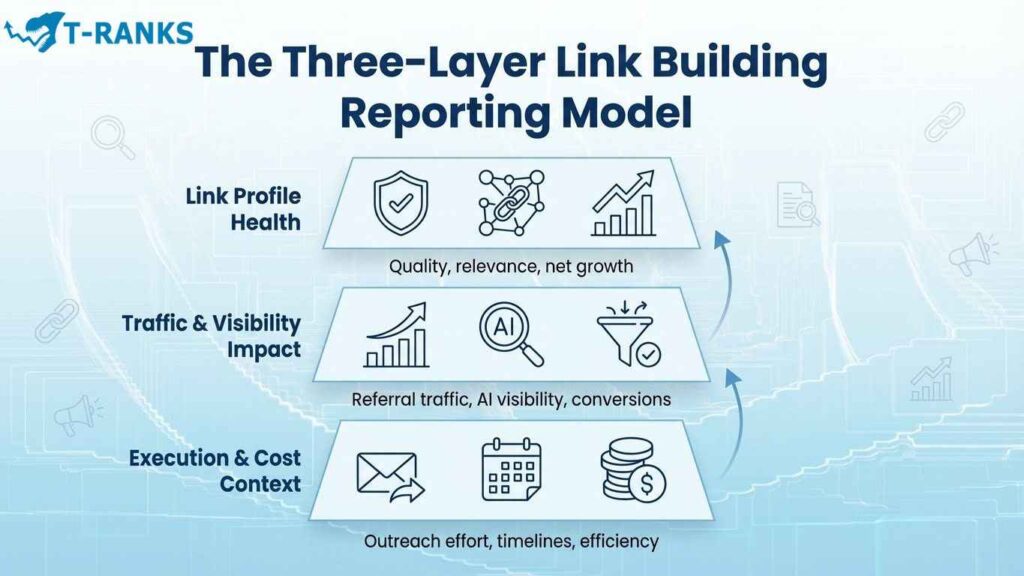
A layered framework aligns reporting with how clients evaluate success.
Each layer serves a specific purpose and audience, reducing confusion while increasing trust.
Layer 1: Link Acquisition and Profile Health
This layer explains what links were earned and how the backlink profile is evolving.
It focuses on quality, relevance, and net growth rather than volume.
Clients see where links came from, how diverse the sources are, and whether authority is expanding safely. This layer establishes accountability and proves that link building is being executed responsibly.
Key elements include net referring domain growth, authority distribution, topical relevance, and anchor text balance. Together, these signals show whether the link profile is strengthening or introducing risk.
Layer 2: Traffic, Visibility, and Outcomes
This layer shows what the links influenced.
It connects backlinks to performance.
Here, reporting ties link acquisition to referral traffic, visibility improvements, assisted conversions, and early authority signals such as AI citations. Clients can see how links support discovery and engagement before rankings fully mature.
This layer shifts the conversation from “links built” to “impact created,” helping clients understand progress even during gradual growth phases.
Layer 3: Execution, Effort, and Cost Context
This layer explains how results were achieved and what it required.
It provides transparency without confusing effort with outcomes.
Clients gain visibility into outreach effort, timelines, and cost efficiency. Importantly, this information appears after results, reinforcing that activity supports performance rather than replacing it.
By explaining timelines and compounding effects, this layer prevents unrealistic expectations and strengthens confidence in long-term strategy.
Setting Realistic Benchmarks and Goals
Benchmarks give clients a reference point for evaluating progress.
Goals define how success develops over time.
Strong reporting frames goals around steady improvement, not instant jumps. Authority growth, traffic gains, and conversions are positioned as compounding outcomes rather than short-term wins.
Clear benchmarks prevent overreaction to month-to-month fluctuations and help clients assess performance logically. When goals are realistic and trend-based, reporting becomes a strategic planning tool instead of a pass-or-fail scorecard.
Designing Client-Friendly Link Building Dashboards
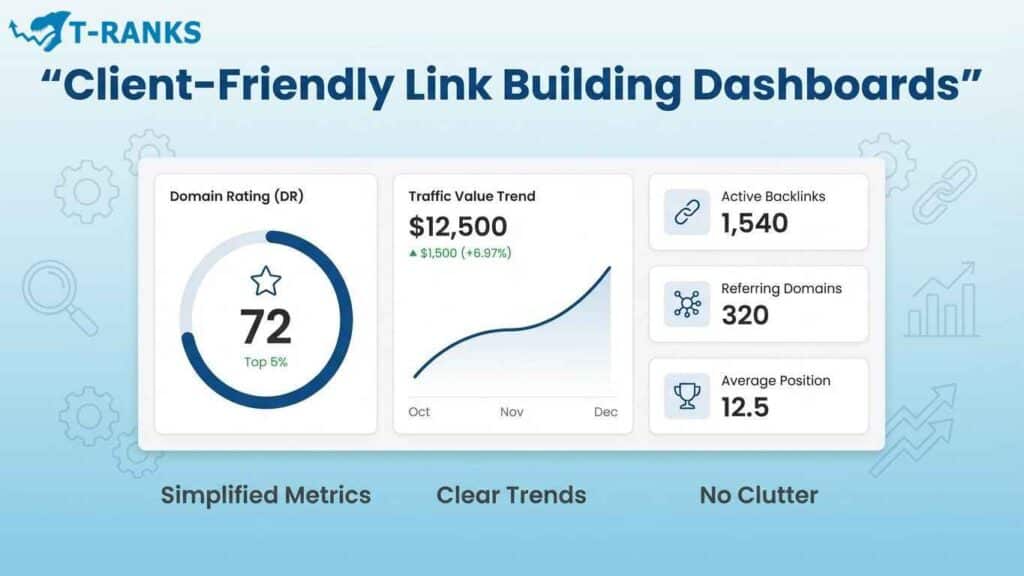
Client-friendly link building dashboards exist to communicate progress clearly and quickly.
They are not built to showcase every available metric. They are built to answer one question: is link building moving in the right direction?
A well-designed dashboard supports the written report, reinforces key insights, and reduces the need for explanation during client conversations.
1. Dashboards as Communication Tools, Not Data Dumps
Dashboards should function as a communication layer, not a storage layer.
Every metric included must serve a purpose. If a metric does not help a client understand progress, quality, or impact, it does not belong on a client-facing dashboard. Technical diagnostics and granular data should remain in internal views.
When dashboards are designed to communicate rather than impress, they build confidence and trust instead of confusion.
2. Structuring Dashboards with a Clear Visual Hierarchy
Dashboards should answer the most important questions first.
Effective dashboards follow a top-to-bottom hierarchy:
- Top section: Immediate performance overview
A small set of high-level KPIs that communicate direction within seconds. - Middle section: Trend and relationship context
Visuals that show how link building activity connects to authority growth, traffic, or visibility over time. - Lower section: Supporting detail and validation
Optional tables or examples for clients who want proof without cluttering the main view.
This hierarchy matches how stakeholders scan information and prevents cognitive overload.
3. Keeping Three to Five Core Metrics Visible
Limiting visible metrics improves understanding and focus.
The most effective dashboards highlight only three to five core KPIs. These metrics summarize link building performance and provide a balanced view of growth, quality, and outcomes.
Displaying too many metrics at the same level forces clients to interpret priorities on their own. Supporting metrics should exist in expandable sections or secondary reports.
4. Showing Trends Over Time Instead of Snapshots
Single-period snapshots often lead to incorrect conclusions.
Link building results compound gradually. Dashboards should emphasize multi-month trends rather than isolated monthly data. Trend views help clients see momentum and direction while reducing emotional reactions to short-term fluctuations.
Longer time ranges also make it easier to explain why link building requires patience.
5. Using Visuals That Explain Performance Instantly
Dashboards should rely on visuals that communicate meaning without explanation.
Simple line charts, bar comparisons, and composition visuals make performance easier to understand at a glance. Complex tables, excessive colors, or dense layouts reduce clarity and slow comprehension.
Each visual should support one clear takeaway. If a chart requires explanation, it should be simplified.
How Dashboards Change for Different Stakeholders
Not every stakeholder needs the same dashboard or the same level of detail.
Effective link building reporting adapts dashboards based on who is viewing the data and what decisions they are responsible for making.
When the same information is shown to every audience, reporting loses value. Executives become overwhelmed, marketing teams lack clarity, and SEO teams lose focus. Dashboards work best when they are designed around stakeholder intent rather than data volume.
What Executives Expect From Dashboards
Executives want fast clarity.
They expect dashboards to answer one core question: whether link building is contributing to business value.
At this level, dashboards should communicate direction, risk, and return without technical detail. Executives are not evaluating tactics. They are assessing confidence, progress, and whether continued investment makes sense.
What Marketing Teams Expect From Dashboards
Marketing teams want insight they can act on.
They expect dashboards to explain what is working, what is not, and where to focus next.
These dashboards support planning and optimization. They help marketing teams align link building with content, PR, and broader growth initiatives without needing deep technical analysis.
What SEO Teams Expect From Dashboards
SEO teams need operational clarity.
They expect dashboards to support execution, monitoring, and risk management.
These dashboards are designed for frequent use and internal decision making. Their purpose is not presentation, but control and optimization of link building performance.
Choosing the Right Reporting Cadence
Different stakeholders also expect different reporting timelines.
Real-time dashboards support fast response and internal monitoring, while periodic reports support evaluation and planning.
For most stakeholders, monthly reporting provides the right balance. It smooths short-term fluctuations and helps link building performance be judged based on trends rather than daily movement.
Agency vs In-House Link Building Reporting
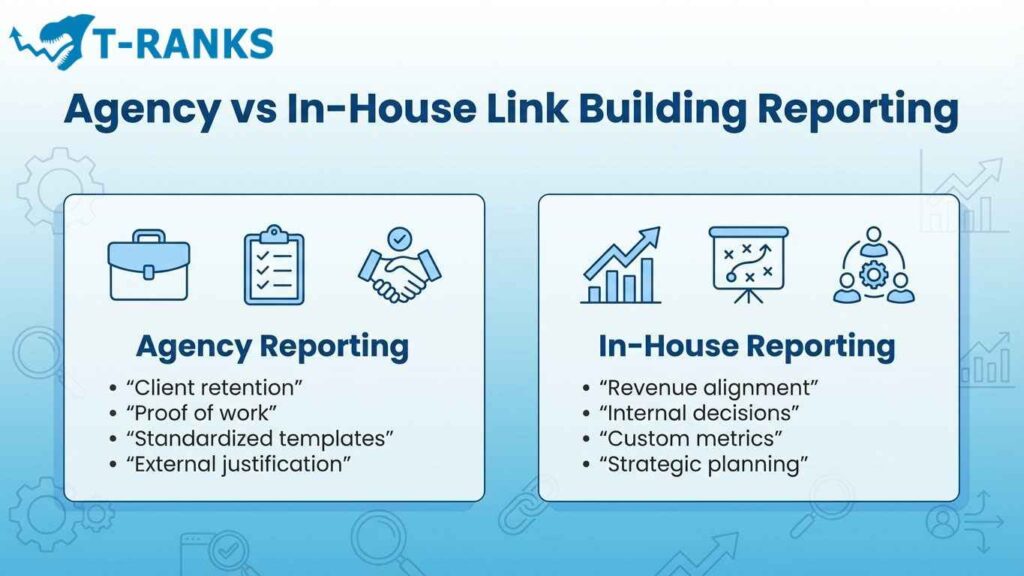
Link building reporting looks different in agency and in-house environments because the intent behind reporting is not the same.
The same backlink data can communicate value or create confusion depending on who the report is meant for and what decisions it needs to support.
Reporting Intent in Agency Environments
Agency reporting is designed to justify external investment.
Clients expect reports to explain progress clearly, show visible evidence of work, and confirm that link building aligns with agreed goals.
Because agencies report to external stakeholders, reporting must educate as well as inform. It reassures clients that effort, quality, and direction are under control, especially when results take time to appear.
The core intent of agency reporting is confidence. When reports clearly explain what changed and why it matters, retention improves and trust strengthens.
Reporting Intent in In-House Environments
In-house reporting supports internal decision making.
Stakeholders already understand the business context, so reports focus on how link building contributes to growth, visibility, and long-term outcomes rather than explaining execution details.
The intent is alignment, not justification. Reporting helps teams decide where to invest next, how to adjust strategy, and how link building supports broader marketing and revenue goals.
Why Using the Wrong Reporting Intent Causes Problems
When agency-style reporting is used internally, teams spend too much time proving work instead of acting on insights.
When in-house reporting is used for clients, a lack of visible proof creates uncertainty and weakens trust.
Effective link building reporting succeeds when it matches its audience.
Agencies win through clarity and reassurance. In-house teams win through focus and alignment.
Link Building Reporting in the AI Search Era
Link building reporting now operates across two visibility environments.
Traditional search results still matter, but AI-generated answers have introduced an additional layer of exposure that does not always produce clicks.
Modern reporting must account for both. When reports focus only on rankings and traffic, they overlook a growing share of brand visibility and authority created through link building.
Today, brands can influence decisions even when users never visit the website. Being referenced or surfaced inside AI-generated answers builds trust, awareness, and credibility earlier in the decision process. Reporting needs to reflect this shift so progress is not misunderstood during periods of flat traffic or stable rankings.
This does not replace traditional SEO reporting. It expands it.
Effective link building reports now explain how authority grows across classic search results and AI-driven experiences at the same time.
Common Link Building Reporting Mistakes (And How to Fix Them)
Many link building reporting issues come from focusing on the wrong signals or failing to explain results in a way clients can easily understand.
Even high-quality link building can appear ineffective when reports rely on vanity metrics, missing context, or unclear communication.
Below are the most common reporting mistakes and how to correct them.
Reporting Quantity Without Quality Context
Reporting raw link counts without quality filters misleads clients.
A line like “50 new backlinks acquired” hides the reality that link value depends on relevance, authority, and placement.
One contextual editorial link from a relevant site can outweigh dozens of low-quality links. Without explaining this, reports create false progress.
How to fix it:
Lead with quality, not volume. Group links by authority range and topical relevance. Highlight unique referring domains and placement context so clients see strategic value instead of vanity numbers.
Ignoring Lost Links and Net Growth
Reporting only new links presents an incomplete picture.
Links are naturally lost over time due to site changes, content updates, or domain shutdowns.
When lost links are ignored, reports overstate success and damage trust once discrepancies appear.
How to fix it:
Always report net link growth. Show new links, lost links, and the net result clearly. Explain why links were lost and outline reclamation or replacement plans to demonstrate active profile management.
Overusing Jargon Clients Do Not Understand
Technical SEO language reduces clarity and confidence.
Metrics like DR, anchor ratios, or trust scores confuse non-technical stakeholders when shown without explanation.
Confused clients often assume underperformance, even when results are improving.
How to fix it:
Use plain language and define technical terms once. Translate metrics into outcomes, timelines, and business impact. Focus on what changed, what it typically leads to, and why it matters.
Showing Data Without Interpretation or Recommendations
Metrics alone do not guide decisions.
Dashboards and charts without explanation force clients to interpret performance themselves.
This shifts responsibility away from the reporting team and weakens perceived expertise.
How to fix it:
Every key metric should include interpretation. Explain what changed, why it likely happened, and what will be done next. Clear recommendations turn data into actionable insight.
Avoiding Difficult Conversations During Slow Periods
Avoiding honest discussion during slow periods erodes trust.
Link building compounds over time, and delays from outreach cycles, indexing, or seasonality are normal.
Silence or overly polished reports create suspicion.
How to fix it:
Address slow periods directly. Explain external factors, realistic timelines, and adjustments being made. Transparent reporting during challenging months strengthens credibility and long-term relationships.
Overlooking Link Longevity and Modern Visibility Signals
Reporting a link once and never revisiting it creates blind spots.
Clients lose confidence when links disappear or visibility declines without explanation.
Modern reporting also fails when it ignores unlinked brand mentions and AI citations that contribute to authority.
How to fix it:
Monitor link health continuously and report on active versus lost links. Include brand mentions and AI visibility signals to reflect the full impact of link building beyond clickable links.
Strong link building reporting does not hide challenges.
It explains them clearly, prioritizes context over volume, and builds trust through transparency and insight.
Link Building Report Templates That Actually Work
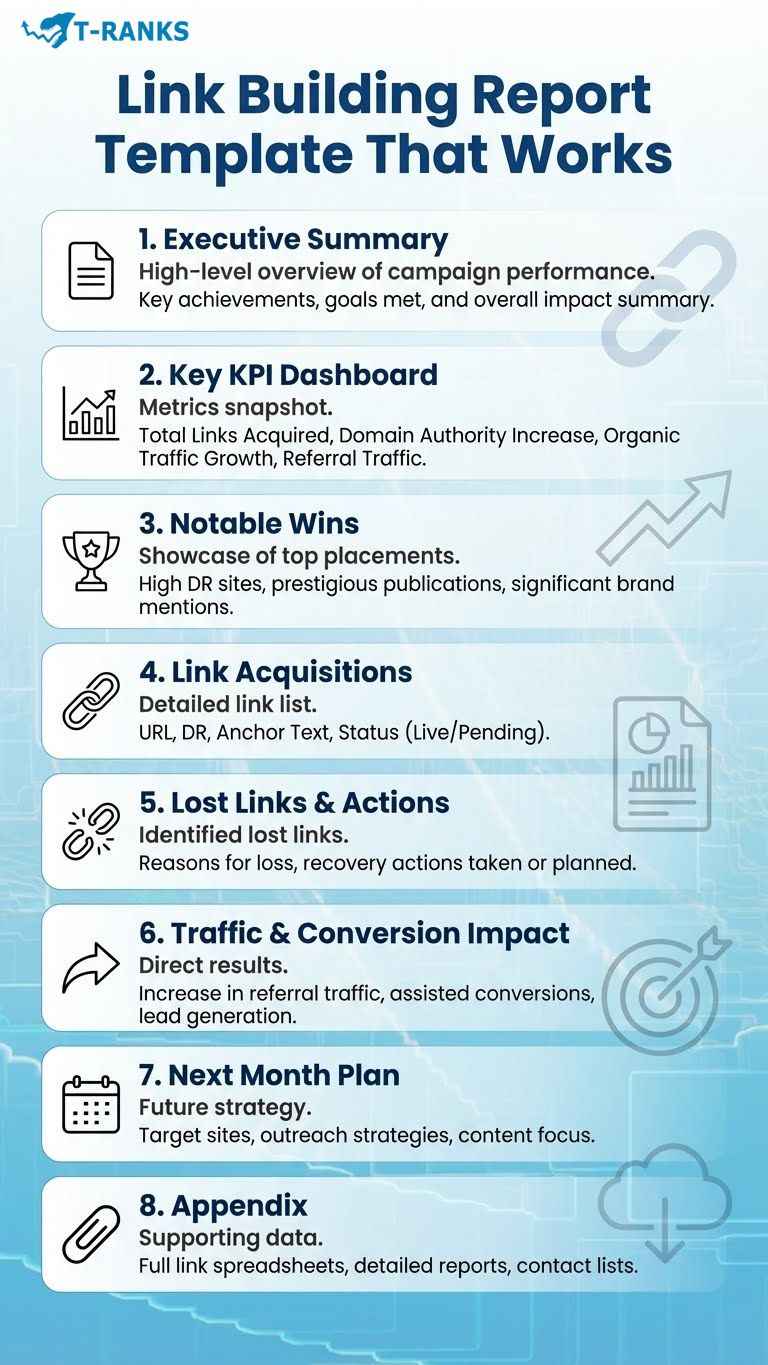
Strong link building report templates make results easy to understand without adding unnecessary complexity.
They help clients quickly see progress, stay oriented month to month, and focus on what matters instead of getting lost in data.
The purpose of a report template is not to document everything that happened.
Its purpose is to communicate progress, value, and direction clearly and consistently.
What a Strong Monthly Link Building Report Includes
A strong monthly link building report allows a client to understand performance within minutes.
They should immediately know whether the campaign is moving in the right direction.
Effective templates usually follow a simple flow:
- Start with the outcome
- Support it with evidence
- End with clear next steps
A reliable structure includes:
Executive summary
A short explanation of overall progress in plain language.
Example: “Net growth of 7 referring domains supported steady referral traffic and early visibility gains.”
Key performance indicators
Three to five metrics shown as trends, not raw tables.
The focus is direction over time, not isolated numbers.
Notable wins
A small number of meaningful highlights such as strong editorial placements, visibility improvements, or recovered links.
Link activity overview
Where links were earned and why those placements matter, without overwhelming detail.
Lost links and actions taken
What changed, why it happened, and how it is being handled.
Impact on traffic or leads
Simple explanations connecting links to referral visits, visibility, or assisted conversions when available.
Next steps
Clear priorities for the coming period with realistic expectations.
Supporting details
Optional data for stakeholders who want deeper inspection.
This structure allows clients to skim or review in detail without confusion.
How to Structure Reports for Fast Understanding
Clients read reports differently than SEO teams.
Important insights must come first.
A simple reading order works best:
- Overall direction
- One primary performance signal
- One business-level outcome
- Supporting context
- Planned actions
When reports follow this order, clients understand progress without needing explanation calls or follow-up emails.
Using Summaries, Highlights, and Next Steps Together
Each report should answer three questions clearly:
- What happened
- Why it matters
- What comes next
Summaries explain progress.
Highlights reinforce credibility.
Next steps set expectations.
This combination reduces uncertainty and keeps reporting focused on decisions, not diagnostics.
Making Templates Reusable Without Becoming Generic
Templates should stay consistent in structure but flexible in execution.
The framework remains the same, while metrics, language, and emphasis adjust to client goals.
Reusable templates save time, improve clarity, and still feel personalized when they reflect the client’s priorities.
When done well, link building report templates turn reporting into a communication asset rather than a monthly obligation.
Best Practices for Link Building Reporting in 2026
In 2026, effective link building reporting focuses on clarity, not volume.
The goal is to help clients understand progress, authority growth, and business impact without confusion.
Good reporting does not try to prove how busy a team was.
It explains what changed, why it matters, and what happens next.
Focus on Fewer Metrics and Explain Them Clearly
Clients understand insight better than long metric lists.
Strong reports use only a small number of meaningful KPIs and explain each one in simple words.
Each reported metric should clearly answer:
- What changed
- Why it matters
- What it signals going forward
If a metric cannot be explained without technical language, it does not belong in a client report.
Lead With Explanation, Not Data
Clear explanation should come before charts and tables.
Clients want the meaning first, not raw numbers.
Effective reports start with a short overview that explains:
- Whether performance improved, stayed stable, or slowed
- What contributed to that result
- What to expect next
Data supports the explanation. It should never replace it.
Always Connect Links to Business Impact
Backlinks only matter when clients understand how they support real outcomes.
Reporting should consistently connect link building to things clients care about, such as visibility, traffic, leads, or authority growth.
Even when results take time, reports should explain how current link building activity supports future performance.
This connection prevents confusion during slower periods and reinforces long-term value.
Keep Reports Easy to Read and Easy to Use
Reports should be simple to scan and easy to share internally.
Clear structure improves understanding and reduces follow-up questions.
Best practices include:
- Consistent section order every month
- Short summaries instead of long explanations
- Simple tables instead of dense charts
- Clear timelines and expectations
Well-structured reports save time for both clients and teams.
Include AI Visibility Without Overcomplicating Reports
Search visibility now extends beyond traditional rankings.
Reporting should acknowledge this without turning reports into technical documents.
When relevant, reports should note:
- Whether the brand is appearing in AI-generated answers
- Whether authority and recognition are increasing
- Whether link building supports trust and reference-worthiness
This helps clients understand progress even when clicks or rankings move slowly.
Why Reporting Quality Matters More Than Ever
Clear reporting strengthens trust and long-term relationships.
Clients stay confident when they understand what is happening and why.
High-quality link building reporting:
- Reduces doubt during slow months
- Supports long-term investment decisions
- Improves retention and expansion
- Differentiates agencies and teams clearly
In 2026, reporting is not an extra task.
It is a core part of delivering and sustaining link building value.
Conclusion: Link Building Reporting as a Strategic Asset
Link building reporting is no longer just a support task.
It is how link building work is explained, evaluated, and trusted.
Good reporting focuses on what matters most. It removes unnecessary data and clearly shows whether link building is making progress. Instead of listing links or activities, it answers simple questions clients care about. Is the campaign moving forward. Why is it moving that way. What should happen next.
As search changes, reporting now looks beyond rankings and traffic alone. Brands can gain visibility and trust even when users do not click. Clear reporting includes these signals without adding complexity, helping clients understand the full value of link building.
Teams that treat reporting as a core part of their work build stronger trust and long-term relationships. Clear reports support better decisions during growth periods and slow periods alike.
When done well, link building reporting becomes a competitive advantage.
It turns link building effort into clear insight, confidence, and long-term value.
FAQs About Client Reporting for Link Building
What is link building reporting?
Link building reporting explains how backlinks contribute to visibility, authority, and business outcomes.
It focuses on progress, quality, and impact instead of listing links without context.
Why is link building reporting important for clients?
Link building reporting helps clients verify whether their investment is working.
Clear reporting builds trust, sets realistic expectations, and supports informed budget decisions.
What should a good link building report include?
A good link building report includes link quality, referring domains, traffic impact, and next steps.
It summarizes results clearly and explains what happened and what comes next.
What KPIs matter most in link building reporting?
The most important KPIs are referral traffic, referring domains, link quality, and visibility growth.
These metrics show real progress rather than surface-level activity.
Are backlink counts enough for client reporting?
No, backlink counts alone are not enough for accurate reporting.
Without relevance, authority, and impact context, raw link numbers can mislead clients.
How often should link building reports be shared?
Link building reports should usually be shared monthly.
Monthly reporting provides enough data to identify trends without creating noise.
What is the difference between reporting links and reporting link impact?
Reporting links lists placements, while reporting impact explains results.
Impact reporting connects backlinks to traffic, rankings, conversions, and visibility.
How do you show ROI from link building in reports?
ROI is shown by connecting backlinks to traffic, conversions, and assisted revenue.
The focus is on contribution across the funnel, not last-click attribution.
Should lost or broken links be included in reports?
Yes, lost and broken links should always be reported.
Net link growth gives a more accurate view of backlink profile health.
What makes a link building report client-friendly?
Client-friendly reports use plain language and focused metrics.
They prioritize clarity, summaries, and explanations over technical jargon.
What is the role of dashboards in link building reporting?
Dashboards provide visibility, while reports provide understanding.
Dashboards show trends, but reports explain what those trends mean.
How does AI search affect link building reporting?
AI search increases the importance of reporting citations and visibility.
Modern reports must reflect how links support AI-generated answers, not just rankings.