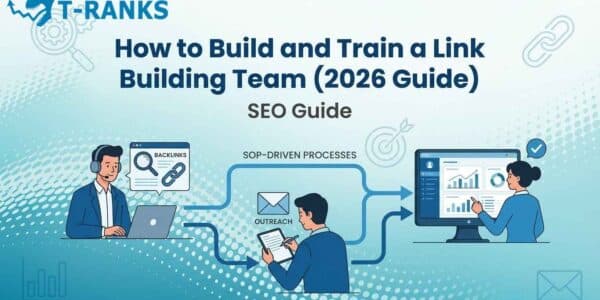
Link building becomes frustrating when one person has to do everything. Researching websites, sending emails, managing content, and checking links quickly turns into a messy and tiring process.
That is why many successful websites use a link building team instead of working alone. A team follows clear steps, assigns specific tasks, and uses simple rules to decide which links are good and which should be avoided. This makes link building more consistent and much safer as it grows.
In this article, you will learn how to build and train a link building team the right way. We cover team structure, roles and costs, SOPs, tools, performance metrics, and quality controls that help link building scale with consistency and predictability over time.
What Is a Link Building Team?
A link building team is a group of people responsible for getting backlinks for a website.
Their job is to earn relevant and high-quality links that improve authority and long-term search visibility.
A link building team works as a system, not as one person doing everything.
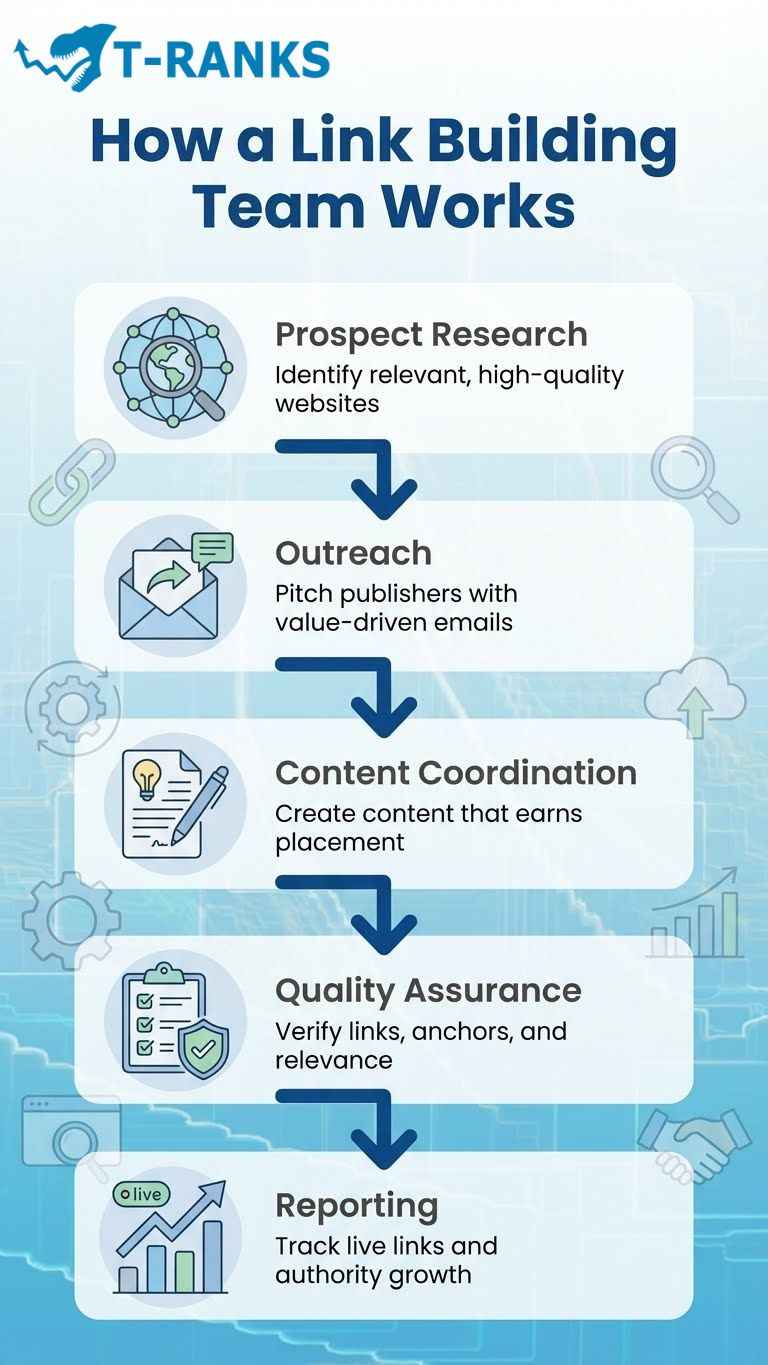
The work is divided into clear steps such as finding websites, contacting site owners, creating or placing content, and checking link quality. Each step follows documented rules, so decisions are consistent and links are approved or rejected based on clear standards.
This setup is different from solo or ad-hoc link building.
When one person handles everything, work becomes slow and quality often drops. Ad-hoc link building has no clear rules, which leads to inconsistent results. A dedicated link building team solves these problems by using defined roles, clear responsibility, and a repeatable process that delivers stable and predictable outcomes.
Why SEO Agencies Build Dedicated Link Building Teams
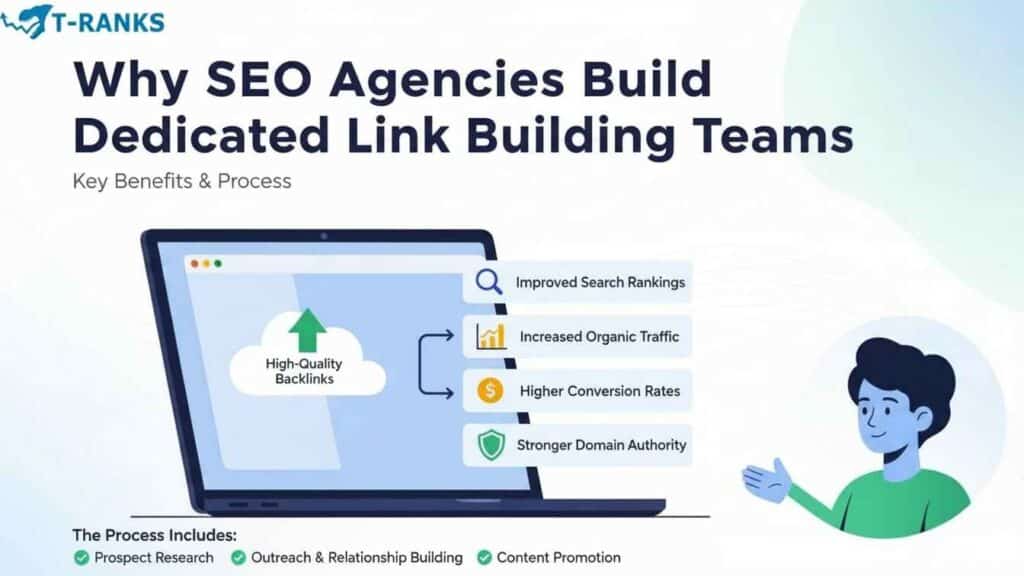
SEO agencies build dedicated link building teams to make link acquisition consistent, scalable, and controllable instead of unpredictable and risky.
As link building becomes more complex and harder to execute safely, agencies treat it as a specialized operation rather than a secondary SEO task.
In my opinion the following are the core reasons agencies opt to Build dedicated link building teams.
Consistency Over One-Off Links
Dedicated teams produce links continuously rather than in short bursts. This creates stable link velocity, which supports long-term authority growth. One-off link campaigns often lead to gaps in acquisition that slow rankings and weaken results over time.
Specialization Improves Outcomes
Link building involves different skill sets at each stage, including research, outreach, content coordination, and quality review. When specialists focus on a single function, outreach responses improve, link relevance increases, and editorial standards remain higher than when generalists handle everything.
Reduced Dependency on Single People
Agencies that rely on one link builder risk operational disruption if that person leaves or becomes unavailable. Dedicated teams distribute knowledge across roles and use SOPs to document workflows. This ensures continuity, faster onboarding, and uninterrupted delivery for clients.
Better Control Over Quality and Risk
Search engines are more effective at detecting low-quality links and unnatural patterns. Dedicated teams apply consistent vetting rules, anchor guidelines, and post-placement checks. This structured oversight reduces the risk of toxic links, anchor misuse, and penalties that can damage client trust and rankings.
Operational Efficiency at Scale
Link building is time-intensive and involves many moving parts. Dedicated teams use defined workflows and tracking systems to prevent bottlenecks and missed deadlines. This efficiency allows agencies to manage multiple clients without sacrificing quality.
Long-Term Publisher Relationship Management
Successful link building depends on relationships, not transactions. Dedicated teams build and maintain ongoing connections with editors, bloggers, and publishers. These relationships lead to higher-quality placements that are difficult for ad-hoc efforts to replicate.
Measurable ROI and Accountability
Clients expect transparency and predictable outcomes. Dedicated teams track every link, monitor performance, and tie acquisition efforts to measurable improvements in authority and visibility. This makes link building easier to justify as a core service rather than an experimental expense.
How to Create Your Link Building Team (Step by Step)
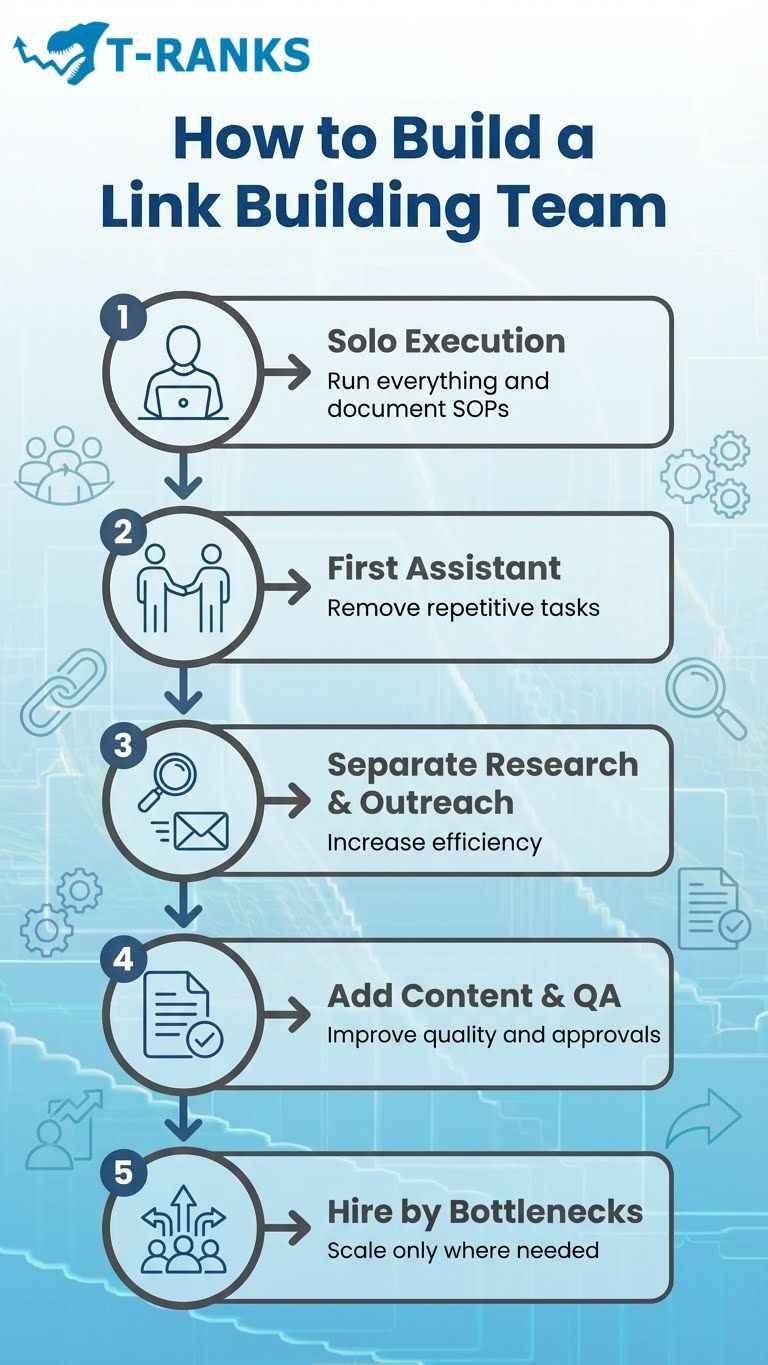
A link building team should be built gradually by turning individual execution into a documented system and hiring only when clear bottlenecks appear.
This step-by-step approach allows agencies to scale link acquisition without losing quality, control, or consistency.
Step 1: Start Solo and Document the Full Process
Begin by running the entire link building operation yourself. This includes finding opportunities, qualifying websites, sending outreach, handling replies, coordinating content, managing follow-ups, and verifying links after placement.
The goal of this step is learning the process, not speed. As you work, document how decisions are made at each stage, including:
- What qualifies or disqualifies a website
- How outreach messages are structured
- How follow-ups are timed
- How links are reviewed after going live
Only document actions that consistently produce results. These documents become your core SOPs and define the system the team will follow.
Step 2: Hire the First Assistant to Remove Repetitive Work
Once your workflow is documented, hire your first assistant. This role should focus on repetitive, time-heavy tasks such as collecting prospect lists, checking basic site metrics, and finding or organizing contact details.
The assistant must work entirely from SOPs. If frequent clarification is required, the documentation is incomplete. This step tests whether your process can be followed without constant guidance and frees your time for strategy, outreach refinement, and quality oversight.
Step 3: Separate Prospecting and Outreach
As link volume increases, research and outreach should no longer be handled by the same person. These activities require different skills and mental focus.
At this stage:
- Prospectors focus exclusively on finding and qualifying websites
- Outreach specialists focus on pitching, follow-ups, and relationship management
This separation improves efficiency, reduces delays caused by context switching, and leads to higher-quality outreach.
Step 4: Add Content Support and Quality Assurance
Once outreach starts converting consistently, content quality and link verification become the main constraints. Introduce content support to handle guest posts, editorial requirements, and linkable assets. Strong content is often the deciding factor between a rejected pitch and a live placement.
At the same time, establish a quality assurance function. Quality assurance should:
- Verify that links are live and correctly placed
- Confirm anchor usage follows SOP rules
- Check relevance and surrounding content
- Record link status accurately
Quality assurance must remain independent from outreach and prospecting to avoid biased approvals.
Step 5: Hire Based on Bottlenecks, Not Titles
Avoid building a team around fixed roles or org charts. Instead, review where the workflow slows down.
For example:
- Many qualified sites but few emails sent indicates an outreach bottleneck
- High reply rates but slow placements indicate a content bottleneck
- Live links with inconsistent results indicate a strategy or quality issue
Each hire should remove a specific constraint. This approach keeps the link building team lean, scalable, and aligned with real performance needs.
Link Building Team Roles and Cost Ranges
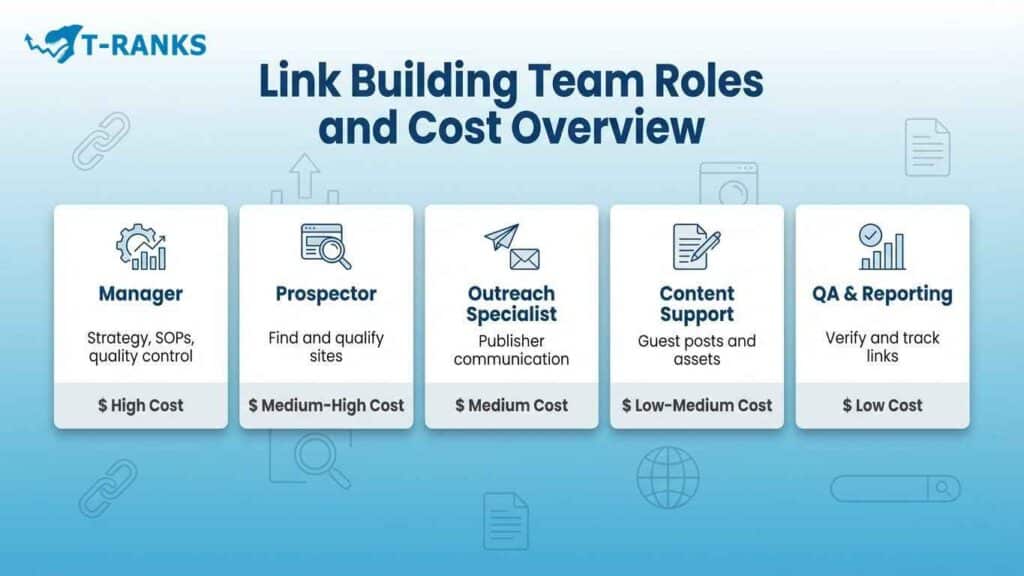
A link building team includes multiple specialized roles, each with a defined cost range that determines the real budget required to scale link acquisition safely and consistently. Understanding these roles and their typical costs helps agencies plan resources, avoid underinvestment, and set realistic expectations.
Most teams combine in-house, offshore, and freelance roles based on budget, scale, and niche requirements.
Link Building Manager
Oversees the entire link building operation, enforces SOPs, maintains quality standards, and reviews performance. This role is responsible for strategic direction and final approval of link quality.
Typical cost range:
- $80,000 to $120,000 per year for US-based in-house roles
- $4,000 to $8,000 per month for senior freelance or fractional management
Costs vary based on experience, campaign complexity, and level of oversight required.
Assistants or Prospectors
Handle opportunity discovery, domain qualification, prospect list building, and research database maintenance. This role supports scale by removing time-intensive research tasks from senior team members.
Typical cost range:
- $45,000 to $65,000 per year for US-based roles
- $1,000 to $3,000 per month for offshore or freelance support, depending on experience and region.
Outreach Specialist
Manages email outreach, follow-ups, publisher communication, and relationship building. This role directly influences response rates and placement success.
Typical cost range:
- $50,000 to $75,000 per year for US-based roles
- $2,500 to $5,000 per month for experienced freelance outreach specialists
Content Writer or Freelance Content Budget
Produces guest posts, editorial content, and linkable assets required for placements. Content quality often determines whether outreach results in acceptance or rejection.
Typical cost range:
- $40,000 to $65,000 per year for in-house writers
- $500 to $2,000 per article for freelance content, depending on niche complexity and editorial standards
QA and Reporting Role (Optional but Common)
Verifies that links are live, checks anchor usage, confirms indexation, audits quality, and maintains reporting accuracy. In smaller teams, this function may be shared with management.
Typical cost range:
- $45,000 to $70,000 per year for in-house roles
- $1,500 to $3,500 per month for part-time or freelance QA and reporting support
Link Placement and Content Budget
Covers editorial fees, sponsored placements, digital PR campaigns, and niche-specific publishing requirements. These figures reflect editorial, sponsored, and PR-based placements, not automated or low-quality links.
Typical cost range:
- $150 to $600 per link for standard niches
- $800 to $1,500 or more per link for competitive industries such as finance, legal, or SaaS
- $3,000 to $10,000 per month for steady placement volume
- $5,000 to $20,000 per month for digital PR or high-authority editorial campaigns
Actual costs depend on competitiveness, authority targets, and volume expectations.
Software and Tools Cost Range
Covers research, outreach, email verification, monitoring, and reporting tools required to operate the team efficiently.
Typical cost range:
- $500 to $2,000 per month
- $6,000 to $24,000 per year, depending on team size and tool stack
Estimated Total Annual Cost for a Lean Team
A lean link building team focuses on essential roles only, without excessive specialization. It typically includes:
- One link building manager
- One prospector or assistant
- One outreach specialist
- Freelance content support
- Basic QA and reporting
- Core software tools
- A moderate placement budget
Estimated total annual cost range:
- $180,000 to $280,000 per year for a lean, fully operational team
Costs vary based on niche competitiveness, editorial standards, regional hiring choices, and placement volume.
Summary Table: Link Building Team Roles and Costs
| Role or Cost Area | Primary Responsibility | Typical Cost Range |
| Link Building Manager | Oversight, SOP enforcement, final quality review | $80,000–$120,000/year or $4,000–$8,000/month |
| Assistants / Prospectors | Prospecting, site qualification, list building | $45,000–$65,000/year or $1,000–$3,000/month |
| Outreach Specialist | Outreach, follow-ups, publisher relationships | $50,000–$75,000/year or $2,500–$5,000/month |
| Content Writer / Freelance Content | Guest posts, linkable assets, editorial content | $40,000–$65,000/year or $500–$2,000/article |
| QA & Reporting (Optional) | Link verification, anchor checks, reporting | $45,000–$70,000/year or $1,500–$3,500/month |
| Link Placement & Editorial Budget | Sponsored placements, PR campaigns | $150–$1,500+/link or $3,000–$20,000/month |
| Software & Tools | Research, outreach, verification, reporting | $500–$2,000/month |
| Lean Team Total (Annual) | Full operational setup | $180,000–$280,000/year |
In-House vs Freelancers vs Hybrid Link Building Teams
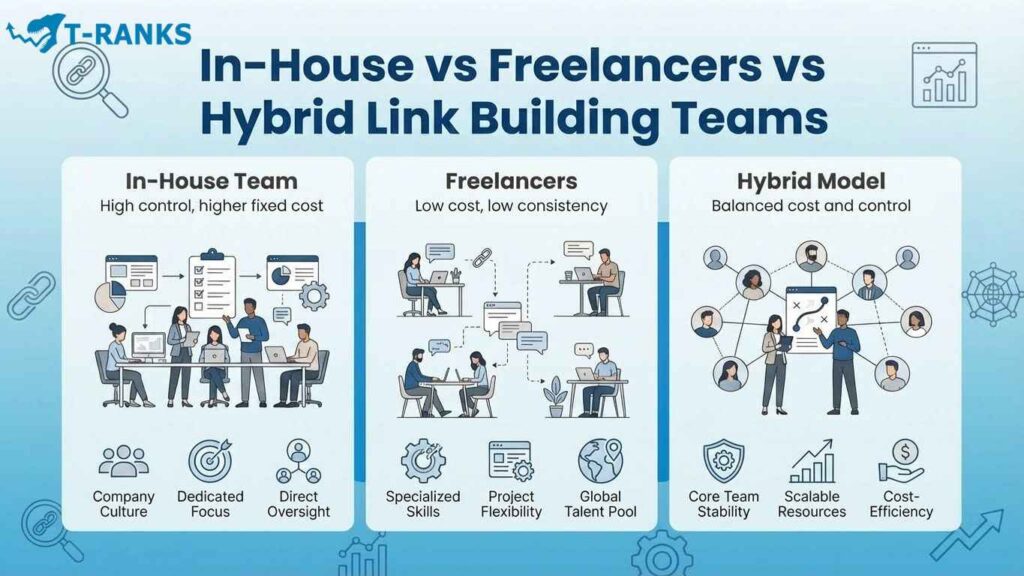
The right link building team model depends on how much control, consistency, and scalability your SEO efforts require.
This section provides a clear decision framework to help you choose the most suitable structure based on budget, risk tolerance, and long-term goals.
When In-House Teams Make Sense
In-house link building teams are best suited for organizations where link acquisition is a core, long-term function.
Choose an in-house team when:
- You need consistent link acquisition at predictable monthly volume
- Brand voice, topical relevance, and editorial quality must be tightly controlled
- The business operates in regulated or high-risk niches
- Internal knowledge and publisher relationships are long-term assets
In-house teams offer the highest level of control and accountability. The tradeoff is higher fixed costs and slower scaling due to hiring and training cycles.
When Freelancers Are More Practical
Freelancers are a practical choice when flexibility and lower upfront costs are the priority.
Choose freelancers when:
- You are testing link building or running limited campaigns
- Budgets do not support full-time roles
- Campaigns are temporary or tied to product launches
- You need short-term help for specific tasks such as prospecting or outreach
Freelancers allow fast execution but require close management to maintain standards.
Risks of Unmanaged Freelancers
Freelancers become a risk when execution is not governed by clear rules and oversight.
Key risks include:
- Inconsistent link quality and weak topical relevance
- Unsafe anchor text patterns
- Links placed on low-quality or unindexed pages
- Tactics that prioritize speed over long-term sustainability
Without SOPs and independent QA, unmanaged freelancers often create link profiles that are devalued or penalized.
Why Hybrid Models Are Common
Hybrid link building teams combine internal control with external execution and are the most common model for scaling.
Hybrid teams work because:
- Strategy, SOPs, and final quality checks remain in-house
- Freelancers handle time-intensive execution tasks
- Costs remain flexible while standards stay consistent
- Volume can scale without increasing permanent headcount
This structure balances cost efficiency with long-term reliability.
Where Strategy and Control Should Live
Regardless of the team model, strategy and control must remain internal.
Keep these responsibilities in-house:
- Link targeting and relevance standards
- SOP ownership and updates
- Anchor text and placement rules
- Final approval of live links
- Performance tracking and audits
Execution can be outsourced, but accountability should always remain with the core team.
Quick Decision Table
| Model | Best For | Typical Cost per Link | Control Level |
| In-House | Long-term scale and IP protection | $400–800 | High |
| Freelancers | Testing and short-term campaigns | $200–500 | Low |
| Hybrid | Scalable growth with control | $300–600 | Medium–High |
SOPs Every Link Building Team Must Have
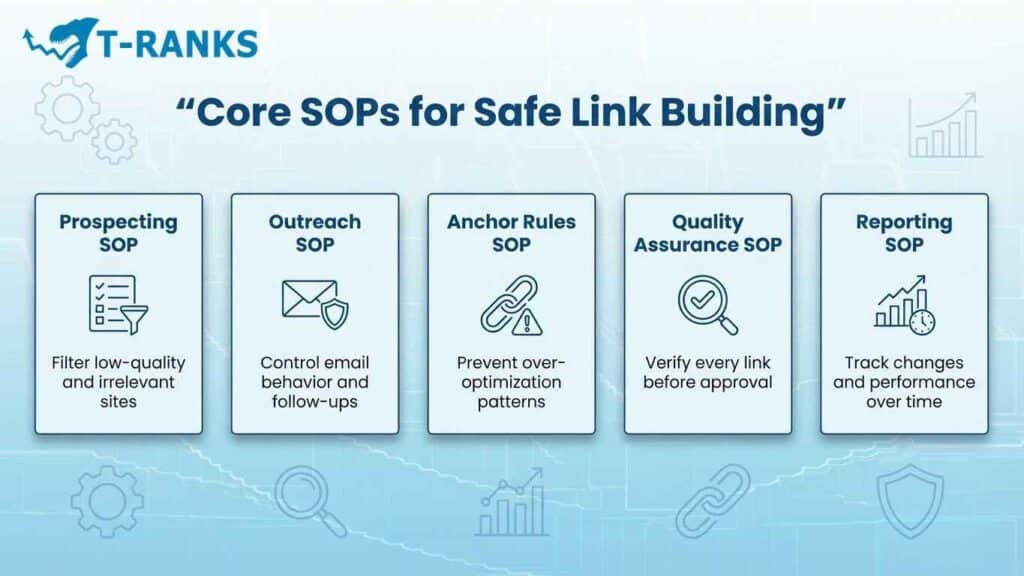
Standard operating procedures define how a link building team decides, approves, and verifies every backlink it builds. SOPs make link building scalable, repeatable, and safe by replacing individual judgment calls with a controlled system based on rules, checks, and accountability.
At a high level, SOPs serve three core purposes:
- Decision filters that define what qualifies and what must be rejected
- Quality gates that prevent weak or risky links from being approved
- Risk controls that protect against penalties and pattern-based devaluation
The SOPs below are non-negotiable for any link building team that wants consistent results without long-term risk.
Prospecting SOP
The prospecting SOP defines which websites are allowed into the link building pipeline. This SOP acts as the primary decision filter and prevents low-quality sites from ever reaching outreach.
It should clearly define:
- Topical relevance requirements
- Minimum traffic and indexation checks
- Acceptable and disallowed site types
- Manual review rules to identify link farms or artificial sites
- A repeatable process for competitor gap analysis
If a site fails at this stage, it is rejected immediately and does not move forward.
Outreach SOP
The outreach SOP controls how the team communicates with publishers and site owners. Its purpose is to ensure outreach remains professional, personalized, and relationship-driven rather than volume-driven.
It should define:
- Personalization requirements for first contact
- Acceptable pitch structure and tone
- Follow-up limits and spacing
- Rules for managing ongoing publisher relationships
Clear outreach rules reduce spam signals, protect email reputation, and improve response quality over time.
Anchor and URL Rules SOP
Anchor and URL rules act as a core risk control within the link building system. This SOP exists to prevent over-optimization and unsafe linking patterns.
It should specify:
- Approved anchor text categories
- Prohibited anchor usage
- Acceptable anchor distribution ranges
- Rules for homepage versus internal page links
- Placement requirements to ensure links appear naturally within content
These rules ensure links look natural and remain aligned with long-term search engine guidelines.
Quality Assurance SOP
The quality assurance SOP is the final quality gate before a link is approved and recorded. It ensures that every placement meets predefined standards before it is counted as complete.
It should require verification of:
- Live link placement on the correct page
- Anchor text and destination URL accuracy
- Contextual relevance of surrounding content
- Indexation status and link attributes
Quality assurance must remain independent from prospecting and outreach to prevent biased approvals and missed issues.
Reporting and Logging SOP
The reporting and logging SOP defines how link activity is recorded, reviewed, and audited. Its purpose is to make performance measurable and problems visible before they scale.
It should standardize:
- Required data fields for every link
- Status tracking for live, lost, or changed links
- Review frequency and audit checkpoints
- Clear ownership for updates and corrections
Consistent reporting creates accountability and supports long-term optimization.
Follow-Up and Response Expectations
In most editorial outreach contexts, teams enforce strict follow-up limits to protect quality and sender reputation. A common standard is one initial email followed by no more than two follow-ups.
Reply rate and positive response rate should be treated as quality signals, rather than raw email volume. This approach favors relevance and relationship building over aggressive outreach.
How to Train a Link Building Team Properly
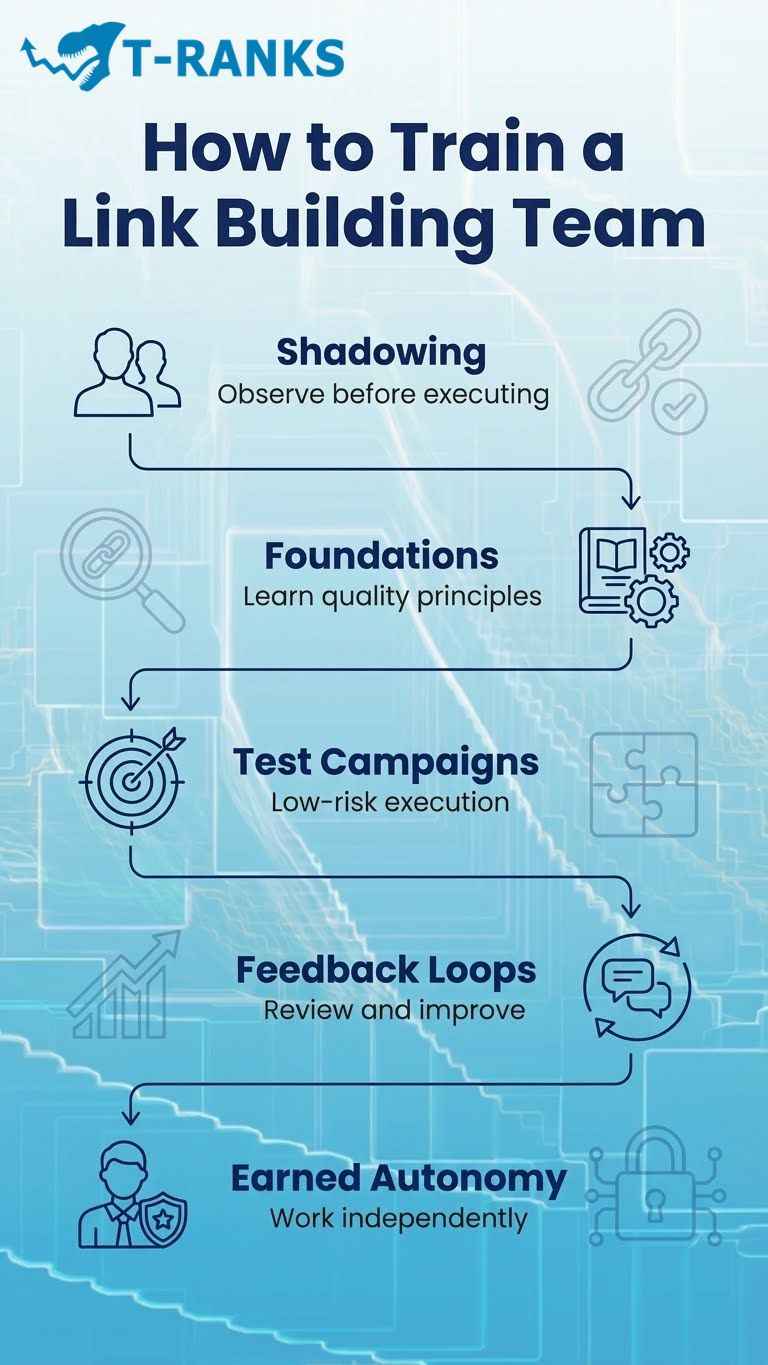
Training a link building team means teaching people how to apply SOPs correctly in real situations, not just follow instructions. The goal is to build consistent decision-making so quality, relevance, and risk control remain stable as link volume increases.
Below is a structured training framework designed to turn documented processes into shared judgment across the team.
Step 1: Shadowing Before Any Execution
Training should begin with observation to build context before responsibility. New team members must understand why decisions are made before they are asked to execute tasks on their own.
This step prevents early mistakes caused by missing context.
Shadowing should include:
- Observing how prospects are accepted or rejected
- Watching how outreach messages are personalized and adjusted
- Reviewing quality assurance checks on live links
This phase builds pattern recognition and reduces errors before execution begins.
Step 2: Foundational Skill Development
Once context is established, training should focus on the principles behind each SOP. This step builds analytical and editorial judgment rather than mechanical task execution.
Foundational training should cover:
- Identifying linkable assets such as research, tools, and evergreen content
- Evaluating site quality using relevance, traffic signals, and editorial integrity
- Advanced prospecting using competitor backlink analysis and search operators
This ensures SOPs are applied with understanding instead of blind repetition.
Step 3: Controlled Test Campaigns
After fundamentals are learned, execution should begin in a low-risk environment. Controlled test campaigns allow new team members to apply SOPs under supervision.
This step limits risk while skills are still developing.
These campaigns should:
- Use small, pre-approved prospect lists
- Limit outreach volume
- Require review before emails are sent
Weaknesses are identified early without risking live campaigns or sender reputation.
Step 4: Feedback and Review Loops
Training only improves performance when feedback is structured and continuous. Review loops turn mistakes into learning opportunities instead of repeated failures.
Effective feedback systems include:
- Prospect list reviews with clear approval or rejection reasons
- Outreach copy reviews focused on clarity and value
- QA audits tied directly to SOP requirements
All feedback should be documented and used to improve both execution and the SOPs themselves.
Step 5: When Autonomy Is Earned
Autonomy should be earned through consistency, not time served. This step defines when a team member can work independently without close supervision.
Autonomy is granted only after a team member:
- Consistently meets SOP benchmarks
- Passes QA checks without correction
- Demonstrates sound judgment in edge cases
Even after autonomy is granted, periodic spot checks should remain standard.
Why SOPs Reduce Ramp-Up Time
SOPs shorten training time by removing uncertainty from decision-making. They give new hires a clear framework for action, review, and correction.
Clear SOPs:
- Eliminate guesswork
- Speed up feedback cycles
- Make errors easier to diagnose and fix
With strong SOPs and proper supervision, most link building roles become productive in weeks rather than months.
Tools That Support a Link Building Team
A link building team uses tools to enforce SOPs, maintain quality, and track progress at scale.
Tools support execution and visibility. They do not replace strategy or judgment.
Each tool in the stack should support a specific stage of the link building workflow, with no overlap or ambiguity.
Below are the core tool categories used by link building teams, organized by the stage they support.
Research and Qualification Tools
These tools control which websites enter the link building pipeline.
Commonly used tools include Ahrefs, Semrush, and SE Ranking.
Used to:
- Find competitor backlink opportunities
- Check organic traffic and topical relevance
- Filter low-quality or risky sites
Outreach and Communication Tools
These tools manage outreach at scale while keeping conversations organized.
Common tools include Pitchbox, BuzzStream, and Respona.
Used to:
- Run outreach and follow-up sequences
- Track replies and publisher relationships
- Prevent duplicate outreach
Email Verification Tools
These tools protect deliverability and sender reputation.
Common tools include Hunter.io, NeverBounce, and ZeroBounce.
Used to:
- Verify contact emails
- Reduce bounces and spam risk
SOP and Workflow Management Tools
These tools keep processes consistent across the team.
Common tools include Notion and ClickUp.
Used to:
- Store SOPs and training material
- Manage tasks and accountability
Reporting and Monitoring Tools
These tools track performance, quality, and risk.
Common tools include Ahrefs, Google Analytics, and Looker Studio.
Used to:
- Monitor live and lost links
- Track referring domains and anchor usage
- Review campaign impact
KPIs That Matter for a Link Building Team
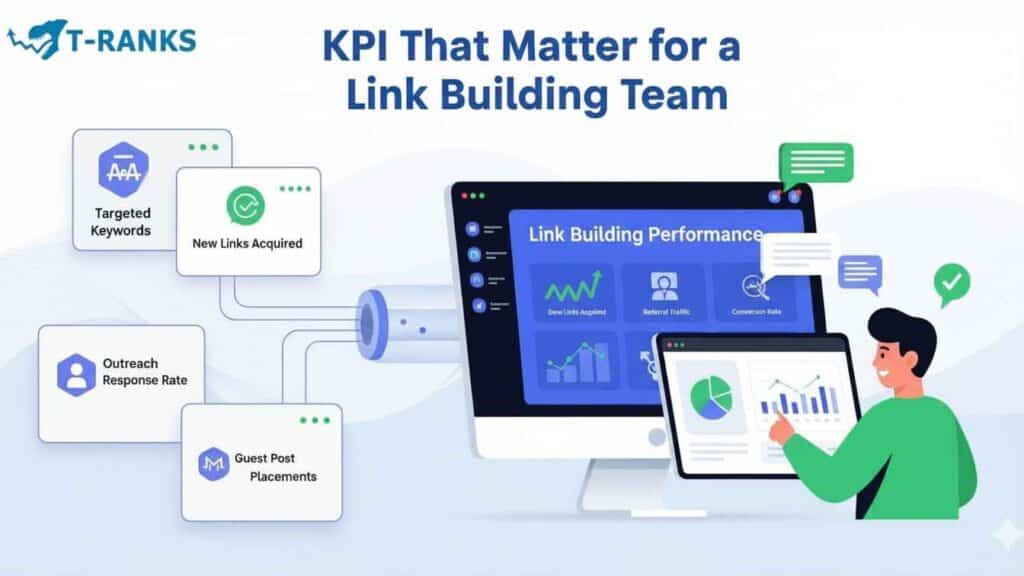
Link building success should be measured using predictive KPIs that signal authority growth and risk control, not vanity metrics like total backlink counts.
In 2026, effective link building teams focus on a small set of indicators that directly correlate with rankings, relevance, and long-term stability.
Below are the core KPIs that matter most.
Referring Domain Growth
Target: 10–20 new DR 50+ domains per month.
This KPI measures authority diversification rather than raw link volume. Growth in unique, high-quality referring domains is one of the strongest predictors of sustained ranking improvement.
Link Relevancy
Target: 80% or higher topical alignment.
Relevancy measures how closely the linking site and page align with your niche. High topical alignment consistently outperforms generic high-metric links and supports stronger trust signals.
Anchor Text Distribution
Target: Approximately 60% branded or naked, 20% generic, under 20% exact match.
Anchor distribution is a risk-control KPI. Natural ratios reduce over-optimization and lower the likelihood of algorithmic devaluation.
Link Velocity Consistency
Target: Less than 30% month-over-month variance.
Consistent link velocity mirrors organic growth patterns. Sharp spikes or drops often indicate manipulation rather than earned authority and can trigger algorithmic scrutiny.
Outreach Response Quality
Target: 30% or higher positive responses.
This metric tracks meaningful replies such as placement offers or collaboration interest, not opens or generic acknowledgements. High response quality reflects accurate targeting and strong personalization.
Cost per Link
Target: Below $400 for DR 50+ placements, adjusted by niche.
Cost per link measures total investment across labor, tools, content, and placements. It is the primary efficiency and ROI metric for link building operations.
KPI Benchmark Overview
Referring Domain Growth
Target: 10–20 new DR 50+ domains per month
Red flag: Fewer than 5 new domains
Link Relevancy
Target: 80% or higher topical alignment
Red flag: Below 70% relevance
Anchor Text Distribution
Target: Approximately 60% branded or naked, 20% generic, under 20% exact match
Red flag: Exact match anchors exceeding 30%
Link Velocity Consistency
Target: ±20–30% month-over-month variance
Red flag: Sudden spikes or drops above 50%
Outreach Response Quality
Target: 30% or higher positive responses
Red flag: Below 15% positive replies
Cost per Link
Target: Below $400 for DR 50+ placements
Red flag: Above $600 per link
Regular reviews against these benchmarks keep link building teams focused on quality, consistency, and sustainable growth rather than short-term volume.
Common Mistakes When Building a Link Building Team
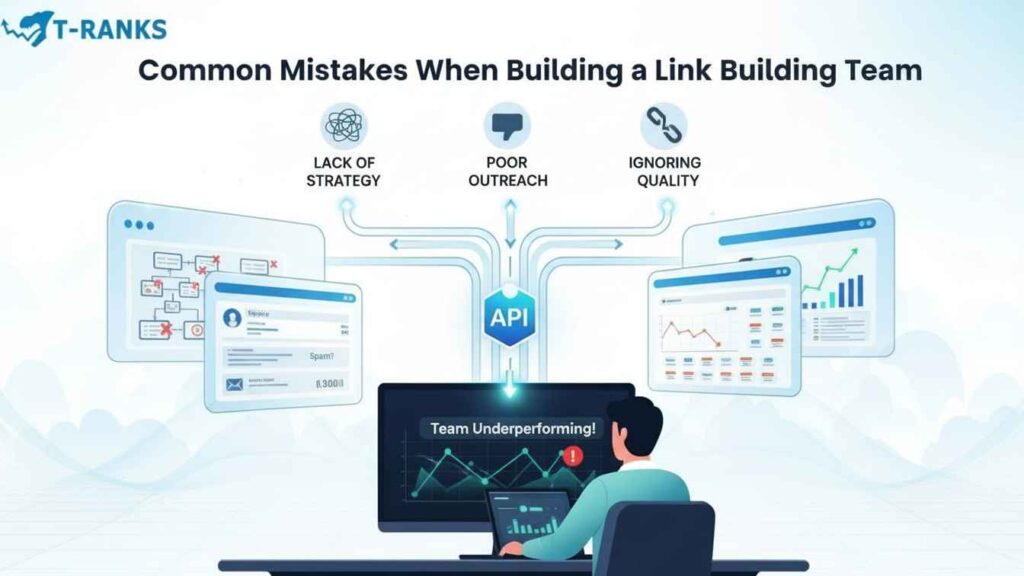
Most link building teams fail because of structural and process-related mistakes, not because link building itself is ineffective.
In 2026, these mistakes carry greater risk due to AI-driven spam detection, relevance scoring, and pattern analysis.
Below are the most common mistakes teams make when building a link building team.
Mistake 1: Hiring Before SOPs Are Documented
Hiring team members before SOPs exist forces each person to rely on their own assumptions and past experience.
This leads to inconsistent prospecting standards, uneven outreach quality, and links that cannot be reviewed or audited against a shared benchmark.
Mistake 2: Allowing Quality Threshold Drift
Teams often start with strict relevance and authority requirements, then gradually relax them to meet short-term delivery goals.
Over time, high-quality placements are replaced with weaker domains that dilute the overall link profile.
Mistake 3: Obsessing Over Volume Instead of Impact
Chasing link quantity shifts focus away from relevance, editorial quality, and contextual placement.
Volume-driven efforts often produce links that add little authority or ranking value.
Mistake 4: No Clear Ownership or Review Loop
When ownership is unclear, mistakes repeat.
Prospecting, outreach, and quality assurance require defined responsibility and routine review to maintain consistent standards.
Mistake 5: Scaling the Team Too Early
Expanding the team before proving quality consistency and unit economics multiplies inefficiencies.
Additional headcount increases output, but it also increases operational complexity and cost pressure.
Common Mistakes and Their Impact
| Mistake | Immediate Effect | Long-Term Risk |
| Hiring before SOPs | Inconsistent execution | Structural instability |
| Quality threshold drift | Lower relevance links | Authority erosion |
| Volume obsession | Low-impact placements | Ranking stagnation |
| No ownership or reviews | Repeated errors | Profile risk |
| Scaling too early | Rising costs | Team inefficiency |
A strong link building team is built on systems, not individuals. Teams that document their process before scaling create repeatable results that are independent of any single person. This foundation makes quality enforceable, decisions traceable, and growth predictable.
Training must always come before volume. Shadowing, controlled test campaigns, and structured review loops ensure team members understand standards before executing at scale. This approach prevents quality drift and protects the link profile as output increases.
The real competitive advantage comes from control and consistency. Control over prospect selection, anchors, link velocity, costs, and quality checks allows link building to compound authority safely over time rather than producing short-term gains that fade or trigger risk.
If you prefer results without hiring or training a link building team, T-RANKS provides fully managed link acquisition services that focus on relevance, authority, and long-term stability.
FAQs About Building a Link Building Team
What is a link building team?
A link building team is a group responsible for acquiring backlinks through a structured, repeatable process. Each role focuses on a specific stage such as research, outreach, content, or quality control to ensure consistent results.
Do I really need a link building team for SEO?
Yes, if you want consistent and scalable link acquisition. Solo or ad-hoc link building usually leads to uneven quality, unstable link velocity, and limited long-term growth.
How many people are needed in a link building team?
Most link building teams start with 2 to 4 people. A common setup includes one manager, one prospector, and one outreach or content support role.
How much does it cost to build a link building team?
A lean link building team typically costs between $150,000 and $200,000 per year. This includes salaries or freelance support, tools, content creation, and basic placement budgets.
Is it cheaper to hire freelancers instead of an in-house team?
Yes, freelancers are usually cheaper upfront. However, they require strong SOPs and active oversight to maintain quality and avoid risky link patterns.
When should I build an in-house link building team?
You should build an in-house team when link building is a long-term, core growth activity. In-house teams provide better control, alignment, and predictable outcomes.
What is a hybrid link building team?
A hybrid link building team keeps strategy and quality control in-house while outsourcing execution tasks. This model balances cost efficiency with operational control.
What roles are most important in a link building team?
The most important roles are strategy, prospecting, outreach, and quality assurance. Content support becomes critical as link volume and editorial standards increase.
How long does it take to train a link building team?
With clear SOPs, most team members become productive within 2 to 4 weeks. Without SOPs, training often takes significantly longer and produces inconsistent results.
What SOPs does a link building team need?
Core SOPs include prospecting, outreach, anchor usage, quality assurance, and reporting. These SOPs reduce errors and prevent unnatural link patterns.
What KPIs should a link building team track?
Key KPIs include referring domain growth, link relevancy, anchor text distribution, link velocity consistency, outreach response quality, and cost per link.
Can Google detect poorly managed link building teams?
Yes, poor management often results in unnatural link patterns. Inconsistent anchors, low-quality sites, and sudden spikes increase detection risk.