Many websites build links without a plan.
One month they send outreach emails. The next month they stop. Sometimes links are built quickly, sometimes nothing happens at all.
This stop-and-start approach is one of the main reasons link building fails. When actions are inconsistent, search engines struggle to understand trust, relevance, and steady growth.
A link building workflow fixes this problem. It turns link building into a structured monthly process where planning, research, outreach, validation, and review follow a clear order. Instead of guessing what to do next, each step supports the next one.
This guide explains a 30-day link building sprint that shows how link building works in practice. You will learn how to organize link building across a month, why timing and structure matter, and how a repeatable workflow helps links grow naturally and consistently over time.
What Is a Link Building Workflow?

A link building workflow is a clear process that shows how links are planned, built, checked, and improved over time. Instead of doing link building randomly, a workflow helps you follow the same steps every month so your efforts stay organized and predictable.
Link building tactics are single actions, like sending outreach emails or getting a guest post. A workflow is different. It connects all those actions into one system, so each step supports the next one. This makes link building easier to manage and prevents long gaps or rushed activity.
Link building workflows can follow different structures, such as a straight sequence or a monthly cycle. The exact structure is less important than consistency. Search engines look at how links grow over time, not at individual links on their own. A simple, repeatable workflow helps create steady link growth that search engines trust.
Why Monthly Sprints Work Better Than Linear Link Building

Monthly sprints work better than linear link building because they create steady, reviewable link growth that matches how search engines crawl, index, and measure trust over time.
How Search Engines Evaluate Link Building Over Time
Link building results are not judged instantly. Search engines observe how links appear, grow, and change across weeks and months. They look for consistency, natural timing, and stable patterns. A few links built quickly do not carry the same meaning as links earned steadily over time.
This is why link building performance cannot be measured from a single action or a short campaign. Time plays an important role in how links are understood.
What Happens in Linear Link Building
Linear link building usually follows a simple sequence. First research is done, then outreach starts, and finally links are built. Once the task is finished, link building often stops until the next campaign begins.
This approach creates gaps. Some months show heavy activity, while other months show none. Because there is no regular review or rhythm, mistakes are repeated and successful actions are not improved. Over time, this stop and start pattern makes link growth look uneven.
Why Monthly Sprints Create Better Consistency
Monthly sprints organize link building into a fixed cycle. Each month includes planning, execution, and review. This keeps link building active without sudden spikes or long pauses.
Monthly cycles also align better with how search engines crawl pages, index new links, and reassess trust. Because every sprint ends with review, weak results can be corrected and strong results can be repeated. Over time, this creates compounding improvement instead of random outcomes.
Linear vs Triangular Link Building Workflows
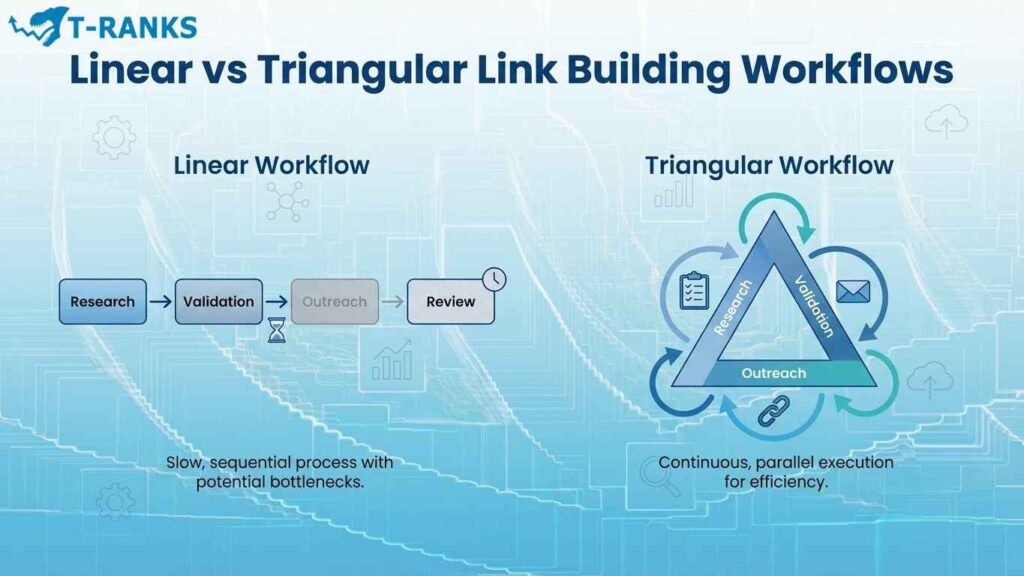
Link building workflows generally follow one of two models. Some teams use a linear workflow, while others use a triangular workflow. Understanding the difference between these two models helps explain why modern link building systems have changed.
What a Linear Link Building Workflow Is
A linear link building workflow follows a straight sequence. One task must finish before the next one starts. Research is completed first. Then the list is handed over for outreach. After outreach is finished, results are reviewed.
This model is simple and easy to understand, which is why many teams start with it. However, simplicity often comes at the cost of speed and flexibility.
Where Linear Workflows Break Down
The main problem with linear workflows is delay. If one stage takes longer than expected, every other stage must wait. This creates bottlenecks where work slows or stops completely.
Another issue is idle time. While one task is being completed, other parts of the workflow are inactive. Over time, this stop-and-go pattern makes link building inefficient and difficult to scale across multiple campaigns.
What a Triangular Link Building Workflow Is
A triangular link building workflow organizes work so that different stages run at the same time. Instead of waiting for one task to finish, research, validation, and outreach happen in parallel.
In this model, multiple campaigns can move forward together. One campaign may be in outreach while another is still being researched. The workflow stays active without depending on a single sequence.
Why Triangular Workflows Enable Better Progress
Because tasks run simultaneously, triangular workflows remove waiting between stages. Work continues even when one part of the process slows down.
This parallel execution allows teams to maintain momentum, respond faster, and manage more campaigns without creating pressure or delays. For this reason, modern link building teams prefer triangular workflows when consistency and scalability matter.
The Triangular Link Building Workflow Explained
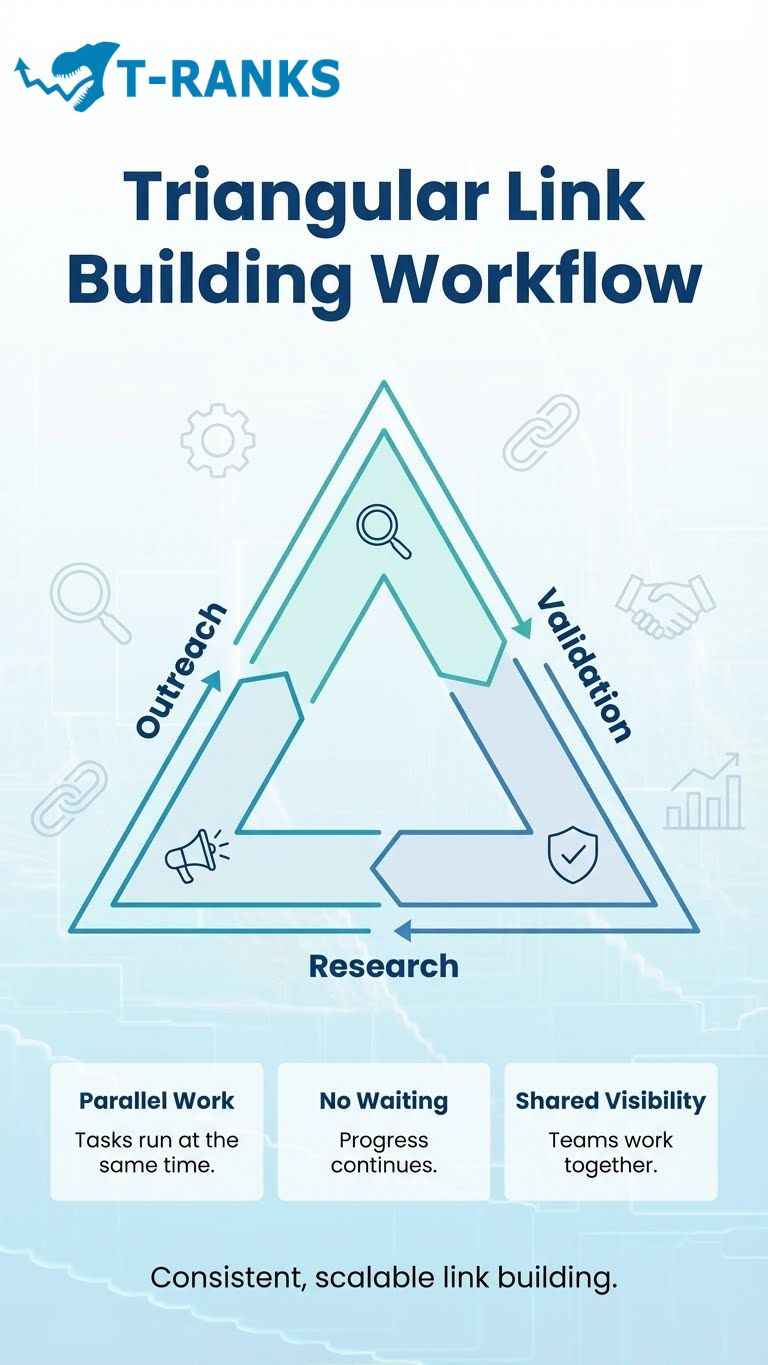
The triangular link building workflow explains how link building work is structured and shared, so progress continues without waiting between stages. Instead of focusing on speed or volume, this model focuses on division of responsibility and continuous collaboration.
What “Triangular” Means in Practice
In a triangular workflow, link building tasks are divided across different areas of responsibility. Each part of the process moves forward independently but stays connected to the others. Work does not pause just because one stage is still in progress.
The triangle represents balance. No single task controls the entire workflow. Progress comes from multiple parts moving together, not from completing one step before starting another.
Core Execution Roles in the Triangular Model
The triangular workflow is built around three core responsibilities.
One responsibility focuses on finding and researching link opportunities. Another focuses on reviewing and validating those opportunities to maintain quality. A third focuses on communication and placement. Each responsibility supports the others, but none of them waits for the entire process to reset.
These are not rigid job titles. They are functional roles that keep link building organized and prevent any single stage from slowing everything down.
Why Parallel Execution Improves Efficiency
Because responsibilities are separated, work can continue even when one area slows. While some opportunities are being reviewed, others can already move into outreach. At the same time, new research can continue for future work.
This structure reduces idle time and keeps the workflow active. Efficiency improves not by working faster, but by removing unnecessary waiting.
How Collaboration Replaces Handoff Delays
In traditional workflows, work is passed from one stage to the next and often sits idle during handoffs. In a triangular workflow, collaboration replaces these handoffs. Information is shared continuously instead of transferred only at the end.
Everyone involved can see what is ready, what is in progress, and what needs attention next. This shared visibility allows faster decisions, smoother transitions, and steady link building momentum throughout the month.
How the Triangular Model Fits Into a 30-Day Sprint
A 30-day sprint gives link building a clear time frame, while the triangular model decides how work moves inside that time. The sprint sets the monthly rhythm. The triangular workflow keeps work moving without pauses or waiting between steps.
Sprint Sets the Timeline, Triangle Controls the Work
The sprint defines when planning starts, when work is reviewed, and when the next cycle begins. Everything happens within a fixed month. The triangular model works inside this timeline by dividing responsibilities so progress does not stop when one task is still ongoing.
In simple terms, the sprint controls when link building happens, and the triangular workflow controls how it happens.
Multiple Campaigns Can Run at the Same Time
During a single 30-day sprint, different link building campaigns can be at different stages. One campaign may be in research, another in review, and another in outreach. Because tasks do not depend on finishing one stage completely, all campaigns can move forward together.
This makes link building more flexible and easier to manage, even as work increases.
From Stop-and-Start Work to a Continuous Flow
Without a clear system, link building often happens in bursts followed by long gaps. The sprint and triangular model remove this stop-and-start behavior. Work continues throughout the month instead of restarting from zero each time.
This steady flow helps maintain consistency, which is important for long-term link growth.
Why This Approach Scales Safely
Scaling link building often creates problems when speed increases faster than control. The sprint-based triangular model avoids this by keeping regular reviews and clear responsibilities in place.
Each month ends with evaluation and adjustment. This keeps link growth controlled, predictable, and less risky, even as output increases.
30-Day Link Building Sprint at a Glance
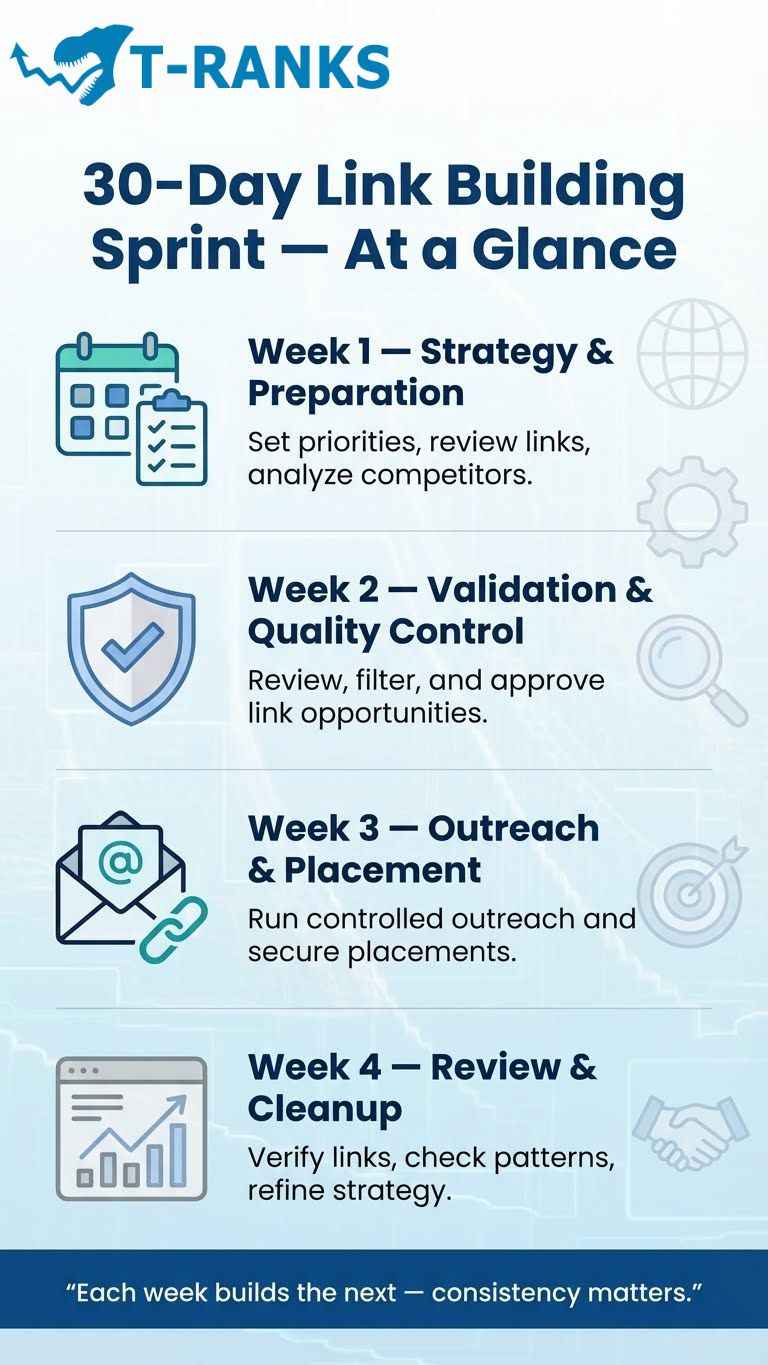
A 30-day link building sprint is divided into four focused stages. Each week has a clear purpose, and together they form a complete, repeatable workflow.
Week 1 focuses on direction and preparation.
This stage sets goals, reviews existing links, analyzes competitors, and prepares a clean list of relevant opportunities. No outreach happens yet.
Week 2 focuses on validation and quality control.
Opportunities are reviewed, filtered, and confirmed before scaling. This week protects the workflow from wasted effort and low-quality placements.
Week 3 focuses on controlled outreach and placement.
Approved opportunities move into outreach while other tasks continue in parallel. The goal is steady execution without delays or spikes.
Week 4 focuses on review, cleanup, and learning.
Links are verified, patterns are reviewed, and adjustments are documented. This stage prepares the workflow for the next sprint.
Each week builds on the previous one. Skipping a stage weakens the entire process, which is why the sprint works best when all four weeks are followed consistently.
Now that you’ve seen how the full 30-day sprint is structured, the next step is to look at how each week works in practice. The sprint begins with preparation, where direction, priorities, and opportunities are clearly defined.
Week 1 – Strategy, Audit, and Prospecting Setup
Week 1 is about preparation. No outreach happens yet. This stage sets the direction for the entire 30-day sprint and removes guesswork from the weeks that follow. The goal is to understand what needs links, what already exists, and which opportunities are worth pursuing.
Set Direction and Priorities
Start by deciding what this month’s link building should support. This may be a key page that needs better rankings, a new piece of content, or an important category page.
Once priorities are clear, select the exact pages that will receive links. Having clear targets ensures that all later efforts are focused and intentional rather than scattered.
Review the Current Link Situation
Before finding new opportunities, review what already exists. Look at your current backlinks and anchor text usage to understand how links are distributed.
Next, review competitors that already rank for your target keywords. Identify websites that link to them but not to you. This helps reveal realistic opportunities and sets expectations for the types of sites that may be open to linking.
This step provides context. It prevents overbuilding similar links and helps maintain balance.
Prepare and Validate Link Opportunities
Now move into prospecting. Look for websites that are closely related to your topic, audience, or industry. Relevance should guide this step more than surface metrics.
As prospects are collected, organize them into a single master list. Remove duplicates, spam sites, and low-quality domains early to keep the list clean.
From this master list, create a smaller group of the strongest prospects. This is your blitz list. It is used to quickly test whether your content and outreach angle make sense before scaling.
Early validation saves time and helps refine the approach for the rest of the sprint.
Week 2 – Validation and Quality Control
After Week 1, you should have clear priorities, target pages, and a prepared list of link opportunities. Week 2 is about slowing down before scaling. This stage ensures that only the right opportunities move forward and that mistakes are caught early.
No large-scale outreach happens yet. The goal is to protect quality and prevent wasted effort.
Validate Link Opportunities Before Scaling
Start by reviewing the strongest prospects from your Week 1 work, especially the blitz list. Check whether these sites are active, relevant, and suitable for linking.
This validation step confirms whether your outreach angle makes sense in the real world. If early responses or checks show poor fit, adjustments can be made before the full list is used.
Early validation saves time and avoids repeating mistakes at scale.
Check Relevance, Quality, and Basic Trust Signals
Each opportunity should be reviewed for topical relevance and overall quality. Look at whether the website matches your niche, publishes meaningful content, and attracts real visitors.
This step is not about chasing perfect metrics. It is about removing obvious risks such as spam sites, thin content, or websites built only to sell links.
Quality checks at this stage protect the workflow from weak or harmful placements later.
Confirm Readiness for Outreach
Once prospects pass validation, they should be clearly marked as ready for outreach. This helps separate approved opportunities from those that still need review or should be excluded.
Clear labeling prevents confusion when outreach begins and keeps the workflow organized as multiple campaigns move forward at the same time.
At the same time, new research can continue for future weeks. Validation does not stop the workflow. It supports it.
Refine the List and Prepare for Execution
By the end of Week 2, you should have a clean, validated list of outreach-ready prospects. Any weak or unsuitable options should already be removed.
This refined list becomes the foundation for outreach in Week 3. Because quality control has already been applied, outreach can begin confidently and efficiently.
With validation complete and approved opportunities clearly identified, the workflow is ready to move into active execution. The next stage focuses on outreach and placement without creating delays or bottlenecks.
Week 3 – Outreach Execution Without Bottlenecks
Week 3 is where link building becomes visible. After planning in Week 1 and validation in Week 2, this stage focuses on controlled outreach and placement. The goal is to execute confidently without creating delays, overload, or inconsistent patterns.
This is not about sending as many emails as possible. It is about keeping the workflow moving while protecting quality and consistency.
Start Outreach Using the Approved List
Begin outreach only with prospects that were validated in Week 2. These opportunities should already be relevant, active, and ready for contact. Starting with an approved list prevents second guessing and keeps execution smooth.
Outreach should follow a steady pace. Avoid large spikes in activity. Consistent sending helps maintain deliverability and keeps link growth natural.
Personalize Without Slowing the Workflow
Each message should feel relevant to the site you are contacting, but personalization should not stop progress. Use simple, honest context that explains why the link makes sense.
The goal is clarity, not perfection. A clear reason for reaching out is more effective than heavy customization that delays execution.
Keep Outreach Moving While Other Work Continues
In a triangular workflow, outreach does not pause other tasks. While messages are being sent and replies are handled, new opportunities can still be researched and validated for future weeks.
This parallel movement prevents bottlenecks. Outreach continues without waiting for every response, and the workflow stays active.
Focus on Contextual Placement and Balance
When links are secured, focus on context. Links should fit naturally within content and support the target pages selected in Week 1. Avoid repeating the same anchor styles or placements too often.
Balanced placement protects long-term stability and keeps link patterns consistent.
By the end of Week 3, outreach is active and links are being placed. The final step of the sprint is to review what happened, confirm results, and prepare the workflow for the next cycle.
Week 4 – Link Verification, Pattern Review, and Cleanup
Week 4 is about review and control. This stage closes the 30-day sprint and prepares the workflow for the next month. The goal is to confirm what actually happened, fix small issues, and make sure link growth stays consistent and safe.
Nothing new is rushed here. Week 4 is about learning from the sprint and protecting long-term results.
Verify Links and Confirm Placement
Start by checking the links that were secured during Week 3. Confirm that links are live, placed on the correct pages, and point to the intended target URLs.
This step ensures that effort turned into real outcomes. It also helps catch simple mistakes early, such as incorrect URLs or missing placements.
Check Indexation and Visibility
Next, review whether the pages containing your links are indexed. Links that are not indexed provide limited value.
Indexation checks help confirm that search engines can actually see and process the new links.
Review Anchor Text and Link Distribution
Look at how new links are distributed. Review anchor text usage and make sure it remains balanced. Check whether links are spread across different referring domains instead of coming from a narrow source set.
This review protects against repetition and keeps link patterns natural.
Assess Link Velocity and Overall Patterns
Step back and look at the month as a whole. Review how many links were built, how they were spaced, and whether activity remained steady.
The goal is not to hit a number, but to maintain a healthy pattern. Consistency matters more than volume.
Clean Up and Prepare for the Next Sprint
Remove or flag any weak placements, broken links, or low-quality sources. Document what worked well and what should be adjusted next month.
Week 4 closes the loop. Cleanup and review ensure that the next sprint starts with better data, clearer direction, and fewer risks.
With the 30-day sprint complete, the workflow is ready to scale and repeat. The next step is to understand the systems that keep this process running smoothly as link building continues.
SOPs That Keep the Link Building Workflow Scalable
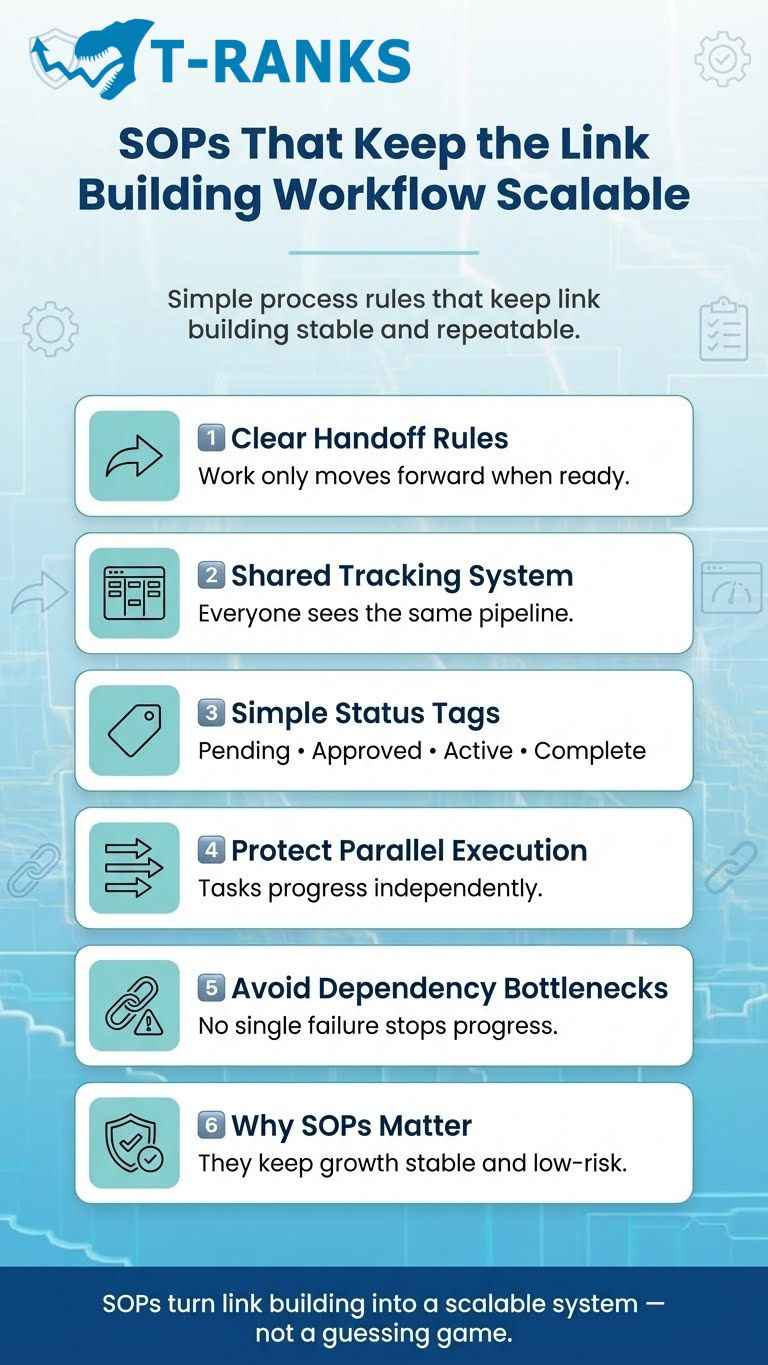
Link building involves many moving parts, including research, validation, outreach, placement, and review. Without clear SOPs, this complexity quickly leads to missed opportunities, repeated mistakes, and inconsistent patterns. SOPs exist to keep the link building workflow stable, repeatable, and safe as activity increases month after month.
This section explains how simple process rules support the triangular workflow and allow the 30-day sprint to scale without losing control.
Define Clear Handoff Rules
Every stage of the workflow should have clear rules for when work is ready to move forward. In link building, this prevents issues such as outreach starting before validation or the same opportunity being reviewed multiple times.
Clear handoff rules reduce waiting and confusion. They ensure that work moves forward based on readiness, not guesswork, keeping the monthly sprint on track.
Use a Shared Tracking System
Link building workflows rely on shared visibility. A single tracking system makes it clear which opportunities are being researched, which are approved, and which are already in outreach.
This prevents duplicate outreach, repeated sources, and misaligned efforts. Everyone can see the current state of the workflow without constant coordination.
Maintain Simple Status Tags
Status tags help manage link building at scale without adding complexity. Clear labels such as pending, approved, active, or complete make it easy to understand where each opportunity stands.
In a triangular workflow, these tags support parallel execution. Multiple tasks can move forward at the same time without overlap or conflict.
Protect Parallel Execution
SOPs should support the triangular model, not slow it down. Tasks should be allowed to progress independently as long as quality checks are met.
Safeguards prevent one stage from blocking others. This keeps outreach active, validation consistent, and research ongoing, even when one part of the workflow slows.
Avoid Dependency Bottlenecks
Scalable link building workflows avoid reliance on a single person, tool, or task. When too much depends on one stage, the entire process becomes fragile.
By separating responsibilities and maintaining shared visibility, dependency bottlenecks are reduced. Problems are identified early, and the workflow continues without disruption.
Why SOPs Matter for the 30-Day Sprint
SOPs are what make the 30-day link building sprint repeatable. They ensure that each month follows the same structure, even as campaigns, goals, and volumes change.
With SOPs in place, the workflow can grow without creating unstable link patterns or operational risk.
Once the workflow is stable and repeatable, the next step is to measure whether it is producing the right signals over time.
How to Measure a Monthly Link Building Workflow

A monthly link building workflow is working when link growth looks consistent, indexation remains stable, and rankings improve gradually without sharp spikes or drops. Measurement is not about counting links. It is about confirming that the process is producing healthy patterns over time.
This section explains what to review each month to evaluate whether the workflow is supporting long-term SEO performance.
Check Link Indexation Rate
Start by confirming whether newly placed links are being indexed. If links are not indexed, search engines cannot fully process them.
A steady indexation rate shows that links are visible and discoverable. Ongoing indexation issues often point to relevance or quality problems that should be corrected in the next sprint.
Review Outreach-to-Placement Ratio
Next, look at how many outreach attempts result in actual link placements. This ratio shows whether your targeting, validation, and outreach messaging are aligned.
A consistently low ratio usually signals issues earlier in the workflow, such as weak prospect selection or insufficient validation.
Monitor Anchor Text Diversity
Review how anchor text is distributed across new links. Check that anchors remain balanced across branded, generic, and descriptive terms.
Healthy diversity supports natural link growth. Repetition or sudden changes often indicate that adjustments are needed before continuing outreach.
Assess Referring Domain Consistency
Focus on how links are spread across different referring domains. A strong workflow builds links from a steady range of relevant sites rather than relying on the same sources repeatedly.
Over-concentration on a small set of domains can create unnatural patterns, even if individual links appear strong.
Track Ranking Stability Over Time
Instead of chasing sudden ranking jumps, monitor overall stability and gradual movement. Rankings that rise slowly and hold are a stronger signal of a healthy workflow.
Sharp spikes or drops often reflect inconsistent link activity rather than sustainable growth.
How Measurement Improves the Next Sprint
Measurement is not the final step. It feeds directly into the next 30-day sprint.
When patterns look healthy, successful actions can be repeated. When problems appear, changes can be made early. This monthly feedback loop is what turns link building from guesswork into a reliable system.
Common Workflow Mistakes That Kill Link Building Results

Most link building failures happen because the workflow breaks, not because links stop working. Even strong tactics fail when structure, validation, or review is missing. These mistakes usually do not cause immediate damage, but they quietly weaken results over time.
Running the Workflow Linearly
A common mistake is running link building in a strict sequence where one task must fully finish before the next begins. This creates waiting between stages and slows progress.
When research, validation, and outreach cannot move in parallel, momentum drops. The workflow becomes fragile, and small delays turn into major slowdowns.
Starting Outreach Before Validation
Outreach that begins before proper validation often targets poor-fit or low-quality sites. This leads to low response rates, wasted effort, and weak placements.
Validation exists to protect the workflow. Skipping it usually results in links that fail to support long-term growth.
Skipping Blitz Testing
Some teams scale outreach without first testing whether their content and positioning actually work. When early testing is skipped, small issues are repeated across many contacts.
Blitz testing is meant to catch problems early. Ignoring it increases inefficiency and makes correction harder later in the sprint.
Reusing the Same Sources Every Month
Relying on the same websites repeatedly creates visible patterns over time. Even strong links lose value when source diversity is ignored.
Healthy workflows continuously expand their pool of referring domains instead of recycling the same placements.
Ignoring Review and Cleanup
Another common mistake is focusing only on building new links and never reviewing what was placed. Broken links, indexing problems, and weak placements often go unnoticed.
Without regular review and cleanup, these issues compound across sprints and slowly reduce stability.
Why These Mistakes Matter
These mistakes rarely cause sudden ranking drops. Instead, they damage consistency, create uneven patterns, and reduce trust signals over time.
A structured workflow exists to prevent exactly these failures. When the process remains disciplined, link building becomes more predictable, scalable, and resilient.
With a clear understanding of what can go wrong, the next step is to understand who this workflow is designed for and when it makes the most sense to use it.
Who This 30-Day Link Building Workflow Is For

This workflow is designed for anyone who wants link building to be consistent, manageable, and repeatable, not random or reactive. It focuses on structure and control rather than shortcuts or one-time campaigns.
SEO Agencies
Agencies benefit from this workflow because it supports parallel execution across multiple clients. Clear weekly stages, validation steps, and reviews make it easier to manage volume without losing quality or creating bottlenecks.
The sprint structure also simplifies reporting and expectation setting.
In-House SEO Teams
In-house teams often balance link building with many other responsibilities. This workflow provides a clear monthly rhythm that helps teams stay focused without constant context switching.
Because review and cleanup are built into the process, risks are identified early instead of after problems appear.
Small but Growing Teams
Smaller teams need systems that scale without adding complexity. This workflow allows growth by organizing work, not by increasing pressure.
Clear stages and shared visibility help small teams operate efficiently even with limited resources.
Solo SEOs Using Systems
Solo SEOs can use this workflow to stay disciplined and avoid inconsistent link building. The sprint format provides structure, while the triangular model allows tasks to move forward without waiting.
This helps solo operators maintain steady progress without burnout.
New and Aged Websites
New websites benefit from the focus on consistency and validation, which helps establish trust early. Aged websites benefit from cleanup, review, and pattern control that protect existing authority.
The workflow adapts to different site stages without changing its core structure.
Conclusion – Link Building Scales Through Systems, Not Volume
Link building does not scale by doing more. It scales by doing the right things consistently within a clear system.
A 30-day sprint creates structure. A triangular workflow keeps progress moving. Together, they turn link building into a repeatable process instead of a series of disconnected efforts.
Consistent workflows outperform isolated tactics. Systems outperform tools. Stable patterns outperform short bursts. Search engines respond to how links behave over time, not to individual placements.
When link building is managed as a system, results become more predictable, risk is reduced, and growth becomes sustainable. That is what separates temporary gains from long-term SEO performance.
FAQs About Link Building Workflow
What is a link building workflow?
A link building workflow is a structured sequence of steps used to earn links consistently.
It defines how links are planned, executed, reviewed, and adjusted over time.
How is a workflow different from link building tactics?
A workflow is a system, while a tactic is a single action.
Workflows focus on consistency and long-term growth rather than one-off link placements.
Why is a link building workflow important for SEO?
Because search engines evaluate link patterns over time.
A workflow helps ensure links grow in a natural, repeatable way that aligns with how trust is measured.
Can link building work without a workflow?
Yes, but results are usually inconsistent.
Without a workflow, links often appear random, making long-term performance harder to sustain.
Do search engines evaluate links individually or as a group?
Search engines evaluate links as a group.
They look at how links behave together rather than judging single links in isolation.
Does a link building workflow reduce SEO risk?
Yes, when it is consistent and intentional.
Structured workflows help avoid sudden spikes, repetition, and unnatural link patterns.
Is a link building workflow only for large websites?
No, Small and new websites often benefit even more because consistency helps establish early trust.
How often should a link building workflow be reviewed?
Regularly, ideally every month.
Frequent review keeps link growth aligned with visibility, relevance, and content changes.
Does a workflow guarantee higher rankings?
No, but it improves reliability.
Workflows reduce randomness and help links support rankings more predictably over time.
Is link quality or consistency more important in a workflow?
Both matter, but consistency connects quality into a pattern.
High-quality links without consistency rarely produce stable results.