Why do some backlinks move rankings while others do nothing, even when they come from high-authority websites?
The answer lies in how search engines evaluate link quality. Not every backlink is treated as a meaningful recommendation. Modern search systems decide whether a link deserves trust, reduced weight, or no impact at all based on relevance, context, and its position within the broader link graph.
Link quality scoring looks beyond visible metrics. It considers whether a link fits the topic, comes from a trustworthy environment, and appears naturally within the content. Links that lack topical alignment or originate from weak link neighborhoods may have little influence, regardless of how strong they look in SEO tools.
In this guide, you will learn how link quality scoring works in 2026. We explain PageRank in simple terms, clarify what metrics like DR and TF actually measure, and show how link graph signals reveal how search engines evaluate links in real conditions. By the end, you will be able to assess backlinks more accurately and build links that support stable, long-term rankings.
What Does “Link Quality Scoring” Actually Mean?

Link Quality Scoring is a descriptive term used in SEO to explain how search engines evaluate whether a backlink should influence rankings.
It is not an official Google metric, and it is not a score that website owners can see or measure.
Search engines like Google do not assign a visible number to links. Instead, they continuously assess links to decide whether a backlink represents a genuine recommendation or something that should be ignored. This evaluation happens automatically and in context, not through a single score.
SEO tools display numbers such as Domain Rating or Trust Flow to estimate parts of a backlink profile. These numbers are useful for comparison, but they are simplified models. They do not represent how Google actually evaluates links.
Link value depends on where and how a link appears. A link from the same website can be helpful on one page and weak on another. Relevance to the topic, placement within the content, and the quality of surrounding links all affect how a backlink is interpreted.
In simple terms, Link Quality Scoring exists to separate real endorsements from artificial links.
It ensures that search results are influenced by relevance and trust rather than link volume or inflated metrics.
What Search Engines Look at When Evaluating Link Quality
Search engines evaluate link quality by interpreting whether a backlink represents a genuine recommendation that improves search results for users. Links are not counted equally. Instead of relying on a single score, search engines examine multiple signals together to decide how much value a link should pass or whether it should be ignored entirely.
These signals are not checked in isolation. Their importance depends on context, intent, and how they interact with each other.
Relevance
Relevance determines whether the linking page and the target page meaningfully relate to the same topic. Links that fit naturally within the subject matter of both pages tend to carry more value than links from unrelated sites, even when those sites appear strong by third-party metrics. Relevance sets the baseline for whether a link is worth considering at all.
Trust
Trust reflects how safe and reliable the linking source appears over time. Domains with clean histories, stable publishing behavior, and connections to reputable sites tend to pass stronger trust signals. Pages associated with spam tactics, unstable link patterns, or repeated manipulation attempts weaken link quality, regardless of other strengths.
Authority
Authority describes how influential a page or site has been based on earned recognition from other trusted sources. Pages that consistently attract natural citations support stronger link signals. However, authority alone cannot compensate for weak relevance or low trust. It amplifies value only when those foundations are already present.
Context
Context explains why a link exists and how it is presented. Editorial links placed naturally within the main content signal intentional recommendations. Search engines also evaluate anchor text usage, alignment with page intent, and whether the link adds real informational value rather than serving as decoration or manipulation.
Network and Link Graph Position
Links are evaluated within a broader network, not as isolated events. Search engines assess whether a site belongs to a healthy, topic-focused ecosystem or an artificial cluster created primarily for linking. Links from well-connected, relevant neighborhoods tend to be trusted more than links from isolated or manipulative networks.
Pattern Consistency Over Time
Search engines observe how links appear and persist. Gradual growth from diverse, relevant sources signals organic authority development. Sudden spikes, repeated patterns from the same domains, or excessive reciprocal linking can weaken link quality, even when individual links appear acceptable.
Together, these signals form the foundation of how modern search engines evaluate backlinks. Understanding this multi-signal interpretation makes it easier to see why early systems like PageRank focused on link relationships and how that original model evolved into today’s more context-aware evaluation methods.
PageRank (PR): How Google Originally Measured Link Value
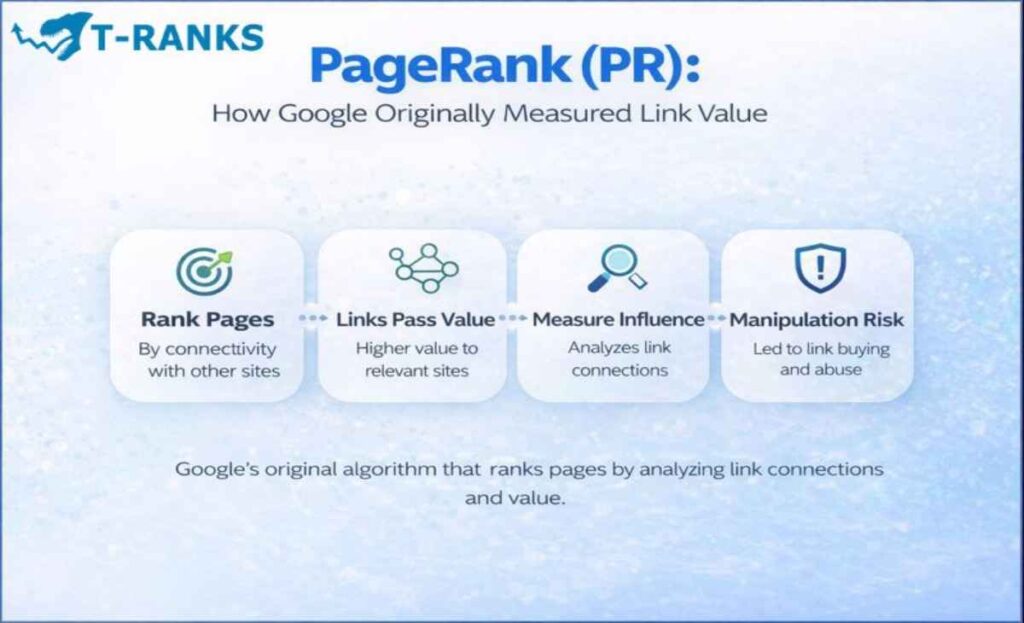
PageRank is Google’s original system for estimating the importance of a web page based on how links connect pages across the web.
In simple terms, it models how influence and attention flow through hyperlinks, helping search engines decide which pages are more likely to matter when many pages cover similar topics.
PageRank was introduced to move beyond keyword matching. Google treated links as endorsements, assuming that pages referenced by important pages were more useful to users.
Purpose of PageRank
PageRank was created to solve a fundamental search problem: how to rank pages when many of them discuss the same subject. Instead of relying only on on-page content, Google evaluated how pages were connected.
If a page was cited by other influential pages, it was assumed to carry higher importance. This allowed Google to surface pages that the web itself appeared to value, not just pages that were well optimized.
Link Equity Flow Concept
PageRank introduced the idea that links pass value. Each page holds a limited amount of influence that is distributed through its outbound links.
A page that links selectively passes more influence per link, while a page that links to many destinations divides that influence. This is why link placement, editorial context, and outbound link volume affect link strength, even today.
Why PageRank Measures Influence, Not Authority
PageRank measures how connected a page is within the web graph, not how knowledgeable, accurate, or trustworthy the content is.
A page can accumulate high PageRank simply because many sites link to it, even if it lacks topical depth or expertise. This limitation is critical. PageRank alone cannot evaluate relevance, trust, or content quality, which is why Google never relied on it as a standalone ranking signal.
Why Public PageRank Disappeared
Google once displayed PageRank publicly through its toolbar. This transparency led to manipulation. Links were bought and sold purely based on visible scores, distorting ranking quality.
To reduce abuse, Google removed public PageRank and retained it as an internal signal. From that point forward, PageRank continued to operate behind the scenes, combined with other evaluation systems.
PageRank in Modern SEO
PageRank still exists inside Google’s ranking systems, but it is no longer visible and no longer used in isolation.
Over time, Google refined PageRank with additional weighting factors such as link placement, trusted sources, topical relevance, and contextual signals. Today, PageRank acts as a foundational layer that supports broader systems focused on relevance, trust, and link graph relationships.
Important Clarification About PageRank Today
There is no public Google PageRank metric.
Any PageRank-style numbers shown in SEO tools are not Google data. Platforms such as Ahrefs, Semrush, Moz, and Majestic create their own link metrics using independently crawled web data.
These tools attempt to model link influence using partial link graphs, not Google’s full index.
How Third-Party PageRank-Style Metrics Differ From Google PageRank
Third-party tools calculate PageRank-like or authority metrics based on what they can crawl, not on how Google actually evaluates links.
When a tool shows a PR-style or authority score, it usually represents:
- Relative link popularity within that tool’s dataset
- The number and perceived strength of linking domains
- Estimated link equity distribution based on outbound links
These metrics do not measure:
- Whether Google crawls the link
- Whether Google trusts the source
- Whether the link fits a relevant topical graph
- Whether the link influences rankings
As a result, third-party PageRank metrics are best used for comparison and filtering, not as indicators of real ranking impact.
This distinction explains why PageRank alone cannot define link quality and why modern link evaluation depends on additional signals such as relevance, trust, and link graph position, which are covered in the next section.
Domain Rating (DR): Measuring Link Popularity at Scale
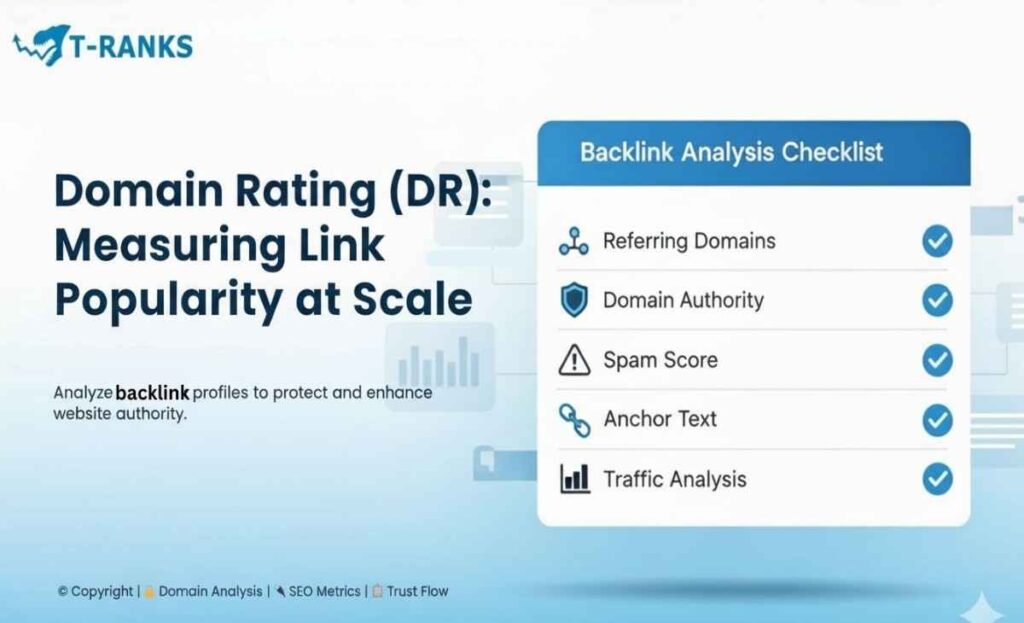
Domain Rating, commonly referred to as DR, is a third-party metric developed by Ahrefs to estimate how popular a website is based on its backlink profile. It is widely used in SEO because it offers a simple way to compare link strength across domains, even though it is not used by search engines as a ranking factor.
What DR Measures
Domain Rating measures backlink popularity at the domain level. It focuses on how many unique websites link to a domain and how strong those linking sites appear within Ahrefs’ own link index. Multiple links from the same domain contribute less than links from multiple unique domains.
DR also accounts for outbound link dilution. If a strong site links to thousands of other domains, the value passed to each one is reduced. This helps explain why not all high-DR links perform equally.
DR uses a logarithmic scale. Moving from DR 70 to 80 is far harder than moving from DR 10 to 20. This makes high DR scores increasingly rare and difficult to achieve.
Why DR Often Correlates With Rankings
DR often correlates with rankings because backlinks themselves are a confirmed ranking signal. Websites that attract consistent editorial links usually gain stronger backlink profiles over time, which increases their DR.
Search engines such as Google do not use DR in their algorithms. The correlation exists because both Google and SEO tools measure similar underlying behavior: real sites earning real links tend to perform better in search.
DR as a Comparative Popularity Metric
DR is most effective when used for comparison. SEO teams use it to benchmark their sites against competitors, evaluate outreach opportunities, and track backlink growth over time.
A related metric is Domain Authority, or DA, developed by Moz. DA serves a similar purpose by estimating ranking potential based on backlinks. Like DR, DA is a third-party metric and is not used by Google. These metrics remain useful because high-quality, well-established websites often show stronger DR or DA scores in practice.
Limitations and Manipulation Risks
DR does not measure relevance, trust, or editorial intent. It can be manipulated through artificial link building, expired domains, or private link networks. This is why some high-DR sites have little organic traffic or weak topical focus.
Trust Flow (TF): Measuring Trust, Not Strength
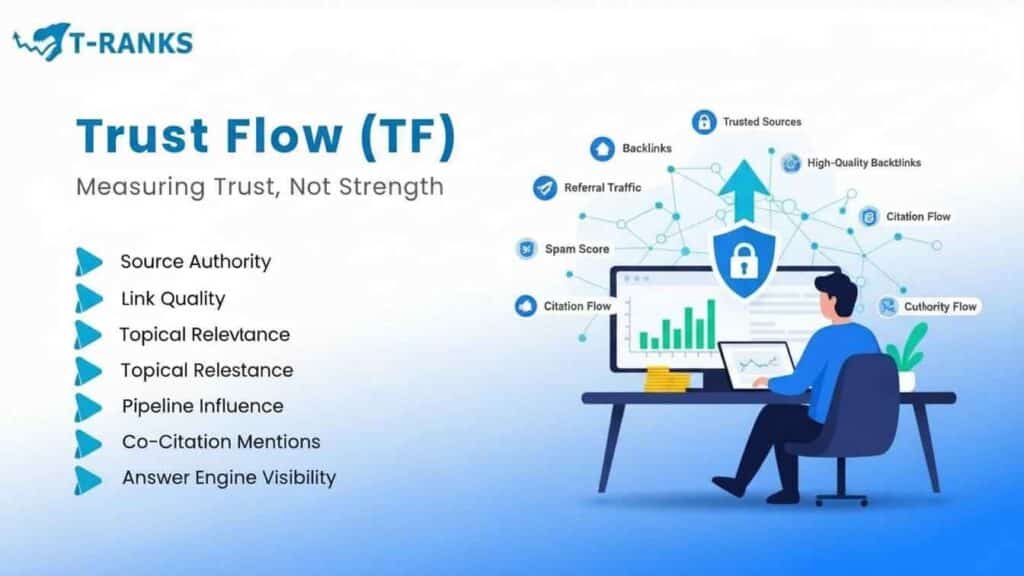
Trust Flow, or TF, is a third-party metric developed by Majestic to estimate how trustworthy a website’s backlink profile appears. Unlike popularity-based metrics, TF focuses on link quality and safety rather than link volume or strength.
Seed Site Concept
Trust Flow is built around a curated set of trusted seed sites. These include highly reliable domains such as universities, government websites, and established news organizations. These seed sites act as trust anchors within Majestic’s link index.
Websites that receive links directly or indirectly from these trusted sources inherit trust signals. The closer a site is to these seed sites through clean editorial links, the stronger its Trust Flow tends to be.
Trust Distance Explanation
Trust decreases as the distance from seed sites increases. A direct link from a trusted source passes strong trust. Each additional link step reduces that trust signal. This decay model makes it difficult for spam-heavy or artificial networks to achieve high Trust Flow scores.
Trust distance helps identify whether a domain belongs to a healthy link neighborhood or sits near low-quality or manipulative ecosystems.
TF as a Risk-Filtering Metric
Trust Flow is best used as a risk-filtering and diagnostic metric, not as a predictor of ranking power. It helps identify domains that may look strong by popularity metrics but carry hidden risk due to poor link neighborhoods or spam associations.
Majestic also provides Topical Trust Flow, which shows whether trust is concentrated within a specific subject area. This adds another layer of safety when evaluating link relevance.
Trust Flow is not used by search engines such as Google. It is a third-party approximation designed to support link audits and safer link selection. In practice, TF is most effective when combined with relevance and popularity checks rather than used in isolation.
Why SEO Tool Link Scores Don’t Match Google Rankings
SEO tool link scores often fail to match Google rankings because tools estimate link popularity using limited datasets, while Google evaluates links inside a live ranking system that also measures relevance, entities, and overall quality. Treating metrics like DR, DA, or TF as ranking scores leads to misunderstanding what actually drives search performance.
Different Goals Lead to Different Evaluations
SEO tools are designed to summarize backlink profiles into simple numbers for comparison. Google’s goal is fundamentally different. It aims to rank the best possible result for a specific query. A page can have strong link metrics and still underperform if the content does not match search intent, lacks depth, or fails to provide the most useful answer.
Search Index Coverage Is Not the Same
SEO tools crawl and maintain their own partial web indexes. Google operates at a much broader scale and discovers links through significantly more paths. This gap creates common mismatches, such as tools counting links Google never values, Google using links tools have not yet discovered, and tools displaying outdated link data that Google has already re-evaluated.
Static Metrics Cannot Reflect a Live Ranking System
Most SEO tools update their metrics on fixed schedules. Google reprocesses ranking signals continuously as pages change, links appear or disappear, and behavioral patterns shift. A link can inflate a tool’s score while contributing little to rankings, or influence rankings before it even appears in third-party reports.
Tools Do Not Interpret Entities and Topical Meaning
SEO tools mainly score connections between URLs and domains. Google interprets links as relationships between entities such as brands, topics, organizations, and authors. A link that reinforces topical relevance within a niche can outperform a numerically stronger link that does not strengthen entity meaning.
User and Quality Validation Signals Are Missing
Third-party tools do not have access to many real-world quality signals that influence rankings. They cannot reliably assess whether content satisfies user intent, appears credible, or aligns with broader trust patterns. This is why pages with impressive metrics can still struggle when overall quality signals are weak.
Manipulation Creates False Authority in Tool Metrics
Metrics like DR and DA can be artificially inflated through expired domains, private networks, and paid placements. This often produces a clear mismatch, high tool scores paired with low rankings and limited real visibility. Google can discount or neutralize these signals even while tool metrics remain high.
Google Interprets Relationships While Tools Grade Links
The core difference is conceptual. SEO tools grade links using simplified formulas. Google evaluates whether links make sense inside a broader system of relevance, trust, and context. Tools measure link popularity. Google measures link meaning within the web graph.
Link Graph Metrics: How Google Evaluates Links in Reality
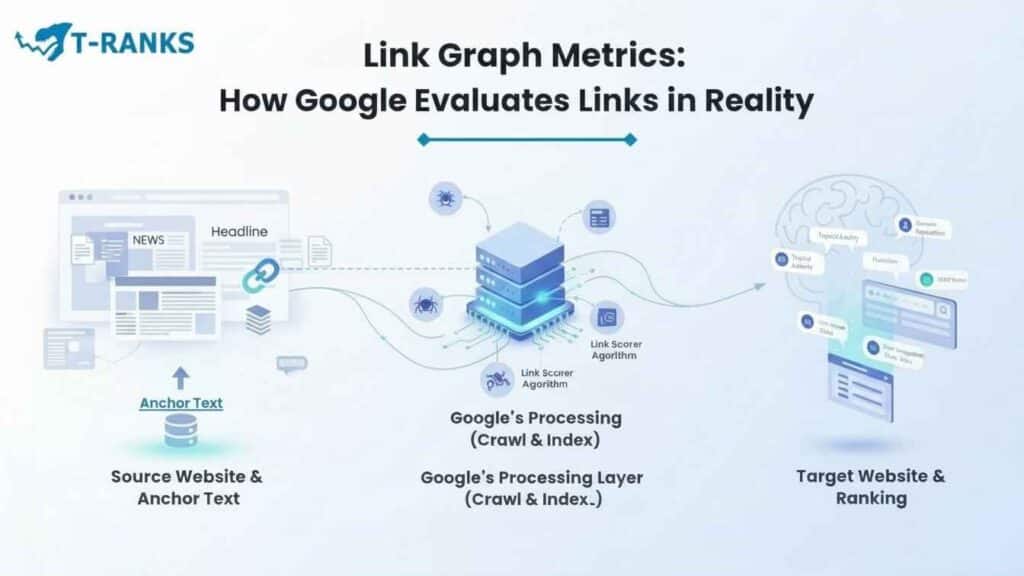
Google evaluates links by analyzing how they behave inside the web graph, not as isolated signals. In practice, link value is shaped by relevance, trust propagation, contextual placement, and network patterns that indicate whether a backlink strengthens a real topical relationship or looks like manipulation.
Links Are Interpreted Inside the Web Graph
Google models the web as a connected link graph where pages and sites form relationships across topics. A backlink has limited meaning on its own. Its value increases when it reinforces an existing topical connection and aligns with how trusted sites naturally reference each other. Links that do not fit any clear relationship in the graph are more likely to be discounted.
Nodes, Hubs, and Topical Link Neighborhoods Shape Value
Each page is a node. Pages that consistently cite high-quality, relevant sources act as hubs. Clusters of related nodes form topical link neighborhoods. Healthy neighborhoods show consistent subject focus, natural linking behavior, and stable site purpose. Unhealthy neighborhoods show scattered topics, excessive outbound links, and repeated patterns that resemble artificial link networks. Links originating from strong hubs inside clean topical neighborhoods tend to carry more weight.
Trust Propagation and Distance From Trusted Sources
Google evaluates trust through propagation. Sites that sit closer, directly or indirectly, to highly trusted sources tend to inherit stronger trust signals. As distance increases, trust decays. Sites located deep inside low-trust neighborhoods or spam-heavy clusters are more likely to have their outbound links suppressed or neutralized, even if they look strong in third-party metrics.
Reasonable Surfer Weighting and Contextual Link Placement
Not every link is treated equally. Google uses placement and usability signals, often described through the reasonable surfer model, to estimate how likely a user is to notice and follow a link. Editorial links placed naturally within main content tend to carry more value than links in footers, sidebars, author boxes, or templated blocks. This contextual weighting helps Google separate genuine editorial endorsements from automated or paid placements.
Topical Interconnectivity Reinforces Relevance
Google looks for topical reinforcement across the link graph. When sites within the same subject area reference each other in a consistent, natural way, it strengthens the topical cluster and clarifies entity relationships. Links that repeatedly jump across unrelated niches weaken topical clarity. In large patterns, off-topic linking can signal manipulation and lead to discounting.
Outbound Link Environment Signals Intent
A backlink is evaluated within its outbound link environment. Pages that link out sparingly and cite credible, relevant sources tend to pass stronger signals. Pages that link to unrelated industries, low-quality sites, or obvious paid placements can reduce the quality of every outbound link on that page. This is why two links from the same domain can perform very differently depending on surrounding outbound links and page intent.
Link Patterns Over Time and Link Velocity Consistency
Google also evaluates temporal patterns such as link velocity and consistency. Natural sites gain links steadily, often tied to genuine visibility, content updates, or brand growth. Manipulative patterns, including sudden spikes from unrelated domains, repetitive anchor patterns, or bursts from low-trust neighborhoods, reduce long-term trust. Stable historical patterns increase confidence that links deserve lasting value.
Together, these link graph signals explain why modern link evaluation depends on ecosystem fit and relationship quality rather than raw link metrics alone. With this foundation, it becomes easier to understand how topical authority forms inside the link graph and why entity reinforcement often matters more than domain-level scores.
Topical Authority Inside the Link Graph
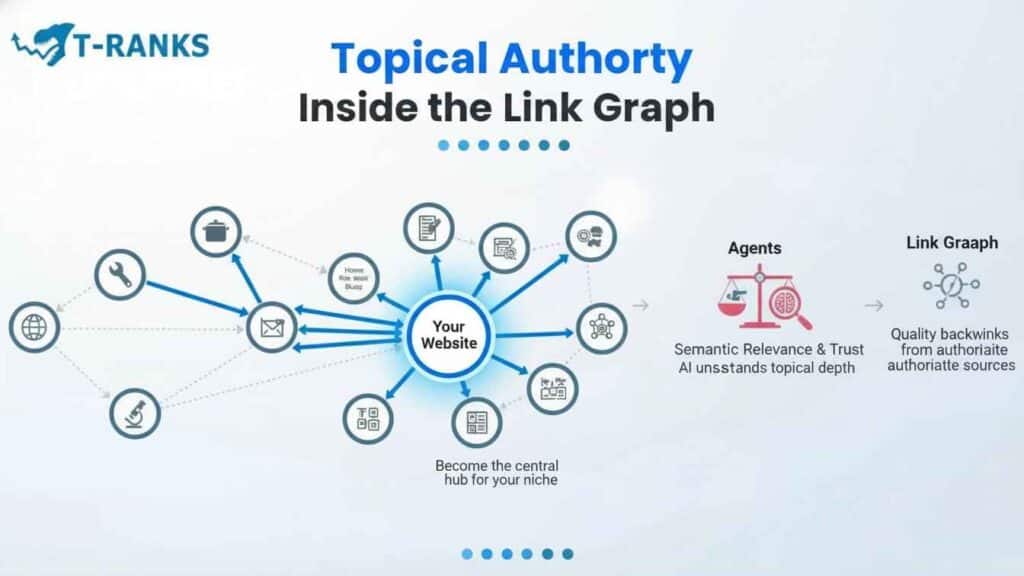
In 2026, topical authority is one of the main ways Google interprets the link graph. Instead of only tracking who links to whom, Google focuses on who links to whom about a specific subject. This helps search engines understand expertise, not just popularity.
Topical Relevance vs Topical Noise
Topical relevance is built when a site consistently earns links from pages that discuss closely related subjects. These links reinforce a clear theme and help search engines associate the site with a specific area of knowledge.
Topical noise appears when links come from unrelated industries or mixed topics. Even if those links come from strong domains, they blur subject focus. Too much noise makes it harder for search engines to confidently rank a site for targeted queries.
Semantic Interconnectivity Signals Expertise
Search engines look at how ideas, concepts, and topics connect across content and links. When pages and backlinks support related subtopics, they form a clear topical cluster inside the link graph.
This pattern signals depth. Sites that cover a subject from multiple connected angles are seen as more authoritative than sites with scattered or unrelated content.
Entity Consistency Across Linking Sources
Entity consistency means that different websites reference your brand, product, or service in the same topical context. When multiple trusted sources describe you using similar language and entities, your role within the topic becomes clearer.
When links reference you in unrelated contexts, this clarity weakens. Even strong metrics cannot fully compensate for inconsistent topical signals.
Why Relevance Often Matters More Than Raw Authority
Within the link graph, relevance often outweighs raw authority. A link from a smaller site that is tightly focused on your topic can provide more value than a generic link from a large but unfocused domain.
Topically aligned links strengthen subject ownership. High authority without alignment adds less clarity and leads to weaker, less stable ranking signals.
Structure Reinforces Topical Authority
Topical authority is strengthened by clear structure. Logical internal linking between related pages helps search engines understand how topics connect and which subjects the site specializes in.
Well-organized content creates clean crawl paths, reinforces subject depth, and improves how external links are interpreted inside the broader link graph.
Together, these signals explain why topical authority plays a central role in modern link evaluation. Search engines reward sites that clearly demonstrate subject ownership, not those that simply collect high-metric links.
How Context Changes the Value of a Link
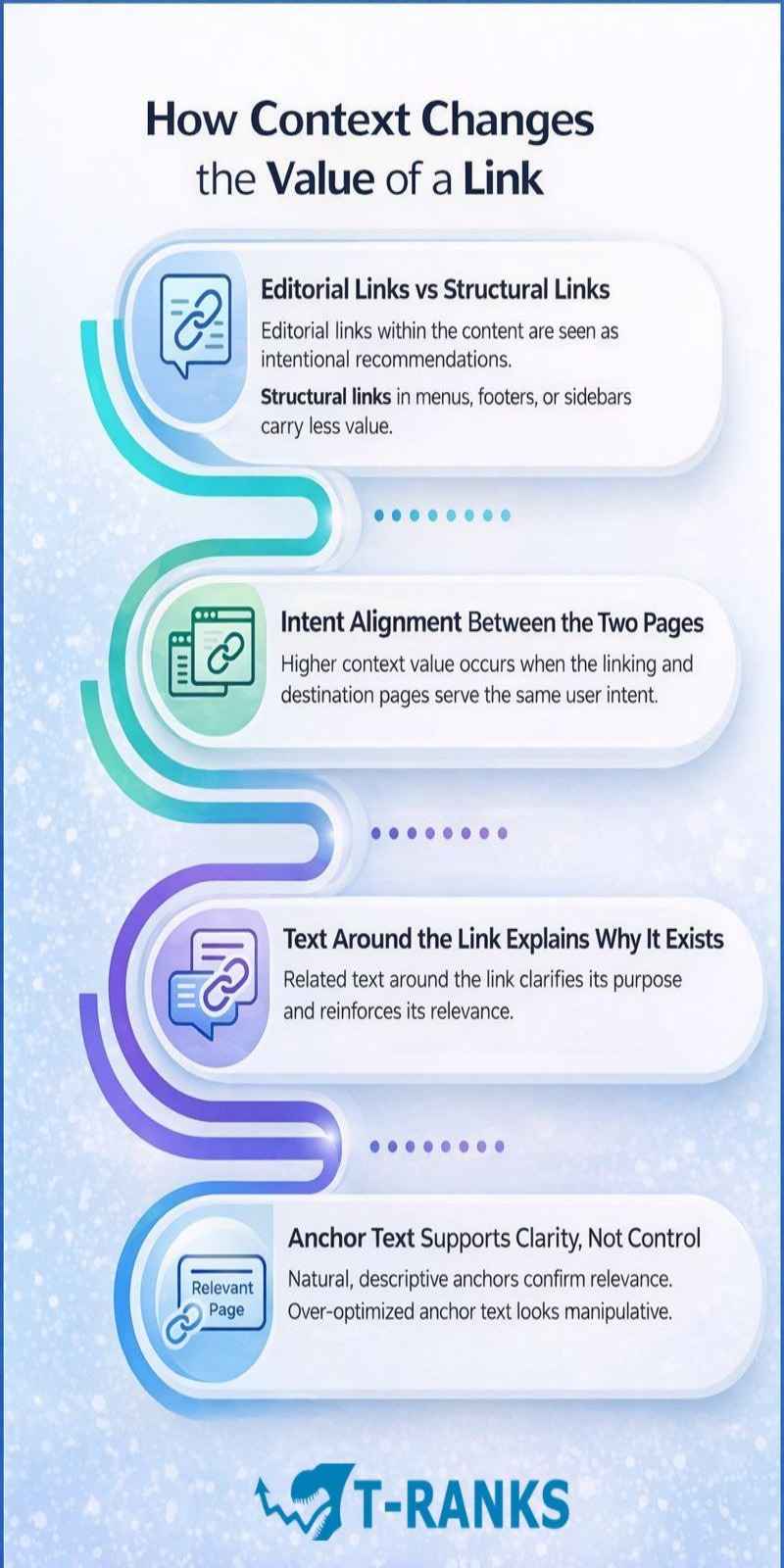
In 2026, a link’s value depends on how naturally it fits the page, the topic, and the user’s expectations, not just the authority of the domain. Search engines evaluate context to decide whether a link looks like a genuine recommendation inside the content or a low-impact structural reference.
Let me provide more details how context changes value of a link.
Editorial Links vs Structural Links
Editorial links are placed inside the main content to support a point or guide readers to related information. Because they appear where users actually read, they are more likely to be interpreted as intentional recommendations.
Structural links appear in menus, footers, sidebars, or repeated templates. These links help navigation and discovery, but they usually carry less weight as endorsements because they are not placed to support a specific argument or topic.
Intent Alignment Between the Two Pages
Context improves when the linking page and the destination page serve the same user goal. If a user would naturally expect that link while reading, search engines have more reason to treat it as meaningful.
When intent is mismatched, the link feels less useful. Even links from strong domains can lose value if they connect pages that serve different purposes or audiences.
The Text Around the Link Explains Why It Exists
Search engines analyze the sentence and paragraph around a link to understand what relationship it suggests. Clear, relevant surrounding text makes the link easier to interpret and strengthens topical connections.
Links placed inside related discussions tend to reinforce topical clusters. Links dropped into unrelated paragraphs tend to look weaker, even if the domain is strong.
Anchor Text Supports Clarity, Not Control
Anchor text gives context about what the destination page is about. Natural, descriptive anchors help confirm relevance.
Over-optimized or repetitive exact-match anchors can look unnatural. Strong link profiles usually include a mix of branded, descriptive, and neutral anchors that match real writing patterns.
User Interaction Can Reinforce Usefulness
Search engines can use engagement signals to understand whether users find a link helpful. Links that attract genuine clicks and lead to useful outcomes can align with stronger trust signals over time.
Links that consistently lead to poor experiences can lose practical impact, even if they remain visible in third-party reports.
Outbound Link Environment Affects Trust
A link is evaluated alongside other outbound links on the same page. Pages that cite a small number of relevant, credible sources tend to look more selective.
Pages filled with unrelated or low-quality outbound links weaken the value of every link they contain, because the linking page looks less trustworthy.
Together, these context signals explain why link placement, intent, and environment matter as much as the source domain. A backlink delivers the most value when it fits naturally within the content and supports the reader’s purpose.
How to Evaluate Link Quality in 2026
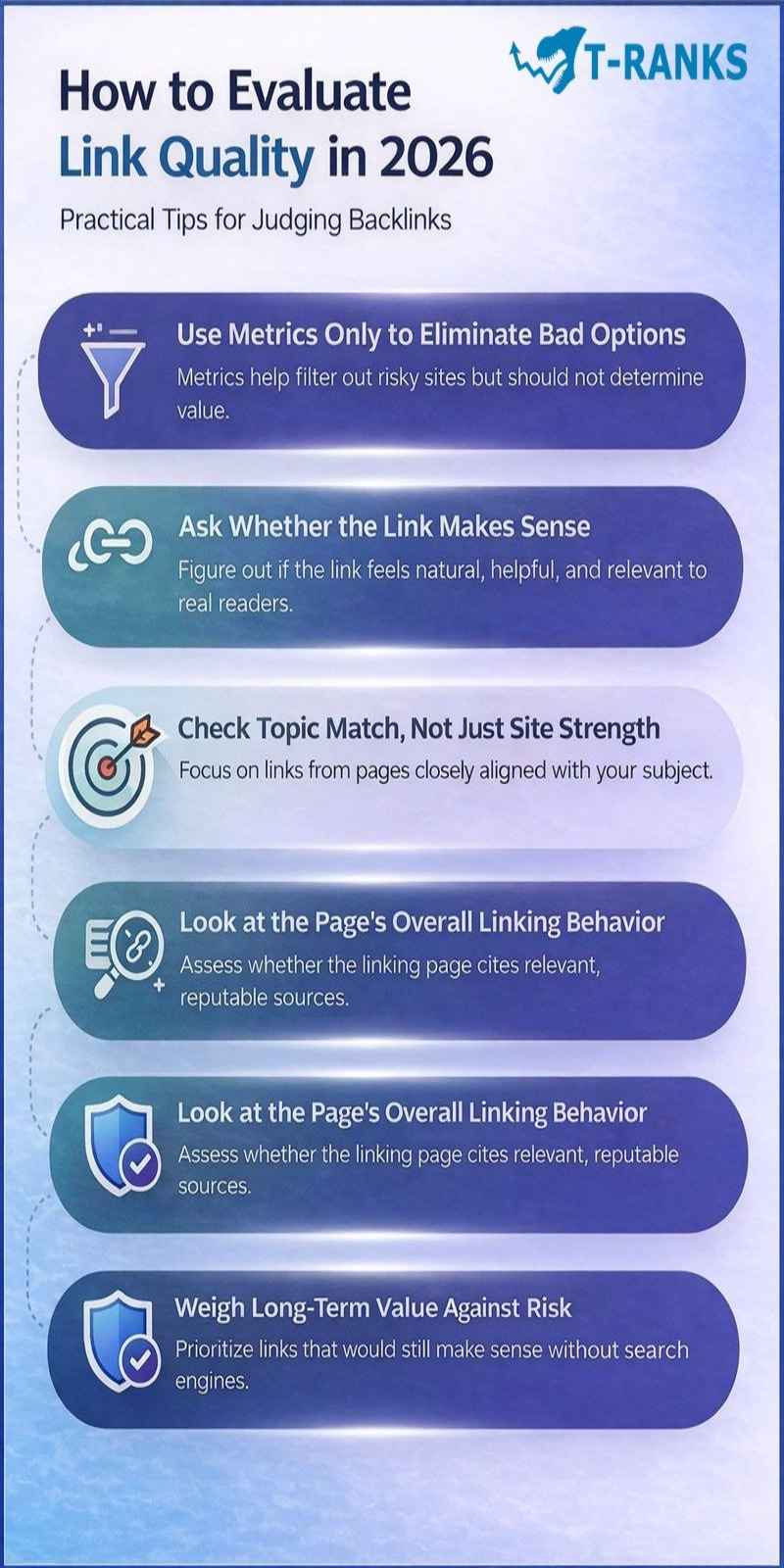
In 2026, evaluating link quality means deciding whether a backlink will strengthen your site’s subject credibility over time, not whether it boosts a visible metric. A good link should make sense to a real reader and fit naturally within your topic, even without thinking about search engines.
The points below offer a simple way to judge link quality using practical, real-world judgment rather than tool scores.
Use Metrics Only to Eliminate Bad Options
Metrics like DR, DA, and TF are useful at the very beginning, but only as basic filters. They help you avoid clearly weak, spammy, or risky sites.
A high metric does not mean a link is valuable. It only shows popularity inside a tool’s database. Once a site clears a basic quality threshold, metrics should stop influencing the decision.
Ask Whether the Link Makes Sense to a Reader
A simple test works well. If a real person read the page, would the link feel natural and helpful?
Strong links usually:
- Appear inside the main content
- Support the topic being discussed
- Lead to a page that expands the idea naturally
If the link feels forced, promotional, or unrelated, search engines are likely to see it the same way.
Check Topic Match, Not Just Site Strength
A link from a smaller site that focuses on your subject can be more valuable than a link from a large site that covers everything.
Good links usually come from pages that:
- Talk about the same subject
- Serve a similar audience
- Share a clear informational purpose
When topic alignment is weak, link value drops quickly.
Look at the Page’s Overall Linking Behavior
Do not judge a link alone. Look at the page it sits on.
High-quality pages usually:
- Link out sparingly
- Reference credible, relevant sources
- Avoid obvious link selling
Pages filled with unrelated or low-quality outbound links reduce the value of every link they contain.
Decide Whether the Link Strengthens Your Position
Before asking “How strong is this link?”, ask:
- Does this link clarify what my site is about?
- Does it support my existing topic focus?
- Does it come from a clean, relevant environment?
If a link adds clarity, it usually adds value. If it adds noise, it weakens your profile, even if metrics look good.
Weigh Long-Term Value Against Risk
Every link carries both benefit and risk. Low-effort links often bring little upside and higher exposure to future algorithm adjustments.
Safer links are usually:
- Earned through real content or collaboration
- Relevant to your topic
- Consistent with how natural sites link
A good rule is simple.
If the link would still make sense in a world without search engines, it is probably a good link.
Final Comparison: PR vs DR vs TF vs Link Graph Metrics
By 2026, link evaluation has moved beyond raw popularity and visible scores. Modern search systems interpret links through multiple layers, including relevance, trust, context, and long-term consistency. The comparison below explains how the four most common link evaluation models differ in purpose and limitation.
How Each Link Metric Actually Works
PageRank (PR)
Origin: Google, internal system
Core focus: Distribution of link influence
Key strength: Forms the foundation of how Google measures how influence flows across the web
Main limitation: Not publicly visible and cannot be measured directly
Domain Rating (DR)
Origin: Ahrefs
Core focus: Link popularity at scale
Key strength: Useful for quick competitive benchmarking and understanding backlink volume
Main limitation: Easily inflated and ignores topical relevance, intent, and trust quality
Trust Flow (TF)
Origin: Majestic
Core focus: Trust proximity
Key strength: Helpful for identifying spam risk and weak or manipulated link environments
Main limitation: Does not predict rankings or topical alignment on its own
Link Graph Metrics
Origin: Modern search and AI ranking systems
Core focus: Context and relationship fit
Key strength: Evaluates whether links function as real editorial endorsements within a topical network
Main limitation: Not exposed as a numerical score and requires qualitative analysis
How to Interpret Each Metric in Practice
For competitive benchmarking
Domain Rating can help you understand whether competitors operate at a larger link scale. This sets expectations, but it should never determine which links you pursue.
For spam auditing and risk awareness
Trust Flow is useful for spotting risky link environments. Large gaps between link volume and trust often indicate manipulation rather than opportunity.
For modern link decisions
Link graph context matters most. Search engines prioritize links that reinforce topical relevance and clarify entity relationships. A tightly aligned link from a smaller site often delivers more value than a high-metric link from an unrelated publisher.
The 2026 Rule for Evaluating Links
Metrics are diagnostic references, not ranking signals. Search engines do not use DR or TF directly. The most valuable links are those that are editorially placed, topically aligned, trusted by their surrounding environment, and genuinely useful to readers.
No numerical score can replace a link that fits naturally within relevant content, attracts engaged visitors, and strengthens clear topical authority over time.
Conclusion
Link quality scoring in 2026 is no longer about chasing higher metrics. It is about building relevance, trust, and meaningful relationships within the link graph. PageRank explains how link influence flows, Domain Rating helps compare link popularity, and Trust Flow highlights risk, but none of these alone reflect how modern search systems evaluate links.
Search engines prioritize topical alignment, contextual placement, clean link neighborhoods, and real user value. Links perform best when they reinforce clear subject expertise, fit naturally within content, and function as genuine editorial recommendations rather than artificial signals.
The strongest link profiles are built by using metrics as filters, applying careful manual evaluation, and prioritizing graph fit over volume. This approach creates durable authority that remains stable across algorithm updates and AI-driven search experiences.
If you want to apply these principles with precision and build links that genuinely influence rankings, explore how T-RANKS helps brands earn high-quality, topically aligned backlinks designed for modern search systems.
FAQs About Link Quality Scoring
1. What is link quality scoring in SEO?
Link quality scoring describes how search engines decide whether a backlink should influence rankings or be ignored. It is based on relevance, trust, context, and position within the link graph, not on a single visible score.
2. Does Google use Domain Rating (DR) or Trust Flow (TF)?
No, Google does not use DR or TF as ranking factors. These are third-party metrics created by SEO tools to estimate popularity or trust, not Google’s internal signals.
3. Is PageRank still used by Google in 2026?
Yes, PageRank is still used internally by Google. It functions as a link influence distribution system and operates alongside many other ranking signals.
4. Why isn’t PageRank enough to judge link quality?
PageRank measures how influence flows through links, not relevance or intent. On its own, it cannot evaluate topical alignment, trustworthiness, or contextual meaning.
5. What does Domain Rating (DR) actually measure?
Domain Rating measures backlink popularity at the domain level. It compares how many strong domains link to a site, not how relevant or editorial those links are.
6. What is Trust Flow (TF mainly used for?
Trust Flow is mainly used to assess link risk and spam exposure. It estimates how close a site is to trusted seed sources rather than predicting ranking strength.
7. Why do high DR links sometimes have little or no ranking impact?
High DR links can lack relevance, context, or proper placement. If a link does not fit within the right topical link graph, popularity alone adds limited value.
8. Can low DR links still help rankings?
Yes, low DR links can help when they are highly relevant and well placed. Topical alignment and clean link neighborhoods often matter more than raw metrics.
9. What are link graph metrics in simple terms?
Link graph metrics evaluate links based on how they fit within a network of related sites. Search engines focus on relationships and context rather than isolated link strength.
10. How does topical authority affect link quality?
Topical authority strengthens link quality by reinforcing relevance across related sources. Links from consistently focused sites carry more weight than links from unrelated authorities.
11. Why don’t SEO tool link scores match Google rankings?
SEO tools rely on partial web data and static crawls. Google evaluates links dynamically using a broader link graph, entity relationships, and quality signals.
12. How should link quality be evaluated in 2026?
Link quality should be judged by relevance, trust, context, and graph fit. Metrics should be used only as filters, with emphasis on topical authority and editorial value.