LLM-friendly backlinks are now a key signal in modern search. AI systems decide which sources are safe to cite before showing any answer. Tools like ChatGPT, Google AI Overviews, Gemini, and Perplexity rely on backlinks to judge trust, relevance, and accuracy.
LLM-friendly backlinks are not about link volume or manipulation. They work as external validation signals. A link from a credible and relevant source helps AI systems understand what your page covers. It also confirms that your information matches other trusted sources and can be safely summarized or cited.
This matters to SEO professionals, publishers, and site owners. Visibility is no longer limited to rankings. Appearing in AI-generated answers now depends on clear expertise and consistent references across the web.
In this article, you will learn what LLM-friendly backlinks are, how AI systems evaluate them, and how to build backlinks that improve both search visibility and AI citation potential.
What Is an LLM-Friendly Backlink?
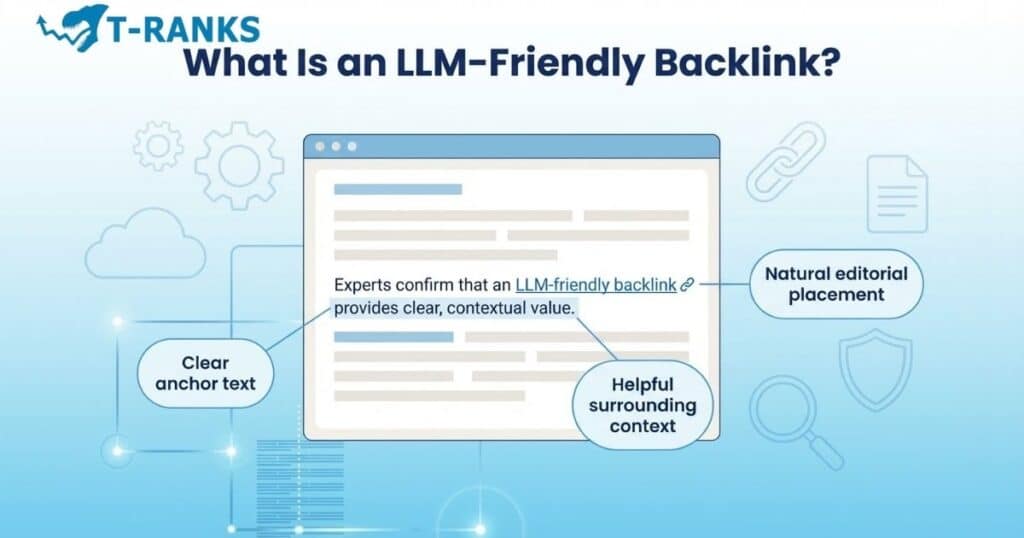
An LLM-friendly backlink is a clear, natural link that helps AI systems understand what a page is about and decide whether it is trustworthy enough to cite in their answers.
These links help tools like ChatGPT, Gemini, Perplexity, and Google AI confirm what your page is about and whether it is reliable enough to reference in their answers.
In simple terms:
An LLM-friendly backlink clearly explains why your page deserves to be cited.
How It Looks in Practice
LLM-friendly backlinks usually include:
- Anchor text that accurately reflects the page topic
- Relevant surrounding text that explains why the link is useful
- Natural placement within a sentence or paragraph
- No keyword stuffing or forced phrasing
- Simple language that is easy for AI systems to extract
These qualities help AI assistants understand context, evaluate trust signals, and confidently pull information from your page.
One Simple Example
Imagine you publish an article titled:
“Best Beginner Exercises for Weight Loss”
Another website writes:
“Many trainers recommend starting with simple routines. A helpful guide on beginner exercises for weight loss explains how walking and light cardio support steady progress.”
The phrase “beginner exercises for weight loss” links to your article.
This is an LLM-friendly backlink because:
- The anchor text clearly describes the topic
- The link fits naturally into the sentence
- The surrounding text provides helpful context
- AI systems can understand the purpose of the link without guessing
Key Takeaway
An LLM-friendly backlink is not about manipulation or keyword density.
It is about clarity, relevance, and trust.
When a link clearly explains what your content covers and why it is useful, AI systems are far more likely to treat your page as a credible source for answers. This makes LLM-friendly backlinks essential for both search visibility and AI-generated answer visibility.
Why LLM-Friendly Backlinks Matter in 2026

In 2026, LLM-friendly backlinks matter because AI assistants must verify information before presenting it as an answer. As search continues to shift toward direct responses, assistants rely on strong backlink signals to identify which sources are reliable, credible, and safe to reference.
These backlinks influence visibility not only in traditional organic search results but also inside responses generated by ChatGPT, Perplexity, Google AI Overviews, and Bing Copilot.
Key Reasons LLM-Friendly Backlinks Are Critical
Foundation of trust and credibility
Backlinks function as third-party validation. When trusted websites link to your content, AI systems interpret this as a signal that your information is dependable, which helps reduce misinformation and improve answer accuracy.
Essential for AI citations
AI assistants are far more likely to evaluate, extract, and cite content that already demonstrates authority through relevant backlinks. Pages with stronger backlink profiles consistently show higher visibility across both organic results and AI-generated summaries, reinforcing the connection between authority and citation eligibility.
Validation of expertise and E-E-A-T
LLMs look beyond writing quality and focus on external proof of expertise. Backlinks from respected industry sources provide clear evidence of experience, credibility, and subject-matter authority.
Contextual understanding and entity recognition
AI systems analyze the context surrounding a backlink, not just the link itself. When links come from niche-aligned, topically relevant sources, they strengthen entity signals and help assistants understand what topics your brand is known for.
Differentiation from generic content
With an increasing volume of repetitive and low-value content online, editorially earned backlinks help AI systems distinguish original insights from generic material. These natural signals highlight content that offers genuine value.
Continued impact on organic visibility
Backlinks remain one of the strongest traditional ranking factors. A strong backlink profile improves domain authority, supports organic rankings, and amplifies visibility across both search engines and AI-driven answer platforms.
Key Takeaway
LLM-friendly backlinks have become a core trust signal in 2026. They help AI systems verify credibility, confirm expertise, and confidently select your content as a reliable source for accurate and relevant answers.
How AI Systems Evaluate Trust and Authority

AI systems evaluate trust and authority by validating a page through external reputation signals, factual consistency, entity recognition, and content clarity before deciding whether it is safe to cite.
They do not rely on link counts or self-published claims alone. Instead, systems like Google AI Overviews, ChatGPT, Gemini, and Perplexity follow a structured validation process to confirm that information is accurate, reliable, and supported by the wider web.
Below, I break down how this evaluation process works step by step.
Step 1: Identify the entity and topic
AI systems first determine who the content represents and what subject it covers. They analyze brand mentions, author information, and contextual cues to confirm that the entity is clearly defined and consistently associated with a specific topic.
If the entity is unclear or inconsistent, trust evaluation often stops at this stage.
Step 2: Check external authority signals
Next, AI systems look for external validation. They evaluate backlinks and mentions from reputable, topically relevant websites to confirm that the entity is recognized beyond its own platform.
Links from trusted sources act as third-party confirmation that the content deserves further evaluation.
Step 3: Compare facts with other trusted sources
AI systems then assess factual alignment by comparing information on the page with content published by other respected websites.
When multiple authoritative sources confirm the same facts, confidence increases. Unsupported or conflicting claims reduce trust and citation likelihood.
Step 4: Evaluate topical relevance and context
AI systems analyze the context surrounding each backlink or mention, not just the link itself.
Mentions from niche-aligned and topically relevant sources strengthen authority signals. Irrelevant placements provide little value and are often ignored.
Step 5: Analyze entity consistency and co-occurrence
Repeated recognition across trusted websites helps establish credibility. When a brand or author appears consistently alongside other known entities, AI systems treat this as a strong reputation signal, even without a clickable link.
Step 6: Assess content structure and extractability
Once authority is established, AI systems evaluate whether the content is easy to read and extract.
Clear headings, concise paragraphs, summaries, and lists make it easier for assistants to pull accurate information for answers and summaries. Poor structure can prevent citation even when authority exists.
Step 7: Apply consistency and freshness checks
Finally, AI systems review whether the content is current and consistent across pages.
Updated information, aligned messaging, and stable factual signals increase confidence. Outdated or contradictory content lowers citation eligibility.
Key Takeaway
AI systems trust content only after it passes a clear validation workflow. They verify the entity, confirm external authority, compare facts, analyze context, and assess structure before deciding whether a page is safe to cite.
Characteristics of an LLM-Friendly Backlink
An LLM-friendly backlink stands out because it sends clear, consistent signals that your content is relevant, trustworthy, and easy for AI systems to understand. These links play a direct role in whether your pages are selected for answer-based results, not just traditional rankings.
Below are the core characteristics that make a backlink effective in the AI era.
Contextual relevance
A strong backlink appears within content that naturally aligns with your topic. When the link supports the surrounding discussion and adds value to the reader, AI systems understand that your page contains meaningful, topic-aligned information.
Entity alignment
Backlinks that reference your correct brand, product, or entity name help AI systems recognize and disambiguate your identity across the web. Consistent naming strengthens your presence in knowledge graphs and reinforces your topical authority.
Clear surrounding context
AI systems evaluate the words around a link, not just the link itself. When the surrounding text is clear, informative, and easy to read, it explains why your content was referenced and signals genuine credibility.
Authority of the linking source
Links from respected, well-established websites carry more weight. AI systems place greater trust in signals coming from news publishers, niche industry sites, review platforms, and active expert communities because these sources already demonstrate authority.
Natural editorial placement
Backlinks placed naturally within the main content signal real recommendations. AI systems favor editorial links added because the writer found the content genuinely useful, not because the link was forced or promotional.
Quality of the linking page
The page hosting the backlink matters. Well-structured, informative, and clearly written pages pass stronger trust signals than thin or poorly written content, even when the domain itself is authoritative.
Freshness of the linked page
AI systems prefer backlinks that point to pages that are current and maintained. Visible updates, refreshed information, and recent improvements signal reliability and reduce the risk of citing outdated content.
Extractability of information
Backlinks perform better when the linked page is easy to scan and understand. Clear headings, concise paragraphs, lists, and clean formatting help AI systems extract accurate answers more efficiently.
Earned, not artificial patterns
Backlinks that emerge naturally from valuable content, original insights, or expert contributions tend to form trust patterns that AI systems recognize as authentic. Artificial or manipulative link patterns are far less likely to reinforce authority.
Key Takeaway
An LLM-friendly backlink is not defined by volume or tactics. It is defined by relevance, clarity, authority, and natural validation. When these characteristics align, AI systems are far more likely to treat your content as a reliable source and include it in answer-driven results.
How LLMs Interpret Pages That Receive Backlinks
LLMs interpret pages that receive backlinks by analyzing how clearly the content is structured, how easy it is to understand, how current it appears, and whether its claims can be verified across trusted sources.
A backlink may help a page surface during retrieval, but the page itself must prove that it is reliable and usable before an AI system will cite it in an answer.
Below, I explain how this evaluation typically works in practice.
Step 1: Structure parsing
AI systems first scan the page structure. They look for a clear H1, logical H2 and H3 sections, and a predictable layout that shows how ideas are organized.
Pages with poor structure often fail at this stage, even when strong backlinks exist.
Step 2: Content clarity assessment
Next, AI systems evaluate how easy the content is to understand. Pages that explain ideas clearly, start sections with direct answers, and use short paragraphs and lists are far easier to interpret.
Dense writing, vague explanations, or overly promotional language reduce citation likelihood.
Step 3: Freshness verification
AI systems then check whether the content appears current. Visible publication or update dates help confirm that the information is still relevant.
Outdated pages introduce risk, and even authoritative backlinks cannot compensate for content that appears stale.
Step 4: Extractability testing
Once clarity and freshness are confirmed, AI systems assess how easily information can be extracted.
Clear headings, summaries, lists, tables, and simple formatting create reliable extraction points that make the page safer to cite.
Step 5: Claim verification
Finally, AI systems cross-check key claims against other trusted sources. Pages that use consistent terminology, align with widely supported facts, and avoid unsupported statements gain higher confidence.
This step ensures that citing the page reduces the risk of misinformation.
Key Takeaway
Backlinks help AI systems discover your page, but content quality determines whether it is used.
Clear structure, simple explanations, freshness, and verifiable claims are what turn a backlink into an actual citation.
The Role of Topic Clusters in LLM-Friendly Backlink Strategy

Topic clusters play a vital role in creating an LLM-friendly backlink strategy because they organize your content in a clear, logical way that matches how modern search systems understand topical authority. By building a central pillar page supported by several related cluster articles, you form an interlinked knowledge base that helps search systems recognize your expertise and understand your niche with confidence.
With this foundation in place, we can now look at how topic clusters directly support deeper expertise, stronger trust, and more effective backlink value.
They help search systems understand your main topics
A topic cluster connects multiple related articles to one central pillar page. This structure makes your core subject easy to identify. When every page supports the same theme and links together naturally, search systems gain a clearer picture of what your website is about and where your authority lies.
They show the depth of your expertise
Strong clusters contain several helpful pages that answer related questions and explore different angles of the same topic. This depth signals that your knowledge extends beyond surface-level content. Search systems use these detailed connections to decide whether your site offers comprehensive, trustworthy information.
They build domain-level trust
A well-organized cluster reinforces trust through consistency. When your content uses clear headings, stable terminology, and clean internal links, search systems can see that your site functions as a unified knowledge source. This consistency makes it easier for them to trust your domain as an authoritative reference.
Backlinks serve as the outer validation layer
Topic clusters help you demonstrate expertise internally, but backlinks provide the external proof needed for stronger authority. When respected websites link to your pillar page or any supporting article, it confirms that your information is useful and valuable. These endorsements strengthen the entire cluster and boost confidence in your domain as a whole.
Together, topic clusters and backlinks form a powerful authority system. Clusters show what you know, while backlinks show that others trust your knowledge. This combination improves visibility across modern search and increases your chances of appearing in answer-driven results.
How to Build LLM-Friendly Backlinks

Building LLM-friendly backlinks requires shifting away from low-value tactics and focusing on earning genuine, high-quality citations that clearly show expertise, trust, and relevance. The goal is to create resources so useful that credible publishers, journalists, and communities naturally choose to reference them.
Below are the most effective and practical strategies for building backlinks that modern assistants recognize and trust.
1. Create Unique, Citable Assets (The “Linkable” Strategy)
The strongest LLM-friendly backlinks come from content that delivers real value. When your page offers original insights or information that cannot be easily found elsewhere, it naturally attracts citations.
Publish original research and data:
Run surveys, analyze industry patterns, or share proprietary insights. Research-based content is one of the most linkable formats because others depend on data when making claims.
Produce clear, comprehensive guides:
Create detailed pillar pages using simple structure—clean headings, short paragraphs, lists, and tables. These guides help assistants extract information easily and establish your site as a reliable authority.
Leverage digital PR:
Pitch your reports, expert insights, or unique findings to journalists. Editorial coverage from trusted publications provides powerful authority signals and earns high-quality backlinks.
2. Become a Go-To Expert Source
Search systems trust insights from recognized experts. By consistently providing accurate, useful information, you position yourself as a preferred source for journalists, creators, and niche publications.
Use HARO-style platforms:
Respond to queries on HARO, Qwoted, and similar services. Short expert contributions often earn backlinks from respected media outlets.
Build an authoritative brand presence:
Include detailed author bios, qualifications, experience, and links to professional profiles. Clear expertise increases credibility and the likelihood of earning citations.
3. Focus on Contextual Relevance and Niche Authority
Backlinks are most valuable when they appear within content that closely matches your topic. Relevance shows search systems that your information genuinely supports the discussion.
Strategic guest posting:
Write for reputable sites within your industry. Place backlinks naturally within the main content where they genuinely add value.
Reclaim unlinked mentions:
Track where your brand or content is mentioned online. If the mention lacks a link, politely request attribution. These quick fixes often yield strong, context-rich backlinks.
4. Optimize for Technical Readability and Trust Signals
A backlink is only as strong as the page it points to. If your content is clear, structured, and easy to interpret, assistants can extract information more accurately and confidently.
Use schema markup:
Add Article, FAQPage, or Organization schema to help search systems understand your content. Structured data strengthens trust and improves visibility.
Ensure clean site architecture:
Use topic clusters, clear internal linking, and well-organized page structures. A clean framework helps assistants understand your expertise and boosts authority.
5. Engage Authentically Where Your Audience Lives
Modern assistants scan real communities for proof of expertise and user satisfaction. Authentic engagement can naturally lead to mentions, citations, and backlinks.
Provide value in communities:
Participate in Reddit threads, Quora answers, and industry forums. Offer helpful, experience-based insights. Only share your content when it directly enhances the discussion.
Content Structures That Increase AI Citation Potential
Strong content structure is one of the biggest factors that determine whether your page earns AI citations or gets overlooked. Even with powerful LLM-friendly backlinks, your content must be easy for systems to read, extract, and verify. When your pages follow a clear, modern structure, every backlink you build works harder and increases your overall citation potential.
Below are the essential content structures that improve visibility across assistants and search results.
Answer capsules
Begin each section with a short, direct answer of 40–60 words. This “answer-first” style helps assistants identify your main point instantly. Pages that use answer capsules earn higher citation rates because they provide quick, extractable clarity that matches how modern systems scan and process information.
Clean H2 and H3 hierarchy
Use simple, organized headings that guide both readers and search systems. A clean H2 and H3 structure creates clear topic boundaries and helps assistants understand how your ideas are arranged. This improves comprehension, strengthens relevance signals, and increases the impact of your LLM-friendly backlinks.
Short paragraphs
Write in three-to-five-sentence paragraphs and focus on one idea per paragraph. Short, scannable text improves readability and allows assistants to isolate accurate answers with ease. Long or dense paragraphs reduce extractability and lower your chances of being cited in AI-generated outputs.
Updated content
Freshness has become a major trust factor. Regularly updating your pages with new data, current examples, and improved explanations increases relevance and keeps your content competitive. Search systems prefer recent information, making frequent updates essential for AI citation potential.
Visible publish and update dates
Add clear “Published on” and “Last updated” dates to your article. Visible timestamps help assistants verify recency, confirm credibility, and understand when the content was last reviewed. Pages with visible dates consistently perform better in both search rankings and answer-based results.
When your content follows these structures, your LLM-friendly backlinks gain significantly more power. Clean formatting, fresh updates, and clear headings allow systems to interpret your information instantly—turning your page into a trusted, citable resource across modern search and answer engines.
Freshness as a Trust Signal for LLM-Friendly Backlinks

Freshness is one of the strongest trust signals for building LLM-friendly backlinks because search systems and assistants prioritize content that is recent, accurate, and actively maintained. When a page feels outdated, even high-quality backlinks lose strength. But when your content stays current, both users and systems view it as a reliable source worth citing.
Why Freshness Matters to Assistants
Combats misinformation:
Updated content helps assistants avoid referencing outdated or incorrect information. When your page includes the latest facts, trends, and data, it becomes a safer and more dependable source for generating answers.
Signals ongoing activity and relevance:
Search systems check whether a website is active. Regular updates show that your brand continues to publish accurate insights, which increases trust and strengthens the long-term value of your LLM-friendly backlinks.
Boosts citation frequency:
Pages selected for AI summaries and answer boxes are often recently published or updated. This is especially important for fast-changing topics like finance, health, technology, and marketing.
Strengthens E-E-A-T signals:
Adding new statistics, refining explanations, and updating examples reinforces Experience, Expertise, Authoritativeness, and Trustworthiness. Strong E-E-A-T improves both backlink performance and citation likelihood.
Strategies to Leverage Freshness as a Trust Signal
Implement visible date signals:
Show “Published on” and “Last Updated” dates on all important pages. Assistants use these timestamps to verify recency and determine whether your page qualifies as a current source.
Perform meaningful content updates:
Real updates mean more than adjusting the date. Replace outdated statistics, improve explanations, add new insights, and include fresh examples. Substantive updates strengthen recency signals and make backlinks more effective.
Prioritize time-sensitive topics:
If your niche changes quickly—such as SEO, tech tools, or market trends—consistent updates give you a major advantage. Fresh content performs better for both backlinks and citations.
Publish new research to earn fresh backlinks:
Timely reports, original data, and industry studies naturally attract new backlinks. These “fresh” endorsements help assistants confirm your authority.
Balance evergreen content with ongoing updates:
Evergreen pages remain valuable, but they must be updated when facts or examples change. Small, regular improvements maintain strong backlink performance.
Use time-specific language in the content:
Phrases like “Updated for 2026” or “As of March 2026” give assistants clear temporal markers and help verify accuracy.
Freshness directly amplifies the impact of your LLM-friendly backlinks. By keeping your pages updated, accurate, and clearly maintained, you increase your chances of earning citations across modern search and answer-based platforms.
Entity Signals and Brand Mentions That Support Backlink Authority

Entity signals and brand mentions make your LLM-friendly backlinks stronger because they help assistants clearly recognize who you are and why your information is trustworthy. When your brand appears across respected websites, communities, and directories, search systems can easily verify your identity and connect your backlinks to a credible, authoritative source.
How Entity Signals Work with Backlinks
Corroboration and verification:
Assistants check whether your brand appears consistently across trusted platforms. When your name, details, and descriptions match everywhere, it confirms reliability and increases the authority passed through your backlinks.
Contextual understanding:
Search systems use brand mentions to understand what topics your business is associated with. When your name appears on industry-specific sites, it reinforces your relevance and expertise in that niche.
Reputation and trust:
Brand mentions help assistants measure public trust. Positive mentions from respected websites strengthen your E-E-A-T signals and show that your content is valued by real users and credible publishers.
Anchor text that reinforces identity:
When other sites link to you using your brand name, it strengthens both your link authority and your brand recognition, making it easier for assistants to confirm who you are.
The Value of Unlinked Brand Mentions
Implied links:
Even without a clickable link, a brand mention still carries value. Assistants treat these as natural endorsements when they appear on reputable platforms.
Authentic recognition:
Mentions on news sites, Reddit, social media, or industry forums reflect genuine user interest and awareness. These signals are often more trusted than artificial link-building tactics.
Better visibility in answer results:
Brands mentioned consistently across authoritative sources are more likely to be included in answer-based outputs like Google AI Overviews, ChatGPT summaries, and Perplexity citations.
Key Actions to Strengthen Entity Signals
Keep your branding consistent:
Use the same brand name, description, and contact details across your website, profiles, directories, and listings. Consistency helps assistants identify your entity without confusion.
Use schema markup:
Add Organization or Person schema to your site to provide machine-readable details about who you are and what profiles belong to you.
Monitor and reclaim mentions:
Track where your brand is mentioned online. If a trusted site references you without linking, reach out and request a link. Turning a mention into a backlink strengthens both authority and visibility.
Entity signals and brand mentions make your backlink profile cleaner, stronger, and more trustworthy. When your brand is recognized across reputable platforms, every LLM-friendly backlink gains more weight and improves your chances of being cited in modern search and answer-based results.
External Ecosystem Signals That Boost LLM Trust

External ecosystem signals that boost LLM trust are confirmations that your brand is credible across the wider web, not just on your own site. These signals come from trusted platforms such as review sites, business directories, industry publications, and social communities, and they help assistants verify that your brand is active, reliable, and recognized by real users.
Assistants rely on these signals because they show consistent proof of expertise and reputation. When your brand appears across multiple respected sources, it strengthens your authority and increases the likelihood that your content will be selected and cited in answer-based results.
Key External Ecosystem Signals
Third-party reviews and ratings:
Reviews on platforms like Google Business Profile, G2, Trustpilot, and niche review sites help assistants understand what real customers think about your business. Strong, consistent reviews signal reliability and raise the trust level of your entire domain.
Directory listings and structured citations:
Accurate and consistent business information across directories helps assistants confirm your identity. These structured listings make it easier for systems to recognize your brand as a verified and established entity.
Industry and association mentions:
Being listed or referenced on professional association websites, trade groups, or academic institutions acts as a high-value endorsement. Assistants interpret these mentions as clear indicators of verified expertise.
Media and press coverage:
Articles, interviews, expert commentary, and press features—even without links—add credibility. Assistants view media recognition as evidence that your brand is notable and widely acknowledged.
Social media activity and engagement:
Active, authentic engagement on platforms like LinkedIn, X, YouTube, and niche communities shows real user interest. When people discuss your brand naturally, assistants treat it as a strong indicator of relevance and authority.
Author credibility:
Clear author bios, credentials, and professional profiles help assistants verify expertise. When authors have a strong digital footprint, every piece of content linked to them gains more credibility.
Awards and recognitions:
Appearances in award listings, rankings, and “best of” publications provide external proof that your brand is respected in your industry. These recognitions contribute to stronger trust signals across the web.
Why These Signals Strengthen Backlink Authority
External ecosystem signals act as independent proof that your brand is trusted beyond your website. When assistants consistently see your name in reviews, directories, media, and online communities, they gain confidence that your information is accurate, reliable, and supported by real-world recognition.
This added layer of credibility makes your backlinks more impactful and significantly increases your chances of being cited in modern, answer-based search results.
Common Mistakes That Prevent LLM-Friendly Backlink Success

Many sites struggle to earn LLM-friendly backlinks because they rely on strategies that no longer match how modern assistants evaluate trust. Avoiding these mistakes is essential if you want your pages to appear in answer-based results on platforms like ChatGPT, Perplexity, and Google AI Overviews.
Relying only on traditional SEO signals
Chasing high domain authority scores or collecting large volumes of links does not help assistants determine trust. They focus more on topical relevance, clarity, and consistent credibility—not DR or DA alone.
Getting irrelevant backlinks
Links from unrelated websites weaken your topical identity. Assistants scan the context around each link, so off-topic placements add little value and can dilute your authority within your niche.
Ignoring page structure
A backlink cannot help if the landing page is difficult to interpret. Pages without answer-first summaries, clean headings, or short paragraphs reduce extractability and lower your chances of being cited.
Publishing isolated content without clusters
A single high-quality article is not enough. Assistants prefer sites that show topical depth. Without supporting cluster pages, systems cannot clearly understand your expertise or determine what your site should rank or be cited for.
Failing to update core pages
Outdated content loses trust quickly. Assistants check for visible update dates, refreshed data, and current examples. Even strong backlinks lose power when the content appears old or inactive.
Neglecting entity identity
If your brand name, descriptions, or details appear inconsistently across the web, assistants cannot recognize you as one verified entity. This weakens authority signals and reduces the value of your backlinks.
Expecting citations without meeting authority thresholds
Assistants do not cite every site. They rely on baseline trust markers—topical depth, consistent mentions, credible references, and recognition across reputable platforms. Without these signals, even relevant backlinks may not turn into citations.
Checklist for Building LLM-Friendly Backlinks
Use this checklist to validate whether a backlink genuinely strengthens trust, relevance, and citation potential across search engines and AI systems like ChatGPT, Perplexity, Gemini, and Google AI Overviews.
Each checkpoint reflects how modern assistants evaluate authority, not just links.
1. Source Quality and Authority
Is the linking site genuinely trustworthy?
The site should have an established reputation, clear editorial standards, and a history of publishing reliable information. AI systems place far more weight on links from sources that already demonstrate credibility.
Is the website topically related to your subject?
Topical alignment matters more than raw authority. A relevant niche site often sends a stronger trust signal than a generic high-authority domain.
Does the linking page show real expertise?
Look for clear explanations, accurate information, and evidence that the author understands the topic. AI systems are more likely to trust content that reflects subject-matter competence.
Was the backlink earned naturally?
Editorial links given because your content added value form healthier trust patterns than links created through payment or manipulation.
2. Context and Placement
Is the link placed within the main content?
Links embedded naturally in the body of an article carry stronger meaning than those placed in footers, sidebars, or author boxes.
Does the surrounding sentence support the link?
The context should explain why the link exists. AI systems read the surrounding text to understand the purpose of the reference.
Would a real reader click the link?
If the link makes sense to a human reader and feels helpful, it is far more likely to be interpreted as a genuine recommendation.
3. Anchor Text and Semantic Fit
Is the anchor text natural and descriptive?
Simple phrasing, brand names, or short descriptive anchors are easier for AI systems to interpret than keyword-heavy or repetitive text.
Does the link support a fact, explanation, or reference?
AI systems trust links more when they clearly reinforce a claim or idea rather than serving as generic navigation.
Does the linked page deliver real value?
Backlinks should point to content that genuinely helps explain, verify, or expand on the topic being discussed.
4. Technical and Entity Signals
Is the linked page easy to understand and extract from?
Clear headings, short paragraphs, lists, and logical structure help AI systems interpret and reuse information safely.
Is the content current and maintained?
Visible publish or update dates signal that the information is actively maintained, reducing the risk of outdated citations.
Is brand and entity information consistent across platforms?
Consistent naming and descriptions across websites, profiles, and mentions strengthen entity recognition and trust.
5. Reinforcement Checks (Optional but Powerful)
Are backlinks pointing to strong pillar or reference pages?
Pillar pages concentrate authority and help AI systems understand your core topics more clearly.
Do you have recognition beyond backlinks?
Mentions in articles, podcasts, reviews, and communities reinforce credibility even when links are not present.
Are you actively avoiding irrelevant or low-quality links?
Links from unrelated or low-trust sites add no value and can weaken the overall authority pattern.
Final Validation
A backlink passes this checklist not because it exists, but because it confirms relevance, credibility, and usefulness.
When most of these checks are met, the backlink is far more likely to support both traditional rankings and AI-generated citations.
Conclusion
In conclusion, AI-driven search has redefined what effective link building looks like. Trust, clarity, and genuine authority are no longer optional. LLM-friendly backlinks matter because they help AI systems verify expertise, understand topical focus, and confidently extract accurate information for answers.
Success now depends on earning real endorsements from relevant sources, building strong topic clusters, maintaining well-structured and updated content, and reinforcing consistent entity signals across the web. Collecting large volumes of low-value links or relying on outdated tactics no longer delivers results. Visibility grows when each backlink strengthens credibility, supports relevance, and makes your content easier for AI systems to interpret.
If you want help building a backlink strategy focused on long-term authority and AI citation visibility, T-RANKS can create a personalized plan tailored to your niche, content, and growth goals.
FAQs on LLM-Friendly Backlinks
1. What are LLM-friendly backlinks?
LLM-friendly backlinks are links that help AI systems verify trust, relevance, and expertise before citing a webpage in their answers.
2. Do backlinks still matter in the AI and LLM search era?
Yes, backlinks still matter because AI systems rely on them as external validation signals before using content in answers.
3. How do backlinks influence AI models like ChatGPT and Google Gemini?
Backlinks help AI models identify authoritative pages, verify information accuracy, and reduce the risk of citing unreliable sources.
4. Why do AI systems trust some websites more than others?
AI systems trust websites that show strong authority, consistent topical expertise, and repeated validation across reputable sources.
5. What type of backlinks help AI models trust my content?
Contextual backlinks from authoritative, niche-relevant websites provide the strongest trust signals for AI systems.
6. How can I make my backlinks more LLM-friendly?
Backlinks become LLM-friendly when they come from trusted sources and point to clear, structured, and updated content.
7. Do AI models ignore low-quality or irrelevant backlinks?
Yes, AI systems typically discount low-quality or irrelevant backlinks because they do not reinforce trust or topical relevance.
8. How do LLMs evaluate authority and trust signals?
LLMs evaluate authority by combining backlink quality, entity recognition, topic depth, content clarity, and corroboration across trusted sources.
9. Why are topic clusters important for LLM-friendly SEO?
Topic clusters help AI systems understand subject depth and confirm that a website consistently covers a topic with expertise.
10. Does content freshness affect AI citation and visibility?
Yes, AI systems prefer current and updated content to reduce the risk of citing outdated or inaccurate information.
11. Can a site without backlinks appear in AI answers?
It is unlikely because AI systems usually require external validation signals before citing a webpage.
12. What mistakes should I avoid when building LLM-friendly backlinks?
Avoid irrelevant links, over-optimized anchors, outdated pages, weak structure, and content outside your topical focus.