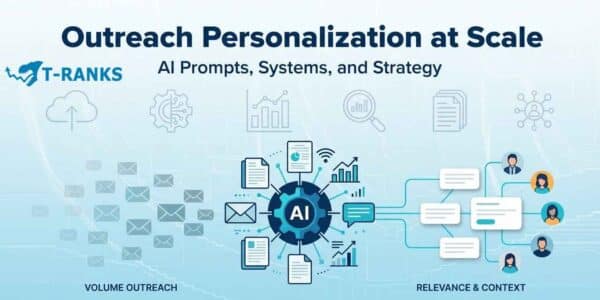
Personalized outreach is no longer about sending more messages.
It is about sending messages that make sense to the person receiving them.
Today, inboxes are crowded and people quickly decide what to read and what to ignore. Messages that feel generic are skipped almost instantly. Outreach only works when it feels relevant and timely.
Modern personalized outreach goes beyond using names or job titles. It focuses on understanding what someone is dealing with right now and connecting your message to that situation. When outreach reflects real context, it feels thoughtful instead of automated.
In this article, you will learn how personalized outreach works at scale. We will explain how clear systems, well-designed AI prompts, and human judgment help maintain relevance, trust, and visibility without relying on generic outreach.
What Is Personalized Outreach?

Personalized outreach is contacting someone with a message tailored to their current situation, intent, or priorities, not a generic template.
It is defined by relevance and timing rather than names, job titles, or surface-level customization.
Personalization is no longer about inserting easily accessible details. Using a name or role only shows data access, not understanding. When outreach relies on these signals alone, it feels automated and fails to earn attention.
Modern personalized outreach is context driven and relevance focused. It connects the message to real signals such as recent activity, business changes, or visible challenges. These signals explain why the outreach is happening now and why it matters to the recipient.
At scale, personalized outreach does not require manual effort for every message. It relies on consistent logic to identify relevance and deliver value across many conversations. When personalization is built on context instead of templates, it can scale without losing authenticity or trust.
Why Generic Outreach No Longer Works at Scale
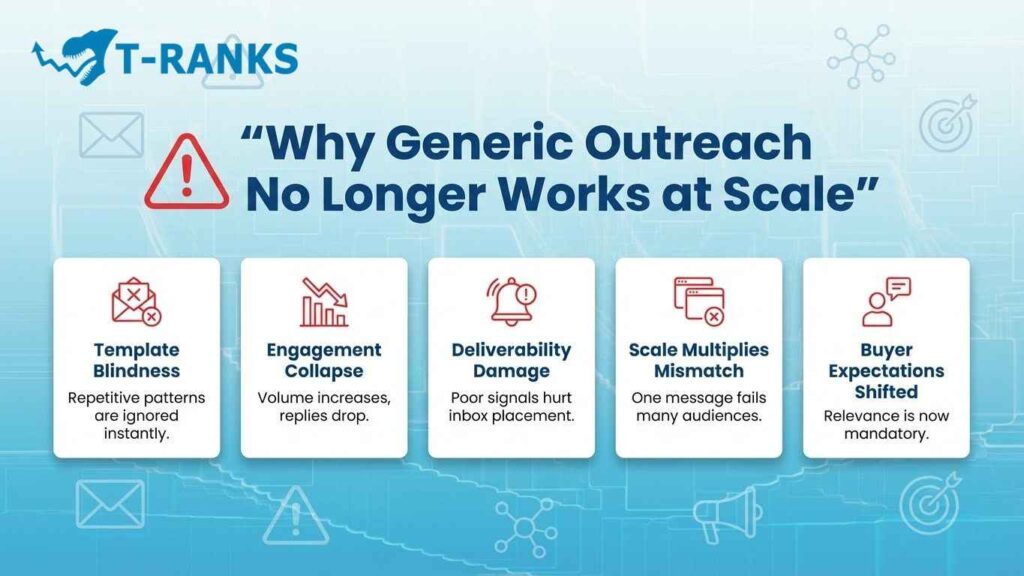
Generic outreach fails at scale because increasing volume exposes its weaknesses instead of improving results.
As message volume grows, non-personalized outreach becomes easier to ignore, easier to filter, and more damaging to trust.
Below are the core reasons generic outreach no longer works.
Template Blindness Happens Instantly
Decision-makers see hundreds of similar messages every week.
Repeated openings, predictable phrasing, and recycled structures are recognized within seconds. Once a message is identified as generic, it is ignored automatically, regardless of how good the offer may be.
Engagement Declines as Volume Increases
Generic outreach gives recipients no clear reason to respond.
Because the message does not reflect real priorities or context, sending more emails does not increase opportunity. It accelerates disengagement and leads to fewer replies and lower-quality interactions over time.
Deliverability Breaks Under Repetition
Inbox providers measure engagement to decide inbox placement. If you’re seeing low deliverability, a backlink audit may also reveal hidden trust issues impacting domain authority.High-volume generic campaigns produce low opens, weak replies, and higher complaint rates. These signals damage sender reputation, causing future outreach to be filtered, delayed, or blocked, even when messaging later improves.
Scale Multiplies Mismatch, Not Opportunity
Generic outreach assumes one message can work for many people.
At scale, this assumption fails faster. Each additional send widens the gap between message and recipient, exhausting prospect lists and eroding brand trust instead of creating momentum.
Buyer Expectations Have Permanently Changed
Modern buyers research independently and expect outreach to add immediate value.
Messages that do not show awareness of timing, context, or real needs are dismissed as noise rather than professional communication.
Relevance Is Now the Minimum Requirement
Relevance is no longer a differentiator. It is the baseline for visibility, engagement, and delivery.
At scale, generic outreach does not just underperform. It actively damages trust, reputation, and long-term results.
Identity-Based vs Context-Based Personalization
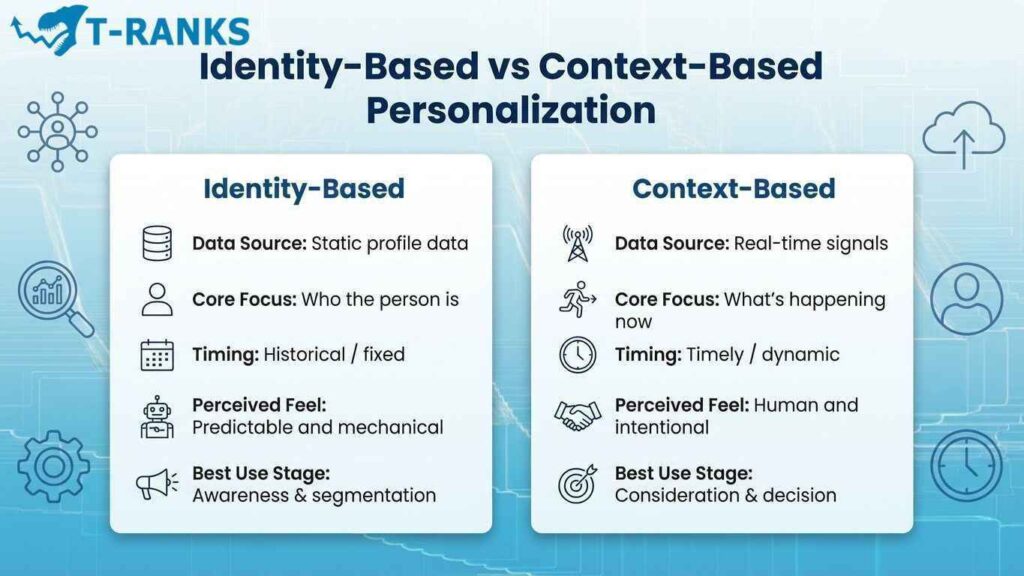
Personalized outreach generally falls into two categories: identity-based personalization and context-based personalization.
Understanding the difference is essential because it determines whether outreach feels automated or genuinely relevant.
Identity-Based Personalization
Identity-based personalization focuses on who the person is.
It uses static information such as:
- Name
- Job title
- Company name
- Seniority or role
- Past achievements
This information helps identify the recipient and shows basic legitimacy. However, it does not explain why the message matters right now.
Because identity data is easy to collect and widely available, referencing it mainly signals access to a database. It does not reflect the person’s current priorities, challenges, or intent. When used alone, identity-based personalization often feels predictable and repetitive, especially at scale.
Why Identity-Based Personalization Falls Short
Static identity details answer surface questions but provide no timing or intent signals.
Mentioning a role or company does not show what the person is currently focused on, evaluating, or dealing with.
As a result, outreach based only on identity details:
- Feels interchangeable
- Lacks urgency
- Fails to earn attention
- Scales poorly
Context-Based Personalization
Context-based personalization focuses on what is happening in the person’s world right now.
It uses dynamic, real-time signals such as:
- Recent activity or content engagement
- Company changes or announcements
- Hiring trends or team growth
- Funding events or product launches
- Visible challenges or industry discussions
Context explains relevance. It answers why the outreach is happening now and why it matters to the recipient at this moment.
Why Context Feels More Human
Context-based personalization feels human because it shows awareness and reasoning.
Referencing a timely and meaningful signal demonstrates intent, not automation.
Even when AI is involved, messages grounded in context feel considered and professional. This is why context-based personalization consistently performs better than identity-based approaches, especially at scale.
Using Both Approaches Together
Effective personalized outreach uses both identity and context, but for different purposes.
Identity data establishes baseline credibility by confirming who the person is.
Context data creates relevance and urgency by explaining why the message exists.
In simple terms:
- Identity answers who the person is
- Context explains why the outreach matters now
When combined correctly, outreach feels relevant, intentional, and scalable without losing trust.
How AI Enables Personalized Outreach at Scale
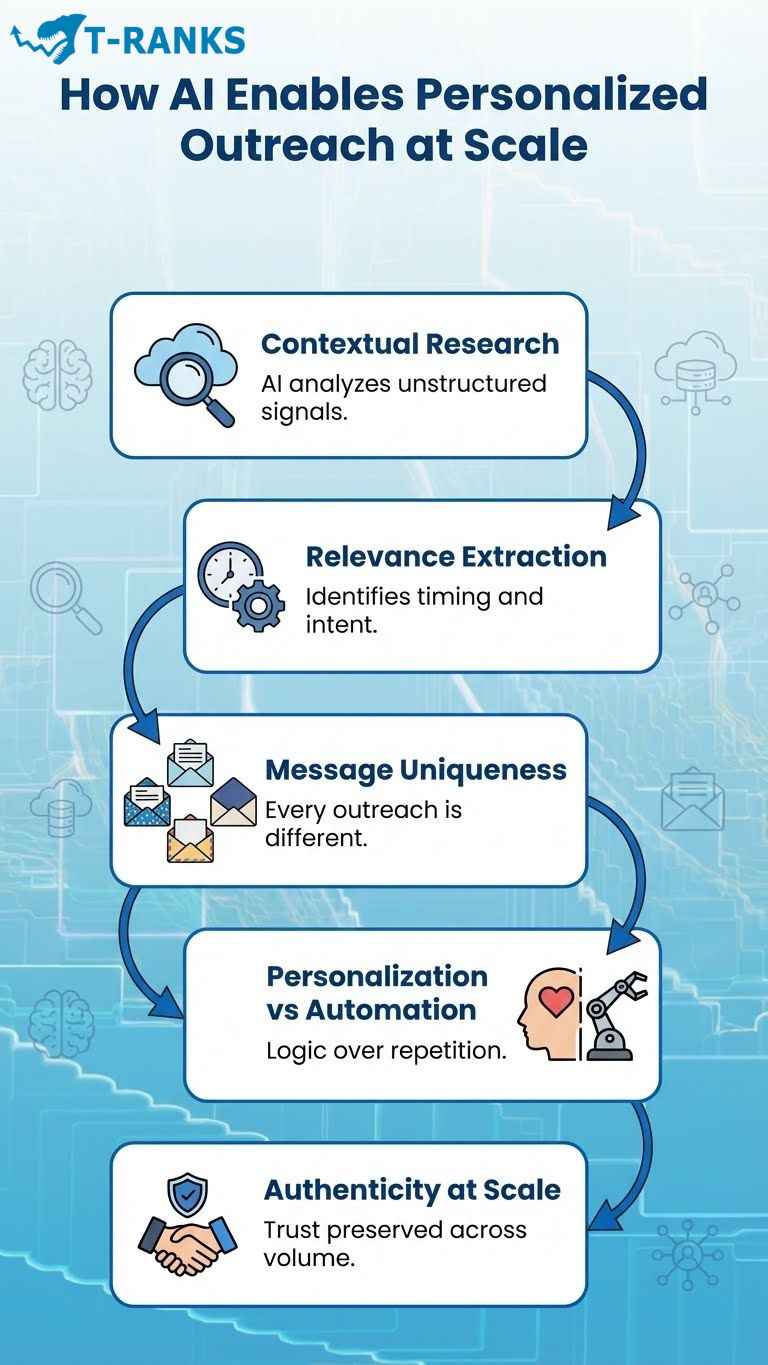
AI enables personalized outreach at scale by reasoning through context before generating any message.
It is not a shortcut for writing faster. It is a system for understanding relevance across volume.
Why This Was Not Possible Before
Before recent advances in AI, scaling outreach meant automation without understanding.
Messages could be sent in bulk, but they relied on static data and rigid templates. This made scale synonymous with spam.
Manual personalization was possible, but it could not scale. Automation could scale, but it could not personalize.
What Changed With Modern AI
Modern AI systems can now analyze unstructured information and reason through it.
They can read activity, interpret signals, and understand timing before producing output.
This shift allows outreach to be both scalable and relevant at the same time.
AI Replaces Manual Research With Contextual Understanding
AI removes the manual research bottleneck by analyzing signals such as recent activity, company updates, hiring trends, content engagement, and industry discussions.
Outreach begins with understanding the situation, not guessing intent.
This turns research from a human limitation into a scalable capability.
AI Extracts Relevance From Signals, Not Just Data
AI does more than collect information. It interprets signals to identify intent, urgency, and priority.
It explains why outreach matters now, not just who the recipient is.
This reasoning layer is what separates intelligent personalization from automation.
AI Enables Scale Without Repetition
Because each message is shaped by different context and signals, large volumes do not collapse into repetition.
Even at scale, outreach remains varied, situational, and intentional.
This prevents pattern detection and avoids the mechanical feel of bulk messaging.
Human-Guided Automation Makes This Sustainable
Modern outreach systems combine AI agents with automation platforms and human oversight.
AI handles analysis and drafting, while humans guide logic, review edge cases, and ensure accuracy.
This human-in-the-loop approach allows personalization to scale without losing trust or authenticity.
AI Prompts That Power Real Personalization
AI prompts power real personalization because they define how relevance is identified, not just how words are written.
The quality of personalized outreach is determined by prompt logic, clarity, and constraints long before any message is generated.
Why Prompt Quality Determines Personalization Quality
Prompt quality directly controls personalization quality. When prompts are vague, the output becomes generic because the system is forced to guess what matters. Instructions like “write a personalized email” lack intent, boundaries, and context, which leads to predictable phrasing and surface-level customization.
Why Generic Prompts Fail at Scale
Single prompts and generic instructions do not scale. They compress research, reasoning, and writing into one step, which increases errors and repetition as volume grows. At scale, these weaknesses become obvious, making outreach feel automated and unreliable.
The Three Elements of Effective Outreach Prompts
Effective prompts are built on three core elements: intent guidance, constraints, and clarity.
Intent guidance explains why the outreach exists and what outcome it should support.
Constraints define limits such as tone, length, and what should be avoided.
Clarity ensures the system understands which signals matter before generating any message.
Prompts as Logic Frameworks, Not Copy Generators
High-performing teams treat prompts as logic frameworks rather than copy generators. A strong prompt guides reasoning in stages, such as identifying the recipient’s situation, connecting it to a relevant challenge, and shaping a message that fits the outreach goal and tone.
When prompts are designed to control thinking rather than phrasing, personalized outreach remains relevant at scale. The result is communication that feels intentional, grounded, and human rather than fast and automated.
Prompt Design Principles for Scalable Outreach
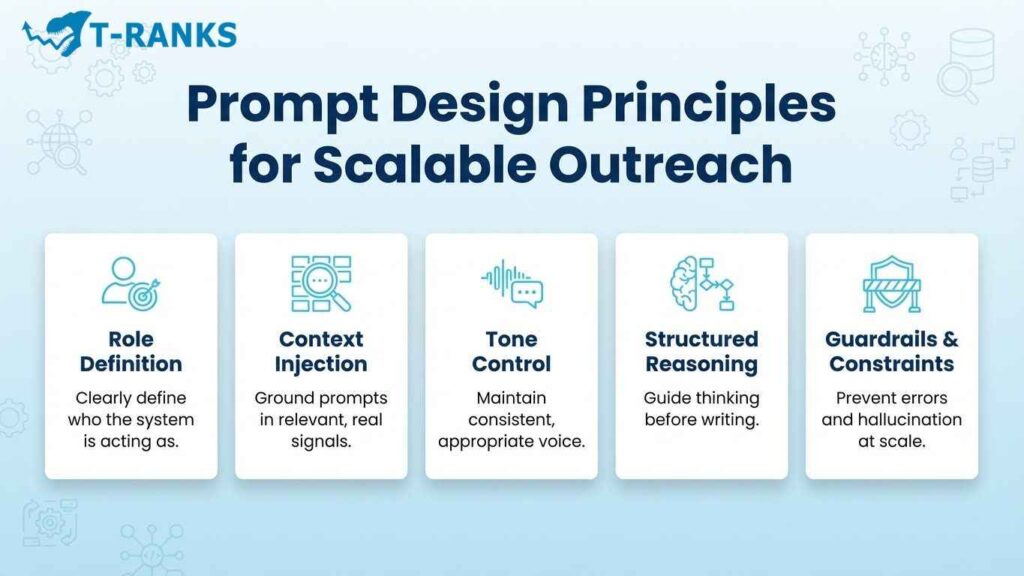
Scalable personalized outreach depends on prompt design that governs reasoning, consistency, and accuracy, not speed or creativity alone.
Well-designed prompts act as a system blueprint, ensuring quality holds steady as volume increases.
At scale, prompt design is not about writing better instructions. It is about defining how decisions are made before any message is generated. The principles below explain how effective prompts maintain relevance, reliability, and trust across large outreach volumes.
Perspective and Tone Control Shape Judgment
Every outreach prompt must clearly define who the system is acting as and how it should communicate.
This perspective controls vocabulary, judgment, and priorities, while tone control ensures consistency without repeating language.
Without a defined role and tone, outputs drift. Messages become inconsistent, overly sales-driven, or unnaturally casual, especially as volume increases.
Context Injection Prevents Guesswork
Prompts must clearly specify which signals are relevant and where they come from.
This includes recent activity, company changes, topical challenges, or verified data fields.
Clear context grounding prevents the system from guessing what matters. It reduces inaccurate references and ensures outreach is tied to real, timely relevance.
Structured Reasoning Improves Reliability
Effective prompts guide the system through a clear reasoning sequence.
This often includes identifying relevance, connecting it to a meaningful problem, and framing value before any call to action.
Structured reasoning reduces randomness and keeps outputs predictable without becoming repetitive.
Guardrails and Constraints Protect Quality at Scale
Prompts must include clear limits on length, acceptable data sources, and scope.
Grounding instructions in verified inputs and setting boundaries prevents hallucination, overreach, and loss of credibility.
Consistent prompt logic scales better than reusable templates. Templates repeat phrasing, which leads to pattern detection and personalization decay. Prompt logic repeats decision-making instead of language, allowing each message to remain unique while meeting the same quality standards.
The goal of prompt design is quality control, not speed. When prompts are treated as programmable logic rather than copy requests, personalized outreach can scale predictably without sacrificing relevance, trust, or authenticity.
Systems That Make Personalized Outreach Scalable
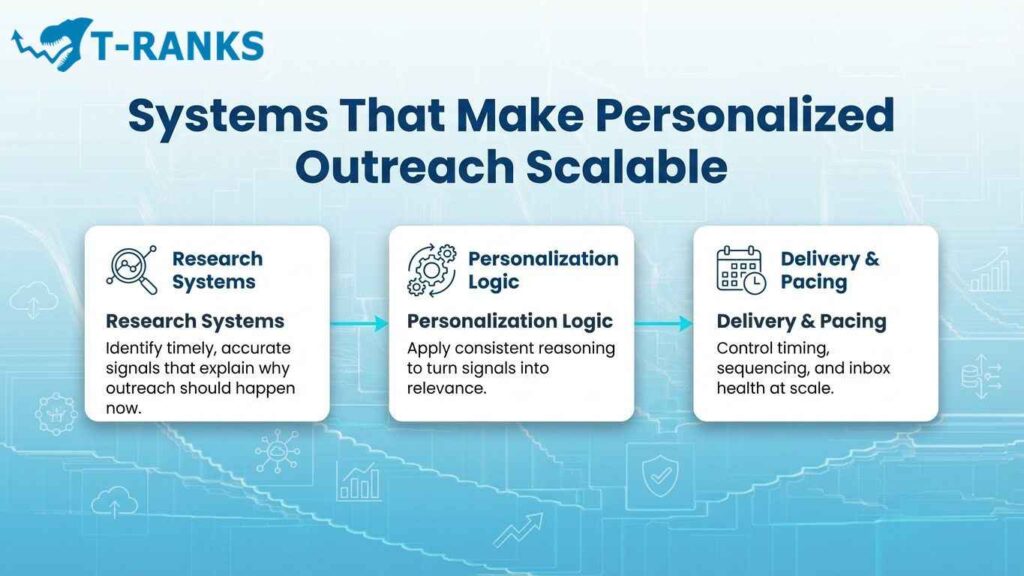
Personalized outreach scales when relevance and quality are managed deliberately, not when sending volume increases.
In this context, a system means an organized way of handling research, personalization, delivery, and human review so each message exists for a clear reason.
Without this structure, higher volume only multiplies mistakes. Messages lose relevance, trust weakens, and outreach quickly feels automated instead of intentional.
What a “System” Means in Simple Terms
A scalable outreach system is not a single tool or automation.
It is a setup where different responsibilities are clearly separated and coordinated.
One part focuses on understanding what is happening around the recipient.
Another part turns that understanding into a relevant message.
Another part controls when and how the message is delivered.
Human oversight ensures accuracy and judgment throughout.
When these responsibilities are mixed or skipped, personalization breaks down.
Why Separation of Responsibilities Matters
Scalable outreach works because each responsibility is handled independently.
Research focuses only on finding timely and accurate signals that explain why outreach should happen now.
Personalization applies consistent logic to connect those signals to relevance.
Delivery controls pacing, sequencing, and inbox health.
This separation prevents quality from collapsing as outreach grows.
A Simple Example of How This Works
Imagine reaching out to hundreds of companies experiencing recent changes.
One part of the process identifies which companies are hiring or launching something new.
Another part uses that signal to shape why the outreach matters now.
Another part ensures messages are sent gradually and consistently.
Because each step has a clear role, scale does not destroy relevance.
How Structure Prevents Personalization Decay
As outreach continues over time, relevance naturally fades if context is not refreshed.
A structured approach continuously updates signals, monitors engagement, and adjusts messaging.
This keeps outreach accurate, timely, and intentional instead of repetitive.
Why Gradual Scaling Is the Outcome, Not the Goal
When relevance and quality are protected, scale becomes predictable.
Volume increases only when engagement remains stable, making outreach safe for trust and deliverability.
The result is personalized outreach that grows steadily without losing credibility.
Why Human Review Still Matters in AI Outreach
Human review matters because fully autonomous outreach lacks judgment, context awareness, and accountability.
AI can misinterpret signals, reference outdated or incorrect information, or apply the wrong tone. At scale, these mistakes spread quickly and damage trust.
Human review does not mean manually writing every message. It means applying human judgment at critical points where accuracy, sensitivity, and credibility matter.
What Human Review Actually Protects
Human oversight acts as a quality safeguard before messages reach recipients.
Spot checks help confirm factual accuracy, appropriate tone, and real contextual relevance.
Humans can detect issues that automated systems struggle with, such as unnatural phrasing, misplaced enthusiasm, or sensitivity to current events and personal situations.
Where AI Autonomy Works and Where It Does Not
AI autonomy works well for low-risk tasks like research, signal analysis, and draft generation.
Human judgment is essential when outreach affects relationships, reputation, or trust.
The most effective outreach systems combine AI efficiency with human oversight. This balance allows personalization to scale while preserving credibility, relevance, and long-term trust.
Common Mistakes in Personalized Outreach at Scale
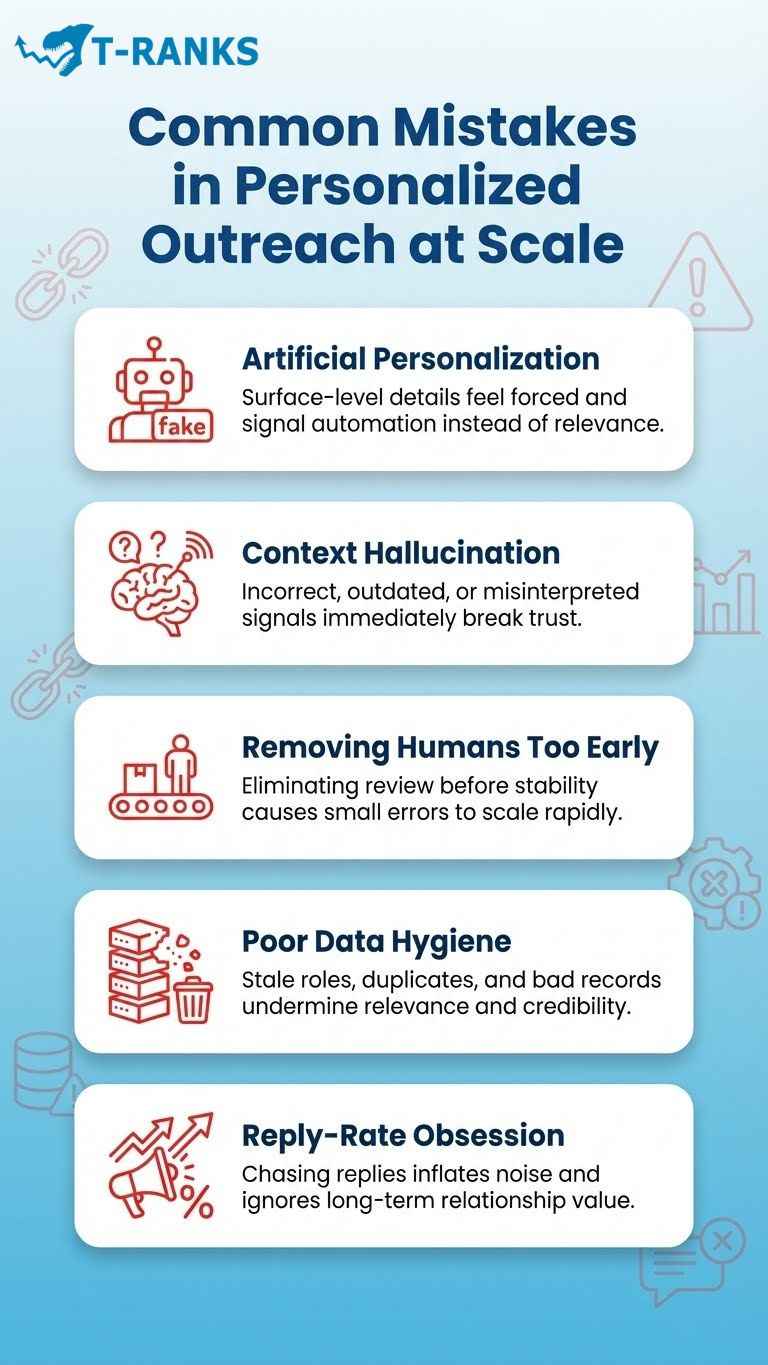
Personalized outreach fails at scale when relevance is forced, accuracy breaks, or quality controls are removed too early.
Even advanced setups underperform when they amplify the wrong behaviors. The issues below are the most common reasons personalized outreach loses trust, engagement, and long-term effectiveness.
Over-Personalization That Feels Artificial
Personalization fails when surface-level details are inserted without meaningful connection.
Awkwardly referenced facts, token customization, or excessive familiarity signal automation rather than understanding. When details do not support a clear business reason, outreach feels forced and uncomfortable instead of relevant.
Context Hallucination and Relevance Mismatch
Outreach breaks down when messages reference incorrect, outdated, or misinterpreted signals.
Invented connections or stale events immediately damage credibility. Relevance mismatch occurs when the message does not align with the recipient’s current priorities, even if it appears personalized on the surface.
Removing Human Judgment Too Early
Eliminating human review before prompts, data, and logic are proven leads to rapid error multiplication.
Without oversight, tone drifts, inaccuracies repeat, and small mistakes scale into brand-level problems. Human judgment remains essential until quality is consistently stable.
Weak Data Quality and Poor Delivery Discipline
Personalization cannot survive poor data hygiene or careless delivery.
Stale roles, duplicates, and inconsistent records cause awkward outreach and over-contacting. At the same time, ignoring pacing, warm-up, or authentication harms deliverability, making even relevant messages invisible.
Optimizing for Reply Rate Alone
Chasing replies as the primary goal backfires at scale.
High reply counts often include negative responses, opt-outs, or low-intent engagement. Effective personalized outreach focuses on meaningful engagement and relationship continuity, not vanity metrics that quietly erode trust.
How to Measure Success in Personalized Outreach
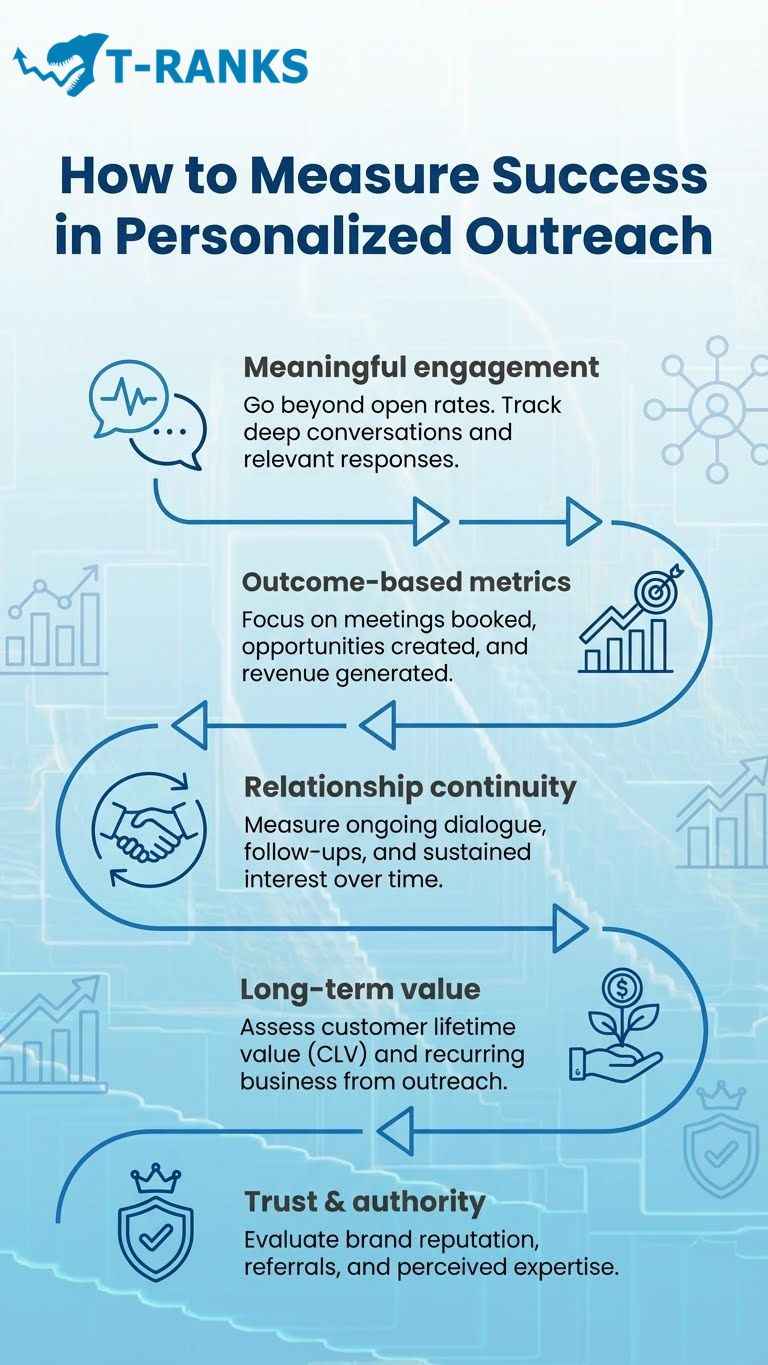
Success in personalized outreach is measured by trust, progression, and long-term impact, not by reply volume alone.
Replies show activity, but they do not reliably reflect relevance, credibility, or relationship strength.
To evaluate success accurately, outreach performance should be viewed across a few core dimensions. These dimensions focus on the quality of engagement, how relationships progress, and whether trust compounds over time rather than spiking briefly.
Separate Meaningful Engagement From Noise
Not all replies indicate success.
Positive interest, meeting requests, referrals, and thoughtful responses signal real engagement. Negative replies, opt-outs, and low-intent responses inflate numbers without adding value. Measurement begins by filtering activity into meaningful and non-meaningful engagement.
Measure Outcomes That Show Progress
Effective measurement focuses on outcomes that move relationships forward.
Meeting conversions, editorial acceptance, continued dialogue, and follow-up interactions indicate that outreach aligned with real needs rather than attracting attention alone.
Evaluate Relationship Continuity Over Time
Personalized outreach succeeds when engagement continues beyond a single interaction.
Ongoing responsiveness, repeat collaboration, and future re-engagement demonstrate durable trust rather than one-time curiosity.
Prioritize Long-Term Value Over Short-Term Spikes
Short-term metrics fluctuate and often misrepresent success.
Long-term value appears in sustained engagement, retained placements, and growing authority. Outreach that compounds trust over time outperforms campaigns optimized for immediate responses.
Tie Measurement Back to Trust and Authority
The strongest measurement frameworks connect performance to trust signals.
Consistent engagement, accepted contributions, and lasting relationships reflect credibility and authority. These outcomes matter more than raw reply counts because they support long-term visibility and impact.
How Personalized Outreach Improves AI Search Visibility
Personalized outreach improves AI search visibility by strengthening the quality and credibility of brand mentions.
AI search systems prioritize sources that demonstrate relevance, trust, and contextual authority, not mass exposure.
Relevance Creates Citation-Worthy Mentions
Personalized outreach earns placements that naturally fit within editorial content.
When mentions are contextually relevant, AI systems are more likely to treat them as reliable sources worth referencing in generated answers.
Quality Signals Matter More Than Volume
AI models discount low-quality or forced placements.
Generic outreach often leads to thin mentions, while personalized outreach results in deeper integration within meaningful content that AI engines trust.
Context Builds Clear Topic Association
Context-driven outreach connects a brand to specific topics, industries, and problems.
This clarity helps AI systems associate a brand with defined subject matter instead of broad or generic marketing claims.
Consistent Mentions Strengthen Entity Trust
Repeated high-quality mentions across authoritative sources reinforce brand recognition.
Over time, this consistency increases the likelihood of appearing in AI Overviews, voice search results, and answer-based queries.
Personalized outreach supports AI visibility by placing brands where AI systems look for authority.
In AI-driven search, relevance and credibility determine visibility, not reach.
Ethical and Deliverability Considerations in Personalized Outreach
Ethical outreach and strong deliverability depend on relevance, consistency, and restraint, not on sending more messages.
At scale, inbox providers and recipients evaluate trust continuously, so small mistakes can quickly damage sender reputation and visibility.
Why Deliverability Breaks at Scale
Deliverability problems usually appear when volume increases without control.
Rapid sending, repeated message patterns, poor list quality, and unstable infrastructure create negative signals such as low open rates, bounces, and spam complaints. Modern inbox systems rely on reputation-based filtering, which means early mistakes can affect all future campaigns, even if messaging improves later.
Relevance Is the Safest Deliverability Strategy
Relevance protects deliverability better than any technical shortcut.
When outreach is clearly tied to context and timing, recipients are less likely to ignore, delete, or report messages. This reduces negative engagement signals and helps inbox providers view the sender as trustworthy rather than intrusive.
Consistency Builds Long-Term Trust
Inbox providers reward consistent behavior.
Steady sending pace, accurate data, and predictable infrastructure signal stability. Outreach that avoids spikes, sudden volume increases, or inconsistent patterns is less likely to trigger filtering or throttling.
Ethics and Deliverability Are Closely Linked
Ethical outreach limits unnecessary contact.
Sending messages only when there is a clear and legitimate reason to engage reduces intrusion and complaints. From a practical standpoint, ethical behavior and deliverability reinforce each other because both depend on relevance, respect, and control.
Ethical, relevance-driven outreach is not just safer.
It is more sustainable, more effective, and more likely to remain visible as inbox systems and recipient expectations continue to tighten.
When AI Is the Right Tool for Outreach and When It Is Not
AI works best in outreach when speed, scale, and data processing are required.
Human judgment is still essential when trust, nuance, and long-term relationships are involved. Successful outreach in 2025 depends on using both in the right places, not on full automation.
Where AI Adds the Most Value
AI is highly effective in high-volume and research-heavy stages of outreach.
It can analyze large datasets, detect intent signals, segment audiences, and generate first drafts quickly. AI helps explain why outreach may be relevant now and supports consistent personalization across many prospects.
AI is also useful for early-stage nurturing.
It can test subject lines, explore different value angles, and support outreach across multiple regions or languages without increasing manual effort.
Where Human Judgment Is Necessary
Human involvement is critical when outreach affects credibility or relationships.
Senior decision-makers, editors, partners, and enterprise accounts require awareness of history, tone, and timing that AI cannot reliably judge on its own.
Humans are better at handling nuance.
They can recognize sensitive situations such as layoffs, crises, negotiations, or prior negative interactions and decide whether outreach should happen at all.
How AI and Humans Work Best Together
The strongest outreach strategies combine AI efficiency with human oversight.
AI handles research, signal detection, and draft creation. Humans review, refine, and decide when and how outreach is appropriate.
This balance allows outreach to scale while remaining respectful, accurate, and trustworthy.
Using AI where it adds leverage and humans where judgment is required keeps outreach effective without becoming impersonal or risky.
Best Practices for Sustainable Personalized Outreach
Sustainable personalized outreach is built on relevance, structure, and long-term trust rather than speed or volume.
The goal is not to send more messages, but to create outreach that continues to perform as scale increases.
Focus on fewer prospects with deeper relevance
Target smaller, high-fit audiences where outreach can reflect real context, timing, and intent. Fewer prospects with strong alignment consistently outperform large lists with weak personalization. Depth of relevance matters more than reach.
Build systems before increasing scale
Scalability comes from structured workflows, not higher sending limits. Separate research, personalization, review, and delivery so quality remains stable as volume grows. Systems prevent errors, refresh context, and protect consistency over time.
Adopt an editorial mindset over transactional outreach
Approach outreach as a contribution, not a request. Share insights, data, or perspectives that add value to the recipient’s work rather than leading with an ask. An editorial mindset earns trust and increases long-term engagement.
Protect infrastructure and sending reputation
Sustainable outreach depends on stable technical foundations. Use dedicated outreach domains, maintain proper authentication, scale volume gradually, and keep lists clean. These practices ensure relevant messages reach inboxes instead of being filtered out.
Prioritize long-term relationships over short-term wins
Measure success by continued engagement, repeat interactions, and credibility over time. Thoughtful follow-ups and value-first communication turn one-off conversations into durable relationships that compound results.
When these best practices work together, personalized outreach remains effective, ethical, and resilient as scale grows.
Conclusion
Personalized outreach is no longer about choosing between manual effort and automation.
Today, it is built on relevance, engineered through clear prompts, structured systems, and thoughtful human oversight.
Effective outreach now depends on understanding context and applying consistent logic at scale. AI strengthens research, personalization, and timing, while human judgment protects accuracy, tone, and trust. When relevance guides every message, scale no longer weakens authenticity.
Long-term success comes from sustainable practices.
Fewer prospects, deeper relevance, reliable systems, and ethical delivery protect sender reputation and support lasting relationships. Trust, authority, and visibility are earned through value-driven communication, not volume.
If you want to build relevance-first outreach that supports long-term authority and AI-era visibility, T-RANKS helps teams design personalized outreach systems focused on trust, credibility, and sustainable growth.
FAQs About Outreach Personalization at Scale
What is personalized outreach?
Personalized outreach is contacting someone with a message tailored to their current context rather than using a generic template. It focuses on relevance such as recent activity, role priorities, or business changes so the message feels intentional and credible.
How is personalized outreach different from generic outreach?
Personalized outreach adapts the message to the recipient’s situation, while generic outreach sends the same message to everyone. The difference is relevance and timing, not just inserting names or titles.
What are the 4 D’s of personalization?
The 4 D’s of personalization are Data, Depth, Direction, and Delivery. Together, they ensure outreach is accurate, meaningful, intentional, and sent at the right moment.
How should you approach personalized outreach to potential leads?
You should approach personalized outreach by understanding why the message is relevant now. The outreach should reference a specific signal and clearly explain the reason for reaching out.
Can personalized outreach scale without losing quality?
Yes, personalized outreach can scale when it is built on structured prompts, systems, and review layers. Without these controls, scaling usually reduces relevance and trust.
Does AI help with personalized outreach?
Yes, AI helps by analyzing context and generating unique messages at scale. It works best when guided by clear prompts and supported by human oversight.
What role do AI prompts play in personalized outreach?
AI prompts define how relevance, tone, and accuracy are determined before writing begins. Strong prompts guide reasoning, not just phrasing, across large campaigns.
Is personalized outreach safer for deliverability than bulk outreach?
Yes, personalized outreach is safer because messages are unique and context-driven. Higher relevance leads to better engagement and fewer spam complaints.
Do you still need human review in AI-driven outreach?
Yes, human review is necessary to confirm accuracy, tone, and appropriateness. Light review prevents costly mistakes without slowing scale.
What are the most common mistakes in personalized outreach?
The most common mistakes are fake personalization, incorrect context, poor data quality, and removing human review too early. These errors reduce trust and effectiveness.
How do you measure success in personalized outreach?
Success is measured by meaningful engagement, not reply volume. Relationship continuity, editorial acceptance, and trust signals indicate real performance.
Can personalized outreach improve AI search visibility?
Yes, personalized outreach helps earn editorial mentions and citations. These references support brand and entity visibility in AI-generated answers.
Is personalized outreach ethical when done at scale?
Yes, personalized outreach is ethical when it is relevant, restrained, and sent for a legitimate reason. Relevance reduces intrusion and protects trust.