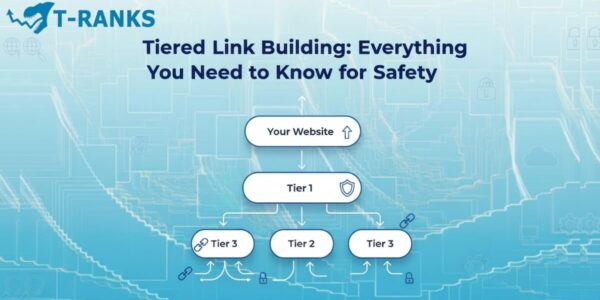
Most website owners know they need backlinks, but they’re not always sure how to build them safely. Tiered link building offers a simple, structured way to strengthen your best links without risking penalties. You start with strong backlinks pointing to your site, then build supporting links behind them. These layers help Google discover your links faster, trust them more, and keep their value over time.
This matters even more today because Google’s systems are better at spotting unusual or artificial link patterns. A tiered structure allows you to build authority gradually, in a controlled and natural-looking way.
In this guide, you’ll learn what tiered link building is, how each layer works, when to use tiers, and how to build them safely. By the end, you’ll know how to apply this method without harming your rankings or triggering penalties.
What is Tiered Link Building
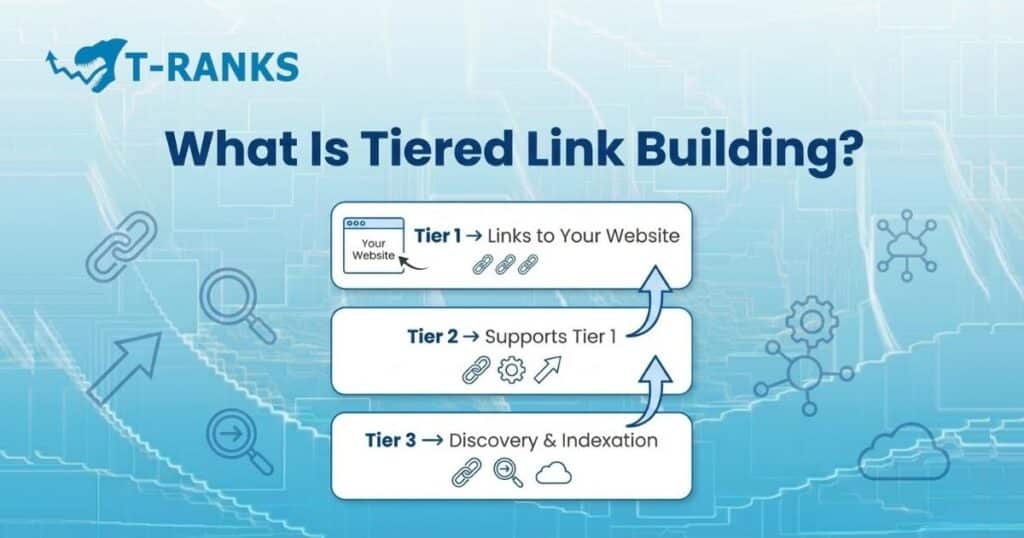
Tiered link building is a backlink strategy where links are built in layers. Each layer supports the one above it. Tier 1 links point directly to your website. Tier 2 links strengthen those Tier 1 backlinks. Tier 3 links help Google discover and index the entire structure. The goal is to increase authority safely and gradually.
A simple example
You publish a guest post on a respected marketing blog that links to your website. This is your Tier 1 link.
You then publish a Medium article that links to your guest post. This is Tier 2.
Later, people share your Medium article on social platforms. These mentions act as Tier 3 signals.
Each layer strengthens the next, pushing more trust toward your main site.
How Tiered Link Building Evolved
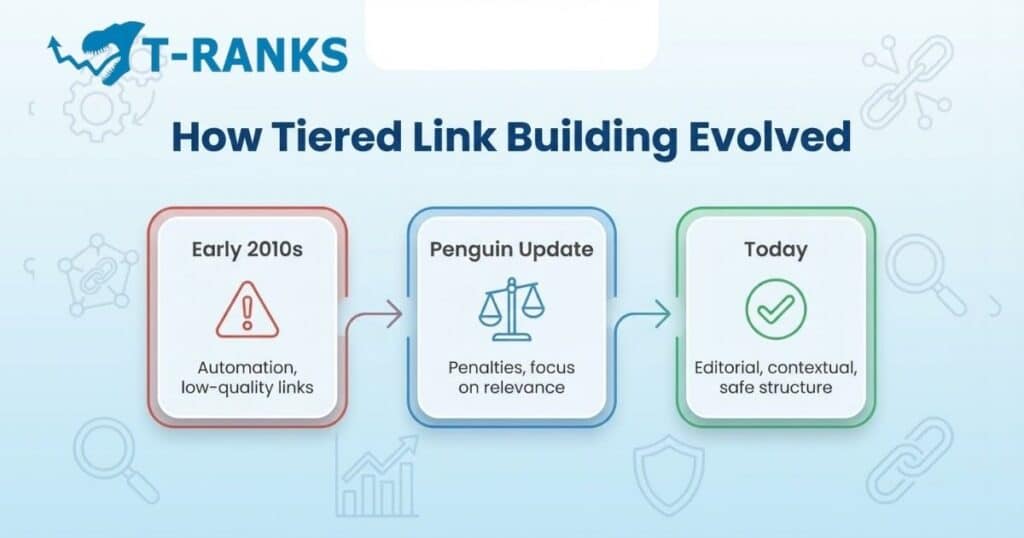
Tiered link building changed as Google became better at detecting manipulative links.
Early use
In the early 2010s, SEOs used automation tools to create large numbers of low-quality backlinks through directories, comment spam, and forum profiles.
After the Penguin update
When Google’s Penguin Update was introduced, unnatural backlinks were heavily penalized. This pushed SEOs to focus on relevance, authority, and human-created content. Tiered link building stayed useful, but it had to look natural and contextual.
Today
Modern tiered link building supports meaningful, high-quality content. Tier 1 links must be genuine editorial placements, while Tier 2 and Tier 3 links work as natural reinforcement. The focus is credibility, not volume.
How Google Evaluates Tiers Indirectly
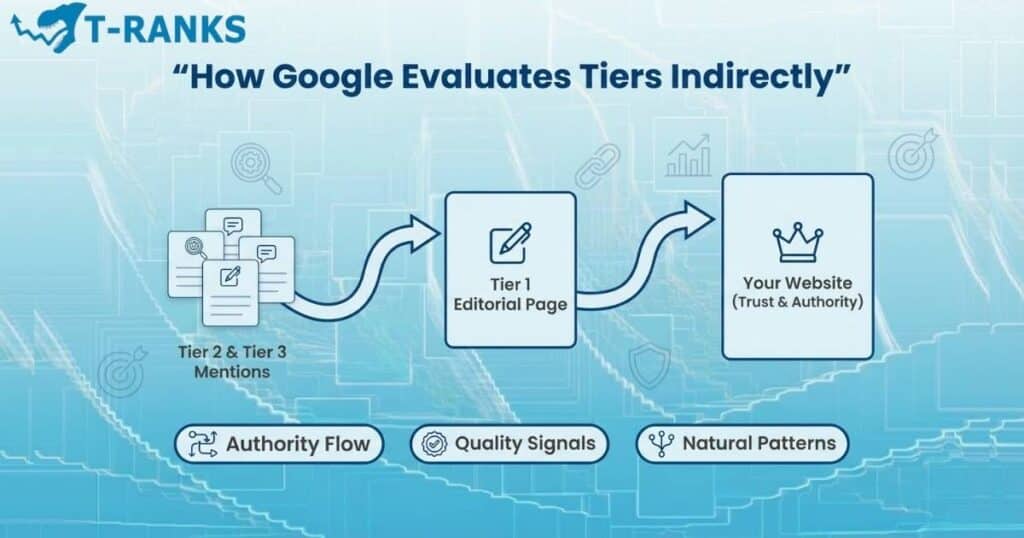
Google does not identify “tiers.” It evaluates how trust and authority move through the web.
Authority flow
Google uses concepts like PageRank to understand how value passes from one page to another. A strong Tier 1 link becomes more powerful when it receives supporting Tier 2 links.
Quality signals
One strong editorial link is more valuable than hundreds of automated backlinks. Relevance and context remain the top ranking factors.
Natural patterns
Google gives value to content that is referenced, cited, and shared across different platforms. A safe tiered structure mimics this natural behaviour, not artificial link schemes.
Tiered Links vs Link Pyramids and Link Wheels
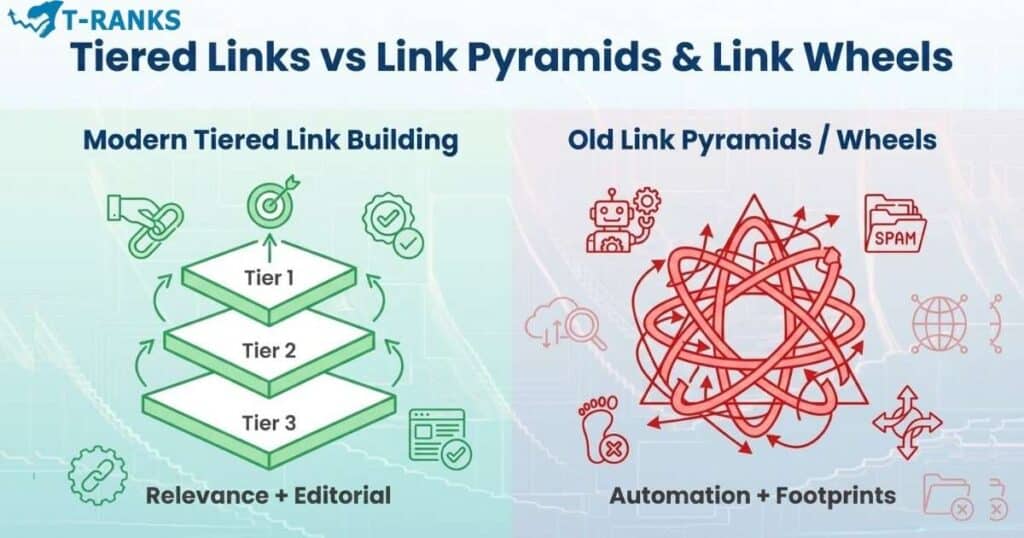
Old link pyramids and link wheels relied on automation and predictable linking paths. These models focused on quantity rather than relevance, which often resulted in penalties.
Key differences
- Tiered link building prioritizes high-quality editorial links
- Lower tiers provide natural reinforcement, not spam
- Old models depended on directories, automated Web 2.0s, and forum spam
- Modern tiered linking focuses on sustainable authority
In simple terms
Modern tiered link building strengthens real content with natural support links. Old pyramid systems tried to inflate rankings with artificial patterns that no longer work in Google’s environment.
Types of Tiered Links
Tiered link building uses different layers of backlinks to reinforce each other. The main types are Tier 1 links, Tier 2 links, Tier 3 links, and Tier 4 links. Each tier plays a different role in strengthening authority, improving indexation, and supporting the layer above it. Upper tiers focus on editorial quality, while lower tiers act as reinforcement and discovery signals.
Tier 1 Links
Tier 1 links point directly to your main website pages. These are your highest-quality backlinks and have the greatest impact on rankings. They must be editorial, contextual, and earned naturally.
Role of Tier 1
Tier 1 links build credibility, trust, and relevance. They directly influence ranking strength and form the foundation of your website’s authority.
Key Characteristics
- Placed on authoritative, niche-relevant websites
- Included within original, high-quality content
- Match search intent and enhance user experience
- Acquired through outreach, partnerships, or digital PR
Examples
- Guest posts on respected industry sites
- Editorial mentions from news or business publications
- Digital PR placements through journalist outreach
- High-quality resource links from curated directories
Tier 2 Links
Tier 2 links do not point to your website. They link to your Tier 1 backlinks and act as reinforcement. Their purpose is to strengthen your best editorial placements and help Google discover them faster.
Role of Tier 2
Tier 2 links amplify Tier 1 authority. They improve indexation and create a natural ecosystem around your primary backlinks.
Key Characteristics
- Moderate authority
- Relevant and contextual content
- Mixed anchor text (branded, generic, partial match)
- Built manually or semi-manually
Examples
- Medium, Blogger, or WordPress.com posts linking to a guest article
- Reddit or Quora threads referencing your Tier 1 content
- Niche roundup posts that cite your Tier 1 link
- LinkedIn or X mentions pointing to Tier 1 placements
Tier 3 Links
Tier 3 links support your Tier 2 content. They rarely pass strong authority but help with indexation, crawl frequency, and natural engagement signals.
Role of Tier 3
Tier 3 links act as discovery signals. They ensure your Tier 2 URLs remain visible to search engines.
Key Characteristics
- Lower authority but higher volume
- Mostly nofollow
- Safe for distribution
- Suitable for light automation under human monitoring
Examples
- Mix, Scoop.it, or Pinterest bookmarks
- Blog comments pointing to Tier 2 content
- Profile and citation listings referencing Tier 2 pages
- Light indexing tools used responsibly
Tier 4 Links
Tier 4 links form the lowest and riskiest layer. They were once used for indexing Tier 3 links but are now considered unsafe due to Google’s spam detection.
Role of Tier 4
Previously used for bulk indexing. Now mostly obsolete and harmful.
Key Characteristics
- Extremely low quality
- Often automated
- High footprint
- Provide little or no SEO value
Examples
- Mass-generated link blasts
- Automated directory submissions
- Spam comments and scraper sites
- Low-quality RSS aggregator links
Modern Best Practice
The safest approach is to focus on Tier 1 and high-quality Tier 2 links.
Tier 3 links can be used lightly for indexation support.
Tier 4 links should be avoided entirely in modern SEO.
How Tiered Link Building Works
Tiered link building works by guiding Google through different layers of backlinks, starting from the smaller links at the bottom and moving up to the strongest links at the top. Each layer helps Google understand and support the next one. When these layers connect properly, your most important backlinks become stronger and transfer more trust to your main website.
You do not need to be technical to understand this.
So here is a simple workflow that explains how this tiered system actually works.
Google Finds the Lower Links First
Google crawls the internet all day. It usually discovers your lower-tier links first because they appear on small but frequently crawled pages, such as social bookmarks, profile links, or community posts. When Google finds these pages, it follows the links placed on them.
This is the starting point. Google begins at the bottom layer.
Google Moves Upward to Your Tier 2 Pages
After landing on a lower-tier page, Google follows the outgoing link and reaches your Tier 2 content. This content usually lives on medium-quality platforms like blogs, Web 2.0 sites, or Q&A threads.
When several Tier 2 pages point to the same Tier 1 link, Google sees that the Tier 1 page is getting attention from different places.
This helps Google understand that your Tier 1 link is worth checking again.
Tier 1 Links Become More Important
Tier 1 links are your strongest, most trustworthy backlinks. When Google sees multiple Tier 2 pages referring to a Tier 1 link, it starts giving extra importance to that Tier 1 page.
The stronger your Tier 1 page becomes, the more power it sends to your main website.
This is how tiered link building increases your website’s ranking strength.
The Whole Pattern Looks Normal to Google
This entire structure works because it follows a pattern Google already sees on the internet. A small website mentions a medium website. A medium website mentions a strong website. And the strong website links to the original source.
Your tiered structure uses the same flow.
Because this matches normal online behavior, Google treats the whole setup as natural and trustworthy
When Tiered Link Building Works Best
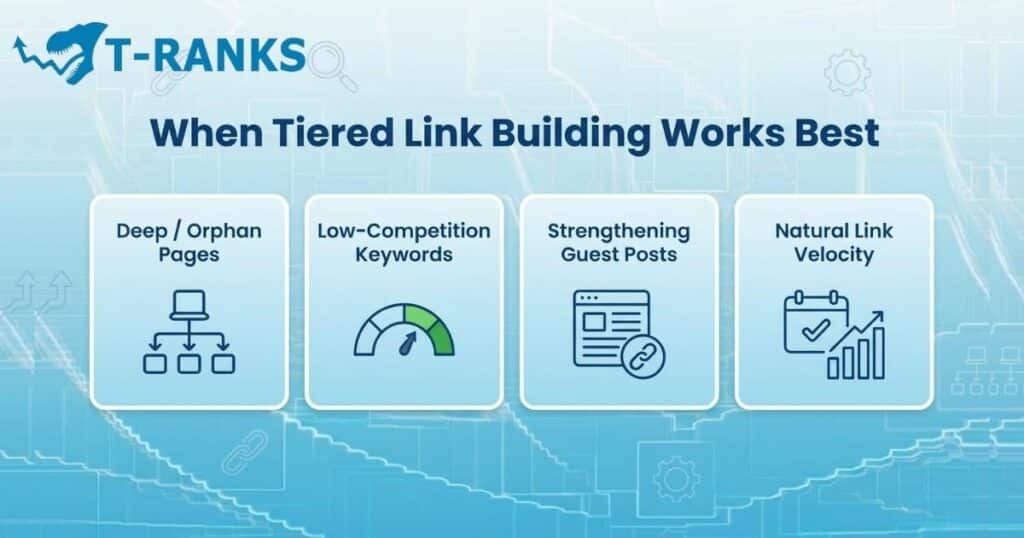
Tiered link building works best in situations where your goal is to enhance visibility, support underperforming pages, and maintain a safe, natural backlink profile. It’s not just about creating layers of links—it’s about knowing when and where to use them for maximum SEO impact.
This strategy performs effectively when you want to:
- Boost indexing and visibility for hidden or deep pages.
- Rank low-competition keywords quickly without heavy link investment.
- Strengthen guest posts and maintain domain authority over time.
- Control link velocity to mimic organic link growth safely.
Let’s look at how each scenario benefits from a well-planned tiered structure.
Supporting Deep or Orphan Pages
Many websites have deep or orphan pages—content buried several clicks away from the homepage or lacking internal links. These pages rarely get indexed or ranked.
Tiered link building helps solve this by:
- Creating Tier 1 backlinks (guest posts or editorials) that link directly to those hidden pages.
- Building Tier 2 support links (from Web 2.0 or niche blogs) that strengthen Tier 1 pages.
- Adding Tier 3 signals (social shares, bookmarks, or community mentions) to increase crawl frequency.
This structure forms a clear crawl path for Google, helping those buried pages get discovered, indexed, and start ranking for relevant queries.
Boosting Low-Competition Keywords
For low-competition or long-tail keywords, even a light tiered link building structure can be enough to push your page up the rankings.
Here’s how to do it:
- Use 2–3 Tier 1 contextual links from relevant blogs or guest posts pointing to your target page.
- Support them with 5–10 Tier 2 links from smaller blogs, Medium posts, or niche directories.
- Add Tier 3 shares—like Reddit threads, LinkedIn mentions, or social bookmarks—to encourage crawling and indexing.
Because competition is low, Google sees this as organic link growth. Within 30–60 days, you can often move from page two to page one.
Strengthening Guest Posts and Domain Rating (DR) Boosting
Guest posts and high-authority backlinks (Tier 1 links) are expensive and time-consuming to earn. To make them more powerful, you can reinforce them with a tiered structure.
Here’s the process:
- Build Tier 2 links from Web 2.0s, niche forums, or resource blogs that point to your guest post.
- Add Tier 3 signals like social shares, comments, or indexing mentions to keep them active.
This keeps your guest post relevant and visible in search results, increasing referral traffic and authority. Over time, this raises your Domain Rating (DR) and improves the strength of every backlink pointing to your site.
Increasing Link Velocity Naturally
Google prefers websites that earn backlinks at a consistent and natural pace. A sudden surge in links can trigger algorithmic suspicion.
Tiered link building helps manage link velocit safely by distributing link growth across multiple layers:
- Add a few Tier 1 links (guest posts or editorials) every month.
- Build steady Tier 2 support links each week to reinforce them.
- Maintain Tier 3 mentions (social signals, bookmarks) regularly to keep the structure active.
This creates a natural-looking growth pattern, where link activity spreads gradually through your tiers instead of focusing entirely on your main domain. The result: stronger authority, safer link velocity, and sustainable SEO growth.
In summary, tiered link building works best when it’s used thoughtfully—helping buried pages rank, amplifying low-difficulty keywords, strengthening high-value backlinks, and maintaining steady link acquisition. When executed strategically, it delivers measurable results without risking Google penalties.
When Tiered Link Building Becomes Risky
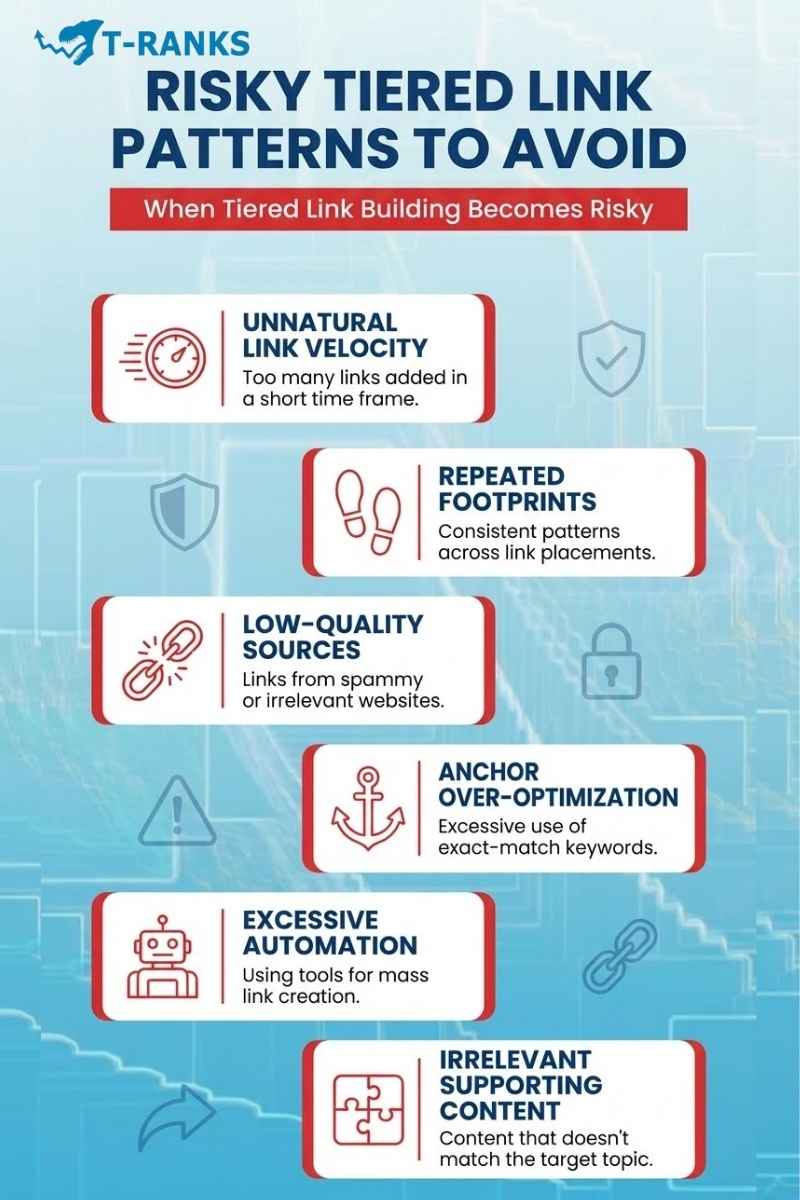
Tiered link building can become risky when the structure looks unnatural, grows too fast, or uses low-quality sources. Google’s systems such as Penguin and SpamBrain can detect suspicious patterns. When these risks appear, your backlinks may lose power or be ignored completely. Below are the situations where tiered link building becomes unsafe.
Unnatural Link Velocity
Tiered links built too quickly create a sudden spike in activity.
If Tier 2 or Tier 3 links grow much faster than Tier 1, Google may view the pattern as forced.
Repeating the Same Footprint
Using the same templates, platforms, hosting, or anchor patterns across all tiers creates a visible footprint.
Google can detect repeated structures that do not look natural.
Low-Quality Tier 2 or Tier 3 Sources
Spammy Web 2.0s, hacked sites, old PBNs, or automated directories can weaken the Tier 1 link they support.
Bad lower-tier links pass negative signals upward and reduce trust.
Anchor Text Over-Optimization
Using the same keyword anchor repeatedly across all tiers creates a clear sign of manipulation.
Google expects mixed anchors and natural language.
Excessive Automation
Heavy use of link automation tools at Tier 2 or Tier 3 creates patterns that Google can detect easily.
Unnatural timing, duplicate content, and repeated site structures increase risk.
Irrelevant Supporting Content
Tier 2 or Tier 3 links placed on unrelated topics or unrelated niches confuse Google and can weaken the entire structure.
Relevance is essential at every layer.
Lack of Monitoring or Clean-Up
Tiered links that are never audited can accumulate spam or broken URLs over time.
This makes the whole structure unstable and reduces ranking strength.
Summary
Tiered link building becomes risky when shortcuts replace quality.
The main dangers include fast link growth, repeated patterns, weak sources, over-optimized anchors, and heavy automation. When each tier is relevant, clean, and built gradually, the structure remains safe and effective.
How to Build Tiered Links Safely
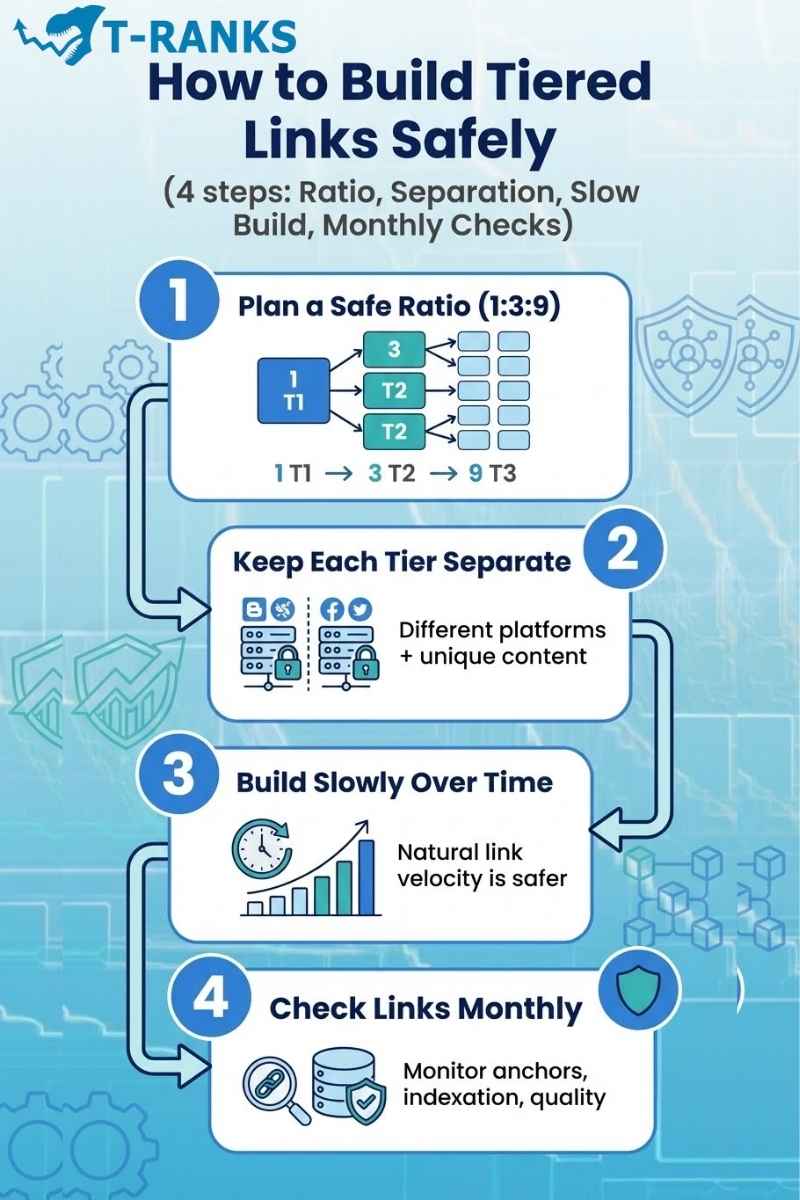
Building tiered links safely means focusing on quality, steady growth, and natural patterns instead of shortcuts or automation. Each layer should make sense to a human reader and fit naturally on the platform where it is published. When the structure looks real and grows slowly, Google treats it as genuine activity. Below is a simple and practical method you can follow to build a safe tiered system.
Step 1: Set a Clear and Safe Tier Ratio
Start by planning how many links you will build for each layer. This prevents unnatural spikes and keeps everything balanced. Your Tier 1 links should always be the strongest and the fewest. Tier 2 supports those links, and Tier 3 adds light activity.
A simple safe ratio is:
- 1 Tier 1 link
- 3 Tier 2 links supporting that Tier 1 link
- 9 Tier 3 links supporting those Tier 2 pages
This gives you a clean structure without looking forced. Remember that one strong Tier 1 link from a good site is better than 20 weak ones.
Step 2: Keep Each Tier Separate
Each tier must look like it comes from a different group of websites. Do not use the same platforms or patterns across all tiers.
Use different types of sites for each layer:
- Tier 1: Guest posts, editorials, niche publications
- Tier 2: Medium, WordPress, Blogger, niche blogs
- Tier 3: Reddit, Pinterest, Scoop.it, bookmarks, social mentions
Write unique content for each link. Mix your anchor text so it looks natural. Most anchors should be branded or generic, with only a few partial matches and very few exact matches. This reduces footprints and keeps everything safe.
Step 3: Build Links Slowly Over Time
The biggest mistake in tiered link building is building links too fast. Google expects backlinks to grow slowly, just like natural content would. Spread your links across several weeks so they look real.
A good pace is:
- Build a small number of Tier 1 links each month
- Add steady Tier 2 links each week
- Add light Tier 3 activity week by week
Avoid creating dozens of links at once. Spreading them out makes each layer look natural and reduces risk.
Step 4: Check Your Links Regularly
After building your tiers, you must keep track of them. This prevents bad links from damaging your structure.
Do a quick check every month:
- View new Tier 2 and Tier 3 links in Ahrefs, SEMrush, or Majestic
- Remove or disavow low-quality domains if they appear
- Make sure your Tier 1 links stay clean and relevant
- Keep a simple spreadsheet of your links, dates, and anchors
Regular maintenance helps keep your structure stable and protects your rankings over the long term.
Summary
Building tiered links safely is about balance, quality, and steady growth. Use a simple ratio, keep each tier separated, build links slowly, and review everything monthly. When done with care, this method strengthens your backlinks, improves rankings, and stays well within safe SEO practices.
Tiered Link Building Strategies
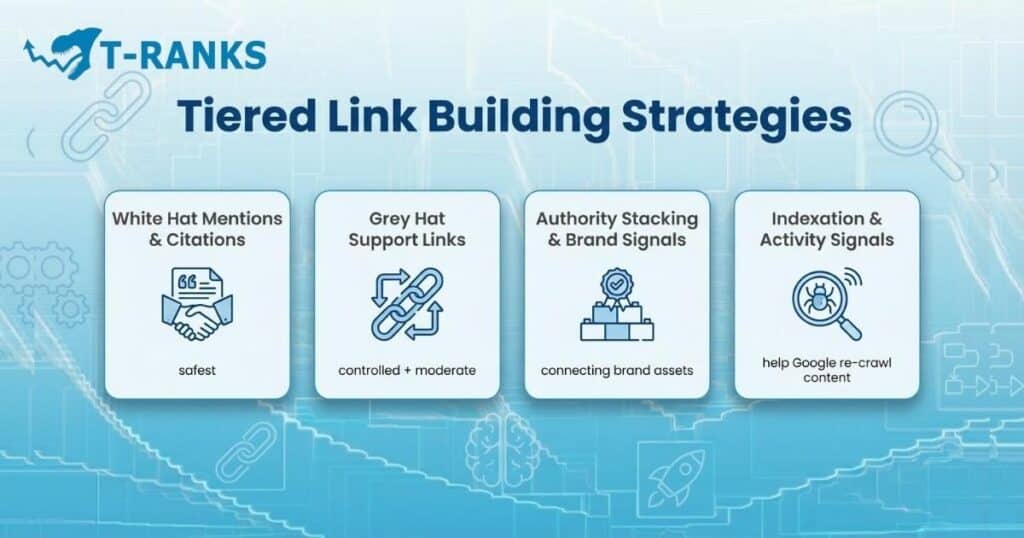
There are several ways to build tiered links, and each method offers a different level of safety, speed, and control. Some strategies focus on earning links naturally, while others use tools or supporting properties to strengthen your backlink system. Below are the main approaches used today and when they work best.
White Hat Mentions and Citations
This is the safest strategy because it focuses on earning real links through good content and helpful information.
How it works:
You create something useful, such as a guide, analysis, or expert insight. Trusted websites link to it as your Tier 1 links. Other websites may also reference those articles as Tier 2 support, and readers share them on social platforms as Tier 3 signals.
This method takes more time but gives the most stable results and builds strong authority for the long term.
Grey Hat Diversified Support Links
This strategy mixes manual work with light automation.
Tier 1 links are still created manually, such as guest posts or PR placements.
Tier 2 and Tier 3 links may use tools or simple platforms like Web 2.0s, profiles, or social mentions.
The goal is to support your Tier 1 backlinks faster, but with careful control.
You must avoid repeated patterns, duplicate anchors, or large bursts of links. When used gently, this method offers good results without exposing your structure to risk.
Authority Stacking and Brand Signals
This approach strengthens your online identity by connecting all your brand profiles and properties together.
Your YouTube channel, Google Business Profile, social accounts, cloud documents, and Medium posts can support each other and link back to your website.
These properties already seem trustworthy to Google, so linking them together creates a strong brand presence.
This is not about building hundreds of links. It is about showing Google a clear picture of who you are.
Indexation and Activity Signals
Your tiered links only help your SEO if Google can actually find and crawl them.
This strategy focuses on keeping your Tier 2 and Tier 3 links visible and active.
Ways to improve indexation:
Share your supporting links on platforms Google crawls often, update your posts occasionally, and use light tools that notify Google when a new page goes live.
Avoid forcing indexation with spam services. Instead, keep your content useful so Google revisits it naturally.
Summary
Tiered link building can be done in different ways depending on how safe or fast you want your results to be.
White-hat strategies grow slowly but safely.
Grey-hat strategies build support faster with careful control.
Authority stacking strengthens your brand identity.
Healthy indexation keeps your entire link structure visible.
When you combine these methods thoughtfully, tiered link building becomes a reliable way to support your backlinks and improve rankings over time.
Tiered Link Building Examples
Seeing a few simple examples makes tiered link building easier to understand. Below are clear, real-world scenarios that show how different industries can apply a basic tier structure safely.
SaaS Example
Goal: Improve visibility for a SaaS homepage.
Tier Structure:
- Tier 1: A guest post on a marketing blog links to the SaaS homepage.
- Tier 2: A Medium article on productivity links to the guest post.
- Tier 3: The Medium post is shared on LinkedIn, Reddit, and Facebook.
Outcome:
The guest post gains more strength, sending more authority to the SaaS site.
eCommerce Example
Goal: Boost product page rankings.
Tier Structure:
- Tier 1: A lifestyle blogger reviews the product and links to the product page.
- Tier 2: A WordPress article about home decor links to the blogger’s review.
- Tier 3: The WordPress article is shared on Pinterest and decor forums.
Outcome:
The review becomes stronger and helps the product page rank for related searches.
Local SEO Example
Goal: Improve local visibility for a service business.
Tier Structure:
- Tier 1: A verified Google Business Profile and a Yelp listing.
- Tier 2: A Medium post about local services links to the Yelp profile.
- Tier 3: The Medium post is shared in local Facebook groups and community forums.
Outcome:
Search engines see more activity and trust around the business, supporting better local ranking.
Key Takeaway
Tiered link building is simply a layered structure:
- Tier 1: Strong, high-quality links pointing to your website
- Tier 2: Supporting content pointing to Tier 1
- Tier 3: Light signals pointing to Tier 2
These examples show how different industries can apply the same basic structure to strengthen their most important links.
Best Sites to Build Tiered Links
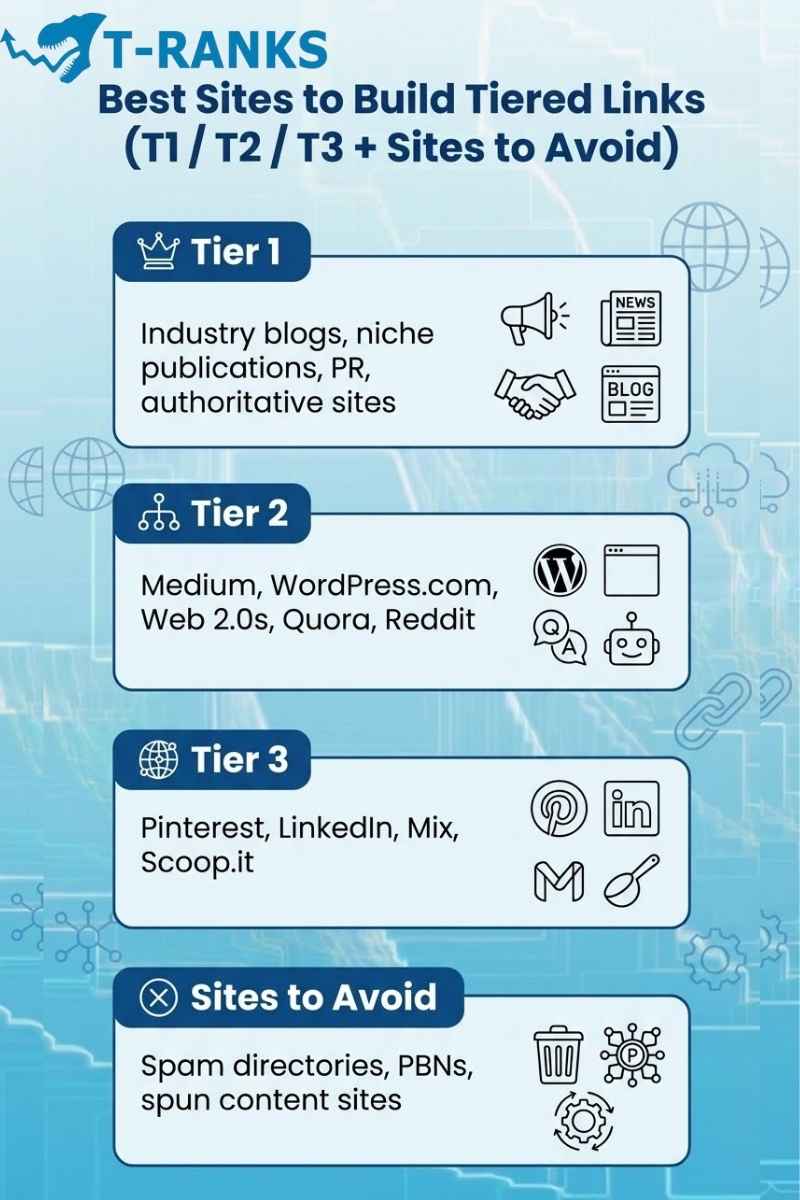
Choosing the right platforms for each tier is essential for building a safe and reliable tiered link structure. Below is a simple, practical breakdown of the best site types for Tier 1, Tier 2, and Tier 3. These examples show the structure clearly, but you should always select sites based on your own niche, organic traffic, and relevance.
Tier 1 Site Types
Tier 1 links point directly to your main website. They must be high-quality, relevant, and editorial. The examples listed below come from the SEO and digital marketing niche, but you should choose equivalent sites within your own industry.
How to Choose Tier 1 Sites in Your Niche
Before selecting Tier 1 platforms:
- Choose websites from your niche, not general unrelated sites.
- Make sure the site has real organic traffic (even 2,000–5,000 per month is enough when relevant).
- Avoid targeting only massive brands like Forbes; instead focus on micro-niche blogs and industry-specific publications.
- Use competitor analysis to find realistic sites that already link within your niche.
Best Tier 1 Platforms (Example from SEO niche)
• Industry blogs such as Search Engine Journal → https://www.searchenginejournal.com/
• Niche-specific publications in your field
• Digital PR platforms like HARO → https://www.helpareporter.com/
• High-trust review sites in your industry
• Local business or professional associations
• Editorial websites that accept guest posts with quality guidelines
Why Tier 1 Works:
Tier 1 links form the foundation of your authority. Relevance and organic traffic matter more than DA. A contextual link from a niche micro-authority is often safer and more powerful than a random high-DA site.
Tier 2 Site Types
Tier 2 links support and reinforce your Tier 1 placements. These should be contextual, readable, and spread across trusted user-generated or community platforms.
Best Tier 2 Platforms
• Web 2.0 platforms
– Medium → https://medium.com/
– WordPress.com → https://wordpress.com/
– Blogger → https://www.blogger.com/
• Community-driven sites
– Quora → https://www.quora.com/
– Reddit → https://www.reddit.com/
• Google properties
– Google Sites → https://sites.google.com/
– Public Google Docs or Sheets when used carefully
• Curated content and content aggregators
– Mix → https://mix.com/
– Scoop.it → https://www.scoop.it/
Why Tier 2 Works:
These platforms help give extra context, relevance, and engagement to your Tier 1 links. They make your Tier 1 content easier for Google to find and index.
Tier 3 Site Types
Tier 3 links do not pass much authority, but they help Google discover and crawl your Tier 2 pages more frequently.
Best Tier 3 Platforms
• Social profiles
– Pinterest → https://www.pinterest.com/
– LinkedIn → https://www.linkedin.com/
• Social bookmarking sites
– Flipboard → https://flipboard.com/
– Mix
– Scoop.it
• Local citations (for local businesses)
– Google Business Profile
– Yelp → https://www.yelp.com/
• Low-impact forums or comments (only when moderated and relevant)
Why Tier 3 Works:
These links help maintain consistent crawl signals and natural activity around your Tier 2 links.
Sites to Avoid
Avoid these across all tiers to protect your website:
• PBNs and link farms
• Auto-generated Web 2.0 networks
• AI-spun content sites
• Expired domains with toxic history
• Spam comments or unmoderated forums
• Hacked websites or platforms with malware history
Why Avoid Them:
These sites contaminate your tiers. Toxic signals can flow upward and harm your Tier 1 links or trigger Google’s SpamBrain systems.
How to Measure Tiered Link Performance
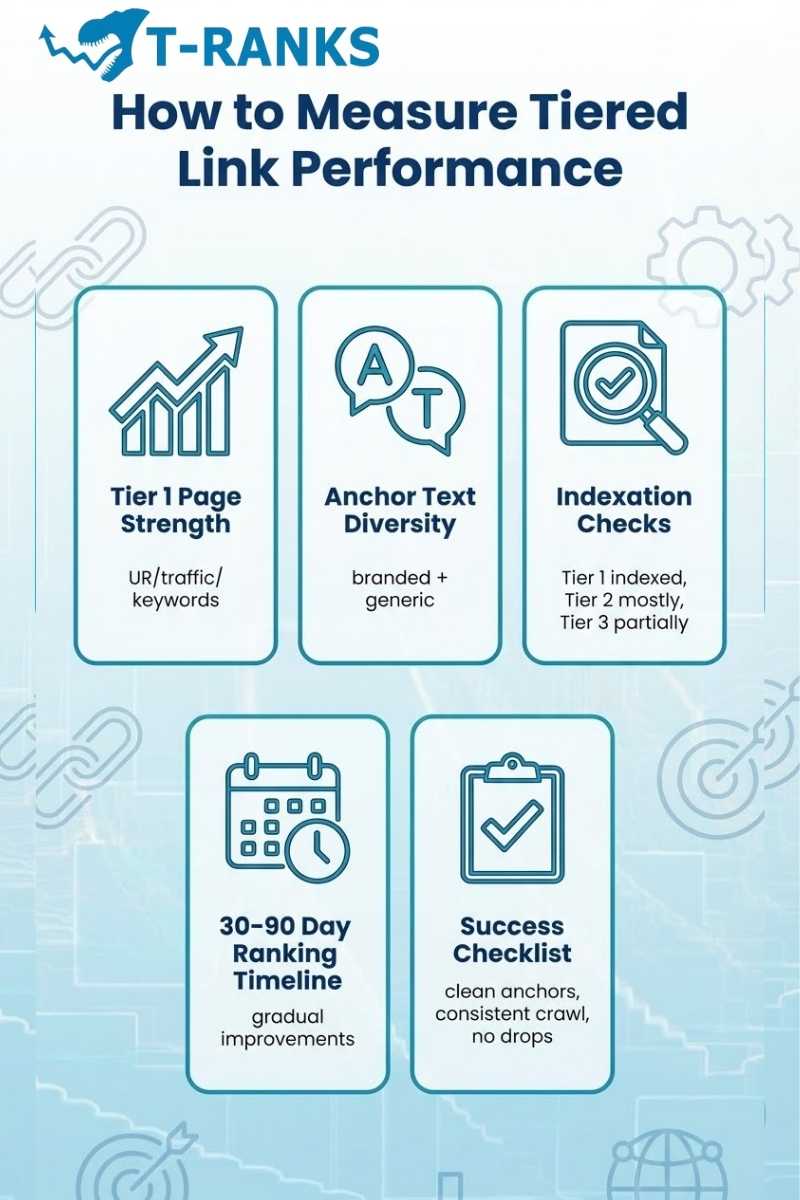
Measuring your tiered link structure helps you understand whether authority is flowing upward and whether each tier is working as intended. You don’t need advanced tools or complicated metrics — a few simple checks are enough to confirm progress.
Check if Tier 1 Pages Are Getting Stronger
When Tier 2 links reinforce your Tier 1 pages, those pages should show gradual improvements in:
• URL Rating / Page Authority
• Organic traffic or impressions
• Keyword positions
• Referring domains
You can check this using tools like Ahrefs, Semrush, or Google Search Console.
What good looks like:
If your Tier 1 page becomes stronger after adding Tier 2 links, your structure is working.
Review Anchor Text Patterns Across All Tiers
Anchor text must stay natural. When too many links use the same keyword, Google may see it as manipulation.
A simple, safe pattern is:
• Mostly branded or generic anchors
• Some partial-match anchors
• Very few exact-match anchors
If your Tier 1 anchors look clean, and Tier 2/3 anchors are varied, your structure remains safe.
Confirm Indexation of Tier 2 and Tier 3 Pages
A link that isn’t indexed cannot pass any value.
Check indexation with:
• site:URL search in Google
• Coverage Report in Google Search Console
• Light indexation tools for Tier 2/3 if needed
What good looks like:
• Tier 1: almost fully indexed
• Tier 2: majority indexed
• Tier 3: at least some indexed
If indexing improves over time, crawl paths to your Tier 1 links stay strong.
Track Ranking Improvements Over 30–90 Days
Tiered link building takes time.
A realistic timeline looks like:
• 30 days: Early crawl and index signals
• 60 days: Tier 2 reinforcement begins working
• 90 days: Main pages show ranking lifts
Look for:
• Better ranking stability
• Higher keyword positions
• More impressions in Search Console
• Improved click-through rates
These signs confirm that your link structure is maturing correctly.
Quick Success Checklist
A tiered system is performing well when:
• Tier 1 pages grow stronger
• Tier 2 pages stay indexed
• Anchors look natural
• Rankings improve over time
• No sudden drops or penalties appear
If any part weakens, focus on cleaning anchors, removing bad links, or rebuilding missing tier support.
Safer Alternatives to Tiered Link Building
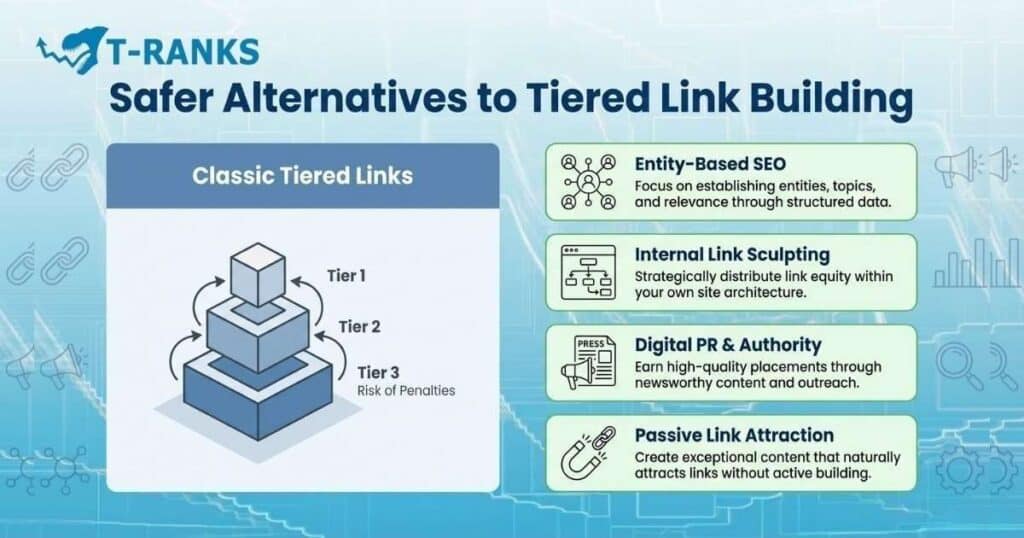
Tiered link building can work, but it also carries risks when done incorrectly. Many SEO professionals now prefer safer, long-term methods that build trust and authority without relying on layered link structures. These alternatives follow Google’s guidelines and help your site grow naturally over time.
Entity-Based SEO
Best for: Building long-term authority without large backlink structures.
Entity SEO focuses on helping Google clearly identify your brand, products, services, and expertise. Instead of depending on many external links, you strengthen your brand’s presence across the web.
How It Works
• Add structured data (Schema) to define your business
• Create topic clusters around core subjects
• Keep brand details consistent across social profiles and citations
• Connect to trusted platforms like LinkedIn or Wikipedia where possible
Why It’s Effective
Entity optimization helps Google recognize your brand as a trusted source. This increases visibility in both search and AI results, even with fewer backlinks.
Internal Link Sculpting
Best for: Improving rankings using your own website’s structure.
Internal linking redistributes authority across your website and strengthens important pages—similar to tiered link flow but without external risk.
How It Works
• Create pillar pages for major topics
• Link supporting articles back to the pillar pages
• Use descriptive, natural anchor text
• Audit internal linking regularly with tools like Ahrefs or Link Whisper
Why It’s Effective
A clean internal link structure improves crawlability and helps Google understand which pages matter most on your site.
Digital PR & Authority Building
Best for: Earning high-quality editorial links safely.
Digital PR generates top-tier backlinks by sharing real stories, data, or expert insights. These links act like strong Tier 1 backlinks—without any manipulation.
How It Works
• Publish newsworthy content such as reports or surveys
• Use platforms like HARO or Qwoted to connect with journalists
• Appear on podcasts, webinars, or industry blogs
Why It’s Effective
These links are earned naturally, improve brand trust, and deliver powerful E-E-A-T signals that support long-term SEO growth.
Passive Link Attraction
Best for: Getting backlinks automatically over time.
This method focuses on creating content that other websites naturally want to reference, link to, and share.
How It Works
• Publish in-depth guides, studies, or resource pages
• Update and improve content regularly
• Promote your content through social media and email
Why It’s Effective
Over time, high-quality content attracts natural backlinks without outreach or tiered systems.
Conclusion: The Future of Tiered Link Building
In conclusion, tiered link building works best when it is built on strategy, relevance, and moderation. The goal is not to create large volumes of links, but to build clean, contextual tiers that support each other naturally. When each layer has a clear purpose — from strengthening authority to improving indexation — the entire system becomes safer and more effective.
As search engines evolve, long-term SEO success will depend more on genuine authority signals, entity relevance, and strong brand presence than on aggressive link quantity. A safe, data-driven tiered structure, paired with quality content and ethical outreach, will continue to offer steady growth without putting your website at risk.If you want help building a powerful, penalty-proof link strategy, T-Ranks can manage the entire process for you.
Partner with T-Ranks to create clean, contextual, and scalable link structures that improve rankings and long-term domain authority.
Frequently Asked Questions About Tiered Link Building
Is tiered link building still effective in 2026?
Yes, tiered link building is still effective when it is built slowly and focused on relevance. It works best with contextual Tier 1 links and light support from Tier 2 and Tier 3, without automation or spam.
How many tiers should I build?
Most sites only need two or three tiers. More tiers increase complexity and can create unnatural footprints. A simple structure is safer and easier to maintain.
Are automated tools safe for tiered link building?
Automation is only safe for light Tier 3 activity. Using automation for Tier 1 or Tier 2 links can create patterns that Google’s SpamBrain easily detects.
What are the best metrics to track tiered link performance?
Track authority growth on Tier 1 pages, anchor text diversity, indexation rates, and ranking improvements. These signals show whether link equity is flowing through the tiers.
Should I disavow lower-tier links?
Yes, remove or disavow spammy Tier 2 and Tier 3 links if they look unsafe. This protects your Tier 1 authority and keeps your backlink profile clean.
How long does tiered link building take to show results?
Most campaigns show early signals in 30 to 60 days and clearer ranking improvements within 90 days, once Google crawls and processes all tiers.
Can Google detect tiered link building?
Google can detect tiered systems that are repetitive, automated, or unnatural. Keeping links contextual, steady, and diverse helps avoid detection.
Is tiered link building white hat or grey hat?
Tiered link building is considered grey hat. It is not directly against Google’s rules, but aggressive or automated methods move it toward black hat territory.
What tools can help manage tiered links?
Use outreach tools for Tier 1 and simple index checks for Tier 2 and Tier 3. Tracking tools like Ahrefs or Google Search Console help monitor authority and indexation.
What happens if my Tier 2 or Tier 3 links get deindexed?
If a lower-tier link is deindexed, it stops supporting the layer above it. You can rebuild the link or refresh the page to encourage reindexing.
How can I make tiered link building safer?
Build slowly, use natural anchors, avoid automation, choose relevant websites, and keep each tier’s content unique. These steps reduce risk and maintain trust.