For most startups, link building feels confusing, expensive, or risky. Not because backlinks do not work, but because most advice is written for companies with established brands, dedicated SEO teams, and marketing budgets that early-stage startups simply do not have.
For startups, link building is not about speed or scale. It is about earning credibility at the right time, in the right places. A handful of relevant, well-earned links can move the needle far more than dozens of low-quality placements that drain budget and increase risk.
This guide breaks down how startup link building actually works when resources are limited. It focuses on what to do first, what to avoid, and how to build authority step by step, without wasting money or creating problems that slow growth later.
What Is Startup Link Building?
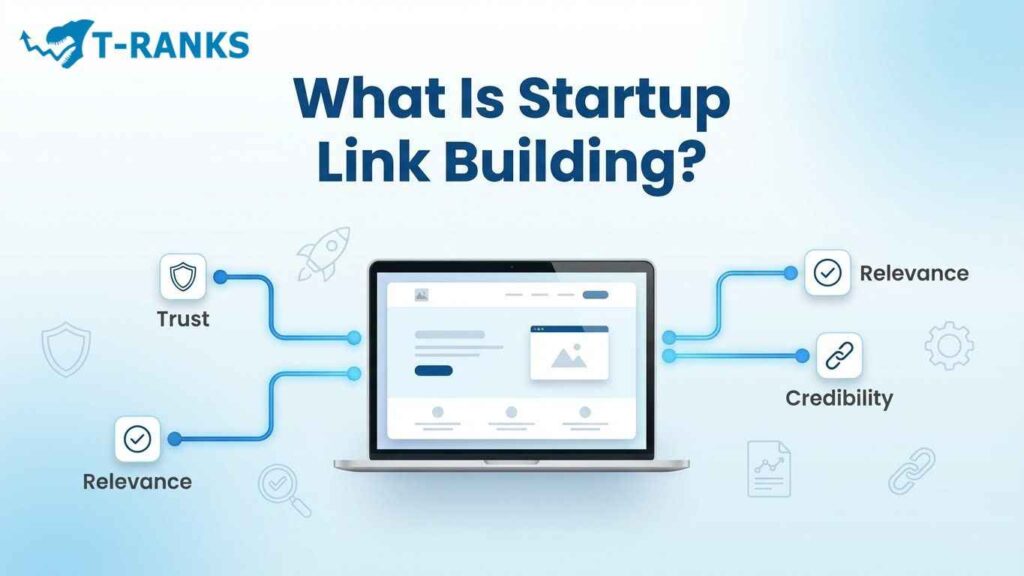
Startup link building is the process of earning backlinks that help an early-stage business build online credibility. These links signal trust, relevance, and legitimacy to search engines when a startup is still unknown and has limited authority.
A startup is a young business that is still establishing its product, brand, and market presence. At this stage, there are usually very few external signals pointing to the website, such as mentions, citations, or referrals. Link building helps fill this gap by creating early trust signals that support visibility and growth.
This approach is different from enterprise or agency-driven SEO. Established companies can rely on brand recognition, large teams, and strong existing authority. Startups cannot. As a result, startup link building focuses on earning a small number of relevant, natural links rather than scaling volume quickly.
With limited budgets and limited brand signals, every link must serve a purpose. The goal is not to accumulate links, but to build a strong foundation of credibility that allows future SEO efforts to scale safely as the startup grows.
Why Startups Need a Different Link Building Strategy
Startups operate in a very different environment than established brands. Because of this, link building approaches that work for enterprises often fail or introduce unnecessary risk when applied to early-stage businesses.
The reasons I provided explain why startup link building must follow a different path and why careful execution matters before any attempt to scale.
Limited Budgets and Resources
Most startups work with strict financial limits and small teams, which makes it unrealistic to run large outreach campaigns, purchase placements, or experiment with tactics that do not show clear early value.
A startup link building strategy must therefore prioritize efficiency, focusing on actions that deliver trust and relevance without ongoing spend.
Low Brand Recognition
Startups usually begin without an established reputation, and publishers or website owners are unlikely to recognize the brand. This reduces the chances of earning links naturally.
As a result, links must be earned through relevance, insight, and credibility rather than brand authority alone.
Fewer Existing Trust Signals
New websites lack historical signals such as long-standing backlinks, citations, and consistent mentions.
Search engines rely more heavily on early link quality to assess legitimacy, which makes selective, relevant links far more important than link volume during the startup phase.
Higher Risk From Early SEO Mistakes
Early link building mistakes can slow growth or limit future potential. Over-optimized anchors, unnatural link velocity, or low-quality placements are harder to correct when authority is still weak.
Startups have less margin for error, which makes conservative execution essential.
Enterprise Strategies Depend on Scale and Authority
Enterprise link building strategies rely heavily on brand recognition, automation, and volume. These approaches assume the business already has authority and can absorb risk.
Startups do not have these advantages, which makes copying enterprise playbooks ineffective or harmful.
The Need for Gradual and Natural Growth
Search engines expect new brands to grow steadily rather than aggressively. Rapid spikes in backlinks without supporting signals can appear unnatural for a startup.
A successful strategy aligns link growth with content development, visibility, and trust over time.
Founder Involvement Changes What Is Possible
In early stages, founders are often the most credible representatives of the brand. Their expertise, story, and direct involvement open doors that brand-only outreach cannot. This allows startups to earn links through relationships and insight rather than budget.
Because of these factors, startup link building must replace scale with relevance, budget with credibility, and automation with intent.
In the next section I will break down seven startup link building strategies that work on a small budget.
7 Startup Link Building Strategies That Work on a Small Budget
Startups cannot build links the same way large companies do. Strategies that depend on automation, paid placements, or large outreach teams usually require brand authority and steady budgets. Most early-stage startups do not have these advantages.
I designed the strategies in this section specifically for startups with limited resources. They focus on quality over quantity and avoid tactics that create unnecessary SEO risk. Each strategy is based on what actually works in early stages, not on what looks impressive on paper.
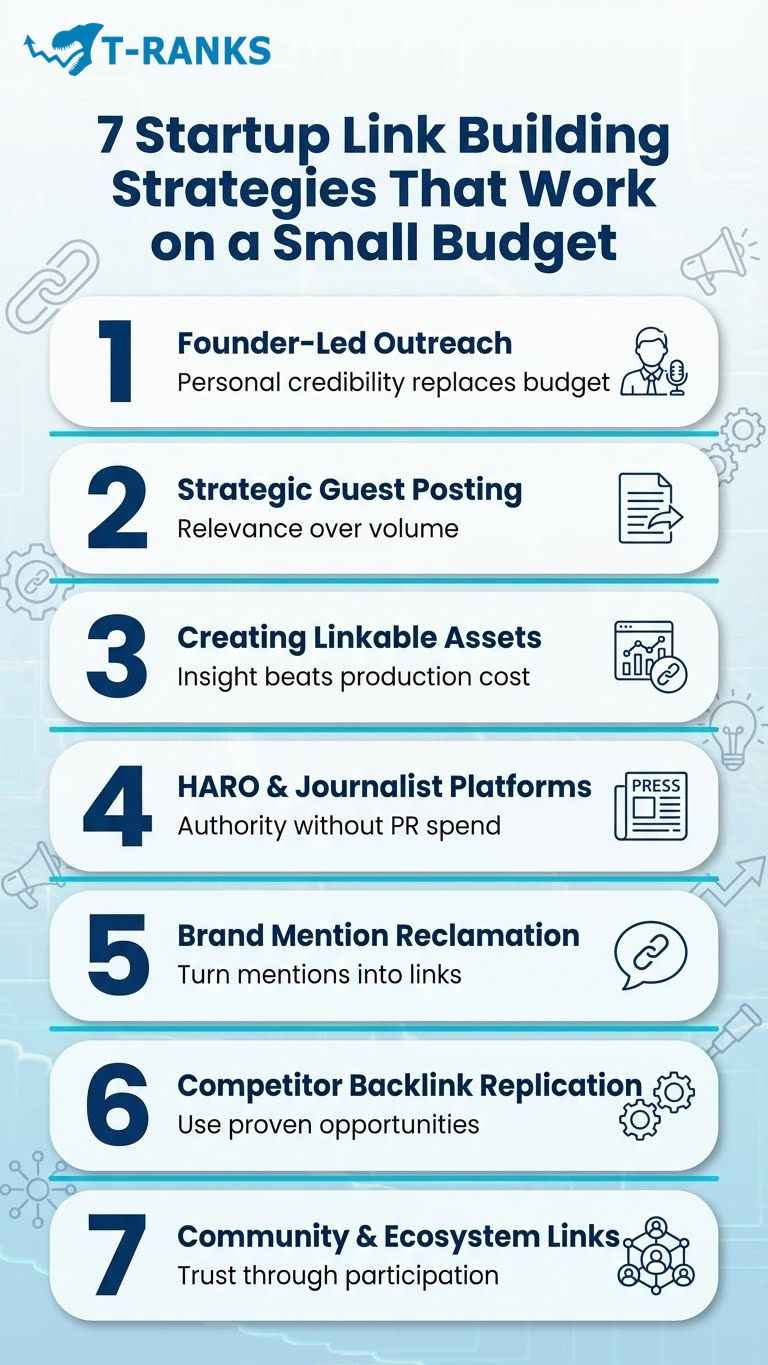
In this section, we will cover the following top 7 startup-safe link building strategies:
- Founder-led outreach
- Strategic guest posting
- Creating linkable assets without big budgets
- HARO and journalist platforms
- Reclaiming unlinked brand mentions
- Competitor backlink replication
- Community and ecosystem links
These strategies are meant to be applied selectively. You do not need to use all of them at once. The goal is to choose what fits your stage, resources, and capacity, then build authority gradually and safely.
1)Founder-Led Outreach as a Core Advantage
Founder-led outreach works because it feels real. When a founder reaches out directly, the message carries personal responsibility and authenticity. Publishers are more likely to respond to a real person who is involved in the business than to a generic brand email.
For startups, this approach replaces budget with credibility. Founders can explain the problem they are solving, share lessons learned while building the product, or offer insights based on real experience. This turns outreach into a conversation instead of a request for a link.
Founder-led outreach works best in places where personal voice matters, such as podcasts, niche blogs, and independent newsletters. Communities and platforms built around participation also respond well to founders who contribute meaningfully.
The focus here is relationship building. Instead of asking for links, founders aim to add value through insights, interviews, or collaboration. Links then appear naturally as mentions, references, or contextual citations, which makes them stronger and more sustainable.
2)Strategic Guest Posting Instead of Mass Outreach
Guest posting can still be effective for startups, but only when it is done selectively. A few relevant guest posts can build more authority than many low-quality placements. At the startup stage, relevance matters more than domain size or traffic numbers.
Strategic guest posting starts with choosing the right websites. Startups should focus on sites that regularly publish content related to their industry or audience. Publishing on closely related websites helps search engines understand what the startup is about.
A startup-friendly guest posting approach focuses on:
- Relevance instead of chasing high metrics
- Natural placement within the content
- Simple, natural anchor text
- Content that genuinely helps the host site’s readers
Mass guest posting often uses templates and repeated patterns. This creates footprints that are easy to detect and risky for new websites. Startups have less authority to offset these signals, which makes recovery difficult if things go wrong.
Strategic guest posting avoids these risks by treating each article as an editorial contribution first. Links support the content rather than drive it. Over time, this builds trust, authority, and a clean link profile that can grow safely.
3) Creating Linkable Assets Without Big Production Costs
Startups do not need expensive reports, interactive tools, or polished design to earn links. What they need is material that other writers can reference. In practice, linkable assets are not marketing pieces. They are reference content that helps explain, compare, or support an idea.
At the startup stage, the strongest linkable assets often come from what the business already knows. Internal insights, early user behavior, founder experience, or lessons learned while building the product can all be turned into content that is genuinely useful and difficult to copy.
Low-cost linkable assets commonly include:
- Simple frameworks that explain decisions or processes
- Comparisons that help readers evaluate options
- Clear explanations of complex topics in plain language
- Experience-based insights drawn from real execution
For early-stage startups, insight consistently beats design polish. Publishers link to content because it helps them make a point clearer, not because it looks impressive. A well-explained idea is easier to cite than a visually polished asset with no unique substance.
When these assets are created with clarity and relevance, they attract links naturally. Writers reference them to support arguments, explain concepts, or add credibility to their content. This results in editorial links that are contextually relevant, durable, and aligned with long-term authority building.
4) Using HARO and Journalist Platforms for Early Authority
Journalist platforms work well for startups because reporters are looking for experience, not brand size. Startups can offer fresh perspectives, practical insight, and real-world examples that are often missing from corporate responses.
These platforms allow startups to earn links without PR agencies or paid campaigns. The primary investment is time and responsiveness. Founders or team members answer journalist questions directly, using their experience rather than promotional messaging.
Strong startup responses usually share a few traits:
- A direct answer to the journalist’s question
- Insight based on real experience, not general advice
- Clear, simple language that is easy to quote
- A short credibility signal explaining the source’s background
Promotion weakens responses. Journalists are not looking for product pitches. They want useful input that improves the quality of their article. When a startup delivers that, links are included naturally as attribution rather than placement.
Over time, earned media links from journalist platforms pass strong trust signals. These links often come from authoritative publications and help search engines associate the startup with credibility and expertise. For early-stage startups, this trust transfer supports both visibility and long-term SEO growth.
5)Reclaiming Unlinked Brand Mentions
Startups often receive brand mentions before they earn backlinks. These mentions appear when writers reference the product, company, or founder without adding a clickable link, which is common for new or emerging brands.
Unlinked brand mentions commonly appear in:
- Blog posts and reviews
- News articles and press coverage
- Community discussions and forum posts
- Partner or customer content
Reclaiming these mentions is one of the highest ROI link building strategies for startups. Because the brand is already mentioned, outreach is minimal. A short, polite request to add a link is often enough to convert the mention into a backlink.
This approach works well because trust already exists. The publisher has acknowledged the startup, which increases success rates and keeps costs low. Brand mention links also strengthen trust signals, helping search engines associate the startup with legitimacy and relevance.
6)Competitor Backlink Replication for Startups
Competitor backlink replication helps startups avoid guesswork by showing where links are already being earned within the niche. Instead of copying everything, startups identify opportunities that match their stage and authority level.
Startup-friendly competitor link types often include:
- Guest posts and contributor articles
- Resource page mentions
- List inclusions and comparisons
- Community or ecosystem references
Selective replication is critical. Blind copying or automated scraping often surfaces links that are paid, outdated, or inaccessible. A focused approach reduces wasted outreach and improves response rates.
Using competitor data allows startups to prioritize realistic opportunities. This makes link building more efficient and lowers risk, especially when time and resources are limited.
7)Community, Ecosystem, and Partnership Links
Community and ecosystem links help startups establish legitimacy early by showing real participation in their industry. These links often come from environments that support new businesses rather than compete with them.
Common ecosystem link sources include:
- Accelerators, incubators, and startup programs
- Integration and partner pages
- Co-working spaces and startup networks
- Selective, niche-focused startup directories
These links matter because they reflect real-world relationships. Search engines interpret them as signals of trust, credibility, and industry involvement, which helps startups build a stable SEO foundation before pursuing more competitive link strategies.
Common Link Building Mistakes Startups Make
Many startups struggle with link building not because links do not work, but because early decisions are made under pressure. Limited budgets, impatience for results, and exposure to outdated SEO advice often lead to mistakes that slow growth or create long-term risk.
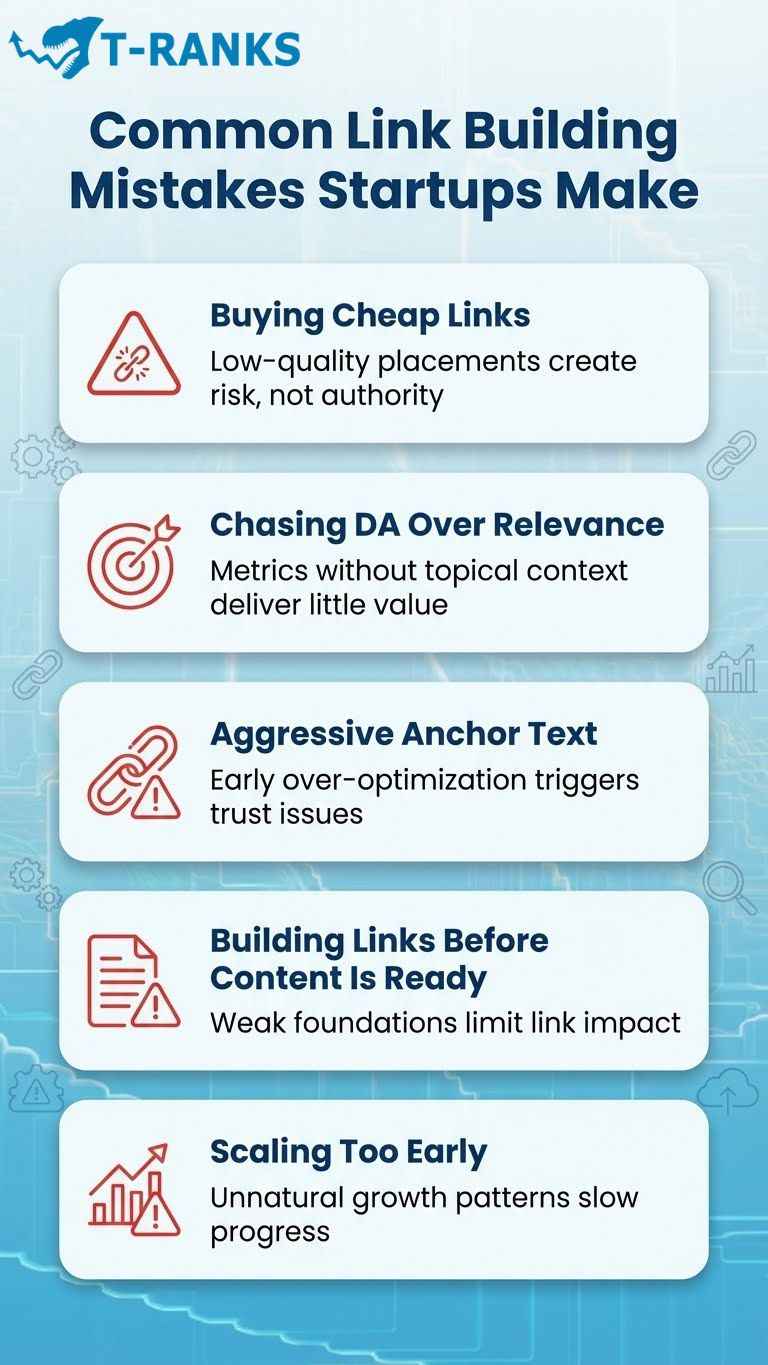
The following mistakes are common among early-stage startups and explain why link building efforts fail or underperform when not handled carefully.
Buying Cheap or Bulk Backlinks Too Early
One of the most common mistakes startups make is buying low-cost backlink packages early. These links often come from unrelated sites, private networks, or low-quality pages created only for placement.
For new websites with limited authority, these links stand out as unnatural. Instead of helping rankings, they are often ignored or devalued by search engines. In some cases, they make it harder for future high-quality links to have an impact.
The safer alternative is to delay paid links and focus on earning a small number of relevant, editorial links. Early-stage link building should prioritize trust and context rather than volume.
Obsessing Over High DA Instead of Relevance
Many startups chase high Domain Authority links without considering relevance. A link from a strong but unrelated website may look impressive on paper but often adds little real value.
Search engines evaluate links based on context, not just metrics. Links from websites that consistently cover related topics help establish topical authority, even if their metrics appear lower.
A better approach is to focus on websites that serve a similar audience or operate within the same industry. Relevant links strengthen topic association and are far more effective for startups than random high-metric placements.
Using Aggressive Anchor Text Too Soon
Startups often overuse keyword-rich anchor text in an attempt to rank faster. This includes repeating exact-match anchors across guest posts, directories, or paid placements.
For new sites, this creates unnatural patterns that are difficult to correct later. Without strong brand signals to balance the profile, aggressive anchors increase risk and reduce trust.
Early-stage anchor text should be simple and natural. Brand names, URLs, and contextual phrases are safer and align better with how new brands naturally earn links.
Building Links Before Content and Positioning Are Ready
Another common mistake is starting link building before the website has clear content focus or strong foundational pages. Links pointing to thin or unfocused content rarely deliver long-term value.
When content does not clearly communicate expertise or relevance, backlinks fail to reinforce meaningful signals. This often leads to wasted outreach and weak results.
Before building links, startups should ensure their core pages clearly explain what they do, who they serve, and why they are credible. Strong positioning allows each new link to amplify authority instead of exposing gaps.
Trying to Scale Before Trust Is Established
Some startups attempt to scale link building too early by increasing outreach volume, automation, or placements. This often creates unnatural growth patterns that do not match a new brand’s visibility or reputation.
Search engines expect startups to grow gradually. Sudden spikes in links without supporting signals such as content growth, mentions, or engagement can slow progress rather than accelerate it.
A more effective approach is steady, consistent link acquisition aligned with overall growth. Slow trust-building creates a stronger foundation and allows scaling later without added risk.
How These Mistakes Affect Long-Term Growth
Each of these mistakes reduces the effectiveness of future link building. Low-quality links, poor anchor choices, and weak relevance make it harder for strong links to move rankings later.
Startups that avoid these errors build cleaner link profiles, establish trust faster, and create space for sustainable growth. The next section focuses on strategies that help startups build links safely without repeating these common pitfalls.
How Many Links Does a Startup Actually Need?
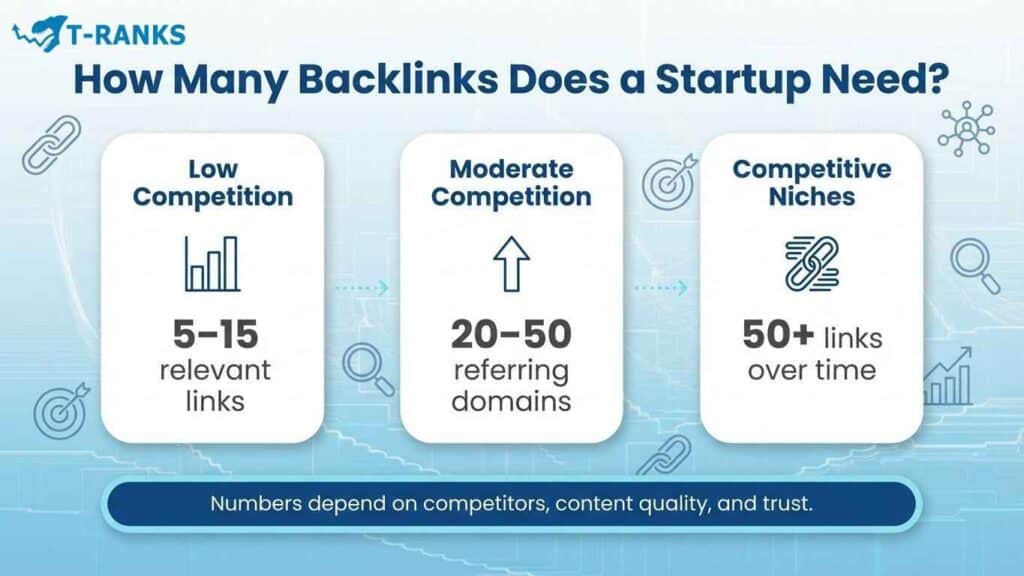
There is no fixed number of backlinks a startup needs to rank. Rankings are relative, not absolute. Each startup competes in a different environment, with different competitors, content quality, and authority gaps. Because of this, setting a hard backlink target often leads to wasted effort or unnecessary risk.
Backlinks work by comparison. What matters is not how many links you have, but how your link profile compares to the pages already ranking for your target keywords. In some niches, a small number of strong, relevant links can be enough. In more competitive spaces, even dozens of links may not be sufficient if competitors are far ahead.
The most reliable way to estimate link needs is to think in terms of stages and competitor baselines, not totals. Early on, the goal is not to match competitors link for link. The goal is to close the credibility gap by earning enough links to signal legitimacy, relevance, and consistency.
Once that foundation is in place, competitor analysis becomes the reference point. By reviewing the backlink profiles of top-ranking pages, startups can identify patterns such as the average number of referring domains, the types of sites linking to competitors, and how steadily those links were built.
From there, startups should work with estimated ranges rather than exact numbers. These ranges are not guarantees. They are directional benchmarks based on common competitive patterns.
- Low-competition or niche topics
Early traction may appear with 5 to 15 high-quality referring domains, especially when content is focused and well structured. - Moderately competitive keywords
Competing often requires 20 to 50 relevant referring domains, built gradually and supported by strong topical coverage. - Competitive or crowded markets
Progress usually requires 50 or more referring domains over time, with steady growth and consistent relevance rather than rapid volume.
These estimates only make sense in context. Backlinks do not work in isolation. Content quality, clarity of positioning, internal structure, and user signals all influence how much impact links have. Strong content often reduces the number of links required, while weak or unfocused content increases link dependency.
The safest approach is to treat link building as a gradual process. Start by earning enough links to establish trust, then measure progress against real competitors, and adjust expectations as visibility improves. This keeps startup link building strategic, realistic, and aligned with long-term growth instead of chasing arbitrary numbers.
Anchor Text Strategy for Startup Link Building
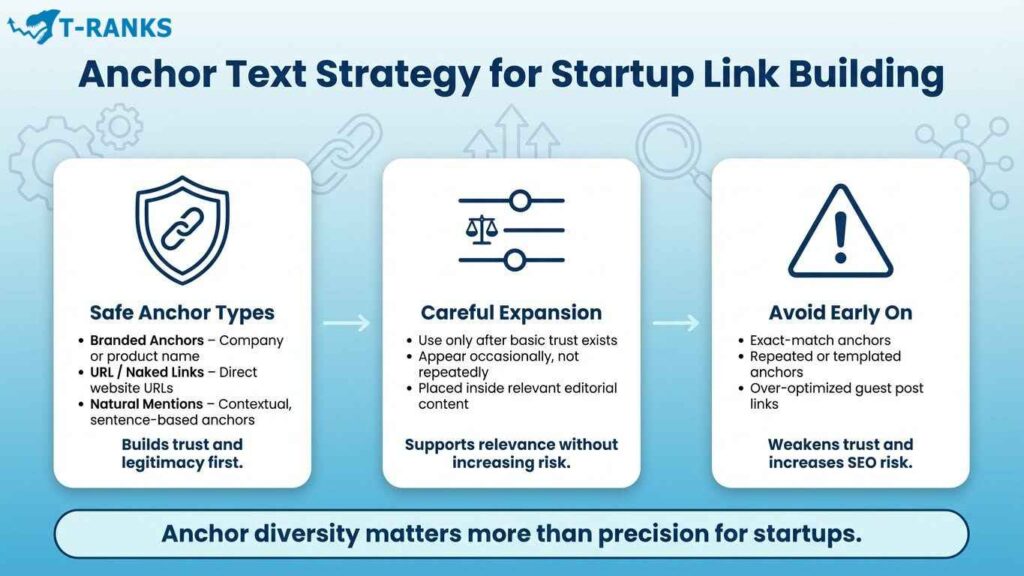
Anchor text determines how search engines interpret backlinks. For startups, anchor text strategy is not about optimization. It is about safety. New websites have limited trust, so anchor patterns must look natural before they can support rankings.
The right anchor strategy protects all link building efforts. The wrong one weakens even high-quality links.
What Anchor Text Strategies Work for Startups
Early-stage startups should focus on anchor types that reflect how new brands are normally referenced online.
The safest and most effective anchor strategies include:
• Branded anchors
Using the startup name, product name, or company name builds trust and legitimacy.
• URL and naked link anchors
Direct website URLs signal organic mentions and reduce optimization risk.
• Natural contextual mentions
Anchors that appear naturally inside sentences without targeting keywords.
These anchors dominate healthy startup link profiles and allow authority to grow without pressure.
When and How to Introduce Partial-Match Anchors
Partial-match anchors should be introduced only after basic trust is established. This usually means the site already has branded links, editorial mentions, and consistent relevance.
When used, partial-match anchors should:
• Appear occasionally, not repeatedly
• Be placed inside relevant editorial content
• Read naturally without forcing keywords
Used correctly, partial-match anchors reinforce topical relevance without triggering risk.
Anchor Text Practices Startups Should Avoid
Some anchor practices create problems early and are difficult to fix later.
Startups should avoid:
• Exact-match anchors in early stages
Repeating keyword-focused anchors creates unnatural patterns for new sites.
• Forced or templated anchor usage
Using the same anchor across multiple links signals manipulation.
• Over-optimization through guest posts or paid links
This often leads to link devaluation rather than ranking gains.
These practices weaken trust instead of strengthening it.
Why Anchor Diversity Matters More Than Precision
A healthy startup link profile includes a wide mix of anchor types. Diversity signals organic growth and natural referencing behavior.
A balanced profile typically includes brand names, URLs, generic phrases, and contextual mentions. This allows search engines to understand relevance without relying on repeated keyword signals.
For startups, anchor diversity is not optional. It is the foundation that allows future optimization to work safely.
Measuring Link Building Success Without Expensive Tools
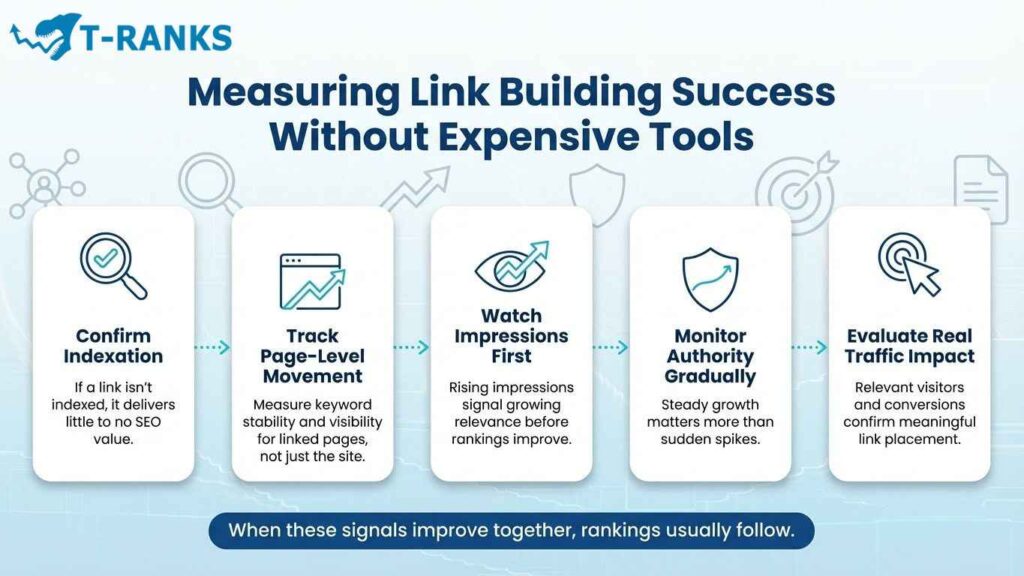
Measuring link building success is essential, especially for startups working with limited budgets. To measure results correctly, you first need clarity on where links were placed and what those links were meant to support, whether that is the homepage, a service page, or a specific blog post.
Before measuring impact, one critical step is confirmation. Links must be indexed. Many providers share link reports claiming high-quality placements, but a large percentage of those links never get indexed. If a link is not indexed, it delivers little to no SEO value. Confirming indexation should always come before judging performance.
Once links are indexed, measurement becomes meaningful.
Track Page-Level Impact, Not Just the Site
Link success should be measured at the page level first. Start by noting the keyword positions for the pages you targeted with backlinks. These could be homepage terms, service-related keywords, or blog-focused queries.
Early signs of progress often include:
- Improved stability in keyword positions
- Pages appearing for more related queries
- Reduced ranking volatility over time
These changes usually happen before major ranking jumps and indicate growing trust.
Watch Search Impressions Before Rankings
Rankings alone are not reliable early indicators. Search impressions provide a clearer signal. When impressions increase, it means search engines are showing your pages more often, even if positions have not fully improved yet.
For startups, rising impressions usually indicate:
- Better crawl and indexing behavior
- Improved relevance for targeted topics
- Stronger recognition of page intent
This stage often comes before traffic growth.
Monitor Authority Growth Carefully
Backlinks contribute to overall site authority over time. While metrics like DA or DR should not be the primary goal, gradual improvement often reflects healthier link profiles.
Authority growth should be viewed as a trend, not a target. Sudden spikes are less important than steady increases that align with link acquisition and content expansion.
Evaluate Referral Traffic and Conversions
Referral traffic is one of the most practical success indicators. When backlinks are placed on sites that receive real traffic, startups often see visitors arriving through those links.
Even small amounts of referral traffic matter if:
- The visitors are relevant
- They engage with the site
- They contribute to leads or conversions
This confirms that links are placed in meaningful contexts, not just for SEO signals.
Why Rankings Should Not Be the Only Metric
Rankings respond slowly, especially for new sites. Measuring only rankings can cause startups to abandon strategies that are actually working.
A better measurement approach looks at:
- Indexation confirmation
- Page-level keyword movement
- Search impressions
- Authority trends
- Referral traffic and conversions
When these signals improve together, rankings usually follow.
Key Takeaway
Effective measurement starts with indexed links, then moves to page-level performance, visibility growth, and real traffic impact. This approach gives startups a realistic view of progress without relying on expensive tools or misleading reports.
When Should Startups Invest in Paid Link Building?
Startups should invest in paid link building after their website foundation is strong and early organic trust signals are visible. Paid links work as amplifiers. They strengthen what already exists. If a site has weak content, poor UX, or unclear positioning, paid links increase risk instead of results.
Paid link building is a legitimate part of modern SEO, but it should never be the first step for a startup.
Why Startups Eventually Need Paid Link Building
Organic link building alone is rarely consistent. Natural links depend on visibility, timing, and third-party decisions. As a result, growth is often slow and unpredictable. Paid link building introduces control, which becomes necessary once a startup wants steady progress.
Paid links allow startups to:
- Build links at a consistent pace
- Choose which pages need authority
- Control anchor style and link context
- Access high-quality sites that rarely link for free
In competitive niches, most ranking competitors already use some form of paid guest posts, niche edits, or sponsored placements. Relying only on free links often makes it difficult for startups to close the gap, even with good content.
Why Paid Links Too Early Increase Risk
Paid links applied too early usually point to pages that are not ready to benefit from them. If content is thin, messaging is unclear, or UX is weak, links fail to convert authority into rankings or traffic.
Early paid links also stand out more. New sites with few brand mentions and sudden paid placements can show unnatural growth patterns. This lowers link effectiveness and increases the effort required to balance the profile later.
Before paying for links, startups should ensure:
- Core pages clearly explain the product or service
- Content answers real user intent
- UI and UX support trust and engagement
- Some organic or earned links already exist
Without these signals, paid links deliver poor ROI.
Signs a Startup Is Ready to Invest in Paid Links
Paid link building becomes effective once a startup has proven that its site can convert authority into visibility.
Common readiness indicators include:
- Pages are indexed quickly and consistently
- Search impressions are rising
- The site already earns some natural mentions or links
- Target pages have clear intent and structure
- Visitors take meaningful actions on the site
At this stage, paid links accelerate growth instead of masking weaknesses.
Safe Paid Links vs Risky Shortcuts
Not all paid links are equal. The difference lies in relevance, context, and control.
Safer paid link approaches include:
- Editorial guest posts on relevant sites
- Contextual niche edits within existing content
- Natural anchor placement aligned with the current profile
- Sites that receive real traffic and publish niche content
Risky shortcuts include:
- Cheap or bulk link packages
- Irrelevant sites with no audience
- Forced or repeated keyword anchors
- Placements with no editorial context
Shortcuts may create short-term movement, but they often damage long-term stability.
How Timing Affects ROI and Safety
Timing determines whether paid links blend naturally or stand out. When a startup already has trust signals, paid links look like a normal extension of growth. This improves both safety and return on investment.
At the right time, paid links help startups:
- Strengthen important pages
- Support competitive keywords
- Balance organic and paid acquisition
- Maintain steady authority growth
The most effective model combines earned and paid links. Organic links build trust. Paid links provide control and consistency.
Key Takeaway
Paid link building is not a shortcut for startups. It is a scaling tool.
Startups do not need paid links to begin SEO.
They need paid links when they are ready to grow deliberately, compete consistently, and control momentum.
Used at the right time, paid links improve ROI and stability. Used too early, they increase risk.
How Much Does Startup Link Building Cost on a Small Budget?
Startup link building costs vary based on effort level, competition, and whether work is done manually or supported with paid placements. There is no fixed price, but realistic ranges exist.
DIY / Founder-Led Link Building (Time-Heavy, Low Cash)
- Cost range: $0 to $150 per month
- Includes:
Outreach, relationship building, HARO responses, brand mention reclamation, content-driven links - Primary cost: Founder or team time
- Best for: Early-stage startups building initial trust
Hybrid Approach (Founder + Selective Paid Support)
- Cost range: $200 to $600 per month
- Includes:
Limited guest posts, niche edits, light PR support, combined with organic efforts - Primary value: Consistency and control
- Best for: Startups with indexed content and early traction
Low-Scale Paid Link Building
- Cost range: $600 to $1,200 per month
- Includes:
High-quality guest posts, niche edits on relevant sites, controlled anchor and page targeting - Primary value: Accelerating growth safely
- Best for: Startups entering moderately competitive SERPs
Why Costs Increase Over Time
Costs rise as:
- Competition increases
- Authority grows
- Higher-quality sites are needed
- Faster growth becomes a priority
Early controlled spending produces better ROI than aggressive upfront investment.
Important Budgeting Reality
Cheap bulk link packages usually fall outside these ranges for a reason. They trade quality for volume and often lead to poor ROI or cleanup costs later.
Key Takeaway
Startup link building does not require large budgets to start.
Most startups grow safely by starting under $300 per month, then increasing spend only when content, authority, and ROI justify i
A Practical Startup Link Building Timeline (0–12 Months)
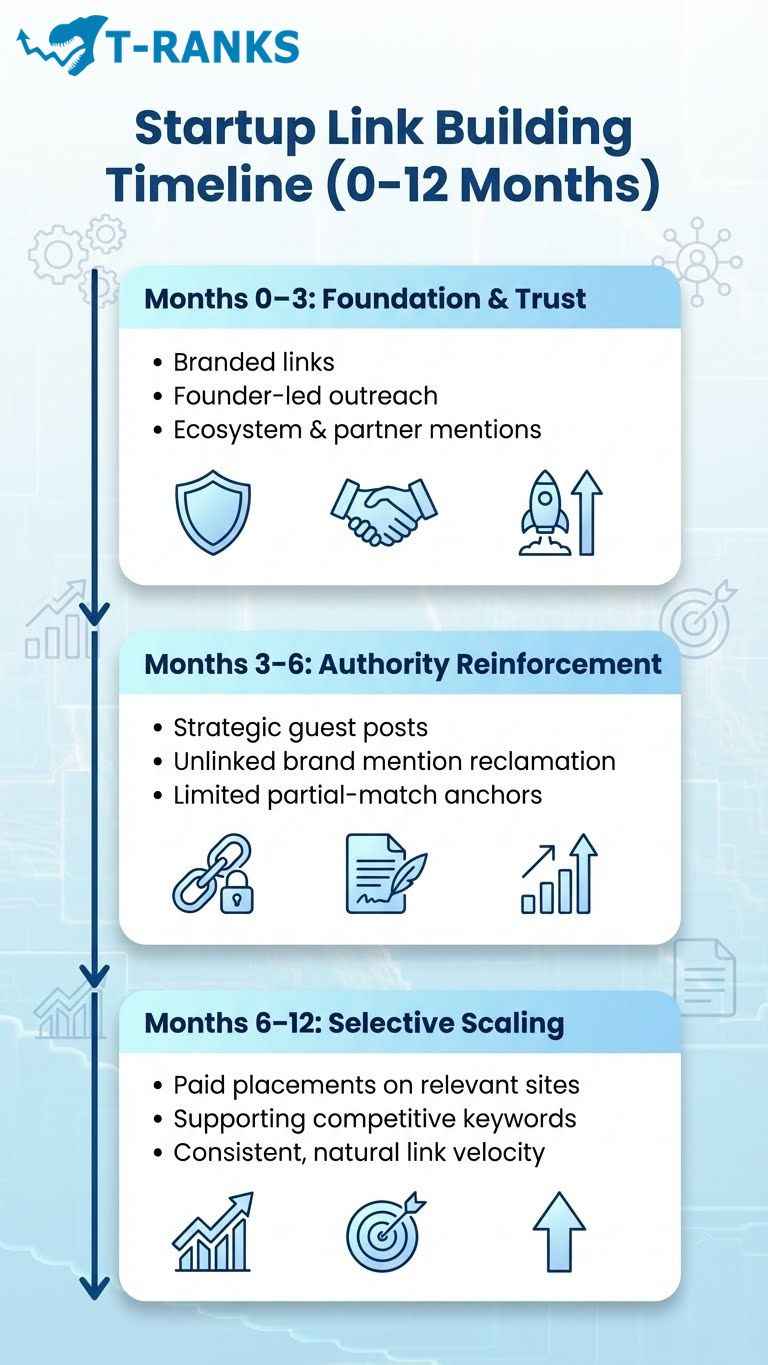
Startup link building works best when it follows a timeline. Search engines expect new sites to grow gradually, and link priorities change as trust and visibility improve. Trying to compress all efforts into the early months often creates risk and weak ROI.
This timeline shows how link building should evolve during a startup’s first year.
Months 0–3: Foundation and Trust
The first three months are about legitimacy, not rankings. Search engines need clear signals that the startup is real, relevant, and credible.
Primary focus during this phase:
- Strong homepage and core service pages
- First branded and URL-based links
- Founder-led outreach and relationship building
- HARO responses and early mentions
- Ecosystem and partnership links
Expected outcome:
Pages index faster, brand mentions appear, and early trust signals are established.
Link volume should stay low. Anchor text should be heavily branded or natural. Consistency matters more than speed.
Months 3–6: Authority Reinforcement
Once indexing improves and impressions start rising, link building becomes more intentional. This phase strengthens topical relevance and supports priority pages.
Primary focus during this phase:
- Strategic guest posting on relevant sites
- Reclaiming unlinked brand mentions
- Selective competitor link replication, only where links are realistic
- Limited use of partial-match anchors
- Supporting key content and service pages
Expected outcome:
Search impressions grow, keyword visibility improves, and topical authority becomes clearer.
Growth should remain controlled. Every link should support a defined topic or page.
Months 6–12: Selective Scaling
At this stage, the startup has measurable trust signals and performance data. Link building can be scaled, but only selectively.
Primary focus during this phase:
- Higher-quality paid guest posts or niche edits
- Consistent but natural link velocity
- Clear page-level targeting
- Balanced anchor mix, branded first
- Expansion into more competitive keywords
Expected outcome:
More stable rankings, stronger authority, and improved ability to compete in tougher SERPs.
Scaling does not mean volume chasing. It means better placements, stronger context, and smarter targeting.
How Priorities Change Over Time
In the early stage, link building proves legitimacy.
In the middle stage, it builds topical authority.
In later stages, it supports competitive growth.
Following this progression keeps link building safe, efficient, and aligned with how search engines evaluate startups.
Conclusion
Startups win at link building by starting correctly, not aggressively. Early success comes from patience, relevance, and disciplined execution, especially when budgets and brand signals are limited. Trying to shortcut trust almost always creates delays instead of results.
Quality links earned through credibility, strong content, and real relationships outperform volume-based tactics every time. Relevance and consistency matter more than speed, and safe growth always beats forced optimization.
Link building should be treated as a long-term business asset, not a quick SEO tactic. When startups invest in trust first and scale only when ready, links compound in value and support sustainable growth well beyond the early stages.
FAQs About Startup Link Building
What is startup link building?
Startup link building is the process of earning relevant backlinks during the early stages of a business to build trust and authority.
It focuses on safety, relevance, and gradual growth instead of scale.
Can startups do link building with a small budget?
Yes, startups can build links effectively with a small budget by relying on founder outreach, earned media, and relevant placements.
Time, expertise, and credibility replace heavy spending in early stages.
How many backlinks does a startup need to rank?
There is no fixed number of backlinks a startup needs to rank.
The right number depends on competition, content quality, and how competitors are already performing.
Is link building safe for early-stage startups?
Yes, link building is safe when startups focus on editorial links, branded anchors, and natural growth.
Risk increases when shortcuts, bulk links, or aggressive anchors are used too early.
Should startups buy backlinks?
Startups should not buy backlinks until content, structure, and basic authority are established.
Paid links work best later as a scaling tool, not as a starting tactic.
What type of links work best for startups?
Editorial, contextually relevant links work best for startups.
Mentions from niche blogs, media sites, and ecosystem partners build trust faster than generic high-metric links.
Is guest posting effective for startup link building?
Yes, guest posting is effective when it is selective and relevant.
A few strong placements outperform mass guest posting campaigns.
Can founders build links themselves?
Yes, founders are often the most effective link builders in early stages.
Personal outreach and real experience lead to higher response rates than brand emails.
How long does startup link building take to show results?
Early signals usually appear within three to six months.
Stronger results compound over time as authority and trust grow.
What anchor text should startups use?
Startups should primarily use branded and natural anchor text.
Exact-match anchors should be delayed to avoid risk.
Do startups need SEO tools for link building?
No, startups do not need expensive SEO tools to begin link building.
Search impressions, indexing behavior, referral relevance, and mentions are enough early on.
Is startup link building worth the effort?
Yes, startup link building is worth the effort because early authority compounds over time.
Links built correctly continue supporting visibility and growth long after they are placed.