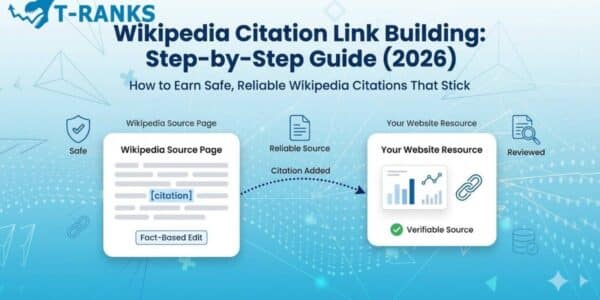
Wikipedia link building is one of the safest and most trusted ways to build authority online. You’ve probably seen Wikipedia ranking at the top of Google for almost every topic. Because Google trusts it so much, a citation from Wikipedia strengthens your website’s credibility, even though the link is nofollow.
This strategy doesn’t focus on chasing backlinks. It focuses on adding accurate, fact-based information that improves Wikipedia articles. When editors approve your citation, it signals to Google and readers that your content is reliable, well-sourced, and worth referencing.
In this step-by-step guide, you’ll learn how Wikipedia citation link building works, how to find safe opportunities, how to replace dead links, and how to add citations that stay live. These methods help you improve brand trust, build topical authority, and support long-term SEO growth.
What Is Wikipedia Link Building
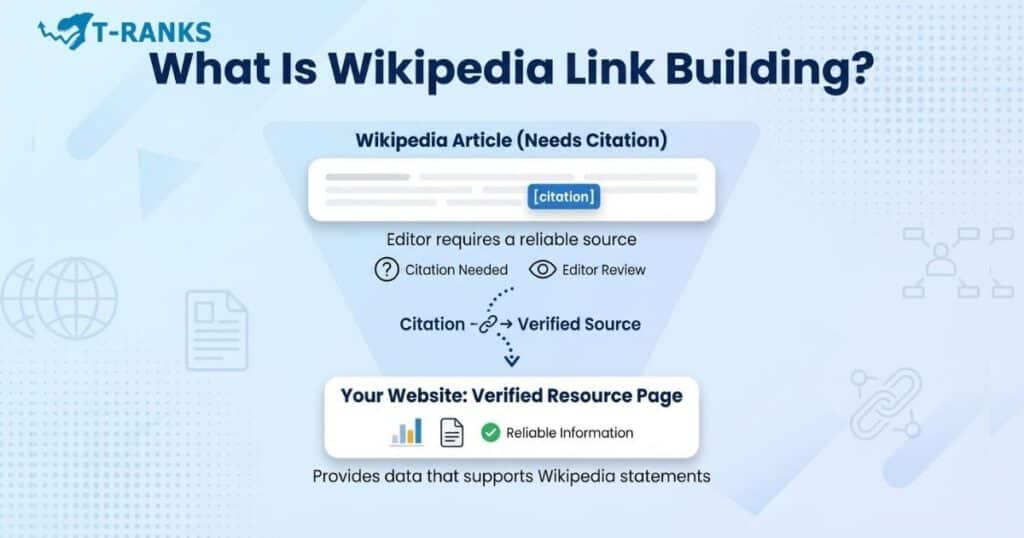
Wikipedia link building means getting a backlink from a Wikipedia page to your own website. You contribute to your target keyword–related page by adding unique, authentic, fact-based information. Then you place your website link within that content or add it as a citation. These citations support a statement on the page and show readers where the information originally came from.
To understand it clearly, link building is when one website links to another website as a signal of trust. When credible sites link to your content, Google sees it as a vote that your information is useful. Wikipedia works the same way, but with stricter rules.
In Wikipedia link building, your goal is not to promote your brand. Your goal is to improve a Wikipedia article by providing a trustworthy source. For example, if a page needs a citation about a solar energy statistic and your website has a verified, research-based explanation, you can add it as a reference.
These links are nofollow, but they still add strong indirect SEO value. A citation from Wikipedia strengthens your E-E-A-T signals, improves brand credibility, and exposes your content to thousands of readers who use Wikipedia for research.
In simple terms, Wikipedia link building is about improving the article first and helping the reader. When you add accurate and useful sources, your website naturally earns trust, visibility, and long-term authority.
Why Wikipedia Backlinks Matter for SEO
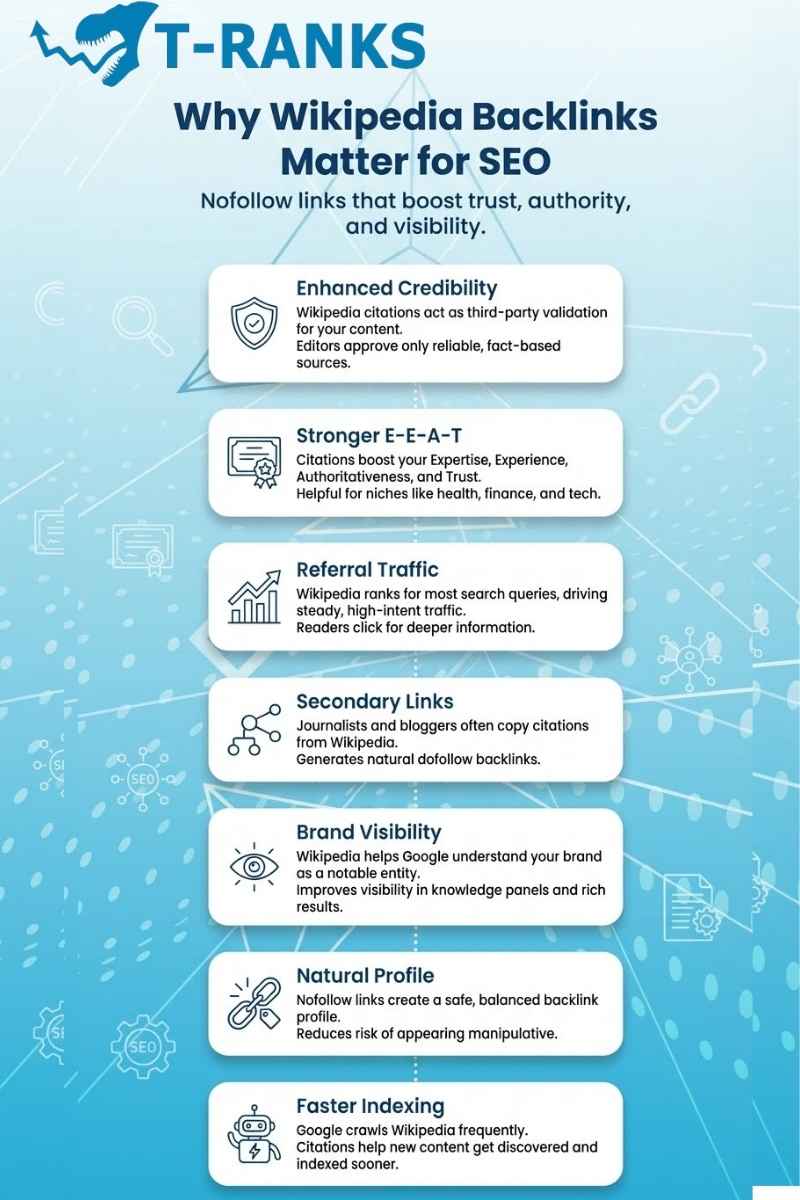
Wikipedia backlinks matter because they come from one of the most trusted websites in the world. Even though these links are nofollow, they still help your SEO by boosting credibility, improving trust signals, and driving consistent referral traffic.
Enhanced Credibility and Authority
Wikipedia is reviewed by real editors and a large volunteer community. When your website is cited there, it works as a strong third-party endorsement. Search engines see your content as reliable because it is being used as a source on a platform known for fact-checked information.
Stronger E-E-A-T Signals
A citation from Wikipedia improves your website’s Experience, Expertise, Authoritativeness, and Trustworthiness. This is especially important in sensitive niches like health, finance, education, or technology. Being referenced on Wikipedia shows that your brand is knowledgeable and trustworthy.
Steady Referral Traffic
Wikipedia ranks on almost every major search query and receives billions of monthly visits. When your link appears on a relevant Wikipedia page, you can receive consistent, high-intent referral traffic from readers looking for deeper information.
Secondary Link-Building Opportunities
Many journalists, bloggers, and researchers use Wikipedia as a starting point. When they see your content cited there, they may reference it on their websites as well. These secondary links are dofollow, pass authority, and can strongly improve your overall link profile.
Better Brand Visibility and Entity Recognition
Citations from Wikipedia help Google understand your brand as a real, credible entity. This improves the chances of appearing in Knowledge Panels, featured snippets, and AI-driven summaries. These placements build long-term brand authority.
Natural and Safe Backlink Profile
A healthy backlink profile contains both dofollow and nofollow links. Nofollow citations from trusted sites like Wikipedia balance your link profile and reduce the risk of penalties from aggressive link-building patterns.
Faster Content Indexing
Google crawls Wikipedia very frequently. When your website is cited there, Google may discover and index your pages faster. This helps new or updated content appear in search results sooner.
In simple terms:
Wikipedia backlinks do not directly raise your rankings, but they strengthen the foundation of your entire SEO strategy. They improve trust, visibility, referral traffic, and long-term authority , making Wikipedia link building one of the safest and most reliable methods for sustainable growth.
How Wikipedia Fits Into Google’s Knowledge Graph
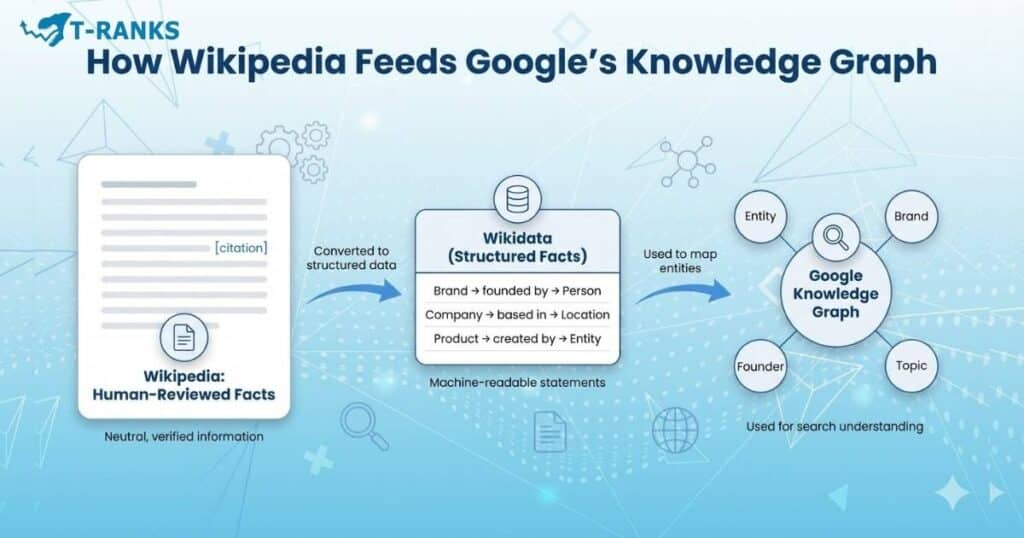
Wikipedia plays a key role in how Google understands people, brands, and organizations. Google relies on Wikipedia because it contains verified, human-reviewed information that can be trusted. This information feeds directly into Google’s Knowledge Graph, which powers Knowledge Panels and other rich search results.
Wikipedia and Wikidata: Google’s Trusted Information Sources
Wikipedia is reviewed and edited by real humans. These editors fact-check important details such as dates, names, founders, and historical events.
This information flows into Wikidata , a structured database operated by the Wikimedia Foundation.
Wikidata stores information in simple, machine-readable triples, such as:
- Tesla, Inc. → founded by → Elon Musk → in 2003
- Apple Inc. → headquartered in → Cupertino, California
Google’s algorithm reads this structured data and uses it to build Knowledge Panels and answer advanced queries.
Entity Home: Why Each Wikipedia Page Matters
Every Wikipedia article acts as an entity home, which means it becomes Google’s main reference point for a topic.
If your brand is mentioned on a Wikipedia page, Google connects your website with that entity. Over time, this helps Google understand:
- What your brand does
- Which topics you are associated with
- How you relate to other entities
This directly supports better visibility in organic search and may help your brand appear in Knowledge Panels.
Why Citations Strengthen Entity Understanding
Citations are the backbone of Wikipedia. When an article cites credible sources such as major newspapers, peer-reviewed studies, or government websites, Google uses those references to verify facts.
These citations help with:
- Accuracy: Confirming that the information is reliable
- Entity disambiguation: Distinguishing between similar names
- Example: Apple Inc. (the company) vs apple (the fruit)
- Example: Apple Inc. (the company) vs apple (the fruit)
- Topic connections: Linking your brand to relevant subjects
When your website is used as a citation, you become part of this trusted information network.
How This Helps Your Brand in Search
Because Google relies on Wikipedia and Wikidata to validate information, appearing as a citation helps:
- Strengthen your brand authority
- Improve entity recognition
- Increase your chances of showing in Knowledge Panels
- Build long-term visibility in both traditional results and AI-powered search features
In Simple Terms
Wikipedia acts as Google’s fact-checker.
When your site is cited there, Google views your brand as more credible and better defined. This strengthens your presence inside the Knowledge Graph and improves your overall visibility across search.
Understanding Wikipedia’s Rules (Before You Add a Link)
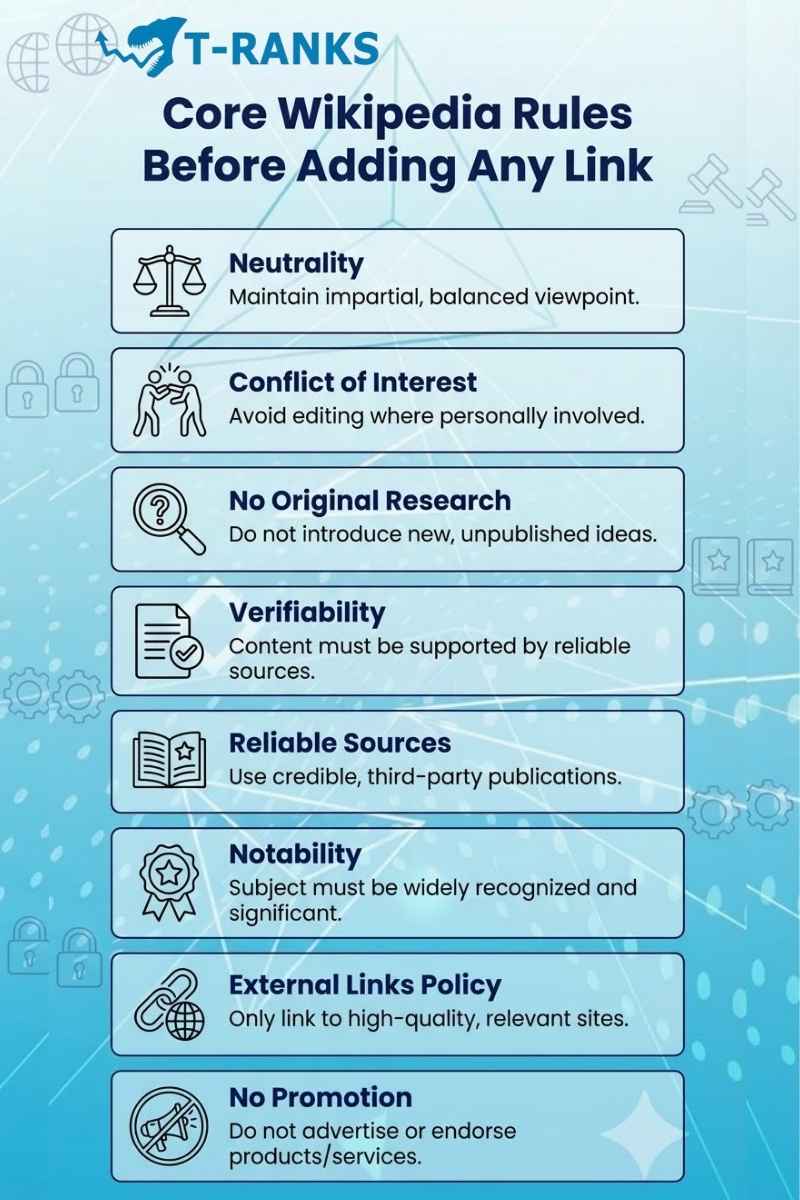
Before adding any link to Wikipedia, you must follow a few core rules that protect accuracy and neutrality. Each rule ensures that edits serve readers, not marketing goals.
Here are the rules in one simple line each:
- Neutrality: Every edit must be factual and unbiased.
- Conflict of Interest: You cannot promote your own brand or client.
- No Original Research: Only published, third-party sources are allowed.
- Verifiability: Every statement must be backed by a trusted reference.
- Reliable Sources: Only reputable, independent publications qualify.
- Notability: Topics must have significant coverage from independent sources.
- External Links Policy: Links must add educational value, not sales value.
- No Promotion: Any promotional or marketing-sounding edit will be reverted.
These rules form the foundation of Wikipedia editing. If your citation breaks even one of them, editors will remove it immediately.
Neutral Point of View and Conflict of Interest
Wikipedia requires neutral, balanced, and factual writing. Anything that reads like advertising or personal promotion is removed.
If you are connected to the brand you are editing, you must avoid biased language and use Talk Pages for transparency.
No Original Research or Self-Published Information
Wikipedia only accepts information that has already been published by independent, third-party sources. Personal insights, unpublished data, and self-created research are not allowed.
Verifiability and Transparency
Every claim must be verifiable through a reliable source. If a reader cannot check the statement through a trusted reference, the edit will be removed.
Broken, irrelevant, or unsupported links never survive.
Reliable Sources and Editorial Quality
Wikipedia accepts citations from:
- Major news outlets
- Peer-reviewed journals
- Academic institutions
- Government publications
It rejects:
- Self-published blogs
- Affiliate articles
- Press releases created by the company itself
Notability and Independent Coverage
A topic must be widely covered by independent, reliable sources to qualify for inclusion. This prevents brands from using Wikipedia for self-promotion.
External Links Policy and Relevance
External links must add genuine educational value. Wikipedia removes sales pages, spam, and irrelevant outbound links immediately.
Why Promotional Edits Get Reverted
Edits that push a product, highlight features, or use marketing tone are flagged quickly by editors and automated tools like ClueBot NG. Wikipedia strictly protects its neutrality.
The Golden Rule
Edit to inform, not to advertise.
Useful, well-sourced, and neutral edits stay live. Promotional edits do not.
How Wikipedia Editors Review Citations
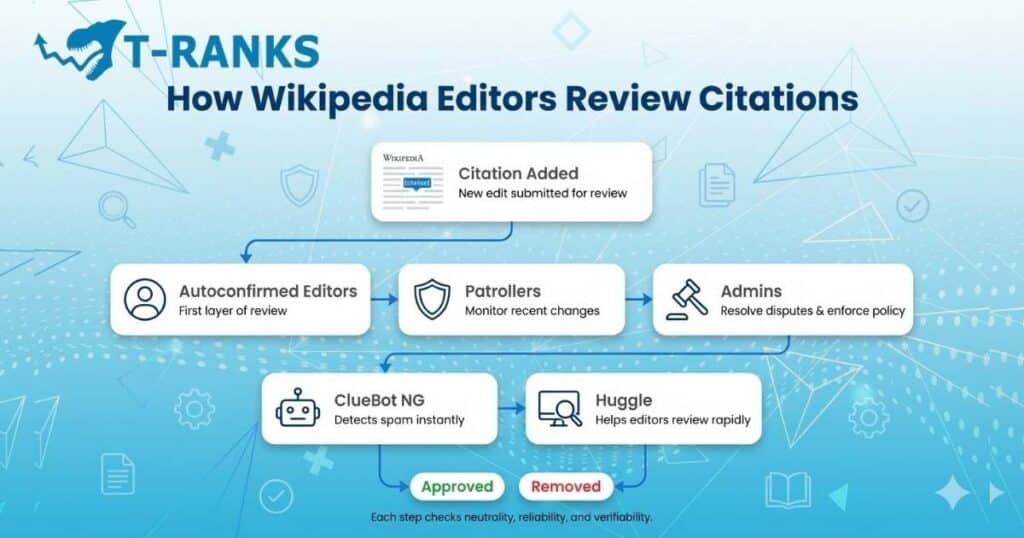
Wikipedia uses a mix of human editors and automated tools to check every citation added to its articles. The goal is to ensure that each source is reliable, neutral, verifiable, and relevant. Understanding how this review system works helps you make edits that stay live.
Editor Roles and Responsibilities
Wikipedia has a structured editor hierarchy, and each level plays a part in reviewing citations:
- Autoconfirmed Editors:
Regular users who have created an account and made a few edits. They can add citations, but their edits are still watched by more experienced editors. - Patrollers:
Volunteers who monitor recent changes. They check whether new links are reliable, neutral, and properly sourced. If a citation looks promotional or weak, they remove it. - Administrators (Admins):
Experienced editors with advanced tools. They step in when there are disputes, repeated violations, or attempts to add spammy or biased sources.
This layered system ensures that every citation is checked for quality before becoming permanent.
How Automated Tools Help Editors
Wikipedia also uses automated tools to catch bad edits quickly:
- ClueBot NG:
An AI-powered bot that scans new edits in real time. It reverts obvious spam, vandalism, and promotional content within seconds. - Huggle:
A tool that highlights suspicious edits for human review. Editors use it to approve, modify, or remove citations that need closer inspection.
These tools help maintain accuracy and prevent low-quality links from entering articles.
What Editors Look for When Checking a Citation
Editors follow Wikipedia’s core content policies—Reliable Sources, Verifiability, and Neutral Point of View.
They check whether your citation is:
- From a reputable, independent source
- Directly supporting the statement it is attached to
- Neutral and non-promotional
- Properly formatted (e.g., using {{cite web}}, {{cite news}}, or {{cite journal}})
- Relevant to the topic of the article
If your link passes these checks, it is likely to stay. If not, it will be removed quickly to maintain article quality.
Safe Edit Checklist (What Makes a Citation “Look Right”)
To increase the chances your edit survives review, make sure your citation is:
- Verifiable and published by a trusted third-party source
- Relevant to the specific sentence you are supporting
- Added with a simple, factual edit summary (e.g., “Added citation to support population data”)
- Not added repeatedly in multiple places (avoids spam signals)
- Checked to ensure the link loads correctly and supports the claim
Following this checklist makes your edits look natural, helpful, and aligned with Wikipedia’s expectations.
Core Wikipedia Link-Building Opportunities
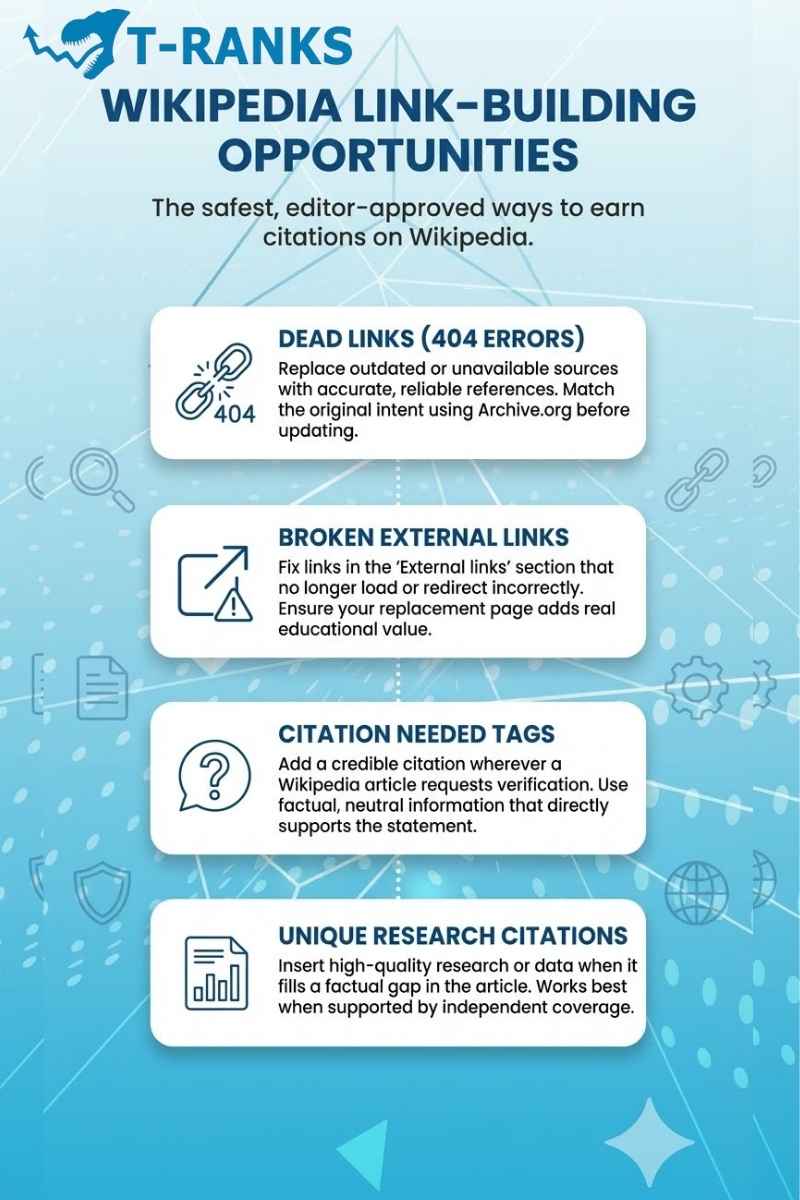
Wikipedia offers safe, editor-approved ways to earn citations while improving the accuracy of its articles. These methods help fix issues like missing citations, outdated references, and broken links. The four main opportunities include dead links, broken external links, citation-needed tags, and unique research citations.
Dead Links (404 Errors)
Dead links appear when a citation leads to a page that no longer exists. Editors want these fixed because broken references reduce trust and make articles outdated. Replacing them with a correct and reliable source improves the page and helps readers access accurate information.
How to use this opportunity:
- Find dead links using tools like WikiGrabber, Ahrefs, or Google search:
site:wikipedia.org “dead link” [keyword] - Open the original page on Archive.org to see what information was cited
- Replace it with a page on your website that supports the same point
- Write your replacement in a calm, factual, and neutral tone
- Make sure your source is clearly related to the statement it supports
Caution:
Your link must match the original citation’s purpose closely; otherwise, editors may remove it.
Broken External Links
Broken external links appear in the “External links” section when a site moves or removes a page. Fixing them improves the reader’s experience and helps maintain the quality of the article. Editors appreciate these fixes because they keep resources updated and reliable.
How to use this opportunity:
- Scan pages using Ahrefs, Semrush, or WikiBroken
- Identify links that redirect, show errors, or no longer load
- Replace the broken link with a relevant and accurate page from your website
- Ensure your page gives helpful information and supports the topic
- Review the article to confirm your source truly adds value
Caution:
Editors check this section carefully, so your link must provide real educational value and not look promotional.
Citation Needed Tags
A “citation needed” tag shows where a statement is missing a source. These tags are good opportunities to add helpful references and improve article quality. By adding a reliable citation, you help readers verify information and strengthen the article’s accuracy.
How to use this opportunity:
- Find tags using Citation Hunt or by searching:
site:wikipedia.org “citation needed” [topic] - Read the unsourced statement to confirm your content supports it
- Add your citation with a simple edit summary like:
“Added citation to verify population data.” - Make sure the reference is neutral, factual, and relevant
- Check that the source is from a trusted, independent publication
Caution:
Adding multiple citations or anything that sounds promotional can trigger automated moderation tools like ClueBot NG.
Unique Research Citations
Unique research citations involve adding high-quality data from studies, surveys, or reports that meet Wikipedia’s Reliable Sources guidelines. This method works best if your research has been mentioned by news outlets or academic sources. It shows editors that your information is verifiable and supported by independent coverage.
How to use this opportunity:
- Identify parts of an article where your research adds factual value
- Confirm your data is independently verifiable and not self-serving
- Add the citation using proper formatting like {{cite web}} or {{cite journal}}
- Ensure your content directly supports the statement you are improving
- Keep your wording neutral and focused on information, not marketing
Caution:
Self-published reports, promotional studies, or unverifiable data will be removed quickly.
Complete Wikipedia Link Building Workflow (Step-by-Step)
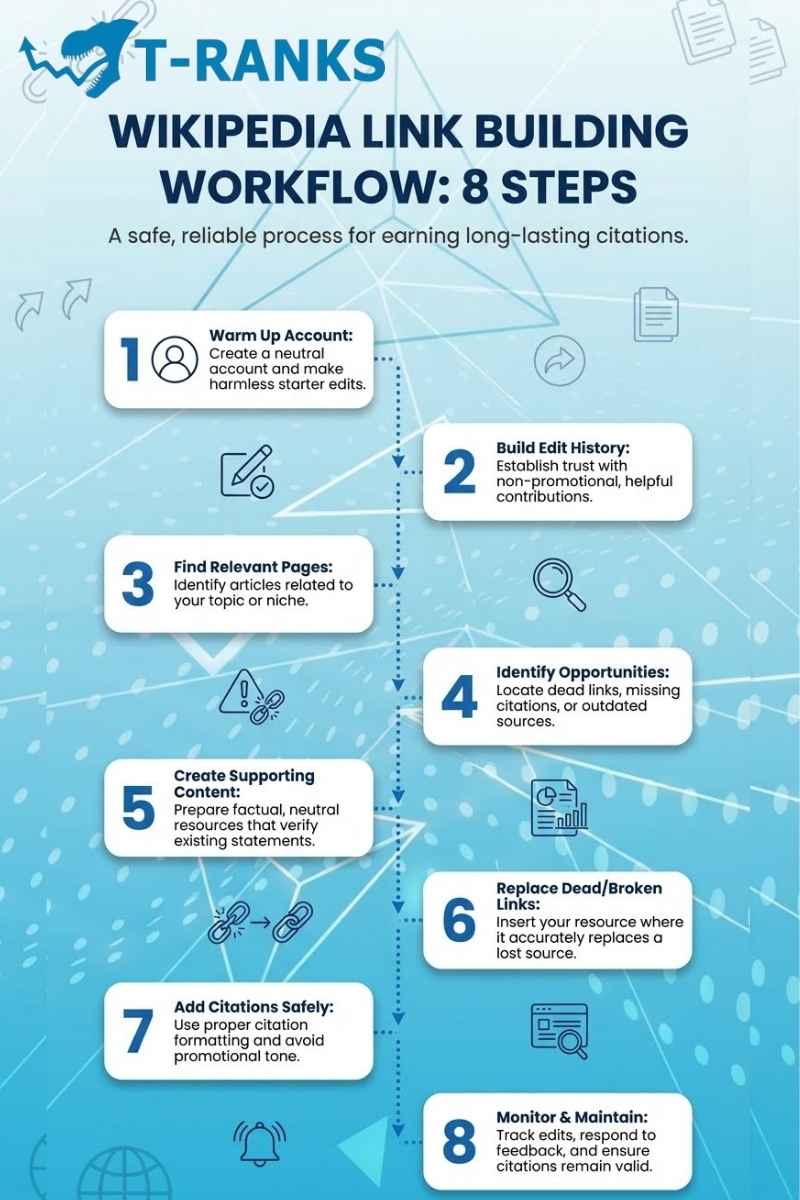
Wikipedia link building only works when you follow its rules, contribute real value, and avoid anything that looks promotional. The process takes patience, but when done correctly, it earns long-lasting citations from one of the most trusted sites online.
Below is a practical, easy-to-follow 8-step workflow based on real editing experience.
Step 1 — Create and Warm Up Your Wikipedia Account
You need a trusted account before attempting any citation. New accounts are monitored closely, and editors revert anything that looks spammy.
What to do:
- Create a neutral username (no brand names).
- Set up a simple user page describing your interests.
- Make small, harmless edits like fixing grammar or improving clarity.
- Reach autoconfirmed status (4 days old + 10 edits).
This warm-up phase shows you understand Wikipedia’s style.
Step 2 — Build Initial Edit History (Trust Layer)
Before adding any links, build a clean edit history. Editors and bots quickly flag new accounts that rush into adding external links.
Practical tasks:
- Fix typos and formatting on low-traffic pages.
- Add citations from strong sources such as BBC, Reuters, The Guardian, or academic sites.
- Make small improvements across different topics.
Do 10–20 safe edits over a week. This creates “editor trust,” which makes your future link edits far more likely to stay.
Step 3 — Find Relevant Wikipedia Pages in Your Niche
Once your account looks genuine, start identifying pages where your content fits naturally.
How to find pages:
- Search keywords related to your niche on Wikipedia.
- Use Google operators:
- site:wikipedia.org “your keyword” “citation needed”
- site:wikipedia.org “your keyword” “dead link”
- site:wikipedia.org “your keyword” “citation needed”
- Look at related categories and subtopics.
Focus on pages where your content can genuinely improve accuracy or fill gaps.
Step 4 — Identify Link Insertion Opportunities
Now that you’ve selected pages, look for clear and acceptable opportunities.
Main opportunities:
- Dead links (404s)
- Broken external links
- Citation needed tags
Use tools like WikiGrabber, WikiBroken, Ahrefs, or Semrush to find broken or missing citations. Always check the original intent of the missing reference using Archive.org before preparing a replacement.
This step ensures your link fits naturally and adds value.
Step 5 — Create High-Authority Content for Replacement
Wikipedia editors only accept citations that come from high-quality, reliable sources. Your content must support the exact statement in the article.
Requirements for linkable content:
- Neutral and non-promotional
- Well-researched with data and references
- Matches the context of the claim on Wikipedia
- Accessible (no aggressive ads, no paywalls)
Types of pages that work best:
- Data-driven reports
- Research-backed articles
- Long guides with sources
- Industry studies
- Government-style or academic-style summaries
Better content = higher chance your citation stays.
Step 6 — Replace Dead or Broken Links
Dead link replacement is one of the safest ways to earn a Wikipedia citation.
How to do it professionally:
- Open the page and locate the dead/broken link.
- Review the old source on Archive.org to match intent.
- Insert your link using the correct citation format.
- Add a simple edit summary such as:
“Replaced dead link with updated reliable source.”
Avoid adding multiple links or making several edits at once. Make it slow, natural, and careful.
Step 7 — Add New Citations Safely
Adding a brand-new citation is more delicate. Only add your link if it directly supports an existing statement.
Best practices:
- Use the correct format ({{cite web}}, {{cite journal}}).
- Make sure your source is high-quality and independent.
- Add a neutral edit summary explaining what you supported.
- Start with less active pages before editing popular ones.
A clean, factual citation with proper formatting is rarely removed.
Step 8 — Monitor Your Edits and Maintain Your Contributions
Your work doesn’t end after adding the link. Wikipedia is constantly updated, and anyone can change or revert edits.
Maintenance tasks:
- Add edited pages to your Watchlist.
- If an edit is reverted, politely ask for clarification on the Talk Page.
- Keep improving pages through small edits over time.
- Make sure your linked content stays live, factual, and stable.
Consistent participation strengthens your credibility as an editor and keeps your citations safe.
Tools for Wikipedia Link Building
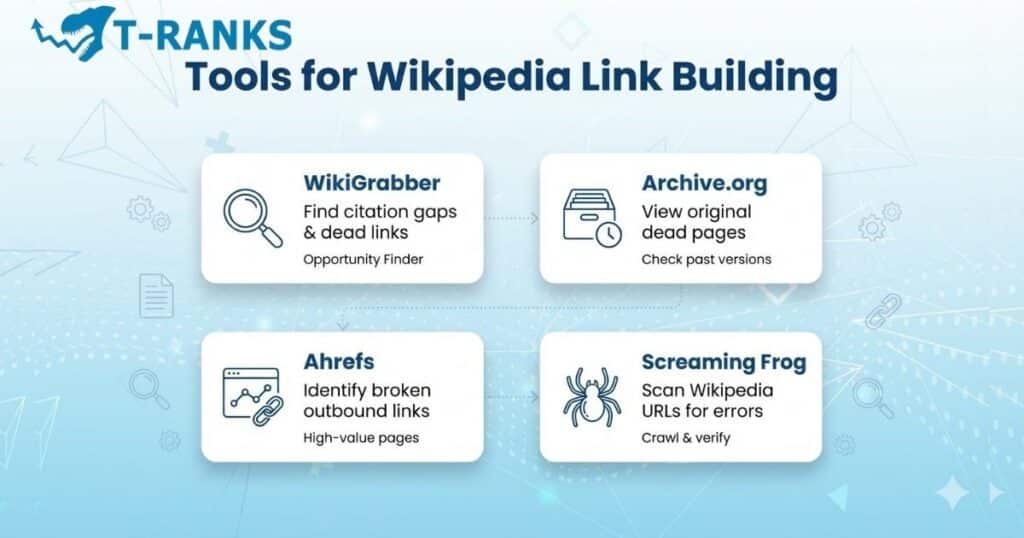
The right tools make Wikipedia link building easier and more accurate. You can use them to find dead links, locate missing citations, and check the original content behind a deleted page. Below are the essential tools and how they help each step of the process.
WikiGrabber
WikiGrabber helps you find Wikipedia pages that have “citation needed” tags or dead links related to your topic.This is not any official tool search in Google the keyword “WikiGrabber” and you will find tools offered by different sites that helps us to find pages articles where citation missing or outdated.
How it helps with Wikipedia link building:
- Finds articles where a citation is missing or outdated
- Shows pages in your niche that need reliable sources
- Helps you plan safe, well-supported citation edits
Archive.orghttps://archive.org/ (Wayback Machine)
Archive.org shows past versions of a deleted or changed webpage.
How it helps:
- Reveals what the dead link originally contained
- Helps you match the same context before adding your own link
- Allows you to add archive URLs for long-term verification
Ahrefs
Ahrefs is useful for finding Wikipedia pages with broken outbound links and checking page authority.
How it helps:
- Finds broken links at scale across many articles
- Shows which Wikipedia pages have strong traffic and authority
- Helps you focus on high-value dead link opportunities
Screaming Frog
Screaming Frog SEO Spider audits link health across pages or entire Wikipedia categories.
How it helps:
- Crawls selected Wikipedia URLs to find 3xx and 4xx errors
- Detects broken links across related articles
- Useful for ongoing audits if you manage multiple Wikipedia contributions
Final Thoughts on Tools
You don’t need dozens of tools for Wikipedia link building. My personal best tools for any type of link research are Ahrefs and Semrush, because they have the most reliable data and the strongest database. Along with WikiGrabber for finding citation gaps and Archive.org for checking old sources, this small toolset is more than enough to identify real Wikipedia issues and fix them with verified, trustworthy references.
Avoiding Wikipedia Link Building Mistakes
Getting a backlink through wikipedia link building can be highly beneficial, but one careless edit can get your link deleted or your account flagged. To make your efforts safe, sustainable, and SEO-friendly, follow these key rules and best practices.
Editing Pages Where You Have a Conflict of Interest (COI)
If you add links to pages about your business, client, or any project you profit from, your edit will almost always be reverted. Wikipedia editors quickly identify COI-related edits, as they go against the platform’s neutrality policy.
Solution: Always disclose your COI and suggest edits on the article’s Talk Page for unbiased review.
Using a Brand Name as Your Username
Usernames that sound like brands or agencies make editors suspicious of promotional intent. Accounts such as “MarketingGuruPro” or “BrandSEOExpert” are often restricted because they imply bias rather than neutral contribution.
Solution: Use a neutral username and build credibility with helpful, factual edits over time.
Linking to Commercial, Promotional, or Sales Pages
Adding links to sales pages, service pages, or press releases will be flagged as spam. Wikipedia’s purpose is to share knowledge, not to promote brands or drive conversions. Editors and bots monitor these links using cloud-based scanning and remove them immediately.
Solution: Only add links to educational or data-based content that supports a factual statement.
Adding Links to Unreliable Sources
If your link points to a blog, affiliate post, or forum discussion, editors will remove it instantly. Wikipedia only allows independent, verifiable, and editorially reviewed sources. This ensures accuracy and protects the encyclopedia from misinformation.
Solution: Use citations from authoritative media outlets, peer-reviewed journals, or official government databases.
Ignoring the “Edit Summary”
Skipping the edit summary makes your contribution appear suspicious. Editors depend on these short notes to understand your intent and verify your purpose. Without one, even a valid edit may get reversed.
Solution: Add short, clear summaries like “Replaced dead link with BBC citation” or “Added reliable source for data.”
Reverting When an Editor Removes Your Link
If an editor removes your link, don’t re-add it immediately. Repeated reinsertions look like edit warring, which can result in warnings or a permanent block. Respect the editorial process and collaborate constructively.
Solution: Review the editor’s feedback and discuss the issue politely on the Talk Page before taking further action.
Final Advice: Edit to Add Value, Not to Advertise
Your goal should always be to inform, not promote. Edits that add real value and improve article accuracy are more likely to stay. Wikipedia favors editors who focus on credibility, not traffic generation.
Solution: Contribute factual, verifiable information that benefits readers and supports Wikipedia’s mission of reliable knowledge sharing.
How to Scale Wikipedia Link Building (Safely)
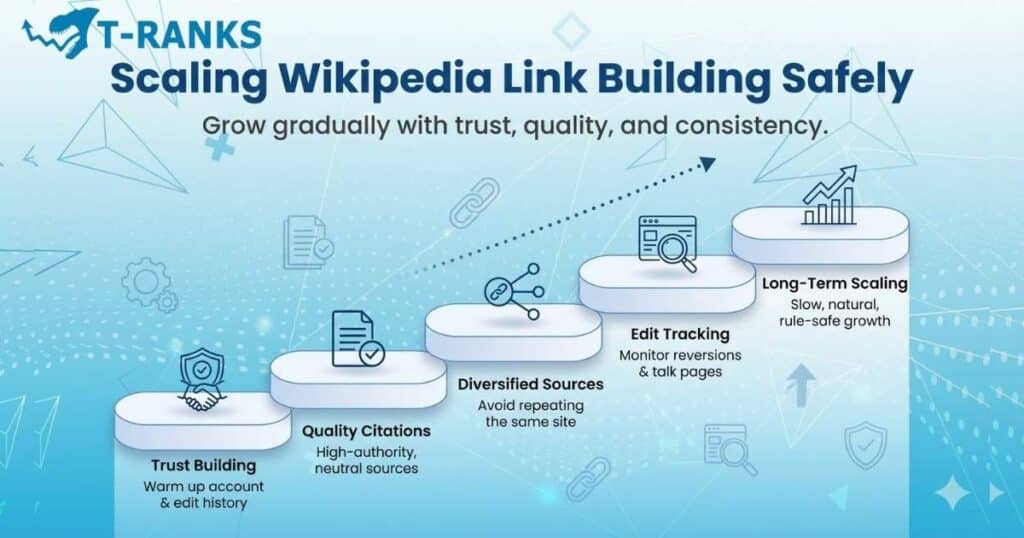
Scaling Wikipedia link building safely starts with building trust first, then expanding slowly. Your edits must be factual, neutral, and supported by reliable sources. Only add citations when they genuinely improve the article. When editors see that you contribute useful information—not promotion—they allow your edits to stay.
To grow at scale, create a small editorial workflow, organize your research, and spread your citations across different domains instead of repeating the same source. Track your edits, respond to feedback, and avoid patterns like adding many links in one session or repeatedly adding your own website. Scaling works only when you move carefully, follow rules, and maintain transparency. This approach builds long-term editorial trust and strengthens your brand authority.
When NOT to Build Wikipedia Links
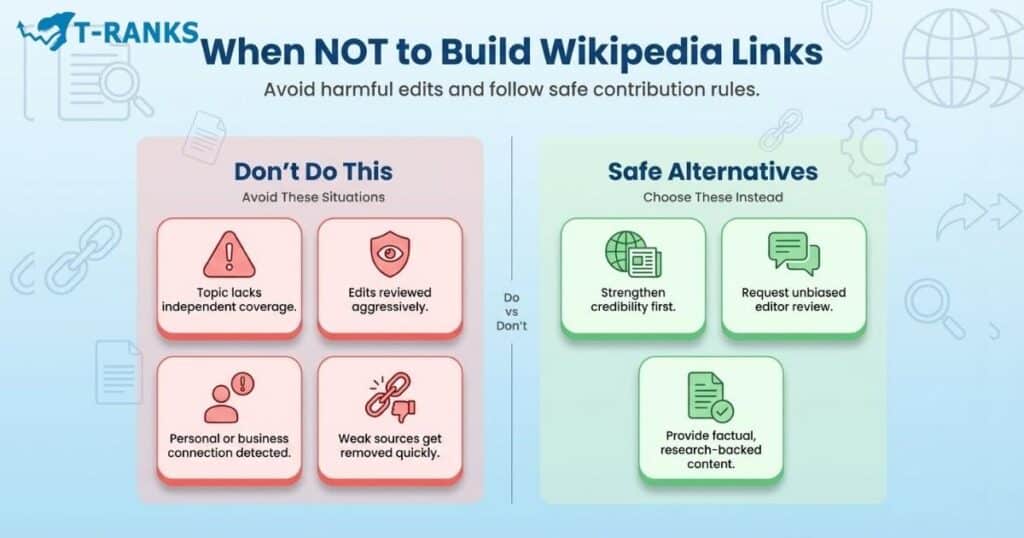
Knowing when not to add a link is just as important as knowing when to add one. Many editors lose their accounts because they push citations into places where they don’t belong. Wikipedia rewards accuracy, neutrality, and reliable sources never promotion. Understanding the limits protects your account and your brand.
Topics With Low Notability
If your topic or website has little or no independent coverage, it does not meet Wikipedia’s notability rules. Pages backed only by press releases, self-published content, or simple blog mentions do not qualify as reliable sources. Editors remove these quickly.
Tip: Wait until your website is covered by respected publications, research papers, or major industry sites before adding it to Wikipedia.
Articles That Reject Commercial Input
Some pages especially those about companies, software, or commercial products—are closely monitored. These articles often reject any link that looks promotional. Even helpful content can be removed if editors feel the source benefits your brand directly.
Tip: Instead of linking to your own site, add neutral third-party data or high-quality references that support the topic.
Promotional Subjects That Risk Bans
Adding links connected to your employer, clients, or your own website without disclosure violates Wikipedia’s Conflict of Interest (COI) policy. This is one of the main reasons editors get banned. Promotional or undisclosed editing damages trust immediately.
Tip: If you are connected to the subject, use the Talk Page. Suggest the change openly and let independent editors decide.
Relevance Mismatch Cases
Every citation must match the exact sentence it supports. Adding sources that are loosely related or off-topic signals manipulation and leads to fast removals. Editors check whether the link directly verifies or expands the statement.
Tip: Only add a link when your content clearly proves the claim. Relevance is more important than getting a link placed.
When Your Website Lacks Authority
New websites, affiliate sites, or commercial sites without editorial review do not qualify as reliable sources. If your site does not have strong credibility, editors will remove the link within hours.
Tip: Build authority first. Publish high-quality, research-backed content and get cited by trusted third-party websites before trying to add it to Wikipedia.
When You Need Fast SEO Results
Wikipedia is not a quick SEO tactic. Edits take time, review cycles are slow, and citations stay only if they add value. If your goal is fast traffic or immediate rankings, you will be disappointed and editors may flag your edits.
Tip: Use Wikipedia as a long-term brand authority strategy. Add gradual, meaningful contributions that help readers and support the platform’s accuracy.
How does Wikipedia link building help overall SEO strategy?
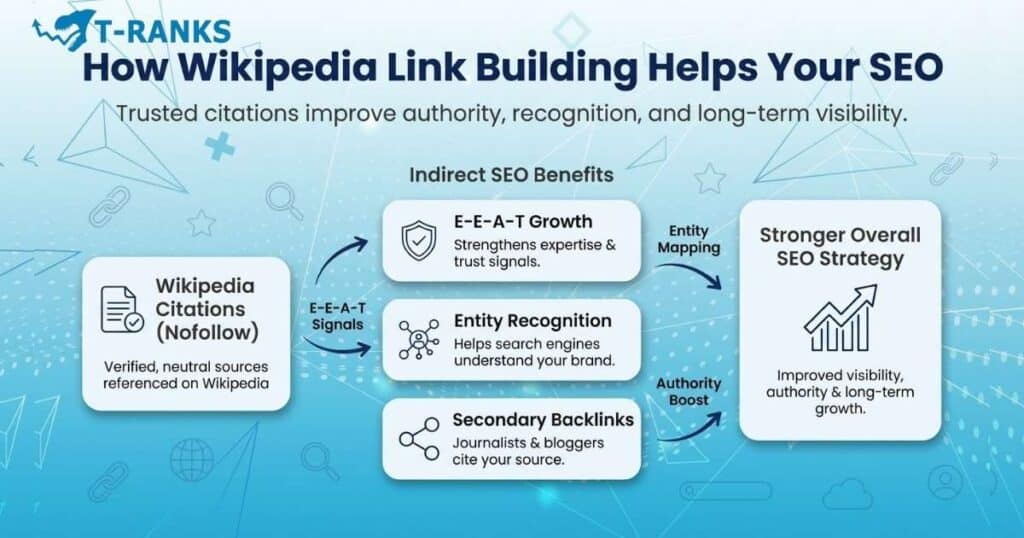
Wikipedia link building supports your SEO strategy by improving trust, credibility, and entity recognition, even though the links are nofollow. When your content is cited on Wikipedia, Google treats it as a signal that your website is reliable and backed by verified information. This strengthens your E-E-A-T profile (Experience, Expertise, Authoritativeness, Trustworthiness) and helps Google understand your brand better inside the Knowledge Graph.
It also creates strong indirect SEO benefits. Many journalists, bloggers, and researchers use Wikipedia to find sources. When they see your content cited there, they often link to it in their own articles. These secondary backlinks pass real ranking value and help you build natural, high-quality tier-2 links.
Wikipedia citations can also improve topical authority, bring steady referral traffic, and increase brand visibility across search results. Over time, this makes your website look more trustworthy, which supports long-term ranking growth and a stronger overall SEO strategy.
Conclusion
In conclusion, ethical Wikipedia link building works when you focus on contributing verified, neutral, and useful information that genuinely improves the platform. This approach strengthens your brand’s credibility, supports Google’s E-E-A-T signals, and helps search engines recognize your website as a reliable source within your niche.
The goal is not to push links. It is to publish high-quality, research-backed resources that deserve to be cited. When you follow Wikipedia’s rules, neutrality, accuracy, and transparency, your citations stay live longer and naturally increase your authority over time.
Effective Wikipedia link building is slow and intentional, but it delivers lasting value. It improves brand visibility, enhances entity recognition in the Knowledge Graph, and supports long-term SEO growth through authoritative mentions and secondary backlinks. The more value you add, the stronger your results will be.
FAQs for Wikipedia Citation Link Building (Step-by-Step 2026 Guide)
1. What is Wikipedia citation link building?
Wikipedia citation link building means adding reliable, third-party sources to Wikipedia articles. The goal is to improve accuracy, fix missing citations, and support facts. When done correctly, it also builds brand visibility and long-term trust.
2. How do I safely add a citation to Wikipedia?
Add a citation only when it verifies a specific statement, replaces a dead link, or fills a “citation needed” tag. Keep the tone neutral, avoid promotion, and use the correct citation format so editors accept the edit.
3. What kind of content can be cited on Wikipedia?
Wikipedia accepts only factual, evidence-based material. Good examples include academic studies, government publications, reputable news sources, and well-researched industry reports. Blogs, affiliate content, and self-published claims are normally rejected.
4. Can I add my own website as a citation?
Yes, but only if your page provides reliable, verifiable information supported by independent sources. It must not sound commercial or biased. If the content looks promotional, editors will remove it quickly.
5. How can I find Wikipedia pages that need my citation?
Use tools like WikiGrabber or Google search operators such as
site:wikipedia.org “citation needed” + your topic.
Focus on pages where your content adds real value.
6. Why do Wikipedia editors remove my links?
Links are often removed because they look promotional, lack reliability, or come from new accounts with little edit history. Use high-quality sources and include a clear edit summary to reduce removal chances.
7. Does Wikipedia link building help SEO even if links are nofollow?
Yes. Wikipedia improves brand trust, entity authority, E-E-A-T, and traffic credibility. These citations also attract natural backlinks from journalists, researchers, and AI content tools.
8. How can I replace a dead Wikipedia link with my own?
Check the original source using Archive.org, create equivalent content on your site, and update the citation. Use a neutral summary like:
“Replaced dead link with reliable source supporting the same information.”
9. Can new Wikipedia editors add links safely?
Yes, but build trust first. Make small edits, fix grammar, add neutral citations, and avoid adding external links too early. Once your account earns credibility, citations are more likely to stay live.
10. What happens if I add promotional or sales-based links?
Promotional links are removed immediately by editors or bots such as ClueBot NG. Repeated violations can lead to warnings, restrictions, or account bans.
11. How can I avoid getting banned during Wikipedia link building?
Warm up your account, avoid conflict-of-interest edits, space out your activity, and cite only factual, non-commercial sources. Always prioritize Wikipedia’s rules of neutrality and verifiability.
12. Can Wikipedia backlinks generate other backlinks automatically?
Yes. Many researchers and journalists use Wikipedia for reference, which often creates secondary backlinks and unlinked brand mentions on external sites.
13. How long do Wikipedia citations stay live?
If your source is reliable, neutral, and relevant, the citation can remain permanently. The first 48–72 hours are the most important because editors review new additions during this period.