Do PBN links actually improve rankings? Instead of relying on opinions, the best way to explore that question is to look at real campaigns and see what happened before and after the links were added.
Private Blog Networks, or PBNs, remain a debated link building method. Some SEOs report ranking improvements from PBN backlinks. Others point to inconsistent results and the risks involved. The problem is that broad claims rarely show what happened during an actual campaign.
This PBN case study looks at six real campaigns. We’ll examine where each campaign started, how PBN links were used, how rankings changed, how long the changes took, and what happened to organic traffic where that data is available.
The six campaigns did not all produce the same results. That makes the comparison useful. By looking at the results together, we can see what worked, what did not, why some campaigns performed differently, and what these real PBN results can actually tell us.
How We Measured These PBN Campaigns

To understand the PBN results, we looked at what each campaign started with, what links were built, how long the campaign ran, and what changed afterward.
This gives each campaign a consistent before-and-after framework instead of judging success from the final ranking alone. A ranking gain has more meaning when we know the starting position, target keyword, backlink activity, campaign timeline, and other SEO work that may have influenced the result.
The six campaigns also started from different positions, so their results should not be compared as if the conditions were identical. We use the available campaign data to show what changed while avoiding the assumption that every ranking or traffic increase was caused by PBN links alone.
The Starting Point
Each campaign began under different conditions. Some websites already had established rankings and backlinks, while others had less authority or were targeting more competitive keywords.
For each PBN case study, we look at the starting keyword positions, existing backlink profile, target page, and organic traffic where that information is available. This gives the before and after numbers proper context. Moving a keyword from position 50 to 20 is very different from moving it from position 10 to 3.
The PBN Links
We then look at what was actually added during each campaign. This includes the number of PBN backlinks, the pages receiving the links, anchor text, and link placement where those details are available.
This matters because the six campaigns did not necessarily use the same PBN strategy. Comparing the links used with the results helps us see whether stronger campaigns shared any clear patterns.
The Results
Finally, we compare the starting point with what happened after the PBN links were placed. The main measures are keyword ranking changes, time to see movement, and organic traffic changes where reliable traffic data is available.
We also note other SEO work performed during the campaign when it is known. This keeps the comparison realistic because a ranking increase after a PBN backlink is added does not prove that the backlink alone caused the change.
With that framework in place, we can now compare the six PBN campaigns side by side before looking at each one in detail.
PBN Results: 6 Campaigns at a Glance
The six PBN campaigns produced different results, which makes them more useful to compare than a single success story. The table below gives a quick view of where each campaign started, what was done, and what happened afterward.
Each campaign should be judged in context. A larger ranking jump does not automatically mean the PBN strategy was better. Starting position, keyword competition, existing backlinks, the number of links built, and the length of the campaign can all affect the final result.
| Campaign | PBN Links Added | Before | After | Time to Results | Organic Traffic Change |
| Campaign 1 | To be added | To be added | To be added | To be added | To be added |
| Campaign 2 | To be added | To be added | To be added | To be added | To be added |
| Campaign 3 | To be added | To be added | To be added | To be added | To be added |
| Campaign 4 | To be added | To be added | To be added | To be added | To be added |
| Campaign 5 | To be added | To be added | To be added | To be added | To be added |
| Campaign 6 | To be added | To be added | To be added | To be added | To be added |
The table should be completed only with verified campaign data. If a campaign does not provide traffic, an exact link count, or a clear timeline, we should mark that information as unavailable rather than estimate it.
Next, we can examine each PBN case study individually to understand what happened behind these numbers.
PBN Case Study #1: 10,000 Monthly Visits Before an Unnatural Links Penalty
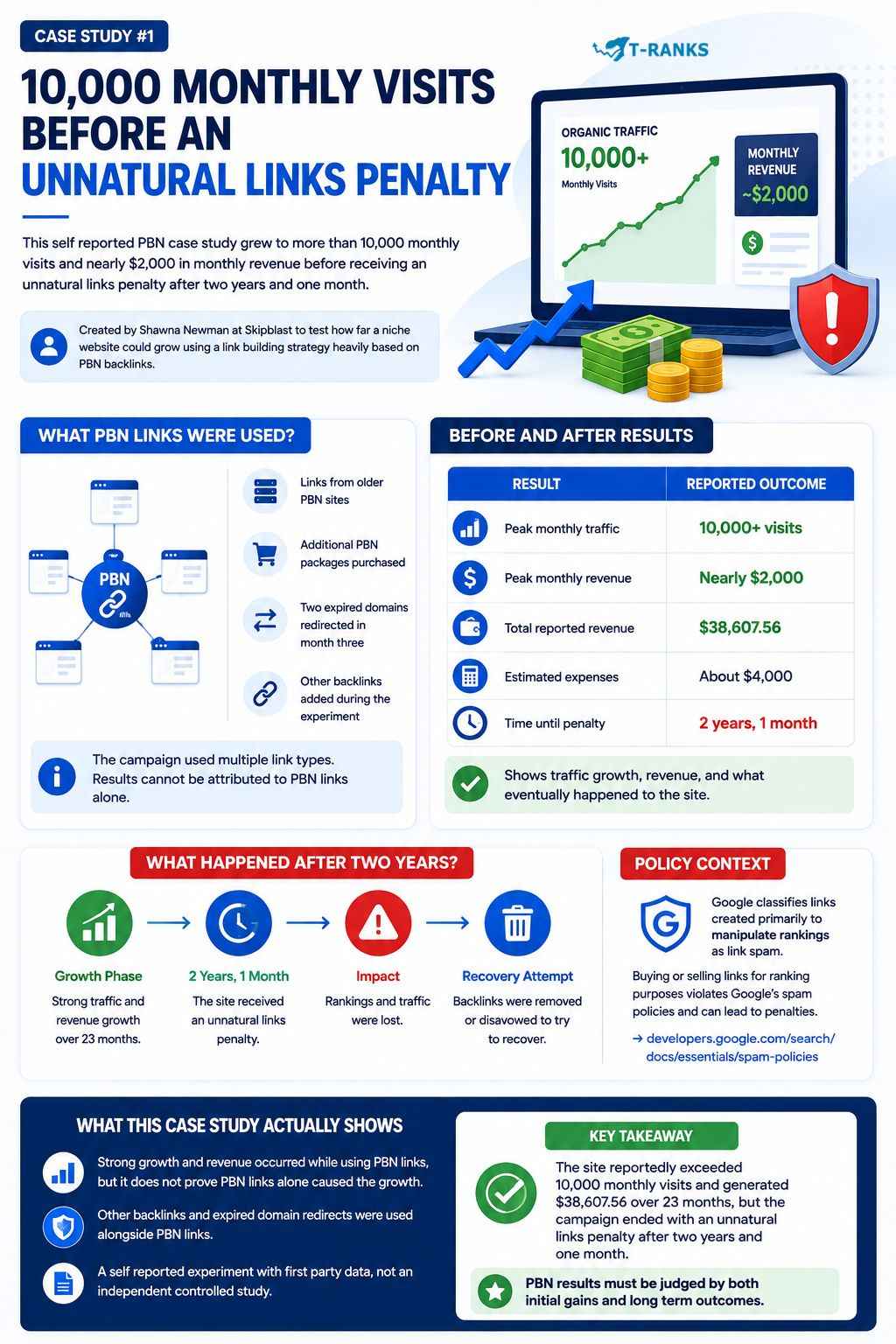
This self reported PBN case study grew to more than 10,000 monthly visits and nearly $2,000 in monthly revenue before receiving an unnatural links penalty after two years and one month.
The experiment was created by Shawna Newman at Skipblast to test how far a niche website could grow using a link building strategy heavily based on PBN backlinks. The site started with around 30 buying guide articles, while backlinks were added gradually as the campaign developed.
Original Skipblast Project PBN Case Study
What PBN Links Were Used?
The campaign used several types of PBN links rather than one fixed backlink strategy. Links were added from older PBN sites, additional PBN packages were purchased, and two expired domains were redirected to the target site during month three. Other backlinks were also added during the experiment.
This detail matters when interpreting the PBN results. The site was not testing one isolated backlink against an unchanged website. PBN links, redirects, and other backlinks were used during the campaign, so the final growth cannot be attributed to PBN links alone.
What Were the Before and After Results?
The site eventually reached more than 10,000 monthly visits and generated nearly $2,000 per month, according to the original case study. The site earned its first dollar about two months after the content was published.
Over 23 months of earnings, Newman reported:
| Result | Reported Outcome |
| Peak monthly traffic | 10,000+ visits |
| Peak monthly revenue | Nearly $2,000 |
| Total reported revenue | $38,607.56 |
| Estimated expenses | About $4,000 |
| Time until penalty | 2 years, 1 month |
These figures make the campaign useful because it shows more than an initial ranking increase. It follows the website long enough to show traffic growth, revenue, and what eventually happened to the site.
What Happened After Two Years?
After two years and one month, Newman reported that the site received an unnatural links penalty. At that point, the site’s earlier performance was effectively lost, and the case study discussed removing or disavowing backlinks as part of a possible recovery attempt.
This longer timeline is important. A PBN campaign can appear successful when measured only during its growth period, while a longer observation period may reveal outcomes that a short case study misses.
Google’s spam policies provide the broader context. Google classifies links created primarily to manipulate search rankings as link spam and lists buying or selling links for ranking purposes among its examples. Violations can result in rankings being lowered or pages being removed from search results.
What Does This PBN Case Study Actually Show?
The campaign shows that strong traffic and revenue growth occurred while the site was using PBN links, but it does not prove that PBN backlinks alone caused that growth.
The original case study provides first party campaign details and supporting screenshots, which makes it more useful than an unsupported success claim. However, it remains a self reported experiment rather than an independent controlled study.
Other backlinks and expired domain redirects were used alongside the PBN links. For that reason, the safest conclusion is that the website experienced substantial growth during a PBN heavy link building campaign and later received an unnatural links penalty.
Key takeaway: The site reportedly exceeded 10,000 monthly visits and generated $38,607.56 over 23 months, but the campaign ended with an unnatural links penalty after two years and one month. The case shows why PBN results need to be judged by both initial gains and long term outcomes.
PBN Case Study #2: Five PBN Links a Month and Six Months of Organic Growth
This self reported PBN case study followed a website that added five PBN links per month for six months. The site reportedly grew from almost no organic traffic to more than 1,000 organic visits per month.
The case comes from Human Proof Designs, or HPD, which published the experiment to show how websites using its monthly PBN link service performed over time. The original page includes before and after ranking screenshots, making it more useful than a case that provides only written claims. However, because HPD also sold the links being tested, the results should still be treated as self reported rather than independent evidence.
Original Human Proof Designs PBN Case Study
What Was the Starting Point?
The website had already been built with content and basic on page SEO, but its off page link building was minimal. According to HPD, it had only a few nofollow blog comment links before the PBN campaign started.
Some keywords were already appearing within Google’s top 100, but they were not ranking high enough to generate meaningful organic traffic.
That baseline is important. The campaign did not begin with a website already receiving thousands of search visits, so the six month period provides a clearer view of how its search visibility changed after regular link building began.
What PBN Links Were Added?
The website joined HPD’s monthly link program and received five PBN links per month. Over six months, that works out to approximately 30 link placements if the stated monthly schedule was maintained throughout the entire period.
The site owner reportedly did little other external link building during this period. The owner did, however, continue publishing new content and making changes to the website itself.
That distinction matters. The limited use of other backlinks makes the PBN campaign easier to examine, but continued content and on site improvements mean the PBN links were still not the only changing variable.
What Were the Before and After Results?
After six months, HPD reported a substantial increase in both keyword visibility and organic traffic.
| Result | Before Campaign | After 6 Months |
| PBN link schedule | None | 5 per month |
| Estimated PBN links | 0 | About 30 |
| Top 100 keyword visibility | Limited | About 10 times higher |
| Organic traffic | Almost none | 1,000+ visits per month |
| Observation period | Starting point | 6 months |
The case study states that the total number of keywords ranking within Google’s top 100 increased roughly tenfold. Organic traffic also grew from almost nothing to more than 1,000 unique organic visits per month.
Unlike Campaign #1, this case did not report one sudden jump. The original account describes slow and steady gains over the six month period, which gives us a different result pattern to compare later.
Can We Attribute the Growth to the PBN Links?
The timing supports an association between the PBN campaign and the site’s growth, but the available evidence does not prove that PBN backlinks alone caused the increase.
The original case study provides before and after screenshots and states that little other external link building occurred. That strengthens the usefulness of the example.
However, the site owner continued adding content and making on site improvements. HPD was also the company providing the PBN service and publishing the case study. Both factors need to be considered when interpreting its conclusions.
There is also no control site showing what would have happened over the same six months without the PBN backlinks.
What Makes This Case Different From Campaign #1?
Campaign #1 used an aggressive mixture of PBN links, redirects, and other backlinks and eventually received an unnatural links penalty. Campaign #2 reports a much simpler schedule of five PBN links each month and gradual growth over six months.
That difference will become useful when we compare all six campaigns. It suggests that PBN results should not be judged only by the final traffic number. The link schedule, other SEO work, observation period, and eventual outcome also matter.
Google’s spam policies remain relevant regardless of how gradually links are added. Google classifies links created primarily to manipulate rankings as link spam, including purchased links intended for ranking purposes.
Key takeaway: This self reported campaign associated roughly six months of regular PBN link building with a tenfold increase in top 100 keyword visibility and growth to more than 1,000 monthly organic visits. The results are supported by before and after screenshots, but continued content work and the commercial relationship between the publisher and the PBN service prevent the links from being isolated as the sole cause.
PBN Case Study #3: Keyword Rankings Improved Within Three Months
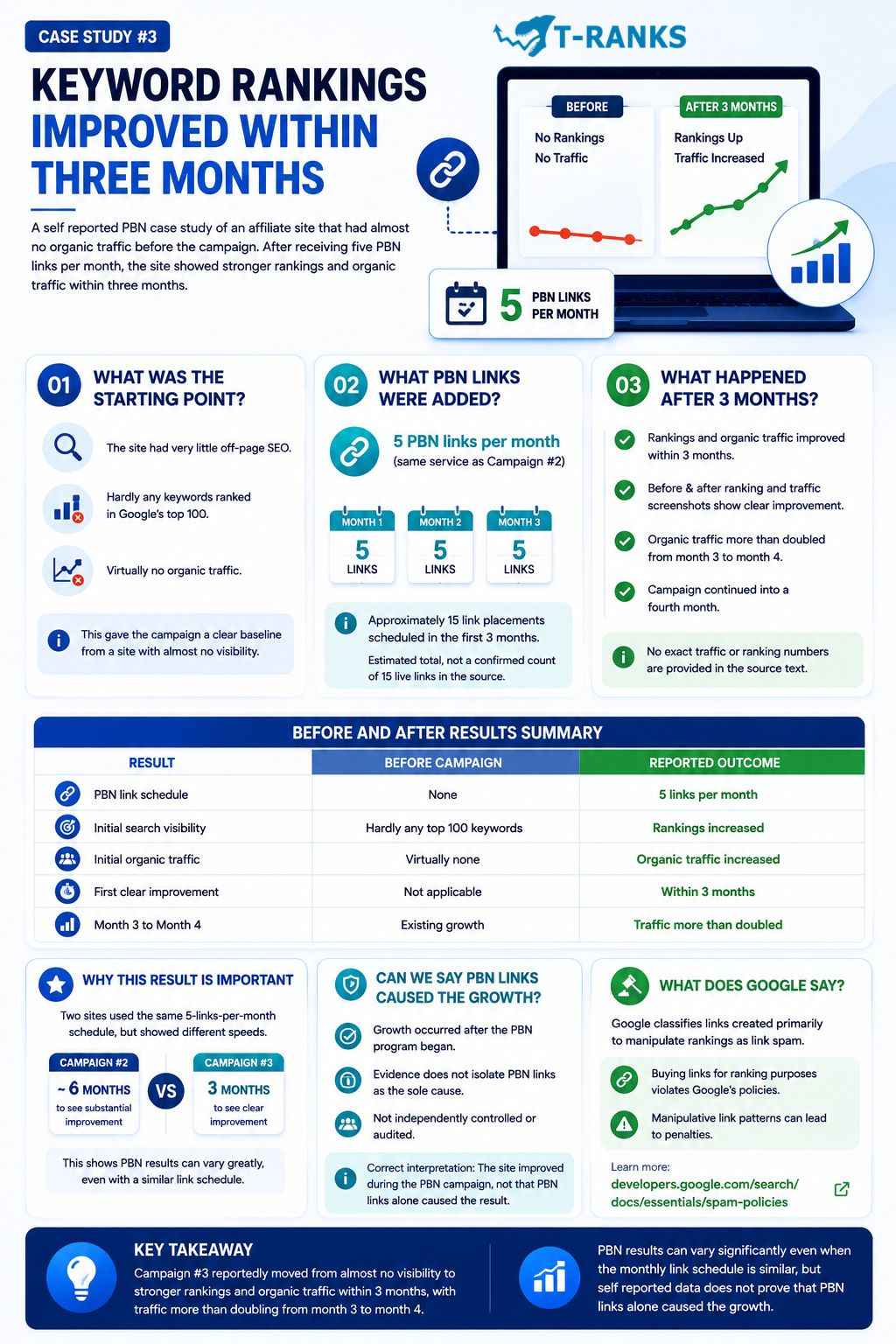
This self reported PBN case study followed an affiliate site that had almost no organic traffic before the campaign. After receiving five PBN links per month, the site showed stronger rankings and organic traffic within three months.
The campaign comes from Human Proof Designs and is the third website included in its original PBN testing article. Unlike Campaign #2, which showed gradual improvement over six months, this website reportedly responded much faster to the same monthly link schedule.
Original Human Proof Designs PBN Case Study
What Was the Starting Point?
The affiliate site had received very little off page SEO before joining the PBN link program. Human Proof Designs reported that hardly any of its keywords appeared within Google’s top 100 and that the website was receiving virtually no organic traffic.
This gives the campaign a useful baseline. Instead of starting with an established site that was already performing well, the test followed a website that had struggled to gain search visibility before the PBN campaign began.
What PBN Links Were Added?
The site received five PBN links per month, using the same monthly service examined in Campaign #2. At that rate, approximately 15 link placements would have been scheduled during the first three months.
That number should be treated as an estimated campaign total, not a confirmed count of 15 live links. The original case study confirms the five links per month service but does not provide a complete link export showing every placement.
This distinction is important. Our case studies should separate numbers shown directly in the source from numbers that can only be calculated from the stated campaign schedule.
What Happened After Three Months?
Human Proof Designs reported that the site’s rankings and organic traffic had changed noticeably after only three months. The original case study includes before and after ranking and traffic screenshots to illustrate the improvement.
The campaign then continued into a fourth month. According to the publisher, organic traffic more than doubled between months three and four.
| Result | Before Campaign | Reported Outcome |
| PBN link schedule | None | 5 links per month |
| Initial search visibility | Hardly any top 100 keywords | Rankings increased |
| Initial organic traffic | Virtually none | Organic traffic increased |
| First clear improvement | Not applicable | Within 3 months |
| Month 3 to Month 4 | Existing growth | Traffic more than doubled |
Unlike Campaign #2, the source does not provide a clear text based figure for the site’s final monthly traffic or exact keyword positions. We should therefore not create those numbers from the screenshots unless they can be read and verified accurately.
Why Is This Result Important?
The interesting part of this campaign is not simply that rankings increased. It is that two sites using the same five link monthly schedule reportedly moved at different speeds.
Campaign #2 required roughly six months to develop substantial search visibility. Campaign #3 showed noticeable ranking and traffic changes within three months, followed by more than double the organic traffic from month three to month four.
That comparison challenges the idea that PBN links have one predictable SEO timeline. Even when the stated link schedule is similar, different websites can respond differently.
The original publisher makes the same broader point, noting that sites do not necessarily react on the same timetable.
Can We Say the PBN Links Caused the Growth?
No. The campaign shows that ranking and traffic growth occurred after the PBN program began, but the available evidence does not isolate the backlinks as the sole cause.
The original page provides before and after screenshots, which gives the claim more support than a text only testimonial. However, Human Proof Designs both supplied the PBN links and published the results. The campaign was not independently controlled or audited.
The available case study also does not give us a complete record of content changes, technical SEO changes, Google updates, or every other factor that may have affected the site during the observation period.
For those reasons, the correct interpretation is that the site improved during the PBN campaign, not that five PBN links per month are proven to produce the same result.
What Does Google Say About This Type of Link Building?
Google’s spam policies classify links created primarily to manipulate search rankings as link spam. Examples include buying links for ranking purposes and creating links mainly to influence search results.
That means a positive ranking result does not establish that the method is safe or that the improvement will last. PBN links can lose value, and manipulative link patterns can expose a site to search visibility or enforcement risk.
Key takeaway: Campaign #3 reportedly moved from almost no search visibility to noticeable rankings and organic traffic within three months, with traffic more than doubling from month three to month four. The faster response compared with Campaign #2 is useful evidence that PBN results can vary significantly even when the stated monthly link schedule is similar, but the self reported data does not prove that the PBN links alone caused the growth.
PBN Case Study #4: 10 PBN Links Failed to Break a Page Two Ranking Plateau
Adding about 10 PBN homepage links was not enough to move this website from position 12 onto Google’s first page. The target keyword showed no meaningful ranking improvement and later dropped further down page two.
Authority Builders published the experiment as part of an aged domain SEO case study. The campaign included PBN backlinks, guest posts, citations, ranking tracking, and on page changes. Because the results were published by the campaign operator and several SEO activities occurred during the same period, the findings should be treated as self reported rather than independently verified.
Original Authority Builders Aged Domain Case Study
The Site Was Already Close to Page One
Before the additional PBN backlinks were introduced, the target keyword had reached position 12. The page was already close to Google’s top 10, so the goal was not to build search visibility from scratch. The goal was to move an existing page two ranking onto page one.
That starting position makes this campaign useful for comparison. A page sitting at position 12 may need only a few places of improvement to reach page one, but those final positions can still be difficult to gain in a competitive search result.
What Happened When 10 PBN Links Were Added?
The campaign added about 10 PBN homepage links. According to the original case study, the PBN sites had more than 100 referring domains each, and most of the links pointed directly to the target money page.
PBN links were not the only SEO work involved. The campaign also included 5 to 7 guest posts, tier two backlinks, citations, FAQ content, and internal anchor text testing.
This is important when evaluating the PBN results. Multiple SEO changes were happening during the campaign, so the effect of the PBN links cannot be measured in complete isolation.
More PBN Links Did Not Improve the Ranking
The additional PBN backlinks failed to push the target keyword from position 12 onto page one. Despite the extra links and other SEO work, the case study reported no meaningful ranking improvement. The keyword later slipped toward the bottom of page two.
| Campaign Detail | Reported Result |
| Starting ranking | Position 12 |
| PBN links added | About 10 |
| PBN link type | Homepage links |
| Referring domains per PBN | 100+ reported |
| Other backlinks | 5 to 7 guest posts, tier two links, citations |
| Target | Reach Google page one |
| Initial result | No meaningful improvement |
| Later result | Dropped further down page two |
The outcome gives us a useful counterexample to the earlier campaigns. Some of those campaigns reported organic traffic or ranking growth after adding PBN links. Here, additional backlink authority was followed by little or no positive ranking movement.
Why Is This PBN Case Study Important?
This campaign shows why the number of PBN backlinks alone cannot predict ranking results.
The page was already close to the first page and received about 10 additional PBN links, yet it did not make the expected move into the top 10. This challenges the idea that adding a certain number of PBN backlinks will reliably produce a specific ranking increase.
It also strengthens our comparison across the six campaigns. Some campaigns showed gradual growth, others showed faster movement, while this one failed to achieve its main ranking goal.
What Can We Actually Learn From the Result?
We can say that about 10 PBN links failed to break the reported ranking plateau, but the available evidence cannot tell us exactly why.
Keyword competition, content quality, search intent, existing backlinks, competitors, and other ranking signals may all have influenced the result. Because guest posts, citations, and on page changes were also used, no single factor can be isolated as the cause of the outcome.
The evidence therefore does not support a formula such as “10 PBN links are enough to reach page one.” It shows that backlink quantity needs to be considered alongside the target page, existing authority, competition, and other SEO factors.
Google also classifies links created primarily to manipulate search rankings as link spam. That policy applies whether those links successfully improve rankings or fail to move them.
Key takeaway: The target keyword started around position 12, but about 10 PBN homepage links, alongside other SEO work, failed to move it onto page one. The campaign provides a useful example of why more PBN backlinks do not automatically produce higher rankings.
PBN Case Study #5: 300 PBN Links and 29.1% Organic Traffic Growth in Three Months
A 300 link PBN campaign was followed by a reported 29.1% increase in organic traffic over three months. Monthly traffic grew from about 16,000 to more than 20,600 visits, while the site also gained wider keyword visibility.
Saket Wahi published the campaign as an ecommerce SEO case study for a supplements brand operating in a competitive search market. The original case-study page provides campaign metrics and supporting SEO screenshots. However, the campaign operator also published the results, so we classify the findings as self reported rather than independently verified.
Original Ecommerce PBN Case Study
What Was Different About This PBN Campaign?
Unlike the smaller PBN campaigns covered earlier, this test used 300 PBN links within three months. The stated goal was to build authority quickly for an ecommerce website competing against established brands in the supplements market.
This makes Campaign #5 useful for a different reason. Instead of asking whether a handful of PBN backlinks could move a ranking, it shows what happened during a much larger and faster link building campaign.
The original case study describes the strategy as a focused 300 link PBN campaign. Because hundreds of links were deployed within a relatively short period, we should evaluate the result as a high volume campaign rather than compare the raw link count directly with smaller tests.
What Changed After Three Months?
Organic traffic reportedly increased from about 16,000 to more than 20,600 monthly visits during the three month campaign. The publisher calculates the overall traffic increase at 29.1%.
The case study also reports growth in organic keyword visibility. Keyword coverage expanded by approximately 2,800 keywords, while the number of keywords ranking in Google’s top three increased by 314.
| Campaign Detail | Reported Result |
| Campaign length | 3 months |
| PBN links | 300 |
| Starting organic traffic | About 16,000 monthly visits |
| Final organic traffic | 20,600+ monthly visits |
| Reported traffic growth | +29.1% |
| Additional organic keywords | About 2,800 |
| Increase in top 3 keywords | +314 |
| Reported Domain Rating | 53 |
The important result here is not one keyword jumping several positions. The reported change occurred across organic traffic and broader keyword visibility, giving us a different type of PBN result from Campaign #4.
Did 300 PBN Links Cause the 29.1% Traffic Increase?
The campaign shows that traffic growth occurred during the three months in which 300 PBN links were deployed, but it does not prove that those links caused the entire 29.1% increase.
The original case study provides useful before and after metrics, but it is not a controlled SEO experiment. Search demand, existing backlinks, content performance, technical changes, competitor movement, and Google ranking systems can also influence organic traffic over a three month period.
There is another reason to interpret the numbers carefully. The case-study page reports much larger changes in the site’s overall backlink profile than the 300 PBN links alone. Total backlinks reportedly increased by approximately 63,700 and referring domains by about 1,300 during the measured period.
That means the 300 PBN links should not automatically receive credit for every change shown in the final SEO metrics.
What Does This Campaign Add to Our PBN Results?
Campaign #5 shows that a larger PBN campaign can coincide with broader traffic and keyword growth, but link volume alone still does not explain the outcome.
This gives us an interesting contrast with Campaign #4:
Campaign #4 added about 10 PBN links to a page near position 12 but failed to break onto page one.
Campaign #5 deployed 300 PBN links and reported a 29.1% increase in organic traffic over three months.
The two cases should not be interpreted as proof that 300 links work while 10 links do not. They involved different websites, niches, starting conditions, competition levels, and campaign strategies.
Instead, they strengthen a pattern that we can examine once all six PBN case studies are complete: the number of PBN backlinks by itself is a poor way to predict the final SEO result.
What About the Risk of a High Volume PBN Campaign?
Positive traffic growth does not remove the risk associated with links built primarily to influence rankings. Google’s spam policies classify buying or creating links for ranking purposes as link spam.
A three month increase also tells us little about long term durability. The original case study describes the campaign as ongoing, so the available evidence does not yet show whether the reported gains remained stable over a longer period.
Key takeaway: Campaign #5 reported 29.1% organic traffic growth after 300 PBN links were deployed over three months, along with wider keyword visibility. The numbers provide a useful before and after comparison, but the broader backlink growth and lack of an independent control mean the PBN links cannot be isolated as the sole cause of the improvement.
PBN Case Study #6: One Site Reached Page One While Another Stayed at Position 66
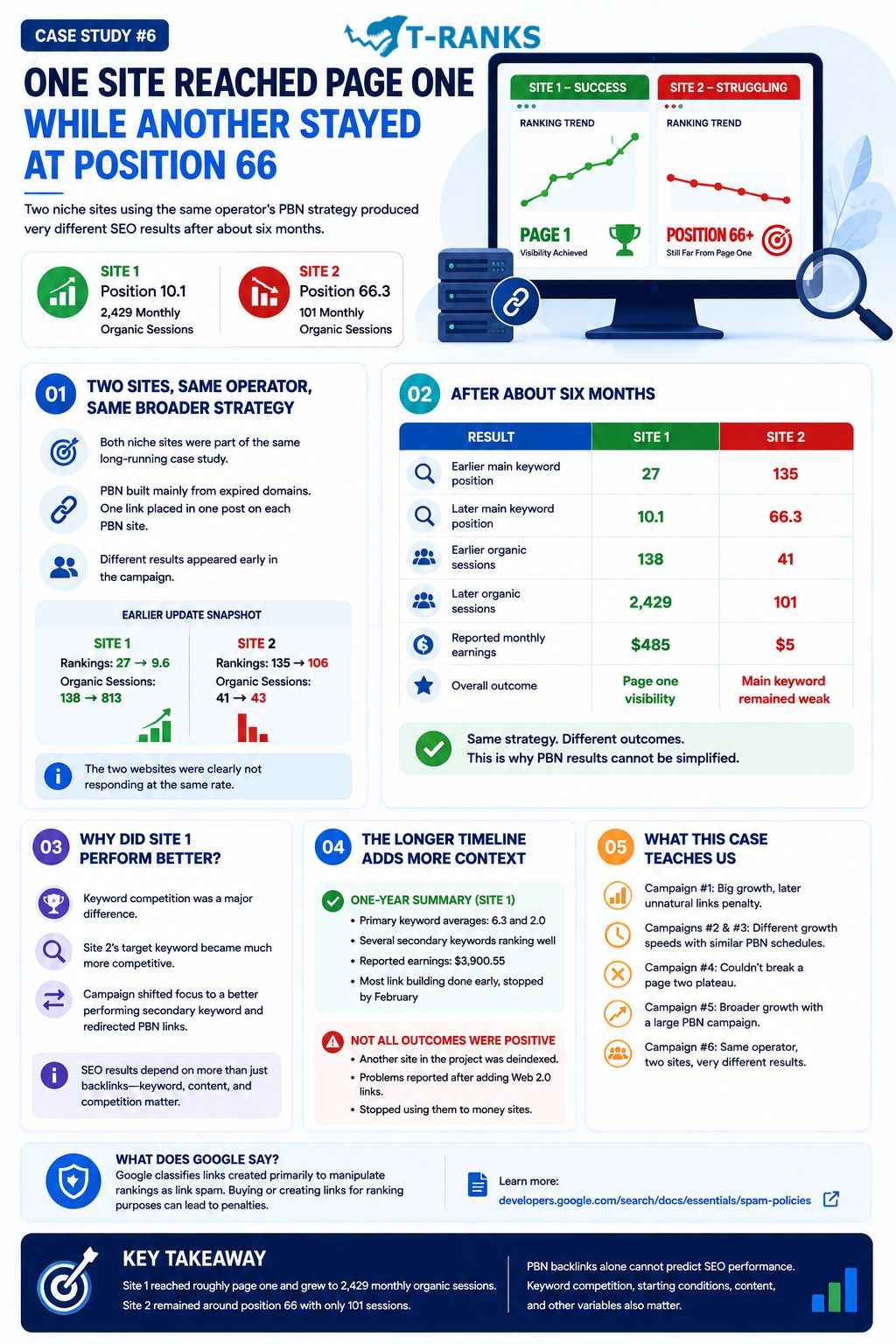
Two niche sites using the same operator’s PBN strategy produced very different SEO results. After about six months, Site 1 was averaging position 10.1 and receiving 2,429 monthly organic sessions, while Site 2 remained around position 66.3 with only 101 organic sessions.
Sharon Gourlay published the results as part of her long running Digital Nomad Wannabe niche site case study. The original series documents the PBN setup, link building process, rankings, organic sessions, and earnings over multiple updates. Because the campaign operator also published the results, the figures remain self reported, although the continuing updates provide more evidence than a single before and after claim.
Original Digital Nomad Wannabe PBN Case Study
Two Sites Started With the Same Goal but Produced Different Results
This campaign is useful because it gives us something the previous PBN case studies did not: two websites being developed by the same operator during the same broader project.
The PBN was built primarily from expired domains. The operator restored the domains with relevant content and generally placed a link to the target niche site in one post on each PBN site. The network was then used as part of the link building strategy for the niche sites.
Earlier in the campaign, the difference between the two sites was already visible.
Site 1 moved from an average main keyword ranking of position 27 to 9.6, while organic search sessions increased from 138 to 813. Site 2 improved from position 135 to 106 on average and generated only 43 organic sessions during the same update.
The two websites were clearly not responding at the same rate.
What Happened After About Six Months?
By the later update, Site 1 was averaging position 10.1 for its main keyword and receiving 2,429 organic search sessions during the month. It also generated $485 in reported revenue.
Site 2 told a very different story.
Its main keyword remained at an average position 66.3, while organic search produced only 101 sessions and $5 in reported revenue. The operator noted that the target keyword had become considerably more competitive during the campaign.
| Result | Site 1 | Site 2 |
| Earlier main keyword position | 27 | 135 |
| Later main keyword position | 10.1 | 66.3 |
| Earlier organic sessions | 138 | 41 |
| Later organic sessions | 2,429 | 101 |
| Reported monthly earnings | $485 | $5 |
| Overall outcome | Page one visibility | Main keyword remained weak |
This side by side comparison is more informative than simply reporting another successful PBN campaign. The same broader link building approach did not produce the same outcome for both websites.
Why Did Site 1 Perform Better?
The case study does not provide enough controlled evidence to say that one specific factor caused Site 1 to outperform Site 2.
Keyword competition appears to be one important difference. Gourlay reported that Site 2’s main keyword had become much more competitive and said she would not have selected it if the later competitive conditions had existed when the original keyword research was performed.
The operator eventually stopped focusing on that primary keyword. A second buying guide targeting a related product was performing better, so the plan was to redirect the PBN links toward the new target instead.
This gives the case an important SEO lesson beyond PBNs. A backlink strategy cannot be evaluated without considering the keyword and SERP it is trying to influence.
The Longer Timeline Adds More Context
The project did not stop at the six month update. Later reports continued tracking the sites.
In the one year summary, Site 1 had primary keyword averages of 6.3 and 2.0, with several secondary keywords also ranking strongly. Reported earnings reached $3,900.55 over the year. The operator stated that most link building occurred during the first few months and gradually stopped by February.
One Year Niche Site Case Study Results
The same project also provides an important warning. Another niche site in the broader case study was deindexed, and Gourlay reported problems after adding Web 2.0 links. She later stopped using those links directly to money sites. This does not establish that her PBN caused the deindexing, but it shows why the project’s positive ranking results should not be separated from its negative outcomes.
What Does This Case Add to the Six Campaigns?
Campaign #6 gives us one of the clearest examples of why PBN results cannot be reduced to a simple link count or fixed ranking timeline.
Within the same broader project, one website reached page one and generated thousands of monthly organic sessions, while another remained far lower in the search results.
The difference also reinforces a pattern appearing across our six PBN case studies:
Campaign #1 showed substantial traffic and revenue growth before eventually ending with an unnatural links penalty.
Campaigns #2 and #3 reported different rates of growth despite using similar recurring PBN link schedules.
Campaign #4 failed to break an existing page two ranking plateau.
Campaign #5 reported broader traffic and keyword growth during a much larger PBN campaign.
Campaign #6 shows two sites under the same operator producing sharply different ranking and traffic outcomes.
That variation is more useful than trying to prove that PBN backlinks always work or never work.
Google’s current spam policies also remain relevant. Links created primarily to manipulate rankings can qualify as link spam, so positive historical case study results should not be treated as evidence that the same approach is safe under current Google policies.
Key takeaway: Site 1 reached roughly page one and grew to 2,429 monthly organic sessions, while Site 2 remained around position 66 with only 101 sessions. The contrasting results show that PBN backlinks alone cannot predict SEO performance because keyword competition, starting conditions, content, and other campaign variables also matter.
What Did the 6 PBN Campaigns Show?

The six PBN case studies showed mixed results rather than one consistent outcome. Some campaigns reported strong ranking and traffic growth, one failed to break a page two plateau, and another eventually ended with an unnatural links penalty.
Looking at the campaigns together is more useful than judging PBN backlinks from one success story. The reported results varied by starting position, campaign size, observation period, keyword competition, and the other SEO work happening at the same time.
The evidence is also mostly self reported, so these comparisons show what the campaign operators reported rather than proving that PBN links alone caused each result.
Which Campaign Improved the Most?
There is no single campaign we can fairly call the biggest winner because the case studies measured different outcomes.
Campaign #1 reported one of the strongest long term outcomes. The Skipblast site eventually exceeded 10,000 monthly visits and generated $38,607.56 over 23 months of earnings. However, the campaign involved PBN links, redirects, and other backlinks, and the site later received an unnatural links penalty.
Campaign #5 provides a clearer short term traffic comparison. Its publisher reported that organic traffic increased 29.1% in three months, from about 16,000 to more than 20,600 monthly visits, during a campaign involving 300 PBN links.
Campaign #6 showed a different type of improvement. One site moved from an average main keyword position of 27 to about 10.1, while organic search sessions increased from 138 to 2,429. The second site performed much more slowly.
These figures should not be placed into a simple winner ranking because traffic growth, keyword movement, revenue, and campaign duration are different measurements.
How Long Did PBN Links Take to Show Results?
The campaigns did not reveal one fixed timeline for PBN results. Reported improvements appeared within a few months in some cases, while others required longer periods or failed to produce the expected ranking gain.
Campaign #3 showed noticeable ranking and traffic improvement within about three months, with the publisher reporting that organic traffic more than doubled between months three and four.
Campaign #5 also reported measurable growth over a three month period. Campaign #2, by comparison, followed a slower six month pattern before reaching more than 1,000 monthly organic visits.
Campaign #4 is the important exception. About 10 additional PBN links did not push its target keyword from position 12 onto page one.
| Campaign | Observation Period | Reported Pattern |
| Campaign #1 | 2+ years | Strong growth followed by penalty |
| Campaign #2 | 6 months | Gradual ranking and traffic growth |
| Campaign #3 | 3 to 4 months | Faster ranking and traffic growth |
| Campaign #4 | Several months | No meaningful ranking improvement |
| Campaign #5 | 3 months | 29.1% reported traffic growth |
| Campaign #6 | 6+ months | Strong growth for one site, weaker growth for another |
The cases therefore do not support claims that PBN backlinks normally take a specific number of days or months to work.
Did More PBN Links Produce Better Results?
No clear relationship between a higher PBN link count and better SEO results appears across these six campaigns.
Campaign #4 illustrates the problem clearly. About 10 PBN homepage links were added when the target keyword was already around position 12, yet the page failed to reach Google’s first page.
Campaign #5 used a much larger campaign of 300 PBN links and reported 29.1% organic traffic growth. But that does not mean 300 links were more effective simply because the final result was positive. The websites, niches, existing authority, competition, and other backlinks were different.
Campaigns #2 and #3 provide another useful comparison. Both reportedly followed a schedule of five PBN links per month, yet their growth appeared at different speeds.
The six cases therefore give us no reliable link count formula for ranking. Link quantity is only one variable within a much larger SEO environment.
Did Better Rankings Increase Organic Traffic?
Better rankings were generally accompanied by higher organic traffic in the campaigns that reported both metrics, but the size of the traffic increase varied.
Campaign #6 provides a useful example. Site 1 improved from an average main keyword position of 27 to around 10.1 while monthly organic sessions increased from 138 to 2,429. Site 2 remained much lower in the rankings and generated only 101 organic sessions in the later comparison.
Campaign #2 also reported growth from almost no organic traffic to more than 1,000 monthly organic visits alongside wider keyword visibility. Campaign #5 reported a 29.1% traffic increase together with growth in the number of ranking keywords.
However, ranking movement does not guarantee an equal increase in traffic. Search volume, ranking position, click behavior, keyword intent, and the number of keywords gaining visibility can all affect how much organic traffic a ranking improvement produces.
The Overall Pattern
Across the six PBN case studies, three points stand out:
- Results varied considerably. PBN link building was followed by strong growth in some cases and little meaningful movement in another.
- More links did not guarantee better rankings. The available cases do not establish a predictable relationship between PBN backlink quantity and SEO performance.
- Short term success did not guarantee long term stability. Campaign #1 is the clearest example because substantial traffic and revenue growth was eventually followed by an unnatural links penalty.
These are observations from self reported campaigns, not controlled proof that PBN links caused each outcome. That distinction becomes especially important when we examine why the PBN results differed in the next section.
Why Did the PBN Results Differ?
The six PBN campaigns produced different results because they did not start under the same SEO conditions. Rankings, existing backlinks, keyword competition, PBN link placement, and other SEO work varied from one campaign to another.
This is why the results should not be reduced to a simple comparison of how many PBN backlinks each site received. Campaign #4 failed to move from page two despite additional links, while other campaigns reported traffic and ranking growth. The differences suggest that the starting conditions and wider SEO campaign matter alongside the backlinks themselves.
Starting Rankings and Existing Backlinks
A PBN backlink is being added to an existing SEO profile, not an empty ranking system.
The campaigns began from very different positions. Campaign #4 already had a target keyword around position 12 before about 10 PBN links were added. Campaign #6, by comparison, included sites whose main keywords were much further from page one.
Existing backlinks also differed. Some sites entered their PBN campaigns with little previous link building, while others already had backlinks and established search visibility.
This makes direct comparisons difficult. A keyword moving from position 60 to 30 and another moving from position 12 to 8 may require very different competitive gains, even though the first example shows a larger numerical jump.
Keyword Competition
Keyword competition appears to be one of the clearest differences between the reported campaigns, although the case studies do not isolate it as the sole cause of performance.
Campaign #6 provides a useful example. Two sites developed by the same operator produced very different results. One reached roughly page one, while the other remained around position 66. The operator reported that the weaker site’s main keyword had become significantly more competitive during the project.
Digital Nomad Wannabe PBN Case Study
This does not prove that keyword competition caused the weaker result. It does show why two websites receiving PBN links should not be expected to move at the same rate.
Search results are competitive environments. A target page has to compete with the content, authority, relevance, and backlink profiles of the pages already ranking for that query.
Number and Placement of PBN Links
The campaign data does not show a simple relationship between more PBN links and better rankings.
Campaign #4 added about 10 PBN homepage links but failed to break its page two plateau. Campaign #5 used a much larger reported campaign of 300 PBN links and experienced traffic and keyword growth over three months.
Campaigns #2 and #3 are even more useful for comparison because both reportedly followed a schedule of five PBN links per month, yet their results developed at different speeds.
Placement also varied between campaigns. Some links pointed directly to target pages, while other campaigns used homepage links, inner page links, or redirects alongside PBN backlinks.
The evidence therefore does not support a fixed rule such as “more PBN links equal higher rankings.” Link count and placement need to be considered within the complete backlink profile and competitive environment.
Other SEO Changes During the Campaigns
PBN backlinks were not the only SEO variable changing in several of these case studies. This is one of the biggest limitations when interpreting the results.
Campaign #1 included PBN links, expired domain redirects, and other backlinks. Campaign #4 combined PBN homepage links with guest posts, citations, tier two links, and on page changes. Campaign #5 also showed much broader growth in the overall backlink profile during its three month observation period.
Content can change too. New articles, internal links, page improvements, technical fixes, and changes in search demand may occur while backlinks are being built.
This creates an attribution problem. If rankings rise after PBN links are added while several other SEO changes are happening, the timing can show an association, but it cannot tell us exactly how much of the improvement came from the PBN links.
This limitation is not unique to PBN research. Google explains that its ranking systems consider many signals and systems rather than relying on one factor alone.
Google Guide to Search Ranking Systems
What Matters Most When Comparing PBN Results?
The strongest comparison is not simply links versus rankings. It is starting point, links added, other changes, time observed, and final outcome together.
That approach explains why our six PBN case studies should not be turned into a formula. A campaign using 10 links can fail while another using regular monthly links grows. A larger campaign can report substantial traffic growth, while a successful site can later lose visibility.
The differences do not prove exactly which factor caused each outcome. They show why PBN results need context before they can be interpreted.
Google also treats links created primarily to manipulate rankings as link spam. Therefore, differences in reported effectiveness do not change the underlying policy risk associated with manipulative PBN link building.
Key takeaway: The six campaigns differed in their starting rankings, backlink profiles, keyword competition, link strategies, and other SEO activity. Those differences help explain why the reported outcomes varied, but the available case studies do not isolate any single factor as the cause of success or failure.
What Worked and What Didn’t?
The six PBN case studies show that some campaigns were followed by stronger rankings and organic traffic, while others produced limited movement or later negative outcomes. No single PBN tactic worked consistently across every campaign.
The clearest pattern is variation. Regular link building coincided with growth in some campaigns, while simply increasing backlink volume did not guarantee better rankings. Longer observation periods also revealed outcomes that short term before and after comparisons could have missed.
What Appeared to Work?
Consistent link acquisition was associated with positive search visibility in several of the reported campaigns.
Campaign #2 added five PBN links per month for six months. During that period, the site reportedly increased its number of top 100 keywords roughly tenfold and grew from almost no organic traffic to more than 1,000 monthly organic visits.
Campaign #3 followed the same five link monthly schedule but showed noticeable movement sooner. Rankings and organic traffic improved within approximately three months, with traffic reportedly more than doubling between months three and four.
Larger campaigns also coincided with growth. Campaign #5 reported a 29.1% increase in organic traffic during a three month campaign involving 300 PBN links.
These cases show a recurring association between link building and improved search visibility. They do not establish that PBN backlinks alone caused the gains.
What Didn’t Work?
Adding more PBN backlinks did not consistently produce the expected ranking improvement.
Campaign #4 is the clearest example. The target keyword was already around position 12 when approximately 10 PBN homepage links were added. Instead of reaching Google’s first page, the ranking plateaued and later moved further down page two.
Campaign #6 also showed that the same broader strategy could produce sharply different outcomes. One site reached roughly page one and generated 2,429 monthly organic sessions, while another remained around position 66 with only 101 organic sessions.
These results weaken the idea that a specific number of PBN links can reliably deliver a specific ranking position.
Short Term Gains Did Not Always Mean Long Term Success
One of the most important findings came from the campaign with the longest reported timeline.
Campaign #1 grew to more than 10,000 monthly visits and nearly $2,000 in monthly revenue. If the case had ended during that growth period, it could have appeared to be a straightforward PBN success story.
It did not end there.
After two years and one month, the site received an unnatural links penalty. That later outcome changes how the earlier growth should be interpreted.
This is why a three month ranking increase and a two year SEO outcome answer different questions. Short term results show what happened soon after a campaign. Longer tracking helps show whether those results remained stable.
What Pattern Appeared Across the Six Campaigns?
The six campaigns point to three practical observations:
- Positive results were possible but inconsistent. Several campaigns reported ranking or traffic growth, while others performed much more slowly or failed to achieve their main ranking goal.
- Link quantity was not a reliable predictor. Smaller recurring campaigns sometimes improved, while additional links failed to move Campaign #4 onto page one.
- Long term outcomes could differ from early results. Campaign #1 demonstrated that substantial initial growth could still be followed by a later penalty.
These observations should not be interpreted as instructions for building PBN links. They describe what happened in the reported campaigns and help separate the available evidence from broader claims about PBN effectiveness.
Google’s current spam policies classify links created primarily to manipulate search rankings as link spam, including certain paid or deliberately created links intended to influence rankings.
Key takeaway: What appeared to work in one PBN campaign did not reliably work in another. The six cases show reported ranking and traffic gains, failed ranking pushes, and a later penalty, making consistency and long term durability the biggest weaknesses in the results.
What Do These PBN Case Studies Actually Prove?
The six PBN case studies show that ranking and traffic improvements can occur during PBN campaigns, but they do not prove that PBN backlinks alone caused those improvements or that similar results can be repeated on another website.
That distinction matters. A before and after case study can show what changed during a campaign, but proving why the change happened requires much stronger evidence. Most of these campaigns involved different websites, keywords, backlink profiles, content strategies, and competitive conditions.
The Cases Show Association, Not PBN-Only Causation
Several campaigns reported positive results after PBN links were introduced. Campaign #2 grew from almost no organic traffic to more than 1,000 monthly organic visits. Campaign #3 reported noticeable ranking and traffic improvements within three months. Campaign #5 reported 29.1% organic traffic growth during its three month campaign.
Those results establish a timeline: PBN links were built and SEO performance later improved.
They do not establish PBN-only causation.
Some campaigns included guest posts, redirects, citations, content additions, internal linking changes, or broader backlink growth. Google rankings can also change because competitors improve or decline, search intent shifts, or Google’s ranking systems change.
For that reason, it would be inaccurate to say that a specific PBN link produced a specific ranking or traffic increase based on these cases alone.
The Cases Do Prove That Outcomes Were Not Consistent
One conclusion is much clearer: the reported PBN results varied substantially from one campaign to another.
Campaign #4 is an important counterexample. About 10 PBN homepage links were added when the target keyword was already around position 12, yet the page did not reach the first page.
Campaign #6 provides another useful comparison. Two sites within the same broader project produced very different outcomes. One reached roughly page one, while the other remained much further down the search results.
This variation means the six cases do not support claims such as:
- A certain number of PBN links guarantees page one rankings.
- PBN backlinks always produce results within a fixed period.
- More PBN links automatically create larger ranking gains.
- An early ranking increase guarantees a lasting result.
The evidence instead points toward conditional and unpredictable outcomes.
Before and After Data Has Limits
Before and after results are useful evidence, but they become weaker when several SEO variables change at the same time.
Suppose a site receives PBN links, publishes new content, improves internal linking, and gains other backlinks during the same three months. If organic traffic then rises, the before and after numbers show that the website improved. They do not tell us precisely how much credit belongs to each change.
This limitation appears in several of our six campaigns.
Campaign #1 combined PBN backlinks with expired domain redirects and other links. Campaign #4 included guest posts, citations, tier two links, and on page work. Campaign #5 experienced wider backlink profile growth beyond the reported PBN campaign.
The strongest claim supported by such evidence is therefore that the SEO improvement occurred during or after the PBN campaign, not that PBN links independently caused the entire improvement.
Self Reported Results Need Additional Caution
Most of the evidence in these PBN case studies comes from the people or companies involved in running or selling the campaigns.
That does not automatically make the data false. Some original sources provide ranking charts, traffic screenshots, timelines, and detailed descriptions of what was done. Those details make the cases more useful than unsupported claims.
However, screenshots and first party reports are still not the same as independently audited data or controlled experiments. Commercial interests can also create selection bias because successful campaigns are more likely to be published than campaigns where nothing happened.
For this reason, we have treated the campaign results as self reported evidence throughout the comparison.
What Can We Reasonably Conclude?
The evidence supports a narrower conclusion than either “PBNs work” or “PBNs do not work.”
The six campaigns show that websites can experience ranking, traffic, and revenue growth while PBN backlinks are being used. They also show that some campaigns fail to achieve their ranking targets and that positive early results may not remain stable.
What they cannot establish is a universal success rate, an ideal number of PBN links, a guaranteed ranking timeline, or a direct causal relationship between PBN links and every reported improvement.
There is also a separate question of compliance. Google’s spam policies classify links created primarily to manipulate search rankings as link spam. A campaign showing positive rankings does not change that policy risk.
Key takeaway: These PBN case studies provide useful real world observations, not a formula for predictable rankings. They show that positive results can occur alongside PBN link building, but they do not prove that PBN links alone caused the gains or that those gains will last.
Can PBN Results Last?
PBN results can appear to last for months or even years, but the six campaigns do not show that ranking gains from PBN backlinks are permanently stable. Long term outcomes depended on the site, campaign, and what happened after the initial growth.
This is an important distinction because most PBN case studies focus on the period when rankings are improving. A campaign that looks successful after three or six months may look very different when measured over several years.
Short Term Results and Long Term Results Are Different
Several campaigns reported positive results within three to six months, but those timeframes tell us little about long term durability.
Campaign #3 showed ranking and traffic improvement within about three months. Campaign #5 reported 29.1% organic traffic growth over three months. Campaign #2 reported more than 1,000 monthly organic visits after six months.
Those results tell us what happened during relatively short observation periods. They do not establish whether the same rankings remained one year, two years, or longer.
This is why the length of a PBN case study matters. A ranking gain is one result. Keeping that ranking over time is another.
Campaign #1 Shows Why Longer Tracking Matters
Campaign #1 provides the clearest long term evidence because the site reportedly performed well for more than two years before receiving an unnatural links penalty.
The website grew to more than 10,000 monthly visits and reached nearly $2,000 in monthly revenue. According to the original Skipblast case study, the site thrived for two years and one month before the penalty occurred.
Original Skipblast Project PBN Case Study
If the campaign had been evaluated after only six months or one year, the conclusion would have been much more positive. Following it for longer revealed an outcome that the early traffic and revenue numbers could not show.
That makes Campaign #1 particularly useful when evaluating whether reported PBN results can last.
A Lasting Ranking Does Not Mean the Risk Disappears
Ranking stability and link policy compliance are two different questions.
A website may continue ranking while questionable backlinks remain in its profile. That does not establish that Google approves those links, that the links are still contributing ranking value, or that the site will continue performing the same way.
Google defines link spam as links created primarily to manipulate search rankings. Its policies also state that sites violating spam policies may rank lower or may not appear in search results.
Therefore, a PBN campaign remaining successful for several months should not automatically be interpreted as evidence that the links are safe.
PBN Links May Also Stop Providing the Same Value
A PBN backlink does not need to disappear for its SEO value to change.
Google’s systems are designed to identify and neutralize unnatural links rather than necessarily producing a visible penalty every time. Google has specifically explained that SpamBrain, its AI based spam prevention system, can detect sites buying links and sites used for passing outgoing links, with unnatural links losing ranking credit when neutralized.
Google Search Central: December 2022 Link Spam Update
This creates an important measurement problem. If a site loses rankings months after a PBN campaign, the available data may not reveal whether links were devalued, competitors improved, the site changed, an algorithmic system changed how signals were interpreted, or several factors occurred together.
What Do the Six Campaigns Tell Us About Durability?
The available PBN case studies provide stronger evidence for short term ranking movement than for predictable long term performance.
Campaigns #2, #3, and #5 reported positive changes within relatively short observation periods. Campaign #6 provided longer tracking and showed that different sites could maintain very different levels of performance.
Campaign #1 provides the strongest warning against judging durability too early. Its substantial growth lasted long enough to look successful, but the later unnatural links penalty materially changed the final outcome.
Campaign #4 adds another perspective because durability was not even the main problem. The additional PBN links failed to produce the expected page one ranking in the first place.
The six cases therefore do not support a reliable timeframe for how long PBN results will last.
Key takeaway: PBN driven ranking gains may appear stable for months or longer, but the available case studies do not establish permanent results. Campaign #1 especially shows why long term outcomes can tell a very different story from early ranking and traffic gains.
Key Lessons From the 6 PBN Campaigns
The six PBN case studies show that PBN results were highly variable. Rankings and traffic improved in several campaigns, but link quantity did not predict success, short term gains did not guarantee lasting results, and PBN links could not be isolated from other SEO factors.
Rather than treating the strongest campaign as proof that PBN backlinks work in every situation, the more useful approach is to compare the patterns that appeared across both the positive and negative results.
1. PBN Links Did Not Produce the Same Result on Every Site
The clearest lesson is inconsistency.
Campaigns #2 and #3 both reportedly used five PBN links per month, yet their results appeared at different speeds. Campaign #6 showed an even stronger contrast. One site reached roughly page one while another remained around position 66.
Campaign #4 went further in the opposite direction. About 10 PBN homepage links failed to move a keyword from position 12 onto page one.
These differences show why one successful PBN case study cannot establish an expected result for another website.
2. More PBN Backlinks Did Not Guarantee Better Rankings
The number of PBN links alone was not a reliable predictor of SEO performance.
Campaign #4 received about 10 additional PBN links but failed to achieve its page one target. Campaign #5 used a much larger 300 link campaign and reported 29.1% organic traffic growth over three months.
However, those campaigns had different websites, keywords, backlink profiles, and competitive conditions. Their results cannot support a formula such as 300 PBN links outperform 10 PBN links.
The evidence instead shows that backlink quantity needs context before it means anything.
3. Results Appeared on Different Timelines
There was no consistent answer to how long PBN links took to show results.
Campaign #3 reported noticeable improvement within approximately three months. Campaign #2 showed a more gradual six month growth pattern. Campaign #4 failed to achieve the expected page one movement despite continued SEO work.
This makes fixed claims such as “PBN links work within 30 days” difficult to support from the six campaigns.
The more accurate conclusion is that ranking timelines varied substantially between websites.
4. Rankings and Traffic Should Be Measured Separately
A higher ranking can increase organic visibility, but ranking movement and traffic growth are not interchangeable metrics.
Campaign #6 demonstrates this well. Its stronger site improved its average main keyword position while organic search sessions also increased substantially. Other campaigns reported broader keyword visibility or overall traffic growth rather than one specific keyword movement.
For that reason, a useful PBN case study should examine several measures where available, including:
- Keyword positions
- Organic traffic
- Number of ranking keywords
- Time to measurable change
- Revenue or conversions
- Longer term ranking stability
Looking at only one keyword can hide what is happening across the rest of the website.
5. Other SEO Changes Made Attribution Difficult
Several campaigns changed more than their PBN backlinks.
Campaign #1 also used expired domain redirects and other backlinks. Campaign #4 included guest posts, citations, tier two links, and on page work. Campaign #5 experienced broader backlink profile growth during the same period.
This prevents us from assigning the entire before and after difference to PBN links.
The case studies are therefore better evidence of campaign outcomes than controlled evidence of the independent ranking value of PBN backlinks.
6. Early Success Did Not Guarantee a Positive Final Outcome
Campaign #1 provides the strongest lesson about judging PBN results too early.
The site reportedly exceeded 10,000 monthly visits and generated $38,607.56 over 23 months of earnings. Those numbers could make the campaign look highly successful if the analysis ended there.
It eventually received an unnatural links penalty after two years and one month.
Original Skipblast Project PBN Case Study
The case demonstrates why initial growth and final outcome should be measured separately. A backlink strategy can coincide with strong rankings for a significant period without establishing that those rankings will remain stable.
7. Reported Success Does Not Remove Google’s Link Spam Risk
Positive PBN results and Google policy compliance are separate issues.
Google defines link spam as links created primarily to manipulate search rankings and lists buying or selling links for ranking purposes among its examples. Sites that violate Google’s spam policies may rank lower or disappear from search results.
This means a PBN campaign reporting higher rankings should not automatically be described as safe simply because no immediate penalty was reported.
The Main Lesson From All Six Campaigns
Taken together, the six PBN case studies do not give us a repeatable formula for rankings. They give us something more useful: evidence of how differently real campaigns can develop.
Some reported strong organic growth. Some moved faster than others. One struggled despite additional backlinks. Another performed well for more than two years before a penalty changed the final outcome.
Key takeaway: The strongest lesson from the six campaigns is not that PBN backlinks always work or never work. It is that PBN results depend heavily on context, are difficult to attribute to links alone, and should be evaluated over both short and long timeframes.
Final Verdict: What Can We Learn From These PBN Results?
In conclusion, the six PBN case studies show that PBN backlinks can coincide with higher rankings and organic traffic, but the results are inconsistent and cannot be attributed to PBN links alone. Some campaigns reported strong growth within months, while others produced limited ranking movement.
The comparisons also show that more PBN links did not guarantee better results. Starting rankings, existing backlinks, keyword competition, content, other SEO changes, and campaign duration all influenced the reported outcomes. This makes it difficult to establish a reliable number of PBN links or a fixed timeline for ranking improvements.
Long term results matter just as much as early gains. One campaign exceeded 10,000 monthly visits before eventually receiving an unnatural links penalty after more than two years. Positive results therefore do not eliminate the risks associated with links created primarily to manipulate search rankings.
The main takeaway is to evaluate PBN results using the complete campaign history, including before and after rankings, traffic, links used, other SEO changes, evidence quality, and long term performance. If you are considering PBN links, compare the potential ranking benefits with the risks and use real campaign evidence to make a more informed SEO decision.
FAQs About PBN Case Studies and Results
Do PBN backlinks really work?
PBN backlinks can coincide with ranking improvements, but results are not consistent or guaranteed. The six campaigns showed positive movement in some cases, limited results in others, and a later penalty in one long term case.
How long do PBN links take to work?
There is no fixed timeframe for PBN links to affect rankings. Some campaigns showed noticeable changes within three months, others developed over six months, and one failed to achieve its expected ranking improvement.
How many PBN links does it take to rank?
There is no proven number of PBN links required to rank a page. Results depend on factors such as existing authority, competition, content, backlink profile, target keyword, and other SEO changes.
Can PBN links improve Google rankings?
Yes, higher Google rankings have been reported during PBN campaigns, but that does not prove the PBN links alone caused the improvement. Several case studies involved other backlinks, redirects, content changes, or on page SEO at the same time.
Do PBN links increase organic traffic?
PBN campaigns can coincide with increased organic traffic when search visibility improves, but traffic growth is not guaranteed. Search volume, ranking position, keyword coverage, click behavior, and other SEO factors also influence organic traffic.
Why do PBN results vary between websites?
PBN results vary because websites compete under different SEO conditions. Starting rankings, domain authority, existing backlinks, keyword difficulty, content quality, link placement, competition, and other SEO work can all affect the final outcome.
Can rankings drop after using PBN links?
Yes, rankings can decline during or after a PBN campaign. Google can neutralize unnatural links so they stop passing ranking credit, while manipulative link patterns can also contribute to manual actions.
How do you measure PBN results?
Measure PBN results by comparing rankings, organic traffic, keyword visibility, conversions, and revenue before and after the campaign. Track the timeline and other SEO changes as well, because before and after data alone does not prove that PBN links caused the result.
Can PBN results last?
PBN results can persist for months or longer, but there is no guaranteed period of stability. One campaign we examined performed strongly for more than two years before receiving an unnatural links penalty, showing why long term tracking matters.
Can Google penalize a site for PBN links?
Yes, manipulative PBN links can create Google Search risk when they are built primarily to influence rankings. Google classifies ranking manipulation through links as link spam and can neutralize unnatural links or apply manual actions for manipulative linking patterns.