Private Blog Networks are one of the most debated topics in SEO. Some call them powerful. Others call them risky. But very few explain clearly how they are actually built.
At its core, a Private Blog Network is a group of websites controlled by one owner and used to place backlinks to a target site. The purpose is to influence search rankings by controlling where links appear, what anchor text is used, and when those links go live.
In 2026, PBNs are no longer random collections of low quality blogs. Modern networks focus on clean domains, rebuilt website structures, relevant content, and controlled link placement. The emphasis has shifted from volume to structure and stability.
This guide explains how Private Blog Networks are built, step by step. You will learn how domains are selected, how sites are rebuilt, how links are placed, why maintenance matters, and what risks are involved. By the end, you will understand how PBNs function and where they fit within a broader SEO strategy.
What a Private Blog Network Is
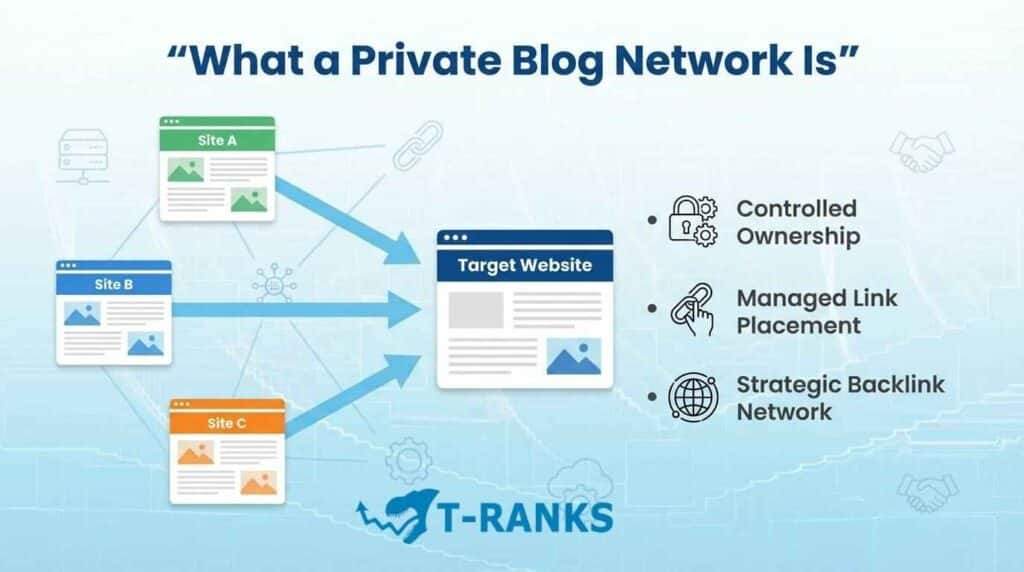
A Private Blog Network is a group of websites controlled by the same owner and used to place backlinks to a specific target site. These websites are built or acquired with the intention of influencing search rankings through managed link placement.
Unlike independent websites that link editorially based on content value, a PBN is created with a strategic purpose. The sites within the network are connected by ownership, even if they appear separate publicly.
The defining feature of a PBN is controlled link placement. The owner determines where links appear, which pages they point to, and how they are structured. This level of control is why some SEO practitioners use PBNs, but it also means the approach carries risk under search engine guidelines.
Why PBNs Are Still Used in 2026
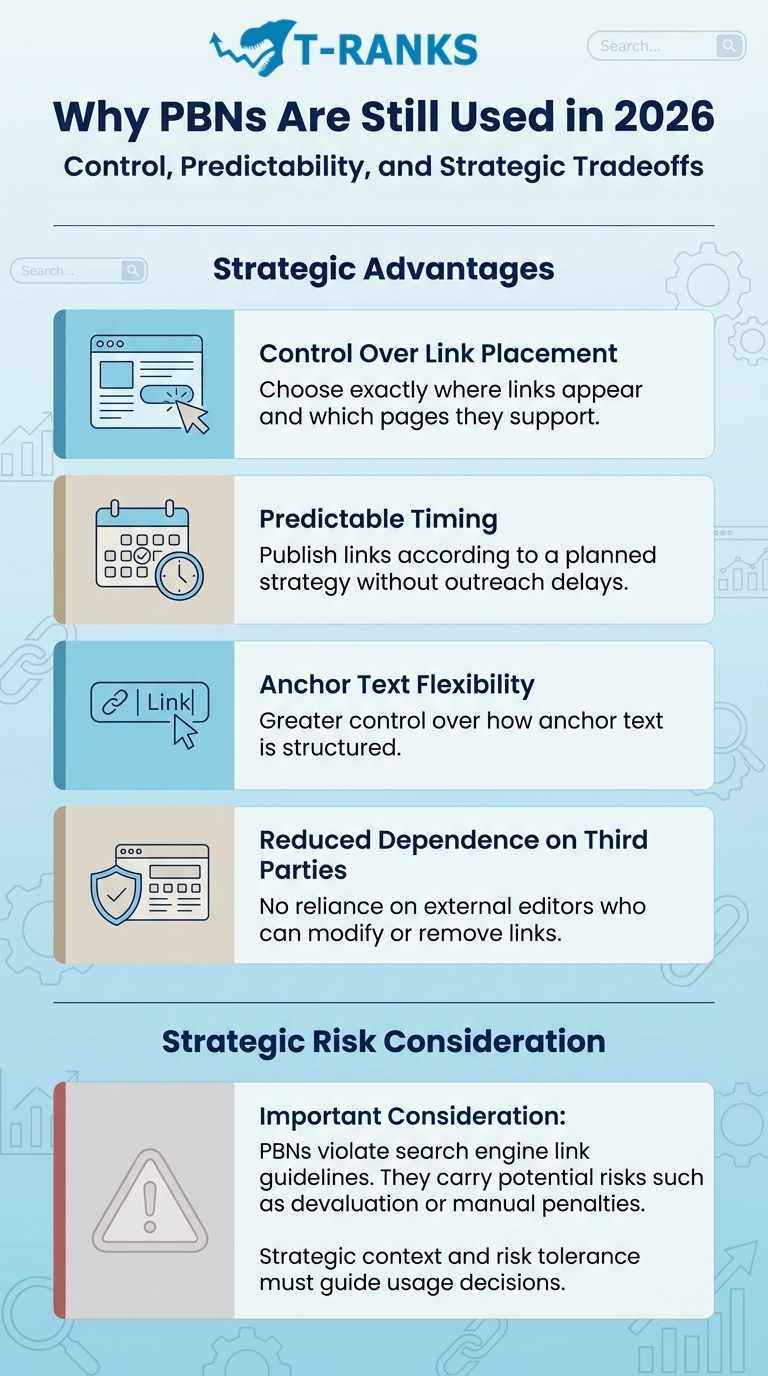
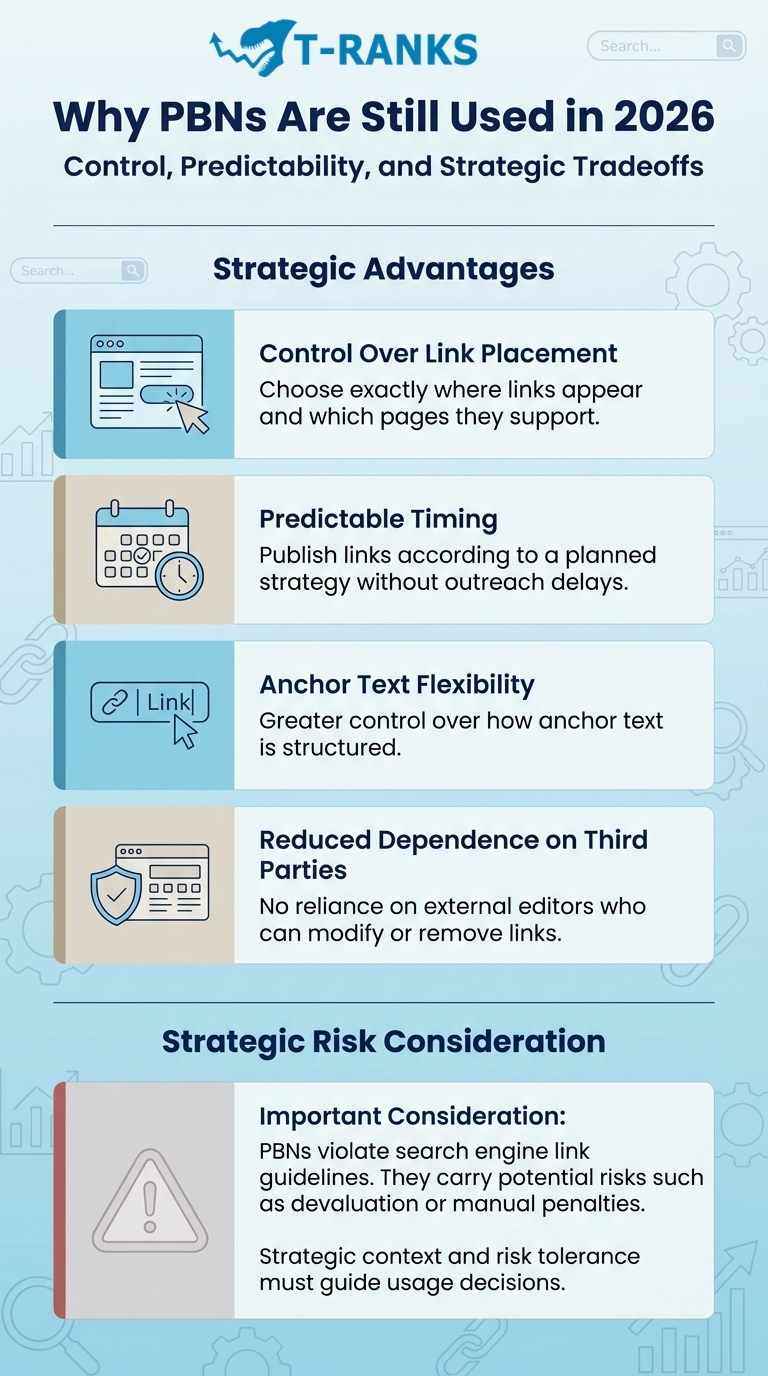
Some SEO professionals and agencies continue to use PBNs because they provide a level of control that outreach-based link building cannot always guarantee. While the risks are well known, the predictability of managed link placement remains a deciding factor in certain competitive environments.
Control Over Link Placement
PBNs allow the site owner to decide exactly where a link appears and which page it points to. In contrast, guest posts and editorial links depend on third-party approval, which can limit placement options or change over time.
Predictable Timing
Outreach-based links can take weeks or months to secure. With a controlled network, links can be published according to a planned schedule. For some SEO campaigns, especially in competitive niches, timing can influence momentum.
Anchor Text Flexibility
Editorial links often restrict anchor text to maintain natural language. A PBN allows greater flexibility in how anchor text is structured. This flexibility is one reason some practitioners prefer managed networks in tightly contested keyword spaces.
Reduced Dependence on Third Parties
Outreach links can be edited, removed, or updated without notice. A PBN reduces that uncertainty because the network owner manages the sites directly. This does not eliminate risk, but it removes external dependency.
Acknowledging the Risk
Despite these advantages, PBNs violate Google’s link guidelines because they are designed to influence rankings artificially. This makes them unsuitable for many businesses, especially brands that prioritize long-term stability over short-term control. Any decision to use a PBN must weigh potential gains against possible devaluation or penalties.
How a Modern PBN Is Structured

Modern PBNs are built as structured systems rather than as isolated link placements. Instead of focusing only on backlinks, the network is designed layer by layer so that each site appears independent and purposeful.
At a high level, a modern PBN is built through five connected stages: selecting suitable domains, rebuilding them into real websites, publishing relevant content, placing links carefully, and maintaining the sites over time.
Domains With Real History and Relevance
The process begins with the domain. Modern PBNs rely on domains that previously had a clear topic and natural backlinks. A domain with clean history and topical relevance provides a stronger foundation than one selected only for high metrics.
Rebuilt Websites That Match Their Original Purpose
Once acquired, the domain is rebuilt as a functioning website. This includes creating proper navigation, structured pages, and a clear theme that reflects its original topic. The goal is to restore continuity, not simply publish random posts.
Content That Supports Topical Relevance
After rebuilding the structure, content is added to support the site’s theme. The articles should align with the domain’s historical focus so that outbound links appear natural within context.
Controlled and Intentional Link Placement
Links are introduced gradually and placed within relevant content. Rather than adding links aggressively, modern networks focus on moderation and context. This reduces obvious patterns and helps the site behave like a normal publication.
Ongoing Maintenance and Monitoring
Building the network does not end after links are placed. Sites require updates, technical checks, and content maintenance to remain active. Neglected sites can lose visibility and stop passing meaningful value.
A modern PBN works best when all these layers support each other. If the domain is weak, the structure is thin, or maintenance is ignored, the entire system becomes unstable. When built carefully, the network functions more like a group of independent websites than a collection of link pages.
Domain Selection, What Actually Matters
Domain selection is one of the most critical steps in building a PBN because the entire site depends on the domain’s past authority. Most PBN sites are built on expired domains, so their previous history directly affects how stable and effective the rebuilt site will be.
A strong foundation reduces risk. A weak foundation makes the entire structure unstable.
Historical Relevance and Topic Continuity
The first priority is understanding what the domain used to represent. A domain that previously focused on a clear niche and published consistent content provides stronger continuity than one that changed topics repeatedly.
If the historical theme aligns with the content you plan to rebuild, the transition appears more natural. When domains have a mixed or unrelated past, their signals become less predictable. Consistency in topic history generally supports more stable performance.
Backlink Profile Quality and Clean Usage History
Metrics like DR or referring domains can provide surface-level insight, but they do not tell the full story. A domain may show high authority scores while carrying low-quality links, unnatural patterns, or excessive outbound linking from its previous life.
Backlink relevance, source credibility, and overall link balance matter more than raw numbers. It is also important to confirm that the domain was not previously used for spam, aggressive link schemes, or unrelated commercial content. Even strong metrics cannot fully compensate for a problematic history.
Domain selection sets the direction for everything that follows. When the domain is clean, relevant, and historically consistent, rebuilding becomes more stable. When the domain is weak, no amount of content or structure can completely correct it.
Rebuilding a Domain Into a Real Website

Rebuilding a PBN site means restoring an expired domain into a functioning website, not simply publishing content and inserting links. Search engines evaluate websites at a structural level, so the way a site is rebuilt influences how credible it appears.
A rebuilt site begins with clear organization. This includes logical navigation, a defined page hierarchy, and essential pages such as About or contact information. These elements help the site resemble a normal, independent publication rather than a temporary asset created only for linking.
Internal structure reinforces that credibility. Content should connect through relevant internal links and follow a consistent theme. When articles are random or disconnected, the site appears fragmented. When content supports a clear topic, the site behaves more like a legitimate resource.
Publishing patterns also matter. A site that shows gradual development and thematic consistency is more stable than one that appears suddenly with minimal structure. Rebuilding is not about visual design alone. It is about restoring continuity so the domain’s past and present align naturally.
The purpose of rebuilding is stability. When structure, theme, and internal organization are aligned, outbound links exist within a broader context. When structure is thin or artificial, the entire network becomes easier to devalue.
How Links Are Placed Inside a PBN
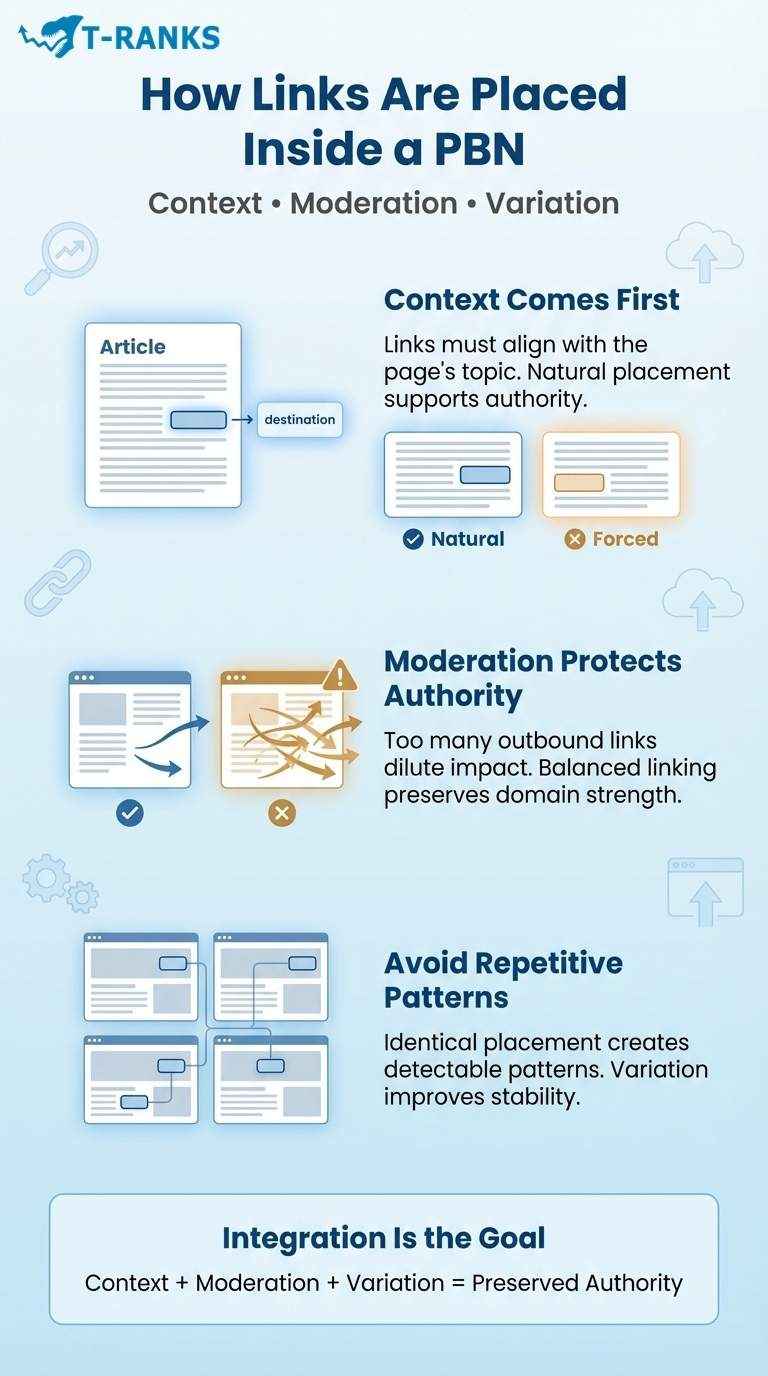
The purpose of a PBN is to place links that pass authority. However, even a strong domain can lose impact if links are added carelessly. Placement must support the site’s structure rather than weaken it. When links are introduced thoughtfully, the domain’s authority is preserved. When they are inserted without planning, the value of the domain can decline.
Context Comes First
Links are usually placed inside relevant articles that match the site’s theme. The content surrounding the link should naturally relate to the page being referenced. When the topic aligns, the link appears as part of the discussion rather than an isolated addition.
For beginners, the simplest rule is this: if the article would make sense without the link, and the link genuinely supports the topic, the placement is stronger. If the link feels forced or unrelated, it reduces credibility.
Strong domains pass authority more reliably when links exist within meaningful and logically connected content. Context gives the link support.
Moderation Protects Authority
Adding too many outbound links can dilute a domain’s strength. When a site links out aggressively or frequently to different targets, it begins to resemble a link directory rather than a focused website.
Each outbound link distributes some of the domain’s authority. When placement is excessive, the impact per link decreases. A balanced approach helps preserve the authority of the domain.
In simple terms, careful placement protects value. Overuse weakens it.
Avoiding Repetitive Patterns
Repetition is one of the most common mistakes in PBN link placement. When links appear in identical positions across multiple sites or follow the same structure repeatedly, patterns become obvious.
Natural websites vary in how they reference other pages. Some links appear within paragraphs, others within supporting sections, and some in resource style mentions. This natural variation makes the site feel authentic.
When every placement follows a rigid formula, the structure looks artificial. Allowing variation while maintaining relevance helps the network remain stable.
The goal of link placement is integration. Links should exist within a broader content environment, not stand out as the main purpose of the page. When context, moderation, and variation align, the authority of the domain is preserved. When placement is careless, even a strong domain can lose much of its value.
Maintenance, The Part Most People Ignore
Building a PBN does not end after links are placed. Maintenance is part of the building process itself. A network that is not maintained gradually loses stability, visibility, and impact over time.
Search engines evaluate websites continuously. When a site becomes inactive, outdated, or technically neglected, its crawl frequency and index stability can decline. Over time, this reduces the authority that supports outbound links.
Keeping Content Updated and Relevant
Content should not remain static for long periods without review. Updating articles, refining outdated information, and occasionally publishing new content help the site appear active and maintained.
Topical consistency also matters. When new content aligns with the site’s original theme, it reinforces relevance. Sudden shifts in subject or long periods of inactivity can weaken coherence.
Consistent publishing patterns support stability. A site that shows gradual development appears more natural than one that becomes active only during link placement and then stops. Maintenance helps sustain long-term trust rather than short bursts of activity.
Monitoring Technical Health
Technical health directly affects site credibility. Broken links, missing images, slow page speed, or indexing issues can reduce how search engines evaluate the site.
If pages are not crawled properly or experience persistent technical problems, the site’s visibility can decline. Even strong domains can lose effectiveness when technical issues accumulate.
Routine monitoring ensures the site continues functioning like a normal publication. Small technical fixes performed regularly can prevent larger structural problems later.
Preserving Structural Integrity
Internal links, navigation, and page hierarchy should remain organized over time. When pages are added without structure or older content is removed carelessly, the site loses clarity.
A stable internal structure reinforces topical relevance and helps search engines understand the site’s purpose. When structure becomes fragmented, overall trust can weaken.
Maintenance protects everything built earlier. Domain selection creates the foundation. Rebuilding restores structure. Link placement introduces authority flow. Maintenance preserves that value over time.
A maintained network remains consistent and stable. A neglected network slowly loses impact, even if it started with a strong domain.
Risks and Limitations of PBNs

PBNs can produce results, but they also carry structural and strategic risks. These risks do not always appear immediately. In many cases, impact fades gradually rather than failing suddenly. Understanding these limitations is essential before treating PBNs as a long-term solution.
Algorithmic Devaluation
The most common outcome is quiet devaluation. Search engines may choose not to count certain links if patterns appear artificial or repetitive. When this happens, rankings may stop improving even though the links remain live.
Devaluation does not usually trigger a warning. The links simply lose influence. This can make it difficult to diagnose whether stagnation is due to link quality, competition, or algorithmic filtering.
Ranking Stagnation and Diminishing Returns
Some sites respond initially to PBN links but later reach a plateau. Additional links may produce smaller gains over time. This often occurs when link placement patterns become predictable or when the overall backlink profile lacks diversity.
Authority growth is rarely linear. Even well-structured networks can experience diminishing impact if not supported by broader SEO signals.
Manual Actions
In more serious cases, manual actions can occur when link schemes are clearly identified. While not frequent, manual penalties can reduce visibility significantly until corrective action is taken.
Manual actions are more disruptive than algorithmic devaluation because they require formal resolution. Recovery may be possible, but it is not guaranteed.
Over-Reliance on a Single Link Source
Depending entirely on PBN links creates structural imbalance. Search engines evaluate the overall backlink profile, not just one type of link.
A natural backlink profile typically includes multiple link sources. When one method dominates, it increases vulnerability. PBNs used in isolation are more likely to experience instability than those used within a diversified strategy.
Strategic and Brand Considerations
PBNs violate search engine guidelines because they are designed to influence rankings artificially. This makes them unsuitable for certain business models, especially brands that prioritize long-term compliance and reputation.
Some industries operate under higher scrutiny, where risk tolerance must be lower. For these businesses, even moderate risk may outweigh potential short-term gains.
PBNs are not inherently guaranteed to fail, but they are not risk-free. Their effectiveness depends on structure, moderation, and strategic context. Any decision to use them should consider both potential benefits and long-term consequences.
How T-RANKS Approaches PBN Building
T-RANKS treats PBN building as a controlled asset strategy, not a shortcut. The objective is long-term stability, measured integration, and disciplined execution. Each decision is evaluated not only for potential impact but also for structural sustainability.
Quality Over Volume
The priority is not the number of links deployed, but the integrity of the underlying assets. Each domain is evaluated for historical consistency, backlink quality, and structural reliability before being considered part of a network.
Volume without stability increases risk. T-RANKS focuses on fewer, stronger assets rather than scaling aggressively. Preserving domain credibility is considered more important than rapid link expansion.
Relevance Before Metrics
Authority metrics are reviewed, but they are not treated as the final decision factor. Topical alignment, backlink context, and clean historical usage are stronger indicators of long-term value than surface-level scores.
A domain that aligns naturally with its content theme provides a more stable foundation. Relevance supports continuity, and continuity supports authority preservation over time.
Rebuilding Before Deployment
No domain is used in its raw state. Each site is rebuilt into a structured publication with clear navigation, internal linking, and thematic continuity. This rebuilding phase restores purpose and coherence to the domain.
Proper structure ensures that outbound links exist within a meaningful content environment. Thin or artificial setups are avoided because they weaken long-term stability.
Conservative Link Integration
Links are introduced selectively and integrated within a diversified backlink profile. PBN assets are not treated as the sole growth mechanism but as one component of a broader SEO framework.
Careful integration reduces structural imbalance. The objective is to support authority without over-reliance on a single method.
Long-Term Stability Over Short-Term Movement
The goal is sustainability, not temporary ranking spikes. Ongoing monitoring, content upkeep, and structural consistency help preserve value across the network.
Every asset is evaluated continuously for performance and risk alignment. If stability declines, adjustments are made conservatively rather than aggressively expanding further.
T-RANKS approaches PBN building with awareness of its limitations. When used, it is deployed deliberately, cautiously, and as part of a balanced SEO strategy designed for long-term performance.
Where PBNs Fit Within a Broader SEO Strategy

PBNs are best viewed as a controlled supplement within a diversified SEO strategy. They are not a complete solution on their own and should be evaluated in the context of a site’s overall authority profile.
Search engines assess the full backlink ecosystem of a website. A profile that relies heavily on a single source of links can appear imbalanced. For this reason, PBNs are generally more stable when used alongside editorial links, strong content development, and internal optimization.
They may be considered in competitive environments where controlled link placement is required. However, they are not suitable for every business model. Brands operating in highly regulated or reputation-sensitive industries often require lower-risk approaches.
Risk tolerance and site maturity also matter. Established sites with diversified signals may absorb controlled experimentation more safely than new or fragile domains. Strategic context should guide usage, not urgency.
When integrated carefully into a balanced framework, PBNs can function as a supporting asset. When used in isolation, they increase structural risk and long-term instability.
Conclusion
Private Blog Networks are structured systems, not simple link placements. Their effectiveness depends on disciplined domain selection, careful rebuilding, contextual link integration, and ongoing maintenance. When these elements align, the network functions with greater stability. When they are neglected, authority weakens regardless of domain strength.
Understanding how PBNs are built clarifies both their value and their limits. They offer control, but that control carries responsibility. They can support growth, but they cannot replace broader strategic foundations.
In 2026, the distinction is not whether PBNs exist, but how they are constructed and managed. Stability matters more than speed. Relevance matters more than metrics. Structure matters more than volume.
FAQs: Private Blog Networks and How They Are Built
What is a Private Blog Network in SEO?
A Private Blog Network is a group of websites controlled by a single owner and used to place backlinks to a target site. These sites are typically created or acquired to influence search rankings through managed link placement.
How are Private Blog Networks built?
Private Blog Networks are built by acquiring domains with prior history, rebuilding them as structured websites, publishing relevant content, and placing controlled backlinks. Ongoing maintenance is required to keep the sites functional and stable.
Are PBNs still used in 2026?
Yes, PBNs are still used in 2026, primarily by experienced SEO practitioners. They are chosen in certain competitive environments where link control is considered important.
Do PBNs violate Google’s guidelines?
Yes, PBNs violate Google’s link guidelines because they are designed to influence rankings through controlled link networks. This means they involve inherent risk.
What makes a high quality PBN different from a spam network?
A higher-quality PBN typically uses cleaner domains, structured rebuilding, and restrained link placement. Spam networks rely on thin content, reused domains, and excessive linking patterns that are more likely to be ignored or devalued.
Does domain history matter more than DR or DA for PBNs?
Domain history is generally more important than DR or DA alone. A domain’s previous topic, backlink relevance, and usage history provide deeper insight than surface-level metrics.
Why is rebuilding a PBN site important?
Rebuilding a PBN site restores structure and continuity. Sites with proper organization and thematic alignment are generally more stable than thin or incomplete setups.
How are links placed inside a PBN?
Links inside a PBN are placed within relevant content and introduced with moderation. Excessive repetition or aggressive linking patterns can reduce effectiveness over time.
Are homepage links from PBNs more powerful?
Homepage links can carry strong authority because homepages often accumulate more inbound signals. However, over-reliance on homepage links may create structural imbalance.
Can Google detect PBNs?
Google can detect patterns associated with artificial link networks. Poorly structured or aggressive networks are more likely to be devalued or penalized.
What happens if Google devalues PBN links?
If PBN links are devalued, they stop contributing to rankings. In many cases, the links are simply ignored rather than triggering a manual penalty.
Are PBNs safe for new websites?
PBNs are generally higher-risk strategies and may not be suitable for new or fragile websites. Foundational SEO work is often recommended before considering higher-risk link tactics.
How long do PBN links take to impact rankings?
Ranking impact varies by competition, site authority, and overall strategy. In some cases, movement may occur within weeks, but there is no guaranteed timeline.
Do PBNs require ongoing maintenance?
Yes, PBNs require regular maintenance. Inactive sites, technical issues, or outdated content can reduce stability and link value over time.
Is buying PBN links from public sellers risky?
Buying PBN links from public networks can increase risk because shared patterns may be easier to identify. Risk levels depend on structure and execution.