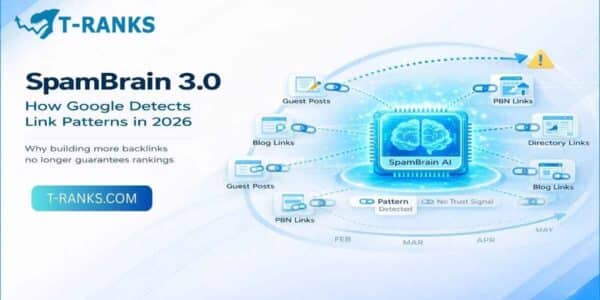
Many people build more backlinks and expect their rankings to improve, but nothing happens.
There is no penalty, no warning, and no clear reason why growth suddenly stops.
This happens because Google no longer judges backlinks one by one.
Today, Google looks at link patterns, which means how links behave together over time.
SpamBrain is Google’s AI system that helps detect spam.
The term SpamBrain 3.0 is used to explain how this system works today, where repeated link behavior matters more than individual links.
In this article, you will learn what SpamBrain link patterns are, how Google evaluates them in 2026, and why building more links alone is no longer enough.
By the end, you will understand why rankings stall and what actually builds trust in modern SEO.
What Is SpamBrain 3.0 and How It Detects Links
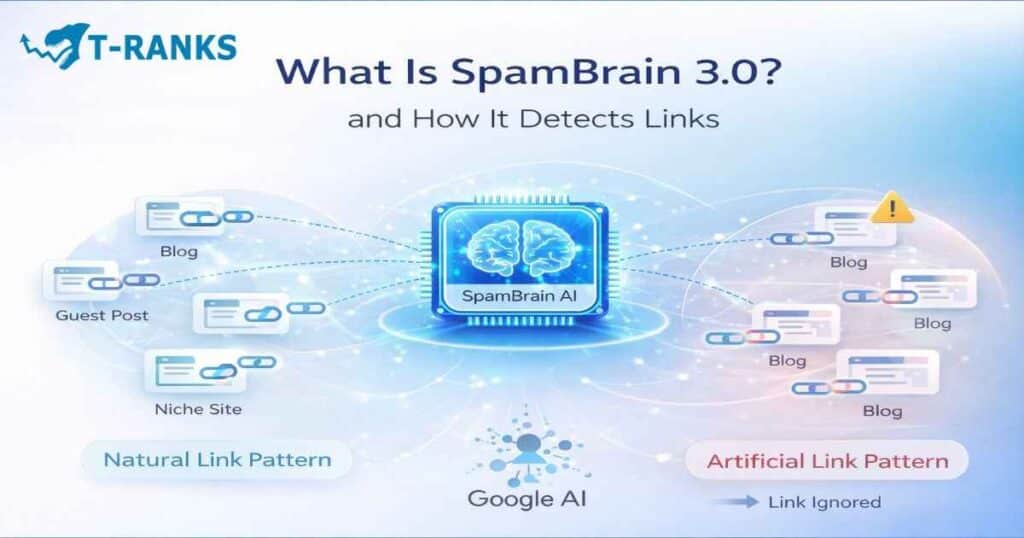
SpamBrain is Google’s AI-based spam prevention system used to identify and neutralize spam at scale.
It evaluates link behavior patterns across websites instead of judging individual backlinks in isolation.
The term SpamBrain 3.0 is not an official Google version name.
It is a practical label used to describe how SpamBrain currently operates in 2025 and 2026, where detection is driven by machine learning and behavioral analysis rather than fixed rules.
In its current form, SpamBrain focuses on intent.
It analyzes whether links appear to be genuine editorial recommendations made independently, or whether they show signs of coordination and manipulation designed to influence rankings.
When link behavior looks artificial, Google usually does not issue a penalty.
Instead, the ranking value of those links is quietly ignored, which can cause rankings to stall or decline even when backlinks continue to exist.
This shift explains why older backlink strategies based on link counts or isolated placements no longer produce predictable results in modern search.
What Google Means by “Link Patterns” in 2026
Link patterns explain how backlinks behave over time.
Link patterns describe how backlinks appear, repeat, and connect across a website over time.
In 2026, Google focuses on these patterns instead of judging individual backlinks, because repeated behavior shows intent more clearly than a single link ever can.
A single backlink only shows that a link exists.
A pattern shows why those links exist.
Why Google no longer relies on individual backlinks
Individual backlinks are easy to manipulate.
They can be bought, exchanged, automated, or placed through systems that do not reflect real editorial choice.
Because of this, Google no longer treats one link as a reliable trust signal.
Instead, it looks at how many links behave together, how they grow, and how they relate to each other.
Repeated behavior across many links is much harder to fake than a single placement.
How link patterns are formed
Link patterns form when multiple backlinks share similar characteristics, such as:
- When the links appear
- What anchor text they use
- Where they are placed on the page
- Which types of websites they come from
- How closely the topics match
When many links behave in similar ways, Google can understand the reason behind the links, not just their presence.
What natural link patterns look like
Natural link patterns grow unevenly and organically.
Links:
- Come from different, independent websites
- Use varied wording instead of repeated keywords
- Appear inside relevant, helpful content
This type of repetition reflects real editorial interest, where different site owners choose to link on their own.
What unnatural link patterns look like
Unnatural link patterns are usually planned and predictable.
They often show:
- Repeated keyword-focused anchors
- Similar placement styles across many sites
- Sudden link spikes without a clear reason
- Links from unrelated or low-relevance topics
When these signals repeat across many backlinks, manipulation becomes easy to identify.
Why repetition matters more than single links
Repetition reveals intent.
When the same link behaviors appear again and again across a site’s backlink profile, Google can confidently decide whether authority is earned or manufactured.
That is why, in 2026, link patterns matter far more than any single backlink.
SpamBrain Link Patterns That Trigger Risk Signals
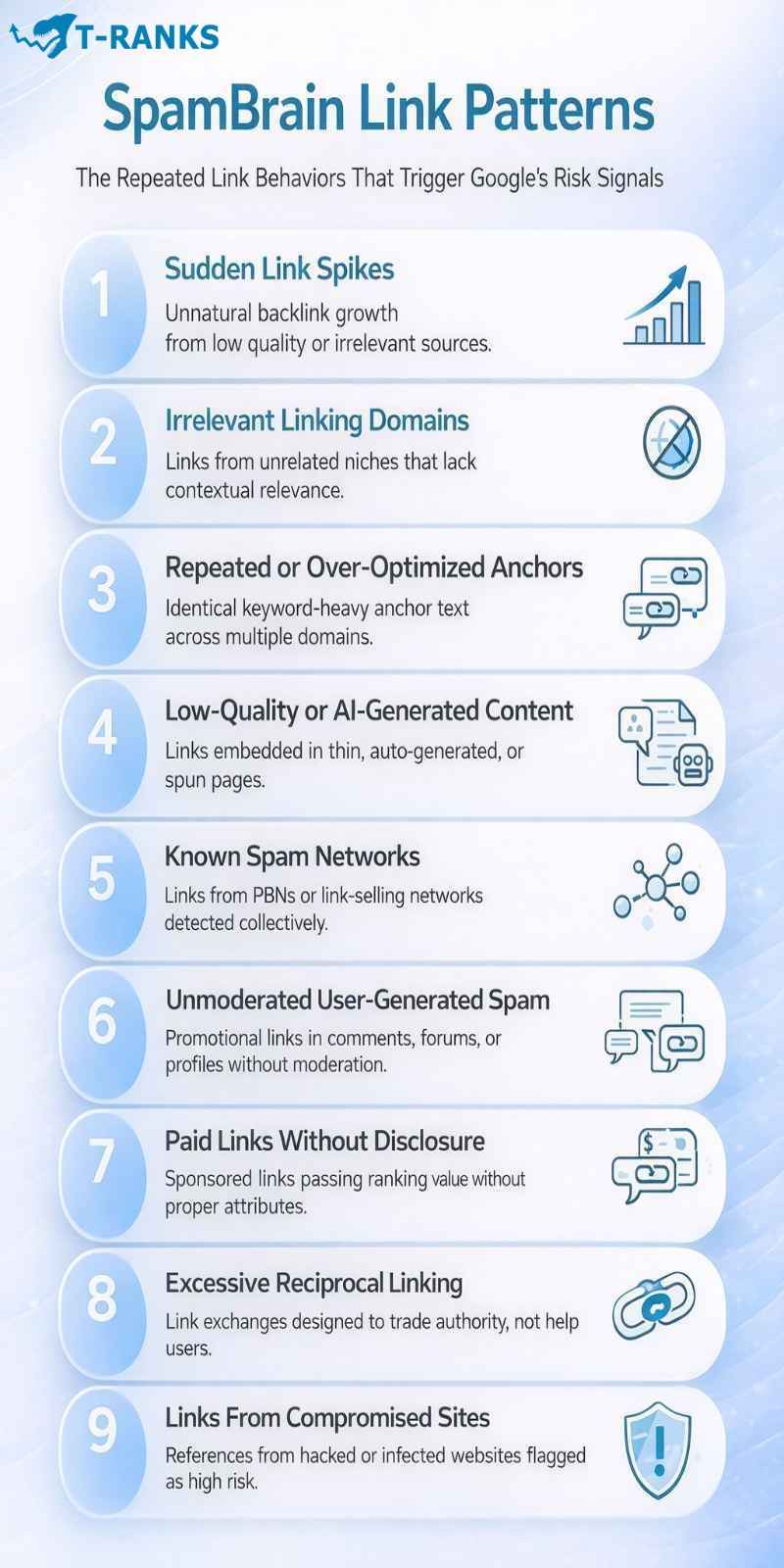
Google’s AI based system, SpamBrain, is designed to detect and neutralize patterns of artificial or manipulative links that violate Google’s quality guidelines.
Instead of evaluating isolated URLs, Google focuses on repeated link behaviors that indicate attempts to inflate rankings rather than earn genuine editorial endorsements.
Key link patterns that trigger SpamBrain risk signals include:
Sudden, artificial link spikes
An unusually rapid increase in backlinks, especially from low quality or irrelevant sources, often signals automated campaigns or paid link schemes rather than natural growth.
Irrelevant linking domains
Links from websites in completely unrelated niches lack contextual relevance and suggest promotion instead of legitimate recommendation.
Over optimized or identical anchor text
Repeated use of the same keyword stuffed anchor text across many domains, instead of varied natural anchors like brand names or URLs, indicates coordinated manipulation.
Low quality or AI generated content
Links placed within thin, auto generated, spun, or low value content environments are treated as untrustworthy and are commonly neutralized.
Links from known spam networks
SpamBrain can identify entire networks of sites created mainly for link selling or exchanging, such as Private Blog Networks, and discount their links collectively.
Unmoderated user generated spam
Large numbers of promotional links appearing in unmoderated comments, forums, or profiles often reflect automated spam behavior.
Paid links without proper disclosure
Buying or selling links that pass ranking value without using appropriate attributes violates Google’s policies and triggers pattern based detection.
Mutual or excessive reciprocal linking
Link exchanges designed mainly to trade authority rather than help users signal artificial coordination.
Links from compromised websites
References originating from hacked or infected sites are closely monitored and treated as high risk signals.
By identifying these repeated patterns, SpamBrain removes the ranking benefit of low quality links instead of rewarding them. This approach prevents artificial authority from influencing results and helps keep search rankings reliable. Website owners should align with Google Search Essentials to reduce risk and maintain long term trust.
Why Individual Links No Longer Matter
Individual links no longer matter as standalone ranking signals because Google no longer evaluates backlinks in isolation.
Today, rankings are influenced by how links behave together through aggregation, clustering, and time based evaluation, not by the strength of a single backlink.
Google moved away from the old “one link equals one vote” model as link buying, automation, and network based manipulation became widespread.
Aggregation replaces single link impact
Google now evaluates backlinks in aggregate.
All links pointing to a site are assessed together to understand overall behavior.
This means:
- One strong link cannot outweigh weak or artificial patterns
- Consistency across many links matters more than standout placements
- Authority is judged at the site level, not by individual URLs
A site with steady, natural link growth will usually outperform a site relying on a few powerful links.
Clustering exposes manipulation
Modern spam systems group links into clusters based on shared characteristics such as anchor text, timing, placement, or source type.
For example:
- One guest post link may appear natural
- Many similar guest posts from related sites form a clear pattern
When a cluster looks coordinated, Google neutralizes the entire group, making the quality of any single link irrelevant.
Time based evaluation reveals intent
Google also evaluates links over time to understand intent.
Natural links:
- Appear gradually
- Align with real visibility events
- Vary in pace
Artificial links:
- Appear in sudden bursts
- Follow fixed schedules
- Stop abruptly after campaigns
Timing patterns often reveal manipulation even when individual links look clean.
Why old SEO assumptions fail
Older SEO advice assumed one powerful backlink could change rankings.
That assumption no longer applies.
Today:
- Suspicious links are ignored before passing value
- Disavowing individual links rarely restores rankings
- Growth comes from consistent, trusted link behavior over time
Core takeaway
One backlink is a weak signal.
Repeated, consistent link behavior creates trust.
That is why individual backlinks rarely influence rankings on their own in modern, AI driven search systems.
How SpamBrain Evaluates Context, Not Just Links
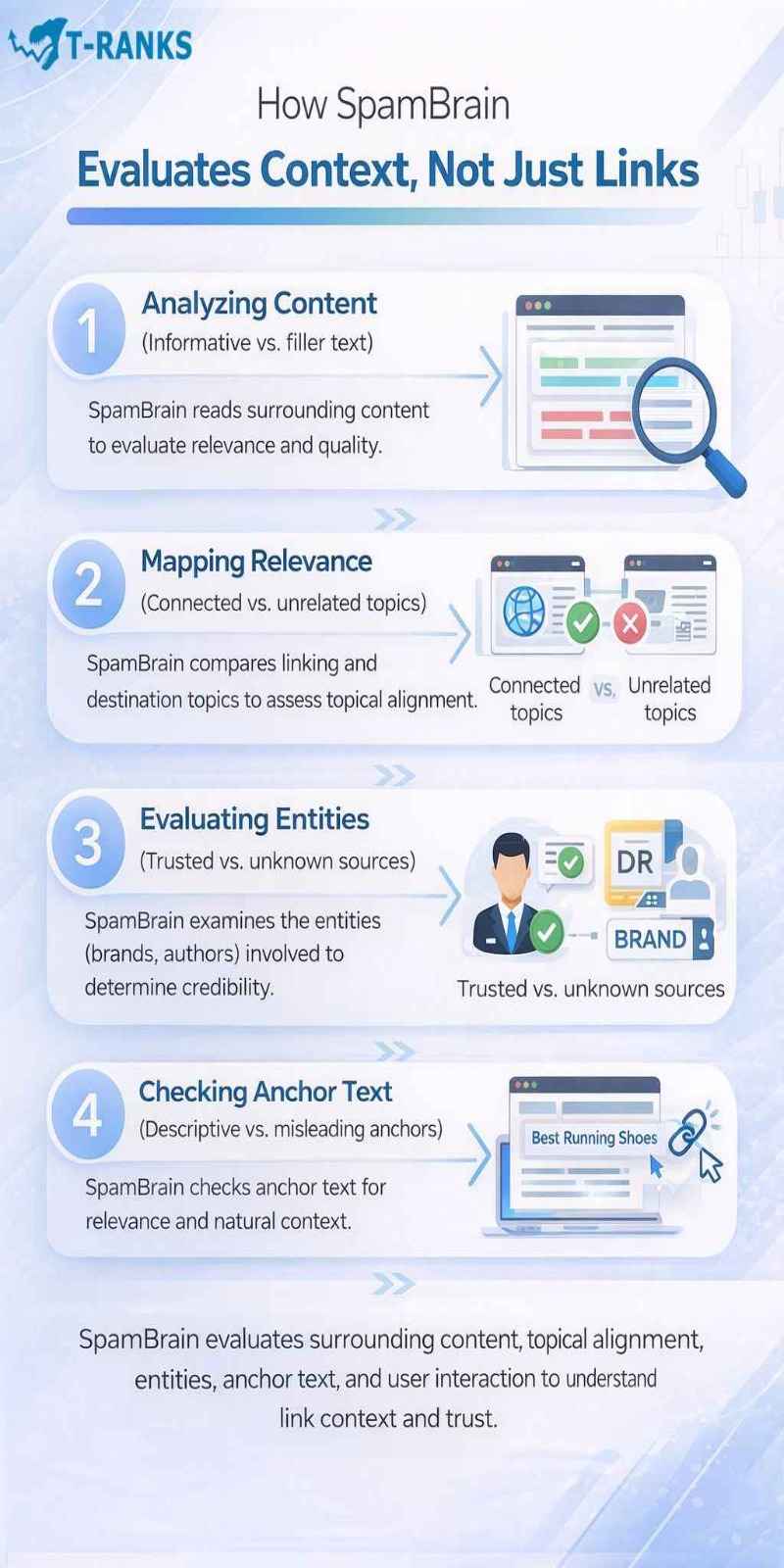
SpamBrain evaluates context by analyzing surrounding content, topical relevance, and entity relationships rather than treating links as standalone signals.
In 2026, link trust depends on whether a link makes sense within its content and ecosystem, not just where it points.
Google uses context to understand intent and usefulness before assigning any value to a link.
Step 1: Analyzing surrounding content
SpamBrain reads the text around a link to see if it adds real value.
Links placed within informative, original content look editorial. Links surrounded by filler, promotional, or thin text weaken trust and are often neutralized.
Step 2: Mapping topical relevance
SpamBrain compares the topic of the linking page with the topic of the destination page.
When topics closely align, trust increases. When topics are unrelated, even links from strong domains lose value.
Step 3: Evaluating entities and expertise
SpamBrain looks at entities involved, such as brands, authors, and organizations.
Links between recognized, relevant entities reinforce authority. Anonymous or unrelated entities reduce credibility, especially without supporting mentions elsewhere.
Step 4: Checking anchor text in context
Anchor text is interpreted within the sentence and page intent.
Descriptive or branded anchors that fit naturally support trust. Forced or misleading anchors weaken the link, even if the page looks authoritative.
Step 5: Validating user behavior signals
SpamBrain observes how users interact with links.
Links that are clicked, read, and engaged with strengthen trust. Links that attract no engagement suggest manipulation and lose value.
Step 6: Detecting scaled content abuse
SpamBrain evaluates whether links appear inside mass produced or low effort content.
If a site shows signs of scaled AI content abuse, its outbound links are often ignored entirely, regardless of individual link quality.
Why context decides link value
A link without context is just a reference.
A link supported by relevant content, aligned topics, trusted entities, and real user engagement becomes a reliable signal.
That is why SpamBrain evaluates context, not just links, when deciding which backlinks deserve ranking credit.
Safe vs Unsafe Link Patterns in 2026
In 2026, the difference between safe and unsafe link patterns is defined by behavior and intent, not by how strong or convincing a link appears on its own.
Modern AI systems evaluate whether links emerge from genuine relevance and trust or from coordination and manipulation.
Instead of judging isolated links, Google analyzes how links behave collectively over time. This makes patterns far more important than individual placements.
How Safe and Unsafe Link Patterns Differ
| Aspect | Safe Link Patterns | Unsafe Link Patterns |
| Primary intent | To reference or recommend useful content | To manipulate rankings or mislead systems |
| Link growth | Gradual or connected to real events | Sudden spikes or repeated campaigns |
| Source quality | Established brands, experts, trusted sites | Low-quality sites, link farms, fake domains |
| Topical relevance | Strong alignment between content topics | Unrelated or mismatched topics |
| Anchor usage | Natural mix of branded, URL, and descriptive text | Repetitive or keyword-stuffed anchors |
| Placement | Editorially integrated within content | Footers, sidebars, spam comments, or messages |
| Transparency | Clear ownership and purpose | Anonymous, misleading, or hidden intent |
| User interaction | Real clicks and meaningful engagement | Little or no genuine interaction |
| Distribution | Independent, organic spread across sites | Coordinated or automated repetition |
| System response | Trust reinforced over time | Link value neutralized or ignored |
Why This Difference Matters
Safe link patterns reflect independent discovery, real editorial choice, and long-term trust.
They strengthen authority gradually because they align with how people naturally reference useful information.
Unsafe link patterns reflect coordination and repetition, even when individual links look legitimate.
When these behaviors repeat, AI systems can reliably identify manipulation and quietly remove ranking value.
Core takeaway
A single link rarely determines trust.
Consistent behavior does.
In 2026, search visibility depends on whether link patterns reinforce credibility over time or signal artificial intent.
How AI-Detected Link Patterns Affect Rankings
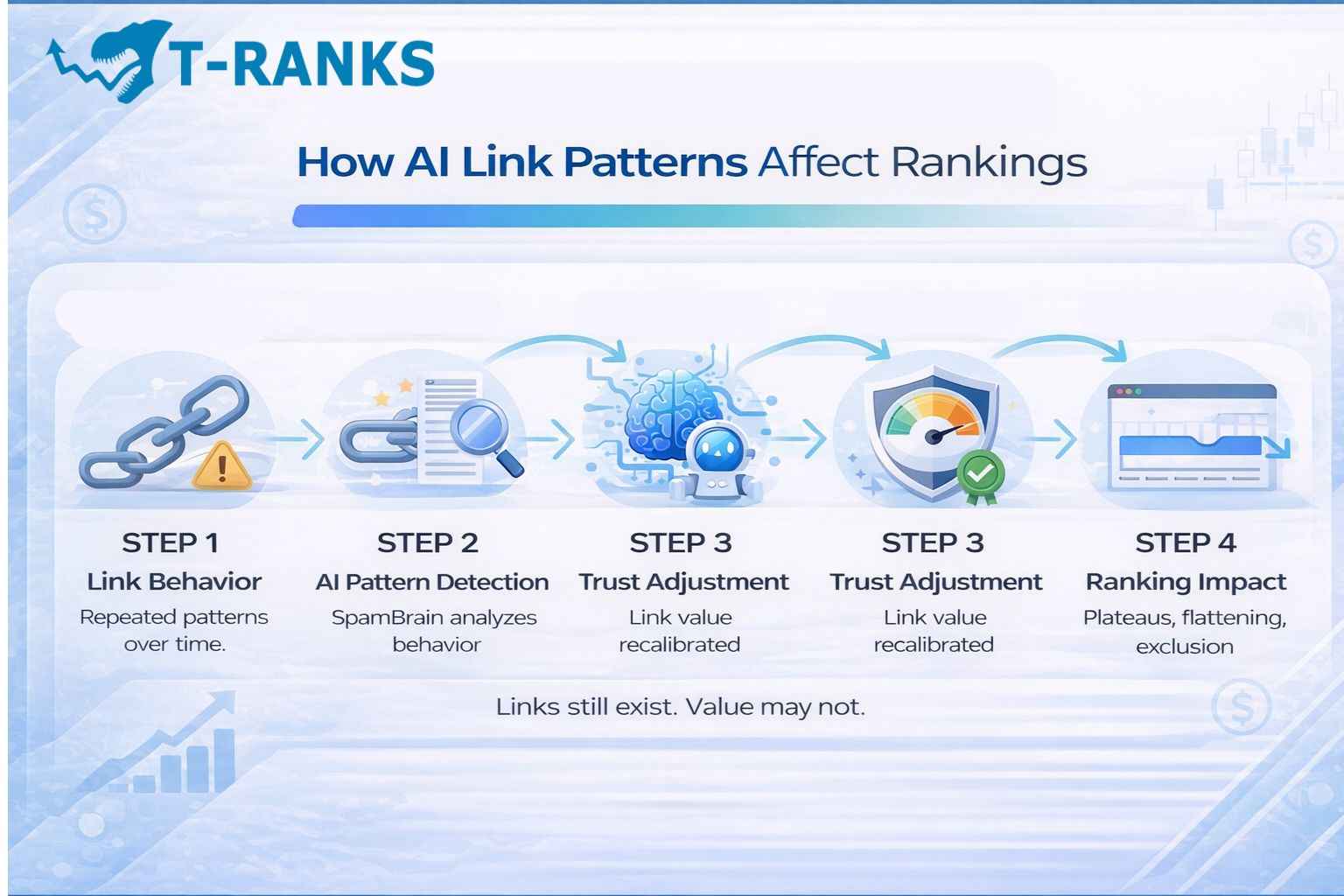
AI-detected link patterns affect rankings by adjusting trust and authority signals, not by counting backlinks or issuing visible penalties.
In 2026, Google’s AI systems evaluate how link behavior looks collectively over time, which is why rankings often stall, flatten, or decline without any warning.
This model is designed to suppress manipulation quietly while allowing genuine authority to grow naturally.
Trust is recalibrated, not punished
When AI systems detect unnatural link patterns, they usually neutralize link value instead of penalizing the site.
The links still exist, but they stop contributing to rankings. This creates silent plateaus where additional links no longer produce gains.
That is why many sites experience stagnation instead of sudden ranking drops.
Quality matters more than quantity
AI systems prioritize links from authoritative, relevant, and trusted sources.
A small number of genuine editorial links can outperform large volumes of low-quality or coordinated links.
When link patterns suggest artificial scaling, added links create little or no lift.
Context determines how links are interpreted
AI evaluates links in context using language understanding and topical analysis.
Links placed within relevant, informative content strengthen trust. Links placed in thin, unrelated, or repetitive environments lose influence.
Context helps AI systems decide whether a link exists to help users or to manipulate rankings.
Repeated behavior reveals manipulation
SpamBrain does not react to single “bad” links.
It detects repeated behaviors, such as over-optimized anchors, coordinated placements, or network-style acquisition.
When these behaviors repeat, the entire pattern is quietly discounted, often without penalties or alerts.
Link value supports E-E-A-T only when trust is confirmed
Backlinks contribute to Experience, Expertise, Authoritativeness, and Trustworthiness only when link patterns confirm credibility.
Links from low-trust environments usually do not harm rankings, but they also do not add meaningful authority.
Brand mentions strengthen ranking stability
AI systems also evaluate brand mentions without links.
Consistent mentions across reputable sources help define entities and reinforce trust, supporting healthy link patterns even when backlink growth is slow.
Impact on AI Overviews and visibility
Pages supported by clean, trusted link patterns are more likely to remain eligible for AI-generated summaries.
When link trust is neutralized, AI systems often exclude those pages first, even before traditional rankings change.
Strategic takeaway
Links still matter.
How they behave matters more.
In 2026, SEO success depends on whether link patterns reinforce trust over time. Artificial amplification no longer creates lift. It creates drag.
How to Build Links That SpamBrain Has No Reason to Question
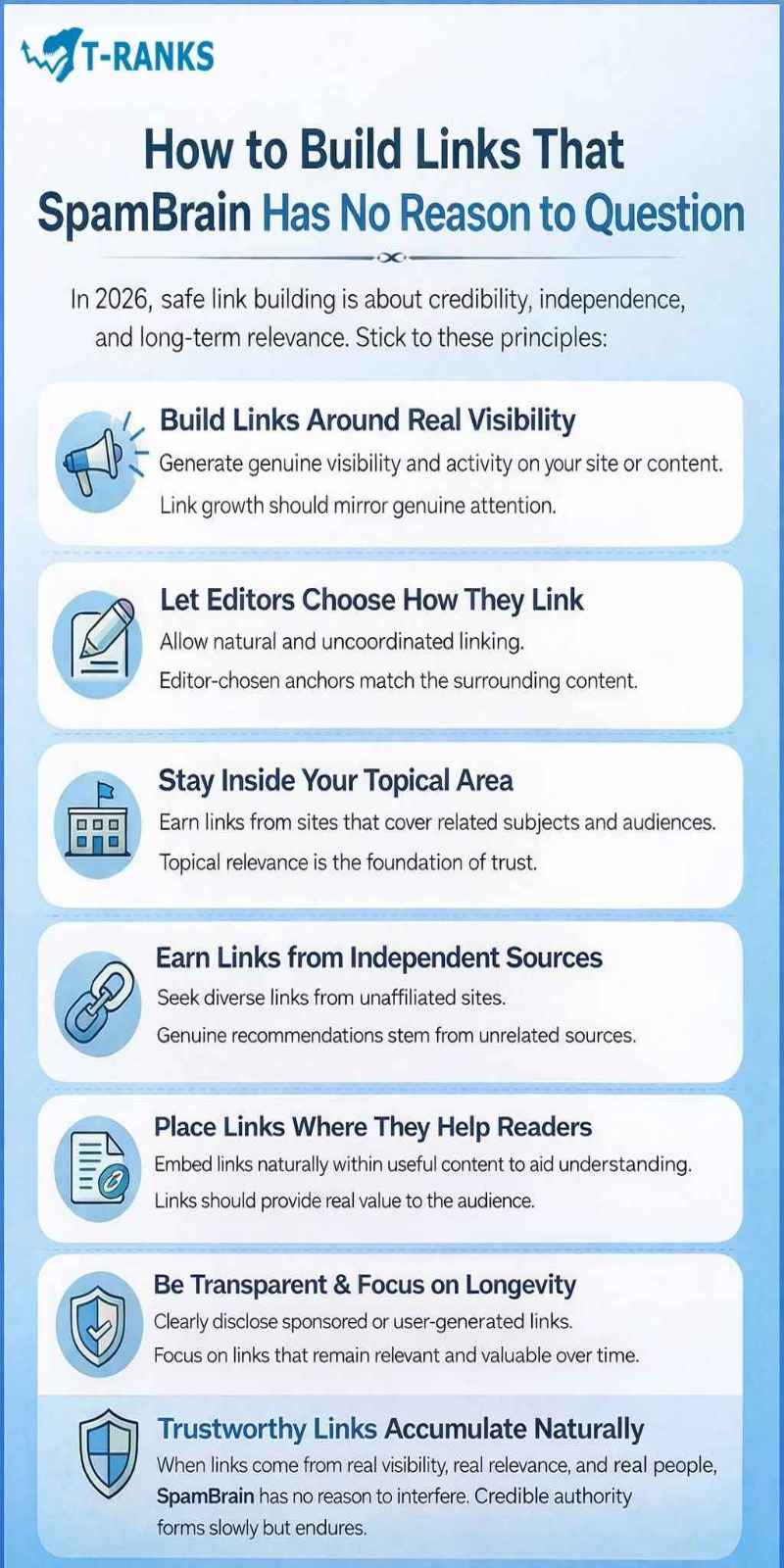
Once link patterns are evaluated at a behavioral level, the only sustainable approach is to build links in ways that align with how real recommendations happen on the web.
In 2026, safe link building is not about speed or volume. It is about credibility, independence, and long-term relevance.
The principles below describe how trusted link patterns form naturally and why SpamBrain consistently reinforces them instead of neutralizing them.
Build links around real visibility and real activity
Links tend to appear when a website becomes genuinely visible for a clear reason.
This visibility can come from publishing in-depth resources, earning media attention, launching something useful, or contributing expertise to ongoing discussions.
When interest increases naturally, links often follow and then slow down again.
This rise-and-fall pattern reflects real attention cycles and is one of the strongest signals of organic discovery.
Link growth that appears without any visible cause looks artificial.
Link growth that follows real activity looks expected and trustworthy.
Let editors choose how they link
In authentic editorial environments, writers choose their own words.
They link using brand names, site names, URLs, or natural descriptions that fit the surrounding sentence.
When anchor language varies naturally across different sites, it reflects independent judgment.
When anchor language repeats unnaturally, it signals coordination.
SpamBrain does not reward optimization.
It rewards editorial freedom.
Stay inside your topical area of authority
Links carry the most trust when they come from websites that cover related subjects and audiences.
This topical alignment helps Google understand why the link exists and whether it makes sense contextually.
When a site consistently earns links from within its subject area, authority compounds naturally.
When links arrive from unrelated topics, the signal weakens, even if the links look strong individually.
Relevance is not optional.
It is foundational to trust.
Earn links from independent and unrelated sources
Real recommendations are made independently.
They come from different people, different websites, and different publishing decisions.
Healthy link patterns show variation in tone, layout, timing, and presentation.
This diversity indicates that links were not planned or coordinated.
When many links appear to come from the same network or follow the same pattern, trust erodes.
Independence is what makes link patterns believable.
Place links where they genuinely help readers
A trustworthy link exists because it adds value to the reader.
It helps explain a concept, provide context, or support a claim.
Links that are embedded naturally inside useful content signal real intent.
Links placed only to satisfy SEO goals signal none.
SpamBrain does not evaluate links in isolation.
It evaluates whether links improve understanding or simply attempt to influence rankings.
Be transparent with sponsored and user-generated links
Transparency reduces risk and increases trust.
Sponsored links and user-added links should be clearly labeled according to their nature.
Clear disclosure aligns with both user expectations and Google’s guidelines.
Trying to disguise intent creates unnecessary ambiguity.
Honesty does not weaken authority.
It protects it.
Focus on links that remain relevant over time
Strong links continue to make sense long after they are placed.
They point to content that remains accurate, useful, and relevant.
Short-term link tactics often produce short-term signals.
Long-term relevance produces lasting authority.
SpamBrain reinforces what continues to help users.
It neutralizes what fades quickly.
What safe link building really looks like in 2026
Safe link building feels slow because it mirrors reality.
It feels unexciting because it relies on consistency rather than shortcuts.
But this is exactly why it works.
When links come from real relevance, real people, and real value, trust accumulates naturally.
And when trust accumulates naturally, SpamBrain has no reason to interfere.
That is what durable authority looks like in 2026.
How Brand Mentions and Entity Signals Strengthen Trust
Brand mentions and entity signals help Google understand who a website represents, what it is known for, and whether its links deserve trust.
In 2026, Google does not rely on backlinks alone. It looks for broader evidence that a real brand or entity is recognized independently across the web.
These signals help reduce misclassification and support more accurate evaluation of link patterns.
What brand mentions mean in modern search
A brand mention is any reference to a brand, company, product, or key person, even when no clickable link is present.
These mentions appear naturally in places like articles, discussions, reviews, and examples.
When a brand is referenced without needing a link, it signals independent recognition.
This helps Google confirm that attention exists beyond SEO-driven link placement.
How mentions and entities support link trust
SpamBrain evaluates links in context.
Brand mentions provide that context by showing that links are part of wider awareness rather than isolated actions.
When links appear alongside consistent mentions:
- Anchor text looks less engineered
- Sudden links appear more believable
- Minor anomalies carry less risk
Mentions act as supporting evidence that links reflect real interest, not coordination.
Entity recognition and long-term authority
Google increasingly organizes information around entities, such as brands, companies, people, and products.
Repeated mentions across trusted sources help Google recognize an entity, associate it with specific topics, and build confidence in ranking it for related queries.
Once an entity is established:
- Links pointing to it are easier to trust
- Topical authority becomes clearer
- Visibility is more stable across algorithm changes
This is especially important for AI-generated results. AI systems prefer citing entities that show consistent recognition and clear topical association, even when backlink profiles are modest.
Practical takeaway
Brand mentions are not built the same way as links.
They grow from visibility, expertise, participation, and credibility.
When links and mentions grow together, Google sees a complete trust picture.
That combination strengthens rankings, improves AI visibility, and reduces risk in 2026.
SpamBrain and AI Overviews
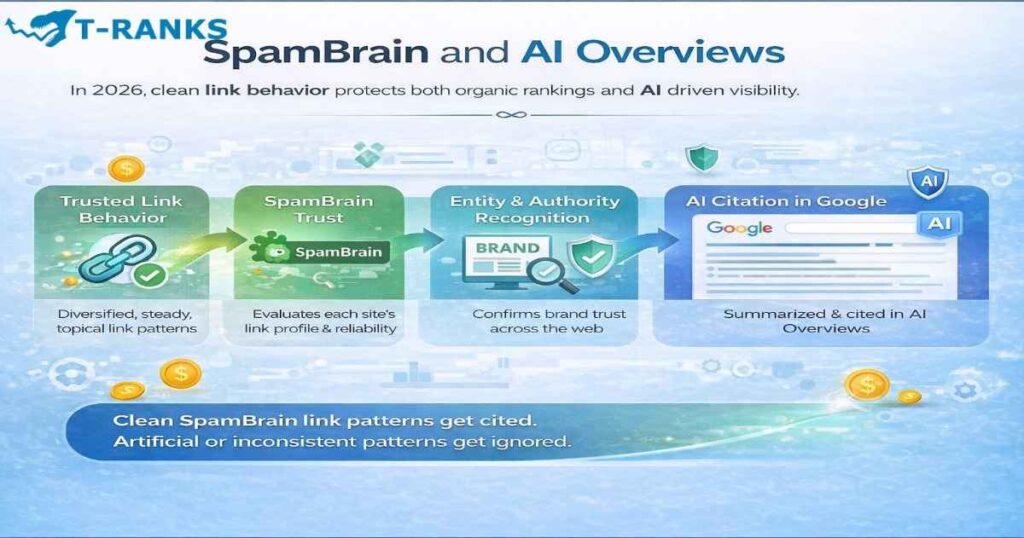
Clean SpamBrain link patterns play a decisive role in whether a page appears in AI Overviews.
In 2026, AI systems prioritize trusted domains for citations, and SpamBrain determines that trust by evaluating long term link behavior before any AI summary is generated.
Google uses SpamBrain as a filtering layer that decides which sources are safe enough for AI generated answers.
Trust signals for AI citation
SpamBrain continuously evaluates link behavior and quietly adjusts trust levels.
When link patterns remain natural and consistent, pages stay eligible for AI Overviews. When patterns are neutralized, those pages are excluded from high visibility placements without any manual warning.
Sites with diversified anchors, steady growth, and strong topical relevance are cited more often because their link behavior matches real editorial endorsement rather than manipulation.
Entity recognition amplifies AI visibility
Clean link patterns strengthen entity recognition.
When a brand is repeatedly cited, mentioned, and linked alongside trusted sources, AI systems gain confidence in its authority.
SpamBrain uses these co citation signals to confirm topical expertise. Brands with sustained web recognition are favored in AI summaries, while profiles built mainly on volume driven links are filtered out even if they rank traditionally.
Behavioral compliance creates a citation advantage
AI Overviews value behavioral consistency more than raw metrics.
Sites that show natural link velocity, independent sources, and editorial integration pass SpamBrain evaluation more easily.
When link behavior violates expected patterns, content can become effectively invisible to AI systems. This creates what many experience as AI invisibility, where pages exist in search but are never selected for summaries.
Why AI visibility drops before rankings
SpamBrain neutralization affects AI systems faster than classic rankings.
Links may stop contributing to trust long before a page visibly drops in SERPs. As a result, AI Overviews exclude the page first, leading to sharp click losses even while rankings appear stable.
This explains why traffic declines often happen without penalties or alerts.
Core takeaway
SpamBrain decides who is trusted.
AI Overviews decide who is cited.
Clean SpamBrain link patterns protect both organic rankings and AI driven visibility, while artificial or inconsistent behavior quietly removes content from the AI citation ecosystem without obvious signals.
What SEOs Must Change After SpamBrain 3.0
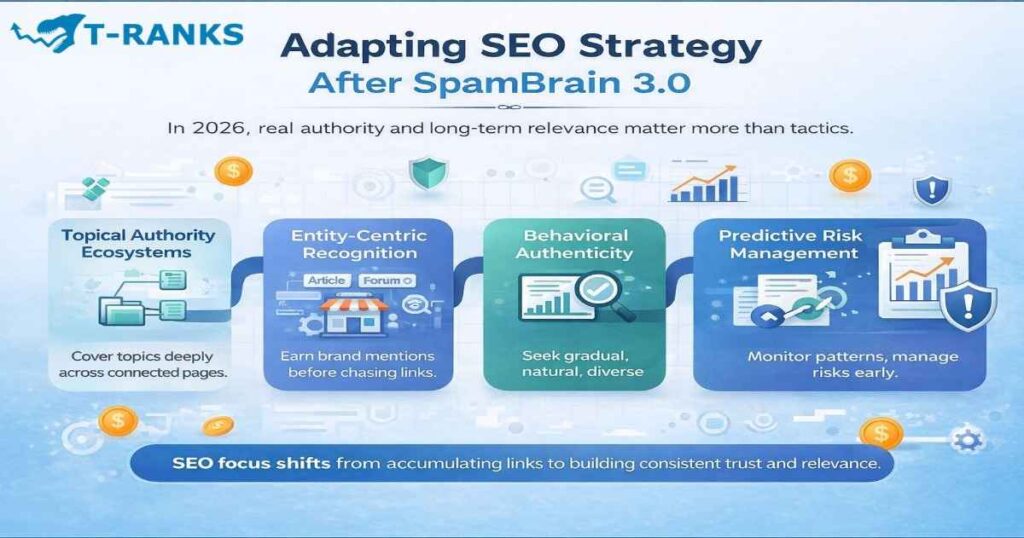
SpamBrain 3.0 changes SEO by making SpamBrain link patterns more important than individual tactics.
In 2026, Google evaluates how links, content, and brand signals behave together across an entire site. Optimizing isolated pages or acquiring single strong backlinks no longer drives results because SpamBrain focuses on repeated, sitewide behavior instead of individual actions.
This means many traditional SEO methods fail silently. SpamBrain link patterns built through bulk content, paid placements, or coordinated outreach are usually neutralized, not penalized. Rankings stop growing because artificial signals lose trust. Only links that appear naturally within relevant content and align with real brand recognition continue to influence performance.
As a result, SEO strategy must shift from accumulation to consistency. SEOs must reduce weak content, prioritize relevance, and earn links as a result of usefulness rather than effort. When SpamBrain link patterns show steady growth, topical alignment, and genuine endorsement, rankings improve without hitting invisible ceilings.
The Future of Link Building Under AI Detection Systems
Link building is no longer about getting links one by one.
Under advanced AI detection systems, the future of link building is about building real authority that naturally attracts links. Search systems now reward websites that show long-term trust, relevance, and recognition instead of short bursts of link activity.
Topical authority ecosystems
In the future, links work best when they support strong topic coverage.
Websites that fully explain a subject through connected pages perform better than sites relying on a few powerful links. When content covers a topic deeply and logically, links strengthen what already exists instead of trying to force rankings.
Entity-centric recognition
Brand recognition now matters before links.
When a website or brand is mentioned across articles, forums, and trusted platforms, search systems learn what that entity represents. Links that appear after recognition carry more weight because they confirm trust rather than trying to create it.
Behavioral authenticity
AI systems reward natural behavior.
Links that appear gradually, come from different independent sites, and use natural language look trustworthy. Sudden spikes, repeated anchors, or coordinated placements are easier for AI to detect and ignore. Slow, consistent growth is safer and more effective.
Dual optimization for generative search
Clean link behavior improves AI visibility.
Websites with trusted link patterns are more likely to be cited in AI Overviews and other AI generated answers. This visibility matters even when users do not click, because it builds brand authority and future trust signals.
Predictive risk management
Modern SEO includes monitoring patterns early.
Checking how links grow, where they come from, and how they are used helps prevent silent ranking limits. Fixing behavior before trust drops is more effective than reacting after visibility declines.
The long-term mental model
The future of link building is simple.
Authority grows when content, links, and mentions all support each other naturally.
Websites that focus on usefulness, clarity, and trust build link profiles that remain strong as AI detection systems continue to evolve.
Conclusion
In conclusion, SpamBrain evaluates link behavior patterns rather than individual backlinks, using AI to judge intent, consistency, and trust across an entire site.
Google now neutralizes artificial link signals quietly, which explains why rankings often stall or decline without warnings. Link value comes from natural growth, topical relevance, clean context, and strong brand and entity signals, not from volume or isolated high-authority placements.
SEO in 2026 requires mastering how links behave over time. Websites that focus on useful content, genuine mentions, and consistent link patterns remain visible in organic results and AI-generated search experiences, while manipulative tactics simply stop contributing value.
Audit your link patterns for SpamBrain compliance today. Book T-RANKS behavioral analysis,receive your risk score and safe ecosystem roadmap.
FAQs About SpamBrain 3.0: Backlinks, Link Patterns, and Detection
What is SpamBrain 3.0 in simple terms?
SpamBrain 3.0 is a practical label for how Google currently detects spam using AI. It describes an always-running system that evaluates link and content behavior patterns rather than judging links one by one.
What are SpamBrain link patterns?
SpamBrain link patterns are repeated backlink behaviors that suggest natural or unnatural intent. Google evaluates how links appear, repeat, and connect over time to understand why links exist at scale.
Does Google still penalize websites for bad links in 2026?
In most cases, no. Google usually neutralizes the value of unnatural links instead of penalizing the site. Manual actions can still occur, but silent devaluation is now more common.
Can SpamBrain automatically detect unnatural link building?
Yes. Google describes SpamBrain as an AI-based system that can identify patterns associated with unnatural linking. Detection is automated and does not rely on manual review in most cases.
Do individual backlinks still matter for SEO?
Yes, but rarely on their own. A single backlink has limited impact unless it aligns with clean, consistent link behavior across the entire site.
How does SpamBrain decide if links are unnatural?
SpamBrain learns manipulation patterns over time. Google does not publish exact signals, but the system identifies repeated behaviors that are commonly associated with artificial link creation.
Does SpamBrain analyze content around links?
SpamBrain evaluates links within a broader contextual framework. Links placed inside relevant, editorial content tend to be trusted more than links added in thin or unrelated environments.
Why do rankings stop growing without any Google warning?
Rankings can stall when link value is neutralized rather than penalized. This creates a silent ceiling where growth slows or stops without a visible warning.
How long does SpamBrain take to evaluate unnatural links?
There is no fixed timeline. Link signals may be reassessed quickly or gradually as SpamBrain continuously updates trust evaluations over time.
Is SpamBrain the same as a Google link spam update?
No. SpamBrain is a permanent AI-based system, while link spam updates are periodic improvements that refine how Google’s spam systems operate.
Can removing spammy links restore rankings?
Sometimes, but not immediately. Since neutralized links may not regain value, earning new, high-quality signals is often more effective than cleanup alone.
Can link building still work safely after SpamBrain?
Yes. Link building still works when links are earned naturally, remain relevant, and reflect genuine editorial choice rather than coordinated manipulation.