If your business does not appear on the first page of search results, most customers will never find you.
SEO is not about tricks or technical shortcuts. It is about creating helpful content that answers real questions and making your website easy for search engines to understand.
When someone searches for a product or service, search engines like Google and Microsoft Bing scan millions of pages and show the ones that best match the search. If your website clearly explains what you offer and solves the user’s problem, you have a strong chance of appearing higher.
Higher visibility leads to more visitors. More visitors lead to more inquiries, sales, and long term growth.
SEO is a continuous process. You identify what your customers are searching for, improve your pages around those topics, enhance your website experience, and track results. Then you refine your strategy based on what works.
You do not need advanced technical skills or a large budget to begin. You need a clear plan and consistent effort. Small improvements made regularly can produce powerful results over time.
This beginner guide explains SEO in simple language and practical steps. Once you understand the fundamentals, you will see how steady action turns search traffic into real business growth.
What Is SEO and How Does It Help Your Business Grow
SEO, or Search Engine Optimization, is the process of optimizing your website and webpages to get “free,” “organic” traffic from search engines like Google, Yahoo, and Bing.
The goal of SEO is to increase your website’s visibility and ranking in search results. This is achieved by making it easy for search engines to understand what your page is about and showing them that your content is “worthy of ranking”.
Let’s look at a real example.

When someone searches for “Best PBN Links Agencies 2026” on Google, Google shows a ranked list of websites. In the screenshot above, T-RANKS appears at the top of the search results.
That position is not accidental. It is earned because the page:
• Matches the exact search intent
• Covers the topic in depth
• Is structured clearly with headings and organized sections
• Demonstrates authority and expertise
• Is technically optimized and easy to access
Search engines follow a simple system. They crawl websites to discover pages, index the content to understand it, and rank pages based on relevance, quality, and trust.
When a page answers the searcher’s question better than others, it earns stronger visibility.
Now connect this to business growth.
If 1,000 people search for that keyword each month and T-RANKS ranks at the top, it gains:
• Targeted visitors who are actively searching
• Higher brand credibility
• More inquiries and leads
• Increased sales opportunities
Higher rankings increase visibility.
More visibility increases clicks.
More clicks create real business results.
SEO is not just about ranking first. It is about positioning your business in front of the right audience at the exact moment they are searching for solutions.
That is how SEO turns search demand into measurable growth.
The 3 Types of SEO and What Each One Does
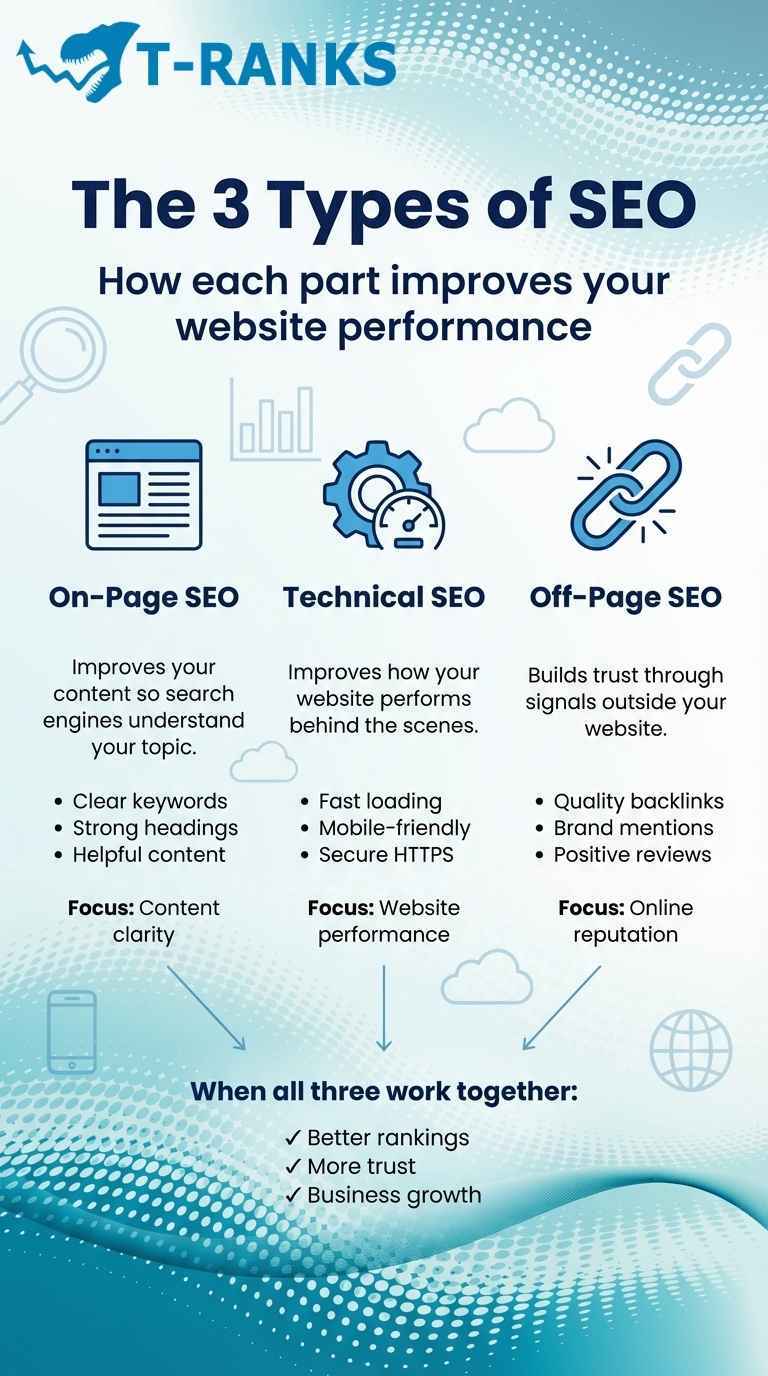
SEO is not just one task. It has three main parts. Each part improves a different area of your website.
Some SEO improvements happen on your website.
Some happen behind the scenes.
Some happen outside your website.
To rank well, you need all three working together.
On-Page SEO — What You Control on Your Website
On-page SEO is everything you improve directly on your web pages.
It focuses on your content and how clearly it explains a topic. The goal is to help both users and search engines understand what your page is about.
On-page SEO includes:
• Choosing the right keywords
• Writing clear and helpful content
• Using strong titles and headings
• Adding internal links to related pages
• Optimizing images with proper descriptions
For example, if someone searches “beginner SEO guide,” your page should clearly explain SEO step by step. The title, headings, and content should all match that topic.
The main goal of on-page SEO is simple: create useful content and make the topic obvious to search engines.
Technical SEO — How Your Website Performs and Loads
Technical SEO focuses on how your website works behind the scenes.
Even great content may not rank if your website is slow or difficult to access.
Technical SEO includes:
• Fast page loading speed
• Mobile-friendly design
• Secure website connection with HTTPS
• Clean and simple URLs
• Proper sitemap setup
• Fixing broken links
Search engines need to crawl and read your website easily. If they cannot access your pages properly, your rankings may suffer.
Technical SEO ensures your website runs smoothly for both users and search engines.
Off-Page SEO — Trust, Backlinks, and Online Reputation
Off-page SEO focuses on building trust outside your website.
Search engines look at how other websites talk about or link to your business. These signals help them decide if your website is trustworthy.
The most important part of off-page SEO is backlinks. A backlink is when another website links to your page.
Common off-page SEO methods include:
• Guest blogging
• Reaching out to other websites
• Getting listed in trusted directories
• Building partnerships
• Earning positive reviews
Quality matters more than quantity. A few strong backlinks from reputable websites are more valuable than many weak ones.
Off-page SEO helps search engines trust your website.
In simple terms:
On-page SEO improves your content.
Technical SEO improves your website performance.
Off-page SEO improves your reputation.
When all three work together, your website becomes easier to understand, easier to use, and more trustworthy. That leads to better rankings and steady business growth.
How to Find Keywords Your Customers Are Searching
Keywords are the words and phrases people type into Google when they are looking for products, services, or answers.
If you understand what your customers are searching for, you can create content that directly matches their needs. When your content aligns with real search demand, your chances of ranking increase.
The first step is identifying your seed keywords.
Seed keywords are short phrases directly related to your business. They act as starting points for discovering more detailed keyword ideas.
For example, if you run a PBN Links Agency, your seed keywords could be:
• PBN links
• buy PBN backlinks
• private blog network links
You can then expand these into more specific search phrases that your customers are actively typing into Google.
Instead of targeting broad terms, focus on specific phrases with clear intent.
For example:
“SEO” is very broad and highly competitive.
“SEO for beginners 2026” is more specific and easier to rank for.
Long-tail keywords usually:
• Have lower competition
• Show clear search intent
• Bring more qualified visitors
Targeting long-tail keywords helps beginners compete more effectively.
How to Think Like Your Customer
To find strong keywords, think like your customer.
Ask yourself:
• What problem is my customer trying to solve?
• What question would they type into Google?
• What simple words would they use?
Customers search differently depending on their stage.
Awareness stage
They want information.
Example: What are PBN links
Consideration stage
They compare options.
Example: Best PBN links provider 2026
Decision stage
They are ready to act.
Example: Buy PBN backlinks for SEO
Each stage requires different content.
Now let’s use Google itself to expand ideas.
When you type your seed keyword into Google, you will see suggestions appear automatically. This is called Google Autocomplete.
These suggestions are based on real searches people make.
You can even type your seed keyword followed by different letters of the alphabet to discover more ideas.
For example:

“SEO a”
“SEO b”
“SEO c”
Each variation shows new search phrases.
Also look at:

• People Also Ask questions
• Related Searches at the bottom of Google
These are powerful sources of keyword ideas because they reflect real user behavior.
You can also explore platforms where your audience asks questions:
• Reddit
• Quora
• YouTube
• Industry forums
• Facebook groups
If people are asking questions there, they are also searching similar phrases on Google.
Free Tools to Find Beginner-Friendly Keywords
You do not need expensive tools to begin keyword research. Free tools are enough to start.
Google Keyword Planner
Shows search volume and competition levels. Look for keywords with steady searches but manageable competition.
Google Autocomplete
Start typing a phrase into Google. The suggestions that appear are real searches people make.
People Also Ask Section
Google shows related questions in search results. These questions are excellent ideas for headings and blog topics.
Google Trends
Shows whether a keyword is gaining or losing popularity over time.
Google Search Console
If your website is already live, this tool shows which keywords your pages are appearing for.
When selecting beginner keywords:
• Focus on specific phrases
• Avoid extremely competitive terms
• Choose keywords with clear intent
• Prioritize topics your audience truly cares about
Specific keywords attract focused traffic. Focused traffic converts better.
Keyword research is about understanding what people are already searching for before creating content. When your content matches real demand, your SEO becomes much more effective.
How to Improve the Pages You Already Have
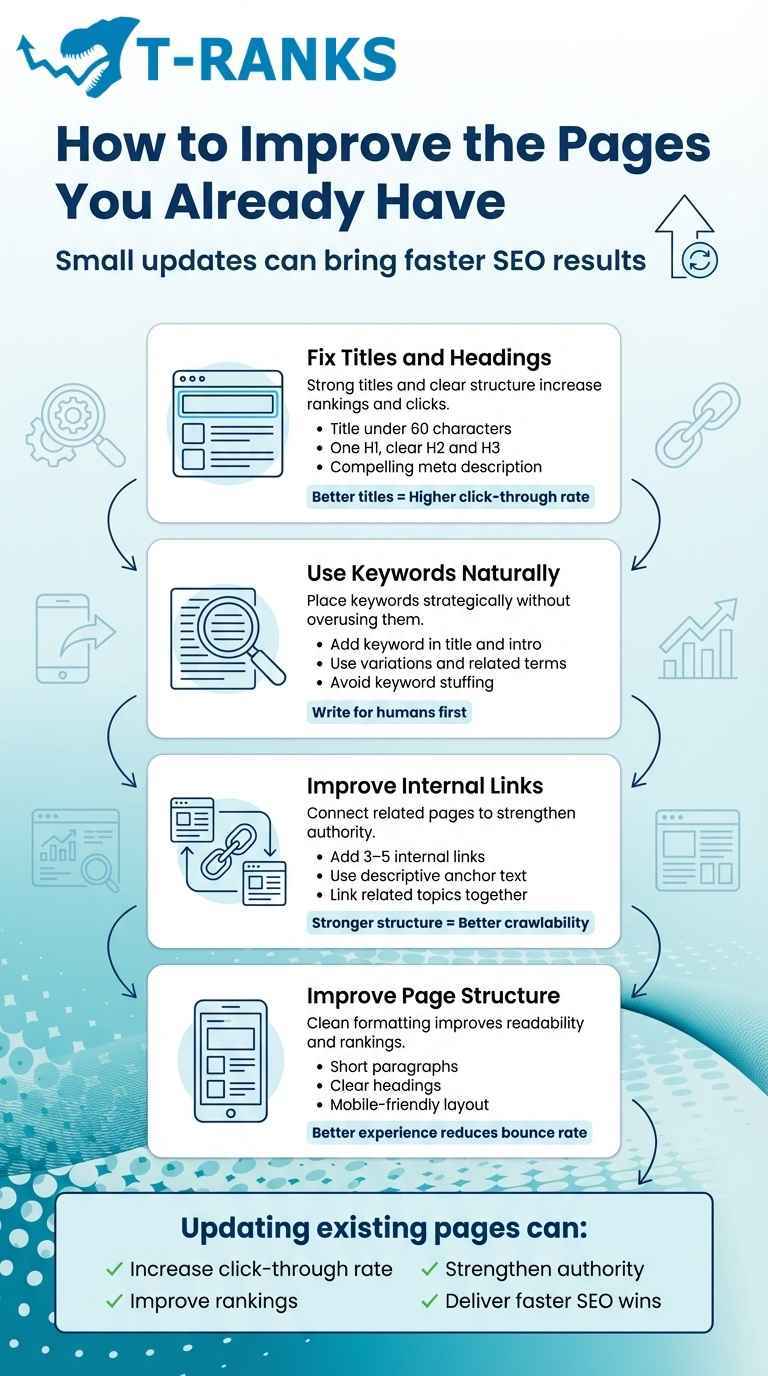
You do not always need new content to increase traffic. Sometimes small improvements to existing pages can bring faster results.
Many pages already appear in search results but receive very few clicks. You can check this in Google Search Console by sorting pages by impressions. Pages with high impressions and low clicks are high-potential opportunities.
Instead of starting from zero, improve what is already ranking.
Fix Titles, Headings, and Meta Descriptions
Your title is one of the strongest ranking and click factors.
A strong title should:
• Stay under 60 characters
• Include the main keyword near the beginning
• Clearly match search intent
• Sound compelling enough to click
For example:
“SEO for Beginners: Rank Higher in 2026”
Clear headings also improve rankings. Use:
• One H1 for the main topic
• H2 for major sections
• H3 for supporting points
Search engines prefer structured content because it is easier to understand and display in featured snippets.
Meta descriptions do not directly increase rankings, but they increase clicks. Keep them around 150 characters and highlight a clear benefit.
For example:
“Learn simple SEO strategies to grow your business in 2026. Step-by-step guide for beginners.”
A better title and description can significantly improve your click-through rate without changing the main content.
Use Keywords Naturally Without Stuffing
Keywords should appear in important areas:
• The title
• The introduction
• At least one H2 heading
• Naturally throughout the content
But avoid repeating the same phrase too often.
Keyword stuffing makes content sound unnatural and can harm rankings.
Instead:
• Use variations of your main keyword
• Use related terms
• Write short and clear sentences
• Focus on solving the topic fully
For example, instead of repeating “find SEO keywords” many times, you can also use:
• keyword research
• discover search terms
• find ranking keywords
Search engines now understand context. They do not require forced repetition.
Write for humans first. If it reads smoothly, it is usually optimized correctly.
Improve Internal Links and Page Structure
Internal links connect your pages together.
Add 3 to 5 internal links per page when relevant. Use descriptive anchor text instead of generic words like “click here.”
For example:
Use “learn keyword research techniques” instead of “read more.”
Internal linking helps:
• Distribute authority across pages
• Improve crawlability
• Keep users on your website longer
• Strengthen topic relationships
Page structure also impacts rankings.
Use:
• Short paragraphs
• Bullet points
• Clear headings
• Bold important phrases when necessary
Most users browse on mobile devices. Long blocks of text increase bounce rate. Clean formatting improves readability and engagement.
You can also add structured data such as FAQ schema to help search engines understand your page format. This increases your chances of appearing in rich results.
Improving existing pages is one of the fastest SEO wins. Small adjustments in titles, structure, and linking can move a page from page two to page one.
How to Create Content That Brings Traffic and Leads
Content brings traffic when it answers real questions clearly. It brings leads when it helps readers take the next step.
Search engines want to show pages that fully solve a problem. If your content matches what people are searching for and explains it better than others, you can rank.
But ranking is not enough. The content must also move visitors toward action, such as contacting you, signing up, or buying.
To create strong content:
• Focus on one main topic per page
• Understand what the searcher wants
• Answer the question clearly and completely
• Use simple examples
• End with a clear next step
Do not write just to increase word count. Write to fully explain the topic.
Some topics need more detail. Some need less. The goal is clarity and completeness, not unnecessary length.
If a reader finishes your page and does not need to search again, you did it right.
What Makes Content Good Enough to Rank in 2026
In 2026, search engines look for helpful and trustworthy content.
Your content should show:
• Real understanding of the topic
• Clear and confident explanations
• Accurate and updated information
• No copied or vague statements
This connects to E-E-A-T, which stands for:
• Experience
• Expertise
• Authoritativeness
• Trustworthiness
You improve these signals by writing clearly, staying honest, and focusing on value.
Structure also matters.
Use:
• Clear headings
• Short paragraphs
• Bullet points where helpful
• Logical order
Good structure makes content easy to read. It also helps search engines understand your page better.
Updating your content regularly is important too. If information changes, update your page. Even small updates show that your website is active.
Most users read on mobile devices. Keep sentences short and formatting clean.
Content ranks when it is:
• Helpful
• Clear
• Well organized
• Trustworthy
• Updated
How Often Should Beginners Publish Content
You do not need to publish every day.
Publishing 1 to 2 high-quality articles per month is enough for beginners.
This gives you time to:
• Research properly
• Write clearly
• Optimize correctly
• Improve older content
Low-quality content published too often can hurt your website.
Instead, create a simple content plan for the year.
Choose:
• Topics your audience cares about
• Keywords with clear intent
• Problems you can solve clearly
Over time, consistent publishing builds authority.
SEO grows slowly but steadily. Each strong article adds value to your website.
When you publish helpful content consistently, traffic increases. As traffic increases, leads and sales follow.
How to Get Backlinks Without Spending Money
Backlinks are links from other websites to your website. They show search engines that other people trust your content.
Think of backlinks as recommendations. When a respected website links to you, it tells Google that your page is helpful and worth showing in search results.
That is why backlinks influence rankings.
But not all backlinks are equal.
One link from a relevant and trustworthy website is more valuable than many links from low-quality sites. Bad links can even damage your rankings.
Backlinks help your business by:
• Improving your search rankings
• Building trust and authority
• Bringing referral visitors
• Increasing brand visibility
Now let’s look at simple ways beginners can earn backlinks without spending money.
Start with trusted listings
If you run a business, create profiles on reputable platforms such as Google Business Profile and other relevant directories in your industry. Make sure your business details are correct and consistent.
These listings build credibility and help search engines trust your website.
Build real relationships
Connect with bloggers, small businesses, or website owners in your niche. Reach out politely and suggest collaboration.
You can:
• Write a helpful article for their blog
• Mention each other’s useful resources
• Share expert insights
When you build real connections, backlinks often happen naturally.
Create useful resources
Websites link to content that is helpful.
You can create:
• Practical guides
• Checklists
• Templates
• Step-by-step tutorials
If your content solves a real problem clearly, others may reference it in their articles.
Fix broken links
Some websites have links that lead to pages that no longer exist. These are called broken links.
If you have content that fits the same topic, you can contact the website owner and suggest your page as a replacement.
This helps them fix their page and gives you a backlink.
Write guest articles
You can offer to write valuable content for relevant blogs. In exchange, you usually receive a backlink.
Focus only on websites that are related to your industry. Avoid websites that exist only to exchange links.
Be patient and consistent
You do not need hundreds of backlinks quickly.
Earning a few quality links each month is enough in the beginning. Over time, these links build strong authority.
Avoid shortcuts
Do not buy cheap links. Do not use automated tools to create links. These methods can cause penalties.
Backlinks should come from value, trust, and real relationships.
When you combine strong content with steady backlink building, your rankings grow safely.
That is how beginners can build authority and visibility without spending money.
Local SEO — How to Show Up in Google Maps and Local Search
Local SEO is the process of optimizing your business so it appears in Google Maps and location-based search results when people search for nearby services.
To understand this clearly, look at the screenshot.

When someone searches for “best restaurants near me”, Google does not show only normal website results. Instead, it displays:
• A map
• A list of nearby businesses
• Star ratings
• Reviews
• Contact information
This section is called the Local Pack.
In the screenshot, you can see restaurants like:
• Dewan Namak Mandi
• Lasani Broast
• Mr Fries
Each listing shows:
• Star rating
• Number of reviews
• Location
• Price range
• Quick review snippet
Google displays these businesses because they are:
• Relevant to the search
• Close to the user
• Well reviewed and trusted
Now connect this to your business.
If someone searches:
“SEO services near me”
“Digital marketing agency in Dera Ismail Khan”
Google will show a similar local pack for agencies.
If your business appears there, you get:
• Phone calls
• Website visits
• Direction requests
• Immediate inquiries
Local SEO puts your business in front of people who are ready to take action.
How to Set Up and Optimize Your Google Business Profile
Your Google Business Profile is the most important part of local SEO.
If you have not created one yet, set it up and verify ownership.
Then complete every important section.
Add accurate business details
Make sure your:
• Business name
• Address
• Phone number
• Website
• Working hours
are correct and consistent everywhere online.
Choose the right category
Select the primary category that best describes your service. This helps Google match you with the right searches.
Write a clear business description
Explain what you do, who you help, and what makes you different.
Add high-quality photos
Upload real photos of your office, team, services, or products. Active profiles receive more engagement.
Collect and respond to reviews
Ask satisfied clients to leave honest reviews. Try to maintain strong ratings.
Reply to every review, both positive and negative. This shows professionalism and activity.
Post updates regularly
You can publish short updates, offers, or announcements. Regular activity signals that your business is active.
An optimized profile increases your chances of appearing in the local pack.
What Helps You Rank Higher in Local Results
Google uses three main factors for local rankings:
Relevance
How closely your business matches the search query.
Distance
How near your business is to the searcher.
Prominence
How trusted and well-known your business appears online.
To improve your local rankings:
Keep your business information consistent
Your name, address, and phone number must match across all directories and listings.
Earn positive reviews
Higher ratings and regular reviews improve trust signals.
Use local keywords on your website
Include your city or area naturally on key pages.
For example:
“SEO services in Dera Ismail Khan”
Create location-specific pages if you serve multiple areas
Each page should clearly explain services in that location.
Build local mentions
Get listed in local directories and mentioned on local websites.
Stay active and updated
Regular updates and engagement show Google that your business is legitimate and current.
Local SEO works best when your website and Google Business Profile support each other.
When done correctly, local SEO brings highly targeted visitors who are actively looking for services near them.
That visibility leads to calls, inquiries, and customers.
How Long Does SEO Take and What Should You Expect
SEO is a long-term strategy. Most businesses see early progress around 3 months, stronger growth around 6 months, and stable results after 12 months.
Search engines need time to crawl your website, understand your content, measure trust signals, and compare you with competitors. Results do not happen overnight.
Let’s break it down clearly.
First 3 Months — Building the Foundation
In the first three months, you focus on setup and improvements.
You will:
• Optimize titles and content
• Improve technical structure
• Publish targeted content
• Set up local SEO if relevant
• Start earning basic backlinks
At this stage, do not expect major traffic spikes.
Instead, look for early signs of progress:
• Your pages are indexed in Google
• Impressions start increasing
• Some keywords appear on page two or three
• Small ranking improvements
This phase is about visibility, not dominance.
Months 4 to 6 — Momentum Begins
If you stay consistent, months four to six show clearer results.
You may start seeing:
• Long-tail keywords ranking on page one
• Noticeable increase in organic traffic
• More stable keyword positions
• First consistent inquiries or leads
This happens because your content, structure, and backlinks begin working together.
Your website starts gaining authority.
Months 7 to 12 — Compounding Growth
After six months of steady effort, SEO begins to compound.
By month twelve, you can expect:
• Stronger rankings for competitive terms
• Consistent monthly organic traffic
• Higher-quality leads
• Improved brand credibility
• More referrals from other websites
At this stage, SEO often becomes one of your main traffic sources.
Realistic Expectations
SEO results depend on several factors:
• Competition in your industry
• Age and trust of your website
• Quality of content
• Backlink strength
• Consistency of work
A brand-new website in a competitive niche will take longer than an established website targeting specific long-tail keywords.
Also understand that search rankings can fluctuate. Algorithm updates may cause temporary changes. But websites with strong, helpful content usually recover.
SEO is not a quick fix. It is a long-term investment.
You build content.
You build authority.
You build trust.
And over time, that effort turns into steady traffic and reliable growth.
In simple terms:
3 months builds foundation.
6 months builds momentum.
12 months builds stability.
Patience and consistency are what turn SEO into a powerful growth channel.
SEO Mistakes Beginners Should Avoid
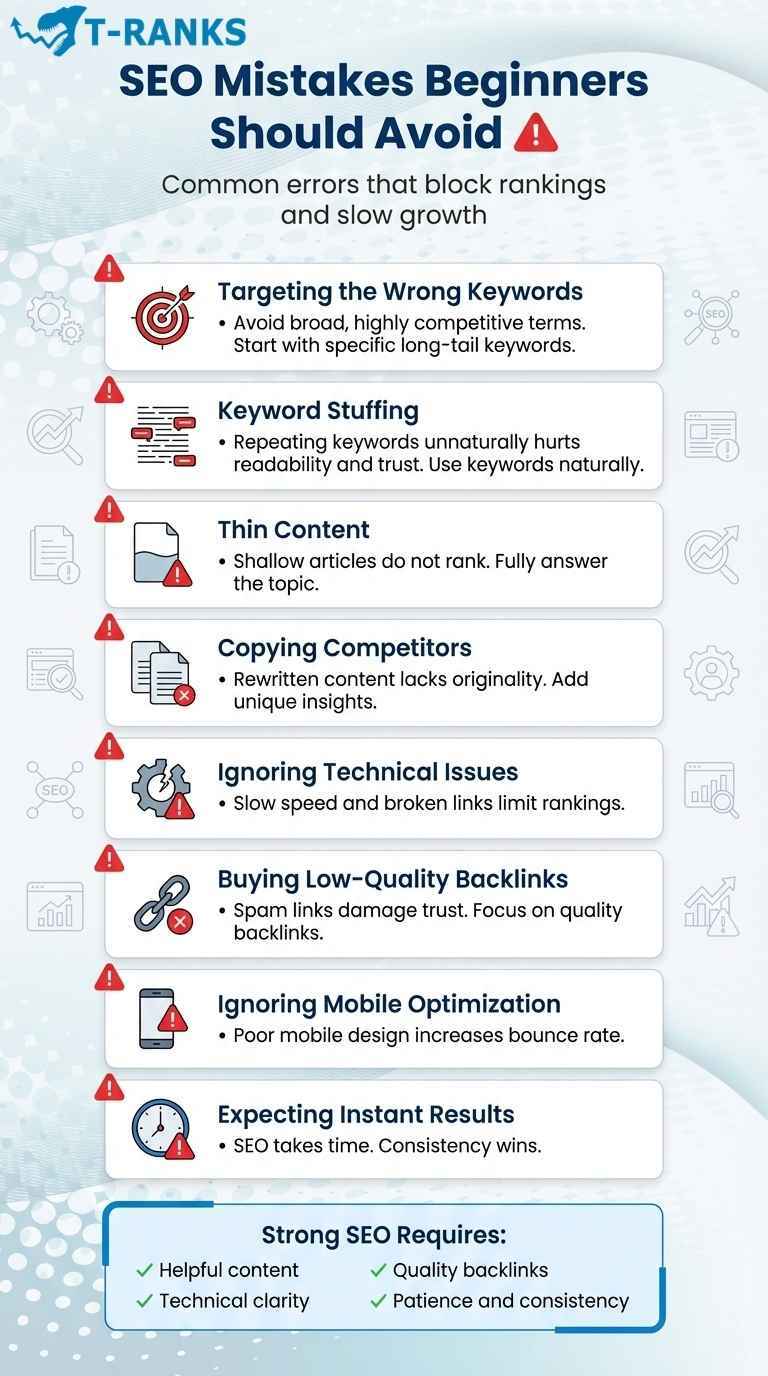
SEO mistakes often happen when beginners chase quick results instead of building a strong foundation. Avoid these errors to protect your rankings and growth.
Targeting the Wrong Keywords
Choosing keywords that are too broad or too competitive makes ranking very difficult.
Instead of targeting large, general terms, focus on specific long-tail keywords with clear intent. Start with easier opportunities and grow from there.
Keyword Stuffing
Repeating the same keyword unnaturally does not improve rankings.
Search engines understand meaning and context. If your content feels forced, it hurts readability and trust.
Use keywords naturally and focus on clear explanations.
Creating Thin Content
Publishing short, shallow articles that do not fully answer the question will not rank well.
Search engines reward complete and helpful content.
Explain the topic clearly and cover it properly. Add value, not filler.
Copying Competitor Content
Duplicate or slightly rewritten content rarely performs well.
Search engines prefer original insight and unique structure.
Write in your own words. Add better clarity, stronger examples, and clearer organization.
Ignoring Technical Issues
Strong content cannot rank on a weak website.
Common technical problems include:
• Slow loading pages
• Broken links
• Poor mobile experience
Fix technical basics before expecting strong rankings.
Buying Low-Quality Backlinks
Cheap backlinks from spam websites can harm your website.
Search engines detect unnatural link patterns.
Focus on earning backlinks from relevant and trusted websites.
Ignoring Mobile Optimization
Most users search on mobile devices.
If your website is difficult to use on a phone, visitors leave quickly.
Make sure your website loads fast and displays correctly on all screen sizes.
Publishing Unedited AI Content
AI tools can help draft content, but unedited content often lacks depth and originality.
Always review, improve, and personalize AI-generated drafts before publishing.
Not Updating Old Content
SEO is not a one-time task.
Outdated content can lose rankings over time.
Review and refresh important pages regularly.
Expecting Instant Results
SEO takes time.
Stopping after a few weeks prevents progress.
Stay consistent and patient.
Avoiding these mistakes keeps your SEO strategy clean and sustainable.
Strong SEO comes from helpful content, technical clarity, quality backlinks, and steady effort.
Free SEO Tools Every Beginner Should Use

You do not need paid tools to start SEO. A few powerful free tools can help you research keywords, fix problems, and track progress.
The key is not having many tools. The key is using the right ones consistently.
Here are the essential free tools every beginner should start with.
Google Search Console
Google Search Console helps you understand how your website appears in Google search.
It shows you:
• Which keywords trigger your pages
• How many impressions and clicks you get
• Which pages are indexed
• Errors that prevent ranking
You can also submit your sitemap to help Google crawl your pages faster.
If your traffic drops or a page is not ranking, this is the first place to check.
Google Analytics
Google Analytics shows what users do after they visit your website.
It helps you understand:
• Where your traffic comes from
• Which pages people visit most
• How long visitors stay
• Which pages lead to conversions
This helps you focus on pages that bring real business value, not just traffic.
Google Keyword Planner
Google Keyword Planner helps you discover keyword ideas.
You can:
• Find new keyword variations
• Check approximate search demand
• Compare related phrases
It works through a free Google Ads account.
Beginners should use it to find specific, lower-competition keywords instead of broad terms.
Google Business Profile
If you run a local business, this tool is critical.
Google Business Profile allows you to appear in:
• Google Maps
• Local search results
• The local pack section
You can manage:
• Business details
• Reviews
• Photos
• Posts and updates
An optimized profile increases visibility and trust.
Ahrefs Webmaster Tools (Freemium)
Ahrefs Webmaster Tools provides free access to basic SEO insights.
You can:
• See which websites link to you
• Detect broken pages
• Check keyword rankings
• Review overall site health
It helps you monitor your backlink profile and catch problems early.
You do not need to master everything at once.
Start with:
• Google Search Console to monitor search visibility
• Google Analytics to track user behavior
Then gradually use keyword and backlink tools as you grow.
SEO is not about using the most tools. It is about using a few tools correctly and taking action based on the data.
These free tools give beginners everything needed to start building steady organic growth.
How to Tell If Your SEO Is Working

SEO is working when your visibility increases, your traffic grows, and your website starts generating real business results.
You do not need complicated tools to understand progress. Focus on four simple metrics.
Impressions
Impressions show how often your pages appear in search results.
If impressions are rising, it means Google is showing your content more often. This is usually the first sign of improvement.
In the early months, impressions may increase before clicks increase. That is normal.
Clicks
Clicks show how many people visit your website from search results.
If impressions go up and clicks also increase, your titles and content are attracting attention.
You can also look at click-through rate. This shows how many people click compared to how many see your page. Improving your title and meta description often increases clicks.
Rankings
Rankings show your position in search results.
Early progress often looks like:
• Moving from page four to page three
• Moving from page three to page two
• Long-tail keywords reaching page one first
Small improvements in ranking are signs that your optimization is working.
Do not focus on daily changes. Focus on steady monthly movement.
Conversions
Conversions are the most important metric.
A conversion happens when someone:
• Submits a form
• Calls your business
• Signs up
• Buys a product
Traffic without conversions does not grow your business.
If organic visitors start turning into leads or sales, your SEO is delivering real value.
Early Signs of Progress
In the first few months, positive signs include:
• More pages indexed in Google
• Impressions increasing steadily
• Rankings slowly improving
• First organic clicks
• Occasional inquiries from search traffic
Growth may start small.
For example:
• Impressions increase month by month
• Clicks grow gradually
• Long-tail keywords reach page one
These small improvements compound over time.
Should You Do SEO Yourself or Hire an Expert

You can do SEO yourself if you have time and a small budget. You should hire an expert if competition is high or SEO directly affects your revenue.
Both options work. The right choice depends on your stage and goals.
When DIY SEO Works
Doing SEO yourself makes sense when:
• You run a small website
• Your niche is not highly competitive
• You are targeting long-tail keywords
• You have time to learn and apply changes
• Your budget is limited
Basic SEO tasks like writing content, improving titles, setting up Google Search Console, and optimizing your Google Business Profile are manageable for beginners.
The trade-off is time. DIY SEO costs less money but requires consistent effort and patience.
When Hiring an Expert Makes Sense
Hiring an expert is better when:
• Your industry is competitive
• SEO drives leads or sales
• Technical issues limit growth
• You need faster and more strategic results
An expert saves time, reduces mistakes, and builds a structured plan instead of random actions.
Cost vs Effort
DIY SEO
• Lower cost
• Higher time investment
• Slower learning curve
Hiring an expert
• Higher cost
• Less time required from you
• Faster strategic execution
In simple terms:
DIY saves money but takes time.
Hiring saves time but costs money.
Choose based on your budget, competition, and how important SEO is to your business right now.
How SEO Is Changing in 2026

SEO in 2026 is no longer just about ranking on Google. It is about visibility across AI answers, search engines, and discovery platforms.
Search behavior is changing. Users now see AI-generated summaries, suggested follow-up questions, and content pulled from multiple sources.
This means SEO is shifting from “ranking pages” to “building trusted visibility.”
Businesses must think beyond keywords. They must focus on authority, clarity, and brand presence.
How AI Search Is Changing Google Results
AI systems now:
• Generate summarized answers directly in search results
• Combine information from multiple websites
• Reduce clicks for simple informational queries
• Prioritize trusted and structured content
This changes competition.
Instead of competing only for position one, you are competing to be referenced in AI summaries.
AI systems prefer content that is:
• Clear and structured
• Comprehensive, not thin
• Accurate and updated
• Written with real expertise
Websites with strong topical authority and consistent quality have higher chances of being cited.
SEO is becoming more about depth and trust than just keyword placement.
How to Get Your Business Mentioned in AI Answers
You cannot control AI-generated results, but you can influence them.
Focus on these principles:
Cover topics completely
Do not write shallow articles. Build detailed pages that fully answer user intent.
Use clear structure
Headings, lists, definitions, and concise explanations help AI systems extract information.
Build brand authority
Earn mentions from reputable websites. Strengthen your reputation across the web.
Maintain consistent messaging
Your website, social profiles, and business listings should clearly communicate who you are and what you do.
Keep content updated
Fresh, accurate information increases trust signals.
Think beyond Google
AI answers may appear in search engines, voice assistants, and other platforms. Visibility now extends beyond traditional rankings.
In 2026, SEO is evolving into visibility management.
The goal is not just to rank.
The goal is to become a trusted source that AI systems and users rely on.
Your First 30 Days of SEO — Simple Action Plan

Your first 30 days of SEO are about building a clear foundation, not chasing fast traffic.
Think of this month as setup and momentum. If you follow this plan step by step, you will start seeing early visibility signals.
Follow it week by week.
Week 1 — Set Up and Measure Your Starting Point
- Create a Google Search Console account and verify your website.
- Set up Google Analytics to track visitors.
- Submit your sitemap so Google can find your pages.
- Check that your main pages are indexed.
- Write down your current impressions, clicks, and average rankings.
This is your baseline.
You cannot measure improvement if you do not know where you started.
Week 2 — Find the Right Keywords
- Write down the problems your customers search for.
- Use Google Autocomplete and Keyword Planner to find related phrases.
- Choose 3 to 5 specific, low-competition keywords.
- Search those keywords on Google and study the top results.
- Assign one main keyword to one page.
Before writing anything, ask:
What is the searcher really trying to solve?
The goal is clarity, not volume.
Week 3 — Improve Your Main Pages
- Update your homepage title and meta description to clearly explain what you offer.
- Add clear headings that describe each section.
- Rewrite confusing paragraphs into short, simple sentences.
- Compress large images so your site loads faster.
- Test your site on a mobile phone and fix layout issues.
Your homepage is your strongest page. Improve it before creating more content.
Week 4 — Publish and Connect Content
- Write one detailed article targeting your strongest keyword.
- Use clear headings and short paragraphs.
- Add 3 to 5 internal links between related pages.
- Share your article on your social platforms.
- Submit the new page for indexing in Search Console.
Now your site is not just optimized. It is growing.
What You Should Expect After 30 Days
Do not expect massive traffic.
Instead, look for:
• More pages indexed
• Gradually increasing impressions
• Some keywords moving closer to page one
• First organic clicks
These are early wins.
SEO is not about instant results. It is about steady improvement.
After 30 days, you will have:
• Proper tracking
• Clear keyword focus
• Optimized core pages
• At least one strong new article
Repeat this cycle every month.
Small improvements each month lead to strong growth over time.
Final Thoughts — Start Simple and Stay Consistent
In conclusion, SEO is a long-term strategy that builds visibility, trust, and steady growth over time. It begins with understanding how search engines work, choosing the right keywords, improving existing pages, creating useful content, earning quality backlinks, and tracking real progress through impressions, clicks, rankings, and conversions.
Early months focus on building a strong foundation. Later, momentum grows as authority increases and more keywords reach page one. Consistent effort, clear structure, mobile-friendly design, and genuine expertise are what separate lasting results from short-term spikes.
SEO is not a quick fix. It rewards patience and smart action. Small improvements made consistently can turn into meaningful traffic and reliable leads.
Start today. Optimize one page. Research one keyword. Publish one strong piece of content. Track your progress and improve step by step.
If you want a faster path with a clear strategy and expert guidance, consider partnering with a professional SEO team to strengthen your visibility in both traditional search and AI-driven results.
FAQs About SEO for Beginners: How to Get Found on Google in 2026
What is SEO in simple terms?
SEO is the process of improving your website so it appears higher in search results. It helps search engines understand your content and show it to people actively searching for your products or services.
How does SEO work in 2026?
SEO works by aligning helpful content, technical performance, and trust signals with user intent. Search engines use AI systems to evaluate relevance, authority, and user experience before ranking pages.
How long does SEO take to show results?
SEO usually shows early improvement within 3 to 6 months. Stronger traffic and stable rankings often appear after 6 to 12 months, depending on competition and consistency.
Can I do SEO myself as a beginner?
Yes, beginners can handle basic SEO tasks like keyword research, content writing, and optimizing titles. More advanced technical issues or competitive niches may require professional support.
What are the three main types of SEO?
The three main types are on-page SEO, technical SEO, and off-page SEO. On-page improves content, technical improves performance, and off-page builds authority through backlinks and mentions.
Is SEO still worth it in 2026 with AI search results?
Yes, SEO is still essential because AI-generated answers rely on authoritative website content. Strong SEO increases your chances of being referenced in AI summaries and generative search results.
What is E-E-A-T in SEO?
E-E-A-T stands for Experience, Expertise, Authoritativeness, and Trustworthiness. Search engines use these signals to evaluate credibility and rank reliable content higher.
What is a long-tail keyword and why does it matter?
A long-tail keyword is a specific search phrase with three or more words. It usually has lower competition and higher conversion potential than broad keywords.
How many blog posts do I need for SEO to work?
There is no fixed number of blog posts required. A few high-quality, well-optimized pages can outperform many weak ones if they fully satisfy search intent.
What are the most important SEO ranking factors in 2026?
Helpful content, strong user experience, quality backlinks, and topical authority are key ranking factors. Search engines prioritize pages that fully answer user queries.
What happens if I ignore SEO completely?
Ignoring SEO reduces your visibility in search results and allows competitors to capture your audience. This increases reliance on paid ads and raises long-term marketing costs.
Is SEO better than Google Ads for small businesses?
SEO is better for long-term growth, while Google Ads provides short-term visibility. Ads stop when spending stops, but SEO builds compounding traffic over time.
How do I know if my SEO is working?
SEO is working when impressions, clicks, keyword rankings, and conversions steadily improve. Google Search Console clearly shows these performance changes.
Can AI replace SEO experts?
No, AI cannot replace SEO experts because strategy and business decisions require human judgment. AI tools assist with research and drafting but do not replace expertise.
Do backlinks still matter in 2026?
Yes, backlinks still matter because they signal trust and authority to search engines. Quality and relevance are more important than quantity.