Many websites publish good content but still struggle to get backlinks. This happens because link building today is not only about outreach or promotion. It also depends on whether search engines and AI systems can clearly understand and trust your content.
Structured data link building helps solve this problem. Instead of placing links directly, it uses JSON-LD to explain what your content is about, who created it, and why it is reliable. When this information is clear, your pages are more likely to appear in rich results, AI summaries, and other places where links are naturally earned.
In this article, you will learn how structured data link building works, why JSON-LD matters for visibility, and how clear structure helps content earn links over time. The goal is to help beginners understand how links are now a result of clarity and trust, not just manual effort.
What Is Structured Data Link Building?
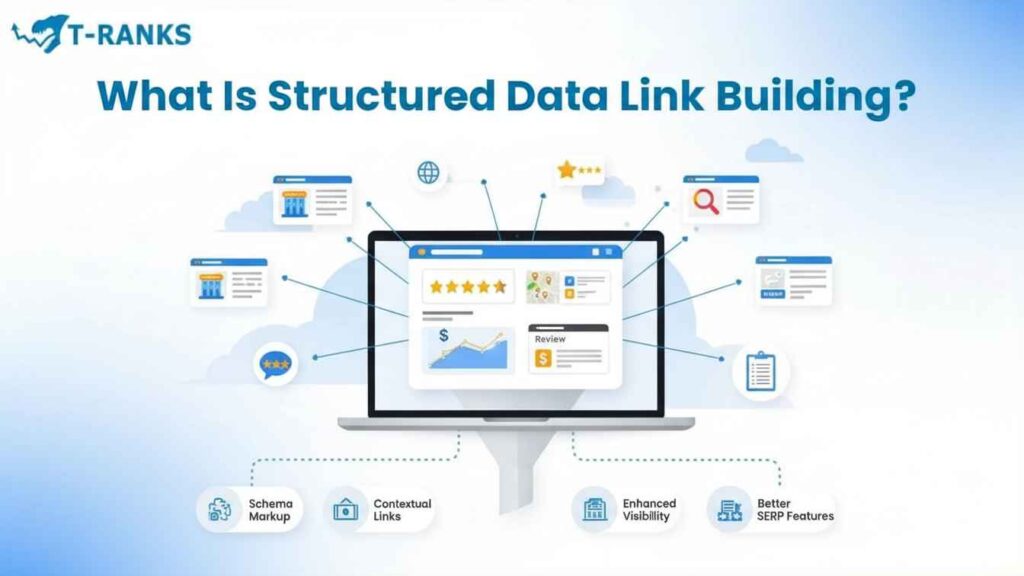
Structured data link building means using a simple code format called JSON-LD to explain your content clearly to search engines and AI tools, so other websites can find and link to it naturally.
It helps search systems understand what your page is about, who it belongs to, and why it is useful.
This method does not involve placing backlinks, buying links, or adding links inside code. Instead, it focuses on making your content easier to read and interpret for machines. When search engines clearly understand your page, they are more likely to show it in search results, summaries, and answer boxes.
JSON-LD is a type of structured data that works like a label or description for your page. It tells search engines things like your brand name, the author, the topic, or common questions related to the content. Because this information is clear and organized, your content becomes easier to discover.
As visibility increases, journalists, bloggers, and researchers are more likely to come across the content while doing research and reference it as a source. In this way, structured data link building helps links happen naturally through better understanding and discovery, not through direct link placement.
Why Structured Data Link Building Matters in Modern SEO
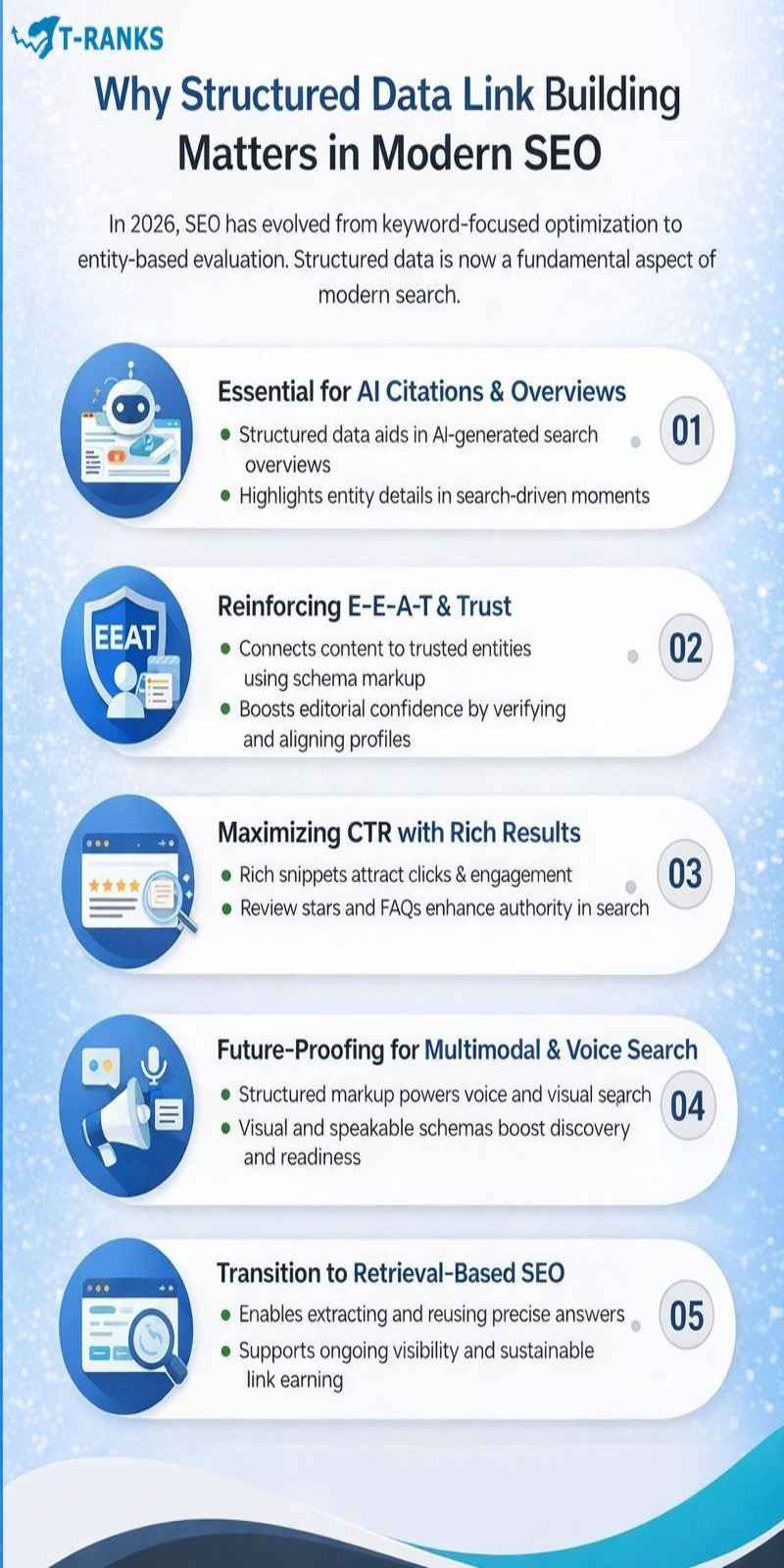
In 2026, structured data link building matters because SEO is no longer only about keywords and rankings. Search engines now focus more on understanding entities such as brands, authors, and topics. While structured data does not directly improve rankings, it helps search engines and AI systems understand content clearly, which makes it easier for that content to be discovered and linked.
Essential for AI Citations and Overviews
Search engines increasingly use structured information to create AI Overviews and answer-based results. When content is clear and well structured, AI systems can extract and reference it with confidence. Being cited in AI summaries often provides more visibility than a traditional ranking because the content appears directly in research and discovery moments.
Reinforcing Trust and Credibility
Search engines evaluate whether content can be trusted before showing or citing it. Structured data helps by clearly connecting content to real people, brands, and organizations. This clarity increases confidence for both search systems and editors when referencing the content.
Improving Click-Through Rates with Rich Results
Enhanced search listings are now expected rather than optional. Structured data allows content to appear with additional details such as FAQs, ratings, or key information. These visual elements help users quickly understand the page and encourage stronger engagement.
Supporting Voice and Visual Search
Voice assistants and visual search tools depend on structured data to understand content accurately. When information is clearly structured, these systems can select better answers. This expands where content appears and increases discovery opportunities.
Adapting to Answer-Focused SEO
Search engines are increasingly showing specific answers instead of full pages. Content that is clearly organized is easier to extract, reuse, and trust. Structured data supports this shift by helping content stay visible and reference-ready over time.
Is Structured Data a Google Ranking Factor?
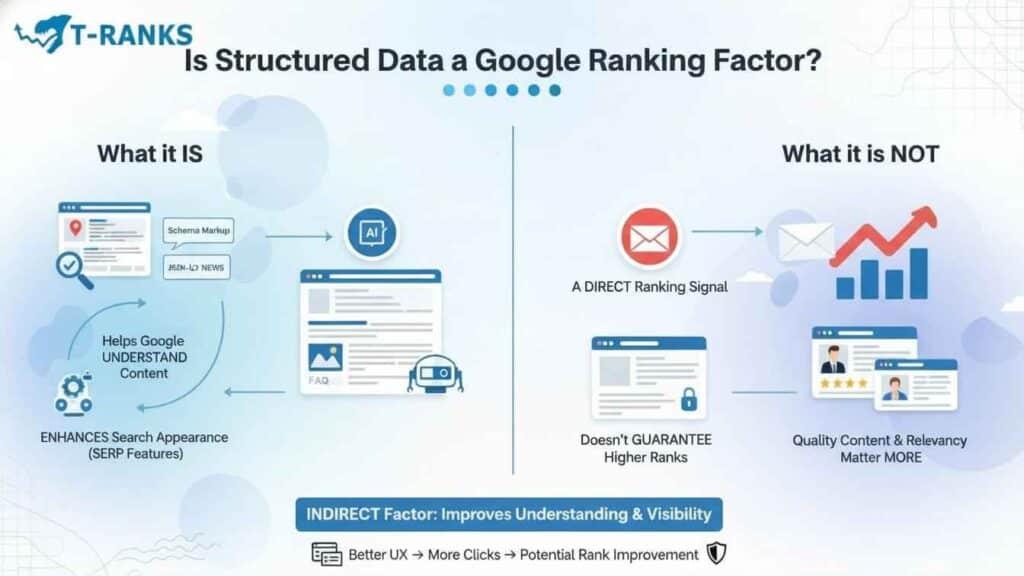
No, structured data is not a direct Google ranking factor.
Google has repeatedly stated that adding schema markup alone does not increase or decrease search rankings.
The important distinction is between ranking and visibility. Structured data does not change where a page ranks, but it influences how that page appears in search results. By enabling rich results, featured snippets, and enhanced displays, structured data increases visibility and user engagement. Higher click-through rates and improved interaction can indirectly support long-term performance, even though schema itself is not a ranking signal.
Google still recommends structured data because it improves how content is understood and delivered. Schema markup helps search engines interpret meaning, connect entities, and index pages more accurately. It also plays a critical role in AI-driven features such as AI Overviews, where machine-readable clarity is required to extract and attribute reliable answers.
In modern SEO, structured data is valuable because it strengthens discovery, usability, and trust across search experiences, not because it directly influences ranking positions.
How Structured Data Actually Leads to Backlinks
Structured data helps earn backlinks by improving how content appears in search results and making it easier for others to discover and reference. Instead of creating links directly, schema markup improves how content is understood and displayed, placing it in the search environments where links are naturally earned.
Structured data improves SERP appearance
Schema markup makes content eligible for enhanced search results such as FAQs, review stars, and author information. These enriched listings stand out from standard results and help users quickly judge relevance and credibility.
Higher visibility leads to broader exposure
When content appears more clearly and attractively in search results, more people engage with it. This increased exposure helps the content reach journalists, bloggers, and researchers who rely on search to find reliable sources.
Discovery turns into citations and backlinks
Content creators often notice featured snippets and enhanced results during research. When structured data clearly defines topics, authors, and answers, it reduces research effort and builds trust. This process naturally turns visibility into citations and earned backlinks, without direct link placement.
.
Why JSON-LD Is the Preferred Format for SEO
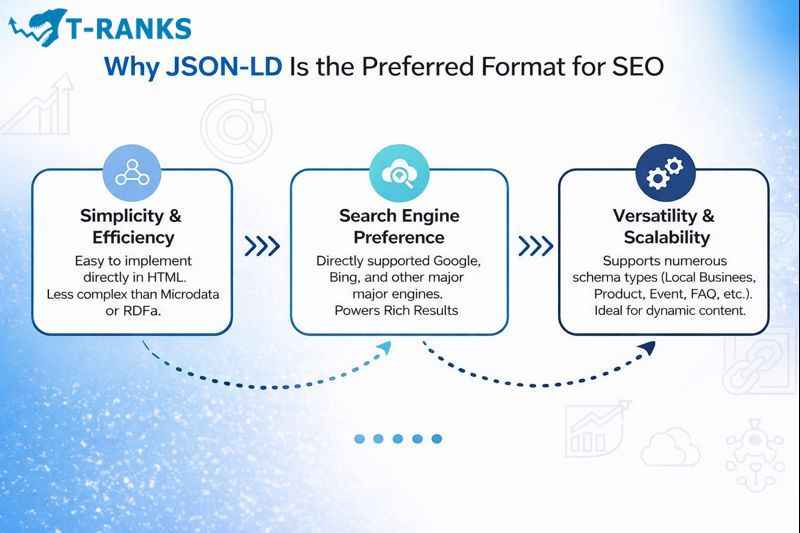
JSON-LD is preferred for SEO because it helps search engines understand content clearly without affecting how a page looks or functions. It allows important information about a page to be explained in a clean, organized way that search engines and AI systems can process easily.
JSON-LD is a format used to add structured data to a website. Structured data is the general concept of organizing information so search engines understand what a page represents. JSON-LD is one way to do this, using a separate script that sits in the background of a page and does not interfere with the visible content or layout.
Unlike other formats such as Microdata or RDFa, which are mixed directly into HTML elements, JSON-LD keeps structured data separate from the page design. This separation makes it easier to manage, update, and scale, especially as websites grow or layouts change.
Google prefers JSON-LD because it is easier to parse and more reliable. Developers can update content or redesign pages without breaking the structured data. JSON-LD also supports complex relationships between entities, which is important for entity-based SEO and Knowledge Graph understanding.
The main limitation of JSON-LD is that accuracy matters. If the structured data does not match the visible content or contains errors, search engines may ignore it. When implemented and maintained correctly, JSON-LD remains the most stable and recommended format for structured data in modern SEO.
How Structured Data Improves Search Visibility
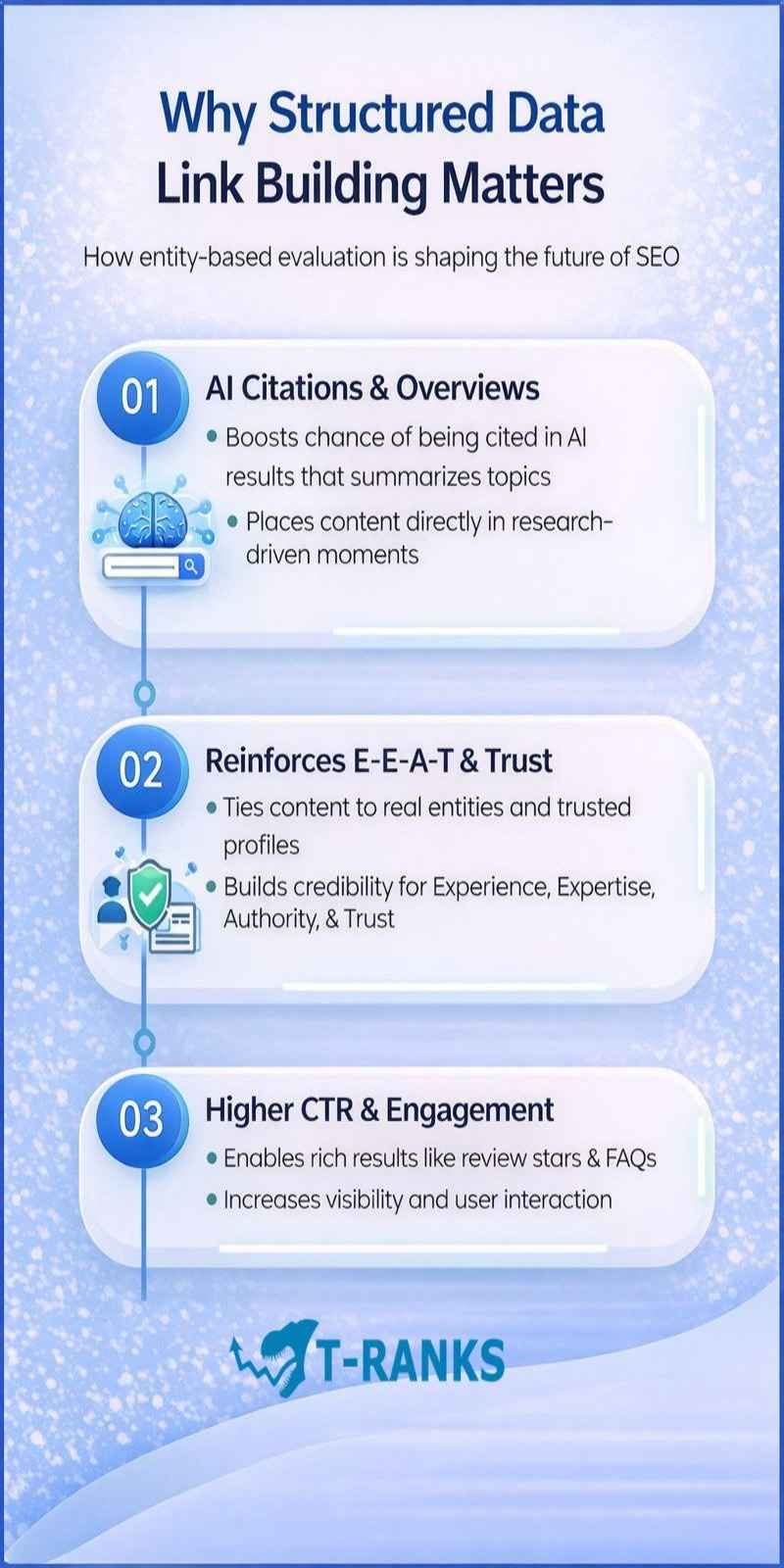
Structured data improves search visibility by enhancing how content is displayed, understood, and prioritized across modern search results. Rather than influencing rankings directly, it increases the chances that content is noticed, trusted, and explored.
This improved visibility happens in a few key ways across search results and discovery features.
Rich results and enhanced listings
Structured data enables rich results such as review stars, pricing details, FAQ dropdowns, and event information. These enhancements increase the visual footprint of a listing, making it stand out from standard results and helping users quickly evaluate relevance and credibility.
Featured snippets and People Also Ask
Schema markup supports inclusion in featured snippets and People Also Ask sections by making answers easier to extract. Clear question-and-answer structures and defined entities help search engines surface content at the top of results and within related query expansions.
Visual prominence increases discovery
Visually enhanced listings attract more attention and engagement, especially on mobile devices. As results become more information-rich, they expose content to broader audiences who are actively researching topics, increasing overall discovery.
By improving presentation and clarity, structured data ensures content appears in the formats where users and researchers are most likely to find it.
The Role of Structured Data in AI Overviews and GEO
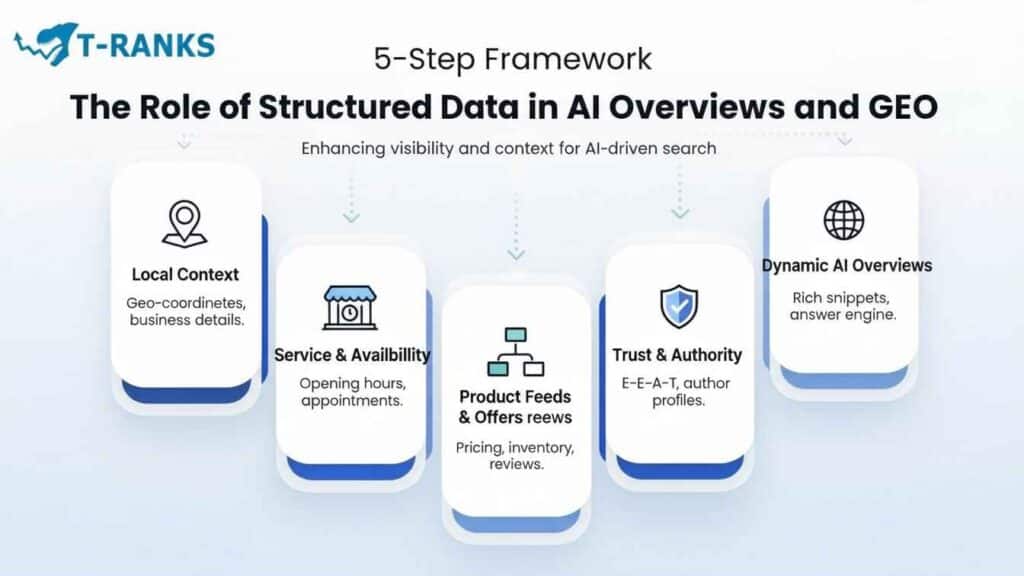
In 2026, Generative Engine Optimization (GEO) and AI Overviews have become increasingly important for brands and businesses. Structured data plays a key role in helping websites adapt to these new search environments. Rather than influencing traditional rankings, structured data acts as a machine-readable visibility layer that helps AI systems understand, verify, and accurately reuse information.
Role in AI Overviews
Structured data gives AI systems the context they need to interpret content with confidence. While AI models can read plain text, schema markup removes ambiguity by clearly signaling whether a section represents a verified answer, an authoritative source, or a defined entity.
When people, organizations, topics, and attributes are consistently defined, AI systems can validate this information against known entity data. This increases citation confidence and makes it more likely for AI Overviews to reference and attribute the content as a trusted source rather than paraphrasing it anonymously.
Role in Generative Engine Optimization (GEO)
Generative Engine Optimization focuses on how AI systems retrieve and assemble information instead of how pages rank in search results. Structured data supports this process by making content easier to extract, organize, and reuse in AI-generated responses.
Clear, answer-oriented structures help AI systems surface accurate information in conversational and summary-based outputs. At the same time, entity-based signals help AI models assess credibility before deciding which sources to cite, reference, or prioritize in generated answers.
Why Structured Data Matters for AI-Driven Retrieval
For AI-driven search environments, structured data functions as retrieval support rather than a ranking signal. It improves eligibility for extraction, attribution, and reuse across AI summaries, conversational results, and research-driven discovery experiences.
When implemented consistently, structured data helps content remain visible and citable as search continues to move toward AI-assisted answers in 2026 and beyond.
How Structured Data Creates Link Opportunities
Structured data creates link opportunities by improving how content is discovered, understood, and trusted across search and AI-driven environments. Rather than generating backlinks directly, it increases the likelihood that the right people encounter and reference the content during research.
These opportunities tend to come from a few consistent sources.
Link Opportunities from Journalists and Media Research
Journalists frequently search for original facts, statistics, and expert explanations when preparing articles. Structured data helps surface content with clear topic definitions and verified attribution in prominent search features. When information is easy to evaluate and appears credible at first glance, it is more likely to be cited in news coverage and reports.
Link Opportunities from Bloggers and Resource Creators
Bloggers and publishers building guides, comparisons, and resource pages look for reliable sources to support their content. Pages that appear with enhanced search visibility and clear topical focus signal depth and usefulness. This makes them stronger candidates for inclusion as linked references in long-form content.
Link Opportunities from Editors and Content Reviewers
Editors prioritize accuracy, clarity, and source legitimacy when deciding what to cite. Structured data reduces uncertainty by clearly identifying authorship, brand identity, and subject relevance. When verification is straightforward, editors are more comfortable linking to the content as an authoritative source.
Link Opportunities from AI Summaries and Secondary Discovery
AI-generated summaries expose content to new audiences beyond traditional search results. When structured data enables a page to be cited in AI-driven answers, it increases brand visibility even without direct clicks. Content creators often explore cited sources during follow-up research, which frequently leads to natural backlinks.
Schema Types That Create Real Link Opportunities
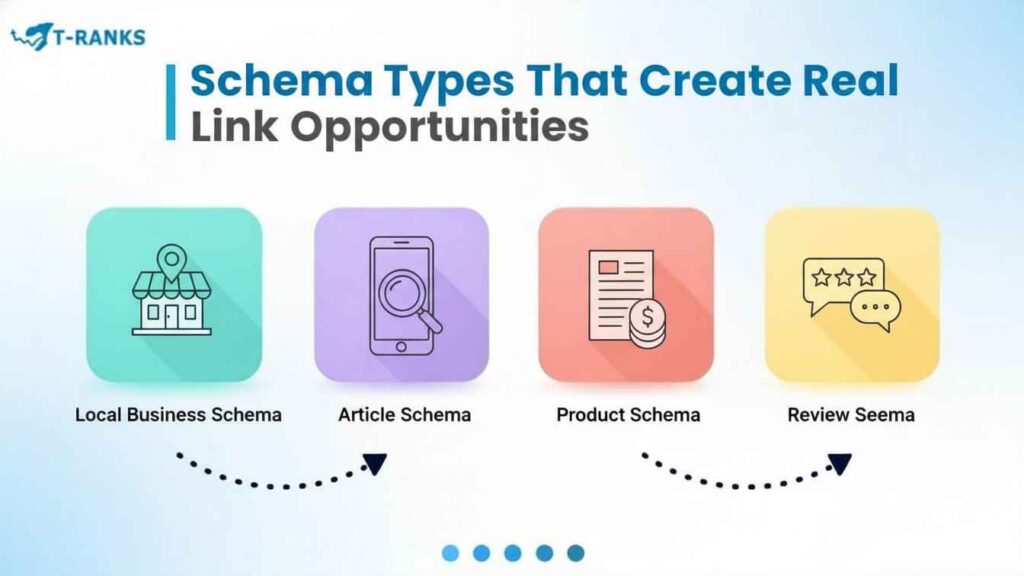
Not all schema types are designed to support link earning.
Some schema formats mainly help with technical understanding, while others directly improve visibility, trust, and citation likelihood. The schema types below consistently create real link opportunities because they align with how publishers, editors, and AI systems evaluate authority.
Organization Schema for Brand Authority
Organization schema defines brand identity and verification by clearly stating who you are, what your organization represents, and where it exists online.
It supports Knowledge Panel eligibility, which acts as third-party validation that journalists and editors trust when deciding whether to cite a source.
The sameAs property consolidates your brand across verified profiles such as official social accounts, Wikipedia, or industry directories, reducing ambiguity and strengthening authority signals that encourage natural backlinks.
Person and Author Schema for Expert Citations
Person and Author schema establish clear authorship and expertise behind content. They define credentials, experience, and topical focus, making expertise immediately verifiable.
This clarity increases editorial and PR citation value because journalists prefer quoting identifiable experts over anonymous sources.
These schema types directly reinforce E-E-A-T signals by demonstrating experience, subject knowledge, and real-world authority, which is critical for earning expert-driven links.
Article Schema for Content Discovery
Article schema clarifies topic ownership, publication details, and authorship. It helps search engines understand what a piece of content covers and who is responsible for it.
This structure improves eligibility for Discover surfaces, news features, and AI summaries, increasing exposure during research moments.
Structured attribution ensures proper credit when content is cited, increasing the likelihood that backlinks point to the original source rather than secondary summaries.
FAQPage Schema for High-Intent Linkable Answers
FAQPage schema organizes content into clear question-and-answer pairs that are easy to extract.
This format is highly compatible with featured snippets and AI-generated answers, making it citation-friendly.
High visibility for informational queries places FAQ content directly in front of researchers and content creators seeking definitive answers, making it one of the strongest schema types for earning natural links.
Product and Service Schema for Commercial Links
Product and Service schema support monetizable link opportunities by clearly presenting offerings in search results.
Review ratings, pricing, and availability act as trust signals that attract affiliates, reviewers, and comparison sites.
These signals increase inclusion in buying guides, “best of” lists, and product roundups that naturally generate backlinks.
LocalBusiness Schema for Local Citations
LocalBusiness schema verifies location-based information such as address, hours, and services.
It improves local pack visibility, making businesses easier to discover by local journalists, bloggers, and community platforms.
Consistent local data also supports directory listings and local media mentions, which are common sources of high-quality local backlinks.
How Structured Data Strengthens Topical Authority
Topical authority is a site’s ability to be recognized as a trusted and comprehensive source on a specific subject. It is built through depth, clarity, and consistent coverage of related topics rather than isolated pages or repeated keywords.
Structured data supports topical authority by clearly defining how topics, subtopics, authors, and concepts relate to each other across a site. Schema markup helps search engines understand these relationships, allowing them to interpret the site as a connected knowledge system instead of a collection of unrelated pages.
Consistency plays a more important role than keyword repetition. When structured data uses the same entity definitions, authors, and topic references across relevant content, it signals genuine subject expertise. This consistent entity usage helps search engines and AI systems associate the site with an entire topic area, not just individual search terms.
By organizing content into a structured network of connected entities, structured data creates a strong foundation for long-term topical authority. It makes expertise easier to verify, easier to trust, and easier to surface across both traditional search results and AI-driven discovery environments.
Entity-Based Internal Linking and Structured Data
Entity-based internal linking reinforces topical authority by connecting concepts instead of keywords and aligning those connections with structured data.
This approach helps search engines and AI systems understand not just where links point, but why pages are related.
Entity-driven internal anchors replace generic or keyword-stuffed links with clear entity references. Instead of linking with vague anchors, pages connect using topic names, concepts, or entities that represent real subjects. This reduces ambiguity and signals stronger semantic relationships across content.
Alignment between schema and HTML links amplifies these signals. When structured data defines an entity relationship using properties like about, mentions, or mainEntityOfPage, and the HTML content links to the same related page, search engines receive consistent confirmation from both machine-readable markup and visible navigation. This consistency helps identify pillar pages, supporting content, and topic clusters more accurately.
Improved crawl understanding is the result of this alignment. Schema-backed internal links act as a semantic map that helps crawlers interpret hierarchy, relevance, and importance faster. Search engines can discover related content more efficiently, understand topical depth, and prioritize authoritative pages. Together, entity-based linking and structured data create a clearer site structure that supports stronger indexing, AI retrieval, and long-term authority building.
How to Measure the Impact of Structured Data on Links
The impact of structured data is measured through visibility, extraction, and citation signals rather than rankings alone.
Because structured data drives discovery and trust, its success is reflected in how often content is surfaced, cited, and referenced across search and AI systems.
Step 1: Track rich result appearance
The first indicator is whether structured data is generating enhanced visibility.
In Google Search Console, use the Enhancements and Performance reports to review rich result impressions and clicks.
Pages appearing as FAQs, reviews, or product snippets should show higher impressions and improved click-through ratesvisual search tools compared to standard listings. Growth here confirms that structured data is increasing exposure and making content easier to discover.
Step 2: Measure featured snippet acquisition
Featured snippets and People Also Ask placements signal successful answer extraction.
Track how often pages appear in position zero using Search Console and rank-tracking tools.
An increase in snippet ownership shows that structured answers are being reused by search systems. These placements are frequently used by journalists and bloggers as citation sources, making them a leading indicator of link growth.
Step 3: Monitor AI Overview inclusion
AI Overviews represent modern discovery beyond clicks.
Manually test key queries and monitor analytics platforms to see whether content is cited in AI-generated answers.
Consistent inclusion indicates that structured data is improving retrieval eligibility and citation confidence. Even when traffic is limited, repeated AI citations strengthen brand visibility and authority.
Step 4: Track brand mentions and referring domains
The final confirmation comes from link and mention growth.
Use backlink tools to compare referring domains before and after structured data implementation.
Look for increases in editorial links, unlinked brand mentions, and citations from relevant publications. These signals show that structured data-driven visibility is converting into earned links.
Key metrics to monitor
| Metric | Tool | Success Indicator |
| Rich result CTR | Google Search Console | 20–30% higher CTR vs standard listings |
| Featured snippets | Search Console / Rank trackers | Consistent position zero ownership |
| AI Overview citations | Manual checks / Analytics | Brand cited as a source in AI answers |
| Brand mentions | Ahrefs / Semrush | Growth in unlinked and linked mentions |
| Referring domains | Ahrefs / Semrush | 5–15% increase over 3–6 months |
Common Structured Data Mistakes That Block Authority
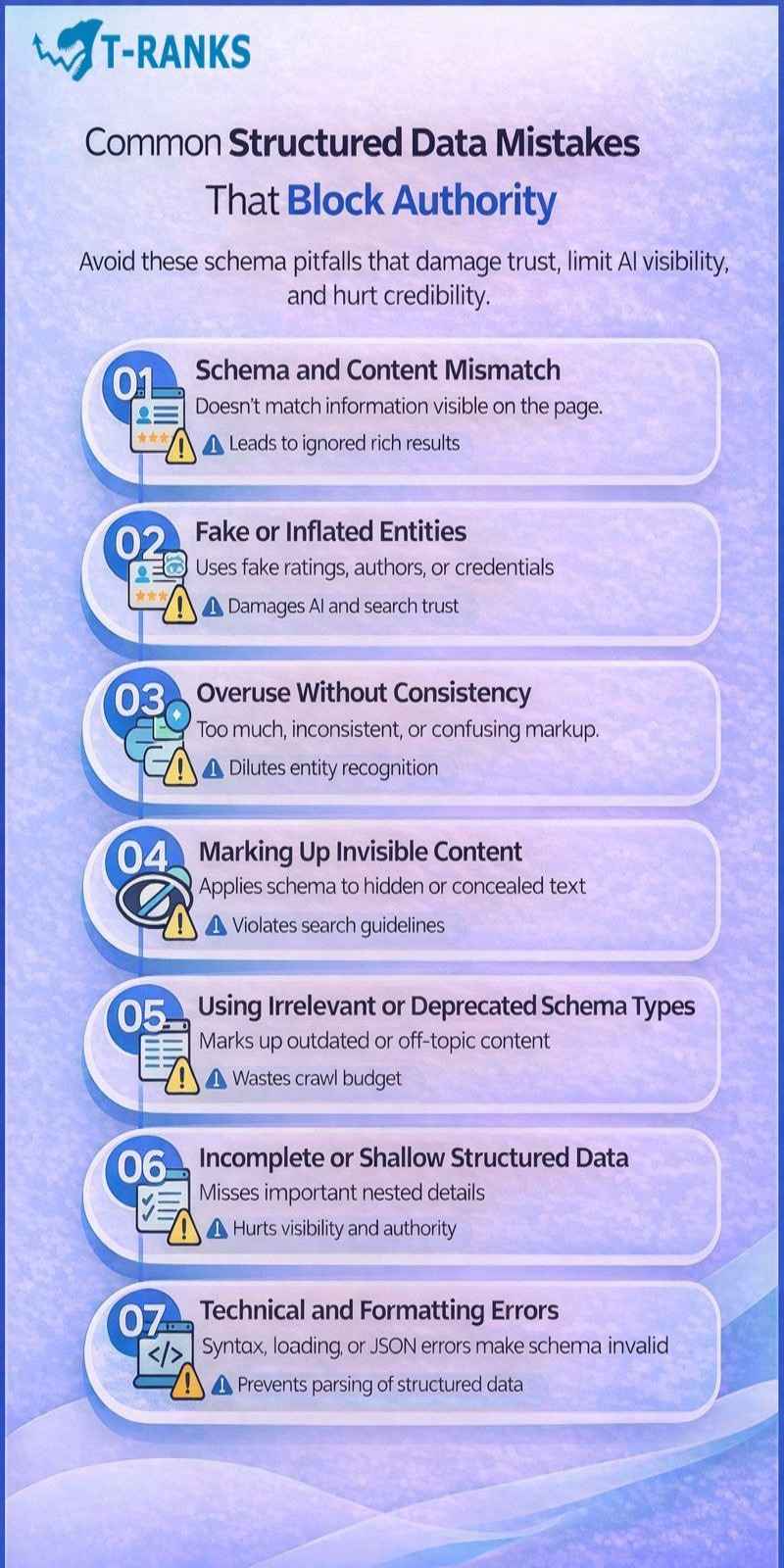
Structured data can block authority when it sends inconsistent, misleading, or low-confidence signals to search engines and AI systems.
In 2025, these mistakes do not just prevent rich results; they reduce trust, limit AI visibility, and weaken entity credibility.
Mistake 1: Schema and Content Mismatch
This occurs when structured data describes information that is not clearly visible on the page. Examples include FAQ answers that are not shown to users, ratings that do not exist, or author details that differ from the content.
Search engines treat this as deceptive behavior. When mismatches are detected, rich result eligibility can be removed, and structured data from the page may be ignored entirely.
Mistake 2: Fake or Inflated Entities
Defining exaggerated reviews, fabricated author credentials, or misleading organization details damages trust. Search engines cross-check entity data against external sources such as Knowledge Graph entries and trusted platforms.
Inflated ratings or false expertise signals can trigger structured data penalties, reduce AI citation confidence, and weaken long-term authority signals.
Mistake 3: Overuse Without Consistency
Applying schema across many pages without a clear framework creates confusion. Common issues include inconsistent entity identifiers, duplicate entities for the same brand or author, and irrelevant schema types applied to the wrong content.
Instead of reinforcing authority, this dilutes entity recognition and makes it harder for search engines to understand topical focus.
Mistake 4: Marking Up Invisible or Hidden Content
Structured data must reflect content visible to the average user. Marking up hidden FAQs, concealed reviews, or non-visible text violates search engine guidelines.
When hidden markup is detected, search engines may ignore all structured data on the page, reducing visibility and trust signals.
Mistake 5: Using Irrelevant or Deprecated Schema Types
Some schema types no longer trigger enhanced visibility or are restricted to specific content categories. Continuing to use outdated or irrelevant schema does not improve performance and can waste crawl resources.
Using schema types that do not align with the actual content prevents structured data from contributing to authority or discovery.
Mistake 6: Incomplete or Shallow Structured Data
Providing only minimal required fields limits authority signals. Missing nested details such as author expertise, organization profiles, or entity relationships reduces confidence for AI systems and search engines.
Shallow schema makes content less attractive for AI Overviews and citation-driven discovery.
Mistake 7: Technical and Formatting Errors
Syntax errors, invalid JSON formatting, or slow-loading schema can render structured data unreadable. If search crawlers cannot parse the markup reliably, it is treated as nonexistent.
To avoid this, structured data must be accurate, visible, consistent, and technically sound. One clean, well-aligned implementation provides more authority value than large-scale, careless markup.
How to Implement JSON-LD for Link Building Safely
Implementing JSON-LD safely means prioritizing authority, accuracy, and long-term trust over rapid or sitewide deployment. When structured data is applied with discipline and restraint, it strengthens discovery and link earning without introducing risk.
As explained below, safe JSON-LD implementation requires prioritization, accuracy, and consistency rather than broad or aggressive deployment.
Start With High-Value Pages Only
Structured data should first be applied to pages that naturally attract links and citations. Pillar content, original research, FAQs, author profiles, core product or service pages, and the main Organization page generate the highest return from structured data. Applying schema to these assets improves visibility where editorial discovery already occurs.
Use Schema Types That Support Visibility and Citation
Not all schema types contribute to link earning. Article, FAQPage, Person, Organization, Product, and Service schema align with how journalists, editors, and AI systems evaluate sources. Generic or loosely related schema types add little authority value and should be avoided.
Define Entities Using Consistent Identifiers
Key entities such as brands and authors should use stable @id values across all relevant pages. Consistent identifiers help search engines and AI systems recognize the site as a single authoritative entity rather than fragmented pages, reinforcing topical authority and link trust.
Avoid Schema Spam and Manipulative Markup
Only mark up content that is visible, accurate, and relevant to users. Inflated ratings, fabricated credentials, hidden FAQs, or irrelevant schema types undermine trust and can result in ignored markup or lost rich result eligibility.
Validate and Monitor Continuously
Every structured data implementation should be validated before publishing. Ongoing monitoring ensures eligibility is maintained as content changes and errors are identified early. Continuous validation protects authority signals over time.
Keep Structured Data Aligned With Page Content
All structured data attributes must match what users see on the page. Author details, pricing, reviews, and answers should be clearly visible and consistent. This alignment prevents manual actions and preserves editorial credibility.
Structured Data Link Building Strategies for 2026
Structured data link building in 2026 is no longer about adding schema for compliance. It is about using structured data strategically to support discovery, credibility, and citation in AI-driven search environments. The following strategies focus on practical actions that consistently create link opportunities without relying on manual outreach.
Strategy 1: Prioritize Pages That Naturally Attract Citations
Not all pages benefit equally from structured data. In 2026, priority should be given to pages that are already designed to earn references, such as original research, statistics pages, FAQs, expert profiles, core service pages, and authoritative guides. Applying structured data to these assets improves their visibility in search features where journalists, bloggers, and AI systems actively look for sources.
Strategy 2: Define Core Entities Before Expanding Coverage
Effective link earning starts with clear entity definition. Brands, authors, products, and key topics should be defined consistently across the site before scaling structured data to supporting content. This ensures search engines and AI systems recognize the site as a single, coherent authority rather than fragmented pages, which strengthens trust and increases citation likelihood.
Strategy 3: Use Answer-Oriented Schema to Support Citation
Content that clearly answers questions is more likely to be reused and cited. In 2026, schema types that support answer extraction, such as FAQPage and Article schema with clear section definitions, help AI systems and editors identify authoritative responses quickly. This increases inclusion in AI Overviews, featured snippets, and research summaries that lead to backlinks.
Strategy 4: Align Structured Data With Editorial Research Behavior
Link opportunities often come from how editors and researchers search, not from how SEOs think. Structured data should highlight authorship, publication context, and factual attributes that editors look for when verifying sources. Making this information explicit reduces verification effort and increases the chance of being cited as a trusted reference.
Strategy 5: Strengthen Entity Relationships Across Related Content
Structured data is most effective when it reinforces topical connections. In 2026, linking related pages through shared entities, consistent authorship, and aligned topic definitions helps search systems understand subject depth. This increases the likelihood that multiple pages from the same site are cited across different contexts, compounding link growth over time.
Strategy 6: Measure Visibility and Citations, Not Just Rankings
Link building success in 2026 cannot be measured by rankings alone. Structured data strategies should be evaluated based on appearance in rich results, AI Overviews, featured snippets, brand mentions, and referring domains. Monitoring these signals helps identify which structured data implementations actually lead to discovery and links, allowing strategies to be refined without scaling blindly.
Final Thoughts on JSON-LD and Authority Building
In conclusion, structured data link building has become a core authority layer in modern search and AI-driven discovery. JSON-LD helps search engines and AI systems clearly understand entities, expertise, and relationships, making content easier to retrieve, verify, and cite.
Rather than driving rankings directly, structured data strengthens eligibility for rich results, AI Overviews, and knowledge-based surfaces where trust is established. As discovery continues to shift away from traditional rankings, backlinks increasingly emerge as a byproduct of consistent visibility and citation.
Over time, accurate entity definitions and aligned schema reinforce Knowledge Graph connections, allowing authority and links to compound as search interfaces evolve. Brands that invest in machine-readable trust today are better positioned to earn sustainable authority moving forward.
FAQs About Structured Data & Link Opportunities
What is structured data link building?
Structured data link building is the use of schema markup to increase content visibility, which leads to earned backlinks.
It helps search engines and AI systems clearly understand entities and answers, making the content easier to discover and cite.
Is structured data a direct Google ranking factor?
No, structured data is not a direct Google ranking factor.
It improves eligibility for rich results, AI citations, and higher click-through rates, which indirectly supports link earning and authority growth.
How does structured data help earn backlinks?
Structured data helps earn backlinks by increasing visibility in rich results, featured snippets, and AI summaries.
This exposure attracts journalists, bloggers, and editors who link to authoritative sources during research.
Why is JSON-LD preferred over other schema formats?
JSON-LD is preferred because it is easier to implement, maintain, and parse by search engines.
Google recommends JSON-LD since it keeps structured data separate from HTML and supports complex entity relationships.
Can structured data improve AI Overview visibility?
Yes, structured data improves AI Overview visibility by making content easier to extract and verify.
Clear entity definitions increase citation confidence for AI-generated answers.
Which schema types are best for link building?
FAQPage, Organization, Person, and Article schema are the most effective for link building.
They support answer extraction, expert attribution, and brand trust signals used by search engines and AI systems.
Why does FAQPage schema attract more links?
FAQPage schema attracts more links because it provides concise, citable answers.
These answers frequently appear in featured snippets and AI summaries, making them easy to reference.
Does Organization schema help with backlinks?
Yes, Organization schema helps by strengthening brand credibility and Knowledge Panel visibility.
Verified brand entities are more likely to be cited and linked by publishers.
How does Person or Author schema support link building?
Person or Author schema supports link building by clearly defining expertise and credentials.
This increases editorial confidence when journalists reference expert content.
Can structured data replace traditional link building?
No, structured data cannot replace traditional link building.
It acts as an authority amplifier that helps quality content earn links more naturally over time.
Can Google penalize incorrect structured data?
Yes, Google can ignore or flag structured data that is misleading or inaccurate.
Incorrect schema can block rich results and weaken authority signals.
Is structured data still worth using in 2025 and beyond?
Yes, structured data is increasingly important in 2025 and beyond.
AI-driven search relies on entity clarity and machine-readable content for discovery and citation.