You have built a great product. You have optimized your landing page. You have published blog content. But your app is still invisible on Google while competitors with weaker products rank above you and take every trial signup you should be getting.
The problem is not your product. It is not your content. It is your backlinks. Without quality links from trusted tech sources Google has no reason to rank your app website above the established players dominating every relevant keyword.
Building backlinks for mobile app and SaaS websites works differently from every other industry. Integration partnerships, developer communities, product launch platforms, and software review sites all create unique link building opportunities that most teams completely ignore.
This guide covers every proven strategy for 2026. From software directories and digital PR to integration links, developer communities, and measuring what actually drives more signups and downloads for your app.
Why Backlinks Matter for Mobile Apps and SaaS Products

Backlinks matter for mobile apps and SaaS products because Google uses them as trust signals. When a respected tech publication, software review site, or developer community links to your app website it tells Google your product is credible and worth ranking.
Think of it this way. Every backlink pointing to your site is a vote of confidence from another website. The more relevant and authoritative those votes are the higher Google ranks your product. Without them your app stays invisible no matter how good your features or content are.
Why SaaS and App Link Building Is Harder Than Other Niches
The tech and SaaS space is brutally competitive. You are not just competing with similar products. You are competing with media outlets, SaaS aggregators, and well-funded competitors that have been building backlinks for years.
According to GrowthBacklinks, over 66% of SaaS product pages have zero referring domains. Feature pages, pricing pages, and comparison pages almost never rank without targeted backlinks. These are the pages that drive trial signups and downloads — and they need external authority signals to compete.
How Backlinks Now Influence AI Search Visibility
In 2026 backlinks do more than help you rank on Google. AI tools like ChatGPT, Perplexity, and Google AI Overviews use backlink signals to decide which apps and SaaS products to recommend in their answers. If your app is not being cited by trusted tech sources it will not appear in those AI-generated recommendations.
According to Ahrefs, 76.10% of pages cited in AI Overviews also rank in Google’s top 10 results. A strong backlink profile wins you visibility in both traditional and AI search at the same time.
App Store Optimization vs Website Link Building
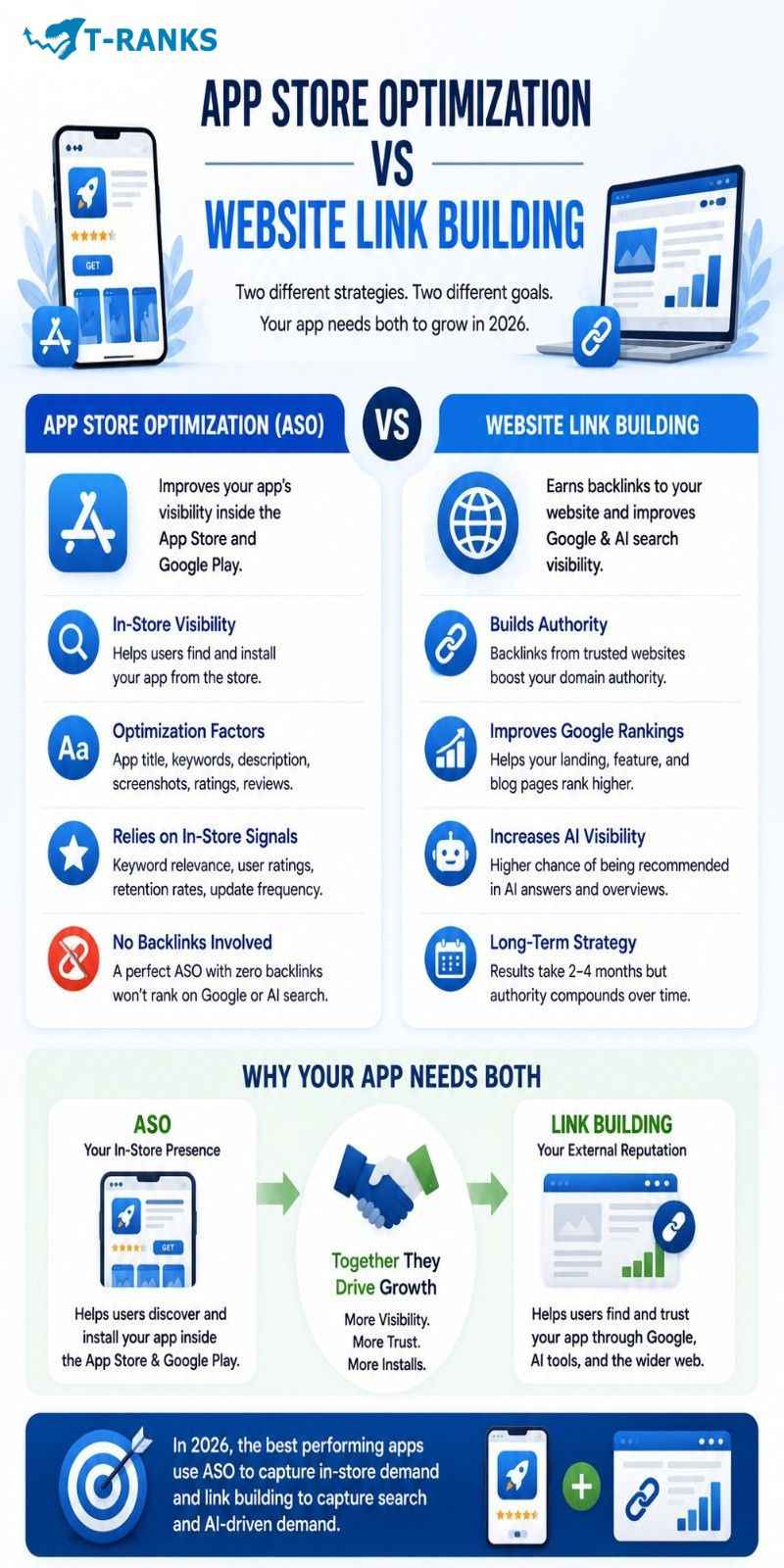
App store optimization and website link building are two completely different disciplines. One improves how your app ranks inside the App Store and Google Play. The other improves how your website ranks on Google and AI search tools. Most app teams focus on one and ignore the other and that is a costly mistake.
What Is App Store Optimization
App Store Optimization is the process of improving your app’s visibility inside the Apple App Store and Google Play. It covers your app title, keywords, description, screenshots, ratings, and reviews. ASO helps users find and install your app directly from the store.
ASO does not involve backlinks. It relies entirely on in-store signals like keyword relevance, user ratings, retention rates, and update frequency. A perfectly optimized app store listing with zero website backlinks will still struggle to appear in Google search results or AI-generated app recommendations.
What Is Website Link Building for Apps
Website link building is the process of earning backlinks from external websites to your app’s landing page, feature pages, or blog content. These backlinks improve your Google rankings, build your domain authority, and increase your chances of appearing in AI-generated answers when users search for apps like yours.
Unlike ASO, website link building is a long-term authority building strategy. Results take 2 to 4 months to show but the authority compounds over time and becomes increasingly difficult for competitors to replicate.
Why Your App Needs Both
ASO and website link building serve completely different purposes but work best together. Think of ASO as your in-store shelf presence. It helps users find and install your app inside the store. Think of website link building as your external reputation. It helps Google and AI tools recommend your app to users who have never opened an app store.
In 2026 the best performing apps use both. ASO captures demand inside the store. Website link building captures demand from Google search and AI-generated recommendations outside it.
What Makes a Good Backlink for Your App

A good backlink for a mobile app or SaaS product comes from a relevant, authoritative tech source that real users and developers actually read. Not every link is worth pursuing. Understanding what separates a valuable app backlink from a useless one saves you time and budget.
Relevance, Authority, and Traffic
Relevance is the most important factor for app and SaaS backlinks. A link from a tech blog, software review platform, developer community, or SaaS publication directly reinforces your product’s topical authority. A link from an unrelated lifestyle or finance site adds almost no value regardless of its domain rating.
Authority determines how much ranking power a link passes to your site. Links from established tech publications, respected SaaS blogs, and high-traffic software directories carry far more weight than links from newly created tech blogs with no track record. Always check a site’s domain rating and organic traffic before pursuing a link from it.
Traffic is the most overlooked factor. A link from a site with real organic visitors sends qualified referral traffic directly to your app landing page. Those visitors are often evaluating tools and are ready to sign up for a trial. A high DR site with no real traffic delivers authority signals but no actual users.
Dofollow vs Nofollow Links for Apps and SaaS
A dofollow link passes full SEO value to your app website. These links directly improve your rankings and build your domain authority. Prioritize dofollow links in every outreach campaign.
A nofollow link does not pass direct ranking value but still has an important place in your backlink profile. Links from G2, Capterra, Product Hunt, and app directories are typically nofollow. They still drive real referral traffic and add natural diversity to your link profile. A healthy app or SaaS backlink profile contains a strong mix of both.
Where to Point Your Backlinks on a SaaS Website
Most SaaS teams build backlinks to their blog posts. That is one of the most common and costly mistakes in SaaS link building. Blog posts build traffic. Product pages, pricing pages, and comparison pages build revenue. Your backlinks should go where your conversions happen.
Product and Pricing Pages vs Blog Posts

Blog posts can sometimes rank on content strength alone. Product pages, pricing pages, feature pages, and comparison pages almost never rank without targeted backlinks. Yet these are the pages your potential users visit when they are ready to sign up or buy.
According to PipeRocket Digital, most SaaS backlinks go to blog posts when product, comparison, and pricing pages are what actually drive revenue. A product page sitting in position 11 to 20 needs only a concentrated backlink push to reach page one. A blog post in the same position may drive traffic but rarely converts into signups.
| Page Type | Ranking Without Backlinks | Conversion Rate | Backlink Priority |
| Product pages | Almost never | High | First |
| Pricing pages | Almost never | Very high | First |
| Comparison pages | Rarely | 3 to 5x blog posts | Second |
| Feature pages | Rarely | High | Second |
| Blog posts | Sometimes | Low | Last |
| Homepage | Sometimes | Medium | Balanced |
How Internal Linking Helps Distribute Authority
Not every backlink needs to point directly to your product pages. When an external site links to your blog post that authority can flow to your product pages through strong internal linking.
Build a clean internal linking structure that connects every blog post to your most important product and feature pages. Use anchor text optimization to ensure your internal links use natural descriptive anchor text. Every external link you earn becomes more powerful when internal links distribute that authority to the pages that drive real revenue.
The Best Link Building Strategies for Mobile Apps and SaaS Products
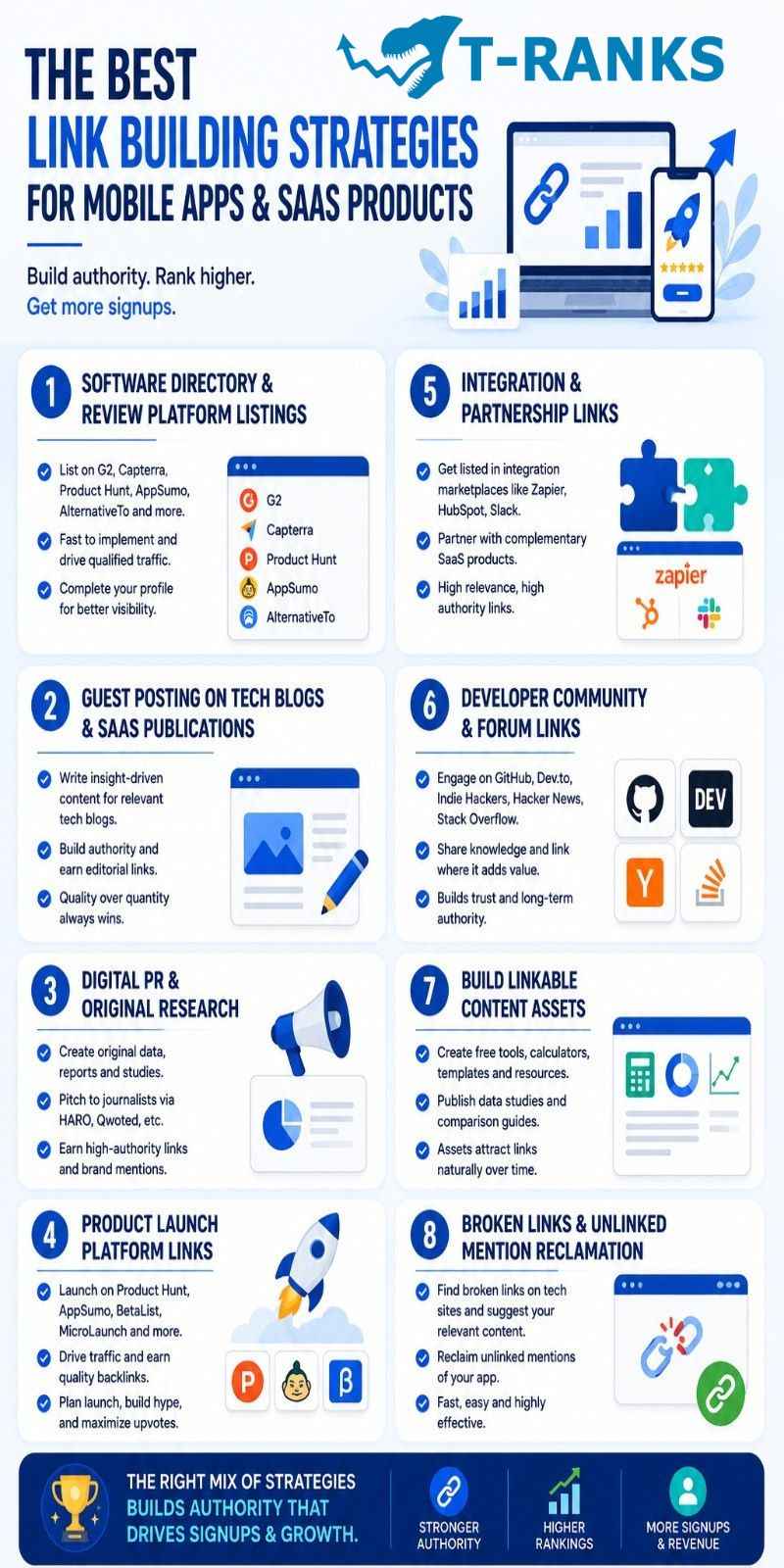
The best link building strategies for mobile apps and SaaS products in 2026 are software directory listings, guest posting, digital PR, product launch platform links, integration partnerships, developer community links, linkable content assets, and broken link building. Each builds authority differently and the right mix depends on your app stage and budget.
1. Software Directory and Review Platform Listings
Software directories are the fastest starting point for any new mobile app or SaaS product. Getting listed on G2, Capterra, Product Hunt, AppSumo, and AlternativeTo earns backlinks from high-authority platforms while putting your product in front of buyers actively evaluating tools.
Most directory listings are free and take less than 30 minutes to submit. The links are typically nofollow but they drive real referral traffic from users already in evaluation mode. A strong profile with genuine reviews also strengthens your E-E-A-T signals and makes your product more credible to AI search tools.
Start with the five most relevant directories for your app category. Complete every field including description, screenshots, integrations, and pricing. Incomplete listings rank lower inside the directory and earn less referral traffic than fully optimized ones.
2. Guest Posting on Tech Blogs and SaaS Publications
Guest posting on relevant tech blogs earns editorial backlinks while positioning your product as a credible voice in its niche. Focus on publications your target users actually read and not generic high-DA blogs with no audience overlap.
Pitch specific insight-driven angles tied to the problem your app solves. A data-backed article, a unique framework, or a firsthand case study gets editorial responses. Generic pitches get ignored. One well-placed guest post on a niche SaaS blog outperforms ten placements on irrelevant high-DA sites.
Use free guest post sites to build your portfolio before targeting premium tech publications. Start with niche-specific blogs your audience reads then work up to established SaaS and tech media outlets.
3. Digital PR and Original Research
Digital PR is the most powerful link building strategy for SaaS products in 2026. One placement in TechCrunch or Forbes Tech can move rankings faster than twenty standard guest posts. The foundation is original data including benchmark reports, product usage statistics, and trend studies that journalists need.
Use HARO, Qwoted, and SourceBottle to respond to journalist queries in your product category. Set up keyword alerts for your niche and respond within the first two hours of receiving a query. Fast credible responses from genuine product experts consistently earn high-authority placements.
When your data gets cited by tech publications you earn natural editorial backlinks without any traditional outreach cost. That is what makes digital PR the highest ROI link building channel available to SaaS products.
4. Product Launch Platform Links
Product launch platforms are a unique link building opportunity most SaaS teams underuse. A successful Product Hunt launch can drive thousands of visitors in a single day and generate dozens of secondary backlinks from tech blogs covering noteworthy launches.
Submit your app to Product Hunt, AppSumo, BetaList, and MicroLaunch. Each platform provides a dedicated product page with a backlink to your site. Plan your Product Hunt launch for a Tuesday to Thursday window and build your hunter network in advance to maximize upvotes on launch day.
Treat every major product update and feature release as a relaunch opportunity. Each submission earns a fresh round of backlinks and referral traffic from users actively looking for new tools.
5. Integration and Partnership Links
Every software integration your product supports is a free high-relevance backlink opportunity. If your app integrates with Zapier, HubSpot, or Slack get listed on their integration marketplace immediately. These platforms have domain ratings above 90 and their pages earn consistent referral traffic from users looking for connected tools.
Reach out to complementary SaaS products that share your target audience and propose co-marketing partnerships. A joint webinar, shared resource guide, or mutual integration creates natural cross-linking opportunities that Google recognizes as genuine ecosystem authority signals.
Partnership links are among the most valuable backlinks a SaaS product can earn. They are highly relevant, editorially placed, and come from sources your potential users already trust and use daily.
6. Developer Community and Forum Links
Developer communities are a goldmine for mobile app and SaaS backlinks that most marketing teams completely ignore. Platforms like GitHub, Dev.to, Indie Hackers, Hacker News, and Stack Overflow are trusted by search engines and heavily referenced by tech publications.
Publish technical articles on Dev.to about the problem your app solves. Open source a useful SDK or library on GitHub. Participate genuinely in Indie Hackers and Hacker News discussions and link to your product where it adds real value to the conversation.
Developer community links are harder to earn than directory submissions but far more valuable. They signal to Google that your product is genuinely recognized within the developer ecosystem and that is a trust signal competitors cannot replicate quickly.
7. Building Linkable Content Assets
A linkable content asset is a resource so useful that other sites naturally want to reference and link to it. For SaaS products this is the most sustainable form of link building because links keep coming long after the content is published.
The most effective linkable assets for SaaS sites include free tools tied to your product such as ROI calculators, cost estimators, and productivity planners. Original research reports, comprehensive comparison guides, and curated statistics pages also attract consistent editorial links over time.
Promote every linkable asset actively after publishing. Share it in developer communities, pitch it to tech journalists, and reach out to bloggers who regularly cite data and tools in your niche.
8. Broken Links and Unlinked Mention Reclamation
Broken link building finds dead links on established tech websites and offers your relevant page as a replacement. It is one of the cleanest white hat link building techniques available for SaaS products because you are solving a real problem for the site owner rather than asking for a favor.
Unlinked mention reclamation is even faster. Use Google Alerts or Ahrefs Content Explorer to find tech blogs and publications that mention your app by name without linking to your website. A short friendly email thanking them for the mention and asking them to add a link converts at 3 to 5 times the rate of cold outreach.
Combine both tactics into a monthly link reclamation audit. Two hours every month finding and claiming broken links and unlinked mentions produces some of the fastest and most cost-effective links available to any SaaS product.
Strategy Comparison
| Strategy | Difficulty | Speed of Results | Best For |
| Software Directories | Easy | 1 to 2 weeks | All apps and SaaS |
| Guest Posting | Medium | 2 to 4 months | All apps and SaaS |
| Digital PR | High | 1 to 3 months | Established products |
| Product Launch Platforms | Easy | 1 to 2 weeks | New and updated apps |
| Integration Links | Medium | 2 to 4 weeks | SaaS with integrations |
| Developer Communities | Medium | 1 to 3 months | Dev-focused apps |
| Linkable Content Assets | Medium | 3 to 6 months | Long term authority |
| Broken Links and Mentions | Easy | 1 to 2 weeks | All apps and SaaS |
Link Building by App Type
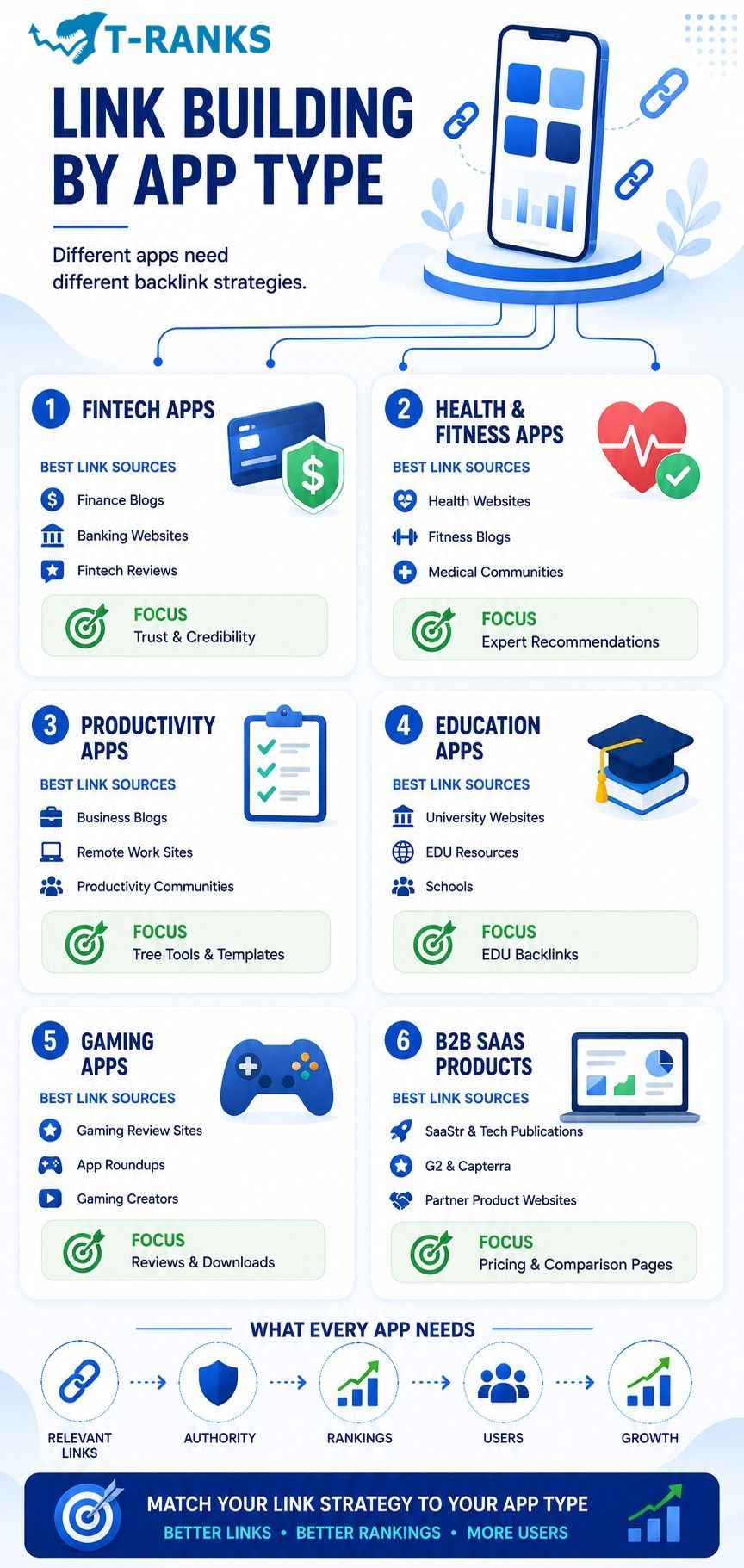
Link building looks different depending on what type of app or SaaS product you have built. The strategies that work for a fintech app are not the same ones that work for a gaming app or a B2B SaaS platform. Here is what each app type should focus on.
Fintech Apps
Fintech apps need to build trust before users will hand over their financial data. Focus on getting links from money and finance websites, banking blogs, and fintech review platforms that your target users already read and trust.
Original research works best here. A report on payment trends or expert commentary in a finance publication earns strong links while showing Google and users that your product is credible and safe to use.
Health and Fitness Apps
Health apps need links from sources that prove your product is credible. Links from health blogs, medical websites, and fitness communities tell Google your app is trustworthy. Google pays extra attention to trust signals for health-related products.
Work with certified health professionals and fitness coaches who have real websites. A review or mention from a qualified health expert is worth far more than a link from a generic tech blog.
Productivity Apps
Productivity apps are great at earning links through free useful content. Templates, workflow guides, and time-saving tools attract links from business blogs, remote work sites, and productivity communities without any outreach needed.
Getting featured in a “best productivity tools” article on a popular business website earns you a strong backlink and sends the right users directly to your app to sign up.
Education Apps
Education apps can earn some of the most powerful links available. EDU backlinks from university websites and academic resource pages carry exceptional trust and are very difficult for competitors to replicate.
Create content that teachers and schools genuinely find useful — study guides, curriculum resources, and learning tools. Getting listed on a university’s recommended tools page earns a highly relevant link that most apps never manage to secure.
Gaming Apps
Gaming apps grow best through links from gaming review sites, app blogs, and gaming communities. Getting your game reviewed on established gaming websites and featured in app roundups builds both authority and direct downloads from the right audience.
Gaming content creators who review apps on their websites are a powerful link source. A genuine review from a gaming YouTuber or blogger drives real downloads while earning you an editorial backlink from a highly relevant source.
B2B SaaS Products
B2B SaaS products need links from sources that business buyers trust. Links from industry publications like SaaStr and TechCrunch, software review sites like G2 and Capterra, and partner product websites all build the kind of authority that helps your product rank for the keywords your buyers search for.
Point your links at the pages that convert visitors into customers. A link to your pricing page or your competitor comparison page is far more valuable than a link to a blog post that never drives a signup.
Launch-Based Link Building for Mobile Apps

Most app teams treat link building as something they do after launching. That is the wrong approach. The most valuable link building window for any mobile app or SaaS product is the period before and during your launch — not after the initial excitement fades.
Start building links 6 to 8 weeks before your launch date. Submit your app to directories and review platforms early so those pages are indexed and passing authority by the time your product goes live. Reach out to tech journalists and bloggers before launch and offer them early access in exchange for a review or feature.
On launch day treat every platform as a link building opportunity. A well-executed Product Hunt launch generates backlinks from the platform itself and from tech blogs that cover noteworthy launches. Submit to Hacker News, BetaList, MicroLaunch, and Indie Hackers on the same day. Each submission earns a dedicated product page with a permanent backlink that continues passing authority long after launch day traffic fades.
After launch do not stop. Every major product update, new feature release, and pricing change is a fresh link building opportunity. Tech journalists cover product updates. Bloggers write roundups of new tools. Build a simple outreach process around every update your product ships and treat each release as a mini launch that earns new links.
Here is a simple launch based link building timeline to follow:
- 6 to 8 weeks before launch submit to directories and reach out to journalists for pre-launch reviews
- 2 weeks before launch pitch tech bloggers for early access coverage
- Launch day submit to Product Hunt, Hacker News, BetaList, MicroLaunch, and Indie Hackers
- Week after launch follow up with journalists who mentioned you without linking
- Every major update repeat the outreach process and treat each release as a new link building opportunity
How to Measure Your App Link Building Results

Most app and SaaS teams build links but never measure whether they are actually working. Without tracking the right numbers you are spending time and budget without knowing if it is driving rankings, trial signups, or app downloads.
Step 1: Set Up Your Tracking Tools
You do not need every tool available. These three cover everything a mobile app or SaaS product needs:
- Google Search Console — free and essential. Shows keyword rankings and organic traffic directly from Google
- Ahrefs or Semrush — tracks referring domains, lost links, and competitor backlink profiles
- Google Analytics 4 — tracks referral traffic, trial signups, and app downloads from every traffic source
Start with Google Search Console first. It is free and connects directly to Google’s own data. Add Ahrefs once you are ready to track competitor backlinks and find new link opportunities in your niche.
Step 2: Track the Right Metrics
Not every metric tells the same story. These six metrics tell you whether your app link building is delivering real results:
- Referring domains — unique websites linking to your site. More important than total backlink count
- Domain Rating — your overall authority score. Track monthly to measure long term progress
- Keyword rankings — monitor the specific pages you are building links to
- Organic traffic — track in Google Search Console for pages receiving new links
- Referral traffic — links from high traffic tech sites send real visitors. Track in Google Analytics 4
- Trial signups and app downloads — the ultimate metric. Track using goal tracking in Google Analytics 4
Referring domains and keyword rankings are your two primary indicators. Trial signups and app downloads confirm those improvements are translating into real business results.
Step 3: Set a Realistic Timeline
Link building is not instant. Google takes 2 to 4 months to process new backlinks into visible ranking improvements. Competitive SaaS keywords can take 6 to 12 months. Do not judge a campaign by what happens in the first 30 days.
Look for these signals that your link building is working:
- Referring domain count growing steadily month over month
- Target page rankings improving from page 2 or 3 into the top 5
- Organic traffic to linked pages increasing versus the previous period
- Referral traffic arriving from tech sites that linked to you
- Trial signup rate improving on pages receiving new backlinks
Step 4: Connect Links to Revenue
Revenue is the only metric that truly matters for a SaaS product. Set up goal tracking in Google Analytics 4 for trial signup completions, demo requests, and app download clicks. Use UTM parameters on every outreach campaign to trace exactly which links are driving paying customers.
Run a backlink audit every quarter. Toxic backlinks left unchecked suppress your rankings without warning. A clean backlink profile is the foundation of accurate measurement and consistent growth.
Link Building Mistakes Apps and SaaS Products Must Avoid

The biggest link building mistakes apps and SaaS products make are buying cheap backlinks, building links only to blog posts, ignoring developer and integration link opportunities, over-relying on software directories, and treating link building as a one-time task. Any one of these can quietly suppress your rankings for months.
Buying Cheap Backlinks and Using PBNs
Cheap backlinks from link farms and low-quality directories damage your app’s authority fast. Google identifies unnatural link patterns quickly and penalties can take months to recover from.
Understand how PBN links work before using them. A poorly executed PBN strategy leaves footprints that Google’s spam systems identify quickly. Invest in quality placements from relevant tech sources instead.
Building Links Only to Blog Posts
Most app and SaaS teams send all their backlinks to blog posts while product pages, pricing pages, and comparison pages sit without any external authority. These are the pages that convert visitors into trial signups and paying customers.
Build links directly to your highest value pages. Use internal linking to distribute authority from blog posts to your core product pages where it actually drives revenue.
Ignoring Developer and Integration Link Opportunities
Developer communities and integration partner directories are among the most valuable and most ignored link sources for mobile apps and SaaS products. A listing on Zapier’s integration directory, a GitHub repository, or a contribution to Indie Hackers earns highly relevant backlinks at zero cost.
These links come from sources your potential users already trust and use daily. They deliver some of the strongest topical authority signals available in the tech niche and are very difficult for competitors to replicate.
Over-Relying on Software Directories
Software directories like G2 and Capterra are a great starting point but should never be your only link building strategy. Most directory links are nofollow and carry limited SEO authority on their own.
Directories build visibility and referral traffic. Editorial backlinks from tech publications and developer communities build the domain authority that actually moves your rankings. Use directories as your foundation then build genuine editorial links on top.
Treating Link Building as a One-Time Task
Many app teams run a link building campaign at launch then stop. Rankings drop within months. Competitors build links every month and older links naturally lose value over time.
Build link acquisition into your monthly marketing process. Treat every product update as a fresh opportunity to earn new backlinks. Consistent ongoing link building is the only strategy that holds rankings long term.
How to Build a Long-Term Link Building Strategy for Your App

Link building for mobile apps and SaaS products is not a campaign you run once and forget. The products winning in 2026 are the ones that build links consistently every single month. Authority compounds over time. A product with 12 months of steady link acquisition is very difficult for a competitor to overtake quickly.
Start with the foundation. Get listed on every relevant software directory and review platform first. These are free, fast, and build your baseline authority before you tackle harder outreach. Then launch your product on Product Hunt, BetaList, and Indie Hackers to earn your first editorial backlinks from trusted tech platforms.
Then layer your outreach strategies on top. Guest posting, digital PR, integration partner links, and developer community contributions all work best when your site already has content worth linking to. Prioritize based on your app stage and budget:
- New apps and early stage startups — start with directory listings, product launch platforms, and unlinked mention reclamation to build baseline authority quickly
- Growing products — add guest posting, digital PR, and integration partner links once your foundational pages have content and authority
- Established SaaS products — focus on high authority editorial placements, original research campaigns, and AI search visibility to compete at the top level
Stop thinking about link building as a cost. Start thinking about it as the infrastructure that makes everything else work. Better rankings mean more trial signups. More trial signups mean more paying customers. More paying customers mean more revenue.
If you need high-quality backlinks built specifically for your mobile app or SaaS product T-RANKS provides premium link building services trusted by tech brands and SaaS companies across more than 50 countries. From white hat link building techniques to PBN management tools built for SaaS authority T-RANKS delivers links that move rankings and drive real product growth.
Get started with T-RANKS today and build the backlink profile your app needs to compete and win in 2026.
Frequently Asked Questions About Backlinks for a Mobile App or SaaS Product
What are backlinks for mobile apps?
Backlinks for mobile apps are links from other websites pointing to your app’s website or landing page. They signal to Google that your product is credible and worth ranking. Without them your app website struggles to compete regardless of how good your content or product is.
Do mobile apps really need backlinks to rank on Google?
Yes, mobile apps need backlinks to rank competitively on Google in 2026. Content alone rarely ranks for competitive app-related keywords. Backlinks from relevant tech sources, software directories, and developer communities are what give your app website the authority it needs to appear on page one.
What is the difference between app store optimization and website link building?
App store optimization improves your app’s visibility inside the Apple App Store and Google Play. Website link building improves how your app’s website ranks on Google and AI search tools. ASO uses in-store signals like keywords and reviews. Website link building uses external backlinks. Both serve completely different purposes and your app needs both.
How many backlinks does a mobile app website need to rank?
There is no fixed number. The right target is having more quality referring domains than the competitors ranking above you for your most important keywords. Use Ahrefs or Semrush to analyze competitor backlink profiles and set your monthly acquisition target based on that data.
What is the fastest way to build backlinks for a new mobile app?
The fastest starting point is submitting your app to software directories and review platforms like G2, Capterra, Product Hunt, and BetaList. These are free, take under 30 minutes each, and earn backlinks from high-authority platforms immediately. Combine with unlinked brand mention reclamation for the fastest early results.
Can a small indie app compete with established SaaS products through link building?
Yes — but not by targeting the same keywords. Small apps win by building deep topical authority in a specific niche. A focused backlink profile from niche-relevant tech sources, developer communities, and integration partners consistently outperforms a generic high-volume link profile for long-tail and niche product keywords.
Does getting listed on Product Hunt count as a backlink?
Yes. A Product Hunt listing gives your app a permanent backlink from a platform with a domain rating above 90. A successful launch also generates secondary backlinks from tech blogs that cover noteworthy Product Hunt launches making it one of the most efficient single link building actions available to any new app.
How long does link building take to show results for a mobile app?
Link building typically takes 2 to 4 months to produce visible ranking improvements. Competitive SaaS keywords can take 6 to 12 months. Consistent monthly link acquisition compounds over time and produces more stable long-term results than short bursts of activity.
What happens if I buy cheap backlinks for my mobile app website?
Buying cheap backlinks from link farms or irrelevant directories can trigger Google penalties that take months to recover from. Google’s spam detection identifies unnatural link patterns quickly. One penalty can suppress your app website’s rankings for an extended period and undo months of legitimate link building work.
Is guest posting still effective for SaaS products in 2026?
Yes, guest posting is still effective when targeted correctly. Focus on niche-relevant tech blogs and SaaS publications with real organic traffic. One well-placed guest post on a blog your target users actually read outperforms ten placements on generic high-DA sites with no audience overlap.
How do integration partnerships help with mobile app link building?
Integration partnerships earn free high-relevance backlinks from platforms your users already trust. Getting listed on Zapier, HubSpot, and Slack integration marketplaces earns links from platforms with domain ratings above 90 while driving qualified referral traffic from users actively looking for connected tools.
Does link building help mobile apps appear in AI search results?
Yes. AI tools like ChatGPT, Perplexity, and Google AI Overviews use backlink signals and citation patterns to decide which apps and SaaS products to surface in their answers. A strong backlink profile from trusted tech sources increases your app’s chances of appearing in AI-generated product recommendations significantly.