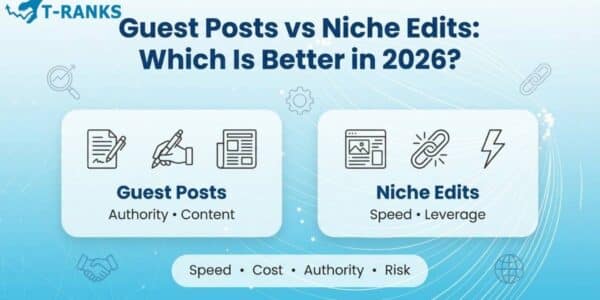
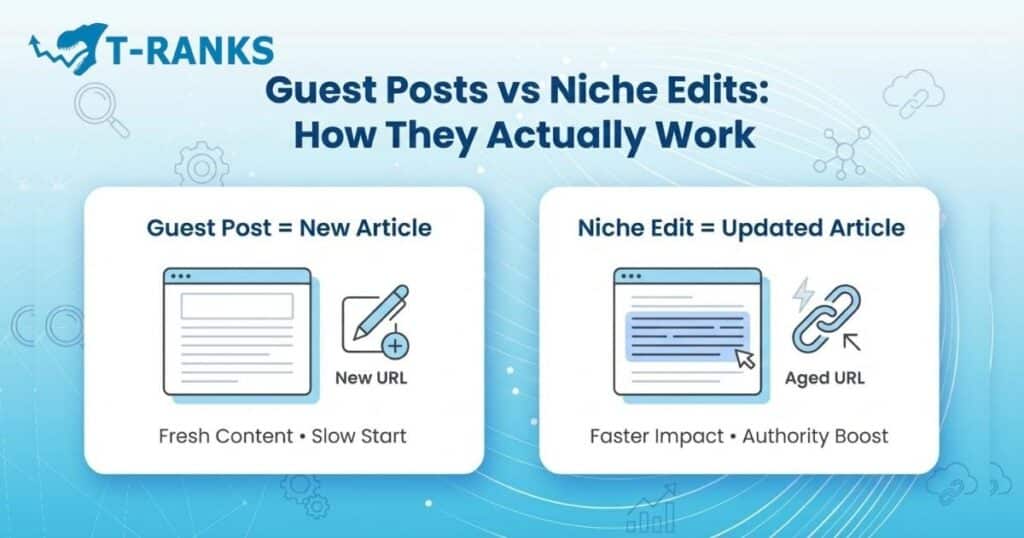
Guest Posts vs Niche Edits is a key comparison in 2026 because each link type delivers different SEO benefits. Guest posts build long-term authority and brand trust, while niche edits create faster ranking movement on aged, trusted pages.
This decision matters more in 2026. Indexing is slower, AI Overviews favor established URLs, and ranking volatility makes link choice directly affect stability and speed.
Guest posts offer controlled content, strong E-E-A-T, and long-term value, but they start from zero authority. Niche edits pass power quickly because the link sits on an already indexed page, though they require careful vetting to avoid unsafe placements.
This guide explains the real differences, costs, risks, and ideal use cases so you can choose the right link type for your 2026 SEO strategy.
Guest Posts vs Niche Edits: The Real Difference
Guest posts and niche edits are two different ways of earning backlinks, and each works differently in how authority, speed, and indexing behave. Understanding these definitions first helps you compare them clearly before looking at cost, risk, or ROI. Guest posts rely on new content created for your link, while niche edits use existing articles that already have trust and ranking history. This simple difference affects how fast results appear and how safely the link performs in 2026’s search environment.
What Is a Guest Post?
A guest post is a new article published on another website to earn a contextual backlink and build authority. You write content around a topic relevant to your site, but you do not have full control. The website owner must approve the topic, anchor text, link placement, and publishing guidelines before the article goes live.
Because the URL is new, its authority starts at zero, and indexing depends on the host site’s internal links and crawl depth. This creates natural indexing delays in 2026, especially with slower Google crawl cycles.
Guest posts work best for brand building, E-E-A-T, and long-term authority. You can present expertise, add brand mentions, and earn a stable backlink inside a fresh, well-structured article. They move slower than niche edits because the URL starts with zero authority. Once indexed and internally linked, guest posts become stable, long-lasting backlinks. They are ideal for new websites and brands that need clean, high-quality content placements.
What Is a Niche Edit?
A niche edit is a manual link insertion inside an established article that already has authority, traffic, and a strong crawl history. Because the page is already indexed, the link passes value quickly, often triggering faster ranking movement than a guest post.
Niche edits work best when placed on pages with real organic traffic, solid Page Authority, and topical relevance. Updating an old article usually triggers a recrawl, creating a “freshness boost” that accelerates link impact.
The risk comes from poor-quality vendors who use hacked sites, SAPE networks, or insert links into pages with no internal links. These placements pass little value and may be removed when a site updates its content. Only manual niche edits on real, relevant sites are safe and effective.
Niche edits are fast, affordable, and high-ROI, but require stricter quality checks compared to guest posts.
Guest Posts vs Niche Edits: Speed, Cost, and Risk Compared
Niche edits win on speed and cost, while guest posts win on safety and long-term stability. Niche edits pass authority immediately because they live on aged pages that Google already trusts. Guest posts take longer because the URL starts from zero and must be crawled, indexed, and internally linked before it can influence rankings. In 2026, with slower indexing cycles, stricter relevance checks, and AI Overviews prioritizing trusted URLs, understanding these differences is essential for choosing the right link type for your campaign.
To make the comparison clearer, here is a practical breakdown of how both link types behave across speed, authority, costs, and risks.
Comparison Table: Guest Posts vs Niche Edits
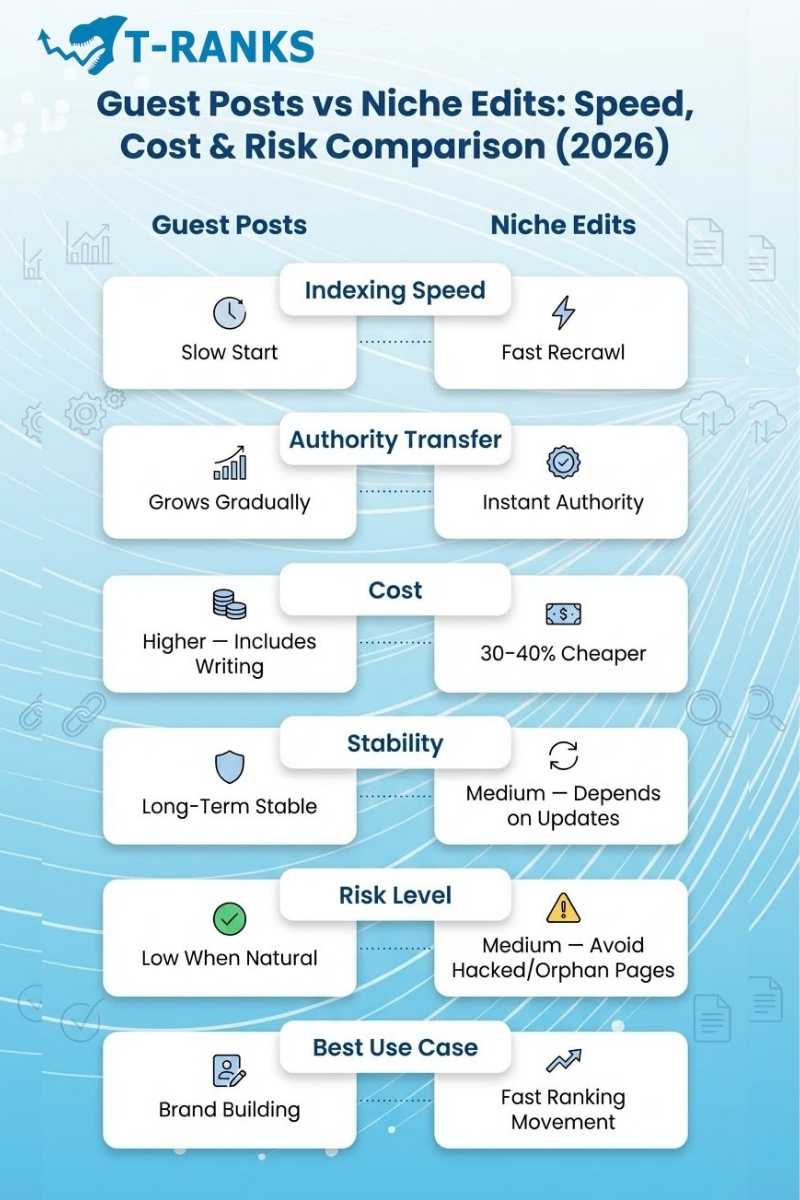
| Factor | Guest Posts | Niche Edits |
| Indexing Speed | Slow, new URL must be crawled; 1–4 weeks average | Fast, page is already indexed; recrawl happens quickly |
| Indexing Failure Rate | ~20% may not index without strong internal links | Very low; pages already trusted and crawled |
| Authority Transfer | Starts at zero; grows slowly with internal links | Instant authority from existing Page Authority (PA) |
| Ranking Impact Speed | Slow to medium | Fast, often noticeable within weeks |
| Cost | Higher; includes writing + placement | ~30–40% cheaper; no content needed |
| Stability | High; long-term and rarely removed | Medium; page updates may remove link |
| Risk Level | Low when placed naturally | Medium; risks include hacked edits, orphan pages |
| Best Use Case | New sites, brand building, E-E-A-T | Page 2 keywords, quick boosts, limited budgets |
Below is a detailed explanation of the four main factors: indexing speed, authority transfer, cost differences, and risk level.
Indexing Speed: Why Niche Edits Move Faster
Niche edits index faster because they sit on existing articles that Google already crawls frequently. When the page gets updated with your link, the modification triggers a freshness boost, causing rapid recrawling and faster link impact. This makes niche edits ideal for quick rankings, especially in competitive queries stuck on page two.
Guest posts move slower because the URL is brand new. Google must crawl it, evaluate it, and determine relevance before indexing. In 2026, many new URLs face delayed indexing due to tighter crawl budgets, and about 20% of guest posts fail to index unless the host site links internally to the new article. This delay slows ranking movement even when the content is well-written and high-quality.
When speed is the priority, niche edits outperform guest posts every time.
Authority Transfer: Aged Pages vs New URLs
Niche edits work by inserting your link onto pages that already have Page Authority, existing backlinks, and a stable URL history. These aged pages pass authority immediately because they already belong to Google’s trusted crawl cycle. This creates instant “authority voltage,” where the link begins influencing rankings without waiting for the URL to grow.
Guest posts, on the other hand, start at zero authority. The new page needs internal links, crawl frequency, and time to accumulate strength. Authority grows, but slowly. Well-written guest posts still build strong topical relevance and brand signals, but their immediate SEO influence is weaker than a niche edit placed on a PA 30–40+ page.
When fast authority transfer matters, niche edits hold a clear advantage.
Cost Breakdown: Why Pricing Depends on the Website and Page Strength
Niche edits are often described as 30–40% cheaper because you do not pay for content creation. You only pay for the placement on an existing article, which helps scale volume quickly for campaigns with tight budgets.
However, real-world pricing in 2026 is not always this simple. When a niche edit opportunity comes from a high-value page that is already indexed, ranking, and receiving real organic traffic, website owners know the link will pass authority instantly. For this reason, strong niche edit placements can sometimes cost as much as or even more than a guest post on the same website.
Guest posts involve more fixed costs such as:
- article writing ($50–$100+ depending on quality)
- editorial acceptance
- placement fees
- content review
This often makes guest posts more expensive, but they remain predictable and easier to price across different tiers.
Another cost factor is tier level. Niche edits are more commonly available on mid-tier websites, while top-tier publications (DR 70–80+) rarely allow edits to old content. These high-authority sites usually only accept guest posts, which can range from $500 to $2,000+ depending on niche, brand strength, and editorial guidelines.
Overall, niche edits tend to be cheaper at scale, but their pricing can surpass guest posts when the donor page has strong rankings or real traffic. Cost depends on page authority, relevancy, traffic, and the editorial policies of the website offering the placement.
Risk Factors: Safety Issues You Must Consider
Both link types work, but their risk profiles differ.
Guest posts are safer because the content is new, editorially approved, and placed naturally within a relevant article. The link is stable and rarely removed, making guest posts better for long-term brand safety and clean backlink profiles.
Niche edits require caution. Risks include:
- Hacked placements from SAPE-style networks
- Orphan pages with no internal links
- Low-quality donor pages with no traffic
- Content updates that may remove your link
- Spammy outbound link neighborhoods diluting authority
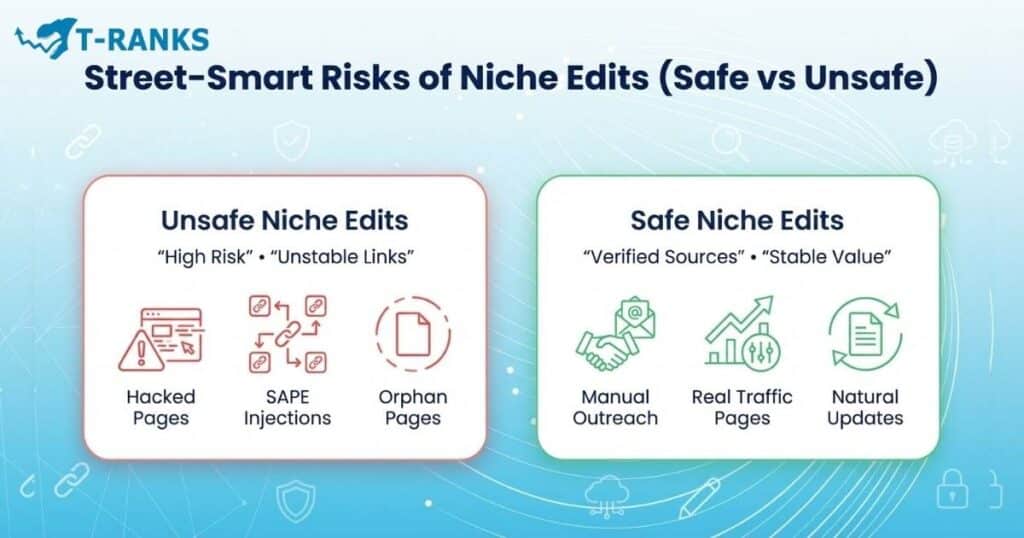
These risks come from bad vendors—not from niche edits themselves. When niche edits are acquired through manual outreach on real, relevant websites, they are safe and extremely effective. When bought cheaply, they become risky.
Choosing a trustworthy provider removes 90% of niche edit risk.
Why Niche Edits Win on Short-Term ROI
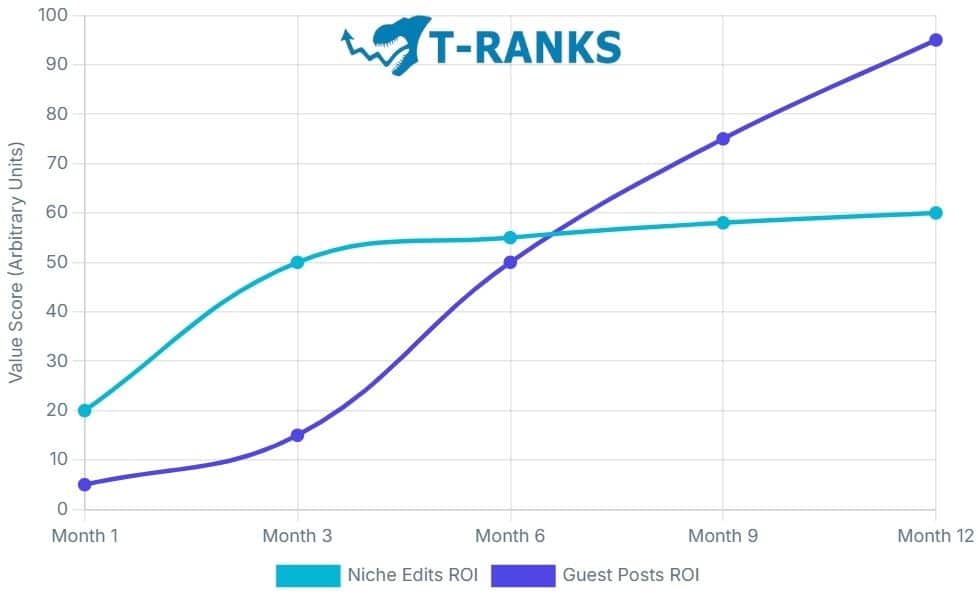
Niche edits deliver stronger short-term ROI because they pass authority instantly, index faster, and require no content creation costs. In 2026, when Google’s crawl cycles are slower and ranking volatility is high, link types that move quickly have a measurable advantage. Niche edits sit on aged URLs that Google already crawls regularly, so the link influences rankings almost immediately. Guest posts start from zero authority and take longer to gain strength, making them slower for quick campaigns.
Short-term ROI is important for stuck page-two keywords, seasonal traffic pushes, and competitive niches where fast movement matters. For these cases, high-ROI link insertions on aged pages outperform slower, new-URL placements like guest posts.
No Content Cost
Niche edits do not require article writing, editing, or formatting. This saves $50–$100 per link, allowing you to build more backlinks with the same budget. At scale, these savings compound, making niche edits extremely efficient for large link-building campaigns or wholesale purchasing.
Even when the placement cost is higher, niche edits often still win on ROI because the ranking impact happens faster. This means the same investment produces results sooner, which is critical when quick ranking shifts are needed.
Freshness Boost Effect
Updating an old article with your link triggers a recrawl and freshness boost, which helps the page regain visibility and increases the power of the link. Google treats content updates as renewed relevance, so recrawled pages see faster adjustments in search results.
This is one of the main reasons niche edits outperform guest posts in short-term movement. New guest posts must wait for crawling, evaluation, and internal linking, while an updated, aged page is already in Google’s active crawl queue.
The freshness boost also becomes a negotiation point when securing placements, since website owners benefit from updated articles just as much as you benefit from the link.
Immediate Authority Voltage
Niche edits inherit the existing Page Authority (PA) and backlink profile of aged URLs. When a link is placed on a PA 30–40+ page, it passes trust immediately because the page already has rankings, traffic, and historical credibility. This creates “authority voltage,” where the link begins influencing rankings without waiting for the URL to mature.
Guest posts cannot deliver this effect. Since they begin on brand-new URLs, authority starts at zero and grows only after internal links and indexing. This makes guest posts reliable long-term assets but slower for quick impact.
For campaigns where immediate ranking influence matters, especially lifting keywords stuck on page two niche edits remain the most effective short-term link type.
Street-Smart Risks of Niche Edits (What Most Blogs Ignore)
Niche edits are powerful, but they come with real-world risks that most SEO blogs never talk about. Experienced link builders on Reddit and BlackHatWorld see these problems every day, especially when niche edits are bought cheaply or placed without proper verification. Knowing these risks helps you stay safe, avoid penalties, and invest only in placements that genuinely improve rankings. Below are the two most common issues that catch beginners off guard.
The Hacked Link Trap
Cheap niche edits almost always come from hacked websites or SAPE-style networks, where links are inserted without the website owner’s permission. These placements look real at first, but they are unsafe, temporary, and get removed as soon as the site’s owner regains control. Hacked edits are usually sold for very low prices because sellers have no cost or access restrictions—they simply inject links into compromised sites.
You can identify hacked or fake placements by checking for red flags such as:
- sudden outbound link bursts across unrelated niches
- links placed in outdated or irrelevant content
- linking pages with no recent activity or owner engagement
- suspicious domains with malware warnings or spam pages
- edits appearing without proper content context
Genuine niche edits always come through manual outreach, where the site owner approves the link addition and updates the article legitimately. If a placement seems too cheap or too fast, it is usually hacked and should be avoided entirely.
Orphan Page Risk (No Internal Links = Weak Authority)
Many low-quality vendors place niche edits on orphan pages—articles that receive no internal links and no meaningful crawl attention from Google. These pages look normal on the surface, but they sit in parts of the site that Google barely crawls, which drastically reduces the power of any link placed there.
Orphan pages have several issues:
- weak internal link signals
- low or no organic traffic
- shallow crawl depth
- minimal Page Authority
- higher removal or update risk
To evaluate a donor page, always check whether:
- the page receives real organic traffic
Why Guest Posts Win on Long-Term Authority and Brand Building
Guest posts stand out as the strongest long-term link-building asset because they combine editorial control, brand visibility, and stable authority signals that compound over time. Unlike niche edits, which rely on existing pages, guest posts create new content that frames your brand as an expert and positions your website as a credible source in your niche. Let me break down the long-term advantages clearly.
Stronger E-E-A-T and Brand Presence
Guest posts allow you to introduce your brand inside fresh, relevant content.
This gives you the opportunity to:
- present expertise through high-quality writing
- include an author bio or company mention
- demonstrate topical knowledge
- contextualize your link in a rich, informative article
In niches like finance, health, legal, SaaS, B2B, and other sensitive industries, this E-E-A-T reinforcement makes guest posts more valuable than simple link insertions.
Your backlink is supported by content that signals expertise, authority, and trust, which strengthens both your brand and ranking stability in 2026.
Long-Term Stability With Lower Removal Risk
Guest posts are rarely removed because they are created intentionally for publication.
This makes them safer over the long run for three reasons:
- the article is newly written and designed to stay live
- the link is part of an editorial piece, not a retroactive edit
- site owners have no reason to delete their own published content
Compared to niche edits, which can be removed during updates or content cleanups, guest posts retain their value longer.
They age naturally and gather authority as the host website grows, making them ideal for long-term SEO strategies.
Better Fit for YMYL and Professional Niches
Google is stricter with pages that influence people’s money, health, or safety.
In these categories finance, health, legal, medical, cybersecurity guest posts are often the safer and more compliant choice because they offer:
- stronger contextual depth
- editorial oversight
- expert tone and structure
- a clean, natural place for authoritative outbound links
Top-tier publications in these industries almost never allow niche edits, but they do accept expert guest posts that add value to their readership.
This makes guest posts essential for websites competing in regulated or sensitive topics.
Opportunity to Earn Passive Backlinks From Valuable Content
A high-quality guest post can continue to grow in value long after publication.
Well-written articles may:
- rank for their target keywords
- attract natural backlinks
- be referenced by other websites
- receive social shares or mentions
- build topical authority for your brand
Niche edits rarely attract passive backlinks because they rely on old content.
Guest posts give you the chance to add something new to the web and allow that content to expand your digital footprint naturally.
This long-term compounding effect is one of the strongest reasons guest posts remain a powerful link type.
Supports Topic Clusters and Semantic Authority
Guest posts help you expand and reinforce your topical ecosystem.
By publishing relevant articles across multiple websites in your niche, you:
- position your brand in different topic clusters
- strengthen your site’s semantic relevance
- create more entry points for contextual backlinks
- appear more frequently in sources across a niche
This layered topical presence is especially valuable in 2026, when search engines increasingly evaluate entity authority and topic depth.
Guest posts help you grow both consistently.
In short, guest posts are the best choice when your goal is long-term authority, safer backlink acquisition, and stronger brand positioning.
They may move slower than niche edits, but their value continues to grow with time, making them a foundational link type for sustainable SEO success.
Guest Posts vs Niche Edits — When Each One Works Best in 2026
Both link types work, but each one works best in different situations. Let me break this down clearly so you always know when to choose guest posts, when niche edits are the smarter choice, and when using both together gives the best results. At T-RANKS, we evaluate link types based on timeline, budget, website stage, niche difficulty, and short-term vs long-term goals. Once you understand these scenarios, the decision becomes simple and strategic.
When Guest Posts Are the Best Choice
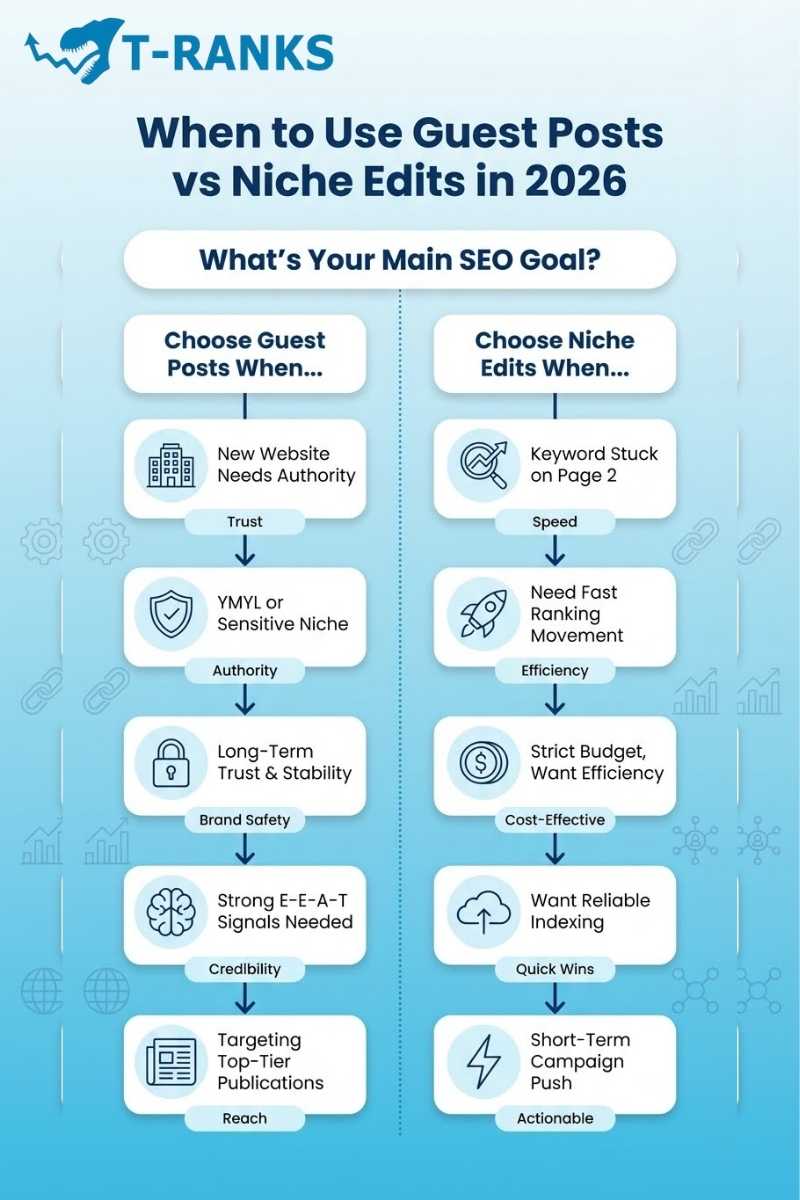
Guest posts are the right choice when your website needs authority, trust, and strong editorial signals. They take longer to show results, but they build the type of credibility Google rewards in the long run. Let me explain when guest posts make more sense:
- New Websites Need a Clean Foundation
If you’re just starting, guest posts help build homepage authority, branded anchors, and safe, clean backlinks. This is the most stable way to establish your presence. - YMYL or Sensitive Niches Require Trust
In finance, health, legal, or medical topics, Google expects expert voices. Guest posts let you publish high-quality content with author bios, brand mentions, and helpful context. - You Want Strong E-E-A-T Signals
Guest posts showcase your expertise publicly. This builds long-term authority, something niche edits cannot provide. - Long-Term Stability Matters
Since guest posts live on new content created for your link, they rarely get removed. They age well and stay stable. - You Need Brand Awareness
Guest posts expose your brand to a new audience. This helps with trust, partnerships, and future mentions. - You Want to Earn Passive Backlinks
Strong guest posts sometimes attract natural backlinks over time. - You Are Targeting Top-Tier Sites
DR 70–80+ publications rarely allow link insertions but do accept high-quality guest posts.
Whenever your main goal is trust, safety, brand growth, or long-term authority, guest posts are the smarter choice.
When Niche Edits Are the Best Choice
Niche edits work best when speed, indexing, and short-term ranking movement are the priority. Let me show you where niche edits outperform guest posts clearly:
- Keywords Stuck on Page 2 Need a Boost
If a keyword is close to ranking, niche edits provide instant authority voltage and move it faster. - You Want Fast Ranking Movement
Niche edits live on aged URLs that Google already trusts. This means faster, more predictable results. - You’re Working Within a Strict Budget
No content cost means you can buy more links with the same budget. - You Need Reliable Indexing
Updated pages get recrawled quickly, making niche edits more consistent than new URLs. - You Want to Leverage Page Authority (PA)
A link placed on a PA 30–40+ page transfers power immediately. - You Want AI Overview Visibility
AI Overviews often use aged and trusted pages. Niche edits let you “inherit” the trust of those URLs. - You Need Fast Results for Seasonal Campaigns
Niche edits shine when time is limited and movement must happen quickly. - You Want Topical Relevance Without Creating New Content
Editing an existing page ensures instant contextual relevance.
Whenever your goal is speed, indexing reliability, or short-term ROI, niche edits are the better option.
Hybrid Strategy for Maximum SEO Results (T-RANKS Expert Recommendation)
From our experience managing hundreds of campaigns, the strongest overall strategy is a hybrid approach that uses both link types in the right ratio. Guest posts build long-term trust and authority, while niche edits deliver fast movement. When combined, they produce a natural, powerful, and diversified backlink profile that supports steady growth and quick wins.
Here is the mix that consistently performs best for our clients:
- New Websites:
70% guest posts
30% niche edits
(Strong foundation first, movement later) - Growing Websites:
50% guest posts
50% niche edits
(Balanced authority + speed) - Established Websites Targeting Competitive Keywords:
30% guest posts
70% niche edits
(Authority is already there; speed is needed)
This hybrid structure is the safest, most natural, and most effective way to rank in 2026’s volatile environment.
How T-RANKS Builds Guest Posts and Niche Edits Safely
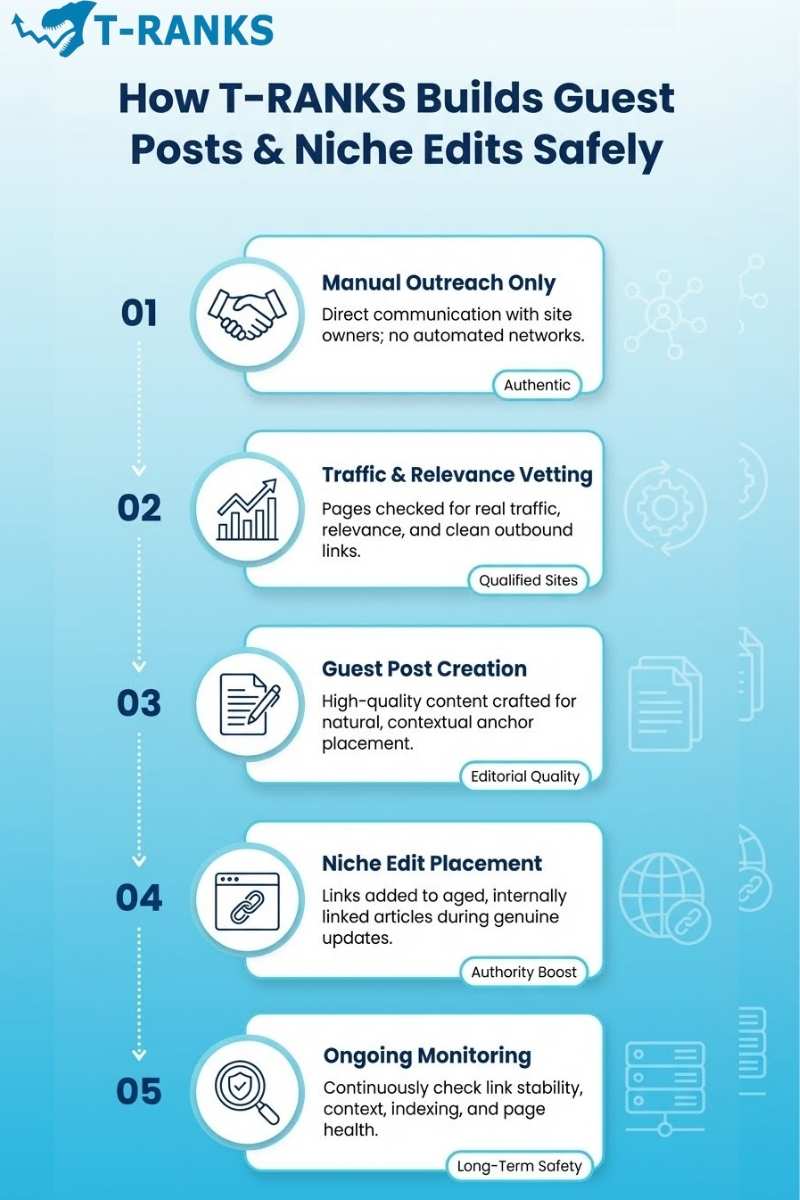
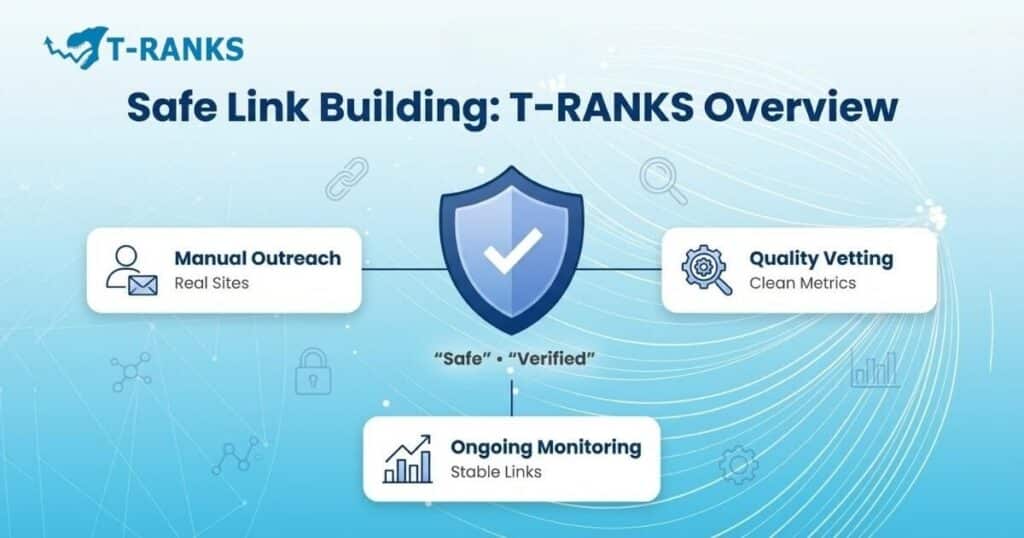
Safe link building comes from proper outreach, relevance checks, and long-term placement stability. At T-RANKS, these principles guide how guest posts and niche edits are created, ensuring every backlink is earned naturally and placed on real websites. The goal is simple: provide links that move rankings without exposing your site to unnecessary risk.
Manual Outreach Only
T-RANKS uses manual email outreach to secure both guest posts and niche edits.
Every placement begins with direct communication with the site owner or editorial team.
No automated injections, no unauthorized edits, and no SAPE-style networks are ever used.
For guest posts, the receiving website reviews and approves the content before publishing.
For niche edits, the webmaster intentionally updates an existing article and places the link in a natural context.
This approach ensures that every placement is transparent, intentional, and compliant with safe SEO practices.
Traffic and Relevance Vetting
Before a link is placed, T-RANKS evaluates websites using strict quality criteria focused on real traffic, contextual relevance, and overall site health. A placement only moves forward when the website:
- has consistent, verifiable organic traffic
- publishes content relevant to the client’s niche
- has strong internal linking on the target page
- maintains clean outbound link profiles
- shows natural ranking patterns rather than artificial spikes
This prevents links from being placed on ghost sites, irrelevant blogs, or domains with manipulated metrics.
Each backlink is selected to add real SEO value rather than simply increasing link count.
Monitoring for Long-Term Stability
T-RANKS follows a careful monitoring process to ensure that each placement remains relevant and valuable over time. Instead of relying on a “publish and forget” approach, every backlink is periodically reviewed to confirm that it continues to support healthy SEO performance.
The monitoring process includes:
- checking that the link remains live and accessible
- reviewing the surrounding context to ensure it still fits naturally
- confirming the page is still internally linked and not isolated
- observing whether the page retains its traffic and topical relevance
When content updates, redesigns, or structural changes occur on the host website, T-RANKS reconnects with the site owner to understand the adjustments and ensure the placement retains its intended purpose.
These ongoing checks help maintain the long-term stability of backlinks and ensure that each link continues to contribute positively to the site’s authority.
Conclusion
In conclusion, guest posts are stronger for long-term authority, brand trust, and E-E-A-T, while niche edits offer faster ranking movement through aged, high-trust pages. Guest posts build stability and expert positioning, especially for new or YMYL sites. Niche edits deliver quicker impact, better indexing, and high short-term ROI when placed on relevant pages with real traffic. Both methods work, but the best results come from using them together in a balanced strategy that supports both fast gains and lasting authority.
If you want safe, high-quality guest posts and niche edits built through real outreach and strict relevance checks, T-RANKS can help you create a strategy that delivers reliable and sustainable rankings in 2026.
FAQs On Guest Posts vs Niche Edits
What is the main difference between guest posts and niche edits?
Guest posts are articles you publish on another person’s or brand’s website, while niche edits are backlinks added to an existing page by updating the content and inserting your link.
Are niche edits safe in 2026?
Yes, niche edits are safe when they come from manual outreach on real websites, but risky when inserted through hacked, automated, or SAPE-style networks. Always check for real traffic, topical relevance, internal links, and a natural content update before buying.
Do niche edits index faster than guest posts?
Yes. Niche edits index faster because they live on pages that Google already crawls and trusts. Guest posts create new URLs, which face slower crawling and higher indexing delays, especially in 2026.
Which is cheaper: guest posts or niche edits?
Niche edits are usually cheaper, but this is not true in every situation. When the link comes from a highly relevant page with real traffic, niche edits can cost more than guest posts on the same website. Pricing ultimately depends on the website owner, the page’s relevance, and the amount of organic traffic the page receives.
Which link type gives faster SEO results?
Niche edits give faster SEO results because they pass authority immediately from aged pages with existing Page Authority. Guest posts grow slower but offer stability and stronger long-term relevance.
Which link type is better for long-term SEO?
Guest posts are better for long-term SEO because they remain stable, rarely get removed, and build E-E-A-T over time. Niche edits can be affected by content updates or structural changes on the host site.
Can niche edits help with AI Overviews (SGE)?
Yes. Niche edits help with AI Overview visibility because the link is placed on aged pages that AI systems already trust and cite. This increases the chance of being referenced in high-trust SERP summaries.
Do guest posts still work in 2026?
Yes. Guest posts remain effective in 2026 for building E-E-A-T, brand authority, and long-term link equity. They offer full editorial control and are safer in sensitive niches like finance, health, and legal.
Are niche edits considered black hat?
Niche edits are not black hat when they come from real websites through manual outreach. They become black hat only when taken from hacked pages, automated networks, or spam-heavy sites. As long as the edit is placed on a genuine, organic site with the owner’s approval, niche edits are considered a safe and white-hat link building method.
Should new websites use guest posts or niche edits?
New websites should start with guest posts to build foundational authority and clean branded anchors. Niche edits can be added later for faster movement once the site has some stability.
Do guest posts pass more authority than niche edits?
Niche edits pass authority faster, but guest posts can pass deeper topical authority when the content is well-written and contextually rich. Niche edits win on speed, while guest posts win on thematic relevance.
Which link type gives the best ROI?
Niche edits give the best short-term ROI because they move rankings quickly at a lower cost. Guest posts give the best long-term ROI because they build lasting authority and brand value. The right choice depends on budget and timeline.