Getting students to discover your EdTech platform is becoming harder every year. More online learning websites are competing for the same search traffic, which means simply publishing courses or educational content is no longer enough. This is why link building for EdTech has become a key part of growing search visibility and building online authority.
High quality backlinks help education websites improve Google rankings, increase organic traffic, and build trust with both search engines and users. But link building for education websites works differently from most industries. Universities, schools, and educational websites are more selective about the websites they reference, and Google applies stronger quality standards to education related content.
Because of this, many traditional link building tactics produce weak results for EdTech platforms. In 2026, successful link building depends more on educational relevance, trusted backlinks, useful learning resources, and strong topical authority instead of backlink quantity alone.
In this guide, you will learn how link building works for EdTech platforms, which backlink strategies actually improve rankings, how to build links to course pages, what mistakes to avoid, and how search changes are reshaping educational SEO and online authority.
What Is Link Building for EdTech?

Link building for edtech is the process of getting other websites to link to an education website or online learning platform. These links are called backlinks.
Backlinks help search engines understand whether a website is trustworthy, useful, and relevant to a specific educational topic. When respected websites link to an EdTech platform, Google treats those links as signals of credibility and authority.
For education websites, link building is not just about increasing traffic. It is about building trust within the learning and academic ecosystem.
EdTech platforms often earn backlinks from:
- Educational blogs
- Teacher resource websites
- Universities and schools
- Research publications
- Online learning communities
- Industry related websites
For example, an online course platform may publish a useful study guide, free learning tool, or industry research report. If teachers, bloggers, or educational websites reference that resource, those references become backlinks.
Link building for e-learning websites is different from link building in many commercial industries. Google evaluates educational content more carefully because users rely on it for learning, research, certifications, and skill development.
Because of this, Google looks closely at:
- Relevance of the linking website
- Quality of the educational content
- Trustworthiness of the source
- Context surrounding the backlink
One of the biggest misunderstandings in SEO is believing that more backlinks automatically improve rankings. In reality, a small number of highly relevant educational backlinks often provides more value than hundreds of low quality or unrelated links.
For example, a backlink from a respected teacher resource website is usually far more valuable than dozens of unrelated directory links.
The main goal of link building for edtech is to build long term trust, authority, and visibility within the education space, not simply collect backlinks for SEO metrics.
Why Google Holds Education Content to a Higher Standard

Google evaluates education websites more carefully because people rely on them for learning, career decisions, certifications, and skill development.
Education content often falls under YMYL, which stands for “Your Money or Your Life.” These are topics that can influence a person’s future, finances, safety, or overall well being. Because of this, Google applies stricter quality standards to educational websites than it does to many general content sites.
Google also uses E-E-A-T, which stands for Experience, Expertise, Authoritativeness, and Trustworthiness, to evaluate whether educational content appears reliable and credible.
Backlinks are part of this evaluation process. When trusted education websites, academic resources, or industry publications link to an EdTech platform, those links help strengthen authority and trust signals.
This is why link quality matters more in education SEO. A few relevant backlinks from trusted educational sources are usually more valuable than a large number of unrelated or low quality links.
Why Link Building in EdTech Is Harder Than Most Niches
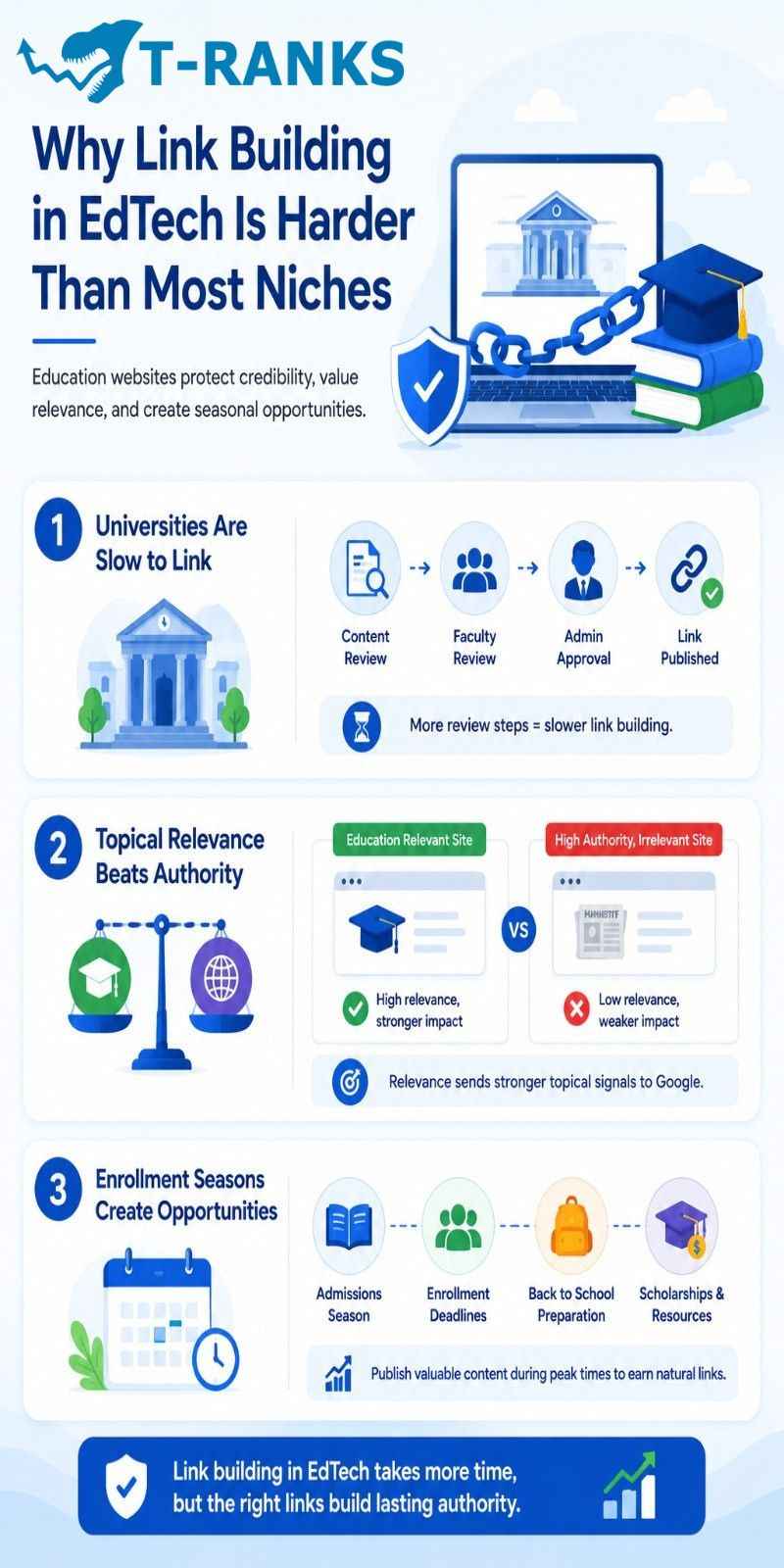
Link building is harder in the education industry because educational websites are more careful about what they link to and recommend.
Schools, universities, and academic platforms usually want to protect their credibility. Before linking to an external website, they often review whether the content is accurate, trustworthy, and genuinely useful for students or educators.
This makes education link building slower than link building in many commercial industries.
Why Universities and Academic Institutions Are Slow to Link to External Sites
Many universities and academic institutions have approval processes for adding external links to their websites. In some cases, content updates may need to pass through editors, faculty members, or department administrators before they are published.
Because of this, large scale outreach campaigns often perform poorly in the education niche. Building relationships and providing useful educational resources usually works better over time than sending high volumes of outreach emails.
Why Topical Relevance Beats Domain Authority in the EdTech Space
In EdTech SEO, relevance is often more valuable than raw authority metrics.
For example, a smaller education blog focused on online learning may provide a stronger backlink than a major news website with no connection to education. Google looks at how closely the linking website matches the topic of the content being referenced.
A backlink from a website connected to learning, teaching, research, or student resources usually sends stronger topical signals than a backlink from an unrelated website with higher authority metrics.
How Academic Enrollment Seasons Create Natural Link Opportunities
Education websites often follow seasonal publishing patterns tied to admissions periods, enrollment deadlines, and back to school preparation.
During these periods, schools, blogs, and educational communities actively search for resources that can help students, teachers, and parents.
This creates natural opportunities for EdTech platforms to promote useful content such as study guides, enrollment resources, scholarship information, career planning tools, or free learning materials. Content published during these high interest periods is often more likely to earn attention and backlinks naturally.
Which Backlink Types Actually Work for EdTech Platforms

The most effective backlinks for EdTech platforms come from trusted, relevant, and education focused websites.
In education SEO, backlink quality matters more than backlink quantity. A relevant backlink from an education related website often provides more value than many unrelated high authority links.
Google pays close attention to:
- Relevance of the linking website
- Context surrounding the backlink
- Educational value of the content
- Trustworthiness of the source
Because of this, some backlink types are far more valuable for EdTech platforms than others.
Editorial and Institutional Links, The Highest Trust Tier
Editorial links are backlinks added naturally because the content is useful and worth referencing. These links usually appear inside articles, research pages, study resources, or educational guides without direct control from the website receiving the link.
Institutional links come from organizations such as universities, schools, research centers, academic departments, or educational associations. These backlinks often carry strong trust signals because they are connected to education and learning.
For example, if a university resource page references an EdTech platform’s study guide or free learning tool, that backlink usually provides stronger topical value than a general website mention.
What .edu Backlinks Are Actually Worth in 2026
A common misconception is that every .edu backlink automatically improves rankings. In reality, the domain extension alone does not determine backlink quality.
A .edu backlink becomes valuable when the page itself is relevant, trusted, and connected to the educational topic being discussed.
For example, a backlink from a university learning resource page may provide strong value for an online learning platform. A random .edu profile page with no educational relevance may provide little SEO benefit.
This is why modern education SEO focuses more on contextual relevance and trust than simply collecting .edu backlinks.
Resource Page Links, Niche Edits, and Partnership Based Links
Resource page links appear on pages that collect useful educational tools, guides, or references for students and educators. These links work especially well for study resources, research content, and free educational tools.
Niche edits are backlinks added into existing educational articles where the linked resource naturally supports the topic being discussed.
Partnership based links come from collaborations with educational communities, webinars, industry organizations, learning initiatives, or academic events.
For many EdTech platforms, resource page links and partnership based links offer the best balance between scalability, trust, and long term SEO value.
How Anchor Text Distribution Protects Your Backlink Profile
Anchor text is the clickable text used inside a backlink. A natural backlink profile usually contains a mix of:
- Brand name anchors
- URL anchors
- Natural phrase anchors
- Topic related anchors
Problems often appear when the same keyword is repeated too aggressively across many backlinks. This creates an over optimized anchor profile that may appear unnatural to search engines.
A simple rule is that anchor text should describe the destination naturally instead of forcing exact keywords into every backlink.
How to Create Content That Earns Backlinks Without Constant Outreach
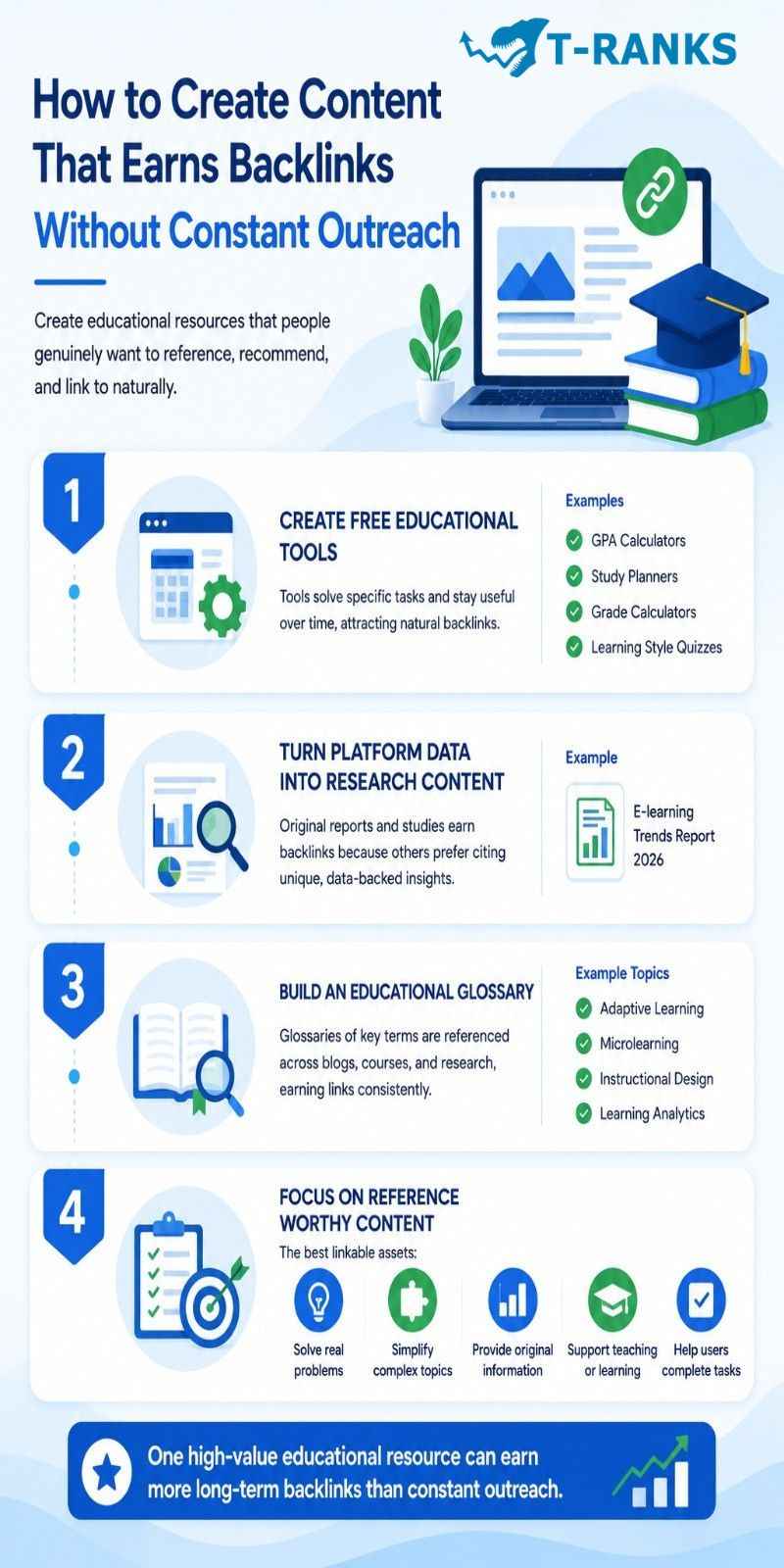
EdTech platforms earn backlinks more naturally when they create educational resources that other websites genuinely want to reference, recommend, or cite.
In education SEO, this type of content is often called a linkable asset. A linkable asset is content that provides enough value for teachers, students, bloggers, researchers, or educational websites to link to it naturally.
Step 1: Create Free Educational Tools
Free tools often attract backlinks because they help users complete specific educational tasks.
Examples include GPA calculators, study planners, grade calculators, curriculum planners, and learning style quizzes. Educational blogs and student resource pages frequently link to these tools because they remain useful over time.
Step 2: Turn Platform Data Into Research Content
Many EdTech platforms collect useful data through course engagement, completion rates, or learning activity.
This data can be turned into reports, studies, or industry statistics pages. Original research often earns backlinks because journalists, bloggers, and researchers prefer citing unique information instead of repeating existing content.
Step 3: Build an Educational Glossary
Educational glossaries explain learning terms and industry concepts in simple language.
Topics such as adaptive learning, microlearning, instructional design, and learning analytics are frequently referenced across blogs, courses, and research content. Because these definitions remain useful over time, glossary pages can continue attracting backlinks long after publication.
Step 4: Focus on Reference Worthy Content
The strongest linkable assets usually:
- Solve a real educational problem
- Simplify complex topics
- Provide original information
- Support teaching or learning
- Help users complete a task
In many cases, one highly useful educational resource can attract more long term backlinks than large outreach campaigns alone.
The Best Link Building Strategies for EdTech Platforms

The best link building strategies for EdTech platforms focus on earning trusted backlinks through useful educational resources, industry relationships, and real learning value.
In education SEO, backlinks work best when they come from websites connected to learning, teaching, research, or student support. Google evaluates education websites more carefully than many other industries, which is why trust and topical relevance matter more than large backlink numbers.
Scholarship Page Link Building
Scholarship pages can help EdTech platforms earn backlinks from university financial aid pages and student resource sections.
This strategy works best when the scholarship is legitimate and genuinely useful for students. A strong scholarship page clearly explains eligibility requirements, application details, deadlines, and the educational purpose behind the program.
For example, an online learning platform offering a scholarship for digital skills or technology education may contact university financial aid departments that maintain scholarship resource pages.
Google has become more cautious about scholarship campaigns created only for SEO. Because of this, scholarship link building works best when the program provides real educational value instead of functioning as a backlink shortcut.
Guest Posting on Education Websites
Guest posting helps EdTech companies build authority by sharing useful educational insights with relevant audiences.
The process usually starts by identifying teacher blogs, EdTech publications, online learning websites, or education news platforms that publish industry related content.
Instead of submitting promotional articles, successful guest posts focus on:
- Teaching strategies
- Learning technology trends
- Student engagement
- Classroom challenges
- Educational research
For example, an LMS company may publish a guest article about improving hybrid learning experiences or reducing teacher workload through automation.
In the EdTech space, guest posting works best as a relationship building strategy rather than a direct link placement tactic.
Resource Page Link Building
Many educational websites maintain resource pages that recommend useful tools, guides, and learning materials for students or teachers.
EdTech companies can earn backlinks by creating genuinely useful educational resources and suggesting them to relevant websites.
For example, a platform offering a free GPA calculator, study planner, or learning guide may reach out to teacher resource pages or student support websites that already curate educational tools.
This strategy works well because the website already intends to recommend valuable resources to its audience.
Broken Link Building for Education Websites
Education websites often contain broken links because older research pages, academic resources, and external references become outdated over time.
Broken link building works through a simple process:
- Find broken educational links
- Create or match replacement content
- Suggest the updated resource to the website owner
For example, if a university resource page links to an outdated study guide that no longer exists, an EdTech platform can create an updated version and recommend it as a replacement.
This strategy works well because it helps educational websites improve their own resource quality while also creating a relevant backlink opportunity.
Digital PR and Education Media Coverage
Digital PR helps EdTech companies earn editorial backlinks from education publications, journalists, and industry websites.
This usually involves publishing:
- Research studies
- Learning trend reports
- Student outcome data
- Expert commentary
- Industry insights
For example, an EdTech platform may analyze student engagement trends across thousands of online learning sessions and publish the findings in a public report. Education journalists and bloggers may reference the study when covering online learning trends.
Backlinks earned through media coverage are valuable because they are based on expertise and original information rather than direct link requests.
LMS and Technology Partnership Link Building
Technology partnerships often generate some of the strongest backlinks in the EdTech industry.
Platforms such as Canvas, Blackboard, Moodle, Google Classroom, and PowerSchool maintain partner directories and integration pages that link to compatible educational tools and platforms.
For example, if an EdTech product integrates directly with an LMS platform, the company may receive a backlink from the platform’s official partner or integration directory.
These backlinks are highly trusted because they are connected to real educational functionality and long term platform relationships.
Which Strategy Works Best for EdTech Platforms?
No single strategy works for every education website or online learning platform.
In most cases, the strongest backlink profiles are built through a combination of:
- Useful educational resources
- Trusted partnerships
- Editorial mentions
- Industry relationships
- Original research and data
The goal is not simply to collect backlinks. The goal is to become a trusted and authoritative resource within the education ecosystem.
How to Build Links to Course Pages and Program Landing Pages

The best way to build links to course pages is by earning backlinks to useful supporting content and passing authority internally to the landing page.
Most websites avoid linking directly to enrollment or sales focused pages. They are more likely to link to educational resources that teach, explain, or help users solve a problem.
Because of this, successful EdTech platforms usually build backlinks to informational content first, then use internal linking to strengthen the main course or program page.
Create Informational Content Around the Course Topic
The first step is publishing informational content related to the same topic as the course or program.
For example, a cybersecurity course page can be supported with articles such as:
- Beginner cybersecurity guides
- Career path articles
- Certification comparisons
- Online safety checklists
These pages are easier to promote because they target informational search intent instead of direct conversions. As a result, they are more likely to attract backlinks naturally from blogs, forums, and educational websites.
Once this supporting content starts earning backlinks, it can help strengthen the authority of the related course page.
Build Linkable Assets That Support the Program
After creating informational content, the next step is building linkable assets related to the program topic.
Course pages rarely attract backlinks on their own, but useful educational resources often do.
Examples include:
- Salary guides
- Free templates
- Study checklists
- Industry statistics
- Skill assessment tools
For example, a digital marketing course can create a free SEO checklist that bloggers, teachers, and marketers reference in their own content.
These resources naturally attract backlinks because they provide practical value. The authority earned by these assets can then support the related program page through internal linking.
Use Internal Links to Strengthen the Course Page
Once supporting articles and linkable assets begin earning backlinks, internal links help pass authority to the main landing page.
For example, an article titled “Beginner Guide to Data Science” can internally link to a Data Science Certification Program page using natural anchor text.
This helps Google understand the relationship between the educational content and the course offering. It also strengthens the topical relevance of the program page within the broader subject area.
Focus Outreach on Educational Resources Instead of Enrollment Pages
Direct outreach for course pages usually produces low response rates because most websites avoid linking to commercial or enrollment focused pages.
Outreach becomes much more effective when promoting educational resources such as:
- Study guides
- Free tools
- Research reports
- Industry statistics
- Learning templates
For example, an education blog may be willing to link to a free study planner or industry report, even if it would not link directly to a paid course page.
This approach helps EdTech platforms earn backlinks naturally while still supporting conversion focused pages indirectly.
Why This Strategy Works Better Long Term
Educational resources naturally attract more trust and backlinks than sales oriented pages.
By first building backlinks to informational content and linkable assets, EdTech platforms create stronger topical authority and a more natural backlink profile over time.
This approach not only improves the visibility of course pages but also helps the entire website build long term educational authority in search results.
How New EdTech Platforms Should Start Link Building From Zero
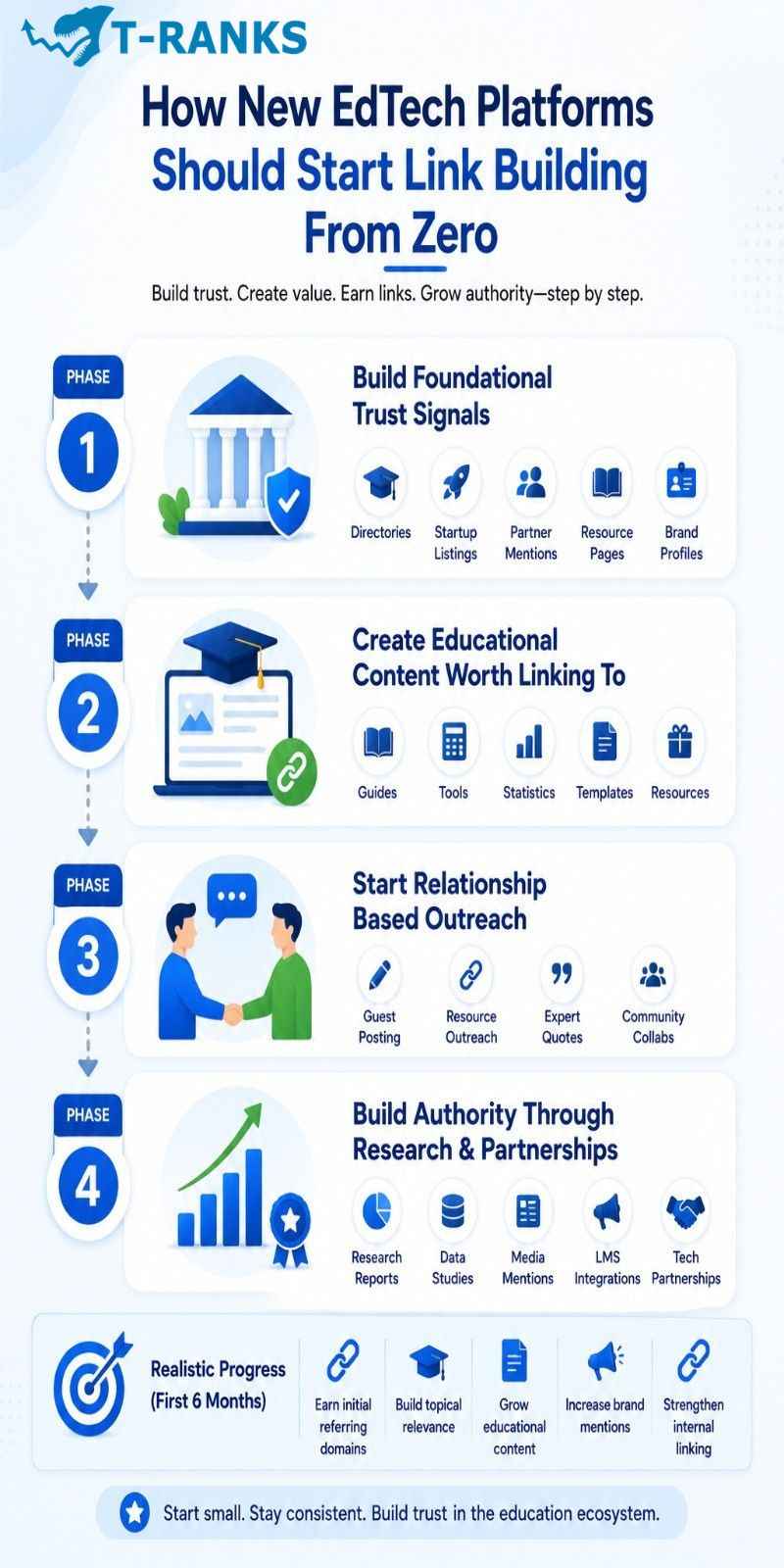
New EdTech platforms should approach link building in phases instead of trying to build large numbers of backlinks immediately.
In the beginning, the goal is not rapid rankings or high authority metrics. The goal is building enough trust, relevance, and educational presence for Google to understand what the platform offers.
Phase 1: Build Foundational Trust Signals
The first phase focuses on helping Google understand that the platform is real, active, and connected to the education industry.
At this stage, the best starting points usually include:
- Educational directories
- Startup listings
- Partner mentions
- Community resource pages
- Brand profiles
For example, a new online learning platform may receive its first backlinks from an EdTech startup directory, a partner website, and a local education resource page.
These links may not be highly powerful, but they help establish early trust and indexation signals.
Phase 2: Create Educational Content Worth Linking To
Once foundational links are in place, the next step is publishing useful educational content that can naturally attract backlinks.
This usually includes:
- Beginner learning guides
- Study resources
- Free educational tools
- Industry statistics
- Educational templates
For example, a small EdTech platform may publish a free GPA calculator or study planner that student blogs and teacher websites later reference.
At this stage, the focus should be usefulness rather than aggressive promotion.
Phase 3: Start Relationship Based Outreach
After publishing useful content, outreach becomes much easier because the platform now has resources worth sharing.
This phase may include:
- Guest posting on education blogs
- Resource page outreach
- Expert quote contributions
- Collaborations with teacher communities
For example, an EdTech founder may contribute insights to an article discussing online learning challenges or classroom technology trends.
In education SEO, relationship building usually performs better than mass outreach campaigns.
Phase 4: Build Authority Through Research and Partnerships
Once the platform starts gaining visibility, the next phase focuses on building stronger authority signals.
This often includes:
- Original research reports
- Platform data studies
- Media mentions
- LMS integrations
- Technology partnerships
For example, an EdTech platform may publish a report about student learning behavior or receive a backlink from a learning management system integration directory.
These backlinks usually carry stronger topical relevance and long term trust signals.
What Realistic Progress Looks Like
During the first six months, most new EdTech platforms focus on:
- Earning initial referring domains
- Building topical relevance
- Growing educational content
- Increasing brand mentions
- Strengthening internal linking
The first few relevant backlinks often matter more than trying to build links at scale.
In education SEO, early link building is foundation work. Long term authority usually grows gradually as the platform builds trust within the education ecosystem.
Link Building Mistakes That Damage EdTech Websites

Many EdTech websites struggle with SEO because they focus too heavily on backlink numbers instead of educational relevance and trust.
In education SEO, Google evaluates backlinks more carefully because users rely on educational content for learning, research, and career development.
Mistake 1: Chasing .edu Backlinks Without Checking Relevance
Many website owners assume every .edu backlink is valuable. In reality, the domain extension alone does not determine backlink quality.
A backlink from a university website only helps when the page is related to the educational topic being discussed. Random profile pages or unrelated university directories usually provide little long term value.
Mistake 2: Over Optimizing Anchor Text With Exact Match Keywords
Repeating the same keyword across many backlinks can create an unnatural backlink profile.
For example, using the exact phrase “best online coding course” in dozens of backlinks may appear manipulative to search engines. In most cases, anchor text should describe the destination naturally instead of forcing keywords into every link.
Mistake 3: Building Backlinks Too Fast
Many new EdTech websites try to scale backlinks aggressively in the early stages.
Sudden spikes in backlinks from unrelated websites can create unnatural link velocity patterns that look manipulative. Educational websites usually build authority gradually through trusted mentions, useful resources, and educational relationships.
Mistake 4: Treating Every Page as a Linkable Asset
Most course pages, enrollment pages, and product pages are not naturally attractive to other websites.
Educational guides, free tools, research reports, and student resources are usually much easier to promote and earn backlinks to. This is why successful EdTech SEO strategies often build links to supporting content first.
Mistake 5: Disavowing Links Too Quickly
Some websites disavow backlinks without clear evidence that the links are actually harmful.
In many cases, Google already ignores weak or irrelevant links automatically. Removing links too quickly without proper evaluation may accidentally remove useful trust signals.
Mistake 6: Copying Competitor Backlinks Without Understanding Them
A backlink may appear valuable in an SEO tool, but the real reason behind the link may be a partnership, research contribution, media relationship, or long term collaboration.
Copying competitor backlinks blindly often leads to low quality outreach and poor results because the context behind the original backlink is missing.
In education SEO, successful link building usually comes from usefulness, relevance, and trust rather than shortcut tactics or aggressive scaling.
The Best Tools for EdTech Backlink Research and Competitor Analysis

Backlink research tools help EdTech platforms understand where competitors earn links, which educational content attracts authority, and how search visibility grows over time.
Different tools solve different SEO problems. Some are better for backlink discovery, while others are stronger for keyword research, authority evaluation, or competitor tracking.
| Tool | Best Used For | Most Useful for EdTech SEO |
| Ahrefs | Backlink discovery and competitor analysis | Finding educational backlinks, resource pages, and link opportunities |
| Semrush | Combined SEO and keyword research | Tracking competitors, keyword gaps, and backlink growth |
| Moz | Authority and backlink quality evaluation | Checking Domain Authority and backlink trust signals |
| Google Search Console | Website performance monitoring | Tracking backlinks, indexing, and search visibility |
| Google Trends | Trend and topic research | Discovering rising education topics and seasonal search interest |
Ahrefs for Backlink Discovery
Ahrefs is commonly used for backlink analysis and competitor research.
EdTech SEO teams often use Ahrefs to:
- Find competitor backlinks
- Discover resource page opportunities
- Analyze anchor text patterns
- Identify broken link opportunities
For example, an online learning platform can review which educational guides or free tools attract the most backlinks in its niche.
This helps identify the types of content that websites naturally reference.
Semrush for Combined SEO Research
Semrush combines backlink analysis with keyword and competitor research.
In the EdTech space, Semrush is often useful for:
- Comparing competitor domains
- Tracking backlink growth
- Finding keyword gaps
- Monitoring ranking changes
For example, an education platform can compare its authority against larger competitors and identify subject areas where its visibility is still weak.
This helps connect link building with overall content strategy.
Moz for Authority Evaluation
Moz is widely used for evaluating website authority and backlink quality.
Many EdTech teams use Moz to:
- Review Domain Authority scores
- Evaluate backlink quality
- Analyze spam signals
- Compare linking websites
For example, a new EdTech startup may use Moz to check whether a backlink opportunity comes from a trusted education website or a low quality source.
Useful Free Tools for Early Stage Platforms
New EdTech platforms often start with limited SEO budgets. Free tools can still provide useful research data in the early stages.
Some commonly used free tools include:
- Google Search Console for backlink monitoring and search visibility
- Google Trends for educational topic trends
- Ahrefs Free Backlink Checker for basic backlink insights
- Moz Link Explorer for authority evaluation
These tools may not provide complete backlink databases, but they are often enough for small EdTech startups building their initial SEO foundation.
Which Tool Matters Most?
No single tool handles every part of backlink research perfectly.
In most cases:
- Ahrefs works best for backlink discovery
- Semrush works best for broader SEO research
- Moz works best for authority evaluation
The goal is not simply collecting backlink data. The goal is understanding which educational content, partnerships, and resources build long term authority in search results.
How AI Search Is Changing Link Building for EdTech

AI search is changing link building for EdTech by increasing the importance of educational trust, topical authority, and expert backed backlinks.
Google AI Overviews now try to summarize information from sources that appear reliable, well referenced, and strongly connected to a topic. Because of this, backlinks are no longer evaluated only as ranking signals. They also help Google understand which education websites deserve visibility inside AI generated search results.
For EdTech platforms, this means link building is becoming more quality focused, authority driven, and closely connected to E-E-A-T principles.
What Google AI Overviews Mean for Backlinks on Education Websites
Google AI Overviews often pull information from websites that already demonstrate strong educational authority and trust.
Backlinks from universities, educational organizations, and trusted industry websites help Google identify which sources appear reliable enough to reference in AI summaries.
This means backlinks now influence both traditional rankings and AI search visibility for education websites.
In AI driven search, trusted educational mentions usually matter more than large backlink volume alone.
How Stricter E-E-A-T Standards Are Raising the Bar for EdTech Links
Google continues increasing its focus on E-E-A-T, which stands for Experience, Expertise, Authoritativeness, and Trustworthiness.
In education SEO, Google now looks more closely at author expertise, educational credibility, editorial quality, and institutional relevance.
Backlinks connected to real educational expertise usually carry stronger trust signals than generic backlinks from unrelated websites.
Because of this, educational credibility is becoming a larger part of modern link evaluation.
Which Tactics Are Losing Effectiveness and What Is Replacing Them
Some older link building strategies are losing effectiveness because Google has become better at evaluating educational trust and topical relevance.
Generic scholarship campaigns, low quality directory links, and thin guest posts often provide weak educational value and limited authority signals.
At the same time, trust based strategies are becoming more important in EdTech SEO.
Original research, expert authored content, LMS partnerships, and editorial mentions now create stronger long term educational authority.
In Conclusion
In conclusion, successful link building for EdTech platforms depends more on trust, topical relevance, and educational value than on backlink volume alone.
The strongest education websites usually earn backlinks by publishing useful learning resources, building genuine institutional relationships, creating expert backed content, and developing assets that other websites naturally want to reference.
As Google AI search and E-E-A-T standards continue evolving, low quality link tactics are becoming less effective while trusted educational signals are becoming more important. Backlinks still matter, but the quality, context, and credibility behind those links now play a much larger role in long term search visibility.
EdTech platforms that focus on educational authority, helpful content, and sustainable relationship building are more likely to build lasting rankings and stronger organic growth over time.
If your EdTech platform needs a scalable and education focused backlink strategy, now is the time to build authority with trusted, relevant, and long term SEO driven links that support real growth.
FAQs About Link Building for EdTech
What is link building for EdTech platforms?
Link building for EdTech is the process of earning backlinks from trusted, relevant websites to improve an online education platform’s search rankings and authority. Because education content is held to higher quality standards by Google, link relevance and source credibility matter more than the number of links earned.
Why is link building harder for EdTech websites than for other industries?
EdTech link building is harder because the pool of genuinely relevant websites is smaller, academic institutions respond slowly to outreach, and Google evaluates education content more strictly than most other niches. Generic link building tactics that work in commercial industries rarely produce the same results for education platforms.
Are .edu backlinks still valuable for EdTech SEO in 2025?
Yes, but only when the linking page is topically relevant to your platform. A .edu link from an unrelated university department carries less value than an editorial mention from a respected education media publication. The domain extension alone does not determine the link’s SEO impact.
What type of content earns the most backlinks for EdTech platforms?
Free tools, original research studies, EdTech glossaries, and data-driven platform reports consistently earn the most backlinks with the least ongoing outreach effort. These formats attract links from academic blogs, education journalists, and institutional resource pages without requiring a cold outreach campaign for every link.
How long does it take to see results from EdTech link building?
Most EdTech platforms see measurable referring domain growth within three months and meaningful ranking improvements within four to six months. Results depend on competition level, content quality, and how consistently new backlinks are earned during that period.
What is the best starting point for a new EdTech platform with no backlinks?
Start with partner mentions, resource page submissions, and one strong linkable asset such as a free tool or original data study. These three approaches require no existing authority to execute and deliver the most reliable early results before your platform has brand recognition or traffic.
Can incorrect link building hurt an education website’s rankings?
Yes. Over-optimized anchor text, unnatural link growth speed, and backlinks from irrelevant or low-quality sources all send negative signals to Google. Education websites are particularly vulnerable because Google already applies stricter quality evaluation to content that affects people’s career and financial decisions.
How does E-E-A-T affect link building for education websites?
E-E-A-T raises the standard for which backlinks Google considers credible for education content. Links from credentialed authors, accredited institutions, and editorially reviewed publications carry more weight than links from general blogs. EdTech platforms need backlinks that signal expertise and trustworthiness, not just high domain authority scores.
How do I build backlinks to course pages and program landing pages?
Course pages earn links most effectively through indirect methods. Build internal links from high-backlink blog posts to course pages, add outcome data and instructor credentials that journalists naturally reference, and pitch your platform to education media for editorial mentions that link directly to program pages.
How do I know if my EdTech link building is actually working?
Track referring domain growth, organic traffic to pages receiving new backlinks, and keyword ranking movement for target terms. Domain authority scores and total backlink counts are unreliable indicators. A simple monthly report tracking new referring domains, lost links, and ranking changes for your key pages gives an accurate picture of real progress.
Should I disavow backlinks found during a backlink audit?
Only disavow links when there is clear evidence of manipulative or harmful link patterns that are visibly affecting your rankings. Most low-quality links found in an audit are already ignored by Google. Disavowing aggressively without clear cause can remove link equity that is quietly helping your site perform.
How is Google’s AI search changing link building for EdTech platforms?
Google’s AI Overviews now pull answers from sources with strong, credible backlink profiles, meaning well-linked EdTech platforms gain visibility in AI-generated results as well as traditional search rankings. This makes authoritative link building more important than before — being cited by trusted academic and media sources now influences AI search inclusion directly.