Most real estate agencies struggle to rank because they rely on the same SEO tactics as everyone else. They publish listings, create service pages, and buy a few backlinks, yet stronger local competitors still dominate Google search results and Google Maps.
The difference is usually link building. Real estate agencies with strong local backlinks often earn more visibility, more trust, and more qualified leads from organic search. Google uses these backlinks to understand which agencies are genuinely connected to a specific city, neighborhood, or housing market.
Link building for real estate agencies is no longer just about guest posting on random blogs. Today, Google pays more attention to local relevance, trusted business mentions, community authority, and backlinks from real housing related websites. A single backlink from a respected local source can provide more value than multiple links from unrelated websites.
This guide explains the link building strategies that actually work for real estate agencies beyond guest posts. You will learn how to build local authority, earn stronger backlinks, improve Google Maps visibility, avoid common SEO mistakes, and increase your chances of appearing in both Google search results and Google AI Overviews.
Why Link Building Still Matters for Real Estate SEO

Link building still matters for real estate SEO because backlinks help Google identify which agencies are trusted and relevant in a local market.
Real estate is one of the most competitive local SEO industries. Many agencies target the same cities, neighborhoods, and buyer searches. Backlinks help Google decide which businesses deserve stronger visibility in organic search and Google Maps results.
Google uses backlinks as trust and authority signals. When local websites, news sources, business directories, or community organizations link to a real estate agency, those links strengthen local credibility and market relevance.
But modern SEO is not about building the highest number of backlinks.
A common misunderstanding is that high DR backlinks automatically improve rankings. In local real estate SEO, relevance often matters more than raw authority. A backlink from a trusted local website usually provides more value than a generic backlink from an unrelated high-authority domain.
Google now evaluates:
- Geographic relevance
- Topical relevance
- Local trust signals
- Context surrounding the backlink
This is why successful real estate SEO depends on earning relevant and locally connected backlinks, not simply building more links.
Why Guest Posts Do Not Work for Real Estate Agencies
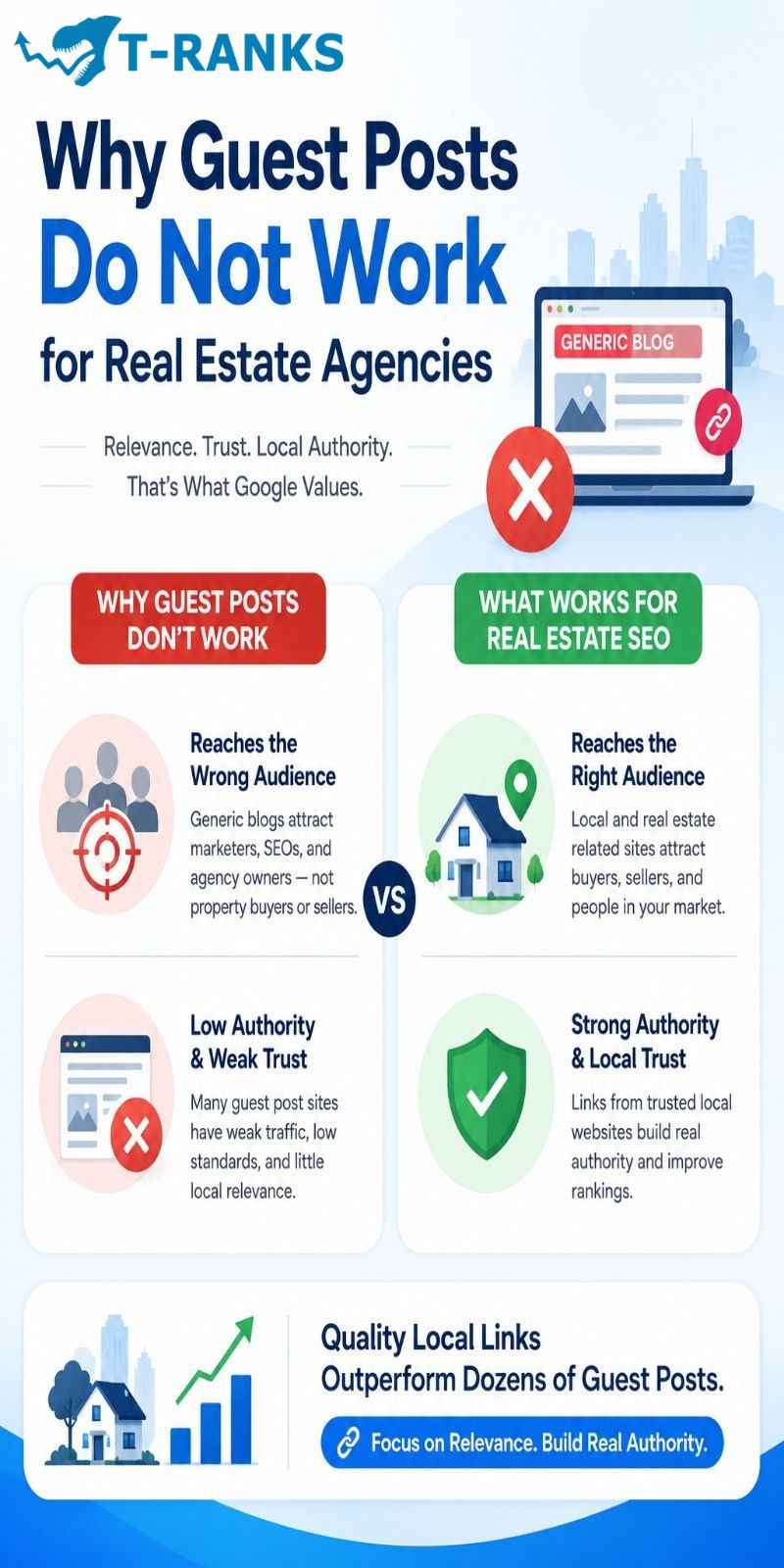
Guest posts often fail in real estate SEO because most of them come from websites that have no local relevance, weak audience trust, and little connection to actual property buyers or sellers.
Many real estate agencies still use guest posting as their main link building strategy. The problem is that most guest post backlinks are published on generic blogs instead of websites connected to the local housing market.
Google now evaluates backlinks differently than before. The search engine looks beyond backlink quantity and focuses more on whether the linking website helps confirm real local authority and market relevance.
A backlink from a random SEO blog may increase SEO tool metrics, but it usually does little to improve local real estate rankings.
Most Real Estate Guest Posts Reach the Wrong Audience
Many real estate guest posts are published on SEO, marketing, or general business blogs. These websites are not built for people searching for homes, local agents, or property services.
Most visitors reading those blogs are:
- Marketers
- SEO professionals
- Agency owners
- Businesses looking for backlinks
They are not searching for a real estate agent in a specific city or neighborhood.
Because of this, traffic from many guest posts rarely converts into qualified buyer or seller leads. Google also understands this difference. A backlink from a website with no local audience rarely strengthens local real estate authority.
Most Real Estate Guest Post Sites Have No Real Authority
Many websites selling guest posts have weak traffic, low editorial standards, and little topical focus. Some publish sponsored content across completely unrelated industries only to sell backlinks.
Google increasingly evaluates whether a website demonstrates:
- Real audience activity
- Topical consistency
- Local relevance
- Editorial trust
- Genuine business credibility
A backlink from a website nobody reads provides very limited SEO value.
This is why a few backlinks from trusted local websites often outperform dozens of guest posts published on weak blogs. In real estate SEO, relevance and trust matter far more than backlink quantity.
Why Link Building Is Harder — and More Valuable — in Real Estate

Link building is harder in real estate because Google expects stronger local trust signals in industries connected to major financial decisions.
Real estate is a hyper-local industry. Buyers and sellers search for agents within specific cities, neighborhoods, and communities. Because of this, Google closely evaluates whether a real estate agency is genuinely connected to the local market it wants to rank in.
A backlink helps confirm that connection. But in real estate SEO, not every backlink carries the same value. Google looks at whether the linking website is relevant to the local area, the housing industry, and the audience searching for property services.
This is why a backlink from a trusted local website often provides more SEO value than a backlink from a large national website with no geographic connection.
Google also applies stronger trust evaluation in real estate because users make high-value financial decisions when buying or selling property. Search engines increasingly prioritize signals connected to local authority, business credibility, community trust, and topical relevance.
This makes link building more valuable in real estate SEO than in many other industries. Strong local backlinks help improve:
- Google Maps visibility
- Neighborhood rankings
- Local keyword performance
- Brand trust within the market
The relationship-driven nature of real estate creates another important advantage. Real estate agencies naturally work with mortgage brokers, contractors, interior designers, local businesses, and community organizations. These relationships create highly relevant backlink opportunities that are difficult to replicate artificially.
Google often treats these locally connected backlinks as stronger trust signals because they reflect real business relationships within a specific market.
What Makes a Good Backlink for a Real Estate Website

A good real estate backlink comes from a trusted and locally relevant website that helps Google understand your authority within a specific market.
Many real estate agencies focus only on backlink quantity or domain authority. But Google evaluates backlinks based on relevance, trust, context, and how naturally they fit within the local market.
A few relevant local backlinks often provide more SEO value than dozens of generic backlinks from unrelated websites.
Local Relevance Matters More Than Domain Authority
A backlink from a local news website, city blog, or community organization usually provides stronger local SEO value than a backlink from a large generic website with no geographic connection.
Google uses geographic signals to understand whether a business is trusted within a local market. This is especially important for real estate SEO because rankings often depend on neighborhood and city relevance.
Before building a backlink, ask a simple question:
Would a home buyer or seller in my area realistically visit this website?
If the answer is yes, the backlink is usually more valuable for local SEO.
The Difference Between Dofollow and Nofollow Links
Dofollow links pass SEO authority directly to a website and help strengthen rankings. These are the links most agencies target during link building campaigns.
Nofollow links do not pass direct ranking value in the same way, but they still help build:
- Brand visibility
- Referral traffic
- Local awareness
- Natural backlink diversity
A healthy backlink profile normally includes both dofollow and nofollow links. Google expects backlink patterns to look natural rather than artificially controlled.
Why Using the Same Anchor Text Repeatedly Is Dangerous
Anchor text is the clickable text used inside a backlink. Many real estate websites make the mistake of repeating the same keyword-rich anchor text across multiple backlinks.
For example, repeatedly using phrases like:
- “best real estate agent in Dallas”
- “Miami luxury realtor”
- “homes for sale agent”
can create spam signals.
Natural backlink profiles use a mix of:
- Branded anchors
- Generic anchors
- Partial keyword anchors
- Natural sentence-based anchors
This variety helps Google understand that the backlinks were earned naturally instead of manipulated for rankings.
7 Link Building Strategies That Actually Work for Real Estate Agencies
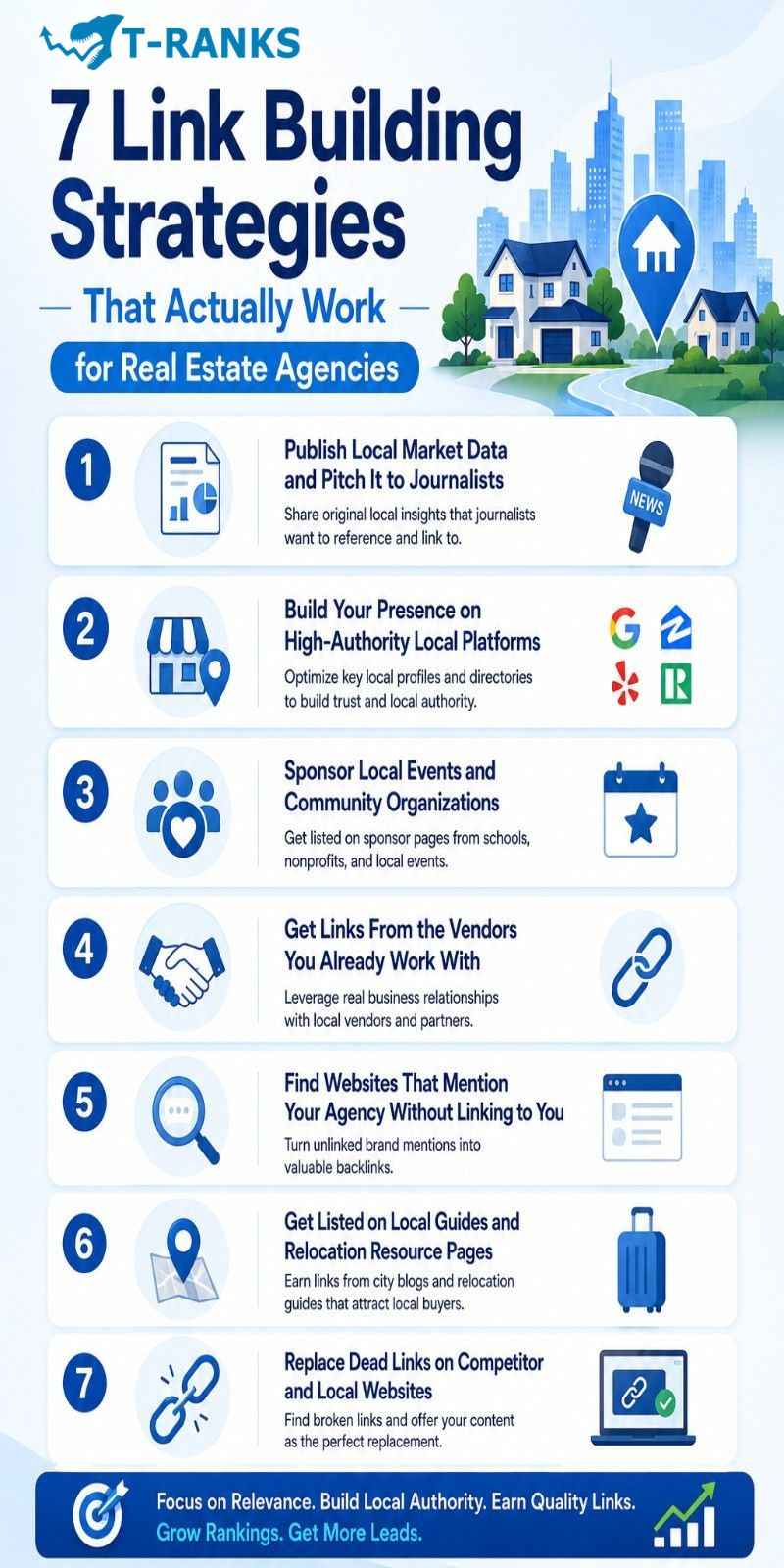
Real estate agencies need backlinks that improve local authority, strengthen community trust, and help Google understand where the business operates.
Real estate link building is different from general SEO because rankings depend heavily on local relevance. A backlink from a trusted local source often provides more value than multiple backlinks from unrelated websites. Google wants to rank agencies that appear genuinely connected to a specific city, neighborhood, or housing market.
Fortunately, there are several link building strategies that work especially well for real estate agencies. These strategies help improve local rankings, Google Maps visibility, referral traffic, and overall market authority.
1. Publish Local Market Data and Pitch It to Journalists
Local housing data is one of the strongest backlink opportunities in real estate SEO. Journalists regularly search for updated information about home prices, inventory levels, neighborhood trends, buyer demand, and days on market.
When a real estate agency publishes original local market insights, news websites often reference the data and link back to the source. These editorial backlinks carry strong authority because they come from trusted local publications.
You can pitch market insights through Connectively, direct outreach to local reporters, or the #JournRequest hashtag on X. This strategy works well because local news backlinks help strengthen both authority and geographic relevance.
2. Build Your Presence on High-Authority Local Platforms
Trusted local business platforms help Google verify that a real estate agency is legitimate and active within a specific market.
Every agency should fully optimize profiles on:
Local directories, Chamber of Commerce websites, and regional business listings also help strengthen local trust signals. Your Name, Address, and Phone number should remain consistent across every platform because Google uses this information to validate business legitimacy and geographic relevance.
3. Sponsor Local Events and Community Organizations
Sponsoring local organizations can generate highly relevant backlinks that are difficult for competitors to replicate. Many schools, charities, sports teams, and nonprofit organizations maintain sponsor pages that naturally include backlinks to supporting businesses.
These backlinks work especially well because they connect the agency to real community activity inside the local market. A backlink from a trusted community website often provides stronger local SEO value than a generic backlink from an unrelated website.
4. Get Links From the Vendors You Already Work With
Real estate agencies already work with businesses that have locally relevant websites. This includes mortgage brokers, contractors, interior designers, home staging companies, and moving companies.
Many of these businesses maintain partner pages, vendor lists, or client testimonial sections. Writing a testimonial for a trusted vendor can often earn a backlink back to the agency website.
These backlinks work well because they reflect real business relationships within the same geographic market. Google increasingly values backlinks connected through genuine local business activity.
5. Find Websites That Mention Your Agency Without Linking to You
Many local websites mention real estate agencies without adding a clickable link. These are called unlinked brand mentions.
You can find these opportunities using:
Once you find a mention, send a short and polite email asking the website owner to add a link to your website. This strategy works well because the website already recognizes your agency and has already referenced your business publicly.
6. Get Listed on Local Guides and Relocation Resource Pages
Many city blogs, relocation websites, and neighborhood guides maintain resource pages for home buyers, families moving into the area, and new residents.
A backlink from these websites can improve both local SEO visibility and referral traffic because the audience already has local intent. Search for opportunities using phrases like “best real estate agents in [city]” or “[city] relocation guide.”
These backlinks perform well because they come from websites already connected to local housing searches and community-based traffic.
7. Replace Dead Links on Competitor and Local Websites
Many local websites contain broken links pointing to outdated pages. These broken links create opportunities to suggest your own content as a replacement.
This strategy works especially well on:
- Local news websites
- Housing blogs
- Community resource pages
- Real estate directories
You can find broken links using Ahrefs or the Check My Links Chrome Extension. Website owners usually want to replace outdated resources quickly, which makes broken link outreach more natural and effective.
What Types of Content Earn the Most Backlinks in Real Estate

The real estate content that earns the most backlinks is the content that provides local information, original data, or useful resources people cannot easily find elsewhere.
Most blog posts do not attract backlinks naturally because they repeat information already published on hundreds of websites. In real estate SEO, backlinks are usually earned by content that helps buyers, sellers, journalists, businesses, or local communities make decisions.
The content formats below work well because they provide long-term value and attract links from websites already connected to local audiences and housing-related topics.
Local Quarterly Market Reports
Local market reports are one of the strongest linkable assets in real estate SEO. Journalists, bloggers, and local publications regularly need updated housing statistics for articles and market coverage.
These reports often include:
- Home price trends
- Inventory changes
- Buyer demand
- Days on market
- Neighborhood comparisons
When the data is original and locally focused, other websites naturally reference it as a trusted source. This is why local market reports often earn backlinks from news websites, housing blogs, financial publications, and local business websites.
Neighborhood Comparison Guides
Neighborhood comparison pages help buyers compare different areas before making a decision. These guides attract backlinks because they provide useful local information that many websites do not cover in depth.
A detailed comparison guide covering schools, property prices, commute times, and lifestyle differences can become a useful reference page for local audiences. These guides are often linked by local blogs, relocation websites, and community-focused publications because they help users evaluate different neighborhoods clearly.
Cost-of-Living and Relocation Guides
People moving into a new city often search for cost-of-living information before choosing where to live. Relocation guides answer these questions and naturally attract backlinks from businesses helping people relocate.
These guides usually perform well because they support real decision-making. HR departments, relocation companies, employer resource pages, and local business websites often link to detailed relocation content that helps employees or families moving into the area.
School District Information Pages
School district information is one of the most searched real estate topics for families relocating to a new area. Many buyers choose neighborhoods based on school quality before contacting an agent.
A detailed school district page can attract backlinks from parenting blogs, education resources, community websites, and relocation guides because families actively search for this information during the home-buying process.
First-Time Home Buyer Resource Pages
First-time buyers often search for educational content before entering the housing market. Resource pages explaining mortgages, down payments, closing costs, and financing basics can become strong backlink assets over time.
Mortgage brokers, financial blogs, housing nonprofits, and local assistance programs often link to these pages because they simplify complex topics for new buyers. Educational content works especially well in real estate because it solves real problems and remains useful for years.
How Link Building Differs for Luxury, Commercial, and Rental Agencies
Luxury, commercial, and rental real estate agencies need different link building strategies because each audience trusts different websites and searches with different intent.
Many real estate agencies use the same backlink strategy across every market segment. But luxury buyers, commercial investors, and renters consume different content, visit different platforms, and respond to different trust signals. Google also evaluates authority differently across these real estate niches.
The table below shows how backlink sources, content formats, and SEO goals differ across each type of real estate business.
| Real Estate Niche | Best Backlink Sources | Content That Attracts Links | Main SEO Goal |
| Luxury Real Estate | Lifestyle magazines, architecture blogs, luxury local media | Luxury property stories, architecture features, lifestyle content | Build premium brand authority |
| Commercial Real Estate | Business journals, commercial directories, industry associations | Vacancy reports, lease trends, investment insights | Build business and market authority |
| Rental & Property Management | Relocation websites, tenant resources, apartment platforms | Renter guides, affordability reports, moving resources | Improve local renter visibility |
Link Building for Luxury Real Estate Agencies
Luxury real estate SEO depends heavily on brand perception and high-end authority. Backlinks from luxury-focused websites often provide stronger value than generic real estate backlinks because they match the audience luxury buyers actually follow.
Luxury agencies should focus on earning backlinks from lifestyle publications, architecture blogs, interior design websites, and premium local magazines. Unique property stories, celebrity homes, waterfront estates, and architectural features often attract attention from high-end local media.
Partnerships with private clubs, luxury brands, concierge services, and upscale event organizers can also create valuable co-mentions and backlinks. These backlinks strengthen both local trust and premium brand positioning.
Link Building for Commercial Real Estate Agencies
Commercial real estate SEO relies more on business authority and investment-focused visibility. Commercial audiences usually search through business publications and industry websites instead of traditional home-buying platforms.
Commercial agencies should focus on backlinks from business journals, commercial property directories, industry associations, and economic development organizations. Chamber of Commerce websites are especially valuable because they reinforce local business credibility.
Publishing commercial market reports can also attract natural backlinks over time. Reports covering vacancy rates, lease trends, office demand, and investment activity are frequently referenced by local business media and commercial property websites.
Link Building for Rental and Property Management Agencies
Rental and property management SEO depends heavily on local living searches and relocation-related intent. Renters often search for affordability, neighborhood information, transportation access, and tenant resources before choosing where to live.
Property management agencies should target tenant resource pages, apartment review platforms, relocation websites, and city living guides. Employer housing assistance pages and relocation companies can also become valuable backlink sources.
Publishing renter-focused content often earns backlinks naturally. Affordability reports, renter checklists, moving guides, and local cost-of-living pages perform especially well because they help users make housing decisions before relocating.
How to Use Internal Links to Get More Value From Every Backlink You Earn

Internal links help distribute SEO authority from strong pages to other important pages across a real estate website.
Many real estate agencies build backlinks only to their homepage. The problem is that most of the SEO value stays concentrated on one page instead of helping the rest of the website rank.
Google uses internal links to understand how pages connect to each other. When a strong page links naturally to supporting pages, part of that authority flows through the site structure. This helps weaker pages gain visibility more easily.
This is especially important for real estate websites because city pages, neighborhood pages, and property-related pages often struggle to earn backlinks directly. Internal linking helps transfer authority from stronger pages to these important local landing pages.
A simple internal linking structure usually works best:
| Strong Page Receiving Backlinks | Internal Links Point To | SEO Benefit |
| Homepage | Main city pages | Improves local keyword visibility |
| Local market report | Neighborhood guides | Strengthens geographic relevance |
| Relocation guide | School district pages | Supports local topical authority |
| High-traffic blog post | Property or service pages | Distributes authority across the site |
For example, a local housing market report may earn backlinks from news websites and community blogs. If that report internally links to nearby neighborhood pages or city landing pages, some of the authority from those backlinks can help improve rankings for those supporting pages as well.
This is why one strong backlink to the right page can sometimes improve rankings for an entire section of a real estate website when the internal linking structure is properly connected.
How to See Which Backlinks Your Top Competitors Already Have
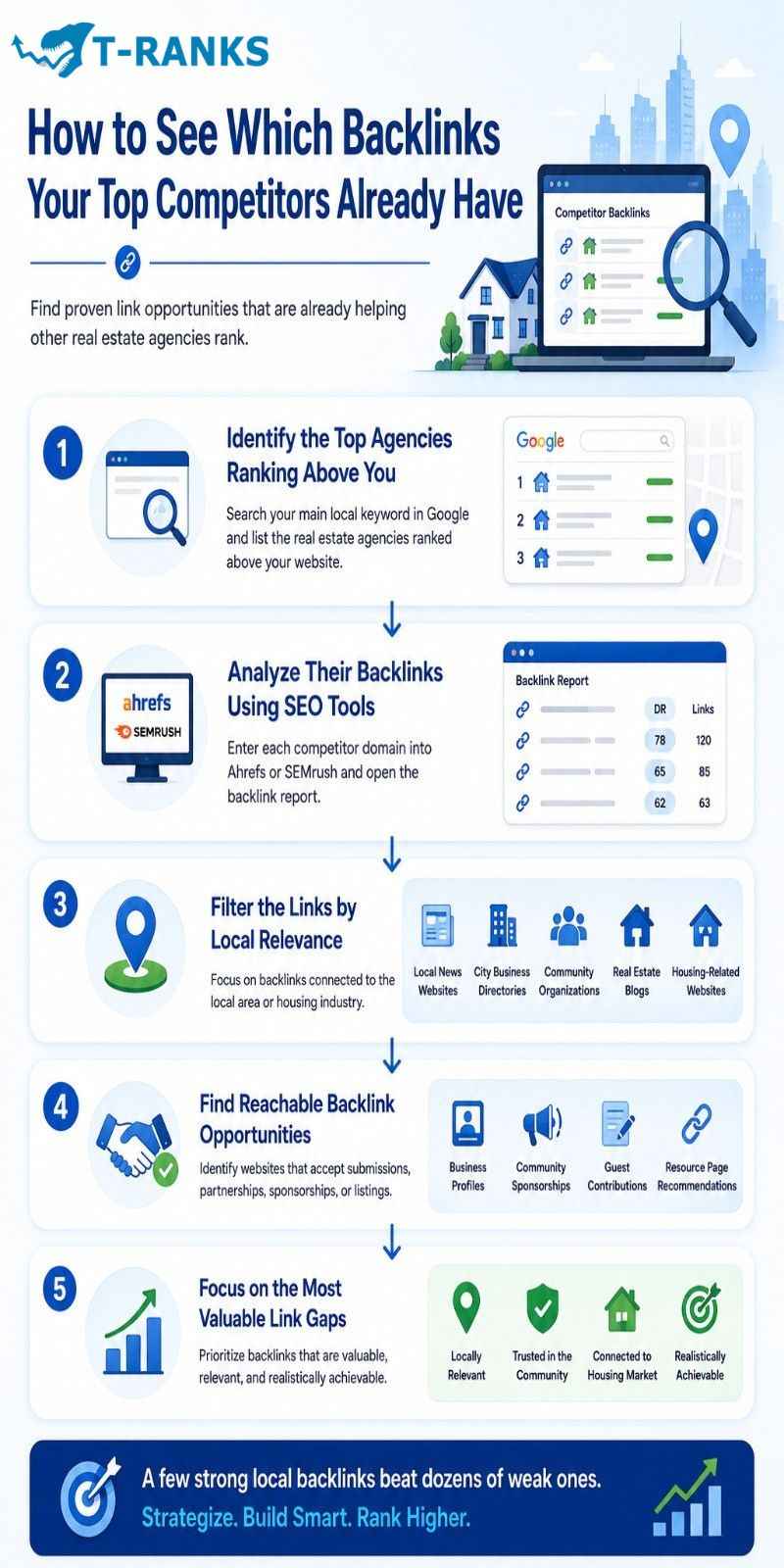
Competitor backlink analysis helps real estate agencies find proven link opportunities that are already helping other local agencies rank.
Instead of guessing where to build backlinks, you can study the websites already ranking above you in local search results. Google has already identified these competitors as trusted sources within your market. Their backlink profiles often reveal which local websites, directories, news sources, and community pages influence rankings in your area.
The process below helps identify backlink opportunities that are both realistic and locally relevant.
Step 1: Identify the Top Agencies Ranking Above You
Search your main local keyword in Google and identify the top real estate agencies consistently ranking above your website.
For example:
- “real estate agent in Dallas”
- “Miami luxury realtor”
- “homes for sale in Austin”
Focus on agencies competing in the same geographic market and service category as your business.
Step 2: Analyze Their Backlinks Using SEO Tools
Enter each competitor domain into tools like:
Open the backlink report to see which websites are linking to those agencies. These reports help uncover the sources already influencing local rankings in your market.
Step 3: Filter the Links by Local Relevance
Not every backlink matters equally in real estate SEO. Focus on links connected to the local area or housing industry.
Look for backlinks from:
- Local news websites
- City business directories
- Community organizations
- Real estate blogs
- Housing-related websites
These backlinks usually provide stronger geographic relevance and local trust signals.
Step 4: Find Reachable Backlink Opportunities
After filtering the results, identify websites that realistically allow submissions, partnerships, sponsorships, outreach, or business listings.
Many valuable local backlinks come from websites that already accept:
- Business profiles
- Community sponsorships
- Guest contributions
- Resource page recommendations
This step helps separate realistic opportunities from backlinks that are difficult or impossible to replicate.
Step 5: Focus on the Most Valuable Link Gaps
Not every competitor backlink should be copied. Some links may be low quality, irrelevant, or impossible to earn naturally.
Prioritize backlinks that are:
- Locally relevant
- Trusted within the community
- Connected to the housing market
- Realistically achievable
A few strong local backlinks often provide more SEO value than dozens of weak backlinks copied without strategy.
How to Protect Your Rankings While Building Links

The safest way to build backlinks for a real estate website is to grow links naturally, focus on relevant websites, and avoid manipulative SEO practices.
Real estate websites fall into Google’s YMYL category because they influence major financial decisions. This means Google applies stricter trust and spam evaluation standards to real estate SEO than many other industries.
The steps below help real estate agencies build backlinks safely while protecting long-term rankings.
Step 1: Build Backlinks Slowly and Naturally
Google expects backlink growth to happen gradually over time. A sudden spike of hundreds of backlinks can look artificial, especially for smaller local real estate websites.
The safest approach is to earn links steadily through local partnerships, useful content, community involvement, and business relationships. Natural growth patterns help Google view the website as trustworthy and established within the local market.
Step 2: Focus on Relevant and Trusted Websites
After building links at a natural pace, the next priority is backlink quality. Google evaluates whether the linking website is connected to the local area, housing industry, or audience searching for real estate services.
A backlink from a trusted local website usually provides more long-term value than multiple backlinks from unrelated blogs or low-quality SEO websites.
The strongest backlinks often come from:
- Local news websites
- Community organizations
- Housing-related blogs
- Business associations
- Trusted local directories
Relevant backlinks help strengthen local authority without creating spam signals.
Step 3: Watch for Unnatural Backlink Patterns
Even high backlink numbers can become risky if the link profile starts looking manipulated. Google pays close attention to unnatural patterns that suggest aggressive SEO activity.
Common warning signs include:
- Sudden ranking drops after rapid link building
- Large numbers of backlinks from unrelated foreign websites
- Repeated exact-match anchor text
- Backlinks from obvious spam networks
These signals can weaken trust and reduce ranking stability over time.
Step 4: Avoid Low-Quality Paid Link Networks
Many cheap backlink services sell links through private blog networks, automated websites, or mass guest posting platforms. These links may temporarily increase SEO metrics, but they often provide weak long-term trust signals.
This is especially risky for real estate websites because Google applies stronger quality standards to YMYL industries. A few trusted local backlinks usually provide more ranking value than hundreds of low-quality paid links.
Step 5: Use Google’s Disavow Tool Only When Necessary
Most real estate websites naturally attract some strange or low-quality backlinks over time. In many cases, Google simply ignores these links automatically.
Google’s disavow tool should only be used when there is strong evidence that harmful backlinks are negatively affecting rankings. Disavowing the wrong links can sometimes remove useful authority signals from the website.
In most situations, building stronger and more relevant backlinks is safer than aggressively removing links.
How Long Link Building Takes and How Much It Costs

Real estate link building usually takes several months before meaningful ranking improvements appear because Google needs time to discover, evaluate, and trust new backlinks.
Many real estate agencies expect fast SEO results after building a few backlinks. But local SEO works gradually, especially in competitive housing markets. Rankings improve over time as Google processes backlink relevance, local authority, internal linking, and overall website trust.
The timeline and cost of link building depend heavily on market competition, backlink quality, local authority, and the consistency of the strategy.
What to Expect at 3, 6, and 12 Months
Link building results usually appear in stages rather than all at once. Early improvements often involve visibility and trust signals before major ranking movement happens.
| Timeline | Typical SEO Progress |
| First 3 Months | Local citations get indexed, brand visibility improves, backlink profile begins growing, but major ranking changes are usually limited |
| Around 6 Months | Local pack movement may begin for lower-competition keywords, referral traffic increases, and some city pages start gaining visibility |
| Around 12 Months | Stronger ranking improvements often appear for target city, neighborhood, and service-related keywords |
Real estate SEO usually compounds over time. Consistent backlink growth combined with strong local content and internal linking often produces the best long-term results.
What You Can Do Based on Your Budget
Different budgets require different link building approaches. Smaller agencies can still build valuable backlinks by focusing on local relevance and relationship-based opportunities.
| Budget Level | Recommended Strategy |
| Zero Budget | Focus on citations, vendor testimonials, brand mention reclamation, local networking, and community sponsorships |
| Small Budget ($300–$800/month) | Add local digital PR outreach, niche directory placements, and locally relevant content promotion |
| Growth Budget ($1,000+/month) | Scale with a dedicated link building agency or in-house outreach specialist focused on local authority building |
The most important factor is consistency. A steady stream of relevant local backlinks usually performs better than short-term aggressive campaigns focused only on link quantity.
How Link Building Helps Real Estate Agencies Show Up in AI Search Results
Link building helps real estate agencies appear in AI search results because Google uses backlinks, brand mentions, and local authority signals to decide which businesses it trusts enough to recommend.
Google AI Overviews now recommend specific local businesses directly inside search results. This includes real estate agencies, mortgage companies, and other location-based service providers.
These recommendations are influenced by entity signals. Google evaluates consistent citations, trusted brand mentions, editorial backlinks, and local authority across the web to understand which agencies are credible within a specific market.
A real estate agency with strong local backlinks is more likely to appear in AI-generated answers because Google sees the business as trusted, locally relevant, and connected to real housing-related sources.
The strongest AI search signals usually come from consistent Name, Address, and Phone number data, trusted local citations, brand mentions across recognized websites, and editorial backlinks from authoritative local publications.
The Most Common Link Building Mistakes Real Estate Agencies Make

Most real estate link building mistakes happen when agencies focus on backlink quantity instead of local relevance, natural growth, and long-term authority.
Below are the most common link building mistakes real estate agencies should avoid.
Building Backlinks Only to the Homepage
Many agencies send all backlinks to the homepage while ignoring city pages, neighborhood pages, and local service pages. This limits how much authority reaches the pages that often need rankings the most.
Using the Same Keyword Phrase Repeatedly as Anchor Text
Repeated exact-match anchors can create spam signals and make the backlink profile appear manipulated instead of naturally earned.
Submitting the Website to Every Directory Available
Many directories have little traffic, weak trust signals, and no real local relevance. These links usually provide minimal long-term SEO value.
Choosing High-DA National Websites Over Trusted Local Websites
In real estate SEO, geographic relevance often matters more than raw domain authority metrics. A trusted local backlink usually provides stronger local ranking signals.
Expecting Ranking Improvements Within 30 to 60 Days
Real estate SEO usually takes several months before meaningful ranking movement appears, especially in competitive local markets.
Building Too Many Backlinks Too Quickly
Sudden spikes in backlink growth can look unnatural. Google generally trusts steady and consistent backlink growth patterns more.
Not Monitoring Backlink Performance
Tools like Google Search Console and Ahrefs help track which backlinks improve rankings, referral traffic, and local visibility over time.
Where to Start With Real Estate Link Building
The best place to start with real estate link building is by building trusted local signals instead of chasing large numbers of generic backlinks.
Many real estate agencies rely too heavily on guest posts. In most cases, guest posting works better as a supporting tactic, while stronger local authority comes from trusted community and business relationships.
The strongest backlink profiles are usually built through local citations, vendor partnerships, community sponsorships, original market data, and trusted local mentions. These signals help Google understand that the agency is genuinely connected to a specific market.
Start with one realistic strategy and execute it consistently. One trusted local backlink from a relevant source often provides more long-term SEO value than multiple backlinks from websites with no real local audience.
Conclusion
In conclusion, successful link building for real estate agencies depends more on local relevance, trusted relationships, and consistent authority signals than backlink quantity alone.
Google increasingly evaluates whether a real estate agency is genuinely connected to the local market it serves. Backlinks from trusted local websites, community organizations, business partners, housing resources, and recognized publications help strengthen those trust signals over time.
The strongest long-term results usually come from steady and natural growth. Local citations, market reports, community sponsorships, internal linking, and geographically relevant backlinks often provide more value than aggressive guest posting or large-scale link campaigns.
If you want stronger local rankings, better Google Maps visibility, and higher trust in AI-driven search results, focus on building backlinks that reflect real authority within your market. Start with one proven strategy, execute it consistently, and build your local presence step by step.
FAQs About Link Building for Real Estate Agencies
What is link building for real estate agencies?
Link building for real estate agencies is the process of getting backlinks from relevant websites to improve local SEO rankings and online authority.
These backlinks help Google understand that the agency is trusted within a specific city or housing market.
Why is link building important for real estate SEO?
Link building is important because backlinks help improve local rankings, Google Maps visibility, and search authority.
Google uses backlinks as trust signals when deciding which real estate agencies deserve stronger local visibility.
Do guest posts still work for real estate agencies?
Yes, guest posts still work, but they should not be the main link building strategy.
Local backlinks from trusted community websites and regional publications usually provide stronger long-term SEO value.
What types of backlinks work best for real estate websites?
The best backlinks usually come from locally relevant and trusted websites.
This includes local news sites, Chamber of Commerce websites, housing blogs, and regional business directories.
How long does real estate link building take to show results?
Real estate link building usually takes several months before meaningful ranking improvements appear.
Many agencies begin seeing visibility improvements within 3 to 6 months, while stronger ranking gains often take 6 to 12 months.
Can backlinks improve Google Maps rankings for real estate agencies?
Yes, relevant local backlinks can improve Google Maps visibility.
Google uses local authority, citations, and trusted business mentions to evaluate map pack rankings.
What content earns the most backlinks in real estate SEO?
Local market reports, neighborhood guides, relocation resources, and first-time buyer content often earn the most backlinks naturally.
These content types provide useful information that journalists, bloggers, and local businesses regularly reference.
Can Google detect spammy real estate backlinks?
Yes, Google can identify many manipulative backlink patterns.
Repeated exact-match anchors, spam networks, irrelevant foreign backlinks, and unnatural growth spikes can weaken trust signals over time.
What is local relevance in link building?
Local relevance means the backlink comes from a website connected to the same city, region, or housing market as the business.
These backlinks usually provide stronger local SEO signals than unrelated national websites.
Which tools help analyze competitor backlinks?
Tools like Ahrefs and SEMrush help analyze competitor backlink profiles.
These tools show which websites are linking to competing real estate agencies in your market.
How does link building help real estate agencies appear in AI search results?
Google AI search systems use backlinks, citations, and brand mentions to evaluate trusted local businesses.
A strong local link profile increases the likelihood of appearing in AI Overviews and local recommendations.
What is the biggest link building mistake real estate agencies make?
One of the biggest mistakes is focusing only on backlink quantity instead of local relevance and trust.
Generic backlinks from unrelated websites usually provide weaker long-term SEO value.