Your food is great. Your service is excellent. Your reviews are solid. But your restaurant is still buried on page three while competitors take every booking you should be getting.
The problem is not your menu page. It is not your Google Business Profile. It is your backlinks. Without quality links from trusted local sources Google has no reason to rank your restaurant above the competitors showing up every time a nearby customer searches for food.
Most businesses treat link building for restaurants the same way they would any other industry. Restaurants are different. Community relevance, local authority, and Google Maps visibility all change how link building works for local food businesses.
This guide covers every proven strategy for 2026. From food blogger outreach and digital PR to event sponsorship links, Google Maps pack rankings, and measuring what actually drives more bookings for your restaurant.
Why Link Building Still Matters for Restaurants in 2026

Link building still matters for restaurants in 2026. Every backlink pointing to your website tells Google that another trusted source considers your restaurant relevant and credible. In local search that trust signal directly translates into higher rankings and more customers walking through your door.
If you have been focusing only on reviews and Google Business Profile you are missing the third piece of the puzzle. Reviews build reputation. Citations build consistency. But backlinks in SEO build the authority that pushes your restaurant above competitors in both organic results and the Google Maps pack.
Think of it this way. When a respected local food blog, a neighborhood newspaper, or a city tourism board links to your restaurant website it is a digital endorsement. Google reads that endorsement as proof that your restaurant is a genuine and trusted part of the local dining scene. The more relevant endorsements you earn the more prominently your restaurant appears in local search.
In 2026 this matters beyond Google too. AI tools like ChatGPT, Perplexity, and Google AI Overviews now surface local restaurant recommendations based on citation patterns and trusted references. If your restaurant is not being referenced by credible local sources AI search will simply overlook you.
Citations vs Backlinks — What Restaurants Need to Know

Most restaurant owners use the terms citations and backlinks interchangeably. They are not the same thing. Understanding the difference is the first step toward building a local SEO strategy that actually works.
What Is a Local Citation
A local citation is any online mention of your restaurant’s name, address, and phone number. Citations do not always include a clickable link to your website. They exist to verify that your restaurant is a real, legitimate business operating at a specific location.
Citations appear on platforms like Yelp, TripAdvisor, Google Business Profile, OpenTable, and local business directories. Their primary job is consistency. When your restaurant’s name, address, and phone number appear identically across every platform Google gains confidence in your business information. This is called NAP consistency and it is foundational to local SEO.
What Is a Backlink
A backlink is a clickable link from another website pointing directly to your restaurant’s website. Unlike citations backlinks pass authority and trust directly to your site. They tell Google not just that your restaurant exists but that other trusted sources consider it worth referencing.
A link from a respected local food blog, a neighborhood newspaper, or a city tourism board is a backlink. These links strengthen your domain authority, improve your organic rankings, and boost your prominence signal in Google’s local algorithm. A strong backlink profile is what separates restaurants that dominate local search from those that rely entirely on paid advertising.
Why Your Restaurant Needs Both
Citations and backlinks work together but serve completely different purposes. Think of citations as your restaurant’s digital ID card — they confirm who you are and where you are. Think of backlinks as your restaurant’s reputation — they confirm how trusted and authoritative you are within your local food ecosystem.
| Factor | Citations | Backlinks |
| What it is | Mention of your NAP data | Clickable link to your website |
| Requires a link | No | Yes |
| Primary purpose | Verify business existence | Build authority and trust |
| Where they appear | Directories and review platforms | Blogs, newspapers, tourism sites |
| SEO impact | Local pack rankings | Organic rankings and prominence |
| Difficulty to earn | Easy | Medium to hard |
| Build first or second | First | Second |
Build your citations first. Ensure your NAP data is consistent across every major platform. Then focus on earning editorial backlinks from locally relevant sources. Together they represent roughly 50 percent of your local search ranking authority.
What Makes a Good Backlink for a Restaurant Website

A good backlink for a restaurant comes from a relevant, locally trusted source that real diners and food lovers actually read. Not every link is worth pursuing. Understanding what separates a valuable restaurant backlink from a useless one saves you time and budget.
Relevance, Authority, and Traffic
Relevance is the most important factor for restaurant backlinks. A link from a local food blog, city dining guide, or neighborhood newspaper directly reinforces your local authority. A link from an unrelated tech or finance site adds almost no value regardless of its domain rating.
Authority determines how much ranking power a link passes to your site. Links from established local publications and respected food magazines carry far more weight than links from newly created blogs. Always check a site’s domain rating and organic traffic before pursuing a link.
Traffic is the most overlooked factor. A link from a site with real organic visitors sends referral traffic directly to your restaurant. Those visitors are often ready to book a table. A high DR site with no real traffic delivers authority but no customers.
Dofollow vs Nofollow Links for Restaurants
A dofollow link passes full SEO value to your restaurant website. These links directly improve your rankings and strengthen your local authority. Prioritize dofollow links in every outreach campaign.
A nofollow link does not pass direct ranking value but still has its place. Links from Yelp, TripAdvisor, and OpenTable are typically nofollow. They still drive real referral traffic and add natural diversity to your backlink profile. A healthy restaurant backlink profile contains a mix of both.
The Best Link Building Strategies for Restaurants in 2026
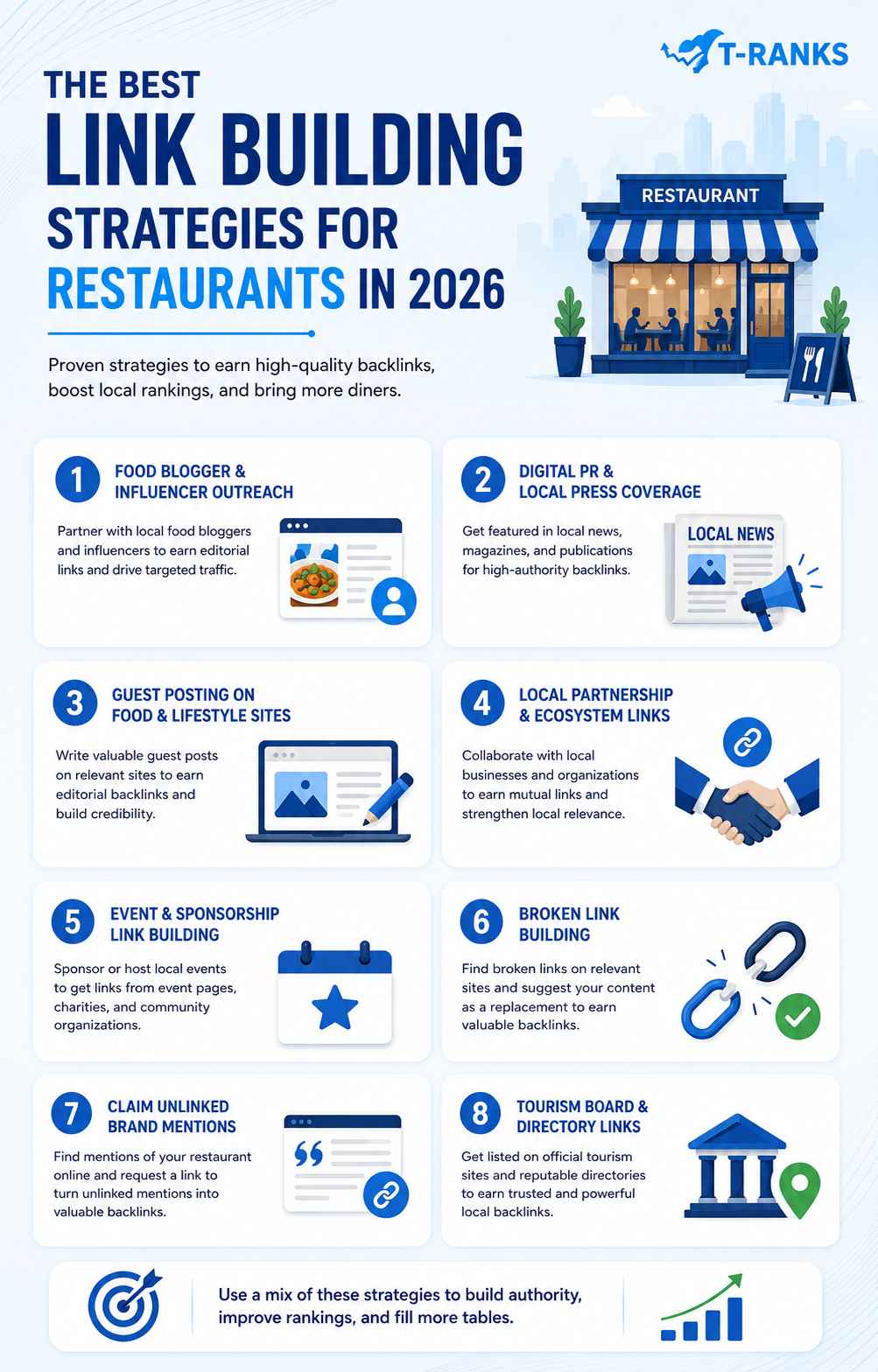
The best link building strategies for restaurants in 2026 are food blogger outreach, digital PR, guest posting, local partnerships, event sponsorship, broken link building, unlinked mention reclamation, and tourism board links. The right mix depends on your restaurant size and budget.
1. Food Blogger and Influencer Outreach
Food bloggers are one of the most powerful link building channels for restaurants. A feature from a respected local food blogger earns you an editorial backlink and drives direct referral traffic. It also puts your restaurant in front of an engaged local audience looking for dining recommendations.
Focus on bloggers with established websites and real organic traffic — not just social media followers. A food blogger with 30,000 monthly organic visitors and a DR 40 website delivers far more SEO value than an Instagram influencer with no website.
Invite local food bloggers for a complimentary dining experience. Make it remarkable and give them a genuine story to tell. Use guest post outreach principles — personalize every approach and lead with what you are offering before asking for anything in return.
2. Digital PR and Local Press Coverage
Local press coverage produces some of the most valuable backlinks available to restaurants. A feature in a city magazine or a listing in a “best restaurants in [city]” roundup earns high-authority editorial links that directories cannot match.
Local journalists constantly need content about new openings, seasonal menus, and community stories. Your restaurant is naturally newsworthy. You just need to give journalists a compelling reason to cover you.
Send press releases for new menu launches, chef appointments, awards, and community events. Use HARO and Qwoted to respond to journalist queries about local dining and food trends. Build genuine relationships with local food writers before pitching.
3. Guest Posting on Food and Lifestyle Publications
Guest posting on relevant food blogs and lifestyle publications earns editorial backlinks while positioning your restaurant as a culinary authority. Focus on publications with real organic traffic and genuine editorial standards.
Pitch specific experience-driven angles only your restaurant can offer. A recipe from your head chef, a behind-the-scenes kitchen story, or a seasonal menu pairing guide gets editorial responses. Generic pitches get ignored.
Use free guest post sites to build your initial portfolio first. Start with local lifestyle blogs and city guides then work up to regional food magazines and national culinary publications.
4. Local Partnership and Ecosystem Links
Every real-world business relationship is a potential link building opportunity. Local breweries, wine suppliers, food producers, nearby hotels, and event venues all have websites. Genuine partnerships produce cross-linking opportunities Google recognizes as authentic local authority signals.
Create joint content with your partners — a seasonal food and wine pairing guide or a local produce sourcing story. Ensure every partner links to your restaurant website and return the favor with a dedicated partners page on your site.
Build profile backlinks from your local chamber of commerce and neighborhood association websites. These links add strong geographic authority signals that reinforce your restaurant’s connection to its local community.
5. Event and Sponsorship Link Building
Sponsoring local events is one of the most natural ways to earn backlinks for a restaurant. Event organizers, charities, and community groups publish sponsor pages on their websites. Those pages link back to every sponsor.
Choose events that genuinely align with your restaurant’s brand. A farm-to-table restaurant sponsoring a local food festival earns a highly relevant backlink. A neighborhood bistro sponsoring a charity run earns a link from a trusted community organization.
Host your own events too. Wine tastings, cooking classes, and seasonal food festivals generate press coverage and natural backlinks from event listing sites, local blogs, and community calendars.
6. Broken Link Building in the Food Niche
Broken link building finds dead links on established food websites and offers your relevant page as a replacement. You are solving a real problem for the site owner. This makes it one of the cleanest white hat link building techniques available for restaurants.
Use Ahrefs or Semrush to find broken outbound links on local food blogs, city dining guides, and restaurant review sites. Look for broken links pointing to restaurant recommendations or local food guides your site can replace.
Keep your outreach short and specific. Mention the exact broken link, the page it appears on, and explain why your page is the right replacement. A specific helpful pitch gets responses. A generic request gets ignored.
7. Claiming Unlinked Brand Mentions
Many local food blogs and newspapers mention restaurants by name without linking to their website. These unlinked mentions are the easiest link building opportunity available. The site already knows your restaurant — adding a link is a small ask.
Use Google Alerts or Ahrefs Content Explorer to monitor mentions of your restaurant name across the web. When you find an unlinked mention reach out with a short friendly email thanking them for the feature and politely asking them to add a link.
This tactic works because you are following up on a warm relationship that already exists. Response rates for unlinked mention outreach are 3 to 5 times higher than cold link building outreach.
8. Tourism Board and Directory Links
Links from official tourism boards and city visitor guides carry exceptional local trust weight. Getting listed requires a genuine local presence — but the links they provide are among the most valuable a restaurant can earn.
Research the official tourism website for your city and look for restaurant listings, recommended dining pages, and local food guides. Contact their digital team directly with a proposal explaining why your restaurant deserves a feature.
For directories focus on established EDU backlinks from culinary schools and food-specific platforms with real traffic. These add strong authority signals when your restaurant contributes genuinely educational content about food or local cuisine.
Strategy Comparison
| Strategy | Difficulty | Speed of Results | Best For |
| Food Blogger Outreach | Easy | 2 to 4 weeks | All restaurants |
| Digital PR | Medium | 1 to 3 months | Established restaurants |
| Guest Posting | Medium | 2 to 4 months | All restaurants |
| Local Partnerships | Easy | 1 to 2 months | All restaurants |
| Event Sponsorship | Easy | 2 to 6 weeks | Community focused brands |
| Broken Link Building | Medium | 1 to 3 months | All restaurants |
| Unlinked Mentions | Easy | 1 to 2 weeks | Established restaurants |
| Tourism Board Links | High | 3 to 6 months | Destination restaurants |
Link Building by Restaurant Type
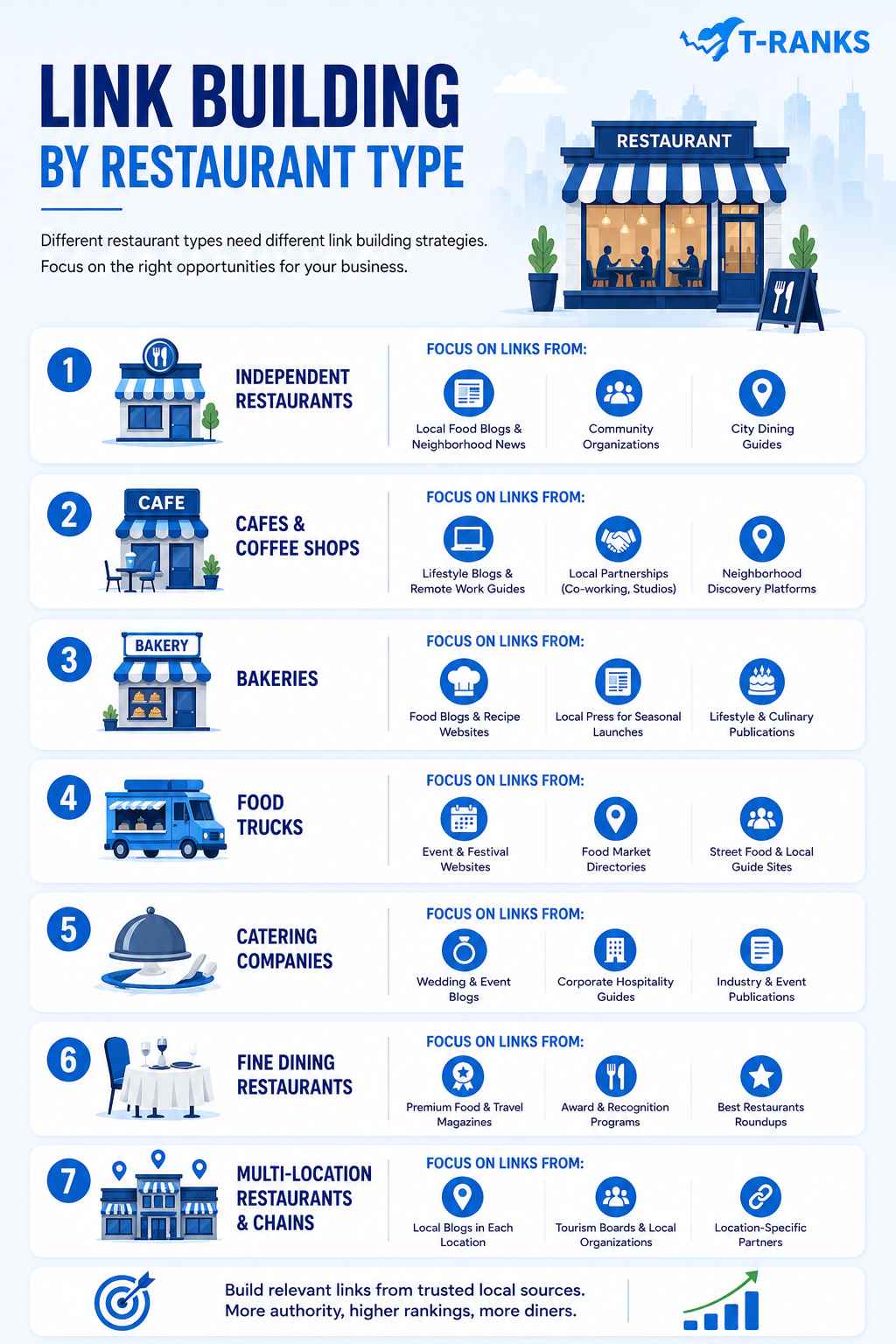
Link building looks different depending on what type of food business you run. The strategies that work for a fine dining restaurant are not the same ones that work for a food truck. Here is what each restaurant type should focus on.
Independent Restaurants
Independent restaurants compete on community relevance and local personality. Focus on earning links from local food blogs, neighborhood newspapers, community organizations, and city dining guides that speak directly to your local audience.
Guest posting, local press coverage, and event sponsorship are your strongest channels. Build links to your menu page, booking page, and location page first. Those are the pages that convert visitors into diners.
Cafes and Coffee Shops
Cafes compete on lifestyle relevance. Target lifestyle blogs, remote work guides, city exploration content, and neighborhood discovery platforms. A cafe featured in a “best places to work from in [city]” article earns a highly relevant backlink and direct referral traffic from exactly the right audience.
Partner with local co-working spaces, bookshops, and creative studios. These real-world relationships produce natural cross-linking opportunities that reinforce your cafe’s position within the local lifestyle ecosystem.
Bakeries
Bakeries have a natural advantage for linkable content. Recipes, baking guides, seasonal menu stories, and behind-the-scenes content all attract links from food bloggers and culinary websites. A well-crafted recipe post featuring your signature product earns consistent editorial citations long after it is published.
Focus on guest posting on food and lifestyle blogs to build authority and drive referral traffic. Local press coverage around seasonal launches — Christmas hampers, Easter specials, wedding cake services — generates timely high-authority links from local media.
Food Trucks
Food trucks operate across multiple locations and need local authority in every area they serve. The most effective strategy is event-based link building. Every market, festival, and pop-up your food truck appears at is a link building opportunity.
Get listed on every local event website, food market directory, and street food guide in every area you operate. These listings build a diverse local backlink profile that signals to Google your food truck is an active and recognized part of multiple local food communities.
Catering Companies
Catering companies need links that signal expertise across multiple event types — corporate events, weddings, private parties, and hospitality. Expert commentary in event planning publications, wedding blogs, and corporate hospitality guides builds the broad authority profile that catering sites need to rank for high-value booking keywords.
Focus on earning links to your specific service pages — corporate catering, wedding catering, private dining — rather than just your homepage. A link pointing directly to your corporate catering page passes authority exactly where it produces the most booking impact.
Fine Dining Restaurants
Fine dining restaurants benefit most from high-authority editorial placements in premium food publications, travel magazines, and lifestyle media. A feature in Condé Nast Traveler, Eater, or a Michelin-recognized food guide carries enormous trust weight and drives exactly the right audience to your reservation page.
Award submissions and culinary recognition programs are powerful link building tools for fine dining. Getting listed in “best restaurants” roundups and food critic reviews earns editorial links from some of the highest-authority sources in the food industry.
Multi-Location Restaurants and Chains
Multi-location restaurants need a location-specific link building strategy. Each restaurant location needs its own backlink profile built from locally relevant sources in its specific area. A chain with ten locations should be running ten separate local outreach campaigns — not one generic national campaign.
Build location-specific pages on your website for each restaurant. Earn links pointing directly to those pages from local food blogs, tourism boards, and community organizations in each area. This builds genuine local authority for every location and improves Google Maps pack visibility across your entire restaurant network.
Seasonal Link Building for Restaurants

Seasonal link building matters for restaurants because Google takes 2 to 3 months to process new backlinks into ranking improvements. Start building links during peak season and the results arrive after demand has already passed.
Restaurant search demand follows predictable cycles. Valentine’s Day, Easter, summer dining, Halloween, and Christmas all create surges in local food searches. Your link building needs to happen ahead of those surges — not during them.
Food journalists and bloggers start researching seasonal dining content months in advance. A food writer covering “best Valentine’s Day restaurants in [city]” starts research in December. Being their cited source earns a high-authority link precisely when it carries the most local search relevance.
Here is a seasonal link building calendar for restaurants:
- Valentine’s Day — start outreach in November and December
- Easter and spring dining — begin campaigns in January and February
- Summer and outdoor dining — run outreach in March and April
- Halloween and autumn menus — start campaigns in July and August
- Christmas and holiday dining — begin outreach in September and October
- New Year’s Eve — start building links in October and November
- Local food festivals and events — begin outreach 3 to 4 months before the event date
Not all restaurant content follows the same timing. Evergreen assets — menu pages, location pages, and about pages — attract backlinks consistently throughout the year. Seasonal assets — Christmas menus, Valentine’s Day set menus, summer terrace guides — earn concentrated link bursts around specific dining periods.
Build your evergreen pages first. Layer seasonal content on top once your site has baseline authority. A site publishing only seasonal content struggles to maintain consistent link acquisition year-round.
Link Building and Google Maps Pack Rankings
Link building directly impacts your Google Maps pack rankings. Most restaurant owners do not know this. They focus entirely on reviews and Google Business Profile while competitors quietly earn local backlinks and take every Maps pack position they are targeting.
Google ranks restaurants in the Maps pack using three core factors. Relevance is managed through your Google Business Profile. Distance is fixed. Prominence is where link building makes the biggest difference and it is the factor most restaurants completely ignore.
How Backlinks Build Local Prominence
Google defines prominence as how well-known and trusted your restaurant is across the web. It measures this through your review volume, citation consistency, and the quality of backlinks pointing to your website.
When a respected local food blog or city tourism board links to your restaurant website it sends Google a clear signal. It confirms that your restaurant is not just a pin on a map. It is a recognized and trusted part of the local dining community. The stronger that signal the higher your restaurant climbs in the Maps pack.
Geographic relevance beats raw domain authority for Maps pack rankings. A link from your city’s local newspaper outweighs a link from a national publication with ten times the domain rating. Google Maps rewards community relevance over global authority every time.
A restaurant with 200 reviews but no local backlinks will consistently lose its Maps pack position to a competitor with 80 reviews and a strong local backlink profile. Reviews signal popularity. Backlinks signal authority. Without both your Maps pack position will always be vulnerable.
How to Use Link Building to Climb the Maps Pack

Follow these steps to connect your link building directly to Maps pack performance:
- Prioritize links from locally relevant sources because geographic relevance carries more Maps pack weight than domain authority
- Build links to your location pages because links pointing directly to your location page strengthen its geographic relevance signal
- Run a backlink audit to identify and remove toxic links suppressing your local prominence signal
- Combine link building with review velocity because fresh reviews and new backlinks together produce the fastest Maps pack improvements
- Track your Maps pack position monthly using BrightLocal or Google Search Console to measure progress after each campaign
How to Measure Link Building Results for Your Restaurant
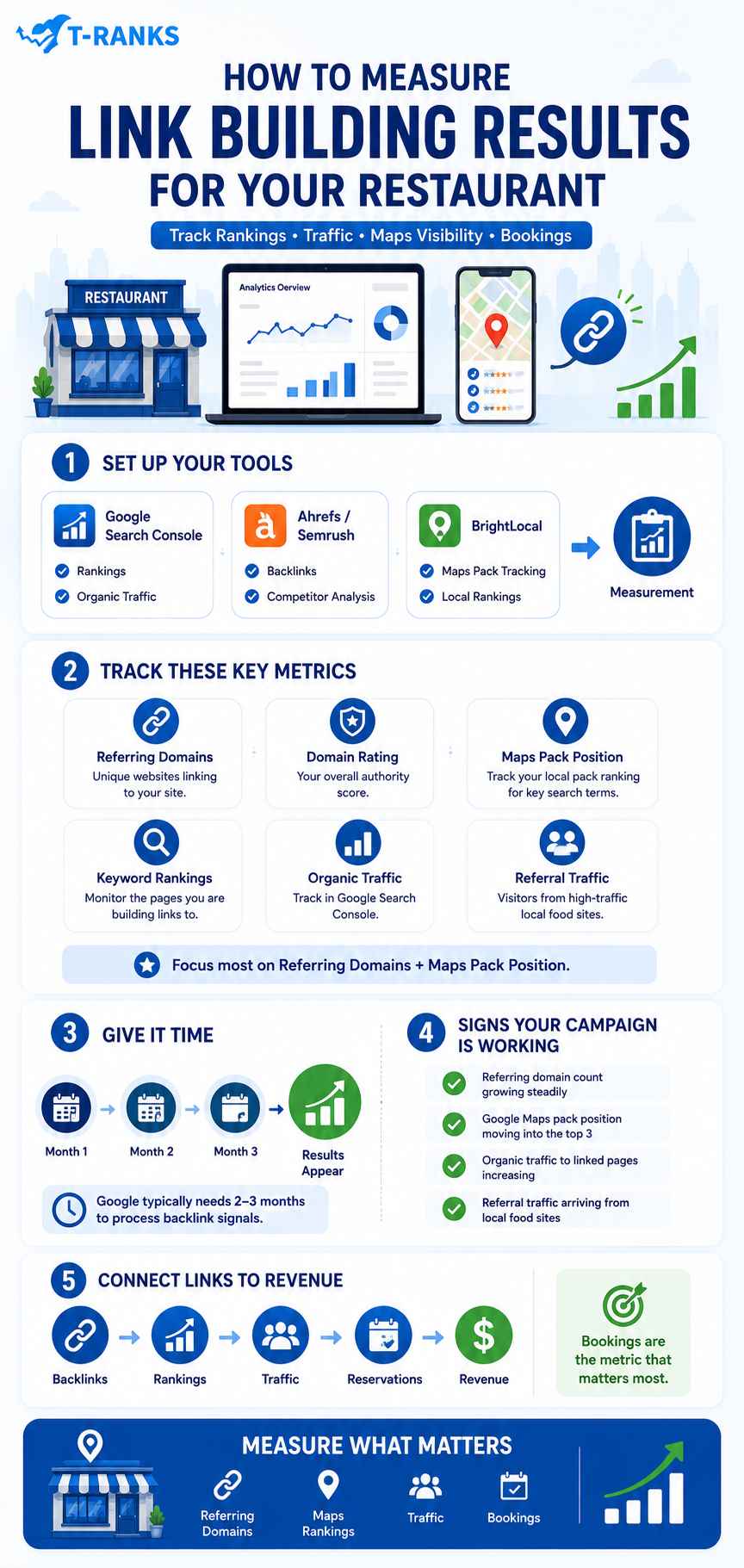
Most restaurants build links but never measure whether they are actually working. Without tracking the right metrics you are spending time and budget without knowing if it is driving rankings, traffic, or bookings.
Step 1: Set Up Your Tracking Tools
Before you measure anything you need the right tools in place. These three cover everything a restaurant needs:
- Google Search Console — free and essential. Shows keyword rankings and organic traffic directly from Google
- Ahrefs or Semrush — tracks referring domains, lost links, and competitor backlink profiles
- BrightLocal — tracks your Google Maps pack position at the neighborhood level
Start with Google Search Console first. It is free and connects directly to Google’s own data. Add Ahrefs and BrightLocal once you are ready to track competitor backlinks and local pack movement.
Step 2: Track the Right Metrics
Not every metric tells the same story. These six metrics tell you whether your restaurant link building is delivering real results:
- Referring domains — unique websites linking to your site. More important than total backlink count
- Domain Rating — your overall authority score. Track monthly to measure long term progress
- Google Maps pack position — track your local pack ranking for your most important search terms
- Keyword rankings — monitor the specific pages you are building links to
- Organic traffic — track in Google Search Console for pages receiving new links
- Referral traffic — links from high traffic local food sites send real visitors. Track in Google Analytics
Referring domains and Maps pack position are your two primary indicators. Everything else confirms those improvements are translating into real visitors and real bookings.
Step 3: Set a Realistic Timeline
Link building is not instant. Google takes 2 to 3 months to process new backlinks into visible ranking improvements. Maps pack changes can take slightly longer in competitive local markets. Do not judge a campaign by what happens in the first 30 days.
Look for these signals that your link building is working:
- Referring domain count growing steadily month over month
- Google Maps pack position moving into the top 3
- Organic traffic to linked pages increasing versus the previous period
- Referral traffic arriving from local food sites that linked to you
Step 4: Connect Links to Bookings and Revenue
Rankings and traffic are useful metrics. Bookings are the only metric that truly matters for a restaurant. Set up goal tracking in Google Analytics for reservation completions, enquiry forms, and phone call clicks.
Run a backlink audit every quarter. Restaurants attract spam links over time. Toxic backlinks left unchecked suppress your local rankings without warning. A clean backlink profile is the foundation of accurate measurement and consistent results.
Link Building Mistakes Restaurants Must Avoid
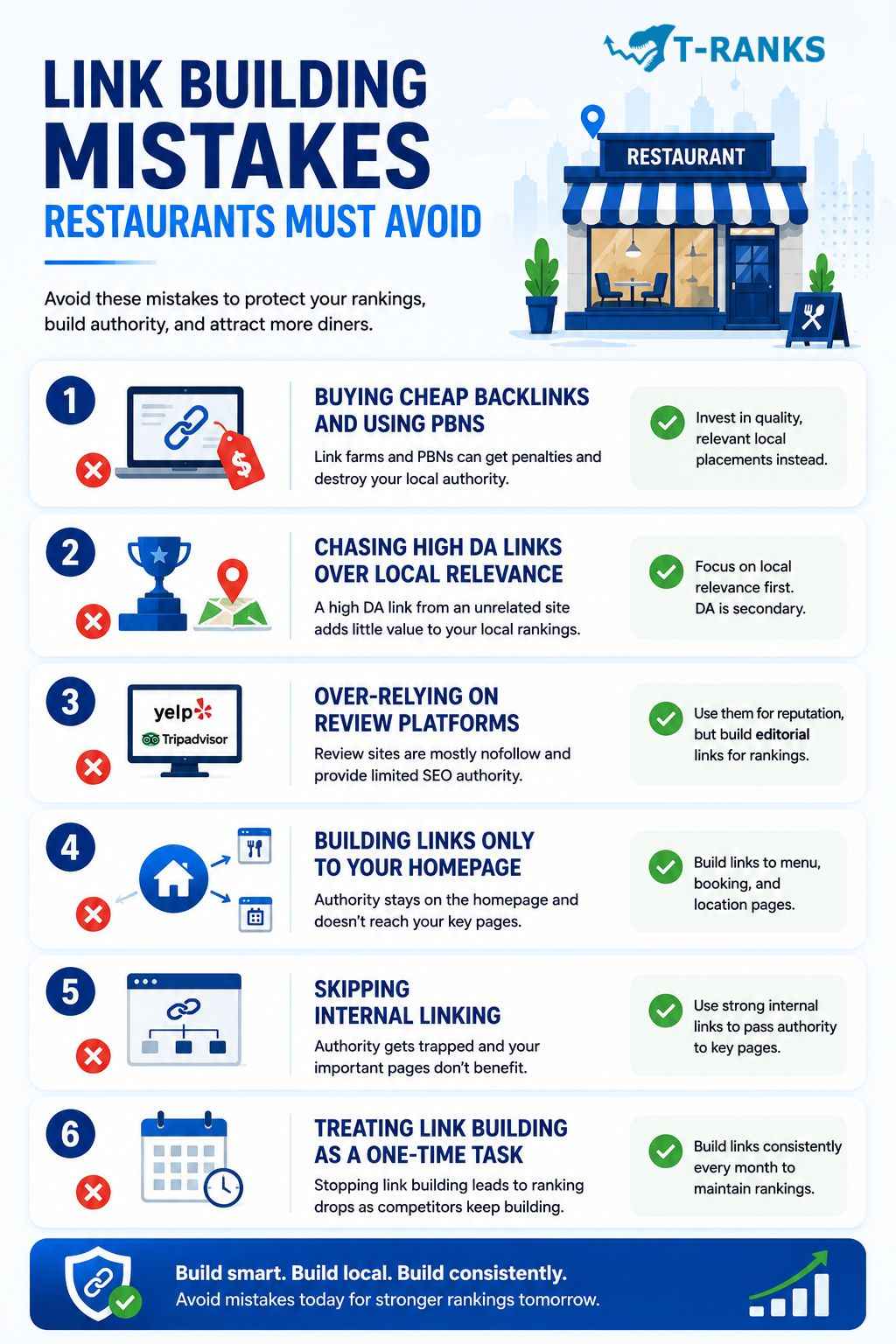
Most restaurants make the same link building mistakes. They buy cheap links, ignore local opportunities, and treat link building as something they do once rather than consistently. Here is what to avoid and why it matters.
Buying Cheap Backlinks and Using PBNs
Cheap backlinks from link farms and low-quality directories damage your restaurant’s local authority fast. Google identifies unnatural link patterns quickly and the penalties can take months to recover from. Understand how PBN links work before using them. Poorly executed PBN strategies leave footprints Google penalizes. Invest in quality local placements instead.
Chasing High DA Links Over Local Relevance
A DA 80 link from an unrelated national blog adds almost no value to your local restaurant rankings. A DA 40 link from a neighborhood food blog or local newspaper carries far more Maps pack impact. Always evaluate local relevance first. Domain authority is secondary for restaurants.
Over-Relying on Review Platforms
Yelp and TripAdvisor links are typically nofollow and carry limited SEO authority. They build reputation but not rankings. Review platforms are a foundation — not a link building strategy. Build genuine editorial backlinks on top of them to drive real local search visibility.
Building Links Only to Your Homepage
Many restaurants earn backlinks that point exclusively to their homepage. That authority never reaches the pages that actually convert visitors into diners. Build links directly to your menu page, booking page, and location pages. Those are the pages that drive real revenue.
Skipping Internal Linking
When external sites link to your homepage but your key pages have no internal links pointing to them that authority stays trapped. Connect your homepage to your menu, booking, and location pages through strong internal linking. Every external link becomes more powerful when authority flows freely across your site.
Treating Link Building as a One-Time Task
Many restaurants run one link building campaign then stop. Rankings drop within months. Competitors build links every month and older links lose value over time. Consistent ongoing link acquisition is the only strategy that holds local rankings and Maps pack positions long term.
Conclusion
In conclusion, link building for restaurants in 2026 is not optional. It is the difference between a restaurant that owns its local search visibility and one that stays invisible while competitors take every booking.
Google uses backlinks to measure how trusted and recognized your restaurant is within its local community. Citations verify your existence. Reviews build your reputation. But backlinks build the authority that pushes your restaurant into the Google Maps pack and keeps it there.
Start small. Start local. Build consistently. The restaurants winning local search in 2026 are not the ones with the biggest budgets. They are the ones that show up every month and build genuine authority within their local food ecosystem.
Ready to Fill More Tables Through Local Search?
T-RANKS provides high-quality, locally relevant backlinks trusted by restaurants and local SEO professionals across more than 50 countries. From white hat link building to targeted guest post placements T-RANKS builds links that move your restaurant up the Maps pack and drive real bookings.Get started with T-RANKS today and build the local authority your restaurant deserves.
FAQs About link building for restaurants
What is link building for restaurants?
Link building for restaurants is the process of earning backlinks from relevant websites to improve local search rankings, Google Maps visibility, and online authority. These backlinks signal to Google that your restaurant is trusted and recognized within the local dining community.
Do restaurants really need backlinks to rank on Google?
Yes, restaurants need backlinks to rank competitively on Google in 2026. Citations and Google Business Profile establish your presence but backlinks build the authority that pushes your restaurant above competitors in both organic results and the Google Maps pack.
What is the difference between a citation and a backlink for a restaurant?
A citation is an online mention of your restaurant’s name, address, and phone number — it does not always include a clickable link. A backlink is a clickable link from another website pointing directly to yours. Citations verify existence. Backlinks build authority and improve rankings.
How many backlinks does a restaurant website need to rank?
There is no fixed number. The right target is having more quality referring domains than the competitors ranking above you for your most important local keywords. Use Ahrefs or BrightLocal to analyze competitor backlink profiles and set your benchmark accordingly.
What is the fastest way to build links for a new restaurant website?
The fastest starting point is local directory listings, unlinked brand mention reclamation, and local partnership links. These are easier to earn than editorial placements and build baseline local authority quickly without waiting months for outreach campaigns to deliver.
Can a small independent restaurant compete with chain restaurants through link building?
Yes — but not by targeting the same keywords. Independent restaurants win by building deep local authority within a specific neighborhood or cuisine niche. A focused local backlink profile from community organizations and local press consistently outperforms a chain’s generic national link profile for hyperlocal searches.
Does link building help restaurants rank in Google Maps?
Yes. Backlinks directly strengthen your prominence signal — one of the three core factors Google uses to rank restaurants in the Maps pack. Links from locally relevant sources like neighborhood food blogs and local newspapers tell Google your restaurant is a trusted part of the local dining scene.
How long does link building take to show results for a restaurant?
Link building typically takes 2 to 3 months to produce visible ranking improvements. Google Maps pack changes can take slightly longer in competitive local markets. Consistency over several months produces lasting local search visibility — not short bursts of activity.
What happens if I buy cheap backlinks for my restaurant website?
Buying cheap backlinks from link farms can trigger Google penalties that take months to recover from. Google’s spam detection identifies unnatural link patterns quickly. One penalty can erase months of local SEO progress and suppress your Maps pack position significantly.
Is food blogger outreach still effective for restaurant link building in 2026?
Yes, food blogger outreach is still one of the most effective restaurant link building tactics in 2026. Focus on bloggers with established websites, real organic traffic, and DR 40 and above. Social media influencers with no website deliver exposure but not the editorial backlinks that move rankings.
How do I know if a website is worth getting a link from for my restaurant?
A website is worth pursuing if it publishes genuine food or local content, has real organic traffic, and serves an audience geographically relevant to your restaurant. Local relevance and real readership determine whether a link actually improves your local rankings.
Does link building help restaurants appear in AI search results?
Yes. AI tools like ChatGPT, Perplexity, and Google AI Overviews use citation patterns and backlink signals to identify authoritative local sources. A strong local backlink profile from trusted food and community websites increases your restaurant’s chances of appearing in AI-generated dining recommendations.