You have great travel content. You have optimized your pages. But your site is still buried on page three while Booking.com and Expedia take every ranking you are targeting.
The problem is not your content. It is your backlinks in SEO. Without quality links from trusted travel sources Google has no reason to rank your site over the giants dominating every keyword.
Most travel sites struggle because they treat link building for travel websites the same way they would any other niche. Travel is different. Relevance, destination authority, and timing all change how links work here.
This guide covers every proven strategy for 2026 — from guest posting and digital PR to tourism board links, seasonal campaigns, and measuring real results.
Why Link Building Still Matters for Travel Websites in 2026

Link building still matters for travel websites in 2026 because Google uses backlinks to decide which travel sites are trustworthy enough to rank. Without quality links, even the best travel content stays invisible.
If you have been trying to rank a travel website lately, you already know how brutal the competition has become. OTAs, booking giants, and global media brands dominate every high-value keyword and they are not slowing down.
Backlinks in SEO now directly influence your visibility across every search surface that matters in 2026:
- Google organic rankings
- Google AI Overviews
- ChatGPT and Perplexity results
- Featured snippets and knowledge panels
When authoritative travel publications, tourism boards, and destination sites consistently link to your pages, Google recognizes your site as a genuine destination expert. That topical authority translates directly into better rankings, more traffic, and more bookings.
What Has Changed in Travel Link Building in 2026
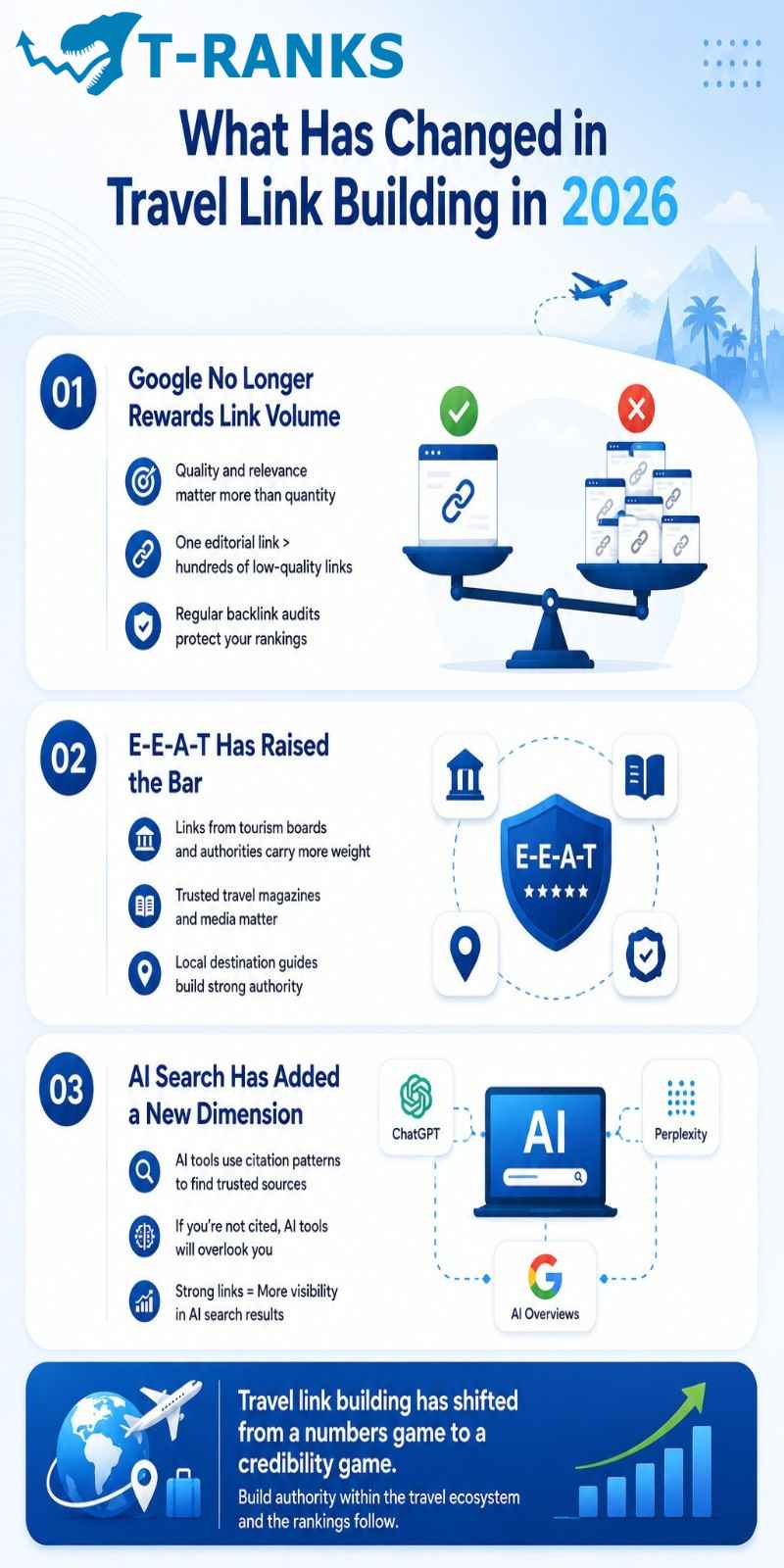
Travel link building in 2026 looks very different from what worked two or three years ago. The rules have shifted, and sites still using old tactics are quietly losing rankings without understanding why.
Google No Longer Rewards Link Volume
It now evaluates relevance, editorial intent, and whether your site is genuinely cited within the travel ecosystem. One editorial link from a respected travel publication outweighs a hundred links from unrelated blogs. This is why a proper backlink audit matters more than ever — knowing which links are helping and which are hurting is the first step.
E-E-A-T Has Raised the Bar for Travel Sites
Google wants verified travel experts, tourism authorities, and trusted destination sources vouching for your content. Links from tourism boards, established travel magazines, and local destination guides now carry more weight than ever before. According to Google’s E-E-A-T guidelines, experience and authoritativeness signals are evaluated across your entire link profile, not just your content.
AI Search Has Added a New Dimension to Backlinks
Tools like ChatGPT, Perplexity, and Google AI Overviews use citation patterns to decide which travel sources to surface. If trusted sources across the web are not referencing your site, AI tools will simply overlook it.
Travel link building has shifted from a numbers game to a credibility game. Build authority within the travel ecosystem and the rankings follow.
What Makes a Good Backlink for a Travel Website
A good backlink for a travel website comes from a relevant, authoritative source that Google already trusts — and one that real travelers actually read.
Not all backlinks are equal. A link from Lonely Planet carries more ranking weight than fifty links from unrelated lifestyle blogs. Understanding what separates a valuable travel backlink from a useless one will save you wasted outreach effort.
Relevance, Authority, and Traffic
Relevance is the most important factor. A link from a travel blog, tourism board, destination guide, or hospitality site directly reinforces your topical authority. A link from an unrelated finance or tech site adds almost no value regardless of its domain rating.
Authority determines how much ranking power a link passes to your site. Links from established travel publications like Travel + Leisure, Condé Nast Traveler, or Lonely Planet carry far more weight than links from newly created travel blogs with no track record.
Traffic is the most overlooked factor. A link from a site with real organic visitors sends referral traffic your way and signals to Google that the linking site is genuinely active. Always check a site’s organic traffic before pursuing a link.
Dofollow vs. Nofollow Links for Travel Sites

A dofollow link passes full SEO value to your site and directly contributes to your rankings. These are the links you want to prioritize in your outreach campaigns.
A nofollow link does not pass direct ranking value but still adds diversity to your backlink profile and makes it look natural to Google. A healthy travel site profile contains a mix of both — heavily weighted toward dofollow but not exclusively.
How Anchor Text Works and Why Diversity Matters
Anchor text is the clickable text used in a backlink. Getting anchor text optimization right is critical for travel sites. Over-using exact match anchor text like “best tours in Bali” triggers Google’s over-optimization filters and can suppress your rankings instead of improving them.
A natural anchor text profile for a travel site should include:
- Branded anchors — your site or brand name
- Partial match anchors — natural phrases that include your keyword
- Generic anchors — “read more”, “this guide”, “click here”
- Naked URLs — your raw URL as the anchor
- Exact match anchors — used sparingly, no more than 5 to 10 percent
The Best Link Building Strategies for Travel Websites in 2026
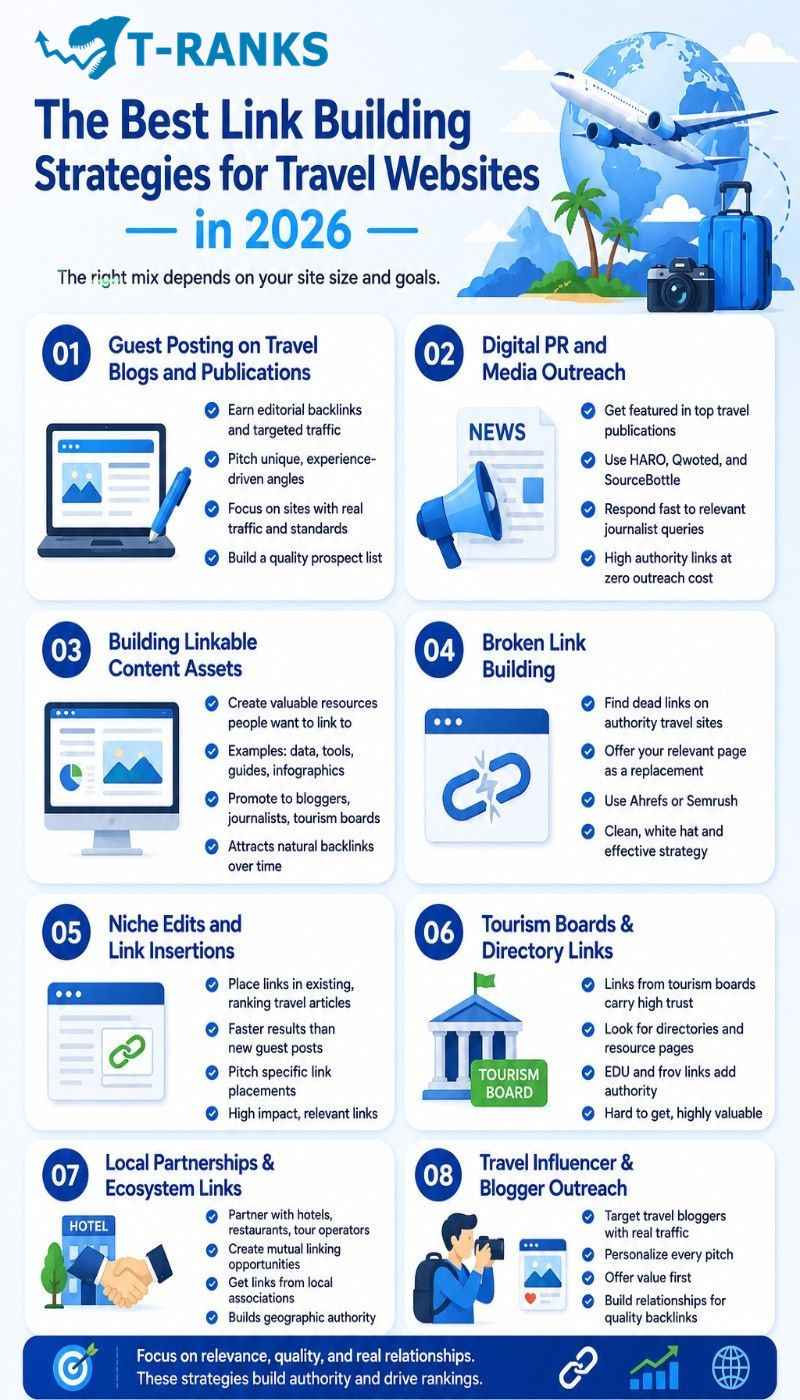
The best link building strategies for travel websites in 2026 are guest posting, digital PR, linkable assets, broken link building, niche edits, tourism board links, local partnerships, and influencer outreach. The right mix depends on your site size and goals.
1. Guest Posting on Travel Blogs and Publications
Guest posting on relevant travel publications earns editorial backlinks while positioning your brand in front of a targeted travel audience. Focus on sites with real organic traffic and genuine editorial standards.
Pitch a specific experience-driven angle rather than a generic travel topic. Use free guest post sites to build your portfolio before targeting premium publications.
Build a list of 20 to 30 travel blogs in your niche using Ahrefs Content Explorer and only pitch sites where real travelers are reading. When evaluating prospects look for:
- DR 40 and above with verified organic traffic
- A genuine editorial process not open to everyone
- An audience that matches your travel niche
- Recent content published within the last 30 days
2. Digital PR and Media Outreach
Digital PR earns editorial links from major travel publications by giving journalists something worth covering. One placement in Travel + Leisure outweighs twenty standard guest posts.
Use HARO, Qwoted, and SourceBottle to respond to journalist queries in the travel space. Fast, credible responses to relevant travel queries earn high-authority links at zero outreach cost.
Set up keyword alerts on HARO for terms like “travel expert”, “tourism”, and your specific destination niche. Respond within the first two hours of receiving the query — journalists work on tight deadlines and early responses get far more attention than late ones.
3. Building Linkable Content Assets
Linkable assets are resources so useful that other travel sites naturally reference and link to them. Original destination data, trip cost calculators, and travel statistics pages all attract consistent editorial links over time.
Once published, actively promote your asset to travel bloggers, tourism boards, and journalists. A linkable asset nobody knows about earns no links.
The most effective linkable assets for travel sites include:
- Destination statistics pages — sourced facts about costs, tourism numbers, and travel seasons
- Original research and data studies — unique insights journalists need for their stories
- Interactive tools — visa checkers, trip cost calculators, packing list generators
- Comprehensive destination guides — in-depth references that become the go-to resource for a location
- Infographics and visual maps — shareable visuals travel publications embed with a link back
4. Broken Link Building
Broken link building finds dead links on established travel websites and offers your relevant page as a replacement. You are solving a real problem for the site owner rather than asking for a favor.
Use Ahrefs or Semrush to identify broken outbound links on high-authority travel sites. This is one of the cleanest white hat link building techniques available for travel sites today.
In Ahrefs go to Site Explorer, enter a competitor travel site, and navigate to the Broken Links report. Filter for DR 40 and above and look for broken links pointing to destination guides, travel resources, or itinerary pages. These are your highest value replacement opportunities.
5. Niche Edits and Link Insertions
A niche edit places your link inside an existing, already-indexed travel article that is actively ranking and receiving traffic. This often produces faster ranking improvements than a new guest post.
Pitch specifically by identifying exactly where your link fits within the existing content. Vague requests get ignored. Specific, value-driven pitches get results.
Search Google for established travel articles in your niche using queries like:
- “best things to do in [destination] guide”
- “complete [destination] travel tips”
- “[destination] itinerary for [X] days”
Find articles missing a resource your site covers well then reach out to the site owner with a specific suggestion for where your link adds genuine value.
6. Tourism Board, Government, and Directory Links
Tourism board and government travel site links carry exceptional trust weight because they are among the hardest links to earn. Getting listed requires a genuine connection to the destination or a valuable content contribution.
EDU backlinks from hospitality schools and university travel programs also add strong authority signals when your content genuinely serves an educational purpose.
Research the official tourism board for your target destination and look for:
- Partner and supplier directories
- Recommended travel resource pages
- Local business listing sections
- Press and media resource pages
Contact their digital team directly with a specific proposal explaining how your content adds real value to their visitors.
7. Local Partnership and Ecosystem Links
Every real-world travel partnership is a link building opportunity. Hotels, restaurants, tour operators, and activity providers all have websites and genuine partnerships naturally produce cross-linking opportunities Google trusts.
Build profile backlinks from local business associations, destination networks, and chambers of commerce to add geographic authority signals for destination-based travel businesses.
Create a dedicated partners page on your travel site listing every local business you work with. Reach out to each partner and ask them to do the same. This creates a natural local linking ecosystem that reinforces your destination authority without any outreach cost.
8. Travel Influencer and Blogger Outreach
Travel bloggers with established websites and real organic traffic are far more valuable for link building than social media influencers. Focus on bloggers with DA 40 and above and genuine monthly search visitors.
Personalize every pitch using guest post outreach principles. Lead with what you are offering them before asking for anything in return.
Use Ahrefs Content Explorer to find travel bloggers who have already written about your destination. These are warm prospects because they have demonstrated interest in your topic. Reference their specific article in your pitch and offer something genuinely useful — exclusive access, unique data, or a free experience.
Strategy Comparison
| Strategy | Difficulty | Speed of Results | Best For |
| Guest Posting | Medium | 2 to 4 months | All travel sites |
| Digital PR | High | 1 to 3 months | Established brands |
| Linkable Assets | Medium | 3 to 6 months | Long term authority |
| Broken Link Building | Medium | 1 to 3 months | All travel sites |
| Niche Edits | Easy | 2 to 6 weeks | Fast ranking boosts |
| Tourism Board Links | High | 3 to 6 months | Destination sites |
| Local Partnerships | Easy | 1 to 2 months | Local travel brands |
| Influencer Outreach | Medium | 2 to 4 months | Tour operators, blogs |
Link Building Strategies by Travel Sub-Niche

Link building looks different depending on what type of travel business you run. The strategies that work for a travel blog are not the same ones that work for a hotel or an OTA. Here is what each sub-niche should focus on.
Travel Blogs
Travel blogs compete on topical authority and content depth. Your links should come from travel publications, tourism boards, and destination guides that validate your expertise.
Guest posting, digital PR, and linkable assets are your strongest channels. Build links to your best performing destination guides first. Those pages already have traction and additional links compound their authority faster.
Hotels and Resorts
Most hotel visibility online is owned by OTAs rather than the hotel’s own website. Link building is how hotels break that dependency and drive direct bookings without paying commission.
Focus on local ecosystem links from tourism boards, nearby attractions, and regional travel publications. A link from an official city tourism board or a “best hotels in [destination]” roundup carries enormous trust weight for hotel SEO.
Tour Operators
Tour operators benefit most from editorial placements in destination guides and activity roundups. Getting your tours mentioned in “best things to do in [destination]” articles builds both links and direct booking traffic.
Partner with local hotels and accommodation providers. That real-world relationship translates naturally into website links. Google recognizes these as genuine destination authority signals.
Travel Agencies
Travel agencies need links that signal expertise across multiple destinations. Digital PR, expert commentary, and guest post outreach to travel magazines build the authority profile that ranks competitive booking-intent keywords.
Focus on earning links to destination-specific landing pages rather than your homepage. A link pointing directly to your “Thailand holidays” page passes authority exactly where it matters most.
OTAs and Booking Platforms
OTAs compete against the most authoritative travel sites on the internet. Link building at this level centers on data-driven digital PR. Publish original travel trend reports and booking statistics that major publications cite as industry sources.
Focus on high DA backlinks from established travel media and news outlets. One editorial placement from Forbes Travel or BBC Travel drives more ranking impact than dozens of standard guest posts.
Seasonal Link Building for Travel Sites

Seasonal link building matters because Google takes 2 to 4 months to process new backlinks into ranking improvements. Build links during peak season and the benefits arrive after demand has already passed.
Front-load your campaigns 3 to 4 months before your peak period. Journalists covering seasonal destination guides start researching months in advance. Being their cited source earns links precisely when they carry the most relevance for your target keywords.
Here is a complete seasonal link building reference for travel sites:
- Summer travel — start building links in February and March
- Christmas and winter holidays — run outreach in August and September
- Spring breaks — begin campaigns in November and December
- Major travel events — start 4 months before the event date
- Evergreen assets — destination guides, visa pages, travel cost comparisons — build these first and maintain them year-round
- Seasonal assets — “best Christmas markets in Europe”, “summer packing list for Southeast Asia” — publish 3 to 4 months before the relevant travel period
Build your evergreen assets first. Layer seasonal content on top once your site has established baseline authority. A site that publishes only seasonal content struggles to maintain consistent link acquisition year-round.
How to Measure Your Travel Link Building Results
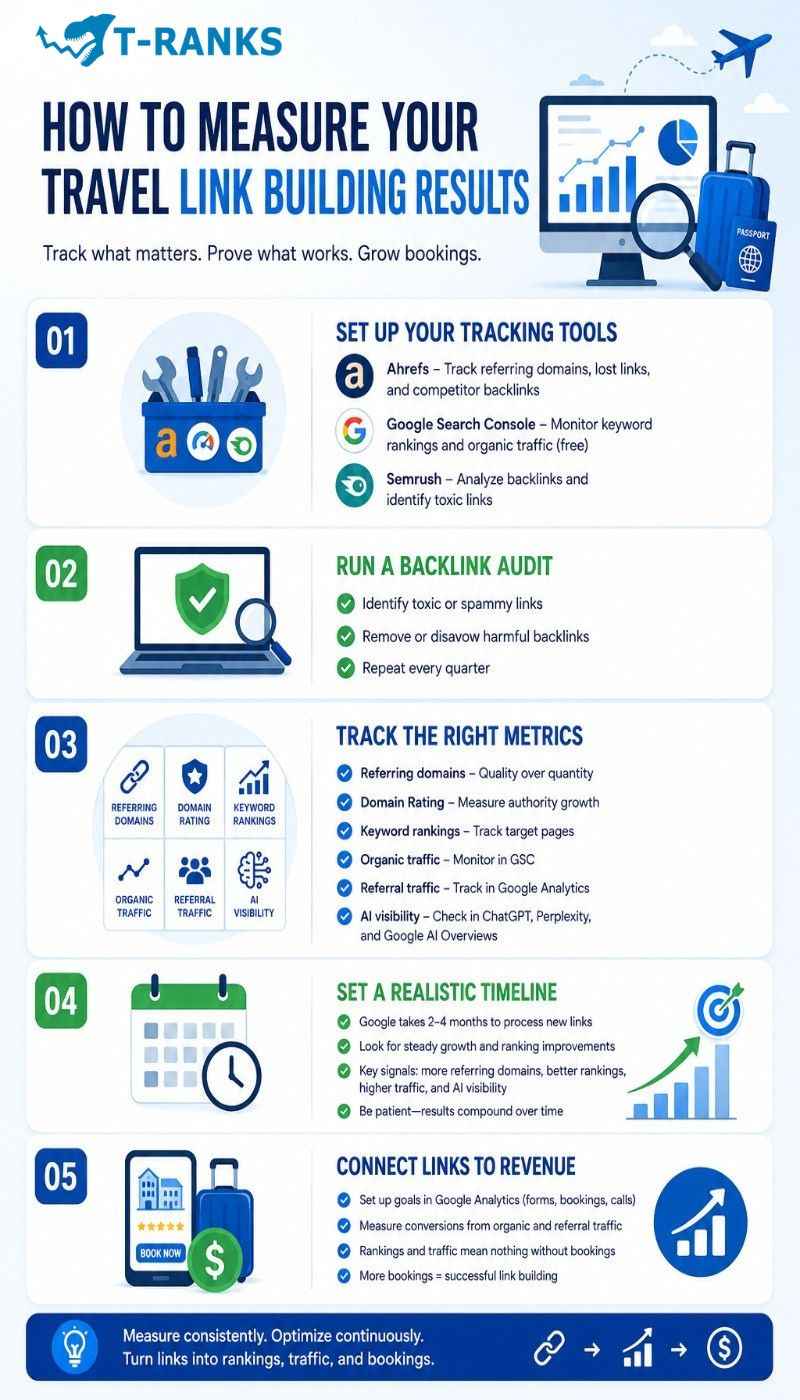
Most travel sites build links but never measure whether they are actually working. Without tracking the right metrics you are spending budget without knowing if it is driving rankings, traffic, or bookings.
Step 1: Set Up Your Tracking Tools
You do not need every tool available. These three cover everything a travel site needs:
- Ahrefs — tracking referring domains, lost links, and competitor backlink profiles
- Google Search Console — free and essential for monitoring keyword rankings and organic traffic
- Semrush — strong alternative with a built-in toxicity scoring system for identifying harmful links
Start with Google Search Console first since it is free and connects directly to Google’s own data. Add Ahrefs or Semrush once you are ready to track competitor backlink profiles and identify new link opportunities.
Step 2: Run a Backlink Audit
Before measuring progress you need a clean baseline. Run a backlink audit to identify toxic or spammy links already pointing to your site. Harmful backlinks left unchecked suppress rankings without any obvious warning signs. Repeat every quarter.
A clean backlink profile is the foundation of any successful travel link building campaign. You cannot accurately measure progress if your baseline data is polluted by low-quality or irrelevant links pointing to your site.
Step 3: Track the Right Metrics
Focus on these six metrics every month:
- Referring domains — unique websites linking to your site. More important than total backlink count
- Domain Rating — your overall authority score. Track monthly to measure long-term progress
- Keyword rankings — monitor the specific pages you are building links to
- Organic traffic — track in Google Search Console for pages receiving new links
- Referral traffic — links from high-traffic travel sites send real visitors. Track in Google Analytics
- AI visibility — check if your site appears in ChatGPT, Perplexity, and Google AI Overviews for target travel queries
Do not track all metrics equally. Referring domains and keyword rankings are your primary indicators. Organic traffic and referral traffic confirm that those rankings are translating into real visitors. AI visibility is the emerging metric most travel sites are not tracking yet — but should be.
Step 4: Set a Realistic Timeline
Google takes an average of 2 to 4 months to process new backlinks into visible ranking improvements. Do not judge a campaign by what happens in the first 30 days.
Look for these signals that your link building is working:
- Referring domain count growing steadily month over month
- Target page rankings improving from position 8 to 15 into the top 5
- Organic traffic to linked pages increasing versus the previous period
- Your travel site appearing in AI Overview answers for destination queries it did not rank in before
Patience is essential in travel link building. Seasonal niches in particular can take longer to show results because Google evaluates ranking changes against search demand patterns. A link earned in February for a summer travel page may not show its full impact until April or May.
Step 5: Connect Links to Revenue
Set up goal tracking in Google Analytics for enquiry forms, booking completions, and phone call clicks. When rankings improve and traffic grows the conversion data tells you whether that traffic is turning into actual bookings and revenue.
The ultimate measure of a successful travel link building campaign is not rankings or traffic. It is bookings. Every metric you track should connect back to that single outcome. If your referring domains are growing and your rankings are improving but bookings are flat, the problem is conversion — not link building.
Link Building Mistakes Travel Websites Must Avoid

The biggest link building mistakes travel websites make are buying cheap backlinks, chasing domain authority over relevance, over-using exact match anchor text, skipping internal linking, and treating link building as a one-time task. Each one can suppress your rankings without any obvious warning signs.
Buying Cheap Backlinks and Using PBNs
Cheap backlinks from link farms and low-quality directories are the fastest way to damage a travel site’s authority. Google has become very good at identifying unnatural link patterns and penalties can take months to recover from.
Understanding how PBN links work is important before using them. Relevance, placement quality, and pattern detection determine the risk level. A poorly executed PBN strategy leaves footprints that Google’s spam systems identify quickly. Invest in quality placements instead of cheap volume.
Choosing Domain Authority Over Relevance
A DA 80 link from an unrelated finance blog adds almost no value to a travel site. Many travel brands waste budget chasing high authority numbers from irrelevant sources while ignoring lower DA travel publications that deliver far more ranking impact.
Relevance always beats raw authority in the travel niche. A DA 45 link from an established travel blog carries more topical signal than a DA 75 link from a generic lifestyle site with no travel focus. Evaluate relevance first and authority second.
Over-Using Exact Match Anchor Text
Using the same keyword-rich anchor text repeatedly across multiple backlinks triggers Google’s over-optimization filters. A travel site with fifty links all using “best tours in Bali” looks manipulative — and Google treats it that way.
Keep your anchor text natural and varied. Follow the anchor text optimization principle of mixing branded anchors, partial match phrases, generic terms, and naked URLs. Exact match anchors should make up no more than 5 to 10 percent of your total anchor profile.
Skipping Internal Linking
Internal linking is one of the most overlooked parts of travel link building. When an external site links to your homepage but your destination pages have no internal links pointing to them, that authority never reaches the pages that need it most.
Build a strong internal linking structure that connects your homepage to your destination guides, tour pages, and booking landing pages. Every external link you earn becomes more powerful when internal links distribute that authority across your site.
Treating Link Building as a One-Time Campaign
Many travel sites run one link building campaign, see some ranking improvements, and stop. A few months later rankings drop and the cycle repeats. Competitors are building links every month and older links naturally lose some value over time.
Link building needs to be consistent and ongoing. New content needs new links. The travel sites that maintain steady link acquisition throughout the year are the ones that hold their rankings long term.
How to Build a Long-Term Link Building Strategy for Your Travel Site

Link building for travel websites is not a campaign you run once and forget. The sites winning in 2026 treat link acquisition as an ongoing investment. They build authority month after month until their brand becomes the go-to reference for their destination or niche.
Start with the foundation. Build your evergreen linkable assets first. Destination guides, statistics pages, and resource content attract links consistently throughout the year. These assets do the heavy lifting long after you publish them.
Then layer your outreach strategies on top. Guest posting, digital PR, broken link building, and local partnership links all work best when your site already has content worth linking to. Prioritize based on your site size and budget:
- New travel sites — start with local partnership links, directory listings, and free guest post opportunities
- Growing travel sites — add digital PR, niche edits, and tourism board outreach once you have established content assets
- Established travel sites — focus on high-authority editorial placements, original data campaigns, and influencer outreach
Stop thinking about link building as a cost. Start thinking about it as the infrastructure that makes everything else work. Better rankings, more traffic, and more bookings all follow from a consistent and well-executed strategy.
Conclusion
In conclusion, link building remains the most important off-page investment a travel website can make in 2026. Google uses backlinks to decide which travel sites deserve visibility. AI search tools use citation patterns to decide which sources to surface. Without a consistent link building strategy your travel site cannot compete.
The travel niche is brutal. OTAs and global booking giants dominate every high-value keyword. The only sustainable way to carve out rankings is by building genuine authority through quality links from relevant travel sources — tourism boards, travel publications, and local partners who vouch for your content.
Relevance beats volume. Consistency beats campaigns. A well-earned link from a trusted travel source will always outperform a hundred cheap backlinks from irrelevant sites. Start building. Stay consistent. Measure what matters.
Ready to Build Authority for Your Travel Site?
T-RANKS provides high-authority, niche-relevant backlinks trusted by travel brands across 50+ countries. Get started with T-RANKS today and build the backlink profile your travel site needs to win in 2026.
FAQs About Link Building for Travel and Tourism Sites in 2026
What is link building for travel websites?
Link building for travel websites is the process of earning backlinks from relevant websites to improve your travel site’s authority, rankings, and visibility in search results. These backlinks signal to Google that your content is trustworthy and worth showing to travelers searching for destination information, tours, or travel services.
Does link building still work for travel websites in 2026?
Yes, link building still works for travel websites in 2026 and remains one of Google’s strongest ranking signals. The approach has shifted from volume to relevance — one editorial link from a respected travel publication carries more weight than dozens of low-quality directory links.
How many backlinks does a travel website need to rank?
There is no fixed number. The right benchmark is having more quality referring domains than the competitors ranking above you for your target keywords. Use Ahrefs or Semrush to analyze competitor backlink profiles and use those numbers as your target.
Can a small travel website compete with Booking.com through link building?
Yes — but not by targeting the same keywords. Small travel sites win by building deep topical authority in a specific destination or niche. A focused travel blog about Southeast Asia can outrank Booking.com for long-tail destination queries by earning highly relevant niche links.
What makes a backlink high quality for a travel website?
A high quality travel backlink comes from a relevant, authoritative site with real organic traffic from actual travelers. Relevance to your destination or travel niche matters more than raw domain authority numbers alone.
Is guest posting still effective for travel sites in 2026?
Yes, guest posting is still effective when done correctly. One placement on a genuine travel publication with real traffic outperforms ten placements on low-quality blogs. Focus on sites with DR 40 and above and a genuine editorial process.
How long does link building take to show results for a travel website?
Link building typically takes 2 to 4 months to produce visible ranking improvements. Google needs time to discover, crawl, and process new backlinks before incorporating them into ranking signals. Early results within 30 days are rarely a reliable indicator of campaign performance.
What is the fastest way to build links for a new travel site?
The fastest starting point is local partnership links, directory listings, and broken link building. These are easier to earn than editorial placements and build a baseline authority profile quickly without waiting months for guest post campaigns to deliver.
What happens if I buy cheap backlinks for my travel website?
Buying cheap backlinks from link farms or low-quality directories can trigger Google penalties that take months to recover from. Google’s spam detection systems identify unnatural link patterns and either ignore or penalize sites that rely on them.
Do PBN links work for travel websites?
PBN links can work for travel websites when used carefully with relevant domains, quality content, and natural anchor text. Understanding how to build PBN links correctly is essential — poorly executed PBN strategies leave detectable footprints that Google identifies quickly.
How do I measure whether my travel link building is actually working?
Track referring domains, keyword rankings, and organic traffic to linked pages every month using Ahrefs and Google Search Console. Connect those metrics to booking conversions in Google Analytics to confirm improved rankings are translating into actual revenue.
Does link building help travel websites appear in Google AI Overviews and ChatGPT results?
Yes. AI tools like Google AI Overviews, ChatGPT, and Perplexity use citation patterns and backlink signals to identify authoritative travel sources. A strong backlink profile from trusted travel publications increases your chances of appearing in AI-generated travel recommendations.