Cheap PBN links often seem like a quick fix when rankings are stuck. When budgets are limited and results are needed fast, low-cost links can feel like a practical option rather than a risky one. Most people use them for speed, not because they are aiming for poor quality.
In 2026, cheap PBN links can still cause short-term ranking movement, especially in low-competition niches. That early boost is real. The problem is that it usually does not last. These links are cheap because they often use reused expired domains, little maintenance, and shared setups. Over time, search engines reassess those signals and reduce their value.
The real question is not whether cheap PBN links work at all. The question is how long they work. Once link decay starts and replacements are needed, the initial savings often disappear. Monitoring weak links also adds time and effort.
This section looks at cheap PBN links in practical terms. It explains why they sometimes work, why they often stop working, and how cost, risk, and lifespan affect their real value in the 2026 search environment.
What “Cheap PBN Links” Really Means

Cheap PBN links refer to links chosen mainly because they fit a limited budget, not because they are intentionally designed to be weak. When people use the word “cheap,” they are usually reacting to price, not openly asking for low-quality links. This is why terms like affordable PBN links or PBN links under budget are used instead of labels that directly imply poor quality.
In practice, however, price and quality are closely connected. To reduce cost, many providers cut corners. Cheap PBN links usually fall into one or more of the following categories:
- Low upfront cost, where a link is placed once with little or no ongoing care
- Low maintenance, where hosting, content updates, and site management are kept minimal
- Short lifespan, where links are not expected to hold value for long and are reused or replaced over time
Users rarely search for “low quality PBN links” because that is not their intent. Most people looking for cheap PBN links want low cost PBN backlinks that still work, at least temporarily. Budget PBN link building is driven by the hope that lower price does not automatically mean poor results, especially in the short term.
The important expectation to set is that cheap often increases the chance of lower quality, even if it does not guarantee it. Some affordable PBN links can create short-term ranking movement, while many lose value quickly. Price alone does not decide performance, but compromises made to lower cost often reduce durability, control, and long-term effectiveness.
Why Cheap PBN Links Sometimes Work
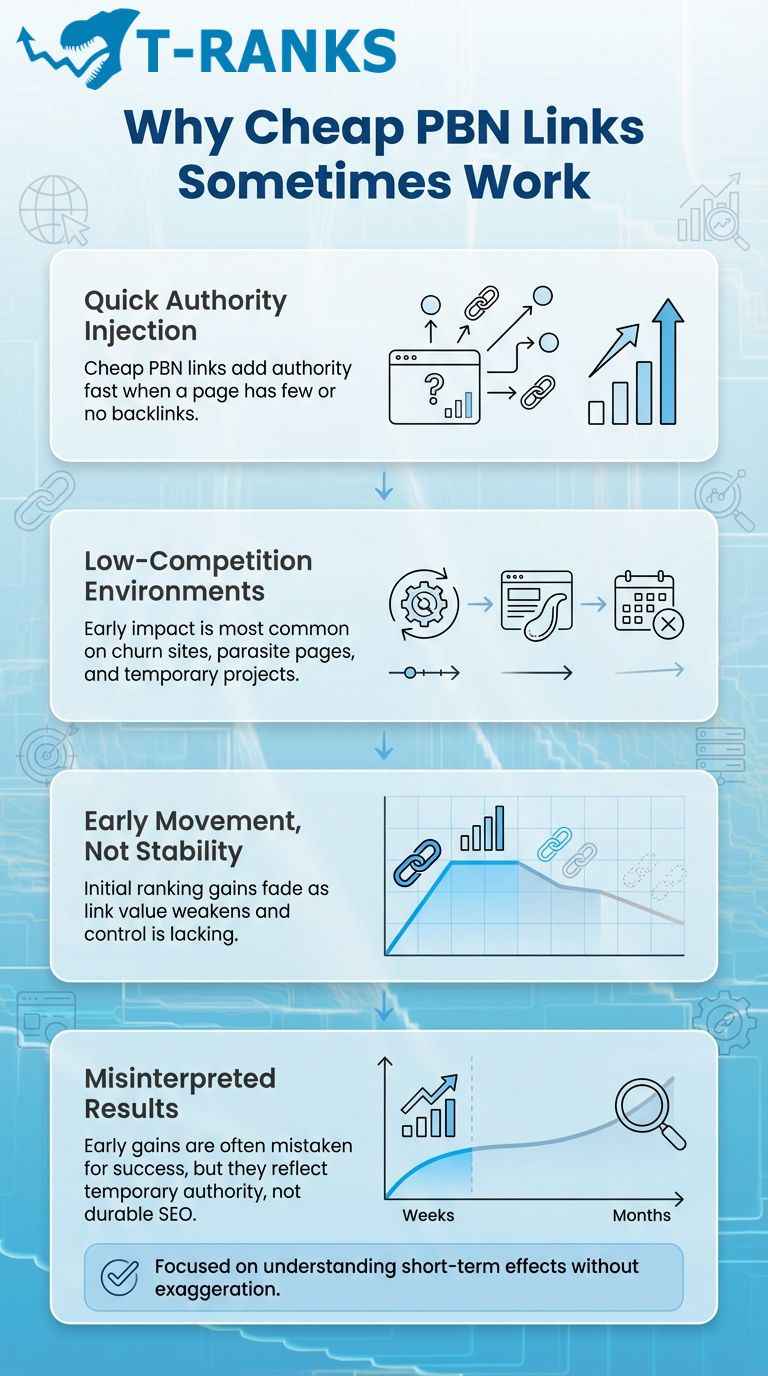
Cheap PBN links can show results in some situations, but those results are often misunderstood. To understand why they work at first, it helps to break the process into simple steps instead of treating it as a single outcome.
Quick Authority Boost on Low-Competition Pages
Cheap PBN links sometimes work because they add authority very quickly. When a page has few or no backlinks, even a small number of new links can make a noticeable difference. In low or medium competition niches, this sudden boost is often enough to move rankings upward in the short term. This is why many people see early results and assume budget PBN links work.
Where This Effect Is Most Common
This short-term impact is most common on churn sites, parasite SEO pages, and temporary projects. These pages are built to rank fast, capture traffic or leads, and then be replaced if rankings drop. In these situations, speed matters more than stability. Because competition is low and expectations are short term, even weak or low-cost links can appear effective at first.
Early Movement Does Not Mean Stability
The main issue is that early ranking movement does not mean long-term success. Cheap PBN links often lack strong maintenance, isolation, and control. As time passes, their influence weakens. Rankings may stop improving or slowly decline as link value fades or network patterns become easier to detect. This usually happens quietly, without penalties or warnings.
Why Many People Misjudge the Results
Many users mistake early gains as proof that cheap PBN links work well. In reality, those gains only show that authority was added temporarily. Real SEO performance is measured over months, not weeks. What looks like success at the beginning is often just a short phase before rankings fade due to weak link foundations and limited control.
Why Cheap PBN Links Stop Working

Cheap PBN links usually stop working because their value fades gradually rather than disappearing overnight. At first, they may pass enough authority to move rankings, especially on weaker pages. Over time, as search engines reassess the source, that authority weakens. When PBN sites are poorly maintained or left unchanged, their ability to support rankings slowly declines. This silent decline is the most common reason cheap PBN links fail after an early boost.
To understand this properly, the failure usually happens through a few predictable patterns.
Link Value Fades Over Time
Cheap PBN links are often affected by index decay and link devaluation. The link may stay indexed, but the authority it passes is reduced.
This typically happens when:
- Content is not updated or expanded
- The site shows no growth, traffic, or engagement
- Trust signals tied to the domain weaken over time
As a result, rankings decline even though the backlink still exists.
Reused Networks Become Easy to Detect
Many low cost PBN backlinks come from networks that reuse the same infrastructure across multiple buyers. This reuse lowers cost but increases detection risk.
Common reuse signals include:
- Similar site layouts and themes
- Shared hosting or overlapping IP ranges
- Repeated publishing and linking patterns
When these signals accumulate, search engines algorithmically discount the links without removing them, reducing their impact quietly.
Anchor Over-Optimization Accelerates Decline
Cheap PBN links are often sold with aggressive anchor text to promise faster results. Repeated use of exact or partial match anchors creates unnatural patterns that draw attention.
When anchor over-optimization occurs:
- Link value is reduced
- Manipulation risk increases
- Rankings lose long-term support
Aggressive anchors do not cause instant penalties, but they speed up how quickly cheap PBN links lose effectiveness.
What Cheap PBN Links Usually Look Like
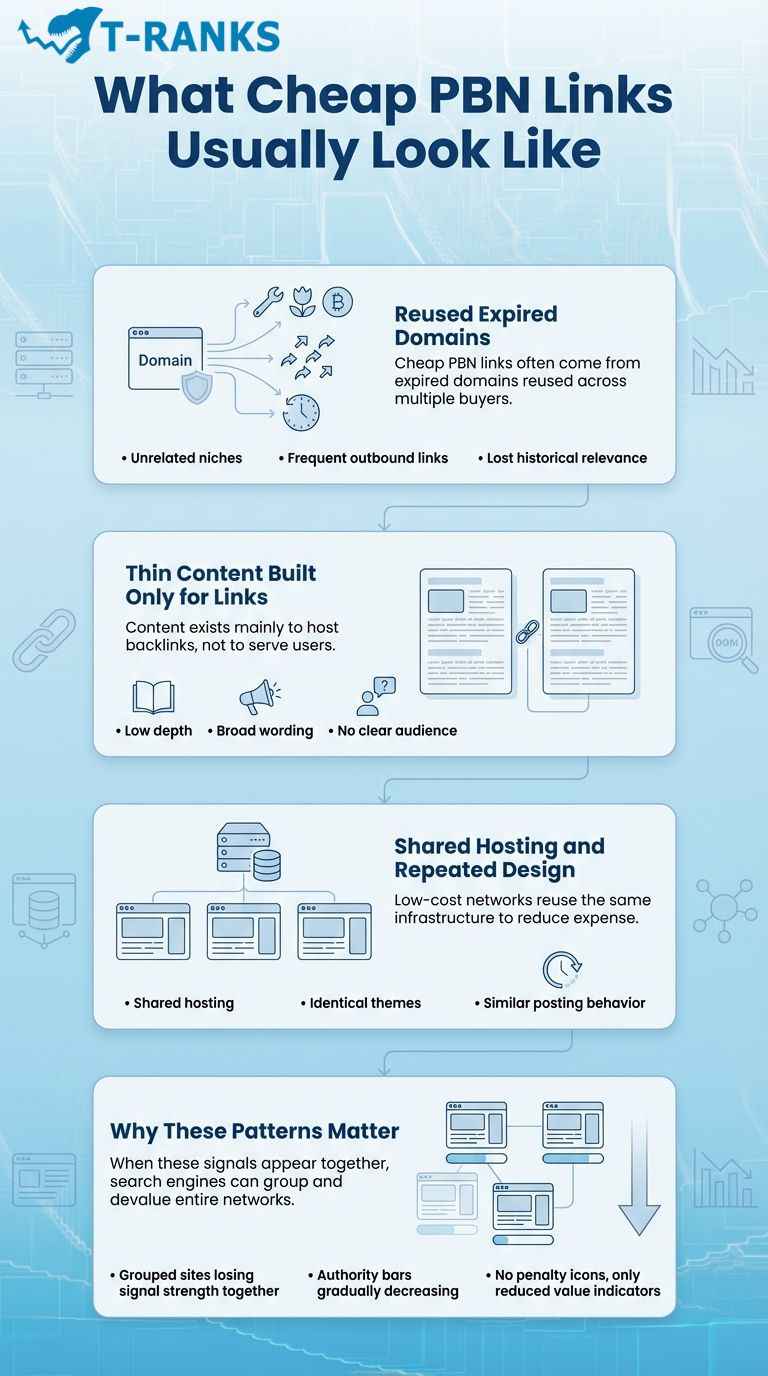
Cheap PBN links often share the same visible patterns because they are built to reduce cost, not to support long-term rankings. Speed, reuse, and volume shape how these links are created. Once you know what to look for, it becomes much easier to understand why cheap PBN links behave differently from higher-quality ones.
Reused Expired Domains Across Multiple Buyers
One of the most common signs of cheap PBN links is the reuse of expired domains. These domains may show past authority, but their original purpose and relevance are usually gone. Over time, the same domain links out to many unrelated websites, which lowers trust and exposes shared PBN networks.
Typical signs of reused expired domains include:
- Links pointing to completely different niches
- Frequent outbound links to new buyers
- No clear connection between the domain’s past history and its current content
Thin Content Created Only for Links
Another strong indicator is thin or generic content created mainly to host backlinks. These pages are not written for users. They exist to place links as quickly as possible. Content is often reused in structure and tone across multiple sites.
Common content patterns include:
- Short articles with little or no depth
- Broad wording that can fit almost any niche
- No clear audience, purpose, or topical focus
Shared Hosting and Repeated Site Design
To keep costs low, many cheap PBN networks reuse the same technical setup across multiple sites. This includes hosting, themes, and publishing behavior. These similarities make low quality PBN sites easier for search engines to group together.
Frequent infrastructure signals include:
- Shared hosting or overlapping IP ranges
- Reused themes and identical layouts
- Similar plugins, page structures, or posting schedules
Why These Patterns Matter
When reused domains, generic content, and shared infrastructure appear together, they form detectable networks. Search engines do not need to penalize each link individually. Instead, they reduce the value of the entire group. This is why cheap PBN links are easy to scale at first, but also easy to identify and devalue over time.
Cheap vs Quality PBN Links

Cheap and quality PBN links are often discussed together, but they serve very different purposes in SEO. The main difference is not just price. It is how much control, stability, and predictability you get from each type. Cheap PBN links focus on quick placement and low cost, while quality PBN links focus on relevance, structure, and long-term value. Both can influence rankings, but they behave very differently over time.
Domain Selection
Cheap PBN links usually come from expired domains chosen mainly because they are affordable and easy to reuse. These domains may have decent metrics, but their past topic often does not match the new content. Many of these domains are also reused across multiple buyers.
Quality PBN links rely on stricter domain selection. Domains are chosen for clean history, topical relevance, and long-term usability. Each domain is treated as a controlled asset rather than something that gets sold repeatedly.
Content Quality and Relevance
Content on cheap PBN sites is written mainly to host links. It is often short, generic, and loosely related to the target site.
Quality PBN links are placed inside relevant and meaningful content. Articles are written to match the site’s topic and provide real context. This helps links look natural and retain value for a longer time.
Outbound Link Control
Cheap PBN links usually have poor outbound control. A single site may link to many unrelated pages, often using similar anchor text patterns.
Quality PBN links are more selective. Fewer outbound links are placed, anchors are varied, and placements are planned to look editorial rather than forced.
Predictability vs Guesswork
Cheap PBN links are unpredictable. Some may work briefly, others lose value quickly, and results are inconsistent.
Quality PBN links offer more predictable outcomes. Because domains, content, and outbound links are controlled, ranking movement is easier to manage and more stable over time.
Quick Comparison: Cheap vs Quality PBN Links
| Factor | Cheap PBN Links | Quality PBN Links |
| Primary goal | Low cost and speed | Stability and control |
| Domain usage | Reused across buyers | Treated as long-term assets |
| Content | Thin and generic | Relevant and detailed |
| Outbound links | Many and mixed niches | Limited and controlled |
| Anchor patterns | Repetitive | Natural and varied |
| Result consistency | Unstable | More predictable |
Cost, Risk, and Link Lifespan

When people evaluate cheap PBN links, they usually focus on the price of each link. That approach misses the real cost. In SEO, links should be measured by cost per ranking month, not cost per placement. A link that costs less but lasts only a few weeks is far more expensive than a higher-quality link that supports rankings for months or years.
Low cost PBN links often carry higher risk because their lifespan is short. Many links drop, deindex, or lose value as networks are reused or neglected. When this happens, rankings weaken and replacement links are needed. Each replacement adds more expense and more exposure to risk. Over time, these repeated fixes turn low price links into a growing long term SEO cost.
This is why cheap links frequently increase total spend instead of reducing it. Short-lived links force site owners into a cycle of constant rebuilding. Rankings become unstable, traffic fluctuates, and more links are added just to maintain position. The risk compounds as new links introduce fresh patterns and more opportunities for devaluation.
How long PBN links last is rarely random. Lifespan depends on planning, upkeep, and network structure. Low cost networks cut corners on maintenance and isolation, which shortens link life. Well-planned networks extend lifespan through control and consistency. In SEO, durability comes from design, not luck.
Cost and Lifespan Comparison
| Factor | Cheap PBN Links | Quality PBN Links |
| Evaluation method | Cost per link | Cost per ranking month |
| Typical lifespan | Weeks to a few months | Many months or longer |
| Replacement frequency | High | Low |
| Risk exposure | Increases over time | Managed and controlled |
| Long term SEO cost | Often higher | More predictable |
| Ranking stability | Volatile | Stable |
Are Cheap PBN Links Safe to Use?

Cheap PBN links are not fully safe, but they are not instantly dangerous either. The risk depends on how they are used, how often they are repeated, and how visible they are within your overall link profile. When people ask are low cost PBN links safe, the honest answer is that safety is relative, not guaranteed.
The biggest risk comes from direct and heavy use. Cheap PBN links placed straight to a main site increase exposure because patterns are easier to detect. Limited and indirect use can reduce that exposure. This usually means placing links through buffers such as secondary pages, supporting content, or tiered structures. The goal is to lower visibility, not to eliminate risk entirely.
Anchor management also plays a major role. Many cheap PBN links fail because they use aggressive or repeated anchors. Anchor dilution helps reduce pressure by mixing branded, generic, and natural phrases instead of forcing keyword-heavy anchors. This does not make links safe, but it slows down detection and reduces sudden drops.
There is no safe way to use low cost PBNs in the absolute sense. There are only safer methods. Risk grows with volume, repetition, and poor planning. Cheap PBN links should be treated as controlled tools, not core assets. The moment they become the foundation of a site’s authority, the risk usually outweighs the reward.
When Using Cheap PBN Links Makes Sense

Cheap PBN links are not always the wrong choice. They can make sense in specific situations where speed matters more than stability and where risk is expected, not avoided. Understanding when to use PBN links is less about tactics and more about intent and tolerance for loss.
There are a few low budget SEO scenarios where cheap PBN links are commonly used:
- Testing SEO strategies where the goal is to observe ranking reactions, not protect a long-term asset
- Short campaigns tied to events, trends, or temporary offers
- Churn or disposable sites designed to be replaced once performance drops
- Parasite pages where the host platform already carries authority and the lifespan is limited
In these cases, success is measured by speed and learning, not durability. A short ranking window can still deliver value if expectations are aligned with reality.
Brand sites and long-term projects should avoid cheap PBN links. These sites depend on consistency, trust, and gradual growth. Introducing unstable links into a brand profile increases volatility and creates cleanup work later. For businesses, the downside usually outweighs the short-term upside.
Most problems with cheap PBN links come from misuse, not from the links alone. Trouble starts when they are treated as permanent solutions or scaled without control. When intent is clear, risk is accepted, and use is limited, cheap PBN links can serve a purpose. When those boundaries are ignored, they often become a liability instead of a shortcut.
Why Most Cheap PBN Services Rank in Google

Most pages ranking for cheap PBN links are service pages, not guides. This happens because Google groups the word “cheap” with strong buying intent. When users search phrases like buy PBN links or PBN links for sale, Google assumes they want providers, not explanations. As a result, commercial pages are prioritized even if they offer little education.
Intent clustering plays a major role here. Queries that include price related terms are closely tied to transaction intent. Google connects “cheap,” “affordable,” and “low cost” with purchase behavior. That is why affordable backlink services dominate the results instead of long form analysis or risk breakdowns.
Another reason is the lack of educational content in this space. Many sites focus on selling links rather than explaining how they work or why they fail. This leaves a gap where service pages face little competition from detailed articles. With fewer guides available, Google fills the SERP with pages that match buying signals, even if they lack depth.
Google also rewrites intent dynamically for commercial queries. Even when a user is researching, the presence of words like “cheap” often shifts results toward transactional pages. This does not mean those services are better. It simply means Google is responding to perceived intent. Understanding this explains why sellers rank easily, while true evaluations are harder to find.
How to Evaluate Low-Cost PBN Offers

Evaluating low-cost PBN offers requires a shift from price comparison to risk awareness. While budget-friendly links can seem appealing, their real impact depends on structure, reuse, and longevity. A clear evaluation process helps identify whether a link will support rankings or introduce instability after launch.
Phase 1: Historical Integrity and Niche Continuity
The first step is auditing domain history. A reliable PBN asset shows consistent topical use over time. Warning signs appear when a domain jumps across unrelated niches or changes purpose repeatedly. Sudden backlink spikes or sharp drops often indicate reuse, which increases footprint risk and shortens link lifespan.
Phase 2: Operational Intent and Outbound Hygiene
Next, assess the site’s purpose. Sites built mainly to host links reveal link-centric intent. Review outbound neighborhood profiles carefully. Too many outgoing links to unrelated industries suggest shared networks. Clean outbound hygiene reflects relevance, restraint, and better long-term stability.
Phase 3: Volume and Velocity Constraints
Bulk link offers carry the highest risk. High-volume promises usually rely on automation and reused infrastructure. This creates detectable patterns and faster decay. Controlled placement matters more than quantity. More links at once rarely improve results.
A strong PBN risk assessment focuses on structure over pricing. Link value is defined by longevity and control, not the initial cost.
Cheap PBN Links vs Controlled-Cost Strategies

Cheap PBN links and controlled-cost strategies are often treated as opposites, but the real difference is not price. It is control. Cheap links focus on lowering upfront spend, while controlled-cost strategies focus on managing risk, lifespan, and predictability. This middle ground is where many cost effective PBN links actually exist.
Cheap PBN links usually come from unmanaged networks. Domains are reused, content is minimal, and outbound links are sold in volume. Once the link is placed, there is little concern for how long it lasts or how it fits into a broader strategy. Results can happen, but they are inconsistent and difficult to maintain.
Controlled-cost strategies take a different approach. Instead of chasing the lowest price, they focus on controlled PBN pricing. This means fewer links, better domain selection, relevant content, and limits on outbound linking. Costs are higher than cheap links, but far lower than premium builds. The trade-off is predictability instead of guesswork.
Planning is the key separator. Cheap links rely on chance. Controlled strategies rely on structure. Anchor use is planned, networks are isolated, and link velocity is managed. This planning reduces churn and improves lifespan, which lowers total cost over time.
The shift here is simple but important. SEO outcomes are driven by control, not bargains. Sustainable PBN strategies are built by balancing cost with structure, not by cutting corners. When links are treated as assets instead of disposable tools, performance becomes easier to predict and maintain.
Comparison: Cheap vs Controlled-Cost PBN Strategies
| Factor | Cheap PBN Links | Controlled-Cost Strategies |
| Primary focus | Low upfront price | Long-term control |
| Network type | Unmanaged and reused | Managed and isolated |
| Link lifespan | Short and unstable | Longer and predictable |
| Outbound control | Weak or none | Strict and planned |
| Anchor planning | Aggressive or random | Balanced and intentional |
| Overall SEO cost | Often higher over time | More efficient long term |
How T-RANKS Keeps Costs Controlled Without Risk

T-RANKS treats PBN links as managed SEO assets, not low-price commodities. Cost control comes from reducing waste, asset churn, and replacement cycles rather than cutting quality to offer cheaper links. By focusing on planning and longevity, T-RANKS keeps spending predictable while avoiding the instability that comes from short-lived placements.
Network Isolation and Structural Integrity
T-RANKS operates managed PBN networks built around isolation. Each domain is maintained as an independent editorial source, not part of a shared pool sold repeatedly to unrelated buyers. This separation limits footprint overlap and protects link equity from cluster-level devaluation, which is a common failure point in low-cost networks.
Editorial Placement and Ongoing Control
Links are placed with editorial intent, not automation. Each placement sits within relevant content, uses natural anchors, and follows strict outbound link limits. This approach supports safe PBN link building by prioritizing context, restraint, and consistency over speed or volume.
Transparent Pricing and Clear Expectations
Transparent PBN pricing is central to cost control. Expectations around lifespan, risk boundaries, and intended use are defined upfront. There are no volume promises or artificial guarantees. By aligning pricing with realistic outcomes and maintenance standards, T-RANKS reduces surprises and avoids the hidden costs that arise from frequent replacements.
Risk is reduced through process, not discounts. By combining isolation, editorial discipline, and transparency, T-RANKS keeps costs controlled without relying on shortcuts that increase exposure later.
Final Verdict on Cheap PBN Links in 2026
In conclusion, cheap PBN links can still work in 2026, but only for short-term gains. They may create quick ranking movement, especially in low-competition or temporary scenarios, but they rarely sustain results over time. As link value decays and patterns emerge, rankings often fade without warnings or penalties.
The real decision is not whether cheap PBN links work, but whether the trade-off makes sense. Lower upfront costs often lead to higher long-term spend due to replacements, instability, and increased risk. When lifespan is short, overall SEO efficiency drops and volatility increases.
Effective SEO requires balancing cost, risk, and durability. Cheap PBN links may fit testing, short campaigns, or disposable assets, but they are rarely suitable for brands or long-term growth. Predictability and planning consistently outperform shortcuts.
If you want controlled results without unnecessary exposure, work with a partner that prioritizes structure, transparency, and risk management. T-RANKS helps you build authority through managed networks, editorial placement, and clear expectations designed for sustainable performance.
FAQs About Cheap PBN Links
Do cheap PBN links work in 2026?
Yes, cheap PBN links can still work in 2026, but usually only for a short time.
They may trigger brief ranking movement before losing value due to weak domains, reused networks, or detection patterns.
Why do cheap PBN links rank at first and then stop working?
Cheap PBN links rank initially because they inject temporary authority.
As link decay sets in and patterns emerge, search engines gradually discount their value without issuing penalties.
Are cheap PBN links safe to use?
No, cheap PBN links are not fully safe even when used carefully.
Indirect use and low volume can reduce risk, but they cannot eliminate long-term instability or devaluation.
What usually makes a PBN link cheap?
Cheap PBN links are inexpensive because they rely on reused expired domains and minimal maintenance.
Lower pricing often reflects shared infrastructure, thin content, and limited isolation.
Can Google detect low-cost PBN links?
Yes, Google can detect low-cost PBN links through recurring patterns.
Shared hosting, repeated anchor usage, domain reuse, and timing signals increase detection risk.
Do cheap PBN links cause Google penalties?
Cheap PBN links usually lead to devaluation rather than manual penalties.
Rankings often decline quietly as links stop passing authority instead of triggering explicit actions.
How long do cheap PBN links usually last?
Most cheap PBN links last weeks or a few months at best.
Their lifespan is short because they are rarely maintained or protected over time.
Are cheap PBN links good for new websites?
No, cheap PBN links are risky for new or beginner websites.
New sites lack authority buffers, making them more vulnerable to link decay and ranking suppression.
When does using cheap PBN links make sense?
Cheap PBN links make sense only for testing, short-term campaigns, or disposable projects.
They are not suitable for long-term brand growth or stable SEO strategies.
Why do service pages rank for “cheap PBN links” instead of guides?
Google associates “cheap PBN links” with strong buying intent.
This causes commercial service pages to rank even when they lack educational depth.
What is the difference between cheap PBN links and quality PBN links?
The difference lies in control, isolation, and maintenance rather than price alone.
Quality PBN links focus on unique domains, relevant content, and long-term stability.
Do cheap PBN links provide good ROI?
Cheap PBN links usually have poor long-term ROI.
Frequent link loss and replacements often cost more over time than controlled strategies.