High authority PBN links are often talked about as powerful backlinks that can improve rankings quickly. Many people believe that if a website has high DA or DR scores, any link from it must be strong and safe. But SEO is not that simple.
Google does not rank websites based only on tool metrics. It looks at how links are placed, how natural they appear, and how they fit into your overall backlink profile. A link can look strong in a report but still fail to help if it is not built or used properly.
In this guide, you will learn what high authority PBN links really mean, how Google evaluates them, and why some work while others quietly lose impact. The goal is to help you understand these links clearly so you can make smarter and safer SEO decisions.
What People Really Mean by “High Authority PBN Links”

High authority PBN links typically refer to backlinks placed on private blog network sites that show strong third-party authority metrics, most commonly high DA or DR scores.
In most SEO discussions, “high authority” simply means the site has a high DA (Domain Authority) or DR (Domain Rating).
For example, many SEOs consider DA 40+ or DR 40+ as strong authority. The assumption is simple. Higher numbers should pass more link equity and improve rankings faster.
This is how the term is commonly used in the industry.
DA and DR Are Third-Party Metrics
DA and DR are not Google metrics. They are calculated by Moz and Ahrefs based on their own data and crawlers. These tools estimate how strong a domain’s backlink profile looks inside their system.
These numbers are useful for comparison, but they do not show how Google measures trust. A site can have strong DA or DR and still fail to perform if its link behavior looks unnatural.
This is where many misunderstandings begin.
Why Metrics Alone Do Not Confirm Real Authority
High numbers create the impression of power, but numbers alone do not confirm quality. Many high authority PBN sites are judged based on:
- Strong DA or DR scores
- Aged or expired domains that look established
- Large backlink profiles
- Past ranking movement after links were added
These signals shape perception. They do not automatically confirm trust.
A domain may have high DR because of short-term link spikes, recycled backlinks, or artificial boosting. If the authority was manipulated or rebuilt poorly, it may not hold long term.
Real Authority Requires More Than Metrics
Real authority goes beyond visible scores. A strong PBN link should also show:
- Clean backlink history
- Low spam indicators
- Topical relevance
- Consistent publishing behavior
- Natural anchor usage
Google evaluates patterns and behavior over time. It does not rely on snapshot metrics. If the domain’s history, relevance, and linking patterns do not support trust, strong numbers will not protect it.
Why Domain History and Quality Matter
Understanding how authority was built is critical. If a domain gained its strength gradually through relevant backlinks and stable content, that authority is more reliable.
If the authority was inflated through unnatural methods or aggressive rebuilding, the risk increases. This is why checking domain history and backlink quality is more important than just checking DR.
Reliable providers such as T-RANKS evaluate not only DA or DR thresholds, but also domain history, backlink consistency, and long-term stability before placing links.
The Simple Truth About High Authority PBN Links
High authority PBN links are not defined by numbers alone. They are defined by whether those numbers reflect genuine trust, clean history, and natural behavior.
Metrics show potential. Real authority shows durability.
Understanding this difference helps you judge PBN links more accurately and avoid relying only on visible scores.
Why High Authority PBN Links Still Carry Risk

High authority PBN links still carry risk because authority does not remove Google’s ability to recognize unnatural link behavior. Strong metrics may reduce initial friction, but they do not eliminate evaluation.
Search engines do not judge links one by one. They evaluate linking systems through patterns, timing, and structural consistency. Even when private blog network links come from aged domains with strong DA or DR, risk remains if linking behavior appears coordinated or artificially structured.
Common signals that increase risk include:
- Repeated link placement across similar domains
- Consistent timing patterns that suggest coordination
- Structural similarities between linking sites
- Concentrated clusters of links pointing to the same pages
Authority can help links blend into a backlink profile at first. This is why high authority PBN links sometimes show early ranking impact. However, when linking behavior creates recognizable patterns, those links may be discounted or re-evaluated algorithmically.
The idea of “penalty-resistant PBN links” is often misunderstood. There is no guaranteed protection. Authority provides relative safety, not immunity. Risk depends on moderation, relevance, and how naturally links integrate within the broader profile.
In practice, misuse often leads to volatility rather than immediate manual penalties. Google frequently responds by reducing link influence or causing unstable ranking movements. This can appear as short-term gains followed by gradual decline, pages that fluctuate without obvious cause, or links that slowly lose impact over time.
These outcomes reinforce a simple reality. Authority alone is not enough. Long-term stability depends on behavior, consistency, and judgment, not on metrics or perceived strength.
Metric Authority vs Real Authority in PBN Links
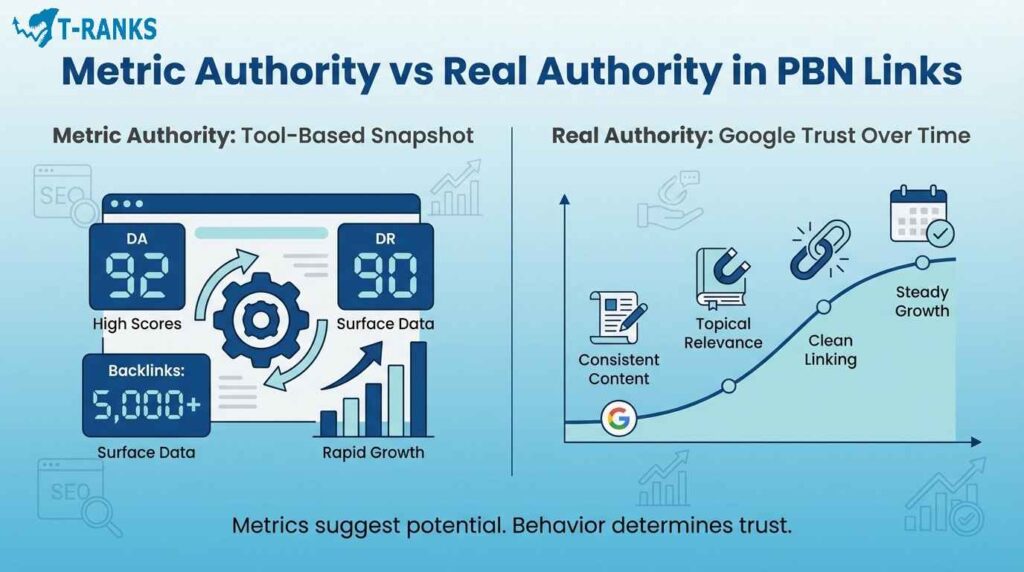
When evaluating high authority PBN links, it is important to understand the difference between metric authority and real authority. Many links look strong inside SEO tools, but not all of them perform well in Google. The reason often comes down to how authority is measured.
What Metric Authority Actually Means
Metric authority is the strength a domain appears to have inside third-party tools such as Moz or Ahrefs. These tools assign scores like DA (Domain Authority) or DR (Domain Rating) based on the number and quality of backlinks they detect in their own databases.
These scores are useful for comparison. Many websites with consistently high DA or DR have built real authority over time and often perform well in search results.
However, metric authority only shows how a site looks at a specific moment. It does not explain how that authority was earned or whether it is stable.
What Real Authority Means in Google’s System
Real authority is how Google evaluates trust. Google does not use DA or DR in its ranking system. Instead, it looks at long-term signals such as steady backlink growth, relevant content, natural anchor patterns, and consistent publishing behavior.
A domain earns real authority when its backlink profile grows gradually and aligns naturally with its niche. Trust develops over time. It is not created instantly through short-term link spikes.
This is why some domains with high DR still fail to deliver stable ranking results. The numbers may look strong, but the underlying signals may not support lasting trust.
How Metrics Can Be Artificially Inflated
In the PBN market, some sellers advertise high authority links in the DR 40 to 70 range. While many of these domains are genuinely strong, others may have gained their metrics through recycled expired domains, artificial backlink boosts, or temporary link spikes.
On the surface, the scores look impressive. In practice, artificially inflated metrics often lead to unstable performance. If authority was engineered rather than earned, Google’s long-term evaluation may reduce its influence.
Most sites with genuinely high DA or DR are authoritative in Google’s eyes — but only when those numbers reflect naturally built trust.
The Practical Difference at a Glance
Metric authority represents a tool-based estimate of link strength. It comes from third-party crawlers and shows how strong a domain appears right now.
Real authority represents Google’s trust-based evaluation. It is built over time through consistent, relevant, and natural behavior.
Metric authority can be inflated through artificial patterns. Real authority requires sustained trust and cannot be faked long term.
Metric authority suggests potential. Real authority determines whether a link creates lasting SEO value.
Understanding this difference helps set realistic expectations when working with high authority PBN links. Metrics are a starting point for research, not final proof of strength. Real authority is what supports stable rankings over time.
Signals That Actually Make a PBN Link High Authority

A PBN link becomes high authority when its trust is supported by history, consistency, and clean behavior, not by surface metrics.
With high authority PBN links, Google places far more weight on what a domain has done over time than on how strong it looks in a tool today.
Why Historical Signals Matter More Than Metrics
Historical signals show whether authority was earned naturally or assembled artificially. Aged PBN domains that have maintained stable topics, steady backlink growth, and consistent use are more likely to carry real trust.
History matters because it reveals:
- How the domain accumulated backlinks
- Whether growth was gradual or sudden
- If the site maintained a clear direction over time
Metrics capture a moment. History shows intent and reliability.
Backlink Profile Quality Over Quantity
Backlink profile strength is not about how many links point to a domain. It is about where those links come from and how well they align.
High authority PBN links are supported by profiles that show:
- Relevant referring domains
- Natural anchor text variation
- Balanced link distribution
- No obvious manipulation patterns
A smaller, cleaner profile often carries more authority than a larger but noisy one.
The Role of a Clean Domain History
Clean backlink history is a critical signal. Domains with past spam, aggressive link building, or repeated ownership changes often carry hidden risk, even if metrics recover.
A clean history typically includes:
- No record of spammy outbound linking
- Consistent indexing and visibility
- Stable ownership and content direction
Without this foundation, inherited authority tends to weaken over time.
Consistency Builds Trust, Spikes Create Doubt
Domain trust signals grow through consistency. Sudden spikes in backlinks, traffic, or outbound links often raise questions instead of reinforcing authority.
High authority PBN links tend to come from domains that show:
- Steady backlink growth
- Predictable publishing behavior
- Consistent outbound linking patterns
Spikes may inflate metrics briefly, but they rarely support long term authority.
How Inherited Authority Actually Holds
Inherited authority works when a domain’s past signals align with its present behavior. When aged PBN domains preserve relevance, structure, and linking patterns, authority can carry forward naturally.
When those elements break, authority decays. This is why real domain trust signals depend on continuity, not on recycled strength.
Understanding these signals helps explain why some high authority PBN links remain stable while others lose influence quietly. Authority is sustained through history, quality, and consistency, not through numbers alone.
Why Relevance Matters More Than Raw Authority
Relevance determines whether authority is trusted or questioned by search engines.
With high authority PBN links, raw strength alone does not decide impact. A backlink can come from a powerful domain and still lose value when it lacks topical alignment.in-content backlinks In those cases, authority often weakens instead of compounding, even when metrics look strong.
Topical relevance of PBN links affects how naturally a link fits into the broader web. When a high authority domain links outside its niche, it creates a disconnect between context and intent. That disconnect reduces credibility and makes the link easier to discount. Authority without relevance may appear convincing in tools, but it rarely holds practical value.
Off topic authority also increases risk over time. When multiple high authority PBN links come from unrelated niches, patterns become more visible. Backlink relevance Contextual PBN links
drops, contextual signals weaken, and trust becomes harder to sustain. Google expects links to reflect logical topical relationships, not just numerical strength.
Relevance acts as a multiplier, not a replacement. Contextual relevance strengthens authority by supporting natural link behavior and reinforcing topic level trust. When authority and niche alignment work together, links are easier to validate and less likely to lose influence.
This is why relevance improves stability. Links from topically aligned environments blend into backlink profiles, reduce visible manipulation signals, and support consistent behavior. High authority PBN links perform best when relevance and trust move together, not when authority is applied without context.
How Link Placement Affects Authority and Risk

Link placement influences both how authority is passed and how risk develops over time. With high authority PBN links, placement is not about choosing the most visible spot on a page. It is about whether the link appears natural, relevant, and consistent with how real websites normally link.
Search engines do not look at placement in isolation. They evaluate it as part of a broader behavioral pattern.
Why In-Content Links Carry More Weight
Links placed inside the main body of relevant content are easier for search engines to understand. When a link appears within a meaningful paragraph, it connects directly to the topic of the page. This makes the intent clearer.
Contextual PBN links and in-content backlinks tend to carry more weight because the surrounding text explains why the link exists. The anchor text and nearby content help reduce ambiguity and make the link look earned rather than inserted.
Links placed in sidebars, footers, or isolated blocks may still pass value, but they often lack contextual support. Without clear connection to the content, they appear weaker and sometimes less trustworthy.
Why Placement Affects Trust
Editorial-style placement mirrors how links naturally appear across the web. When a link fits smoothly inside a useful paragraph, it feels justified. This strengthens both authority and credibility.
In contrast, links that sit alone, appear forced, or interrupt the reading flow can raise suspicion. Even if the domain has strong metrics, unnatural placement weakens trust. Authority depends not only on the domain, but also on how the link behaves within the content.
How Repetitive Placement Increases Risk
A single well-placed link rarely creates issues. Risk increases when the same placement style repeats across multiple pages or domains. For example, identical paragraph positioning, similar sentence structures, or predictable link patterns can make networks easier to recognize.
Search engines look for consistency across sites. If placement patterns are rigid or mechanical, detection becomes easier regardless of authority level.
Homepage vs Inner Page Links
Homepage and inner page links Anchor text footprint
are not risky by default. The issue is repetition and imbalance. When homepage links are used excessively or follow a rigid pattern across multiple sites, they attract attention.
High authority PBN links perform best when placement varies naturally, supports the surrounding content, and does not rely on visibility alone. Authority holds when placement reinforces normal web behavior, not when it prioritizes exposure over context.
Anchor Text Patterns That Reduce Risk in PBN Links
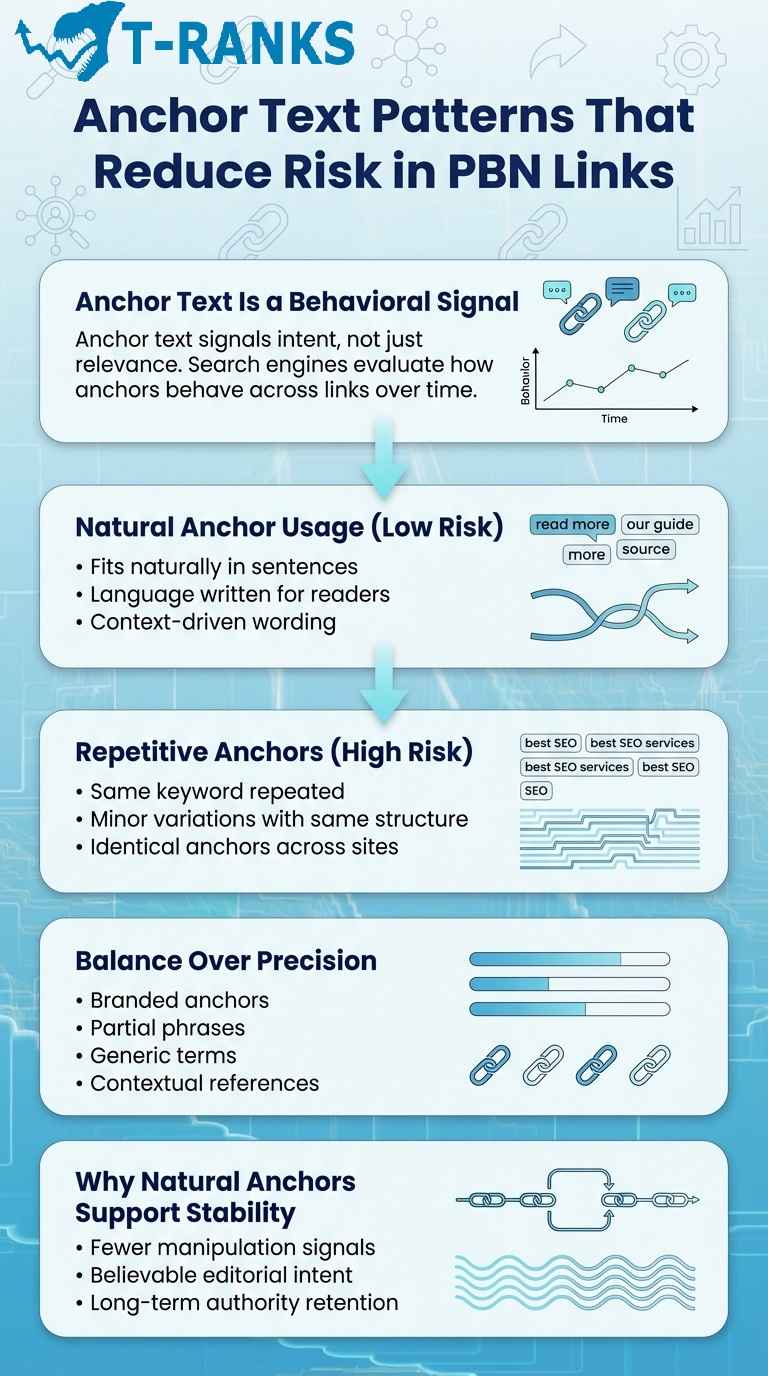
Anchor text is a behavioral signal that tells search engines how and why a link exists.
With high authority PBN links, anchor text is not evaluated for relevance alone. Google looks at how anchors behave across links, how often they repeat, and whether their usage resembles natural linking or coordinated intent. When anchor behavior looks normal, authority holds. When it looks engineered, risk increases.
Anchor Text Shows Intent, Not Just Topic
Anchor text helps search engines interpret the intent behind a link. Natural anchor text reflects how people reference pages in real content, not how keywords are targeted for rankings.
When anchor usage is healthy:
- Anchors fit naturally into surrounding sentences
- Wording varies based on context
- Language feels written for readers
When anchor text looks forced, authority becomes harder to trust.
Repetition Creates Detectable Patterns
Repetition is one of the strongest signals of manipulation. Using the same or very similar anchors across multiple high authority PBN links creates predictable behavior.
Unnatural anchor patterns often appear when:
- The same keyword phrase repeats across links
- Minor variations follow the same structure
- Multiple sites use identical anchor logic
These patterns form an anchor text footprint that is easier to detect than individual links.
Balance Matters More Than Precision
Safe anchor usage is based on balance, not exact targeting. Natural links use a mix of branded anchors, partial phrases, generic terms, and contextual references.
Anchor diversity reduces risk because:
- No single phrase dominates the profile
- Links resemble editorial behavior
- Context supports the anchor naturally
Over focusing on precision increases keyword anchor risk and draws attention.
How Natural Anchors Support Stability
Natural anchor text supports long term stability by blending into normal linking behavior. When anchors vary naturally and align with context, links attract less scrutiny.
Balanced anchor patterns help by:
- Reducing visible manipulation signals
- Supporting believable intent
- Allowing authority to persist over time
High authority PBN links remain safer when anchor text feels natural and varied. The goal is not perfect optimization, but believable behavior that supports trust.
Common Reasons High Authority PBN Links Still Get Penalized
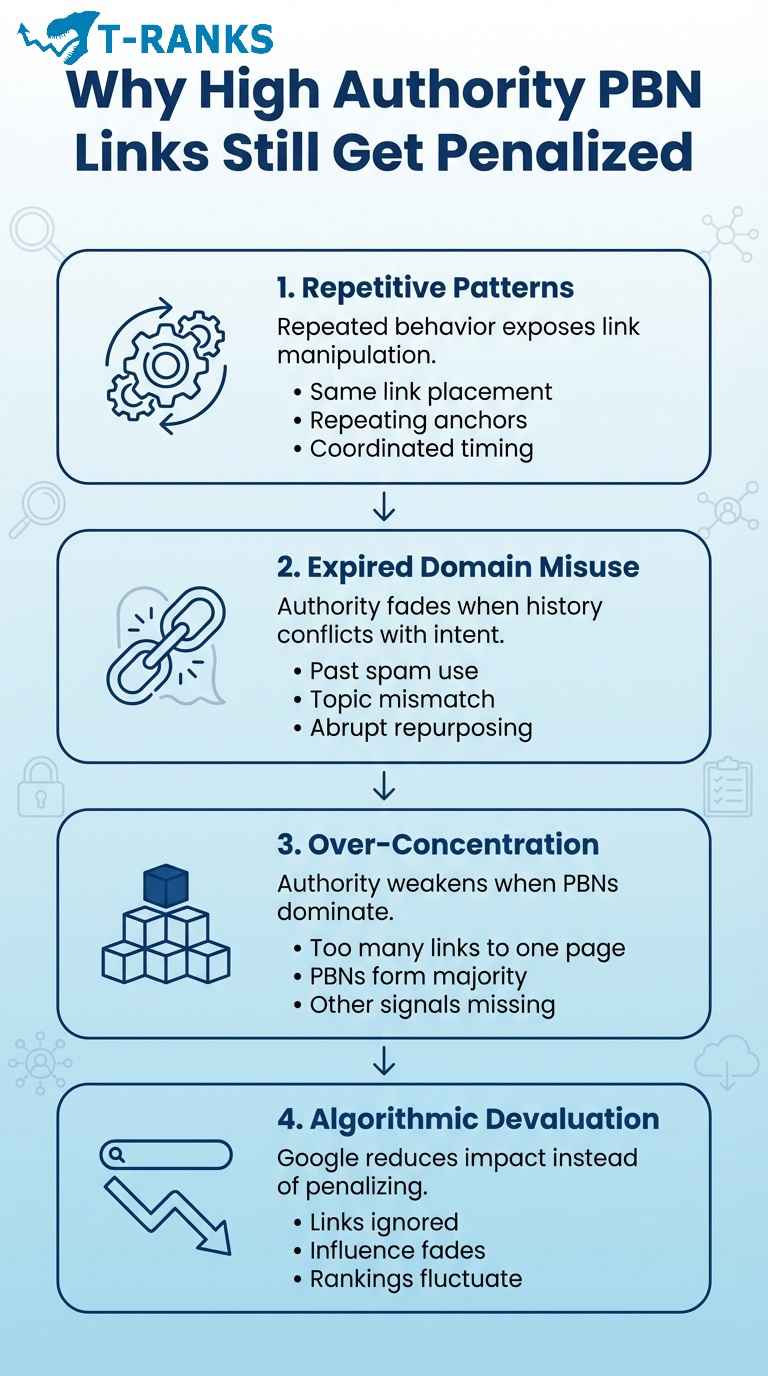
High authority PBN links get penalized when their behavior exposes manipulation, not because authority suddenly disappears.
Search engines evaluate links as systems, not as individual domains. When linking behavior becomes predictable, repetitive, or misaligned with historical signals, authority begins to decay instead of compounding.
Footprint Exposure Through Repetition
Repetition is the most common cause of PBN footprint risk. Even strong domains lose credibility when similar actions repeat across multiple sites. Google identifies networks by observing patterns that remain consistent over time, not by isolating a single link.
Footprints form when:
- Link placement follows the same structure across sites
- Anchor text patterns repeat predictably
- Publishing and linking timing appears coordinated
- Outbound link behavior looks uniform across domains
These unnatural link patterns make Google link spam detection easier, regardless of how authoritative a domain appears.
Expired Domain Abuse and Past Manipulation
Expired domain manipulation is another major cause of authority loss. Aged domains only retain value when their past use aligns with their current behavior. When historical signals conflict with present intent, trust weakens.
Authority breaks down when:
- Domains were previously used for spam or aggressive SEO
- Historical backlinks do not match current topical focus
- Site purpose changes abruptly after acquisition
In these cases, inherited authority fades because trust signals no longer align across time.
Overuse and Concentration Risk
High authority PBN links also fail when they are overused or concentrated too heavily. Authority works best as a supporting signal, not as the dominant source of link equity.
Risk increases when:
- Too many PBN links point to the same pages
- PBN links make up a large share of the backlink profile
- Other authority sources are missing or weak
Over concentration amplifies visibility and accelerates authority decay.
How Google Responds When Authority Fails
Most high authority PBN link failures do not result in manual penalties. Instead, Google adjusts how links are valued.
Common outcomes include:
- Links being ignored entirely
- Gradual dampening of link influence
- Ranking volatility without clear external causes
These responses signal reduced trust, not punishment. Authority is reassessed quietly as behavior changes.
How Google Interprets High Authority PBN Link Patterns

Google evaluates high authority PBN link patterns by analyzing how those links behave across the web. Even when PBNs use aged or expired domains with strong authority metrics, Google’s systems are designed to identify coordinated or unnatural linking behavior.
Search engines do not focus on the label “PBN.” They focus on patterns. If multiple domains show signs of shared control, repetitive behavior, or artificial linking structures, those signals can reduce trust over time.
1. Pattern Recognition and Footprint Analysis
Google uses advanced systems, including SpamBrain, to detect repeated similarities across websites. These systems do not rely on a single factor. Instead, they analyze combinations of signals that suggest coordination rather than independent site ownership.
Common signals may include:
- Shared or closely related hosting infrastructure
- Similar themes, layouts, or technical structures across domains
- Link profiles that heavily target specific pages without balanced inbound authority
- Sudden content expansion on expired domains
- Minimal organic traffic, suggesting the site exists primarily for link placement
Individually, these factors may not create issues. In combination, they can form recognizable patterns.
2. Algorithmic Devaluation Is the Typical Response
In most cases, Google does not apply immediate manual penalties. Instead, links that appear coordinated are often algorithmically discounted. This means they simply stop passing strong ranking value.
The result is usually subtle:
- Rankings fail to improve as expected
- Early gains gradually fade
- Performance plateaus despite continued link acquisition
This process reflects devaluation rather than direct punishment.
3. Manual Actions in Clear Abuse Cases
Manual penalties are less common and usually reserved for clear or repeated abuse. When applied, they can lead to significant ranking drops or removal from search results. These cases typically involve obvious manipulation rather than limited or isolated usage.
4. Authority and Context Still Matter
Authority does not override relevance. Even high authority domains are evaluated based on topical alignment and linking context. Contextual links placed naturally within relevant content can appear stronger individually. However, repeated patterns across multiple domains still reduce trust over time.
High authority PBN links may produce short-term movement. The long-term risk is gradual loss of effectiveness if linking behavior becomes predictable. As Google’s pattern recognition improves, consistency and moderation become more important than raw authority metrics.
How to Evaluate High Authority PBN Links Before Using Them
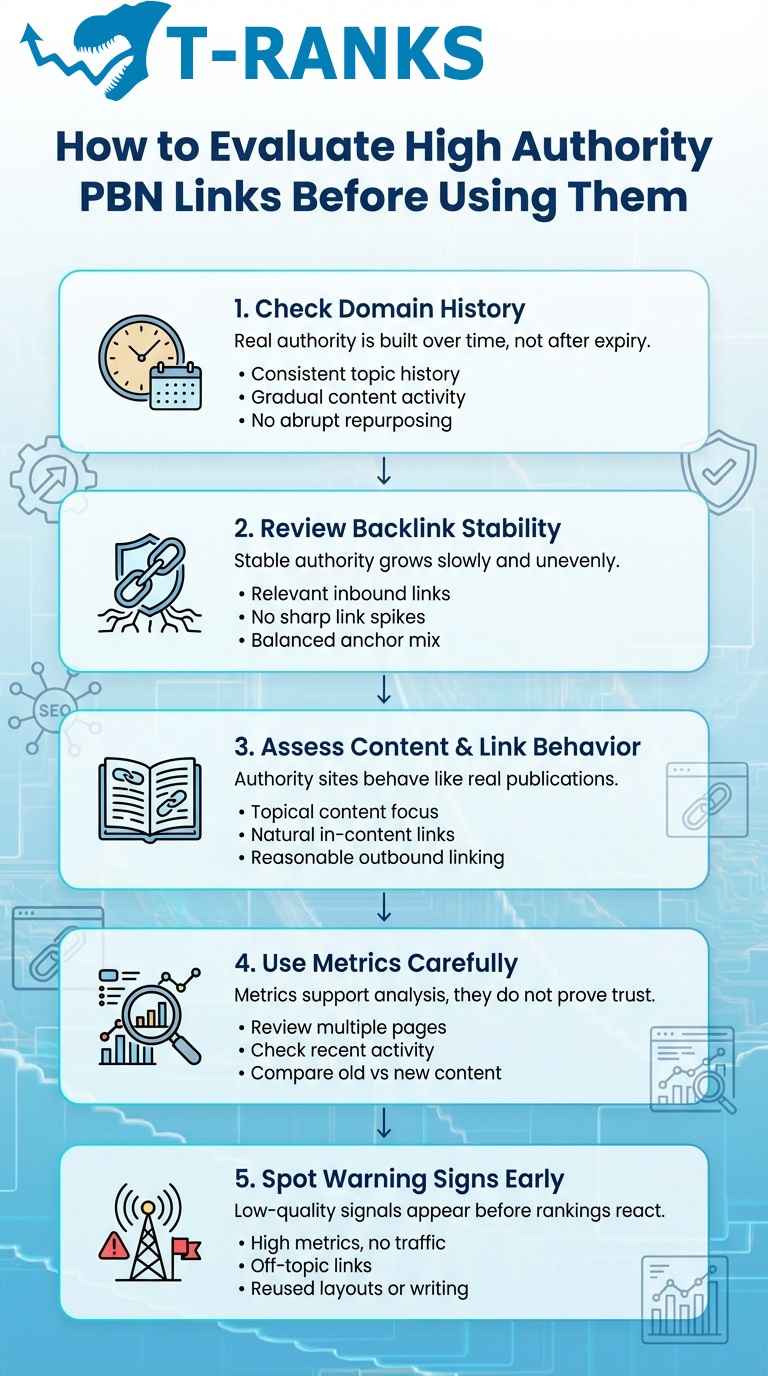
Evaluating high authority PBN links means verifying real authority, not trusting surface signals.
Many links appear strong because of metrics, but effective evaluation looks deeper at history, behavior, and consistency. The goal is to determine whether authority is stable or artificially constructed.
Start With Domain History and Purpose
The first step is understanding how the domain has existed over time. Domain history checks help reveal whether authority was earned naturally or manufactured after expiration.
When reviewing domain history, consider:
- Whether the domain previously served a real audience
- If the topic remained consistent before and after expiration
- Whether content activity looks gradual or suddenly forced
- Any visible shifts in purpose that suggest repurposing
Domains with unclear or erratic histories rarely provide reliable authority.
Analyze Backlink History for Stability
Backlink history analysis helps confirm whether authority developed through natural references or aggressive manipulation. Stable authority grows slowly and unevenly.
When judging PBN link quality, look for:
- Relevant inbound links rather than random sources
- No sharp spikes in link acquisition
- A mix of anchor text types over time
- Balanced growth instead of sudden concentration
Backlink profiles that look engineered often lose value quickly.
Evaluate Content and Linking Behavior
Content and linking behavior reveal intent more clearly than metrics. High authority PBN links usually come from sites that behave like real publications.
Key behaviors to assess include:
- Content relevance to the site’s core topic
- Natural placement of links within meaningful context
- Reasonable outbound linking frequency
- No repeated patterns across multiple pages
Sites created mainly to host links often show thin content and predictable link placement.
Use Tools as Support, Not as Proof
SEO tools can assist evaluation, but they should not replace manual inspection. Metrics explain what exists, not why it exists.
A practical PBN quality checklist focuses on:
- Reviewing multiple pages, not just the homepage
- Checking recent publishing activity
- Comparing older and newer content behavior
- Observing consistency rather than isolated signals
Over reliance on metrics often hides deeper quality issues.
Identify Clear Warning Signs Early
Some signs of low quality PBN links are visible without advanced analysis. These signals usually appear before rankings react.
Common warning signs include:
- Authority metrics without meaningful traffic presence
- Links pointing to unrelated niches
- Reused layouts or writing styles across domains
- Heavy emphasis on numbers with little behavioral support
High authority PBN links should be validated, not assumed to be safe.
Careful evaluation helps distinguish real authority from temporary strength and reduces the risk of volatility caused by misleading signals.
High Authority PBN Links Compared to Other Authority Backlinks

High authority PBN links differ from other authority backlinks mainly in control, risk, and predictability.
They are not inherently better or worse. They simply behave differently. Understanding these differences helps evaluate when they add value and when other link sources are more appropriate.
Control Versus Risk Across Authority Link Types
Authority link types exist on a spectrum. As control increases, so does responsibility and exposure to risk.
- High authority PBN links provide full control over placement, timing, and targets. This control can be useful, but it also increases pattern risk if behavior becomes repetitive.
- Guest post links offer partial control through outreach and content alignment. Risk varies based on site quality and editorial standards.
- Editorial backlinks offer almost no control, but they carry the lowest risk because they are earned naturally.
Greater control does not mean greater safety. It simply shifts where risk appears.
Differences in Predictability and Longevity
Another key distinction is how reliably authority holds over time.
- PBN links can influence rankings quickly, but their impact is less predictable if patterns are detected.
- Guest post links tend to provide steadier results when placed on relevant, real sites.
- Editorial links are usually the most consistent because they align closely with organic discovery.
Predictability improves as links resemble natural editorial behavior.
How Authority Signals Differ by Source
All high authority backlinks pass value, but they signal trust in different ways.
- PBN links emphasize controlled authority transfer.
- Guest posts combine authority with topical relevance and contextual support.
- Editorial backlinks signal trust, reputation, and independent validation.
Google evaluates these signals collectively, not individually.
Why High Authority PBN Links Are One Source, Not the Foundation
Comparing link sources shows why relying on one type creates imbalance. High authority PBN links work best when they complement other authority sources rather than replace them.
A balanced link profile typically includes:
- Controlled backlinks to manage authority gaps
- Editorial links to support trust and credibility
- Guest posts to reinforce relevance and scale
High authority PBN links are most effective when positioned as a supporting authority signal.
Understanding how they compare to other authority backlinks helps reduce dependency, improve predictability, and support long term SEO stability.
When High Authority PBN Links Make Sense and When They Don’t

High authority PBN links make sense only in specific situations where risk is acknowledged and intentionally managed.
They are not default SEO tools. Their usefulness depends on goals, timelines, and tolerance for instability. Understanding when they fit and when they do not is critical for making safe backlink decisions.
When High Authority PBN Links Can Be Appropriate
In some cases, controlled PBN usage can support rankings without becoming a liability. These situations usually involve measured, risk adjusted link building rather than aggressive authority stacking.
They may make sense when:
- A site already has a diverse backlink profile and strong baseline trust
- Authority gaps exist in competitive SERPs and need targeted reinforcement
- Links are used selectively on specific pages, not across the entire site
- SEO risk tolerance allows for limited fluctuation during testing or growth
In these scenarios, controlled link usage supports authority without defining the profile.
When the Risk Outweighs the Benefit
High authority PBN links stop making sense when they become central to ranking performance. As reliance increases, so does exposure to detection and volatility.
They are usually a poor choice when:
- A site depends on PBNs as its main authority source
- Long term ranking stability and brand trust are the priority
- The niche is sensitive to link manipulation signals
- Link reliance replaces broader authority development
In these cases, short term gains often lead to long term instability.
The Importance of Limiting Reliance
One of the biggest risks is not using PBN links, but relying on them too heavily. Even strong links lose effectiveness when they dominate the backlink profile.
Healthy profiles typically show:
- Multiple authority sources contributing unevenly
- No single method responsible for most link equity
- Gradual growth rather than concentrated bursts
Exceeding reliance limits increases visibility and reduces trust over time.
Why Judgment Matters More Than Rules
There is no formula that guarantees safety. Outcomes depend on behavior, context, and response, not numbers or ratios.
Safe backlink decisions come from:
- Monitoring ranking stability, not just movement
- Adjusting usage based on impact rather than expectation
- Prioritizing sustainable authority over quick wins
High authority PBN links are useful only when treated as optional, controlled signals.
They support SEO when used with judgment and restraint, and undermine it when used out of habit or dependency.
How High Authority PBN Links Fit Into a Safer Link Building Mix
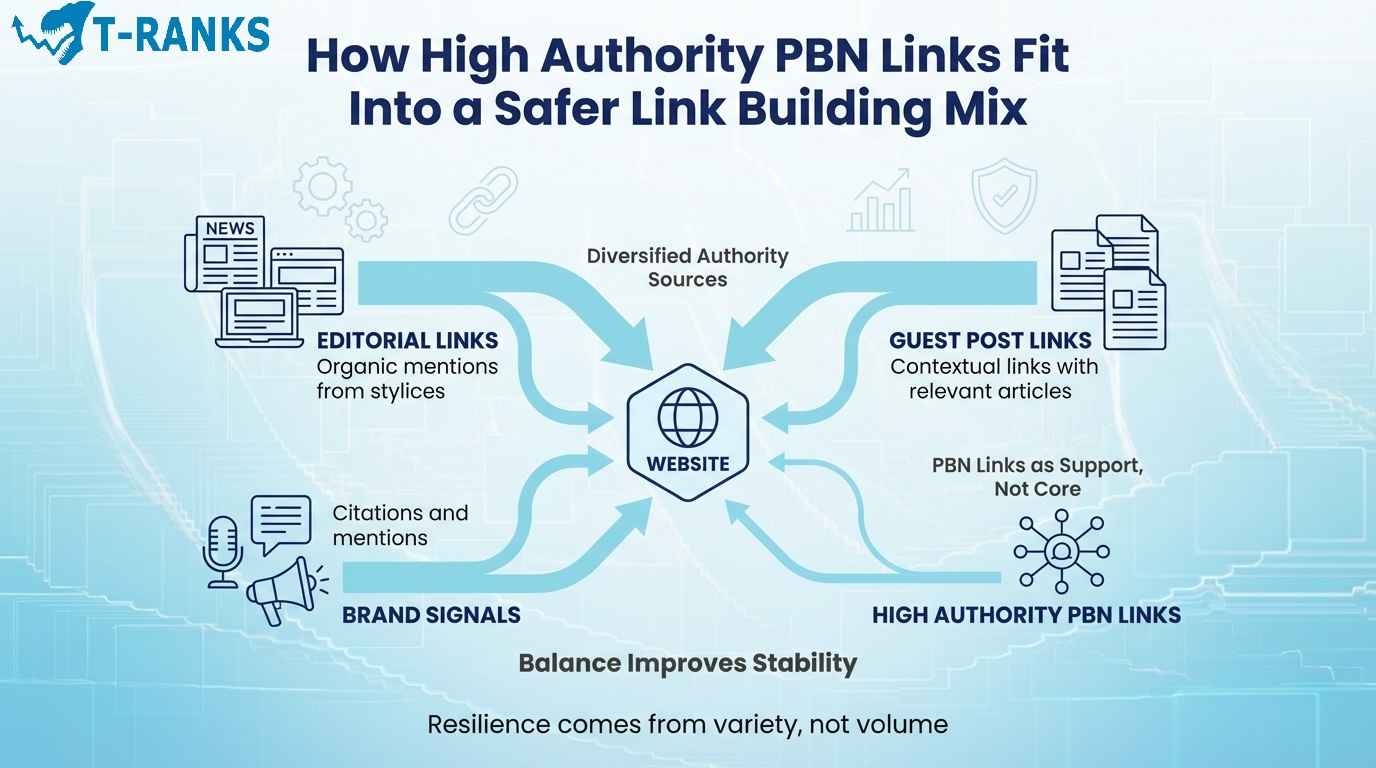
High authority PBN links fit best when they support a diversified backlink strategy rather than dominate it.
A safer link building mix reduces dependency, limits risk exposure, and strengthens long term SEO resilience. The goal is not to eliminate risk, but to distribute authority in a way that aligns with natural linking behavior.
Step 1: Build Diversity Into the Backlink Portfolio
Search engines expect authority to come from multiple sources. When links originate from varied environments, patterns become less obvious and trust is easier to sustain.
Diversification improves stability by:
- Distributing authority across different link types
- Reducing reliance on controlled backlinks
- Creating more natural growth signals
A diverse backlink portfolio reflects how real sites earn links over time.
Step 2: Use Mixed Link Types to Reduce Dependency
Dependency increases risk. Mixing authority sources ensures that no single method carries too much weight in the profile.
A safer link building mix usually includes:
- Editorial links that signal trust and independent validation
- Brand signals from mentions and citations
- Guest posts that reinforce relevance and scale
- Limited use of high authority PBN links to support gaps
This structure lowers the impact if one source is discounted.
Step 3: Strengthen Resilience Through Signal Variety
Search algorithms respond better to overlapping signals than concentrated ones. Variety supports smoother authority distribution and fewer ranking swings.
Signal variety helps with:
- Long term ranking stability
- Reduced volatility during updates
- Stronger alignment with natural link behavior
Resilience comes from balance, not volume.
Step 4: Position PBN Links as Support, Not the Core
High authority PBN links should play a supporting role within the mix. When they are used sparingly and alongside editorial links and brand signals, they add value without increasing visibility.
This approach encourages safer link building decisions and preserves flexibility as algorithms evolve.
A safer link building mix prioritizes balance over speed.
When high authority PBN links are integrated carefully, they enhance authority without becoming a single point of failure in the backlink portfolio.
Conclusion, Authority Is a Signal, Not a Shortcut
In conclusion, authority is a conditional signal, not a guaranteed advantage.
High authority PBN links can influence rankings, but only when they are evaluated carefully, used selectively, and supported by natural link behavior. Metrics like DA or DR alone do not define trust. Google focuses on patterns, relevance, consistency, and how authority is distributed over time.
The difference between stable growth and volatility comes down to behavior. Links that fit naturally within a diversified backlink portfolio support sustainable rankings. Links that rely too heavily on control, repetition, or assumptions increase risk and reduce long term reliability. Controlled authority works only when it complements other signals rather than replacing them.
Penalty resistant SEO is built through judgment, not shortcuts. Safe PBN links are those that blend quietly, respect relevance, and stay within clear reliance limits. Long term SEO growth favors balance, restraint, and consistency over aggressive tactics.
If you want expert guidance on building controlled authority without compromising stability, T-RANKS helps brands and SEO teams design safer, more resilient link strategies that align with how search engines actually evaluate authority.
Frequently Asked Questions About High Authority PBN Links
What are high authority PBN links?
High authority PBN links are backlinks from private blog network sites that use aged domains with clean backlink histories and consistent behavior. Their value comes from real trust signals built over time, not just high DA or DR scores.
Are high authority PBN links safe for SEO?
High authority PBN links can be relatively safe when used carefully and evaluated properly. Safety depends on relevance, placement, link patterns, and moderation, not on authority metrics alone.
Can high authority PBN links still get penalized?
Yes, high authority PBN links can still cause issues if patterns become detectable. In most cases, Google ignores or dampens their impact algorithmically rather than issuing a manual penalty.
Do high DA or DR PBN links guarantee rankings?
No, high DA or DR PBN links do not guarantee ranking improvements. These metrics can be inflated and do not reflect how Google evaluates trust, relevance, or link behavior.
What makes a PBN link truly high authority?
A PBN link is truly high authority when it comes from an aged domain with a clean history, relevant backlinks, and stable publishing behavior. Real authority is built gradually through trust signals.
Why does topical relevance matter for high authority PBN links?
Topical relevance strengthens authority signals and improves link credibility. High authority links from unrelated topics often look unnatural and are more likely to be ignored.
How does Google evaluate high authority PBN links?
Google evaluates high authority PBN links by analyzing patterns, consistency, timing, and link behavior across multiple sites. The focus is on collective behavior, not a single domain’s perceived strength.
Can Google detect high authority PBN links?
Yes, Google can detect PBN links when repeated patterns or unnatural behaviors emerge. Detection is primarily algorithmic and pattern based, not dependent on domain authority metrics.
What happens if high authority PBN links go wrong?
When high authority PBN links go wrong, their impact is often reduced or ignored. Rankings may fluctuate due to algorithmic dampening rather than direct penalties.
How many high authority PBN links are too many?
There is no fixed number that is always safe or unsafe. Over reliance on any single link type increases pattern risk and long term instability.
Are high authority PBN links better than guest posts or editorial links?
No, high authority PBN links are not inherently better. They offer control, while guest posts and editorial links provide natural discovery and trust signals. Combining link types is usually more stable.
Do high authority PBN links still work in 2026?
Yes, high authority PBN links can still influence rankings in 2026 when used selectively and responsibly. Most failures occur due to overuse, repetition, and poor evaluation.