Private Blog Networks are widely used in SEO, but they are rarely explained clearly. When managed properly, they can support rankings and authority. The challenge for most beginners is not whether PBNs work, but how to judge the agencies that provide them.
Many PBN providers present similar metrics and packages, which makes it difficult to understand what actually separates a strong network from a weak one. Important details such as domain control, link placement, and risk management are often overlooked or not discussed at all.
This article provides a clear and practical way to evaluate PBN agencies. It explains what matters in real-world setups and helps you avoid common mistakes that lead to unstable or disappointing results.
What “Good” Means in the Context of PBN Agencies

A good PBN agency is not defined by high DA or DR numbers. Those metrics can be inflated, reused, or misleading when viewed in isolation. In real practice, quality is determined by how authority is applied, not how impressive the numbers look.
What actually matters is relevance, control, and risk management. A professional PBN provider understands where authority should be placed, how it should be placed, and how much risk each placement introduces. These decisions matter far more than surface metrics or link volume.
Every serious PBN agency balances link power and link safety. Link power determines whether a link can influence rankings, while link safety determines whether that influence is stable and sustainable. Focusing only on power creates short-term gains that fade quickly, while focusing only on safety produces links that rarely move rankings.
In practical terms, a good PBN provider:
- Uses niche-relevant domains instead of random high-metric sites
- Knows which pages deserve authority and which do not
- Places links inside relevant content, not forced sections
- Uses anchors with discipline, mixing branded, URL, and partial matches
- Controls link velocity instead of deploying links in bulk
PBNs are not risk-free, and strong providers do not pretend otherwise. Because PBNs operate outside standard search engine guidelines, some level of risk is always present. A professional agency treats PBN usage as risk-managed link building, explains trade-offs clearly, avoids guarantees, and positions PBN links as one controlled input within a broader SEO strategy.
Why Most PBN Agencies Struggle to Stand Out
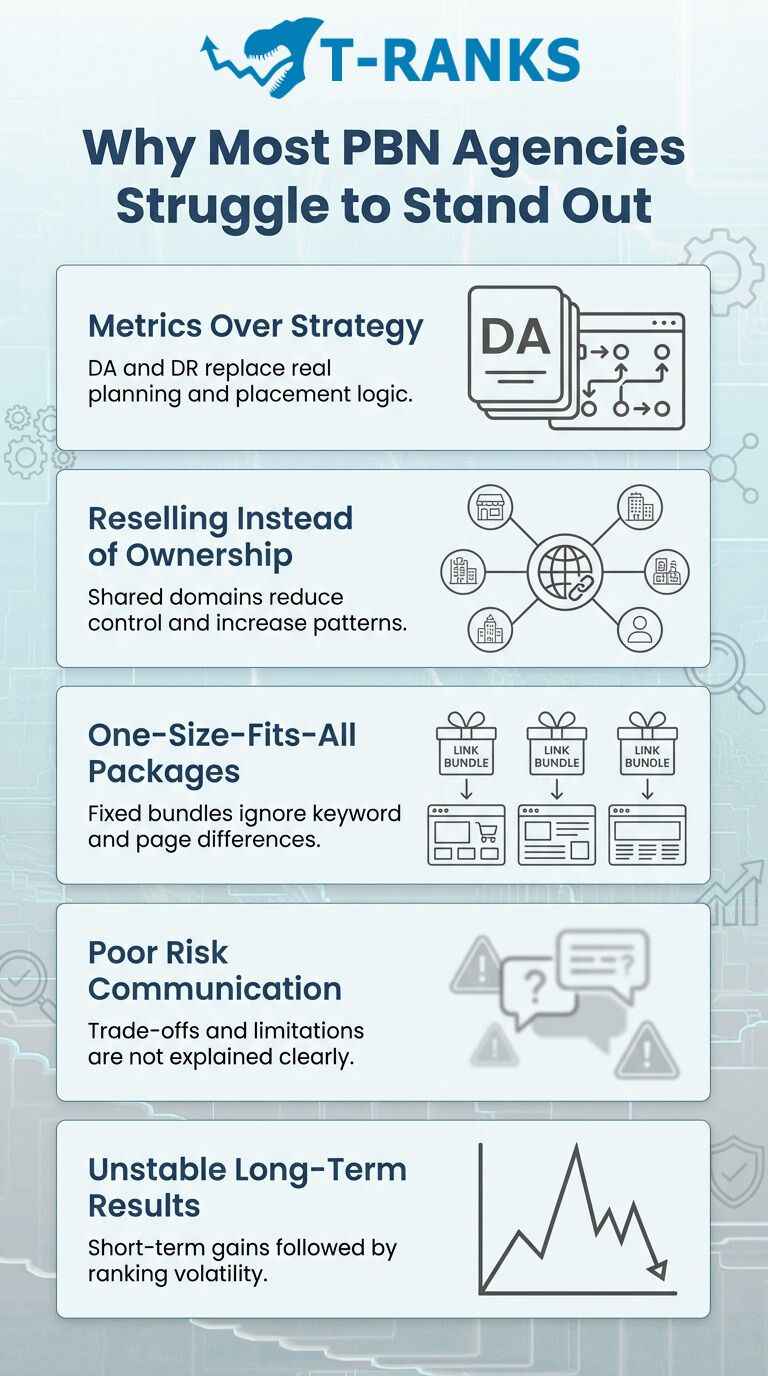
Most PBN agencies struggle to stand out because they present themselves in the same way. Similar metrics, similar packages, and similar claims make many providers look interchangeable. This makes it hard for buyers to understand what actually separates a good provider from a risky one.
The reasons are not hidden. They usually come down to how agencies sell links, how they manage networks, and how clearly they communicate risk. The sections below explain the most common causes.
Overreliance on Metrics Instead of Strategy
Many agencies rely heavily on DA, DR, and similar metrics because they are easy to show and easy to compare. These numbers help sell links quickly, but they do not explain how a domain was built, how it is used, or how risk is controlled.
When metrics become the main selling point, strategy is pushed aside. Agencies stop explaining placement logic, anchor choices, and pacing decisions. As a result, different providers start to look the same, even when their actual execution quality is very different.
Reselling Networks Instead of Owning Them
Another common issue is reselling. Many low-quality providers do not own their networks. Instead, they reuse the same domains and placements for multiple clients.
This limits control and increases pattern risk over time. When agencies do not own their networks, they cannot fully manage outbound links, placement timing, or long-term maintenance. From the buyer’s side, everything may look fine, but the risk builds quietly in the background.
Mass Placement and One-Size-Fits-All Packages
To simplify delivery, many agencies use fixed packages and bulk link drops. Links are added quickly using similar anchors, formats, and timelines, regardless of the site or keyword.
This approach ignores keyword competition, page intent, and existing backlink profiles. It turns link building into a commodity. The difference between a link seller and a strategist becomes clear here. One focuses on speed and volume. The other focuses on fit and stability.
Lack of Clear Trade-Off Communication
Agencies that struggle to stand out often avoid talking about limitations. Risk, trade-offs, and long-term considerations are rarely explained clearly.
Instead, buyers hear strong claims or implied guarantees. This may help close a deal, but it creates unrealistic expectations. When rankings fluctuate or results slow down, trust is lost. Clear communication is not a weakness. It is a sign of experience.
Unstable Results and Loss of Credibility Over Time
These patterns lead to unstable outcomes. Short-term gains are often followed by drops, adjustments, or unexplained losses. Over time, buyers recognize that surface-level differentiation does not lead to lasting results.
Agencies that lack strategy, ownership, and restraint are forced to compete on price and promises. Only a small number build long-term credibility by operating with control, clarity, and discipline.
Domain Selection and Network Ownership as a Quality Signal

A strong PBN starts with domain history, not DA or DR.
Expired domains only work when their past use makes sense. A good provider checks where the domain came from, what it was used for before, and whether its topic matches the site it will link to. They also review the backlink profile and referring domains to confirm the links look natural.
A clean domain history means no spam activity, no sudden topic changes, and no unnatural linking patterns. Metrics can look impressive while hiding serious risk. Domain history shows how safe the authority really is.
Clean Backlink Profiles Reduce Risk
Quality PBN agencies avoid domains with mixed or unclear signals. They look for stable backlinks, relevant past content, and a clear absence of spam. The goal is usable authority, not inflated numbers.
Domains with mismatched niches or noisy backlink profiles increase risk over time. Even if metrics appear strong, these domains often weaken long-term results and create instability.
Ownership Enables Real Control
PBN network ownership is one of the clearest quality signals. Agencies that own and manage their networks control how domains are used, how many outbound links are placed, and when links should stop.
When links are rented or resold, that control is lost. Agencies cannot manage patterns properly, and changes made by others can introduce risk without warning.
Maintenance and Pruning Protect the Network
Professional agencies treat domains as long-term assets, not disposable links. Ongoing maintenance includes monitoring backlink changes, reviewing outbound links, and watching for new risks.
When a domain becomes unsafe, knowing when to retire it matters. Domain pruning protects the rest of the network and supports ranking stability. Together, careful domain selection and ownership show whether an agency is managing risk deliberately or relying on surface signals. This difference separates short-term tactics from controlled, sustainable execution.
How Professional PBN Agencies Design Link Placement

Professional PBN agencies focus on context, not volume. Adding more links does not increase impact if those links lack relevance or look forced. What matters is how naturally a link, along with its anchor text, fits within the surrounding content.
Effective PBN link placement happens when the page topic, paragraph context, and anchor text all support the target page. This is why contextual PBN links outperform multiple low-quality placements. A single well-placed link with a natural anchor can pass cleaner authority than several links added without relevance.
Editorial Placement Inside Relevant Content
Experienced agencies use editorial-style placement. Links are embedded inside relevant paragraphs where they make sense to a reader, not added as inserts or standalone references. Anchor text is chosen to match the sentence naturally, not to stand out or repeat exact phrases.
When anchor text aligns with the surrounding content, in-content backlinks behave like genuine editorial mentions. Sidebar, footer, or isolated link sections are avoided because they separate anchors from context and create obvious patterns.
Outbound Link Control and Clean Link Neighborhoods
Professional agencies control how many outbound links appear on a page and how they are distributed. Pages built only to pass links, or filled with multiple keyword-heavy anchors, increase risk and dilute authority.
By limiting outbound links and varying anchor types, agencies protect the link neighborhood. This balance helps pages look natural, reduces noise, and supports safer authority transfer.
Authority Flow and Anchor Alignment
Effective placement supports smooth authority flow, but anchor alignment is part of that flow. Links perform best when anchors reflect the topic already being discussed, instead of forcing exact-match phrases into unrelated sentences.
Professional placement is deliberate. It is not about hiding links or manipulating anchors. It is about placing links and choosing anchors that belong naturally within the content, supporting relevance, stability, and long-term SEO.
Anchor Text Strategy as a Marker of Experience

In professional PBN strategies, anchor text is one of the strongest risk controls. It influences rankings, but it also sends clear signals to search engines. Aggressive or repeated anchors increase exposure faster than they increase authority.
Experienced agencies treat anchor text as part of risk management, not as a shortcut for quick gains. The goal is to support relevance while avoiding over-optimization and obvious patterns.
Using anchor types the right way
- Branded anchors and URL anchors form the base because they look natural and support trust
- Partial match anchors reinforce topical relevance without pushing limits
- Exact match anchors are used sparingly and only when the backlink profile can absorb them
This balance creates a natural anchor distribution and reduces spam signals that appear when one anchor type dominates.
Ratios, progression, and timing
- There is no fixed anchor text formula
- Ratios depend on site age, existing links, and competition level
- Early profiles lean heavily on branded and URL anchors
- Partial matches are introduced gradually as authority grows
- Sudden shifts or bulk exact-match usage often cause instability
Controlled progression keeps anchor signals aligned with natural growth.
Ongoing anchor adjustment
Anchor strategy does not end after placement. Professional agencies monitor performance and adjust anchors over time.
- If risk increases, aggressive anchors are diluted with safer ones
- Profiles are rebalanced instead of abandoned
This ability to adapt anchor strategy based on real signals is a clear marker of experience. It shows the difference between placing links and actively managing link risk for long-term stability.
Strategy-Led Engagement vs Prebuilt PBN Packages

Strong PBN agencies start with strategy, not with ready-made link packages. Before placing any links, they first understand the website, its goals, and its current position in search results. Skipping this step often leads to poor decisions and unnecessary risk.
Prebuilt PBN packages work in the opposite way. They assume that every website needs the same number, type, and speed of links. In reality, no two websites are the same. Each site has different strengths, weaknesses, and risk tolerance. Without a strategy, links are placed blindly.
Why SERP analysis and page selection matter
A strategy-led approach begins by studying search results.
- Which pages are ranking
- How strong the competition is
- Where authority gaps exist
This helps decide which pages actually need PBN support. Not every page deserves strong links. Professional agencies focus on pages with real ranking potential and business value, instead of spreading links everywhere.
Link pacing matters more than speed
Link velocity is one of the most common reasons PBN strategies fail. Prebuilt packages often rely on bulk link drops because speed is part of the offer. These sudden spikes rarely match natural link growth and often cause unstable results.
Strategy-led agencies plan link placement carefully.
- Links are added gradually
- Pacing matches competition and existing signals
- Risk is controlled instead of rushed
Why prebuilt packages often waste budget
Prebuilt packages often lead to overbuilding.
- Pages receive more links than they need
- Links are placed where they add little value
This wastes budget and increases risk without improving results. In contrast, strategy-based planning ensures every link has a clear purpose. The focus stays on control, efficiency, and long-term performance, not convenience or volume.
How Strong PBN Agencies Manage and Communicate Risk

Strong PBN agencies are honest from the beginning. PBN risk management is not about removing risk completely. It is about keeping risk under control. Because PBNs operate outside search engine guidelines, some level of risk always exists. Professional agencies accept this reality and plan around it instead of denying it.
This honest approach helps avoid unrealistic expectations. It also prevents aggressive link building decisions that often create problems later.
Footprints and pattern avoidance in simple terms
A footprint appears when links or websites follow the same visible patterns.
- Similar website layouts
- Repeated anchor text
- Links placed in the same way across many sites
Over time, these repeated signals make detection more likely. Strong agencies reduce this risk by keeping things varied.
- Different domain types
- Different content styles
- Different link placements
- Different timing
The goal is to make each link look like a natural editorial reference, not part of a system.
Monitoring after placement
Risk management does not stop once a link is placed. Professional agencies continue to monitor links over time.
- They check whether links remain live
- They watch for indexing changes
- They review backlink profile shifts
If risk increases, action is taken early. This may include adjusting anchors or removing links before problems grow.
Honest communication and clear expectations
Strong agencies communicate risk clearly. They explain trade-offs, avoid guarantees, and set realistic expectations. Responsible PBN work does not promise rankings.
Clear communication builds trust. It shows that the agency focuses on long-term stability, not short-term claims, and understands how to manage risk responsibly.
Long-Term Authority Thinking vs One-Time Link Drops

Stable rankings come from gradual authority building, not sudden bursts. A long term PBN strategy focuses on steady growth that mirrors how real sites earn trust. Sustainable backlinks added over time support ranking stability because they align with natural link patterns. Quick spikes may show movement, but they rarely last. Authority compounds when links are deployed patiently and consistently.
Authority Distribution Beyond Money Pages
Strong agencies avoid concentrating all links on one page. Authority distribution across supporting pages builds site-wide strength. Informational and category pages provide internal relevance support, which then reinforces money pages through internal linking. This layered approach creates resilience. When supporting pages gain authority, the whole site benefits, not just a single URL.
Link Decay Requires Ongoing Review
Links change over time. Link decay happens when pages are removed, domains lose value, or links disappear. Lost links quietly weaken authority if they are not reviewed.
Professional agencies plan for link maintenance. They monitor placements, replace decayed links when needed, and keep authority flow consistent. Ongoing review protects long-term performance.
Why One-Time Link Drops Create Instability
One-time link drops ignore how authority develops. Large batches added at once create unnatural link velocity, which often leads to volatility. Rankings may rise briefly, then fall. A long-term approach favors gradual link deployment, balanced distribution, and maintenance. This reduces risk, avoids overbuilding, and supports durable results instead of short-lived gains.
How PBN Agencies Can Stand Out in a Crowded Market
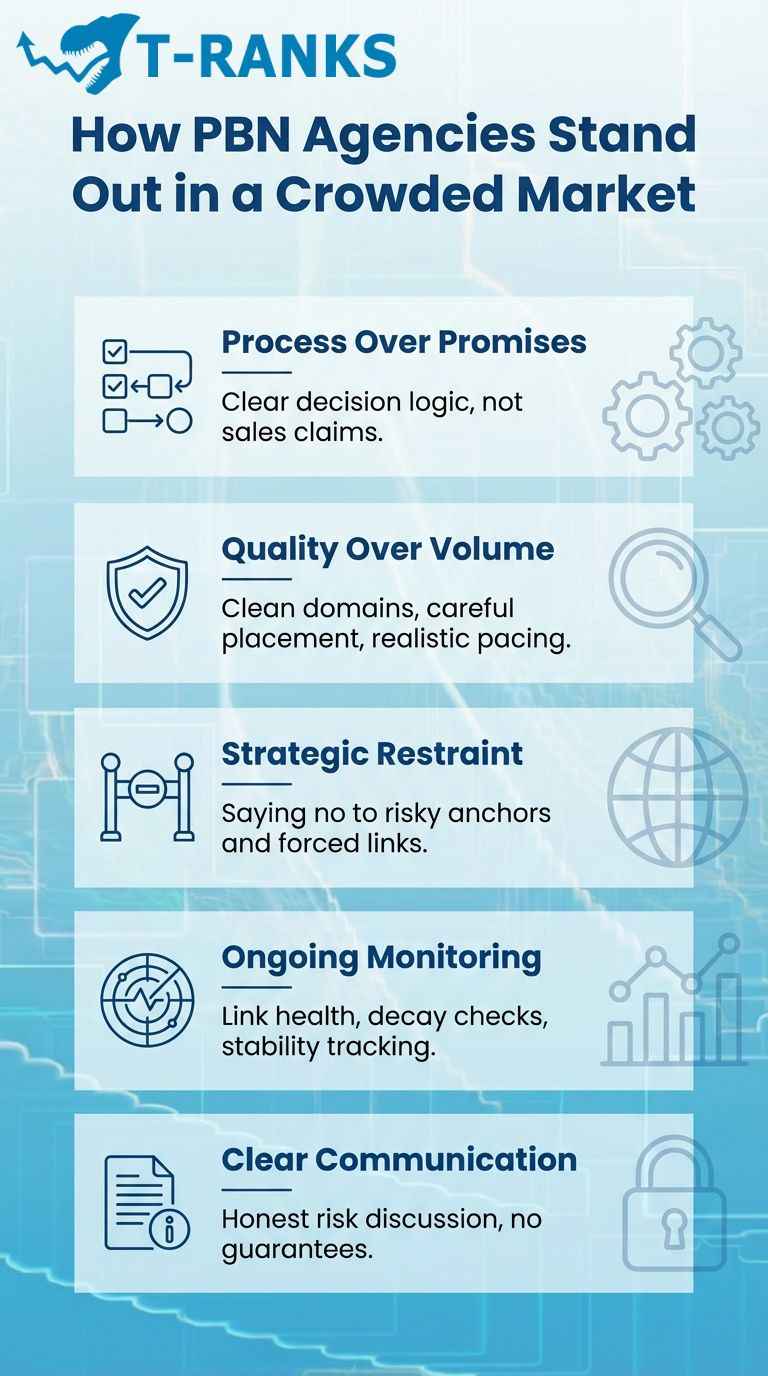
In a crowded market, most PBN agencies sound similar because they rely on promises instead of process. Agencies that stand out do the opposite. They explain how decisions are made, how risk is managed, and what standards guide their work. This clarity helps buyers understand what they are paying for and why certain limits exist.
The difference is not marketing. It is execution.
Transparency in Process, Not Promises
Agencies that stand out are transparent about how they operate. They explain how domains are selected, how link placements are reviewed, and how risk is evaluated before links go live. This does not mean exposing networks or sensitive details. It means explaining the logic behind decisions.
For example, agencies like T-RANKS focus on explaining why a placement is approved or delayed, not just that it was delivered. This level of transparency builds trust without relying on guarantees.
Quality and Safety Over Volume
Strong agencies move away from volume selling. Instead of pushing bundles or fixed quantities, they prioritize clean, niche-relevant domains, careful placement, and realistic pacing. This reduces footprint risk and improves consistency over time.
Quality shows up in small details. Relevant content, limited outbound links, and active site maintenance matter more than how many links are delivered. Agencies that understand this position themselves as professional SEO partners, not link vendors.
Saying No Is a Professional Skill
One of the clearest signs of experience is the ability to say no. Agencies that stand out refuse risky anchors, forced placements, or unrealistic timelines, even when clients request them.
This is not resistance. It is restraint. Protecting long-term outcomes matters more than short-term convenience, and agencies that understand this consistently deliver more stable results.
Client Education and Clear Reporting
Agencies that stand out invest in client understanding. They explain trade-offs, timelines, and risk in plain language. Reporting focuses on placement quality, timing, and link health, not just totals or counts.
Clear communication reduces confusion. Clients know what is happening, what to expect next, and what should not be expected. This clarity is rare, and it strengthens long-term relationships.
Restraint as a Differentiator
Restraint ties everything together. Limiting placements, pacing growth, and maintaining standards signal accountability. In a crowded market, professionalism is defined by control, clarity, and the discipline to protect results rather than chase volume.
Agencies that operate this way stand out naturally, not because they promise more, but because they manage better.
Final Perspective: Choosing or Becoming a Serious PBN Provider
In conclusion, a serious PBN agency is defined by decisions, not promises. Quality providers focus on domain history, controlled link placement, disciplined anchor use, and deliberate pacing rather than surface metrics or volume.
They understand that PBNs are not risk-free and treat link building as a managed process where relevance, restraint, and long-term stability matter more than speed. Agencies that own their networks, communicate trade-offs clearly, and operate with consistent standards stand apart from resellers and short-term operators.
Whether choosing a provider or building an agency, success comes from a strategist mindset that manages authority carefully and prioritizes sustainable SEO outcomes.
If you are looking for a PBN partner that follows this disciplined, risk-aware approach, explore how T-RANKS designs and manages PBN strategies with control, transparency, and long-term SEO stability in mind.
FAQS About PBN agency review
Do PBN agencies still work for SEO?
Yes, PBN agencies can still work for SEO when they control their networks and manage risk properly.
Results depend on domain quality, link placement, and long-term strategy rather than the use of PBNs alone.
How can you tell if a PBN agency is trustworthy?
A trustworthy PBN agency owns and controls its network rather than reselling links.
Clear answers about domain history, link limits, and risk management are stronger signals than DA or DR metrics.
Are DA and DR reliable metrics for choosing a PBN agency?
No, DA and DR alone are not reliable indicators of PBN quality.
These metrics can be inflated and reused, while real value comes from clean domains, relevance, and controlled outbound linking.
What is the biggest risk when using a PBN agency?
The biggest risk is working with agencies that resell links or place links in bulk across the same network.
These practices create patterns that reduce effectiveness and increase long-term instability.
How do good PBN agencies place links?
Good PBN agencies place links contextually within relevant content and limit outbound links per page.
This helps links behave like natural editorial references rather than obvious SEO placements.
Should beginners use PBN agencies?
Beginners can use PBN agencies if they understand the risks and evaluate providers carefully.
Choosing agencies based on structure and transparency is safer than buying large link packages.
How important is anchor text strategy in PBN links?
Anchor text strategy is critical because aggressive or repeated anchors increase detection risk.
Experienced agencies use varied and natural anchors aligned with the page context.
Can PBN links support long-term rankings?
Yes, PBN links can support long-term rankings when used selectively and combined with other link types.
Stability comes from moderation, relevance, and avoiding short-term link spikes.